Home Watch Videos Wars Login

[🇧🇩] Trump's Victory/Tariff/ Bangladesh

[🇧🇩] Trump's Victory/Tariff/ Bangladesh
212
6K
More threads by Saif

G Bangladesh Defense

US hinted at tariff relief for Bangladeshi goods, says Lutfey Siddiqi

bdnews24.com
Published :
Jan 27, 2026 21:56
Updated :
Jan 27, 2026 21:56

1769561132273.webp


Bangladeshi goods may soon face lower tariffs in the United States, Chief Advisor’s International Affairs Special Envoy Lutfey Siddiqi has said after recent bilateral discussions.

On Tuesday, he said the tariffs are “expected to remain around 20 per cent”.

“We hope tariffs will not increase… Compared with the current rate, we have been given very strong assurances that it will be better.”

Speaking at a press conference, Lutfey highlighted Bangladesh’s participation at the World Economic Forum (WEF) in Davos, and the outcomes of multiple bilateral meetings held on the sidelines.

He added, “Following meetings with a senior US Cabinet-level official and further discussions at several levels, prospects of additional benefits in some sectors were also raised.”

The United States has imposed a 35 per cent total tariff on Bangladeshi products -- 20 per cent supplementary duty added to an existing 15 per cent.

While the tariff-reduction signal is promising, no formal decision or announcement schedule has been set, Lutfey said.

“We hope the issue will become clear by the end of this week or early next week, at which point detailed information will be shared.”​
 
Analyze

Analyze Post

Add your ideas here:
Highlight Cite Respond

Pitfalls of Trumpian tariffs

Helal Uddin Ahmed
Published :
Jan 29, 2026 23:44
Updated :
Jan 29, 2026 23:44

1769734147969.webp


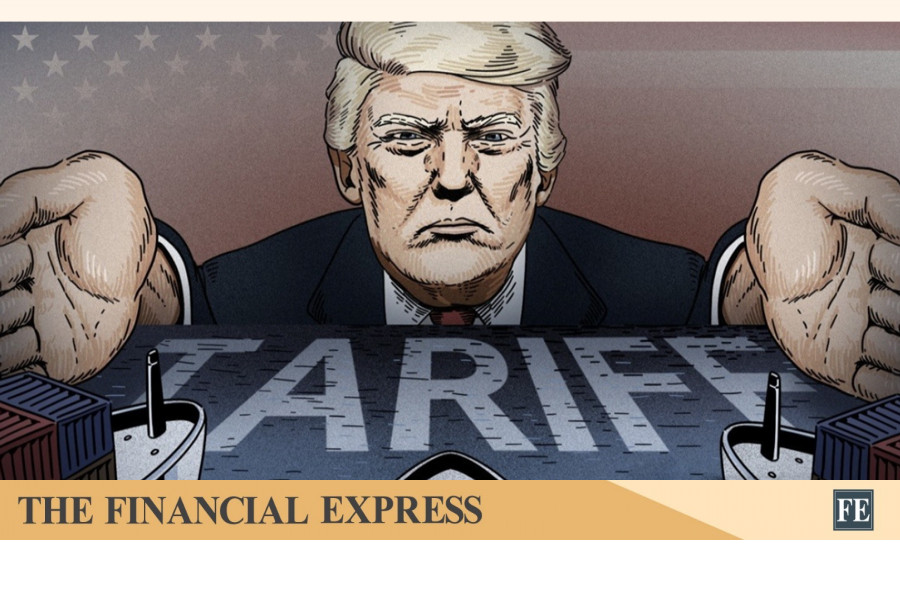
Aimed at pulling up the cost of foreign products, protecting domestic industries, and raising revenue, tariffs are taxes or duties imposed by a government on imported commodities. These are used as an important tool in inter-governmental economic policy-making, as they influence foreign trade, affect consumer prices, but often lead to disputes between nations. However, economists have traditionally considered them as potentially self-defeating protectionism that hinder international trade and increase prices for the people they are supposed to protect. This has been the philosophy that led to a decline in tariff rates levied by the global economic super-power USA from 18.4 per cent in 1934 to below 2 per cent in 2007.

Times, however, have changed and the current administration of the US President Donald Trump appears hell-bent to raise tariffs on commodities from over 90 countries of the world. The Trump administration's approach to tariffs is linked to some key economic and political objectives, which includes a desire to protect American industries and workers from perceived unfair foreign competition. The strategy particularly focuses on trade imbalances with countries like China, India, Mexico, Canada, and the European Union (EU), although political motives are also apparent in many of the United States (US) moves. But these measures already appear to be backfiring especially by hitting the US consumers, and it is not yet clear how long the US administration can sustain this highly aggressive strategy that has already rattled the global economy.

Let us now have a look at the advantages and disadvantages of imposing Tariffs. As mentioned before, tariffs protect domestic industries, as they serve as a vital shield especially for emerging domestic industries against foreign competition. Tariffs also make a significant contribution to revenues generated by a government, especially in developing countries. They can aid countries in managing their trade balances more effectively by influencing the flow of import and export trade. Besides, they can play a vital role in upholding national security by encouraging domestic production in strategic industries, and can also serve as a powerful tool in transnational negotiations and diplomatic bargains.

The disadvantages or downsides of tariffs as pointed out by critics include: higher consumer prices and reduced purchasing power of a country's citizens, as businesses typically pass on the additional costs to the ultimate consumers; curtailment of market efficiency and innovation, as protected firms face less pressure to improve products, optimise operations, and reduce costs; may trigger retaliatory steps from trading partners leading to trade wars that adversely affect the economies of all involved parties; although tariffs may protect jobs in import-competing domestic industries, they often lead to substantial job losses in export-oriented industries dependent on imported inputs; lastly, they distort market signals that often lead to inefficient allocation of economic resources in various sectors.

It may be recalled that the Smoot-Hawley Tariff Act of 1930 passed by the US Congress had raised US tariffs on over 20 thousand imported products; and this unilateral measure contributed to a collapse in international trade soon afterwards that deepened the Great Depression during the 1930s. The 2018-20 trade war waged by the previous Trump administration against China revived the fears of similar harmful consequences for international trade; however, Trump's defeat in the 2020 presidential election provided a temporary respite for other vulnerable countries. But sadly, Trump has gone back to his old ways after winning the presidency in 2024, and the world economic order is once again under serious threat due to a new and more dangerous round of aggressive trade wars being pursued by him.

Before considering the situation since President Trump assumed office in January 2025, let us first review the impact of 2018-2020 US-China trade war during his first tenure. The Trump administration then escalated trade tensions with China through the application of punishing tariffs, as average tariff rate on commodities coming to the USA from China jumped from 1.7 per cent in 2017 to 13.8 per cent in 2019. US tariffs on Chinese goods were mostly targeted at electronics, machinery, furniture, clothing, auto-parts and agricultural equipment, while Chinese tariffs on US goods were mainly targeted at soybean, pork, beef, whiskey, LNG, and automobiles. The two countries, however, signed a trade deal in January 2020 that was showcased as a victory for Trump, although the actual benefits have always been questioned.

The impact of that brief trade war on the US economy included: higher prices for consumers and businesses; disrupted supply chains; bruising the agriculture sector; and volatility in the stock market. The adverse effects in China included export slowdown, currency devaluation, and shift in global supply chains. The global implications were: formal complaints with the World Trade Organization (WTO); ripple effect on international trade; trade uncertainties leading to delayed investments and hirings by businesses worldwide. Lessons learned from that episode were broadly as follows: tariffs are not costless; they may be a negotiation tool, but not a solution; they have long-term consequences, as many tariffs remained in place altering the trade scenario permanently even after the deal came into force; policy unpredictability is harmful, as the uncertainties centring on tariff policy generated instability that adversely affected business decisions and financial markets.

The findings from a recent research-study conducted by the German Think-tank 'Kiel Institute for the World Economy' suggests that the impact of the latest Trumpian tariffs is also likely to adversely affect US citizens over time in the shape of higher consumer prices. The study showed that it was the Americans, not the foreigners, who were bearing almost the entire cost of US tariffs. It contradicts the Trumpian claim that the tariffs applied aggressively during the past year as revenue-raising and foreign-policy tool will be paid by the foreigners. The latest survey by the AP-NORC Centre for Public Affairs also shows that about 60 per cent of US adults now say Trump has hurt the cost of living. Only 16 per cent US citizens now opine that Trump has helped 'a lot' in making things more affordable, down from 49 per cent recorded in April 2025.

The study by the Kiel Institute analysed shipments worth US$4 trillion between January 2024 and November 2025 and found that foreign exporters contributed only 4 per cent of the burden emanating from last year's tariff increases (by lowering prices), while US consumers and importers absorbed 96 per cent of the burden. The tariffs also had a significant impact on trade volumes as exemplified by 18 per cent to 24 per cent reduction in shipments to the USA by Indian exporters despite maintaining prices. The Kiel report concluded that the tariffs therefore acted as a consumption tax on Americans instead of functioning as a tax on foreign producers. A co-author of the report - Professor Julian Hinz of Germany's Bielefeld University claimed: "There is no such thing as foreigners transferring wealth to the USA in the form of tariffs", because the US$ 200 billion in additional tariff revenue was paid almost entirely by the Americans. This is likely to fuel higher inflation in the USA over time, thereby jeopardising Trump's remaining months in office, especially when US Congressional elections are due in November.


Dr Helal Uddin Ahmed is a retired Additional Secretary and former Editor of Bangladesh Quarterly.​
 
Analyze

Analyze Post

Add your ideas here:
Highlight Cite Respond

Interim govt to sign tariff agreement with US 3 days before election

Special Correspondent Dhaka
Published: 01 Feb 2026, 20: 21

1769994479633.webp


The interim government is set to sign a tariff agreement with the United States three days before the upcoming national parliamentary election.

The agreement is scheduled to be signed on 9 February in Washington, United States. Bangladesh’s delegation will be led by commerce adviser Sk Bashir Uddin.

Although the two countries reached an understanding last August regarding the 20 per cent reciprocal tariff imposed on Bangladesh, a formal agreement was not signed at that time. That agreement is now set to be finalised and signed in Washington, DC.

To conclude the agreement with the US, commerce adviser Sk Bashir Uddin and commerce secretary Mahbubur Rahman will depart Dhaka on 5 February.

They will first travel to Japan. On 6 February, the Bangladesh–Japan Economic Partnership Agreement (BJEPA) will be signed in Tokyo, the capital of Japan.

From there, they will proceed to Washington. Officials at the Ministry of Commerce confirmed this information to the media today, Sunday.

Speaking to journalists at the secretariat today, commerce secretary Mahbubur Rahman said, “We have received the date, 9 February, from the United States. We have sent a summary seeking approval of the draft agreement and for its signing on that date.”

When asked what the reciprocal tariff rate might be, the commerce secretary said, “It is currently at 20 per cent. Some countries face the same rate, while others face a higher rate. We are hopeful that the rate will be reduced somewhat. However, we cannot say for certain until before 9 February.”

The government has not made any official statement regarding the agreement with the United States.

Regarding the Economic Partnership Agreement (EPA) with Japan, the Ministry of Commerce had stated at a press conference on 22 December that once the agreement is signed, 7,379 Bangladeshi products will enjoy duty-free access to the Japanese market from the very first day.

On the other hand, 1,039 Japanese products will receive immediate duty-free access to the Bangladeshi market, it added.

Is the government concerned about India–EU agreement?

When asked whether the government is concerned about the recently signed Free Trade Agreement (FTA) between India and the European union (EU), the commerce secretary said, “There is nothing to be concerned about.”

Stating that Bangladesh has built capacity in the ready-made garment sector and is the world’s second-largest exporter in this sector, he further said, “India, meanwhile, is very strong in textiles. They have a strong position globally. We also import raw materials from them.”​
 
Analyze

Analyze Post

Add your ideas here:
Highlight Cite Respond

BD stands to lose in EU, US mkts amid India tariff deals
Exporters urge making speedy EU agreement, product, market diversification


Monira Munni
Published :
Feb 05, 2026 00:50
Updated :
Feb 05, 2026 00:50

1770277525600.webp


Bangladesh is destined to face break-neck competition both in US and EU markets with India emerging as a major competitor with double advantages of Washington-proposed tariff cutback and trade deal with the 27-nation European bloc.

Industry insiders and experts sound the alarm over the headwinds about to blow from the two destinations Bangladesh heavily bank on for its readymade garment export -- the nation's main export earner -- and urge government action.

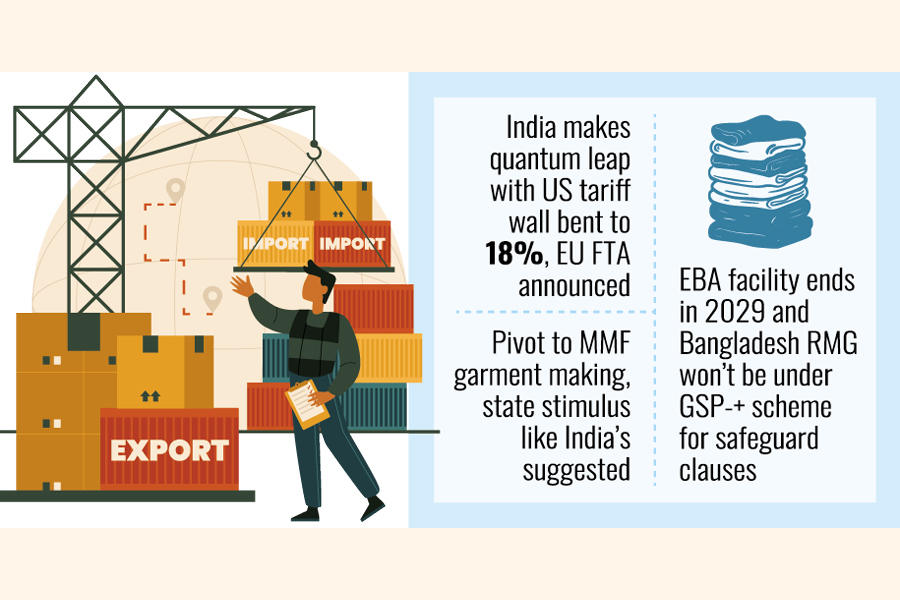
The recent announcement of lowering tariffs on Indian-made goods may be subject to as low as 18-percent tariffs, knocked down from the earlier-imposed 50 per cent. The brusque move from Washington came a week after the announcement of the trade deal between India and European Union.

Bangladesh should immediately act to retain duty -free market access to the European Union and enhance its competitiveness by removing supply-side constraints, industry leaders urge.

A slew of must-dos they list to overcome possible impact of the trade deal between the EU and India: coordinated reforms across trade policy, energy pricing and reliability, logistics and ports, access to finance, skills development and regulatory capacity building.

They also stress both product diversification, mostly by way of producing manmade fibre- based garments, and market diversification through exploring potential non-traditional markets.

Local garment exporters will face cutthroat competition and increased price pressure on the EU market after the free-trade agreement (FTA) announced recently between the EU and India comes into effect, possibly in 2027, as it would grant the neighbouring country's garment makers access to the bloc sans duty on apparel exports, they note.

On the other hand, Bangladesh's current duty-free market access there under EBA (everything but arms) scheme is scheduled to end in 2029 as the county is set to graduate from LDC status this coming November 2026 with a three-year transition period.

Though Bangladesh can apply for GSP- plus facility, its garment products would not get duty-free market access there due to safeguard clauses and are likely to face about 12-percent duty, they said, adding that by this time, another competitor - Vietnam -- would also get duty-free market access.

Talking to The Financial Express, Md Shehab Udduza Chowdhury, vice president of Bangladesh Garment Manufacturers and Exporters Association (BGMEA), said India would be in an advantageous position with reduced rate of 18-percent tariffs compared to 20 per cent for Bangladesh.

On the other hand, the trade deal between the EU and India will be 'dangerous' for them, he said, apprehending a possible threat of losing market share there.

"The impact of the deal would be severe for us. Bangladesh is currently facing tough competition on the EU market as India and China are enhancing their focus there to offset US high-tariff impacts," says Faruque Hassan, managing director of Giant Group.

Bangladesh will become less competitive on the EU market once India secures duty-free access there, he warns.

The first and foremost tasks must be to sustain the duty-free market access there, the apparel maker-exporter told the FE, adding that the government also should initiate move to sign FTA to have an even footing on the largest market as a bloc.

Meantime, Chief Adviser of the interim government Prof Muhammad Yunus Sunday directed opening free-trade agreement (FTA) negotiations with the EU forthwith to safeguard Bangladesh's trade preferences on its largest export market.

MA Razzaque, chairman of Research and Policy Integration for Development (RAPID), says the US tariff reduction for India might not immediately affect the local garment shipment over there as Indian competitive advantage would not change because it is in disadvantage due to existing higher tariffs.

"But Bangladesh will face tremendous pressure in the medium term of three to five years as the EU-India trade deal would bring extreme challenges," he told the FE, explaining India with its backward linkages, including cotton to yarn and fabrics, will be a major competitor for Bangladesh which has to depend on imported raw materials.


Besides, there are no supply-side constraints for other major garment-producing countries like India, Vietnam, Indonesia, Cambodia and Pakistan as Bangladesh face, he adds.

The country has to immediately take measures to remove the supply-side constraints like gas and energy shortages, provide supports to the exporters to be ESG-compliant, develop skilled workforce, and reduce electricity and utility costs, ensure special bank interest rate and simultaneously attract foreign direct investment in RMG sector to boost MMF production.

"To ensure global work orders, FDI is a must for RMG and also for overall export diversification," he notes.

Local exporters will also face price pressure as India would be more competitive, says MA Rahim, vice chairman of DBL Group.

The entrepreneur, however, thinks the EU-India deal would not impact Bangladesh's export immediately, but it would affect gradually.

"India will be a strong future competitor for Bangladesh as the neighbouring country has its own raw materials, including cotton, yarn and fabrics, low labour cost while government facilitates the sector with a number of packages to increase competitiveness," Fazlul Hoque, managing director of Plummy Fashions, points out to underscore the urgency of counterbalancing actions.

Besides, India will jump into the market with better market access also to offset the high tariffs imposed by US administration, he notes.


Echoing Hassan's anxiety, Hoque, who ships up to 80 per cent of his total exports to the EU, says they immediately need government support to reduce cost of production and cost of fund, ensure uninterrupted gas supply and other issues that have been eating up competitiveness.

Hoque voices a consequential note: If Bangladesh fails to secure the duty-free market access under GSP-plus or a bilateral free-trade deal after LDC graduation, it will be out of the market.

The industry also needs to diversify its markets and products and produce manmade-fibre garments, exporters suggest.

They have also demanded incentives for attracting both local and foreign investment into man-made fibre or MMF wears to sustain export growth.

In the last fiscal year of 2024-25, the European Union accounted for more than 50 per cent, coming to US$19.71 billion, of Bangladesh's total garment exports worth over 48 billion US dollars.​
 
Analyze

Analyze Post

Add your ideas here:
Highlight Cite Respond

Bangladesh-US trade deal on 9 Feb, adviser, secy not attending in person
Special Correspondent Dhaka
Published: 05 Feb 2026, 19: 24

1770340342081.webp

Flags of USA and Bangladesh File photo

A trade agreement on reciprocal tariffs with the United States will be signed in Washington, the US capital, next Monday, 9 February.

However, the signing ceremony will begin a day earlier, on 8 February. Despite this, Commerce Adviser Sk Bashir Uddin and Commerce Secretary Mahbubur Rahman will not attend the two-day event in person.

Both the Commerce Adviser and the Commerce Secretary confirmed the matter to this correspondent separately by phone on Thursday afternoon.

Commerce Adviser Sk Bashir Uddin told Prothom Alo that neither he nor the Commerce Secretary would travel to the US for the signing ceremony.

However, a five-member delegation from Bangladesh will go to Washington for the event. A government order (GO) issued by the Ministry of Commerce on 3 February lists the names of the five members.

The delegation will be led by Khadija Nazneen, Additional Secretary at the Ministry of Commerce and Head of the World Trade Organization (WTO) Wing. The other four members are Joint Secretaries Firoz Uddin Ahmed and Mustafizur Rahman, Senior Assistant Secretary Sheikh Shamsul Arefin, and National Board of Revenue (NBR) Commissioner Rais Uddin Khan.

According to the GO, the delegation is scheduled to depart Dhaka on Friday, 6 February, and return to the country on or around 10 February.

Meanwhile, the Commerce Adviser and the Commerce Secretary left Dhaka for Japan at around 1:45 pm today. The signing of the Bangladesh–Japan Economic Partnership Agreement (BJEPA) is scheduled to take place tomorrow, Friday in Tokyo. They are traveling to Tokyo to attend the three-day event from 4 to 6 February.

The government order states that, in addition to the Commerce Adviser and the Commerce Secretary, four other officials are part of the delegation for the Japan event.

They are Ayesha Akter, Additional Secretary and Head of the Free Trade Agreement (FTA) Wing of the Ministry of Commerce; Joint Secretary Firoz Uddin Ahmed; Deputy Secretary Mahbuba Khatun Minu; and Senior Assistant Secretary Mohammad Hasib Sarkar.

Except for the Adviser and the Secretary, these four officials have already been in Tokyo for the past two days. They are expected to return to Dhaka on or around 7 February.

Commerce Secretary Mahbubur Rahman told Prothom Alo that after signing the EPA with Japan, they will return to Dhaka.

Replying to a query about who would sign the agreement with the US on behalf of Bangladesh, the Commerce Secretary said that the Commerce Adviser would sign the agreement online.

Sources at the Ministry of Commerce said that Commerce Adviser Sk Bashir Uddin has already signed the agreement in Dhaka. The signed copy will be taken to Washington by the Bangladeshi delegation. On the US side, the agreement will be signed by US Trade Representative (USTR) Jamieson Greer.​
 
Analyze

Analyze Post

Add your ideas here:
Highlight Cite Respond

Posts you haven't read yet..

Members Online

Latest Posts

Back
 
G
O
 
H
O
M
E