New Tweets

[🇧🇩] Earthquake in Myanmar----Lessons for Bangladesh

G Bangladesh Defense
[🇧🇩] Earthquake in Myanmar----Lessons for Bangladesh
38
1K
More threads by Saif


Bangladesh hands over first consignment of humanitarian relief to Myanmar
United News of Bangladesh . Dhaka 30 March, 2025, 18:06

1743383711049.webp

Bangladesh ambassador to Myanmar Monwar Hossain hands over humanitarian relief materials to the chief minister of Myanmar’s Yangon Soe Thein at a simple ceremony at Yangon Airport on Sunday. | UNB photo

Bangladesh, in solidarity with the people of Myanmar, has promptly responded to the devastating earthquake of 7.7 magnitude that struck northern Myanmar on March 28.

Two Bangladesh Air Force/Army aircrafts (C-130 and CASA) landed at Yangon Airport on Sunday, carrying 16.5 metric tonnes of emergency relief materials, including tents, food packets, medicines, water, hygiene kits, plastic sheets, mosquito nets, solar lights and other essential supplies.

These are the first consignments, with more to follow.

Bangladesh ambassador to Myanmar Monwar Hossain handed over the relief materials to the chief minister of Yangon Soe Thein at a simple ceremony at the airport.

Bangladesh also stands ready to deploy a 50-member rescue team, including a dedicated 21-member medical team, engineers, and fire service and civil defense personnel, to support search and rescue efforts, the ambassador said.

‘Our thoughts and prayers are with the victims, their families, and all those affected,’ he said.

As a close neighbour, Bangladesh remains committed to assisting the people of Myanmar in their time of need, the ambassador added.​
 
Analyze

Analyze Post

Add your ideas here:
Highlight Cite Respond

Rescue hopes fading three days after deadly Myanmar quake

1743467003093.webp

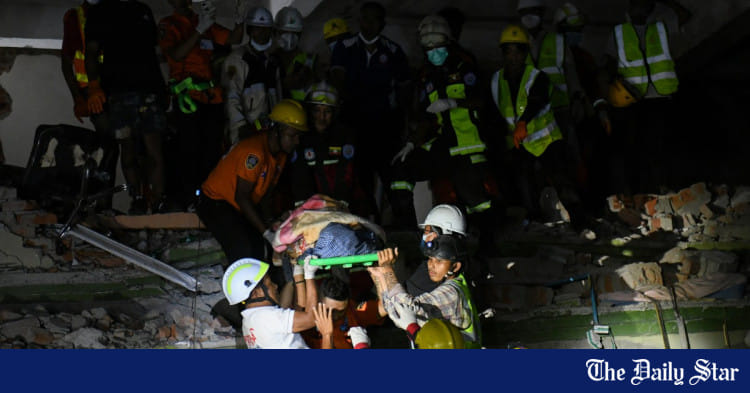
Rescue workers carry a victim trapped under the rubble of the destroyed Sky Villa Condominium development building in Mandalay on March 30, 2025. Photo: AFP/Sai Aung MAIN

Hopes were fading today of finding more survivors in the rubble of Mandalay, where some residents spent a third night sleeping in the open after a massive earthquake killed at least 1,700 people in Myanmar and neighbouring Thailand.

Rescue efforts were less active in the central Myanmar city of more than 1.7 million people early Monday, but conditions are difficult -- with temperatures expected to reach around 40 degrees Celsius (104 Fahrenheit).

The sticky heat has exhausted rescue workers and accelerated body decomposition, which could complicate identification.

A desperate scene unfolded at a collapsed apartment block in Myanmar's second biggest city on Sunday evening, when rescuers thought they had saved the life of a pregnant woman trapped under the rubble for more than 55 hours.

They amputated her leg to free her, but after pulling her out she was pronounced dead.

"We tried everything to save her," said one of the medical responders, but she had lost too much blood from the amputation.

Muslim worshipers, meanwhile, gathered near a destroyed mosque in the city on Monday morning for the first prayer of Eid-ul-Fitr.

Funerals for hundreds of victims are also expected to take place on Monday.

The initial 7.7-magnitude quake struck near Mandalay early Friday afternoon, followed minutes later by a 6.7-magnitude aftershock.

The tremors collapsed buildings, downed bridges and buckled roads, with some of the worst destruction seen in central Myanmar.

Aftershocks cause panic

Aftershocks continued to be felt in Mandalay over the weekend, spurring residents to flee into the streets in multiple instances of brief panic.

The International Federation of Red Cross and Red Crescent Societies launched an emergency appeal Sunday for more than $ 100 million to help victims.

The world's largest humanitarian network said needs were growing by the hour as rising temperatures and the approaching monsoon season increase the risk of "secondary crises".

The challenges facing the Southeast Asian country of over 50 million people were immense even before the earthquake.

Myanmar has been ravaged by four years of civil war sparked by a military coup in 2021.

Reports have emerged of sporadic fighting even after the quake, with one rebel group telling AFP on Sunday that seven of its fighters were killed in an aerial attack soon after the tremors hit.

Before Friday's quake, some 3.5 million people were displaced by the raging civil war, many at risk of hunger.

Bangkok building collapse

In the Thai capital of Bangkok -- about 1,000 kilometres away from Mandalay -- rain fell on Monday morning at the site of a collapsed building that had been under construction at the time of Friday's quake.

At least 18 people have been killed in Bangkok, city authorities said Sunday, with 33 injured and 78 still missing.

Most of the deaths were workers killed in the tower collapse, while most of the missing are believed to be trapped under the immense pile of debris where the skyscraper once stood.

Rescue workers raced over the weekend to find survivors, using large mechanical diggers to uncover rubble while distressed family members waited nearby.

Sniffer dogs and thermal imaging drones have been deployed to seek signs of life in the collapsed building, which is close to the Chatuchak weekend market popular among tourists.​
 
Analyze

Analyze Post

Add your ideas here:
Highlight Cite Respond

Myanmar quake: a nation unprepared for disaster

1743467174436.webp

Photo: AFP

Ravaged by four years of civil war, Myanmar is ill-prepared to cope with the destruction brought by Friday's massive earthquake.

The 7.7-magnitude quake that struck central Myanmar has killed more than 1,600 people and destroyed thousands of homes.

But the bloody conflict sparked by the 2021 military coup has brought the country's infrastructure, healthcare system and power network to their knees.

Here are some of the challenges facing relief efforts in Myanmar:

- Humanitarian crisis -

The United Nations and aid agencies have warned that millions were already facing a dire humanitarian crisis before the quake, and are now in urgent need of yet more aid.

Much of the country was already plagued by a punishing mix of conflict, poverty and instability after the civil war that left 3.5 million people displaced and smashed the economy.

"We have estimated that 19.9 million people are in need of humanitarian assistance, and this is just before the earthquake," said UN humanitarian coordinator in Myanmar Marcoluigi Corsi.

"The situation will be further aggravated."

Before the quake, the World Food Programme (WFP) said more than 15 million out of a population of 51 million were unable to meet their daily food needs.

Just two days after the quake, the UN said the aid effort was being hampered by a severe lack of medical supplies, while rescuers on the ground have pleaded for more equipment to comb ruined buildings for survivors.

The quake also struck Myanmar at a time when US President Donald Trump has slashed jobs and funding to Washington's foreign aid agency.

Trump has promised US help but one million civilians in Myanmar face WFP aid cuts after he took an axe to the US Agency for International Development.

Countries around the world have begun sending rescue teams and aid shipments.

- Junta rule -

The junta, led by General Min Aung Hlaing, has lost control of large parts of Myanmar throughout the conflict, though it remains in charge of major cities including Mandalay -- the closest to the quake epicentre and worst hit.

But many civil servants chose to switch sides following the military coup and join resistance to the junta.

This loss of personnel has further weakened an already antiquated civil administration, making the management and distribution of relief efforts harder.

In a sign of the enormity of the disaster -- and perhaps in a tacit admission of the state's inability to respond -- Min Aung Hlaing issued a rare appeal for foreign aid on Friday.

This marked a major shift from previous military rulers who shunned all international assistance.

Poverty is rampant, the economy shattered, and international sanctions combined with the expense of fighting the civil war have drained the junta's coffers.

- Splintered control -

Much of Myanmar is controlled by a shifting patchwork of junta forces, ethnic armed groups and pro-democracy partisans.

The complex mosaic of control on the ground, often involving competing groups with different agendas, may further frustrate efforts to move relief resources to where they are needed around the country.

Sagaing city -- near the quake's epicentre -- has seen some of the heaviest fighting between junta forces and armed resistance groups.

Ethnic armed groups, border militias and the military have all been vying for control of local resources, spurring fears there will be a similar tussle for aid.

- Poor infrastructure -

Myanmar's infrastructure and medical system have been ravaged by the civil war.

The junta has bombed hospitals in rebel-held areas and many doctors have abandoned government medical facilities to join the rebellion.

The UN has said hospitals in Mandalay, Magway and the capital Naypyidaw "are struggling to cope with the influx of people injured".

The country was already beset by phone and internet blackouts but the quake has further hurt communications and the ability to direct aid to the most in need.

Internet communications in Mandalay were patchy and land and air routes severely disrupted after the quake buckled roads.

With many houses collapsed, the UN and other NGOs say solutions are needed for the many left homeless.​
 
Analyze

Analyze Post

Add your ideas here:
Highlight Cite Respond

Bangladesh dispatches emergency relief for Myanmar earthquake victims
BSS
Published: 31 Mar 2025, 11: 23

1743467505920.webp


Two Bangladesh Air Force/Army aircrafts landed at Yangon Airport on 31 March BSS

With dispatching emergency relief aid, Bangladesh has promptly responded to the devastating 7.7 magnitude earthquake that struck northern Myanmar on 28 March last killing at least 1,644 people and injuring 3,408 others.

Under the instructions of the Chief Advisor, initiatives have been taken to send rescue and medical assistance teams from Bangladesh to Myanmar through the Bangladesh Armed Forces to provide relief materials such as medicines, tents, dry food and rescue and medical services on an emergency basis.

A release of the Directorate of Inter-Services of Public Relations (ISPR) said this evening.

Two Bangladesh Air Force/Army aircrafts (C-130 and CASA) landed at Yangon Airport today, carrying 16.5 metric tonnes of emergency relief materials, including tents, food packets, medicines, water, hygiene kits, plastic sheets, mosquito nets, solar lights and other essential supplies.

The relief supplies being sent to Myanmar today are only a part of the planned relief aid. Later, subject to the permission of the Myanmar government, more relief aid and a rescue and medical assistance teams led by the Bangladesh Army will be sent, the ISPR said.

A 26-member expert search and rescue team of the Bangladesh Armed Forces and a 10-member rescue team from the Fire Service and Civil Defense are ready to provide necessary assistance for the rescue operation.

In addition, two medical teams of 11 members each, 10 of them from the Bangladesh Army and civilian doctors, have also been kept ready to provide medical services.

The Bangladesh Armed Forces are always committed to volunteering for any global needs as per the government's instructions in the coming days, the ISPR added.​
 
Analyze

Analyze Post

Add your ideas here:
Highlight Cite Respond

Bangladesh sends 2nd consignment of emergency aid to Myanmar
UNB
Published: 01 Apr 2025, 13: 47

1743555478673.webp

Bangladesh sends supplies and medicines to Myanmar via three transport aircraft of the Bangladesh Army (BA) and Bangladesh Air Force (BAF) on Tuesday morning UNB

Bangladesh has sent the second mission of emergency medicines and relief supplies to the victims of the devastating earthquake in Myanmar.

These supplies and medicines were sent via three transport aircraft of the Bangladesh Army (BA) and Bangladesh Air Force (BAF) on Tuesday morning, following the instructions of Chief Adviser Prof Muhammad Yunus, CA's Deputy Press Secretary Abul Kalam Azad Majumder said.

The mission consists of rescue and medical teams composed of rescue experts from all three services, Fire Service and Civil Defence (FSCD) doctors, Bangladesh Army (BA) doctors, and civilian doctors.

The total number of rescuers and doctors is 55.

Besides, there are 37 crew members on board in three aircraft.

The rescue and medical teams carry their self-sustainment items (rations, hygiene facilities, communication equipment, cooking utensils, etc.).

Besides, eight tonnes of dry food, 2.5 tonnes of water, four tonnes of medicine, one tonne of hygiene products, and 1.5 tonnes of relief tents are sent for the earthquake-stricken people.

Earlier on Sunday, Bangladesh sent its first mission of urgent relief materials, including medicines, tents, dry food, and medical teams, to Myanmar through the Bangladesh Armed Forces, led by the Bangladesh Army​
 
Analyze

Analyze Post

Add your ideas here:
Highlight Cite Respond

With U.S. absent, China steps in for earthquake-hit Myanmar
REUTERS
Published :
Apr 02, 2025 19:52
Updated :
Apr 02, 2025 19:52

1743642465900.webp

Members of the Chinese Red Cross International Emergency Response Team work at a collapsed residential building following the earthquake, in Mandalay, Myanmar March 31, 2025. Photo : China Daily via REUTERS/Files

After a 7.7 magnitude earthquake shook Myanmar on Friday, killing more than 2,800 people, international rescuers rushed into the devastated Southeast Asian country.

The most ubiquitous among them have been Chinese relief workers, whose blue and orange uniforms appear across videos circulating on social media.

The posts are often accompanied with expressions of gratitude toward Beijing, whose first responders - as well as their Indian and Russian colleagues - have pulled dazed survivors and bodies out from the rubble of hotels, schools, and monasteries.

The reaction marks a change in the negative reception China often receives on Myanmar’s social media because of its support for the unpopular military junta.

America’s chief geopolitical rival has so far pledged to deliver 100 million yuan ($13.76 million) worth of supplies. The first batch of aid, including tents, blankets and first aid kits arrived in Yangon on Monday, Beijing has said.

The United States, which was until recently the world’s top humanitarian donor, has offered a relatively modest $2 million. Washington also said it would send a three-member assessment team, though their arrival has been delayed by problems obtaining visas from the military regime.

In past years, when tsunamis, earthquakes and other disasters struck around the world, the U.S. had regularly and rapidly deployed skilled rescue workers to save lives.

The American absence shows how President Donald Trump’s moves to slash the size of the U.S. government has hobbled its ability to act during disasters, three current and former U.S. officials told Reuters.

With Trump’s blessing, billionaire Elon Musk’s Department of Government Efficiency has enacted huge funding cuts and contractor terminations across the federal bureaucracy in the name of targeting wasteful spending.

Trump has also moved to fire nearly all U.S. Agency for International Development staff, who oversee Washington’s disaster response efforts overseas.

A functional USAID would have activated urban search-and-rescue teams that were capable of being deployed to Myanmar in 48 hours, said Marcia Wong, formerly a top humanitarian official at USAID.

But most of the people who would have coordinated the response have been let go, while third-party partners have lost contracts, she said.

“We have created a vacuum which can allow other actors to step in,” Wong said.

Former U.S. ambassador to Myanmar Scot Marciel told Reuters that while it was unlikely the junta would have allowed big U.S. military teams to enter, Washington could still have “responded more quickly and robustly” were it not for the cuts.

The State Department, which administers the remaining USAID programs, did not immediately return a request for comment. The junta and China’s foreign ministry also did not respond to questions.

Secretary of State Marco Rubio said on X that the cuts targeted programs that “did not serve, (and in some cases even harmed)” U.S. interests. His spokesperson Tammy Bruce told reporters Monday that disaster relief experts were monitoring the situation.

CHINA ON FRONT FOOT

Hours after the quake, the Trump administration told Congress in a pre-planned move that it was firing nearly all remaining USAID personnel and closing its foreign missions.

Meanwhile, Beijing dispatched first-response teams, including dozens of medical workers, earthquake experts, field hospital workers and rescue dogs.

Those teams have been some of the main visible signs of official assistance in affected areas like Mandalay and Sagaing, where residents said they received no help from the military.

India’s foreign ministry said on Tuesday its aircraft and ships had delivered 625 tons of aid, while rescue workers had recovered 16 bodies from Mandalay and treated 104 patients. Russia and India have also set up mobile hospitals.

China has used its state media machine to broadcast its relief efforts.

English-language state broadcaster CGTN was one of the few international media outlets with reporters sending on-camera dispatches from Mandalay, the epicentre of the disaster.

State-run news agency Xinhua has also run extensive reports showing China’s relief efforts.

Some rescue teams entered Myanmar from China’s Yunnan province, travelling overland through areas held by rebels which are opposed to the junta but have a complex relationship with Beijing.

The decision to send rescuers by road as well as air was seen by analysts like Sai Tun Aung Lwin as a signal from Beijing that it had influence with both the rebels and the junta.

China appears to have opened a “humanitarian corridor” that effectively stretches through rebel and junta territory, said the researcher, who studies China’s role in Myanmar. “On social media, the anti-China sentiment (is in) significant decline.”

The junta said Wednesday it had fired warning shots at a convoy from the Chinese Red Cross because it had not asked permission to drive from Yunnan through to Mandalay, including through areas where junta troops have been clashing with opposition armies.

Beijing later said there were no casualties.

‘PROFOUND GRATITUDE’

Myanmar sits between China and India and is of crucial strategic importance to both countries.

Washington also enjoyed warm relations with the Southeast Asian nation under a brief quasi-democratic period before the military seized power in 2021, toppling the elected government led by Nobel Peace laureate Aung San Suu Kyi.

The junta has brutally quashed dissent and sparked a spiralling civil war. However, it remains backed by Beijing, which sees the junta as a guarantor of stability though rebel forces now control most of the borderlands.

Many in the opposition regard China negatively for its role propping up the military. A 2024 poll of regional decision-makers by the ISEAS-Yusof Ishak Institute, a Singapore-based think-tank, found 65% of Myanmar respondents distrusted Beijing.

A spokesperson for Myanmar’s National Unity Government, a parallel administration that includes members of Suu Kyi’s deposed government, said in a statement that it had “profound gratitude to the international rescue teams who have arrived without delay to assist and save the people of Myanmar.”

Washington has retained influence, especially among the opposition to the junta, through humanitarian aid and funds for the democracy movement. The recent Trump-directed cuts, however, have largely erased both.

At least 28 USAID and State Department programs supporting Myanmar have been terminated, according to documents shared with Congress and reviewed by Reuters.

Marciel said Washington’s relations with Myanmar should matter to U.S. citizens because winning international backing for matters of national concern, including “the willingness to stand up to China at times - all depend heavily on the extent of U.S. influence”.​
 
Analyze

Analyze Post

Add your ideas here:
Highlight Cite Respond

Lesson learnt from Myanmar quake
Published :
Apr 02, 2025 23:43
Updated :
Apr 02, 2025 23:43

1743642914981.webp


The death and devastation caused by the Friday's earthquake of 7.7 Moment magnitude scale (Mw) in Myanmar have been on the rise with rescuers accessing the worst affected areas near Mandalay. By Monday the death toll was approaching the 3,000 mark and the number of the injured closing to 5,000. The US Geological Survey which measured the quake's magnitude estimates on the basis of its modelling that the death toll may exceed 10,000 and the losses surpass the country's annual output. For the strife-torn and military junta-led country, the seismic convulsion of this magnitude could not come at a worse time. Although the junta controls the main urban centres, the wider parts of the country has been captured by the National Unity Government (NUG) representing its armed wing, the People's Defence Force (PDF) and other rebel groups. To the junta, the overwhelming concern is to stay in power rather than coordinating a rescue operation in collaboration with countries possessing the required machines and tools as well as expertise in such an emergency.

Although the PDF has suspended its armed hostility, except in self defence, for two weeks, the military government still continued air strikes in some areas, drawing international criticism. However, to its credit, the administration in Nay Pyi Taw has made a rare appeal for international help following which aid from China and India started arriving in the country. How the relief materials will be distributed among the survivors may remain contentious with the warring parties not cooperating at this critical time. The International Rescue Committee (IRC) has made it clear that the crisis of medical care, clean drinking water, food, tent and other basic materials is acute. In the absence of electricity, the situation has become worse still. If the military authorities themselves fail to actively respond to the emergency, the international community cannot rise up to the challenges of this humanitarian service.

The quake that has struck Myanmar was felt in its neighbouring countries including Bangladesh. In Thailand an under-construction high-rise building collapsed, killing at least 14 people there and the total casualty reaching at least 21. This tremor did not cause any loss of life or property in Bangladesh but it surely is a wake-up call for the country that finds itself located at the convergence of the Indian, Eurasian and Burmese tectonic plates. Naturally, the country is earthquake-prone. Although no major seismic disaster took place since the last one of 7.2 Mw struck Netrokona on July 8, 1918, the frequent mild tremors of recent years may be indicative, according to seismologists, of one quite ominous.

Sure enough, a civilian government unlike the military junta in Myanmar is expected to marshal all the forces and capabilities it has under its disposal to respond to such a likely crisis. But the fact is, the Bangladesh authorities have failed to procure the advanced machines and equipment to deal with a severe post-quake crisis. The urban mess in Dhaka and Chattogram ---the latter to have experienced the greatest seismic jolts measuring 6.2 Mw and 5.5 Mw as late as November 26, 2021 and December 2, 2023 respectively---may present a disaster of cataclysmic proportion in case a quake of greater magnitude strikes. In Dhaka, the Fire Service and Civil Defence was supposed to train 62,000 volunteers but hardly have such drills been noticeable. The situation demands procurement of sophisticated and heavy-duty machines and tools along with readying trained volunteers to deal with quake crisis, if any.​
 
Analyze

Analyze Post

Add your ideas here:
Highlight Cite Respond

Myanmar junta declares quake ceasefire, survivors plead for aid
Agence France-Presse . Sagaing, Myanmar 02 April, 2025, 23:46

1743644315830.webp

Workers wearing hazmat suit spray disinfectant to sterilise the rubble of a collapsed building in Mandalay on Wednesday, five days after a major earthquake struck central Myanmar. | AFP photo

Myanmar’s junta announced a temporary ceasefire on Wednesday as the death toll from a devastating earthquake rose and desperate survivors pleaded for more help amid frantic scenes of aid distribution.

The shallow 7.7-magnitude earthquake on Friday flattened buildings across Myanmar, killing nearly 3,000 people and making thousands more homeless.

The military government said it would observe a ceasefire from Wednesday until April 22 to make quake relief efforts easier, after other armed groups fighting the country’s bloody four-year civil war made similar pledges.

The junta said in a statement the move had ‘the aim of speeding up relief and reconstruction efforts, and maintaining peace and stability’.

But it warned its opponents — a complex array of pro-democracy and ethnic minority armed groups — it would still respond to attacks, acts of sabotage or ‘gathering, organising, and expanding territory that would undermine peace’.

UN agencies, rights groups and foreign governments had earlier urged all sides in Myanmar’s civil war to stop fighting and focus on helping those affected by the quake, the biggest to hit the country in decades.

The junta said Min Aung Hlaing will travel to Bangkok on Thursday for a summit of South Asian countries plus Myanmar and Thailand, where he will discuss the quake response.

AFP journalists saw frantic scenes as hundreds of desperate people scrambled for aid distribution in Sagaing, the city closest to the epicentre of the quake, with some running through traffic to join the queues.

Volunteers handed out water, rice, cooking oil and other basic supplies to residents clamouring for assistance.

‘I have never queued for food like this before. I can’t express how worried I am. I don’t know what to say,’ Cho Cho Mar, 35, carrying her baby and clutching instant coffee packs and mosquito repellent, said.

Destruction in the city is widespread, with the World Health Organisation reporting that one in three houses have collapsed, and five days after the quake locals complained of a lack of help.

Aye Thi Kar, 63, head of a school for young nuns razed to the ground by the tremors, said food supplies were low but shelter was a bigger priority — along with nets to ward off mosquitos in the stifling tropical heat.

Many people have been sleeping in the streets since the quake hit, unable to return to damaged buildings or fearful of aftershocks.

‘Right now we need roofing and walls to have proper shelter for the night,’ she said.

‘We also need nets and blankets for sleeping, as we don’t want to sleep directly on the ground.’

Healthcare facilities, damaged by the quake and with limited capacity, are ‘overwhelmed by a large number of patients’, while supplies of food, water and medicine are running low, WHO said in an update.

Hopes of finding more survivors are fading, but there were moments of joy on Wednesday as two men were pulled alive from the ruins of a hotel in the capital Naypyidaw.

The junta said Wednesday that the death toll had risen to 2,886, with more than 4,600 injured and 373 still missing.

But with patchy communication and infrastructure delaying efforts to gather information and deliver aid, the full scale of the disaster has yet to become clear, and the toll is likely to rise.

Relief groups say the overall quake response has been hindered by continued fighting between the junta and the complex patchwork of armed groups opposed to its rule, which began after the military seized power in a 2021 coup.

Even before Friday’s earthquake, 3.5 million people were displaced by the fighting, many of them at risk of hunger, according to the United Nations.

Late Tuesday, an alliance of three of Myanmar’s most powerful ethnic minority armed groups announced a one-month pause in hostilities to support humanitarian efforts in response to the quake.

The announcement by the Three Brotherhood Alliance followed a separate partial ceasefire called by the People’s Defence Force — civilian groups that took up arms after the coup to fight junta rule.

But there have been multiple reports of junta air strikes against rebel groups since the quake.

A junta spokesman said soldiers fired warning shots on Tuesday when a Chinese Red Cross convoy failed to stop while approaching a village in conflict-ridden Shan state to deliver aid to earthquake victims.

Hundreds of kilometres away, in the Thai capital Bangkok, workers continued to scour through the rubble of a 30-storey skyscraper that was still being built when it collapsed on Friday.

The death toll at the site has risen to 22, with more than 70 still believed trapped in the rubble.​
 
Analyze

Analyze Post

Add your ideas here:
Highlight Cite Respond

Latest Posts

Back
PKDefense - Recommended Toggle