New Tweets

[🇧🇩] Energy Security of Bangladesh

G Bangladesh Defense
[🇧🇩] Energy Security of Bangladesh
574
20K
More threads by Saif


Capacity payments feared to mount significantly
M AZIZUR RAHMAN
Published :
Jun 02, 2024 00:28
Updated :
Jun 02, 2024 00:28

1717288420006.webp

The government's capacity payments to private gas-fired power plants are feared to surge significantly for its failure to purchase power due to gas crisis.

Sources said five new facilities with the total generation capacity of 2,673 megawatt have either completed construction or are nearing completion to initiate test runs and then come into operation.

Of the plants, two are owned by the private sector and three by the public sector.

The plants include a 718-MW Reliance-JERA joint venture (JV) gas-fired power plant and 590-MW Anwara Power Plant of the local United Group.

The JV between India's Reliance Power and Japan's JERA has completed construction of its power plants and now carrying out test runs.

Anwara 590 MW Power Plant of United Group has almost completed constructions, said sources.

Two public-sector plants - 156MW Ghorashal 3rd Unit and 409MW Ghorashal 4th Unit - remained idle after completing work due to inadequate gas, according to the Bangladesh Power Development Board (BPDB).

Another publicly-owned 800MW Rupsa Power Plant has completed around 80 per cent of the work.

The BPDB has already started counting capacity payments on new plants as it often fails to buy power from Summit's Meghnaghat 583MW and Unique Meghnaghat's 584MW plants.

Although the duo have started commercial operation recently, the BPDB very rarely keep them operational at one go due to gas crisis and bottlenecks in power transmission systems.

The recent liquefied natural gas (LNG) regasification setback caused from the cyclone Remal has aggravated the gas supply crisis.

The Summit LNG Terminal, which was hit by a stray broken floating pontoon at Moheshkhali in the Bay of Bengal during the cyclone, is now shut, said a senior Petrobangla official.

Dozens of gas-fired plants are now kept idle due to gas crisis and the BPDB has been counting capacity payment on them.

Amid the already surplus generation capacity and limitations in power transmission infrastructure, energy experts warn that this will exacerbate the burden of capacity charges on consumers.

The government paid a total of around Tk 1.05 trillion as capacity payments to power plant owners up to August 2023, according to state minister for power, energy and mineral resources Nasrul Hamid.

To read the rest of the news, please click on the link above.
 
Analyze

Analyze Post

Add your ideas here:
Highlight Cite Respond
  • Like (+1)
Reactions: Bilal9

ISA to support Bangladesh in solar energy
Published: February 24, 2023 21:05:54

1717374143369.webp

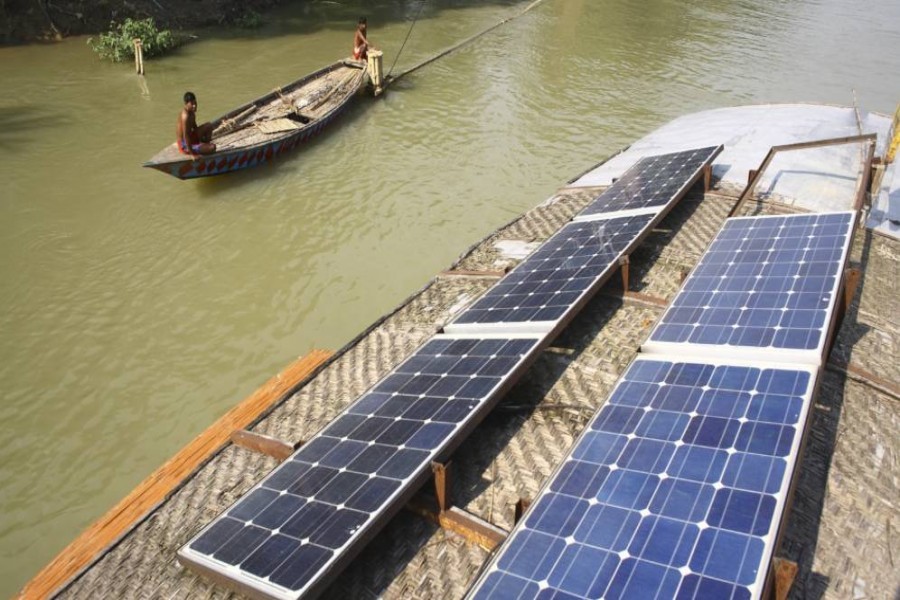
File photo used for representational purposeFile photo used for representational purpose

The International Solar Alliance (ISA) will provide technical support to Bangladesh to pull in financing for the renewable energy sector. "We'll help Bangladesh find a right policy to introduce a right business model for investment in the solar power sector," ISA Director General Ajay Mathur has said. He said this while addressing a press briefing in Dhaka Thursday, reports Xinhua.

The ISA is an alliance based on an intergovernmental treaty whose primary objective is to work for efficient consumption of solar energy to reduce dependence on fossil fuels.

The remarks came following Bangladesh's signing of a strategic country partnership agreement with the ISA to accelerate the development of solar energy.

Power secretary Habinur Rahman and Mathur signed the agreement on behalf of their respective sides.

The ISA chief said that land scarcity and a right technological solution have been the biggest challenges to the government in achieving a target of generating 40 percent of electricity from renewable sources by 2041.

"Options like floating solar could be an ideal solution for Bangladesh ... We'll be working to find innovative ideas," he said.

Rahman noted that a total of eight projects were to be implemented under the agreement with the ISA.

These include installations of 12 trolley-mounted portable solar irrigation systems of about 2kW capacity, 12c portable solar paddy threshers of about 2kW capacity, two rooftop solar projects with a capacity of 22kW, a solar cold storage for preservation of agricultural produce, the development of a rooftop project at Chattogram or any other railway station, the installation of a floating solar project in Gazipur and Munshiganj.

Conversion of two manually operated sluice gates to floating solar-powered auto sluice gates in two sites under the Bangladesh Water Development Board is also included in the agreement.
 
Analyze

Analyze Post

Add your ideas here:
Highlight Cite Respond
  • Like (+1)
Reactions: Bilal9

Gas supplies unlikely to normalise this month
Damaged FSRU of Summit will require repairs abroad

1717628967512.webp

Photo: Summit Group
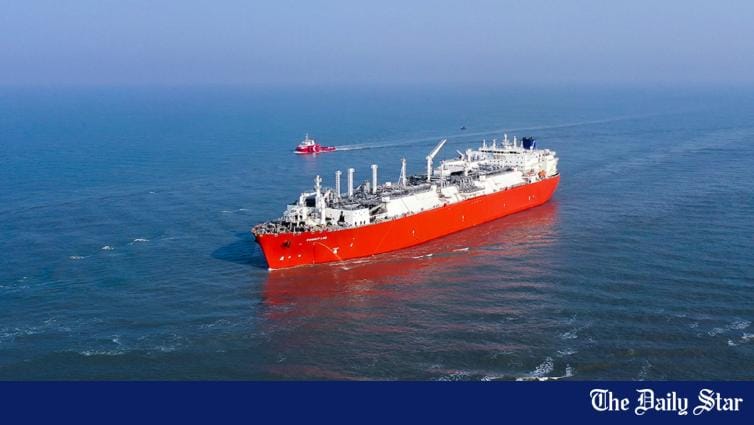
Gas supplies are unlikely to increase this month as a damaged floating storage and regasification unit (FSRU) owned by Summit Group will require repairs abroad, said the company yesterday.

"The Summit LNG Terminal is expected to return to Bangladesh after repairs, hopefully within three weeks," read the Summit statement.

It said, according to assessments by Bureau Veritas, certification societies and international inspectors, the vessel was now ready to discharge all onboard liquefied natural gas (LNG) before proceeding to a dry dock in either Singapore or the Middle East for necessary repairs.

While Cyclone Remal was raging last month, a broken stray steel structure weighing hundreds of tonnes struck the Summit LNG Terminal, causing significant damage, the statement reads.

"The impact sheared the vessel's outer hull, approximately one metre below the waterline, leading to water ingress into the ballast tanks," it said.

"Despite the severe monsoon conditions, the crew, operators, and owners of the vessel, along with the Summit team, worked tirelessly day and night to secure the vessel and its LNG cargo," it said.

"Their bravery and relentless efforts successfully prevented the loss of the cargo," it added.

"This unfortunate incident was mitigated by the grace of Almighty and the hard work of Rupantarita Prakritik Gas Company Limited (RPGCL), customer Petrobangla, the Summit LNG team, our port service operator PSA Marine, and the vessel provider Excelerate," it said.

"Due to their diligence, a major accident was averted," it further added.

Bangladesh avails gas from two FSRU having a total capacity to supply 1,100 million cubic feet of gas a day (mmcfd). The accident reduced the supply to 600 mmcfd.

Overall, Petrobangla can currently supply around 2,600 mmcfd against a demand of 3,800 mmcfd.

The FSRU only resumed operations in mid-April after undergoing maintenance in Singapore for two and a half months.
 
Analyze

Analyze Post

Add your ideas here:
Highlight Cite Respond

Higher non-operating income: State-run energy companies deviating from business norm
Mohammad Mufazzal | Published: February 26, 2023 08:48:49


1717807118189.webp

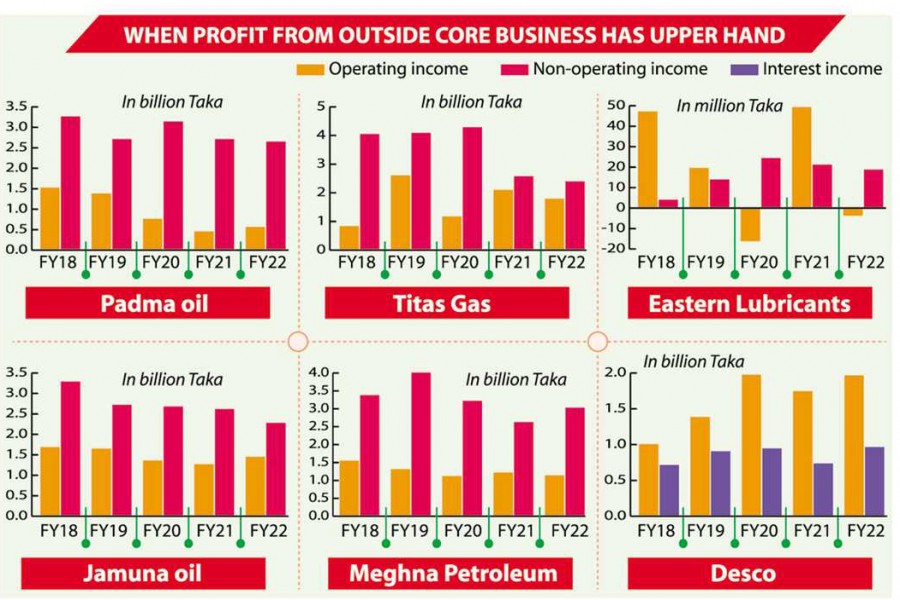
TITAS Gas Transmission & Distribution Company's profit grew at 27 per cent year-on-year for the October-December quarter of the FY23, mainly riding on non-operating income.

Its non-operating income was Tk 674.89 million in the quarter while operating income was Tk 543.66 million.

The non-operating income of another listed state-run company Padma Oil was almost four times its operating income for the second quarter of the ongoing fiscal year.

Like TITAS Gas and Padma Oil, non-operating incomes far outstripped operating incomes of other state-owned fuel and power companies, hence comprising a bigger pie of the net profits earned.

This is not a new trend perceived only in FY23. Rather, the financial data of the last five years reveals that the state-owned energy companies heavily rely upon income generated beyond their business operations to maintain their profit growth.

Dhaka Electric Supply Company Limited (Desco) is, however, an exception with operating income higher than interest income.

In cases, non-operating income kept companies from going into the red. For example, Except Eastern Lubricants Blenders reported operating loss in FY22 and FY20, but both the years saw hefty non-operating income of the company helping it to gain a profit.

A former director general of Power Cell, BD Rahmatullah was surprised when informed that the state-run energy companies had recorded higher income from outside the business operations year after year.

"Interest income is not part of the business of state-owned energy companies. It's not rational because the companies' income remains blocked," Mr. Rahmatullah said.

The government had hiked energy prices time to time, he said, which should have been reflected in the operating income. "These companies are supposed to roll out the money to boost services," Mr. Rahmatullah said.

Save Eastern Lubricants, the rest of the companies have not issued stock dividend for a long time.

To read the rest of the news, please click on the link above.

 
Analyze

Analyze Post

Add your ideas here:
Highlight Cite Respond

Exploiting benefits of solar air conditioners
SYED MANSUR HASHIM
Published :
Jun 07, 2024 22:59
Updated :
Jun 07, 2024 23:00
1717807390998.webp

— Collected

The market of hybrid solar air conditioner is growing globally. As the world turns hotter, the demand for air conditioners has also gone up in Bangladesh along with other tropical countries. With the constant revision of power prices (upward) in the country, electricity bills have become a major headache for most people. There is a desperate need for a more affordable solution to energy consumption at not just household, but also commercial and industrial level. Rooftop solar panels are increasingly becoming visible at factory-level, but there is great potential for expanding that idea to all urban centres where a sizeable portion of the working population lives.

With easier terms of payments made possible through zero interest instalment payments, the middle class in Bangladesh (the largest consumer section) are rushing to buy air conditioners. Inverter-type split air conditioners promise to save a lot of electricity from non-inverter types, but the fact remains that in an import-driven, fossil-fuel powered energy sector, utility bills will inevitably be itching upward every year. This has given rise to technological innovation which calls for a hybrid air conditioner design, which is being developed and increasingly utilised by power-hungry, highly populated economies like China, India, etc. Indeed, market data suggest that given proper regulatory incentives, tax breaks on import of key components, the global market for such air conditioners could be worth as much as US$500 million by 2025.

The system is a combination of traditional air conditioning type (split-type) with solar panels in an effort to reduce both energy consumption and environmental impact. The Asia-Pacific region will be the focal point of this growth because of the large concentration of people living in the region that smarts under high temperatures practically throughout the year. Challenges faced by the market include higher initial costs and limited awareness among consumers. Regulatory and legal factors specific to market conditions include government policies promoting renewable energy adoption and regulations for energy efficiency standards. Overall, the market of hybrid solar air conditioner shows promising growth potential with the right support and innovation.

To read the rest of the news, please click on the link above.
 
Analyze

Analyze Post

Add your ideas here:
Highlight Cite Respond
  • Like (+1)
Reactions: Bilal9

Power gets a third of Tk 108,240cr subsidies
Capacity charges may take up most of it

1717890751340.webp


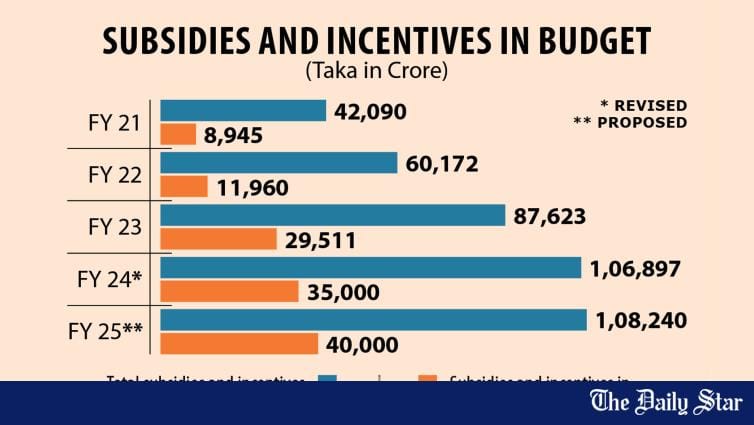
More than a third of the subsidies allocated in the new budget is for the power sector due to what experts say is the huge spending on capacity charges.

The large sum of subsidy has raised eyebrows as the government increased electricity prices several times since January last year.

Currently, the power generation capacity is around 26,000 megawatts while the highest generation was recorded at 16,477MW on April 30 this year.

Finance Minister AH Mahmood Ali in his budget speech said 27 power plants with a combined capacity of 9,144MW were being constructed.

All sectors combined, subsidy allocation for the fiscal 2024-25 is Tk 108,240 crore, of which the power sector will get Tk 40,000 crore, or 37 percent of the total.

In the current fiscal year, the power sector got Tk 35,000 crore of the total Tk 106,897 crore subsidy.

For many years before 2021-22, subsidies for the sector used to be between Tk 7,000 crore and Tk 9,000 crore.

To read the rest of the news, please click on the link above.
 
Analyze

Analyze Post

Add your ideas here:
Highlight Cite Respond
  • Like (+1)
Reactions: Bilal9

Power Grid gets large sums as govt prioritises transmission, distribution

1717891391295.webp


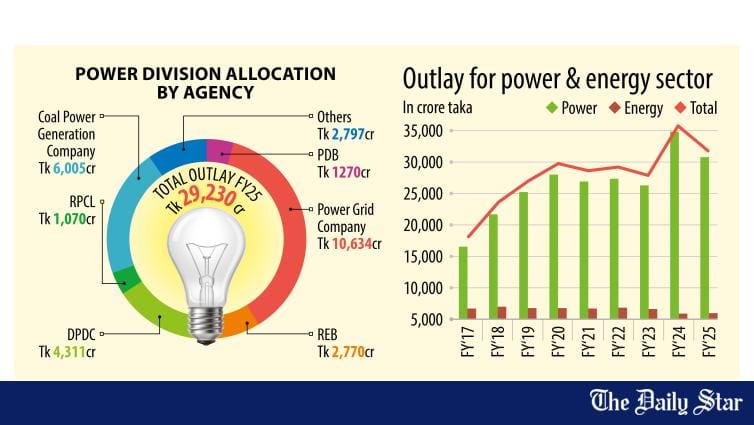
Around a third of the budgetary allocation set aside for the power division is going to the Power Grid Company of Bangladesh (PGCB) as the government plans to make the most of installed generation capacity by expanding grids and making some of the existing facilities smart.

The finance minister has set aside Tk 29,230 crore for the power division for 2024-25, down 13 percent year-on-year. PGCB will get Tk 10,634 crore.

Coal Power Generation Company of Bangladesh, which is implementing the Matarbari power plant in Cox's Bazar, received the second-highest allocation.

Centring the power plant project, PGCB is implementing several projects in Chattogram, upgrading grids. It has received Tk 1,500 crore to carry out the tasks.

The Barapukuria-Bogura-Kaliakair 400kv project has been given Tk 2,356 crore and the power evacuation facilities project Tk 646 crore.

Among the PGCB's schemes, the highest Tk 3,555 crore has been earmarked for the Power Network Strengthening project, which started in 2016.

In Bangladesh, the power generation capacity increased to 30,277 megawatts in 2023-24 from 4,942 MW in 2009, said Finance Minister Abul Hassan Mahmood Ali in his budget speech.

Currently, 27 plants with a combined capacity of 9,144 MWs are under construction. Most of them are in the private sector.

To read the rest of the news, please click on the link above.
 
Analyze

Analyze Post

Add your ideas here:
Highlight Cite Respond
  • Like (+1)
Reactions: Bilal9

The absurdity of subsidies in power sector
Squandering of funds in the name of capacity charges must stop

1717976677548.webp

VISUAL: STAR

In a frustrating if predictable move, the government has once again allocated a third of the budget for subsidies to the power sector, an overwhelming majority of which will be used to pay off capacity charges. It seems no amount of expert logic, public outrage, or even IMF prescriptions can discourage the government from wasting public funds on paying private power plants to sit idle. It has already spent more than Tk 1 lakh crore in capacity charges over the last 14 years. Research by the Centre for Policy Dialogue (CPD) reveals that capacity payments have skyrocketed from Tk 5,600 crore in 2017-18 to a staggering Tk 32,000 crore in the outgoing fiscal year, accounting for a whopping 81 percent of total subsidies in the power sector.

Instead of bringing down capacity charges as a matter of priority, the government is constructing an additional 27 power plants, which can only translate to a further increase in capacity charges in the coming year(s). What's more outrageous is that the government has decided to raise power tariffs three to four times a year apparently to lower subsidies over the next three years. Electricity prices were raised by 8.5 percent in February this year, and thrice by 5 percent each last year. Why is the public being asked to pay higher prices in the name of reducing subsidies when, in fact, the government is increasing subsidy allocation in the power sector—from 32 percent of the total allocation last year to 37 percent in the proposed budget?

As always, it is the people who are being unfairly tasked with absorbing the burden of chronic mismanagement, collusion, and corruption in the power sector. This is simply unacceptable, particularly given that the government does not seem to be taking any visible steps to address the root causes of high production costs—a lack of transparency and accountability in awarding contracts, overreliance on expensive imported fuels, and neglecting domestic gas exploration and renewable energy sources. Subsidies make sense when they ensure cheaper and more accessible services and amenities to the public, not when they prop up big business groups at enormous cost to the country and ordinary citizens.

To read the rest of the news, please click on the link above.
 
Analyze

Analyze Post

Add your ideas here:
Highlight Cite Respond
  • Like (+1)
Reactions: Bilal9

Latest Posts

Back
PKDefense - Recommended Toggle