☕ Support Us
[🇧🇩] - Energy Security of Bangladesh | Page 42 | PKDefense

[🇧🇩] Energy Security of Bangladesh

Reply (Scroll)
Press space to scroll through posts
G Bangladesh Defense
[🇧🇩] Energy Security of Bangladesh
493
15K
More threads by Saif


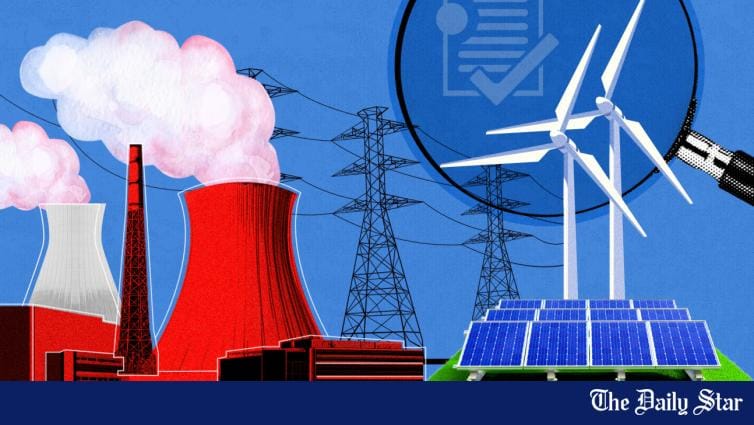
Transforming power sector for net zero
Shahriar Ahmed Chowdhury 08 January, 2025, 00:00

1736296575972.webp


AS 2025 dawns, Bangladesh is shaping up its commitment to cut emissions under the Paris Agreement. While the South Asian country is trying to bring its economy and governance back on track, the moment is ripe to drive a major reorientation in the country’s energy and power sector. Reforms are critical in this particular sector as its future pathway will have enormous consequences for our economy, environment and governance.

The needed shift involves transitioning from a fossil fuel-based energy mix to a green, renewable-based system. The economic case as well as the environmental rationale behind such a shift is indisputable. While Bangladesh has multiplied its power generation capacity over the years, surpassing the demand, the subsidies have become a drain on the national exchequer. Bangladesh has provided more than Tk 1,50,000 crore ($12.61 billion) as a subsidy to the power sector in the last decade — mainly due to poor planning and a faulty fuel mix.

At present, about 25 per cent of our electricity generation capacity and 12 per cent of total generation come from liquid fuels. The cost of power from these liquid fuel-based power plants is more than Tk 25 ($0.21) per unit, whereas the Bangladesh government sells bulk power at Tk 7 ($0.0588) per unit, marking a huge gap that is being met by subsidies. Moreover, the government has to pay the power producers an agreed amount of ‘capacity payment’ even when the power plants sit idle. The high costs of imports, the subsidy burden and the exorbitant capacity charges all make liquid fuel-based power an all-too-costly option for Bangladesh, in addition to their negative environmental footprint.

Renewable energy sources with adequate storage capacity could help Bangladesh get rid of a significant share of the costly liquid fuels. Solar and wind are proven to be the best renewable energy solutions for Bangladesh, with particular potential in the southern part of the country. All the studies show that solar photovoltaic technology will be the cheapest and largest contributor to electricity in the future for the whole world.

But for making that transition, three key bottlenecks — grid, incentives and policy — need to be urgently addressed.

Strong, smart, regional grid

A STRONG and smart grid infrastructure is essential for energy transition, whereas Bangladesh has a weak grid infrastructure for power evacuation. Vested interests often argue that liquid fuel-based plants are indispensable in light of the low voltage problem. We should instead ask the question: Did we delay enhancement of transmission infrastructure to support the liquid fuel plants?

With more variable renewable energy variable renewable energy being injected, grid stabilisation is a concern. Our grid flexibility study shows that we can have up to 20 per cent VRE without power cuts or hampering the grid stability significantly.

With a high-voltage transmission network, smart grid and energy storage, we can easily eliminate the grid-related problems.

Moreover, connecting with the regional grid will increase the flexibility of the national grid. Considering the current geopolitical situation, it is challenging to realise regional connectivity, but we should keep working. Apart from increasing the grid flexibility, the regional grid will support optimising the regional renewable energy potential.

Incentivising energy transition

HEAVY duties hinder the growth of solar photovoltaic in Bangladesh, which is becoming the cheapest source of electricity the world over. There is an 11 per cent import duty on solar panels, 38 per cent on inverters and 58 per cent on mounting structures and lithium batteries. There is a compelling case why these duties should be waived:

Bangladesh receives around Tk 50 crore ($4.20 million) as import duty from a 100MW solar photovoltaic equipment, which is a pittance compared to our present annual subsidy worth Tk 40,000 crore ($3.36 billion), going mainly to fossil fuel. A 100MW solar photovoltaic system will produce 2.4 TWh of electricity in its project life of 20 years. To produce the same amount of electricity from diesel, we need Tk 6,000 crore ($504.20 million) worth of diesel or Tk 4,000 crore ($336.13 million) worth of furnace oil or Tk 1,000 crore ($84.03 million) worth of coal at current market prices. Waiving import duties on imported solar PV equipment could help us replace the need for importing so much fossil fuel with our hard-earned foreign currency. Such a waiver would only be fair since fossil fuel-based power plants enjoyed duty-free import of equipment and 15 years of tax holidays in the past.

Other countries are sparing no means of incentivising renewable energy growth. Take the case of Vietnam, for example. The Southeast Asian country installed around 9,000MW of solar photovoltaic systems in 2020 alone, mainly from rooftop systems, by giving incentives in the form of feed-in tariffs. If this is not possible for us, we can consider other incentives.

We should inspire and allow all consumers, irrespective of phase or voltage level, to avail themselves of the facilities of the net energy metering guideline, including the 132kV and 230 kV consumers who are currently barred from net energy metering connection. The net energy metering guideline should include the following benefits: like the independent power producers, OPEX operators of net energy metering systems should enjoy tax holidays; the capacity limit of the net energy metering systems should be updated to its sanctioned load instead of 70 per cent of the sanctioned load; prosumers should be allowed to install RE systems at any part of the country and use electricity by providing a wheeling charge to the utilities; and industries inside the economic zones and export processing zones are not allowed to avail the benefits of net energy meterings. The economic zones and export processing zones now purchase power from utilities and sell it to the industries inside while keeping a certain profit margin. Rather than holding onto this profit, the zone authorities could get wheeling charges from the net energy metering users that could partly compensate for their current earnings from the current arrangement.

Enabling policies and ambitions

EVIDENCE-BASED and coherent policy will send a clear signal to investors, the industry and the citizens alike about the ambition, speed and modalities of Bangladesh’s energy transition. We should revise our policy documents to have coherent targets for renewable energy. The existing integrated energy and power master plan, IEPMP, which is replete with flaws like estimation of future power demand, lack of genuine renewable ambitions and promotion of questionable solutions, must be thoroughly revised.

In 2019, the UN Development Programme drafted a national solar energy roadmap and in the high case scenario, 30,000 MW solar photovoltaic capacity development by 2041 was recommended. This roadmap was not approved. We can revisit this document and with necessary revisions, we may approve it so that we can have a concrete, ambitious target. We should prepare a similar document for wind.

The plans and policies should also clarify how we will solve the land scarcity challenge. For example, each ground-mounted solar project should have a mandatory plan for other uses of land beneath it. Moreover, the policies should spell out enabling provisions like developing solar power hubs and transmission infrastructure up to the hubs that could significantly reduce the costs.

The last but no less important point is to stress on energy conservation and achieving energy efficiency, which is far easier than generating new power, while being a key pillar to achieving our net zero targets.

The energy and power sector lays the foundation for achieving Bangladesh’s economic aspirations as well as delivering better governance. Achieving a green and inclusive energy transition is essential for Bangladesh, a leader of the global south in global climate actions. No fossil fuel-based plants anymore — support renewables for our clean and green future.

Md Shahriar Ahmed Chowdhury is the founding director of the Centre for Energy Research at United International University.​
 
Cite Fact Check Highlight Respond

Payra thermal power plant resumes full production
Test runs of neighbouring facility nearly complete

1736380202578.webp


A partial view of Payra port in Patuakhali district. With capital dredging works of Ramnabad channel now complete, only the construction of the first terminal remains for Payra port to become the third fully operational seaport in Bangladesh. PHOTO: Sohrab Hossain

The Payra 1,320MW Thermal Power Plant in Kalapara upazila of Patuakhali has resumed full production following a roughly two-month halt for maintenance works on its second unit and test runs of a neighbouring facility.

Upon completing maintenance works, which began on November 9 last year, the authorities began generating electricity from the second unit of the coal-fired power plant at around 9:30pm on Tuesday.

Now, the plant is supplying its full 1,320-megawatt (MW) capacity to the national grid, according to Shah Moni Jico, assistant manager of the Payra plant.

Meanwhile, the first unit of a neighbouring facility with an identical power generation capacity run by RPCL-NORINCO International Power Limited (RNPL) has been undergoing experimental production since mid-January this year.

As such, the first unit of the Payra plant had also been shut down for a week starting December 16.

The second unit of the new plant, which is located just two kilometres north of the Payra plant, is scheduled to begin production this June.

And with its first unit almost commissioned, the facility will have a total power generation capacity of 1,320MW in full production, thereby meeting 10 percent of the country's demand.

Construction of the RNPCL Thermal Power Plant in Londa village under Kalapara began in 2019. However, the facility was unable to commence production as planned last year for various challenges.

The commissioning of its first unit, which has a power generation capacity of 660MW, will likely be complete within the second week of January, said Mohammad Ashraf Uddin, superintendent engineer of the plant.

He informed that all construction works, including that of the power transmission line and coal transport jetty, are now complete.

The first unit is undergoing trial production, with commercial production expected to begin in March.

Shawkat Osman, executive engineer (mechanical) of the RNPCL power plant, said 1.25 lakh tonnes of coal have been stored at the facility to ensure its uninterrupted production once fully operational.

He added that another 1.65 lakh tonnes of coal is expected to arrive this month.

Osman further said that the cost of each unit of electricity generated by the plant is estimated at Tk 9.

Yang Ling, commercial manager of the RNPCL power plant, assured that the facility was built in compliance with global standards.

"It will use the latest ultra-supercritical technology and is designed to operate without causing harm to the environment," he said.​
 
Cite Fact Check Highlight Respond

INDUSTRIAL, CAPTIVE GAS SUPPLY: Gas price hike of up to 152pc proposed
Emran Hossain 09 January, 2025, 00:23

1736382110233.webp


Industrialists say hike to raise production cost

The Bangladesh Energy Regulatory Commission is evaluating a Petrobangla’s proposal to increase by up to 152 per cent the price of gas supplied to industries and captive power plants.

Now a decision on the state-owned agency’s proposal seeking to set the gas price for the two consumer categories on per with imported liquefied natural gas price is due to come by the first half of March.

The decision will come through a public hearing — such hearing has not held since 2023 after the Awami League government ousted amid a mass uprising on August 5, 2024 had curtailed the BERC’s authority to set energy tariffs.

The prospect of the gas price hike angered industrialists who likened the price hike move to following in the footsteps of the past fascist government: trying to solve problem by increasing price arbitrarily.

Industrialists warned that the gas price hike would raise production costs, eventually impacting ordinary people. Production costs would particularly increase in some industries, such as steel, ceramics, glass, and textiles, whose production is directly reliant on gas, they said.

‘BERC’s technical evaluation will complete in about 20 days,’ said Khalilur Rahman Khan, secretary of the BERC.

The public hearing will be held based on the findings of the technical evaluation committee, he said.

The price increase proposal has been approved in principle by the power, energy and mineral resources ministry. The proposal sought the per unit gas price supplied to industries to be increased by more than 152 per cent to Tk 75.72 from existing Tk 30. Per unit gas price for captive power generation has been proposed to be increased by 140 per cent to Tk 75.72 from existing Tk 31.50.

The ousted AL government increased the gas price for four consumer categories, including industry, by up to 179 per cent in January 2023.

In its proposal sent to the BERC, the Petrobangla argued that the gas price needs to be raised to increase its supply from both domestic and import sources to reduce the widening gap between the demand and the production, the same justification used by the past AL government for frequently increasing gas price.

The current gas price was calculated considering LNG import of 1,000mmcfd. But the past government never imported that much of LNG, leaving industries and households depending on gas supply in a serious crisis.

‘This is definitely not the right time to increase energy price,’ former Dhaka Chamber of Commerce and Industry president Abul Kasem Khan told New Age, referring to the slowing down of the country’s economic growth.

Struggling to recover from the Covid pandemic impact, coupled with the dollar crisis and staggering inflation, he said, many industrialists were considering closing down their businesses.

‘Gas is an important raw material and energy source. We are losing competiveness daily. Price hike will block future industrial expansion as well,’ he said.

Bangladesh began importing LNG on August 19, 2018. Until November past year, the average LNG import was 579mmcfd. In 2023-24, the highest annual LNG import of 676mmcfd was recorded. The import dropped a little in 2024-25. The current LNG import capacity is 1,000mmcfd.

A technical evaluation of the BERC revealed in March 2022 that the Petrobangla pocketed Tk 2,538 crore by importing 553mmcfd less LNG than promised in the financial years 2019-20 and 2020–21.

The Petrobangla in its latest proposal estimated that the deficit from selling gas in less than its production price would exceed Tk 16,162 crore if 101 LNG cargoes are bought. The deficit would reach Tk 22,315 crore next financial year if 115 cargoes are bought, the estimation said.

Any new gas connection seekers in industries and captive power plants would have to pay the new price for their entire supply, the Petrobangla proposed.

Those who were promised gas connection but are yet to get it would have to pay the new price for half of its sanctioned load while the rest half of the load could be bought with the previous price, the proposal said.

Existing gas consumers would have to pay the new price if their consumption surpasses sanctioned load, the proposal said.

Businesses said that existing industrial consumers receiving gas more than their sanctioned load sounded like an unreal proposition to many. Industries complain about gas pressure in their pipeline falling nearly zero, they said. In Gazipur area, some industries regularly complain about gas pressure dropping to one to two PSI against the supposed 150.

Captive power production price hike would also contribute to increasing industries production cost, businesses said, adding that industries produced their own power because of unreliable national grid.

Bangladesh Textile Mills Association president Showkat Aziz Russell told reporters on Wednesday that the decision to sell gas at import price would be detrimental to the country’s industries.

Calling the move absurd, particularly because it came without consulting business communities, Russell said that people were expecting energy price to go down after the interim government assumed power through the people’s movement.

If the proposed gas price is approved, the gas price in industries would increase to Tk 75.72 from Tk 16 set in January 2023.

Bangladesh’s current gas demand is about 4,000mmcfd, but the supply remains below 3,000mmcfd. In 2023-24, the average gas supply was 2,493mmcfd. The approved load is 5,356mmcfd.

The piped gas is a blended supply of locally extracted natural gas and imported LNG. Imported LNG accounts for a fourth of the supply. The Petrobangla predicted in its proposal that the share of LNG in the piped gas supply would rise to 75 per cent by 2030-31.

The cost of per cubic metre of imported LNG ranges between Tk 65 and Tk 70.

Bangladesh’s local gas supply is ensured by three state-owned companies and two international oil companies. Piped gas is supplied through six distribution companies.

Two companies are currently regasifying LNG imported through long-term contracts and spot market purchases. About three-fourths of the import comes through long-term contracts.

Three new LNG terminals, including a land-based one, at different stages of development, were cancelled after the interim government assumed power since the development work was won without tender.

Bangladesh cannot drastically increase its import unless new LNG handling capacity is built. New LNG handling capacity is currently at a very preliminary stage.

According to a United News of Bangladesh report: commerce adviser Sk Bashir Uddin has described the move to raise gas price from Tk 30 to Tk 75 per cubic metre as ‘unpleasant yet unavoidable’.

‘The decision to raise gas prices is not a pleasant one for the government. However, it is necessary. The adjustment will be carried out through the Bangladesh Energy Regulatory Commission after discussions with entrepreneurs,’ he said on Wednesday.

Speaking at the inauguration of GAPExpo-2025 at the International Convention City Bashundhara in Dhaka, the adviser acknowledged the challenges posed by the price hike.​
 
Cite Fact Check Highlight Respond

Low gas supply for three days from today
Staff Correspondent 10 January, 2025, 00:11

1736468107738.webp


The piped gas supply will decrease across the country, state-owned oil company Petrobangla said in a notice issued on Thursday, warning about a low pressure in the piped gas supply for 72 hours starting today noon.

This is the second time in less than two weeks the same floating storage and regasification unit is going offline for maintenance, triggering the gas crisis.

Petrobangla officials said that the maintenance of the FSRU owned by Excelerate Energy was not scheduled.

The FSRU remained out of operation between January 1 and 3, further worsening Bangladesh’s energy crisis.

The imported liquefied natural gas supply will be 550-560 mmcfd over the three days of maintenance, the Petrobangla notice said.

On Thursday, the LNG supply was 780.8mmcfd.

LNG accounts for a fourth of piped gas supply. After import, LNG is blended with locally extracted natural gas before being distributed through the national grid. Gas accounts for 60 per cent of Bangladesh’s primary energy consumption.

For a 100mmcfd drop in gas supply, electricity production may reduce by 500MW. The current power demand of the country is about 10,000MW and there is officially no load shedding at the moment.

The impending drop in the gas supply frustrated yet again households and industrialists who have been complaining about receiving far less gas than they paid for over the years, consumers said.

They said that many households were buying food from restaurants despite paying the government for gas and housemaids for cooking.

Many households are spending extra on using liquefied petroleum gas or using electricity for cooking, they said.

Industrialists, on the other hand, are reducing their production to cope with the situation.

Some areas in and adjacent to the capital Dhaka have recently complained about gas supply falling to near zero.

Excelerate Energy began operating Bangladesh’s first FSRU with the current handling capacity of 60mmcfd on August 19, 2018. LNG import through the FSRU at Moheshkhali was disrupted for months during the monsoon in 2018.

The other FSRU, Summit LNG Terminal, remained offline in six months of the first nine months of 2024.

The Summit-owned floating storage and regasification unit was on routine maintenance in Singapore between January 22 and March 31. It shut down again on May 24 after the cyclone Remal hit. The unit could not be reconnected until September 11, prompting the government to cancel four LNG shipments. LNG deliveries to the terminal resumed on September 19.

In 2021, the Summit LNG terminal was out of service for three months due to a damaged mooring line.

In May 2023, Cyclone Mocha shut down both the FSRUs.

Both the LNG import terminals have a contract to receive about $5,00,000 every day as regasification charge, not subject to the actual amount of gas handled.​
 
Cite Fact Check Highlight Respond

Govt floats tenders to purchase two more spot LNG cargoes in Feb
FE ONLINE REPORT
Published :
Jan 09, 2025 19:24
Updated :
Jan 09, 2025 19:26

1736469724139.webp


Bangladesh’s state-run Rupantarita Prakritik Gas Company Ltd (RPGCL) has floated a fresh tender and re-issued another to purchase two spot LNG cargoes for February 13-14 and February 06-07 delivery windows, respectively.

The RPGCL re-issued the tender for one spot LNG cargo for the February 6-7 delivery window after cancelling the previous one due to higher-than-expected price quotes, nearing around US$16 per million British thermal units (MMBtu) from the bidders, said an official.

The bid winners will deliver the LNG cargoes to Moheshkhali Island in the Bay of Bengal, with options to discharge the cargo at either of the country’s two FSRUs (floating storage regasification units) located on Moheshkhali Island.

RPGCL, a wholly owned subsidiary of the state-run Bangladesh Oil, Gas, and Mineral Corporation (Petrobangla), handles LNG trades in Bangladesh.

The two tenders were floated on January 8, with the bid submission deadline ending on January 13.

The volume of each spot LNG cargo will be around 3.36 million MMBtu.

Bangladesh last awarded a spot LNG cargo tender to Excelerate Energy LP of the USA for the January 30-31 delivery window at US$15.69 per MMBtu, the RPGCL official said.

Apart from spot LNG cargoes, Bangladesh has been importing LNG from its two existing long-term suppliers—Qatargas and OQ Trading International—for regasification in its two operational FSRUs.​
 
Cite Fact Check Highlight Respond

AL-APPROVED POWER PROJECTS: Govt still pays high capacity charge
Emran Hossain 11 January, 2025, 00:08

1736553124185.webp


Some of the power projects approved without tender by the Awami League regime ousted in August 2024 continue to receive excessive capacity charge, up to 73 per cent more than what they should get, according to a Bangladesh Power Development Board analysis.

The capacity charge entitlement is itself a controversial arrangement that allows power and energy sector investors handsome profits based on their investment, rather than on the quality of their service.

The capacity charge is an amount of money, often paid in dollars, guaranteed to be paid by the government irrespective of power plants producing power or floating storage and regasification units supplying gas.

Explaining how the past AL regime channelled public money into private pockets through the power sector, energy experts said that the BPDB analysis also highlighted the lack of initiatives on the part of the interim government to take steps against the companies making predatory profits.

The power sector had also turned into a key window to launder money, they said.

The interim government that took office after the ouster of AL regime on August 5, 2024 cancelled the special power act under which the past government had approved power plants without tender, but the interim government did not take any actions against the power plants in operation, saying that taking action against the power plants would be difficult.

The BPDB analysis compared capacity charge expenses in six furnace-oil based power plants – three of them set up competitively, through bidding, while the other three were built without tender.

The contracts for building the power plants, with their installed capacity ranged between 100MW and 163MW, were awarded between April 2017 and February 2018. They began commercial operation between November 2018 and September 2022 for 15 years.

The power plants installed through bidding are 163MW B-R Powergen, jointly owned by the BPDB and the Rural Power Company Limited, 105MW RPCL, owned by the Bangladesh Rural Electrification Board, and 149MW ACE Alliance Power Limited, 64 per cent of which owned by Summit Power.

The power plants installed without tender are 104MW Orion Power Sonargaon Limited, 113 MW Confidence Power Bogura Unit-1 Limited and 100MW Acorn Infrastructure Services Unit-3 Limited.

After comparing the construction costs, the BPDB analysis said that the installation costs of the two publicly-owned power plants were about $8 lakh per MW. State-owned power plants generally cost more than private power plants to be built. The analysis also considered equal returns on equity, LIBOR and fixed interest rate for all the power plants.

Built with a government loan, the power purchase agreement of B-R Power Generation Limited allowed $5.22 as capacity charge per MW per month, which could have been $8.37 per MW/month if the power plant got set up with commercial loan, the BPDB analysis showed.

The PPA of RPCL, built with commercial loan, allowed $8.35 as capacity charge per MW/month, which was less than what should be the actual capacity charge of such a power plant — $8.44 MW/month, the analysis said.

Of the power plants, Ace Alliance Power Limited secured a PPA allowing $8.81 MW/month as capacity charge, 10 per cent higher than the rate should be — $7.99 MW/month, according to the analysis.

Confidence Power’s PPA secured a capacity charge of $13.79 MW/month, which is 73 per cent higher than what the actual rate should be — $7.99 MW/month, the BPDB analysis said.

The PPA of Acorn Infrastructure Services allowed capacity charge payment of $12.75 MW/month, 60 per cent more than the reasonable rate of $7.99 MW/month.

Orion Power has a PPA with capacity charge entitlement of $12.64 MW/month, 58 per cent higher than the reasonable rate of capacity charge of $7.99 MW/month, the BPDB analysis revealed.

‘The same picture would have been found with all other power projects taken under the special power act without tender during the past AL regime,’ said Hasan Mehedi, member secretary of the Bangladesh Working Group on Ecology and Development, a coalition of green activists.

‘The lack of initiatives on the part of the interim government to stop paying such excessive capacity charges is a matter of concern,’ he said.

The AL government had approved more than 100 power projects after assuming power in 2009 under the Quick Enhancement of Electricity and Energy Supply Act, scaling up its installed power generation capacity to about 28,000MW, excluding 2,800MW of captive power capacity, in 2024 from about 5,000MW in 2009.

The power deals signed under the special act accommodated conditions discriminatory to Bangladesh and it remained entirely out of public notice for the deals were never made public, not even after the new government took office.

Energy experts had criticised the special act, often labelling it as the tool to transfer public money into private pocket, eventually leading to the dollar and economic crises that hit the country more than two years ago.

The BPDB said that the past AL government spent $32 billion only in the power sector before its ouster amid a student-led mass uprising.

Former state minister for power Nasrul Hamid told parliament in September 2023 that his government paid Tk 1.04 lakh crore to 82 independent and 32 rental power producers as capacity charge in the past 14 years.

RPCL and Bangla Trac, the owner of Acorn Infrastructure Services, were among the top 10 capacity charge receiving independent power producers with Tk 4,004.08 crore and Tk 1,853.22 crore received over the 14 years, respectively, Nasrul had said.

Two companies of Summit Power, partial owner of ACE Alliance Power, also found places on the list of top 10 capacity charge receiving IPPs with Tk 3,644.39 crore and Tk 2,683.03 crore earned as capacity charge over the 14 years.

Acorn Infrastructure Services was also among the top 10 rental power companies which had received Tk 1,484.30 crore over the 14 years in accordance with the government account.

Confidence Group was ranked sixth among a dozen IPPs listed as the ‘dirty dozen’ in a 2022 study released in March by the BWGED. The combined capacity of the ‘dirty dozen’ was 29.7 per cent of the then installed capacity and they accounted for 32.7 per cent of electricity generated in 2020-21. But the ‘dirty dozen’ received 66.4 per cent or Tk 8,730.14 crore of the capacity payment made in the financial year.

Rental power plants were introduced immediately after the AL assumed power as an immediate measure to tackle power shortages and were supposed to expire in a maximum of five years. But the past government continued to retain them, allegedly for paying huge sums to its favourites.

BD Rahmatullah, a former director general of the Power Cell, a regulatory agency under the power, energy and mineral resources ministry, said that those who had pulled the strings during the past AL regime still got to call the shots.

‘This is frustrating to see that the interim government fails to take initiative to change the system established by the past AL government,’ he said.

The power and energy adviser, the power secretary and the BPDB chairman could not be reached for comments on the issue over phone despite several attempts.​
 
Cite Fact Check Highlight Respond

Energy ministry order allowed United Power to make excessive profits
Emran Hossain 11 January, 2025, 00:13

About four and a half months before a student-led mass uprising overthrew prime minister Sheikh Hasina, the energy ministry in an order sealed the deal on making excessive profits by the United Power, a private power generation company.

Sheikh Hasina also held power, energy and mineral resources portfolio then.

Dated March 25, 2024, the order said that the United Power’s two power plants in the Dhaka and Chattogram export processing zones would receive gas at the independent power plant (IPP) rate for electricity generation supplied to the national grid and Bangladesh Export Processing Zones Authority.

The order went against a February 8 Supreme Court order that settled that the two power plants would pay the IPP rate for gas used for producing electricity supplied to the national grid and the captive rate for gas used for generating electricity commercially sold.

The ministry order immediately guaranteed the United Power an additional profit of Tk 4.61 per kWh besides its regular margin from selling electricity produced at the plants, according to a Bangladesh Power Development Board analysis.

The tariff of per unit electricity, generated using gas at the IPP rate of Tk 15.50 a unit, is Tk 6.41, as per the notification issued by the Bangladesh Energy Regulatory Commission on May 14. The tariff is far less than what the United Power gets by supplying per unit of electricity under a contract signed with BEPZA, Tk 11.03.

The contract with BEPZA was signed in May 2007, allowing the power plants to sell electricity to clients in the export processing zones.

Commercial power producers are supposed to pay the captive rate for gas, which is Tk 30.75 a unit.

The IPP rate is meant for independent power plants who supply electricity to the national grid and are not allowed to privately sell electricity.

Electricity supplied through the national grid is all bought by the BPDB. The power sector is highly subsidised. A quarter of the supply of gas to the power sector comes via import as liquefied natural gas. A unit of LNG costs over Tk 60.

The annual power sector subsidy has recently crossed Tk 30,000 crore.

The order of the energy ministry is reminiscent of the arbitrary use of power by the past government to benefit its cronies, according to experts.

Almost all power and energy deals that the Hasina government allowed over the 14 years since 2010 had come through without bidding, mostly through one-to-one negotiation, under an indemnity law that the interim government has recently cancelled, they said.

The past government also striped the Bangladesh Energy Regulatory Commission of its power to set tariffs in December 2022. The BERC got back the tariff-setting power after the interim government took office on August 8.

The white paper on Bangladesh’s economy submitted recently to the interim government cited the United Group as the past AL government favourite raking abnormal profits by running its power plants in the export processing zones.

Initially, the United Power’s two power generation units used gas at the captive rate, which the company stopped paying in 2009 after the AL government assumed power. The plants with a combined capacity installed generation capacity of 164MW started commercial operation in 2008 and 2009.

Authorities, however, did not raise any objection over the United Power switching to the IPP rate, until in 2018, demanding that the company pay separate prices for electricity sold to the BPDB and private industries.

A prolonged legal wrangle ensued when the United Power went to the High Court challenging authorities’ demand for separate rates. The legal battle ended with the review of the Appellate Division order in February 2024 that went against the United Power.

United Power’s dues to state-owned Titas Gas Transmission and Distribution Company Ltd rose to Tk 486 crore by October 2024 as the company paid less than it should be for gas supplied by the Titas.

The company commercially producing power was not supposed to receive the gas in the first place, considering the 2008 policy, which spoke against supplying scarce national resources such as gas to commercial entities. The policy requires commercial power producers to arrange for their own energy.

The United Power that purchased gas for Tk 988 crore between 2017–18 and 2023–24, earned Tk 3,799 crore from electricity sales. The company enjoys monopoly at the export processing zone in its power business.

An analysis by the Bangladesh Working Group on Ecology and Development revealed that 23 per cent of the power produced between 2017–18 and 2023–24 was supplied to the national grid, while the rest went as a commercial supply to BEPZA.

In the past year, the plant factor at the CEPZ power plant was 76 per cent, following the DEPZ power plant running at 54 per cent capacity.

The United Power in the past year declared 20 per cent profit. Its profit stood at 74 per cent in 2018, followed by similar profits made in 2016 and 2017. In the other years, since 2013, the company has reported 50 per cent or more profit.

Since 2011, the United Power has set up seven more power plants — all IPPs — with installed generation capacity of 1,041MW.​
 
Cite Fact Check Highlight Respond

Members Online

Latest Posts

Latest Posts