Home Watch Videos Wars Movies Login

[🇧🇩] Energy Security of Bangladesh

[🇧🇩] Energy Security of Bangladesh
522
17K
More threads by Saif

G Bangladesh Defense

Energy giants' tax arrears hit revenue drive, expose deep governance gap
State firms clear imported fuel on credit, while private importers pay duties upfront


REZAUL KARIM
Published :
Feb 08, 2026 08:45
Updated :
Feb 08, 2026 08:45

1770597117126.webp


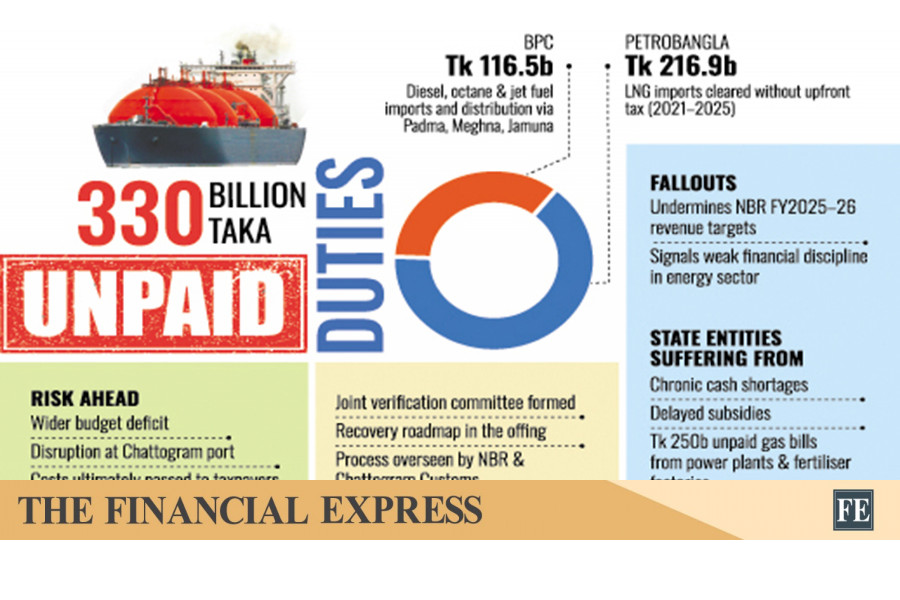
The revenue collection effort has suffered a major blow as two state-owned energy giants, Bangladesh Petroleum Corporation (BPC) and Petrobangla, have accumulated more than Tk 330 billion in unpaid import duties and taxes.

The mounting arrears have raised serious concerns within the National Board of Revenue (NBR) as it struggles to meet its fiscal targets for the current year, officials said.

Beyond the immediate revenue loss, they said the scale of the defaults has highlighted deeper weaknesses in financial discipline and governance within the energy sector, prompting warnings that unchecked liabilities could spill over into the broader economy and ultimately burden taxpayers.

The alarming figures were disclosed at a high-level coordination meeting held recently at the Chattogram Custom House.

Special Envoy to the Chief Adviser Lutfey Siddiqi attended the session, where customs officials warned that the unchecked growth of these arrears is severely undermining the NBR's revenue targets for the current fiscal year (FY2025-26).

According to records presented at the meeting, Petrobangla alone accounts for more than Tk 216.90 billion in liabilities.

These dues stem from liquefied natural gas (LNG) consignments released between 2021 and 2025 without prior payment of mandatory duties and taxes.

Similarly, BPC has defaulted on Tk 116.47 billion in duties related to refined petroleum products, including diesel, octane and jet fuel, imported through its subsidiaries Padma, Meghna and Jamuna oil companies.

Customs officials expressed strong reservations over the long-standing "provisional release" facility extended to state entities.

They pointed out a stark disparity: while private-sector importers are required to pay every taka in duties before goods are cleared, public corporations continue to operate on a credit-based system at the expense of the national exchequer.

"The failure to realise these dues is choking the NBR's annual collection drive and sending a dangerous signal of impunity," a senior official involved in the issue remarked.

Defending their position, a senior Petrobangla official attributed the mounting liabilities to chronic liquidity shortages.

He cited delayed government subsidies and large unpaid bills from other state-run entities, particularly power plants and fertiliser factories, which reportedly owe the gas utility more than Tk 250 billion, creating a vicious cycle of inter-agency defaults.

To contain the fiscal damage, the meeting resolved to form a joint verification committee tasked with reconciling the disputed figures and drafting a binding recovery roadmap.

Chattogram Customs Commissioner Mohammed Shafi Uddin is expected to oversee the reconciliation process under the direct supervision of the NBR.

According to meeting minutes, the commissioner has already held discussions with both state-run organisations, stressing the urgency of recovering the outstanding duties and taxes from BPC and Petrobangla.

Officials warned that without swift settlement, these ballooning liabilities could significantly widen the national budget deficit and disrupt routine import operations at the country's premier seaport, eventually shifting the burden onto the general taxpayer.​
 
Analyze

Analyze Post

Add your ideas here:
Highlight Cite Respond

Energy Advisor Fouzul says final decisions on power, energy sector graft left to next government

bdnews24.com
Published :
Feb 08, 2026 23:28
Updated :
Feb 08, 2026 23:28

1770597298359.webp


Energy Advisor Muhammad Fouzul Kabir Khan has said the interim government has sent documents and information on corruption in the power and energy sector to the relevant authorities, leaving final decisions on the matter to the next government.

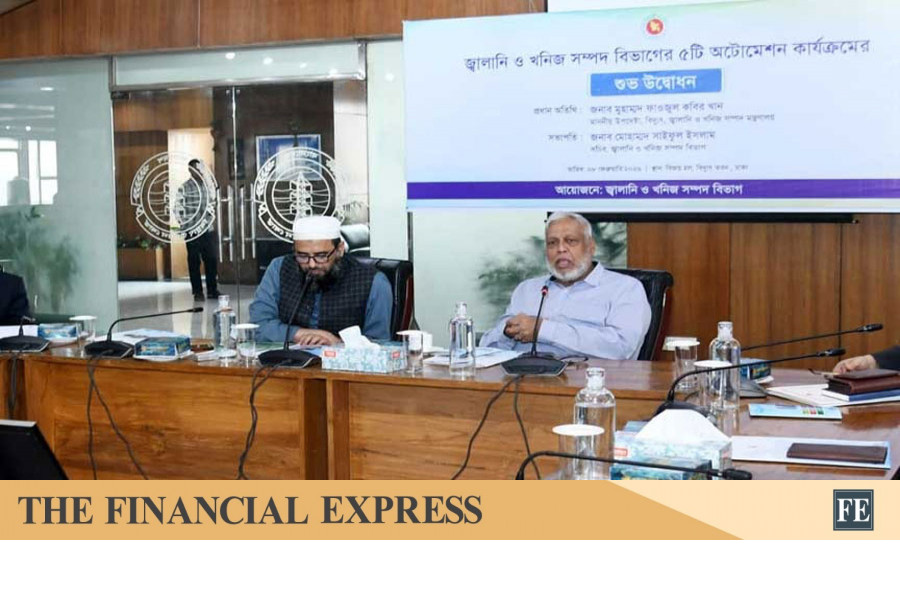
He spoke to reporters on Sunday evening at the Bidyut Bhaban in the capital after inaugurating five apps for the Energy Division.

“Investigating graft and taking punitive action are not within our mandate. There are separate agencies for that, including the Anti-Corruption Commission. However, wherever assistance has been sought from us, we have provided the necessary documents, information, and evidence,” he said.

Referring to the national committee that reviewed contracts and decisions in the power and energy sector taken during Sheikh Hasina’s government, he said the committee submitted its findings within the deadline.

“Due to time constraints, we have left its implementation to the next elected government,” he said.

The energy advisor said many investment initiatives and reform programmes in the power and energy sector could not be implemented or made visible due to the short tenure of the interim government.

“It is not realistic to implement major projects in the power and energy sector within two years. Given the short tenure of the government, we could not secure the level of investment required for this sector. Although several reform initiatives were taken, their benefits could not be demonstrated due to time limitations,” he added.

Referring to his discussion with an unnamed member of the Saudi royal family, he said: “If the government’s term had been a little longer, the investment could have materialised.”

He noted the urgency of setting up another Floating Storage and Regasification Unit, which could not be implemented due to time constraints.

Commenting on his personal assets, the advisor said he submitted his wealth statement.

He confirmed that no power project during the past Awami League government had any official approval.

Replying to a question about the controversial Adani power import deal, the advisor said the contract was finalised before the current government took office.

The interim government avoided engaging in a “witch-hunting”, he said, adding that sudden cancellation of international deals could bear serious legal and financial consequences.

“That’s why all information and evidence based on the national committee report was left for the next government,” he said.

Renewable energy could not be competitive due to high rates, but the trend is changing, with investors now showing interest in generating power at lower costs, he said.

He defended the allegation of discriminatory payments, explaining that payments to foreign companies were prioritised to keep energy supply uninterrupted and to avoid large-scale penalties and inflated future energy bills.

Agreements signed with private and foreign companies make it unviable to withhold their payments for long, he said.

He claimed that they ensured preparations to tackle power demand in the next summer so that the next government does not get embarrassed.

On the LPG crisis, he said that reduced imports over the past two to three months have created a supply shortage in the market.

He explained that the situation has arisen due to international restrictions, high transportation costs, and complexities in the supply chain.

He expected the situation to improve in this month, particularly before the beginning of the month of Ramadan.​
 
Analyze

Analyze Post

Add your ideas here:
Highlight Cite Respond

New energy policy, same challenges: Bangladesh needs an inclusive approach

Bangladesh needs an inclusive approach


9 February 2026, 00:25 AM

1770686407911.webp

FILE VISUAL: Star

To ensure energy security and boost economic growth while reducing emissions by 2050, the Bangladesh government devised an Integrated Energy and Power Master Plan in 2023 (IEPMP 2023). The IEPMP 2023 immediately drew criticism for its inflated power demand projections, a highly import-dependent fossil fuel pathway, and a limited role for renewable energy. Stakeholders also raised concerns over the government’s significant reliance on foreign consultants in drafting the IEPMP 2023 rather than incorporating the suggestions of local experts. Previous power master plans approved between 2010 and 2018 have received similar criticism and ultimately contributed to persistent structural weaknesses in the country’s energy and power sectors.

The interim government of Bangladesh, factoring in these concerns, decided to revisit the IEPMP 2023 and draft a blueprint for the energy and power sectors to place them on a more sustainable path. However, the announcement of the draft Energy and Power System Master Plan 2025 (EPSMP 2025) on January 7, 2026, with limited consultations, confused stakeholders and experts. While the draft EPSMP 2025 seeks to significantly increase renewable energy capacity, its challenges remain largely similar to those of previous master plans, which prioritised liquefied natural gas (LNG) and coal. The reliance on carbon capture and storage (CCS) also poses significant technological and financial risks.

The interim government organised a meeting with selected stakeholders to discuss the draft EPSMP 2025 on February 8. However, this does not guarantee that all key experts’ and important stakeholders’ suggestions will be reflected in the final version. A hasty approval of the plan risks the need for a revision in a few years, delaying the country’s energy transition. Therefore, the next government should draw upon local technical expertise and key stakeholder inputs through an inclusive consultation process before finalising the EPSMP 2025.

A decade and a half of costly dependence on imported fossil fuels

Bangladesh’s high demand for natural gas, combined with a perceived decline in local supply, pushed the government to approve a new Power System Master Plan 2010 (PSMP 2010), with the objective of diversifying fuels in its energy mix. While the PSMP 2010 was built on three core objectives—economic development, energy security and environmental safeguards—it ultimately set the course for a fragile, import-dependent and carbon-intensive power system through 2030 (coal: 50 percent [import 20 percent]; gas: 25 percent; oil: five percent; nuclear, renewable energy and cross-border import: 20 percent). The PSMP 2010 also laid the foundation for an accelerated power system capacity expansion.

Subsequent master plans, such as PSMP 2016, the revised PSMP 2016, and the IEPMP 2023, again failed to meet expectations. A closer inspection shows that these master plans, also formulated without sufficient consultations, raised the power sector’s import dependence from about five percent in fiscal year (FY) 2009–10 to around 65 percent in FY2024–25 (based on shares of imported electricity, coal, LNG and fuel oil). At the same time, the power generation cost increased more than fourfold. Amid the persistent framing of renewable energy as an expensive option in master plans, the country only added renewable energy capacity of 1,694.5 megawatts (MW), including off-grid systems and most of the solar home systems are now non-functional.

The EPSMP 2025 mirrors previous patterns

While the draft EPSMP 2025 projects renewables to comprise about 47 percent of the installed power generation capacity of 89.1 gigawatts (GW) in 2050, the country’s growing dependence on LNG as a primary energy source could lock Bangladesh into decades of supply volatility, leading to energy security concerns. The draft EPSMP 2025’s target of keeping LNG’s contribution below 40 percent in total gas consumption in 2050, as opposed to 28.8 percent in FY2024–25, will keep annual LNG imports within 730 billion cubic feet (Bcf) in 2050. Even so, LNG imports would more than double from FY2024–25 levels, based on projected daily LNG demand of up to 40 percent of the total gas consumption of 5,000 million cubic feet per day in 2050. However, with the EPSMP 2025 estimating more than double the investment in LNG infrastructure compared to local gas exploration, Bangladesh is likely to build LNG terminal capacity well beyond 730Bcf per annum, raising energy security and financial risks.

The EPSMP 2025 envisages that the country’s primary fuel imports will fall below 50 percent, based on the assumption that Bangladesh will produce around 24 million tonnes of domestic coal in 2050, ramping up current local production of around 0.6 million tonnes per annum by 40 times. Given the limited availability of global financing for coal mining, setting up new power plants reliant on local coal could increase import dependence.

The draft EPSMP 2025, like the IEPMP 2023, plans to deploy CCS as an advanced decarbonisation technology that, despite demonstration efforts across the globe, is yet to reach maturity. IEEFA’s detailed assessment shows that CCS projects consistently underperform, intensifying financial risks. IEEFA also concludes that the International Energy Agency has downgraded the role of carbon capture in its net zero emissions 2050 scenario as renewables, energy efficiency, electrification, and fuel switching are likely to reduce emissions by more than 82 percent. This indicates that Bangladesh should avoid financially risky technologies like CCS and advance renewables and energy efficiency instead.

Given the limited success of previous master plans in improving energy security and accelerating renewable energy, it is imperative for Bangladesh to design an inclusive policy formulation process. This should involve local experts and key stakeholders to bring forth solution-centric and effective ideas. For instance, the government should engage with industries that struggle to operate at optimal capacity due to energy supply shortages and come up with sustainable solutions. In addition, industries and corporates face the pressure of decarbonisation, which requires strategic policy attention. Likewise, people affected by climate change, for example in the southern districts of Bangladesh, or women burdened with the responsibility of arranging firewood for cooking, have different types of energy needs.

Unless Bangladesh incorporates rigorous consultations with stakeholders and draws on expert input throughout the formulation of its energy master plan, a lack of ownership and consensus will slow the energy transition. The next government must reform the policy-making process to avoid the high social and economic costs of delay in the energy transition.

Shafiqul Alam is lead energy analyst for Bangladesh at the Institute for Energy Economics and Financial Analysis (IEEFA).​
 
Analyze

Analyze Post

Add your ideas here:
Highlight Cite Respond

Members Online

Latest Posts

Back
 
G
O
 
H
O
M
E