[🇧🇩] Energy Security of Bangladesh

[🇧🇩] Energy Security of Bangladesh
642
22K
More threads by Saif

G Bangladesh Defense

Decisive push for domestic energy harnessing
Bidding for 26 offshore blocks shortly with baits for IOCs

Surplus gas export, full profit repatriation among sweeteners on contract

M Azizur Rahman

Published :
May 02, 2026 23:49
Updated :
May 02, 2026 23:49
1777773944368.webp


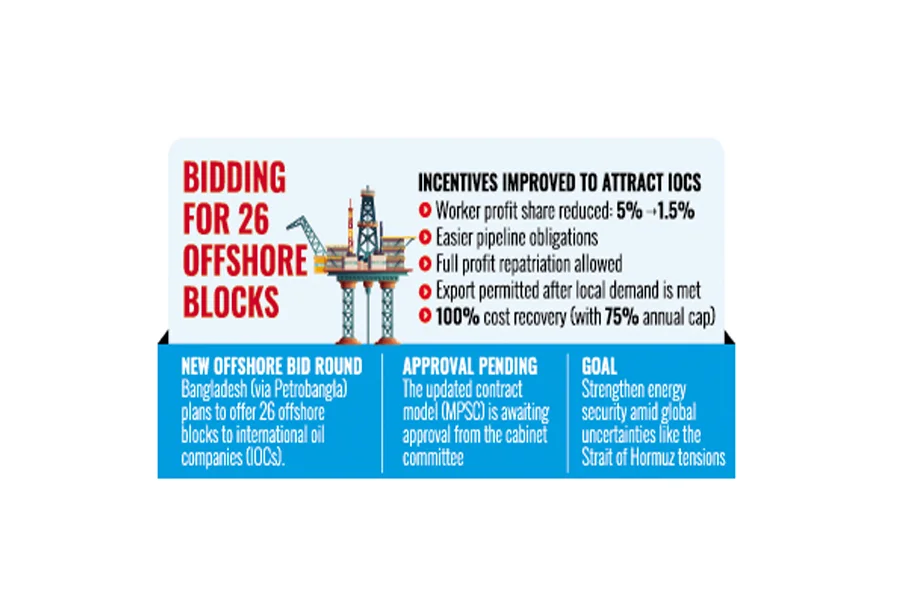
A much-sought-after bidding round offering some 26 offshore hydrocarbon blocks to potential international oil companies (IOCs) with sweetened terms is expected to be launched shortly, says a senior official of Petrobangla.

The energy and mineral resources division (EMRD) under the Ministry of Power, Energy and Mineral Resources (MPEMR) has forwarded the model production-sharing contract (MPSCs) to the cabinet committee on economic affairs for final approval.

The MPSC is expected to get the seal of approval in the cabinet committee next week and the bid round for the offshore oil-and-gas exploration would be launched immediate after obtaining the nod, the state corporation official adds.

The newly elected BNP-led government has moved fast to launch the bid round to ensure the country's future energy security through delineating new hydrocarbon reserves against the backdrop of persistent Middle East crisis and restrictions on vessels passing through the Strait of Hormuz.

The state-run Petrobangla has already sweetened further the drafts of the model production -sharing contract to lure the IOCs in the forthcoming bidding rounds, Petrobangla chairman Md Arafanul Hoque told The Financial Express.

He says the mandatory portion to workers' profit -participation fund (WPPF) has been reduced to 1.5 per cent from previous 5.0 per cent.

Besides, decision has been taken for easing responsibility on construction of hydrocarbon pipeline after discovery and subsequent operations, he adds.

Sources say not a single IOC did take part during the latest offshore bidding although half a dozen IOCs purchased bid documents.

Lack of confidence from the IOCs coupled with inadequate data on offshore blocks resulted in the non-response in the bidding, market insiders say.

Petrobangla had put the offer on board for nine months after floating the international tender on March 10, 2024.

Twenty-four offshore blocks -- 15 in deep sea and nine in shallow sea -- were on offer for exploration lease.

The 15 deep-sea blocks on offer are DS-08, DS-09, DS-10, DS-11, DS-12, DS-13, DS-14, DS-15, DS-16, DS-17, DS-18, DS-19, DS-20, DS-21 and DS-22.

The nine shallow-water blocks are SS-01, SS-02, SS-03, SS-05, SS-06, SS-07, SS-08, SS-10 and SS-11.

The gas prices for the offered blocks were tagged to the price of Brent crude on the international market during the previous year's bid so that the gas price becomes flexible in line with the movement of global oil-price indices.

The gas price was offered at 10 per cent of Brent Crude, meaning if the Brent crude is traded at $100 per barrel, the gas price would be $10 per million British thermal unit (MMBTu).

The pricing modalities were fixed same for both shallow-and deep-water blocks. Petrobangla will purchase the explored IOC gas at the Brent crude-linked rate, which will have no capping.

Capping-free price means Bangladesh will have to purchase the gas, to be extracted by the contractors, at a rate as high as it goes or as low as it slips. The foreign firms also had the liberty to export natural gas after meeting domestic demand following Petrobangla's first right of refusal.

They were offered the facility to repatriate full profit, too.

There was the provision for assignment of interest and share-transfer and 100-percent cost recovery with an annual cap of 75 per cent.

Contractor must have to have a mandatory work programme consisting of a 2D seismic survey and the mandatory purchase of available 2D multi-client seismic data to get relief from mandatory work obligations proportionately.

Over the last decade, Bangladesh had launched only one bidding round - in 2017 - and that was only for three deep-water blocks, according to Petrobangla data.

Although Posco-Daewoo was awarded one deep-water block - DS-12 - after the bidding, the South Korean oil-and-gas -exploration company left the block in 2020 after carrying out a 2D seismic survey.

Previously Petrobangla had floated a bidding round in 2012, through which three shallow-water blocks and one deep-water block were awarded to contractors.

Currently, four IOCs have active PSCs, either individually or under joint venture, to explore three shallow-water blocks in Bangladesh.

US oil-major Chevron is active in exploring and producing natural gas in three gas fields under onshore blocks 12, 13 and 14. Singapore's KrisEnergy is producing natural gas from the Bangura field under Block 9. ONGC Videsh and Oil India are jointly exploring shallow -water blocks SS-04 and SS-09.​
 

RE: A strategic choice for Bangladesh

M. Rokonuzzaman

Published :
May 02, 2026 23:20
Updated :
May 02, 2026 23:20

1777774153945.webp


There is growing recognition that Bangladesh's energy crisis may ease in the short term, but a lasting solution demands a decisive transition to renewable energy. As reported in the media, the government's target of generating 10,000 megawatts from renewables by 2030-requiring an estimated USD 9.36 billion investment across solar, wind, biomass, and biogas-signals important intent. Yet a critical question remains: should Bangladesh rely on importing technologies, or should it learn from countries like Denmark and China that built strong domestic capabilities? Merely importing solutions may address supply gaps but will limit long-term value creation and independence. Instead, Bangladesh should leverage this transition to cultivate local expertise, foster innovation, and develop a competitive energy technology industry. By doing so, the country can not only strengthen energy security but also create high-paying jobs for science and engineering graduates. A strategic shift towards indigenous capability building will transform the energy challenge into an opportunity for sustainable economic growth.

Bangladesh currently faces a formidable economic challenge, with annual energy import costs hovering around $12 billion. Driven by Middle East tensions and global price hikes, this figure is projected to surge by $4.8 billion-a staggering 40 per cent increase from 2025 levels. With fossil fuels like oil, gas, and coal powering between 46 and 95 per cent of the nation, the resulting strain on foreign exchange reserves has reached a critical tipping point.

To mitigate this crisis, the transition to renewable energy is no longer optional; it is a necessity. However, the true strategic dilemma lies in technological execution. Bangladesh stands at a crossroads: should it continue the historical trend of merely importing foreign technology and focusing on basic operation and maintenance? Or, should it adopt a more ambitious "assimilate and upgrade" model?

By choosing to license and further develop foreign technologies through local Research and Development (R&D), Bangladesh can achieve far more than just energy efficiency. This proactive approach would create a robust ecosystem of high-paying jobs for the nation's science and engineering graduates. Furthermore, developing such domestic capacity transforms Bangladesh from a consumer into a provider. It opens doors to exporting renewable innovations to other developing nations struggling with similar import dependencies. Ultimately, investing in indigenous technological mastery is the key to turning an energy crisis into a catalyst for long-term industrialization through innovation.

Here is a powerful lesson from Denmark. The country has emerged as a global leader in wind energy, with wind supplying over 50 per cent of its electricity consumption as of 2019. However, the deeper insight goes beyond clean power generation. Denmark's real success lies in building a robust wind energy industry through sustained investment in local research and development, continuously improving efficiency and innovation. This industry has become a vital economic pillar, supporting more than 30,000 jobs-around 2.5 per cent of private sector employment. Companies like Vestas exemplify this achievement, generating over €17 billion in 2024 by manufacturing, selling, installing, and servicing wind turbines. Denmark's experience shows that renewable energy is not just about solving energy shortages; it is also about creating high-value industries, fostering technological leadership, and generating skilled employment opportunities for long-term economic growth.

Following the 1973 oil crisis, Denmark faced a stark reality, relying on foreign oil for more than 90 per cent of its energy needs. Determined to reduce this vulnerability, the country embarked on a long-term transition away from fossil fuels. At the time, Denmark suffered from poor energy efficiency and lacked domestic wind energy firms. Instead of waiting and depending on imports, it chose to build a local industry by investing in research, engineering, and efficiency improvements. Over time, this strategy transformed Denmark into a leader in wind energy innovation. Advances in turbine size, materials, and offshore deployment significantly boosted performance, with modern turbines now achieving 44-48 per cent efficiency. These gains enabled higher energy yields and improved reliability. More importantly, Denmark cultivated a globally competitive ecosystem spanning technology innovation, manufacturing, and engineering-demonstrating how energy challenges can be turned into opportunities for industrial development and technological leadership.

A related lesson can be drawn from China. From a modest and experimental beginning in the mid-1980s, China's wind energy sector has expanded into the world's largest market, surpassing 400 GW of installed capacity by 2024. In its early stages, Denmark played an important role as a "teacher," sharing knowledge and technical expertise. However, unlike many developing countries, China did not remain dependent on importing wind turbines and expert services from Denmark. Instead, it focused on absorbing advanced technologies and learning how to improve them.

As reported by the Copenhagen Post, Chinese engineers collaborated with Danish experts in the mid-2000s to understand optimal turbine placement, wind measurement techniques, and technical design requirements. Yet China moved far beyond learning. Through deliberate policies-such as technology transfer agreements, local content requirements reaching 70 per cent by 2005, and strong state support for intensifying competition among private firms and collaboration with R&D facilities for performance improvement-Chinese firms rapidly built domestic capabilities. They transitioned from assembling licensed designs to investing in proprietary research and development, particularly in large-scale, high-altitude, and offshore turbines.

China's experience shows that true success lies not in import dependence, but in mastering, adapting, and advancing technology to build globally competitive industries.

The critical question for Bangladesh is how to build a global edge in renewable energy-spanning technology advancement, product innovation, manufacturing, system design, and deployment. As large-scale investments are planned, the country must avoid relying on subsidies to import foreign technologies. Instead, the priority should be developing strong technology assimilation capacity. This can begin with establishing renewable energy R&D laboratories in leading universities and fostering competition among private firms to design, manufacture, and install advanced systems such as wind turbines.

To accelerate progress, Bangladesh should adopt policies that encourage technology transfer while enforcing local content requirements to gradually build domestic manufacturing capabilities. Since renewable energy components offer continuous opportunities for improvement, targeted incentives should reward performance gains achieved through research and development. By linking investment and incentives with learning and innovation, Bangladesh can transform its renewable energy push into a platform for industrial growth, technological capability building, and high-value job creation.

Rokonuzzaman, Ph.D, Academic and Researcher: Technology, Innovation and Policy.​
 

Ten steps to guide Bangladesh out of the energy crisis

Dr Khondaker Golam Moazzem

1777776611562.webp

VISUAL: ANWAR SOHEL

It’s good news that a special parliamentary committee has been formed to address the energy crisis by offering recommendations on the legal, institutional, and operational issues arising from it. The committee is scheduled to hold its first meeting today (May 3). One expects it to recommend not only immediate and urgent solutions but also, more importantly, medium- to long-term solutions for a sustainable transition towards clean and renewable energy development in the country. While this committee’s tenure will be for one month, it is expected to recommend follow-up and monitoring by the parliamentary standing committee on the Ministry of Power, Energy and Mineral Resources in the coming days.

The special committee should duly acknowledge the challenge of over-dependence on the import-dependent fossil fuel supply chain. The war imposed on Iran has created cracks in the oil-dependent economies of the Middle East, and the unresolved reality of the war has put the world in such a situation that even if the war stops temporarily, the crisis will return repeatedly in the coming decades. This means the global energy system has entered a kind of permanently unstable situation. As a result, the global oil market and related energy markets such as LNG, coal, and LPG will remain unstable. Therefore, it is especially important now to emphasise energy diversification in Bangladesh.

As someone who has worked in the power and energy sector, I would like to recommend the following.

1. Gradually reduce subsidies in the power and energy sector

Government is under pressure to reduce the subsidy payment for the Bangladesh Power Development Board (BPDB), BPC (Bangladesh Petroleum Corporation), Rupantarita Prakritik Gas Company Limited (RPGCL), and Petrobangla. However, subsidies should not be reduced only through the adjustment of tariffs on the consumer’s end. Rather, BPC’s pricing policy should be revised to make it market-based. Much of the demand for subsidies exists due to the faulty pricing for independent power producers (IPPs) in the power sector. Hence, the government should not go for the renewal of IPPs after the contractual period is over.

2. Introduce a real-time monitoring system

From fuel import to filling stations, in the five to seven stages of the distribution process, widespread leakages and corruption have been exposed during the recent crisis. Therefore, it is very important to establish a real-time digital monitoring system from import to unloading at the depot, from the depot to the filling station, and from the filling station to consumers. Allocation should be made in the next national budget to establish this system. India and Pakistan have made significant progress using such digital monitoring systems.

3. Allocate increased expenditure for energy imports

Even if the US-Iran war is over soon, it may take more than one year for global energy prices to stabilise and return to pre-war prices. Therefore, the usual allocation for energy imports by the government will not be sufficient this time. At least 50 percent higher allocation should be made for energy imports in the next fiscal year. However, to obtain this additional funding, low-interest loans from the World Bank and the IMF may be helpful for the government. But the special committee should recommend against taking high-interest loans from the international market.

4. Urgently connect discovered gas to the national grid

Gas found in Bhola, plus gas available in previously used residual gas wells, and gas obtained through accelerated exploration should be urgently transmitted to the national grid. It is necessary to prioritise gas well drilling. Petrobangla or Bangladesh Petroleum Exploration and Production Company Limited (BAPEX) should declare this as an emergency. Besides, Tengratila gas well can be drilled now since the Niko case is over. Petrobangla should also retender the exploration of 24 offshore gas blocks after revising the tender documents as necessary, taking into account terms that would attract gas exploration companies.

5. Suspend construction of LNG-based infrastructure

A major challenge in meeting Bangladesh’s current energy costs is expensive LNG imports, leading to permanently high government expenditure. Unfortunately, multinational banking corporations are highly interested in providing bank guarantees and bank loans for LNG imports and related infrastructure development. These expensive infrastructures are creating long-term liabilities and will continue to do so. In contrast, moving towards more accessible and sustainable renewable energy will not create such long-term liabilities. Therefore, the committee should discourage LNG imports and the development of LNG-related infrastructure as part of a medium- to long-term strategy.

6. Eastern Refinery expansion is unnecessary

Modernisation of the existing infrastructure of Eastern Refinery is sufficient. The argument for expanding it to increase “strategic reserves” is not acceptable. Such reserves will increase import dependency further in the long run. Therefore, the committee should recommend the modernisation of the existing ERL infrastructure, instead of constructing another unit.

7. Reduce diesel use and increase solar irrigation in agriculture

The 13 lakh diesel-powered irrigation pumps currently in use in the country can easily be converted to solar-powered irrigation pumps. Due to insufficient funding, this sector is progressing slowly. Conversion to solar power will help the government reduce 12-13 percent diesel usage and thereby reduce diesel imports by three lakh tonnes. Such foreign currency savings will reduce pressure on the balance of payments and foreign exchange reserves. The committee should recommend necessary investment by the government, multilateral development banks (MDBs), and international financial institutions (IFIs) funds in this transformative journey.

8. Introduce EV-based vehicles instead of diesel

About 66 percent of the diesel used in the country is consumed by the transport sector. If 30 percent of vehicles, especially buses, trucks, and lorries, can be converted to electric vehicles by 2030, the government could reduce diesel use by 8.3 lakh tonnes. Such an amount in foreign currency savings will reduce pressure on the balance of payment and foreign exchange reserve. To achieve this, the committee should advise converting all government vehicles to EVs, as well as reducing duties on all EV vehicles.

9. Urgently declare a plan to implement 10,000 MW of renewable energy

The current government has announced a plan to generate 10,000 megawatts (MW) of solar electricity by 2030. This would be a positive move. The committee should recommend announcing the government’s plan to achieve this target and monitoring it through the parliamentary standing committee. This may include accelerating the implementation of the existing 3,000 MW national rooftop solar programme, completing the tender process for the 5,000 MW large-scale solar projects, and setting timelines for quick implementation by the private sector. In addition, the committee should recommend completing the review of the cancelled letters of intent (LOIs) of the 31 renewable projects as per the recent office order and quickly issue implementation orders. In this case, for newly announced Power Purchase Agreements (PPAs), alternative acceptable conditions may be included instead of the “guarantee clause” to attract private sector investment.

10. Accelerate foreign investment in the renewable sector

Ensure easy one-stop service for foreign investors, introduce online-based payment and exchange of documents and information with different agencies and ensure predictability in receiving specific services on time—both in terms of quality and price. The committee should advise relevant agencies to undertake specific activities to be reported to the parliamentary standing committee. The agencies include Bangladesh Investment Development Authority (BIDA), BPDB, Sustainable And Renewable Energy Development Authority (SREDA), Bangladesh Rural Electrification Board (BREB), Bangladesh Economic Zones Authority (BEZA), Bangladesh Export Processing Zones Authority (BEPZA), Department of Fire Service and Civil Defence (FSCD), Department of Environment (DoE), Registrar of Joint Stock Companies And Firms (RJSC), Petrobangla, Titas, city corporations, etc.

Since foreign investors are interested in investing in wind-based power generation, SREDA should publish its updated wind maps of the country, establish a dedicated office for the wind sector, and create a policy framework on wind-based power generation to provide necessary predictability to foreign investors in this potential sector.

Finally, the committee should advise that the government carry out long-term planning using its own resources and not use financial support from development partners or international agencies, as this weakens national policy ownership as well as the country’s policy sovereignty.

Dr Khondaker Golam Moazzem is research director at the Centre for Policy Dialogue (CPD) and director at the CPD Power Energy Study.​
 

Latest Posts

Back