[🇧🇩] Energy Security of Bangladesh

Post a Reply — Share your thoughts or reply to this thread...
Reply
Quick Reply ✓ Posted!
[🇧🇩] Energy Security of Bangladesh
833
35K
More threads by Saif

G Bangladesh Defense

Rooftop solar power offers lifeline to industries amid gas crisis, high tariffs

Shahriar Azam . Dhaka

1794098410275.webp


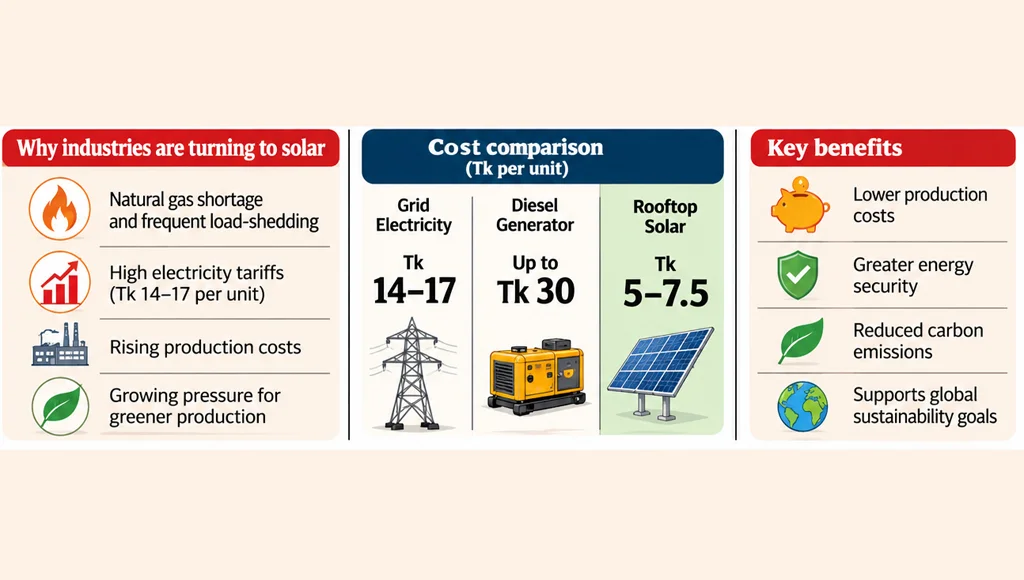
Rooftop solar power is emerging as a financial lifeline for Bangladesh’s energy-intensive industries, helping factories reduce electricity costs and maintain production amid persistent natural gas shortages, frequent load-shedding and rising electricity tariffs.

Manufacturers in major industrial hubs, including Gazipur, Savar, Narayanganj and Chattogram, are increasingly turning to solar photovoltaic systems to reduce their dependence on grid electricity and fossil-fuel-based captive power generation.

The shift comes as declining gas pressure has disrupted industrial production, forcing many factories to rely on diesel generators to maintain operations at significantly higher costs.

Industrial consumers pay around Tk 14–17 per kilowatt-hour for grid electricity, while electricity generated by diesel generators can cost up to Tk 30 per unit. In comparison, rooftop solar can deliver electricity at an estimated levelised cost of Tk 5–7.5 per unit over a system’s operational life of around 25 years.

Industry experts said rooftop solar could therefore help manufacturers lower production costs, improve energy security and meet the growing environmental requirements of international buyers.

Power Division Secretary Mirana Mahrukh said on Sunday that the government was promoting the operational expenditure model to encourage private investment in rooftop solar.

Under this model, third-party investors can install solar panels on the rooftops of public and private institutions without requiring the building owners to make an upfront investment.

The arrangement could make solar power more accessible to smaller factories that lack the capital to install their own systems.

Under the net-metering framework, eligible consumers can also feed surplus electricity into the national grid, allowing them to receive credits against their electricity bills in accordance with applicable regulations.

Hasan Mehedi, member secretary of the Bangladesh Working Group on Ecology and Development, said each kilowatt of installed solar capacity could save Tk 29,600–31,300 annually in furnace oil imports and reduce carbon emissions by around 1.4 tonnes.

For factories requiring uninterrupted electricity, solar can operate alongside grid connections and captive generators, reducing fuel consumption without necessarily replacing existing power sources.

A study by the Centre for Policy Dialogue found that rooftop solar could meet a median 40 per cent of electricity demand at large factories, 33 per cent at medium-sized factories and 38 per cent at small factories.

The study estimated a combined rooftop solar potential of 1,768 megawatt-peak across 3,320 factories, highlighting the scope for expanding distributed renewable energy in the industrial sector.

Ha-Meem Group has emerged as an example of large-scale industrial adoption. The group installed 12.2MWp of rooftop solar across 10 units in 2024, investing approximately Tk 54 crore through concessional financing. A subsequent phase added around 16.9–17MWp in 2026.

At its Kaliganj facility, solar power reportedly meets the entire daytime electricity load between 10:00am and 3:00pm. Load-shedding on the relevant feeder was also discontinued, illustrating the potential operational benefits of large rooftop solar installations.

The Institute for Energy Economics and Financial Analysis said rooftop solar had become the dominant source of distributed energy resources in Bangladesh and was already contributing to a slight reduction in daytime electricity demand.

Government data showed that rooftop solar capacity stood at 418.1MW as of June 2026. IEEFA, however, estimated that installations across 239 establishments, including groups of companies, had reached 667MW.

The country’s total rooftop solar capacity could approach 1,000MW if smaller installations below 0.15MW were included, according to the estimates.

Shafiqul Alam, lead energy analyst at IEEFA, said Bangladesh’s industrial sector alone had the potential to add several thousand megawatts of rooftop solar capacity if policy and financing barriers were addressed.

The expansion could also help reduce pressure on the power system during daytime hours and limit reliance on expensive fossil-fuel imports.

Despite the economic advantages, high upfront costs, financing constraints and administrative delays continue to hinder wider adoption of rooftop solar.

Bangladesh Sustainable and Renewable Energy Association President Mostafa Al Mahmud said import permissions under the 1 per cent duty facility had enabled the import of around 88MW of solar panels and inverters and 4.5 megawatt-hours of batteries in September.

In October, permissions were issued for 120MW of solar panels and inverters and 10 megawatt-hours of batteries, he added.

However, financing remained a major bottleneck, Al Mahmud said, stressing the need for wider access to concessional loans and predictable policies to accelerate solar deployment and battery storage.

Access to affordable financing is particularly important for small and medium-sized enterprises, which often struggle to mobilise the capital required for installation despite the prospect of lower electricity bills over time.

Battery storage could further increase the usefulness of solar power by storing surplus daytime generation for use when sunlight is unavailable. However, storage adds to project costs, making financing arrangements and suitable policies important for its wider adoption.

The economic case for rooftop solar is reinforced by the growing emphasis on decarbonisation in global supply chains.

International garment brands are placing greater importance on emissions reduction and environmental performance among their suppliers. For Bangladesh’s export-oriented apparel and textile industries, adopting renewable energy can therefore help reduce operating costs while strengthening compliance with buyers’ sustainability requirements.

Rooftop solar also offers a way to reduce emissions associated with electricity consumption and fossil-fuel-based captive generation.

Industry experts argue that Bangladesh’s extensive factory rooftops represent a largely unexplored resource for clean electricity. Faster deployment could reduce fuel imports, ease daytime pressure on the national grid and improve the competitiveness of export-oriented manufacturers.

However, achieving the sector’s potential will require coordinated action to improve access to finance, simplify approval procedures, ensure the quality of imported equipment and provide stable policy support.

As domestic gas production declines and industrial consumers face persistent supply constraints and high electricity costs, rooftop solar is increasingly becoming more than an environmental investment. For many factories, it offers a practical route to lower energy expenses, more reliable daytime operations and greater resilience against disruptions in the country’s energy supply.​
 

Matarbari power plant with own funds after Japan pullback
Lender's funding for 1200MW plant denied over climate impact


1794354598600.webp


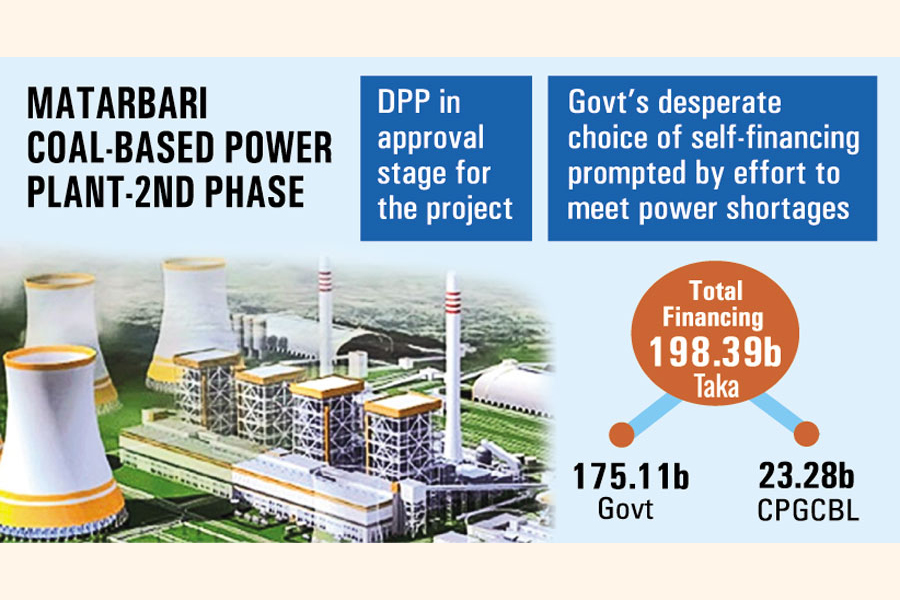
Japanese financing pullback leaves the government with the option to build another 1200-megawatt coal-based power plant at the Matarbari infrastructure hub on the bay coast through self-financing, officials say.

The state-run Coal Power Generation Company Bangladesh Limited (CPGCBL) has undertaken a Tk 198.39-billion project (2nd phase) for setting up the 2X600MW (3rd and 4th units) 2nd phase of the coal-fired power station, they said Tuesday.

The company has already set up 2X600MW-capacity 1st and 2nd unit of the ultra-supercritical coal-fired power station at a cost of Tk 518.55 billion at Matarbari where a coal-handling port, sea-channel expansion, and township have also been developed.

The Japanese-funded 2X600MW power station has been supplying electricity to the national grid since August 2023.

Amid one of worst power crises, the government in August 2014 undertook the 'Matarbari 2X600MW ultra-super-critical coal-fired power project in phase-1 with the financial support of the Japan International Cooperation Agency (JICA).

The JICA was supposed to provide funds for 2X600MW power plant in phase-2 beside the current location. However, it declined to bankroll the 2nd phase over the issue of massive carbon emission by a coal-based power plant.

A senior Power Division official has said the government has decided to set up the 2nd-phase power project (2X600MW) without foreign development assistance.

"Since Bangladesh is struggling with energy crisis and the gas-based power stations are falling short of fuel, the proposed coal-based power station will be a good solution for Bangladesh," he said.

According to the proposed fresh project, the DPP does not include any foreign financing for the project, indicating that the government will have to arrange the entire investment through domestic resources. Of the total expenditure, the government will provide Tk 175.11 billion from its own exchequer, while CPGCBL will contribute the remaining Tk 23.28 billion from its own resources.

The proposed project, titled 'Matarbari 2x660 MW Ultra Super Critical Coal Fired Power Project (Phase-2)', was scheduled to begin in October 2026 and be completed by September 2030.

"We have already sent the DPP to the Planning Commission for getting approval. Upon receiving approval, we will start construction of the 1200MW coal-based 2nd-phase station," he added.

The project aims to increase the country's electricity-generation capacity, improve quality and reliability of power to the national grid and strengthen energy security through fuel diversification.

The proposed investment is equivalent to around US$1.61 billion, calculated at the exchange rate of Tk 122.98 per US dollar mentioned in the DPP, based on the Bangladesh Bank rate in August 2026.

The decision to finance the project from domestic resources comes after Japan, Bangladesh's longstanding development partner and a major financier of the original Matarbari power project, declined to provide financial support for its second phase.

The development marks a shift in the financing arrangement for one of Bangladesh's major coal-based power-generation initiatives, as the government moves to shoulder the investment responsibility itself.

However, the large-scale allocation of domestic resources for a single power project could put additional pressure on government development budget and reduce fiscal space for other priority sectors, including education, healthcare and social infrastructure.

The Matarbari power project is located in Maheshkhali, Cox's Bazar. The original project was undertaken with Japanese assistance and is considered one of the country's major energy- infrastructure investments.

The proposed second phase is expected to add substantial generation capacity to the national grid and help meet the country's growing electricity demand.​
 

BAPEX team visits Inani, decides to urgently control gas well


1794354997785.webp


A nine-member expert team of Bangladesh Petroleum Exploration and Production Company Limited (BAPEX) on Tuesday visited the site of an uncontrolled gas leak and water flow in Inani of the district and decided to take urgent measures to secure and bring the well under control.

The team inspected the site at Chhotokhal area of Jaliapalong Union under Ukhiya upazila, where gas and water have been gushing out continuously since an abandoned tube-well was drilled on October 27, reports BSS.

After observing the site and monitoring the intensity of the gas flow for 15 consecutive days, the technical team and geological experts opined that the source was not merely a temporary gas pocket, but a potentially large underground gas reservoir.

Head of the delegation and former BAPEX General Manager (GM) Howlader Rafiqul Islam said the 15-day observation was primarily aimed at assessing the sustainability and capacity of the gas source.

"As the gas flow is continuing at the same rate and pressure, allowing it to burn uncontrollably at this moment is risky. As the first priority, a decision has been taken to urgently secure and bring the well under control," he said.

He added that further initiatives, including geological surveys and assessments of the commercial potential of the gas reserve, would be undertaken only after successfully bringing the well under control to ensure safety.

Gas began emerging from an abandoned tube-well hole in the Chhotokhal area of Inani on October 27. An expert team subsequently monitored the site for 15 days to assess the nature and potential of the gas source.​
 

Solar ambitions, grid realities

Monower Mostafa

TO REDUCE import dependency and ensure energy security, expanding renewable energy is no longer an option but a necessity. Amid the global energy crisis fuelled by geopolitics and wars, this renewable energy expansion is no longer just about fighting climate change; it has become an essential protective shield for our national economy.

To achieve this sustainable transition in the energy sector, the government has set an ambitious target to generate 10,000 megawatts of renewable energy (primarily solar) by 2030. Rooftop solar has been prioritised and tariffs on solar equipment have been lifted. This push for ‘green energy’ over fossil fuels is undoubtedly commendable. However, amidst the excitement of these high targets, two crucial technical aspects are often left out of the conversation: battery energy storage systems and smart grids.

Integrating renewable energy is not as simple as connecting a wire to the national grid, as is done with traditional fossil-based power plants. Adding 10,000MW of solar power to the grid without adequate battery storage and an automated smart grid is a recipe for an inevitable technical disaster.

Swimming in a calm pond vs diving into a rough sea

MANY might wonder: currently, several large solar projects in the country (like 200MW in Gaibandha or 100MW in Mongla) are running without battery storage, and they are not causing any grid disasters. This line of thinking is actually a technical misconception.

Currently, our massive national grid has a capacity of 26,000-27,000MW, out of which solar contributes a maximum of 1,500MW — just 3 to 4 per cent of the total capacity. The natural ‘inertia’ of such a large grid can easily absorb the fluctuations of this tiny amount of solar power. In simple terms, it is like swimming in a calm pond.

However, in engineering terms, there is a safe limit or ‘tipping point’ for renewable energy integration into the grid, which is typically 15–20 per cent. If 10,000MW of solar power is added by 2030, it will account for about 25–30 per cent of our total demand. At that point, if a sudden storm or heavy cloud cover wipes out 3,000MW to 4,000MW of solar generation in a matter of seconds, no manual backup in our current system will be able to handle the shock. The grid’s frequency will collapse instantly and within a fraction of a second the entire country will plunge into a blackout.

In short, a 10,000MW solar capacity is not like swimming in a calm pond; it is like diving into a rough sea. And when you dive into the sea, you must wear a life jacket — which, in this case, means a smart grid and battery storage.

Traditional grids and the challenge of frequency stability

OUR current national power grid is primarily designed to manage coal, gas or oil-based plants, which are almost 100 per cent under human control. Engineers at the National Load Despatch Centre (NLDC) can monitor dashboards and adjust power generation simply by making a phone call. But solar power generation depends entirely on nature.

A major condition for a stable grid is maintaining its frequency at a specific level (50Hz in our country). When clouds gather, solar generation can drop to near zero in milliseconds. If the frequency drops even slightly, large power plants automatically trip (shut down) to protect themselves. For solar fluctuations, filling this millisecond gap manually by looking at a dashboard is simply impossible for a human being.

First line of defence: battery energy storage systems

THE primary technical solution to combat nature’s unpredictability and grid instability is grid-scale battery storage. It acts as the ultimate ‘shock absorber’ for the national grid. When solar generation suddenly drops due to cloud cover, the battery automatically supplies electricity within milliseconds to keep the frequency stable.

Furthermore, integrating a massive amount of solar power into the grid creates a critical challenge known as the ‘Duck Curve’. During midday, when the sun is blazing, solar panels produce maximum power, but the overall electricity demand remains relatively low. Conversely, just as the sun sets in the evening, the country’s electricity demand hits its absolute peak. If batteries are charged using the surplus solar power generated during the day, this sudden evening deficit can be managed effortlessly. Without battery storage, this daytime surplus power goes to waste — a situation technically referred to as ‘curtailment’.

The smart grid: the brain of the entire system

IF BATTERY storage is the muscle or shield of the grid, the smart grid is its ‘brain’. The current method used by our National Load Despatch Centre to manage the grid is tailored for large, stable, fossil-fuel-based plants. In this traditional one-way system, control room engineers monitor the dashboard and call specific power plants to increase production when demand rises. They have enough time to make and execute these decisions.

However, in the future, numerous solar parks and heavy industries like RMG, textile or cement factories will have their own rooftop solar and battery systems. They will act as both electricity consumers and producers commonly called as ‘prosumers’. Managing this massive network, where electricity flows in and out from thousands of points in milliseconds, is humanly impossible.

This is exactly why an internet-based, two-way communication system — the smart grid — becomes essential. In this system, IoT sensors are installed in every sub-station, factory inverter, battery and solar panel. Artificial intelligence analyses real-time data and satellite weather forecasts to predict where clouds will gather in the next few minutes. Without any human instruction, the system automatically decides in milliseconds when a factory’s battery should be charged and when it should feed power back into the grid. Simply put, our current grid management is like a ‘manual transmission car’ driven by a skilled driver, whereas handling the massive pressure of renewable energy requires a fully automated ‘self-driving car’ — the smart grid.

The base-load fallacy and escaping the LNG trap

IT IS true that Battery Energy Storage Systems are still quite expensive. This creates financial anxiety among policymakers, which can be termed the ‘base-load trap’. Bangladesh has already invested heavily in several large gas and coal-based mega-projects under ‘take-or-pay’ contracts, meaning the government must pay a capacity charge even if the plants sit idle. Many fear that bringing in more solar power will force coal or gas plants to remain idle during the day, resulting in double capacity charges.

There is a major strategic flaw in this fear. Battery storage never comes to replace base-load plants. To meet the peak demand in the evening, the Bangladesh Power Development Board currently runs highly expensive and polluting oil-based ‘peaking plants’. The primary target of battery storage is not the base-load, but rather phasing out these costly peaking plants. Using battery power in the evening instead of burning oil or in some cases expensive LNG would save massive amounts of dollars spent on fuel imports and capacity charges for peaking plants. These savings can easily cover the initial costs of storage and smart grids.

The financing equation: initial shock vs long-term gains

IT IS true that bringing the entire country under a smart grid step-by-step over the next 10-15 years will cost billions of dollars. The World Bank and ADB have already undertaken grid modernisation projects worth $500 million and $200 million, respectively. A pilot smart grid project just in the DPDC area of Dhaka city alone is costing around Tk 1,300 crore.

Although the initial investment seems huge, energy economics suggests that this cost can be recovered within a few years. With a smart grid and storage in place, there will be no need to run highly expensive and polluting oil-based power plants to handle evening peak hours. This alone will save millions of dollars in capacity charges and oil imports.

Solar and battery storage systems act as a powerful ‘hedging mechanism’ for the national economy. Sunlight and wind have no international market price and their supply cannot be disrupted by wars. If expensive LNG is not burned for electricity but instead supplied to RMG, textile or fertiliser factories, it would be far more profitable for the national economy.

Let the dream of energy transition not become a risk

WHILE wide-ranging fields of solar panels form the visible infrastructure of our energy transition, battery storage and smart grids act as its invisible nervous system. Just as a muscular body is useless without a brain, pursuing 10,000MW of solar power without this smart infrastructure is a severe technical risk. Without it, massive investments in solar will fail to deliver stable and affordable electricity.

Economically, traditional power has major limitations: idling coal or nuclear plants incur massive ‘capacity charges’, while oil-based peaking plants suffer from skyrocketing fuel costs. In contrast, a battery-integrated solar system requires a slightly higher initial investment but guarantees zero fuel costs and no capacity charges. Battery-integrated solar system can meet the evening peak demands while significantly reducing the stress on our economy from capacity charges and the volatility of the global energy market.

Monower Mostafa is an adviser to the Bangladesh Working Group on Ecology and Development.​
 

Dr Zubaida Rahman for transforming waste into energy, source of growth

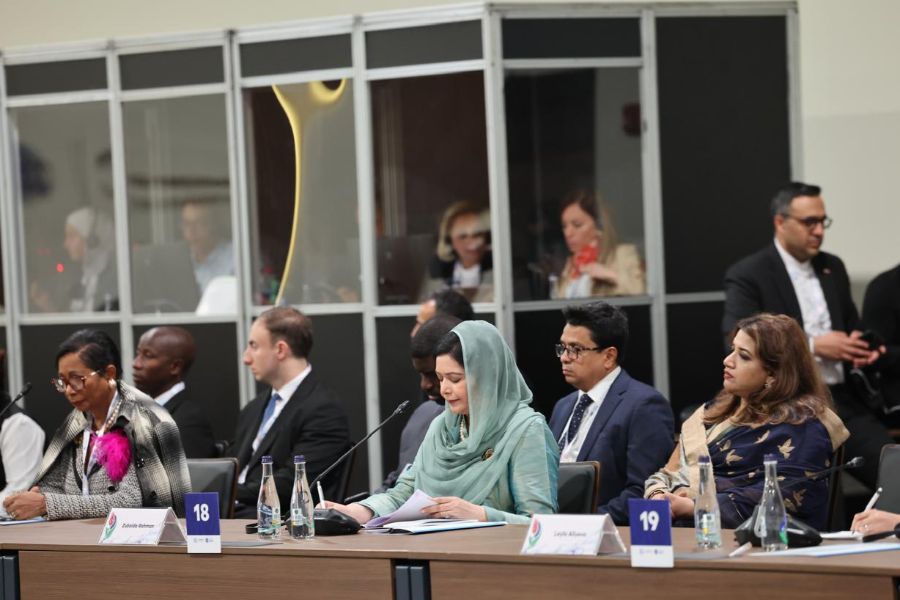
Prime Minister Tarique Rahman’s spouse and eminent physician Dr Zubaida Rahman on Wednesday stressed transforming waste into resources, sources of energy and opportunities for economic growth.

“Waste should not be allowed to go to waste without being put to any use. Rather, it must be transformed into resources, sources of energy and opportunities for economic growth,” she told a high-level meeting of spouses of heads of state and government held on the sidelines of the United Nations Climate Change Conference (COP31) there.

Dr Zubaida said: “Let us turn waste into resources, pollution into solutions, and commitments into concrete actions,”

Expressing her sincere gratitude to Türkiye’s First Lady Emine Erdogan for hosting the meeting, she said Emine’s leadership in advancing the zero-waste agenda was truly inspiring.

She said Bangladesh strongly welcomes and supports the Global Zero Waste Alliance. The objectives of the alliance are fully aligned with the Bangladesh government’s vision of building a clean environment, a healthy population and a sustainable future, she mentioned.

Dr Zubaida said the Bangladesh government is encouraging waste reduction, reuse and recycling (the 3Rs).

At the same time, she said, waste segregation and safe disposal systems were being strengthened under the Solid Waste Management Rules.

She noted that under Bangladesh’s Third Nationally Determined Contribution (NDC 3.0), the country has set a target of reducing greenhouse gas emissions from the waste sector by 1.78 million tonnes of carbon dioxide equivalent by 2035.

Highlighting the government's priority initiatives, she said emphasis was being placed on recycling, composting, landfill gas recovery, waste-to-energy generation, wastewater treatment, and the safe management of waste from medical and healthcare facilities.

Referring to an initiative to implement a large-scale waste-to-energy project in Dhaka, she said the project would process 3,000 tonnes of household waste daily to generate 42.5 megawatts of electricity.

She added that there were plans to expand similar projects to other major cities across Bangladesh.

She said the government's key objective was to convert urban waste into clean energy while protecting the environment.

At the same time, initiatives to clean the country's lakes, canals, ponds and other water bodies were continuing to reduce plastic pollution, she said.

Emphasising the promotion of jute products as an alternative to plastic, Rahman said Bangladesh's golden fibre, jute, was a natural alternative to plastic. She added that efforts were underway to expand the use of jute-based products.

She also invited the delegates attending the conference to visit the Bangladesh Jute Pavilion, located in the Green Zone of the conference venue.

Noting that Bangladesh, as a signatory to the Global Methane Pledge, was committed to reducing methane emissions, she said the government was encouraging climate-friendly agriculture and improved rice cultivation practices. Initiatives had also been undertaken to produce organic fertiliser and clean energy from organic waste.

Highlighting the importance of international cooperation in building a zero-waste world, she said the goal could not be achieved through individual efforts alone. Affordable climate finance, technology transfer and capacity building were essential to achieving this objective, she said.

She further stressed the need for strong private-sector participation and ensuring adequate protection for informal waste management workers.

Calling for the engagement of the younger generation in the movement, she said environmental awareness must begin at home, in educational institutions and in society.

“Young people were not only the leaders of tomorrow but also important partners in addressing today's challenges,” she added.

Dr Zubaida said Bangladesh was fully prepared to further strengthen global cooperation and translate collective commitments into action.​
 

Govt targets 10,000MW solar power generation in 5 years: Minister


1794439486885.webp


The government has undertaken various initiatives to accelerate solar power generation as it targets generating 10,000 megawatts (MW) of solar power during its first five years in office as part of its plan to meet 20 percent of the country’s electricity demand from solar energy, said Power, Energy and Mineral Resources Minister Iqbal Hassan Mahmood on Wednesday.

“We pledged in our election manifesto to generate 30 percent of the country’s electricity from solar power. Accordingly, we have set a target of generating 10,000MW from solar power during the first five years,” he said.

The minister made the remarks while responding to a call attention notice on matters of urgent public importance under Rule-71 of the Rules of Procedure placed by ruling party lawmaker Shacot Ara Akter from reserved women’s seat-33 in the Jatiya Sangsad.

Iqbal said the government had formulated a policy within two to three months and prepared the relevant legislation through a Cabinet decision before placing it in Parliament.

The minister said the government has undertaken various initiatives to accelerate solar power generation, attract private investment and raise public awareness about rooftop solar systems.

As part of the campaign, the government has recently organised a two-day National Solar Expo, which attracted thousands of visitors and generated considerable public interest in solar energy.

“More than 8,000 providers applied in response to our tender to expand solar energy services. We have also increased the number of providers to accelerate the programme,” he said.

The government would organise similar exhibitions in divisional cities and gradually extend the campaign to district levels to familiarise people with the benefits of rooftop solar systems, he added.

Highlighting the economic benefits of rooftop solar power, the minister said households could generate electricity on their rooftops, meet their own demand and earn money by selling surplus electricity to the government.

“Under the Prime Minister’s announcement, the government will purchase surplus electricity generated from rooftop solar systems at Tk 10 per unit, while the maximum production cost will be Tk 8. This will allow consumers to earn Tk 2 per unit,” he said.

The minister stressed the importance of battery storage alongside solar panels to ensure uninterrupted electricity supply.

“Solar power alone is not enough; battery storage is also necessary. We are working to promote solar systems with battery facilities,” he said.

Citing the Prime Minister’s residence as an example, he said the premises now run entirely on solar power with battery backup, ensuring electricity supply round the clock.

The government has also undertaken publicity campaigns, advertisements and awareness programmes to encourage people to install rooftop solar systems, he said.

The minister added that the Cabinet Division had instructed deputy commissioners across the country to install solar systems in government offices and allocated funds for the initiative.

Referring to the recently promulgated ordinance on solar power development, he said the move had restored investor confidence and encouraged private-sector investment.

Iqbal said following the promulgation of the ordinance by the President, around 200MW of solar electricity has already been added to the national grid within a short period.

The minister also expressed optimism that continued policy support, private investment and public participation would help the government achieve its solar power generation targets and reduce the country’s dependence on conventional electricity sources.​
 

Govt okays third LNG terminal amid soaring import costs

Staff Correspondent . Dhaka

1794528856974.webp


The government has approved yet another liquefied natural gas import terminal even as global supply chains remain disrupted by conflicts, which have pushed up spot prices to three-times and curbed output at some of the country’s major suppliers.

The third floating LNG terminal at Kutubjom in Maheshkhali, Cox’s Bazar, has been awarded to China National Energy Engineering and Construction Co Ltd under a government-to-government arrangement on Thursday.

The approval was given at the 53rd meeting of Cabinet Committee on Government Purchase at the secretariat with Finance Minister Amir Khasru Mahmud Chowdhury in the chair.

- Another LNG terminal under current circumstances economically suicidal: expert

- Proposed Kutubjom terminal’s daily use charge termed ‘bottomless drain’ on taxpayers’ money

- Rationale for expanding LNG import infrastructure questioned as govt can cut gas use through large-scale rooftop solar installations

According to a document placed by the Energy and Mineral Resources Division before the CCGP, the proposed cost of the project is around Tk 12,324 crore for a 15-year term or Tk 13,161 crore for a 20-year term.

The committee approved CNEE as the recommended bidder for the project, according to a press release issued by the Cabinet Division.

In a previous attempt on October 13, EMRD withdrew the same proposal from CCGP agenda. However, the Energy Division re-submitted the proposal a month after and received nod to award the deal to CNEE.

Hasan Mehedi, member secretary of the Bangladesh Working Group on Ecology and Development said building another LNG terminal under the current circumstances was economically suicidal for Bangladesh.

He said the cost of LNG at the prevailing international market could translate into an end-user gas costing around Tk 132 per cubic metre, against an average domestic selling price of approximately Tk 18 per cubic metre.

The resulting gap would leave the government bearing a massive subsidy, he said, adding that the proposed Kutubjom terminal would require a daily terminal-use charge of $3,42,000 as well.

The proposed Kutubjom terminal’s daily use charge is 44 per cent higher than the $2,37,000 paid for Excelerate Energy’s Floating Storage Regasification Unit and 57 per cent higher than the $217,000 paid for Summit LNG’s FSRU.

Describing the arrangement as a ‘bottomless drain’ on taxpayers’ money, he questioned the rationale for expanding LNG import infrastructure when the government could instead reduce gas consumption in the power sector through large-scale rooftop solar installations.

Bangladesh currently has two FSRUs at Moheshkhali with a combined capacity of 1,100 million cubic feet of gas per day and they account for 35 per cent of the daily gas supply.

Since the outbreak of the West Asian conflict in late February, Bangladesh’s major LNG suppliers, including Qatar and Oman, declared force majeure, forcing Bangladesh to secure the gas largely from spot market at an inflated price.

JKM, the regional benchmark index for LNG spot prices in Asia, stood at around $31 per Million British thermal units on Thursday, which was three times the pre-war rate.

The purchase committee has also recommended approval of the import of two LNG cargoes in 2027 from Malaysia-based Pentitude Energy Sdn Bhd at a price of JKM minus $0.18 per MMBtu.

Meanwhile, the Cabinet Committee on Economic Affairs at its 37th meeting on Thursday recommended in-principle approval for direct LNG purchases from three companies based in Japan, the United Arab Emirates, and Nigeria.

The Energy and Mineral Resources Division proposed purchasing LNG from Japan’s JERA Global Markets Pte Ltd, along with signing a short-term LNG sale and purchase agreement and a term sheet between Petrobangla and the company.

The committee also recommended direct LNG purchases from ADNOC Trading Ltd of the UAE and Ojimadu & Marites Oil Marketing Nigeria Ltd/Uzzy Gems Beehive of Nigeria.​
 

Titas Gas returns to profit in Q1 on lower system loss


1794613481771.webp


A sharp reduction in system loss helped Titas Gas Transmission & Distribution Company make a strong turnaround in profitability in the first quarter of FY27.

The company posted a profit of Tk 1.47 billion in the July-September quarter, against a loss of Tk 2.49 billion in the same period a year earlier. It attributed its return to profit to a reduction in system loss from 9.96 per cent in Q1 FY26 to 5.91 per cent in Q1 FY27.

System loss represents the difference between the volume of gas entering Titas's distribution network and the volume ultimately billed to consumers.

The reduction significantly lowered the volume of purchased gas that goes unaccounted for and does not generate corresponding revenue.

In its quarterly financial statements published on Thursday, Titas Gas, which enjoys a monopoly on pipeline gas distribution in Dhaka and Mymensingh, said intensified drives against unauthorised gas connections and illegal pipeline networks, alongside an expansion of prepaid gas metering, had cut its system loss.

These initiatives helped curb unbilled gas consumption, improve measurement accuracy and narrow the gap between the volume of gas purchased and the amount billed to consumers, according to the company.

Despite the reduction, system loss remains well above the regulatory ceiling of 2 per cent.

Under the regulatory framework, the company has to contain its system loss to 2 per cent, and it must absorb the financial burden of any excess loss.

The persistent gap between actual and allowable system losses is one of the major structural challenges facing the country's largest gas distribution company.

The earnings recovery came despite a contraction in revenue. Titas Gas's revenue declined 14 per cent year-on-year to Tk 83.3 billion in the September quarter. Its cost of sales, however, fell by a steeper 18 per cent, providing significant relief to its bottom line.

The faster decline in costs compared with revenue highlights the importance of lower system loss in improving the company's financial performance, as unrecovered gas procurement costs directly affect its profitability.

Higher finance income also contributed to the profit growth, as finance income rose 5 per cent year-on-year to Tk 375 million in the September quarter.

Despite returning to profitability, Titas Gas continued to face mounting pressure on its operating cash flow, highlighting a gap between its accounting earnings and actual cash generation.

Its net operating cash flow per share (NOCFPS) deteriorated to negative Tk 5.73 in the July-September quarter from negative Tk 0.58 in the same period a year earlier.

The negative cash flow indicates that the company's operating payments exceeded cash collections during the quarter. Higher payments for gas purchases relative to collections from customers were the main reason behind the deterioration, according to the company.

That points to persistent working-capital pressure, as the company needs to maintain regular payments to gas suppliers while collecting outstanding bills from its large customer base.

Meanwhile, its net asset value (NAV) per share increased to Tk 85.43 as of September from Tk 83.94 at the end of June this year.

Annual losses still weigh on performance

The quarterly turnaround follows a difficult financial year for Titas Gas. The company reported a net loss of Tk 5.95 billion in FY26, although the loss narrowed from Tk 7.72 billion in FY25.

The company explained that an excess system loss of 7.96 percentage points over the allowable limit in FY26 forced it to absorb substantial gas procurement costs without generating corresponding revenue.

Titas Gas has identified illegal gas connections, ageing and corroded pipelines, inaccurate metering and accidental damage to distribution networks during excavation work as major contributors to excessive system loss. Inaccurate billing of unmetered domestic consumers has also added to the problem.

Following the quarterly earnings announcement, Titas Gas shares climbed 9.50 per cent to close at Tk 19.60 on the Dhaka Stock Exchange on Thursday, reflecting a positive market response to its return to profitability.​
 
Back
Top