[🇧🇩] Evolving partnership between Bangladesh and Malaysia

[🇧🇩] Evolving partnership between Bangladesh and Malaysia
60
2K
More threads by Saif

G Bangladesh Defense

PM arrives in Malaysia on first official overseas visit

Published :
Jun 21, 2026 19:16
Updated :
Jun 21, 2026 19:16
1782084333663.webp


Prime Minister Tarique Rahman arrived in Kuala Lumpur on Sunday night on his maiden overseas visit since taking office, undertaking the two-day trip at the invitation of his Malaysian counterpart Anwar Ibrahim.

A special Biman Bangladesh Airlines flight carrying the Prime Minister, his wife Dr Zubaida Rahman and other accompanying delegation landed at Kuala Lumpur International Airport at 8:45pm local time (6:45pm Bangladesh time).

At the exclusive VVIP terminal Bunga Raya Complex, the Prime Minister was received by Malaysia’s Religious Affairs Minister Zulkifli Hasan and his wife.

A little girl presented a bouquet to Zubaida Rahman at that time, reports UNB.

Bangladesh High Commissioner to Malaysia Manjurul Karim Khan Chowdhury and Deputy High Commissioner Mosammat Shahanara Monica were also present.

From the airport, Tarique Rahman will travel in a ceremonial motorcade to Shangri-La Hotel in Kuala Lumpur.

Earlier, the Biman flight departed from Hazrat Shahjalal International Airport in Dhaka at 2:45pm Bangladesh time.

The visit marks Tarique Rahman’s first foreign trip after assuming office on February 17 following his party’s landslide victory in the 13th parliamentary election.

Officials said the Prime Minister chose Malaysia as the destination for his first official foreign visit, aiming to strengthen economic ties, expand labour market opportunities and deepen strategic cooperation during the two-day tour.

To mark the occasion, roads leading to Kuala Lumpur International Airport and his place of residence were decorated with the national flags of Bangladesh and Malaysia.

The Prime Minister is leading a 23-member high-level delegation that includes Foreign Minister Dr Khalilur Rahman, Expatriates’ Welfare and Overseas Employment Minister Ariful Haque Choudhury, State Minister for Power, Energy and Mineral Resources Aninda Islam Amit, Prime Minister’s Adviser on Foreign Affairs Humaiun Kobir, Adviser on Expatriates’ Welfare and Overseas Employment Mahdi Amin and Adviser on Defence AKM Shamsul Islam.

The delegation also includes Prime Minister’s Principal Secretary ABM Abdus Sattar, Foreign Secretary Asad Alam Siam and his Additional Press Secretary Atikur Rahman Rumon.

Malaysian Prime Minister Anwar Ibrahim extended the invitation to Tarique Rahman shortly after the formation of the new government, leading to the official visit.

Malaysia is one of Bangladesh’s major trading partners in Asia, although the trade balance remains heavily in Malaysia’s favour. Bangladesh imports around US$2 billion worth of goods from Malaysia annually, while exports to the Southeast Asian nation stand at about US$135 million.

Bangladesh mainly exports ready-made garments, particularly knitwear products, to Malaysia, while importing fuel and edible oil.

On Monday morning, the Prime Minister will be accorded an official reception upon his arrival at the Malaysian Prime Minister’s Office, Perdana Putra, in Putrajaya.

He is scheduled to hold his first one-on-one meeting with his Malaysian counterpart there. The meeting will be followed by bilateral talks between high-level delegations, led by the two leaders.

The discussions are expected to focus on expanding cooperation in trade and investment, energy, halal economy, manpower recruitment, semiconductor industry, agriculture, education and people-to-people connectivity.

Bangladesh will also request Malaysia to recruit more Bangladeshi workers in various sectors and discuss measures to ensure the welfare of Bangladeshi expatriates living in the country.

During the visit, Bangladesh is expected to seek Malaysia’s support for becoming a Sectoral Dialogue Partner of the Association of Southeast Asian Nations (ASEAN) and joining the Regional Comprehensive Economic Partnership (RCEP), the world’s largest free trade bloc.

Officials said memorandums of understanding on tourism and cultural cooperation may also be signed during the visit.

The Prime Ministers of the two countries will be present at the signing ceremony of the bilateral cooperation documents.

They will hold a joint press conference, and the Prime Minister of Malaysia will host a luncheon in honour of his Bangladeshi counterpart.

After concluding his visit to Malaysia, Prime Minister Tarique Rahman will depart from Kuala Lumpur for Dalian, China, on Monday afternoon on a four-day official visit to China.

The Malaysian Prime Minister paid a brief official visit to Bangladesh on October 4, 2024 at the invitation of former interim government Chief Adviser Prof Muhammad Yunus.

Prime Minister Tarique Rahman’s visit to Malaysia has raised fresh hopes for the reopening of the Southeast Asian country’s labour market to Bangladeshi workers, which has remained suspended since June 2024.​
 

Malaysia rolls out red carpet to welcome PM Tarique Rahman
Soon after the prime minister formed the government on 17 February, Malaysian Prime Minister Anwar Ibrahim extended an invitation to him.

BSS
Kuala Lumpur
Published: 21 Jun 2026, 20: 35

1782086844372.webp

Prime Minister Tarique Rahman arrived at Kuala Lampur International Airport, Malaysia on 21 June 2026 BSS

A red carpet was rolled out as Prime Minister Tarique Rahman arrived in Kuala Lumpur on Sunday on an official visit at the invitation of his Malaysian counterpart Anwar Ibrahim.

A special Biman Bangladesh Airlines flight carrying the Prime Minister, his wife Zubaida Rahman and the accompanying delegation landed at Kuala Lumpur International Airport at 8:45 pm local time (6:45 pm Bangladesh time).

At the exclusive VVIP terminal Bunga Raya Complex, the prime minister was received by Malaysia's Religious Affairs Minister Zulkifli Hasan and his wife.

A child presented a bouquet to Zubaida Rahman at that time.

Bangladesh High Commissioner to Malaysia Manjurul Karim Khan Chowdhury and Deputy High Commissioner Mosammat Shahanara Monica were also present.

The prime minister and his spouse were given a red-carpet reception and a guard of honour. During the ceremonial guard of honour presented by a smartly turned-out contingent, the national anthems of both countries were played.

Afterward, the prime minister was escorted from the airport to the Shangri-La Hotel in Kuala Lumpur in a special motorcade. The prime minister, his spouse, and members of the delegation will stay at the hotel during the visit.

The route from Kuala Lumpur International Airport to the Shangri-La Hotel, a journey of about 50 minutes by road, was decorated with the national flags of Bangladesh and Malaysia to welcome the prime minister.

This is Tarique Rahman’s first visit to Malaysia since assuming office as head of government on 17 February following his party’s landslide victory in the 13th parliamentary election.

The prime minister is accompanied by Foreign Minister Khalilur Rahman, Expatriates' Welfare and Overseas Employment Minister Ariful Haque Choudhury, State Minister for Power, Energy and Mineral Resources Aninda Islam Amit, Prime Minister's Foreign Affairs Adviser Humaiun Kobir, Overseas Employment Adviser Mahdi Amin, Defense Adviser Brigadier General (retd) AKM Shamsul Islam, and others.

Also accompanying the prime minister are his Principal Secretary ABM Abdus Sattar, Foreign Secretary Asad Alam Siam, and Additional Press Secretary Atikur Rahman Ruman.

Soon after the prime minister formed the government on 17 February, Malaysian Prime Minister Anwar Ibrahim extended an invitation to him.

The Bangladeshi Prime Minister’s current official visit is being undertaken in response to that invitation.

After China and India, Bangladesh is Malaysia’s largest trading partner in South Asia. However, Malaysia maintains a significantly larger share in bilateral trade. Prime Minister Tarique Rahman chose Malaysia for his first state visit.

Malaysian Prime Minister Anwar Ibrahim will formally receive the Bangladeshi prime minister on Monday morning at his office in Putrajaya.

The two leaders will first hold a one-on-one meeting, followed by bilateral talks between high-level delegations led by the two prime ministers. They will later address a joint press conference.

During the visit, two Memorandums of Understanding (MoUs) on cooperation in tourism and culture may also be signed between Bangladesh and Malaysia.​
 

Bangladesh PM asks Malaysia to reopen labour market to Bangladeshi workers

REUTERS

Published :
Jun 22, 2026 12:33
Updated :
Jun 22, 2026 12:37

1782170560692.webp


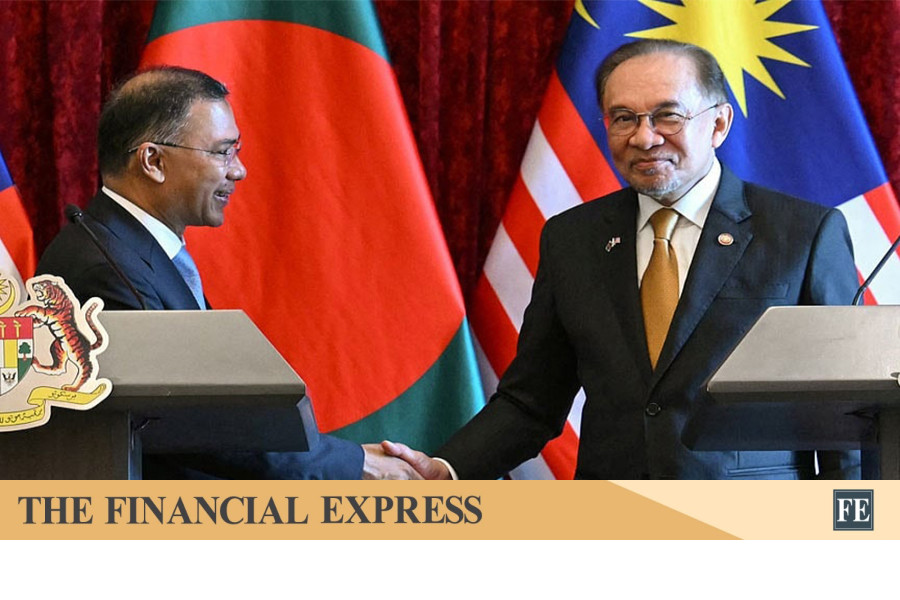
Bangladesh's Prime Minister Tarique Rahman and Malaysia's Prime Minister Anwar Ibrahim shake hands during a press conference at the Federal Government office, in Putrajaya, Malaysia, on June 22, 2026. — Pool via REUTERS

Bangladesh's Prime Minister Tarique Rahman said on Monday he had asked his Malaysian counterpart to consider reopening the ‌labour market to Bangladeshi migrant workers, as the leaders expressed concerns over long-standing issues of foreign worker exploitation.

Malaysia has been a key destination for Bangladeshi migrant workers, whose remittances are a crucial source of foreign exchange for the South Asian nation.

However, Kuala Lumpur has restricted the hiring of workers ⁠from Bangladesh since 2024 amid reports of debt bondage and forced labour, with workers incurring substantial debts to secure employment in Malaysia.

Hundreds of workers were left stranded in 2023, after arriving in Malaysia only to find that jobs promised to them by recruitment agents did not exist, leaving them forced to seek work illegally and exposing them to detention and deportation risks.

"I also raised issues relating to regularisation of illegal workers and repatriation of the detained Bangladeshis if possible," Rahman ‌told ⁠reporters during a visit to Malaysia where he met Prime Minister Anwar Ibrahim.

Anwar said both countries agreed to take measures to ensure transparency in the recruitment of workers and protect their welfare.

"This continued use of workers being exploited, ill-treated... solely for personal company ⁠gains cannot be tolerated," he said.

Anwar and Rahman also witnessed the exchange of several agreements, including collaborations on investment promotion, cultural cooperation and counterterrorism, and the two countries also pledged ⁠to move forward with negotiations on a free trade agreement.

Rahman is on his first overseas trip since taking office, as Bangladesh looks to attract investment, boost ⁠overseas employment and strengthen ties with Asian partners.

He is due to travel to China next for a three-day visit at the invitation of Chinese Premier Li Qiang.​
 

BANGLADESH-MALAYSIA FTA LIKELY BY 2027
Tarique, Anwar pledge to take bilateral ties to new highs

FE REPORT

Published :
Jun 23, 2026 00:06
Updated :
Jun 23, 2026 00:06

1782170705827.webp

Prime Minister Tarique Rahman and Malaysian Prime Minister Anwar Ibrahim address a joint press briefing at the Perdana Putra, the Prime Minister's Office in Putrajaya, Malaysia, on Monday. - PID

Bangladesh and Malaysia pledge to elevate bilateral relationship to a new level in broad agreements on expanding cooperation across trade, investment, labour migration, technology, defence and regional diplomacy, as Prime Minister Tarique Rahman concludes his first foreign visit since taking office.

During the bilateral meeting held in Putrajaya on Monday, Tarique Rahman and Malaysian Prime Minister Anwar Ibrahim agreed to deepen a partnership that both leaders described as being rooted in shared values, mutual respect and decades of people-to-people ties.

The visit, coming just four months after Tarique Rahman assumed office, was rich in symbolism. It marked not only his first overseas trip as prime minister but also an attempt by the new government in Dhaka to signal continuity in regional engagement while pursuing what it has called a "Bangladesh First" foreign policy.

Capping the talks, Bangladesh and Malaysia signed a Memorandum of Understanding (MoU) on cultural cooperation and exchanged two bilateral documents following the talks. Prime Minister Tarique Rahman and Malaysian Prime Minister Anwar Ibrahim witnessed the signing.

Also, the two sides exchanged a document on cooperation in research and capacity building in counter-terrorism and another bilateral document related to investment.

Foreign Minister Dr Khalilur Rahman and Malaysian Foreign Minister Utama Haji Mohamad bin Haji Hasan exchanged the documents on behalf of their respective governments.

In a joint statement issued after their talks, the two leaders have expressed a "strong commitment" to taking Bangladesh-Malaysia relations to "new heights" and pledged to intensify engagement through high-level exchanges and institutional mechanisms, including the long-pending Joint Commission Meeting and bilateral consultations between the foreign ministries.

The meeting reflects growing convergence between the two Muslim-majority nations at a time of shifting economic and geopolitical dynamics across Asia.

Economic cooperation dominate the discussions.

The two governments have welcomed progress towards launching negotiations on a Bangladesh-Malaysia Free- Trade Agreement (MBFTA), with both sides aiming to conclude the pact in 2027.

Bangladesh is Malaysia's second-largest trading partner in South Asia, and both leaders acknowledged the need to expand two-way trade and investment beyond their current levels.

A key development is the progress made towards establishing a Malaysia-Bangladesh Joint Business Council, designed to provide a structured platform for engagement between private- sector leaders from both countries.

At the bilateral summit talks, the leaders identified telecommunications, energy, infrastructure, ports and logistics, halal industries, digital technology, semiconductors, agro-processing, education and advanced manufacturing as priority sectors for future collaboration.

For Bangladesh, which is seeking to accelerate growth following years of economic strain, attracting Malaysian investment is a central objective of the visit by projecting latest opportunities.

"The Bangladesh Nationalist Party received a strong mandate in the parliamentary elections of February 2026. Our priority is to create jobs, attract foreign investment and accelerate economic growth," Tarique Rahman told a joint press conference.

"We are building a business-friendly environment and creating new opportunities for investors. I see strong potential for Malaysian investment in Bangladesh and warmly invite Malaysian businesses to explore these opportunities."

Labour migration, long one of the most important pillars of Bangladesh-Malaysia relations, featured prominently in the talks.

More than a million Bangladeshis have worked in Malaysia over the past decades, making the country one of the most significant destinations for Bangladeshi migrant workers.

Tarique Rahman urges Malaysia to recruit more Bangladeshi workers and requests consideration of issues related to undocumented workers and the repatriation of detained Bangladeshis.

Malaysia stops short of announcing a broad reopening of its labour market but acknowledges Bangladesh's proposals and agrees to continue discussions through the Joint Working Group mechanism.

The two sides have reiterated that any future recruitment process should be transparent, competitive and affordable, reducing the role of intermediaries and lowering migration costs for workers.


Malaysia has said approvals for new foreign-worker quotas would continue to be assessed on a case-by-case basis according to labour- market requirements.

The joint statement highlights emerging areas of cooperation that would have been absent from bilateral discussions a decade ago.

Recognising the growing importance of digital transformation, the two countries agree to expand cooperation in artificial intelligence, fintech, cybersecurity, digital governance and the broader digital economy.

Particular attention is given to the semiconductor sector, where Malaysia has developed a globally significant ecosystem in chip packaging, testing and assembly.

Bangladesh has proposed a bilateral talent-development framework under which engineering graduates would receive structured training through exchanges, knowledge-sharing programmes and technical collaboration.

For Dhaka, the initiative forms part of a broader effort to move beyond labour-intensive industries and integrate into higher-value global supply chains.

The leaders also agree to strengthen defence cooperation through military training, institutional exchanges and the operationalisation of an existing defence-cooperation agreement.

In the energy sector, Bangladesh has invited Malaysian companies to invest in offshore oil and gas exploration in the Bay of Bengal, mineral extraction and renewable-energy projects. Both countries also pledge to deepen cooperation between national energy companies, including Malaysia's PETRONAS and Bangladesh's PetroBangla.

Regional issues feature prominently in the discussions.

Anwar Ibrahim reiterated Malaysia's support for Bangladesh in dealing with the Rohingya refugee crisis, praising Dhaka's humanitarian efforts in hosting nearly a million displaced people from Myanmar.

Both leaders have renewed calls for the safe, dignified and sustainable repatriation of the Rohingya population to Myanmar and pledged to continue raising the issue in regional and international forums.

One of the most strategically significant outcomes of the visit is Malaysia's support for Bangladesh's growing engagement with Southeast Asia.

Tarique Rahman reiterates Bangladesh's desire to secure ASEAN Sectoral Dialogue Partner status, while Malaysia pledges to support Dhaka's aspirations within the regional bloc.

Kuala Lumpur also endorses Bangladesh's long-term ambition to join the Regional Comprehensive Economic Partnership (RCEP), the world's largest trading arrangement, arguing that Bangladesh's eventual membership would strengthen regional trade and supply chains.

The endorsement reflects Dhaka's increasing focus on diversifying its economic and diplomatic relationships beyond South Asia as it prepares for graduation from least-developed country (LDC) status.

The visit also carries a personal dimension for Bangladesh's prime minister.

Speaking at the joint press conference, Tarique Rahman recalled the visits of his father, President Ziaur Rahman, and his mother, former prime minister Khaleda Zia, to Malaysia, describing them as milestones in the development of bilateral relations.

"I remember my father, Shaheed President Ziaur Rahman, visiting Malaysia in 1979. His visit strengthened political ties and laid the foundation for labour cooperation between our two countries," he says.

The reference underscores the Bangladesh Nationalist Party's attempt to present itself as both the inheritor of an established diplomatic tradition and a government seeking fresh partnerships in a changing region.

By the end of the day, both leaders appeared eager to frame the visit not merely as a diplomatic courtesy call but as the beginning of a broader strategic partnership.

Whether the ambitious agenda outlined in Putrajaya translates into tangible outcomes will depend on implementation. Yet the visit clearly signals that both governments see considerable room for expanding ties at a time when economic integration, labour mobility and regional cooperation are becoming increasingly important across Asia.

Meanwhile, Prime Minister Tarique Rahman called on Malaysian King Sultan Ibrahim ibni Almarhum Sultan Iskandar at the Royal Palace Istana Negara in the afternoon, according to Prime Minister's Additional Press Secretary Atikul Rahman Ruman.

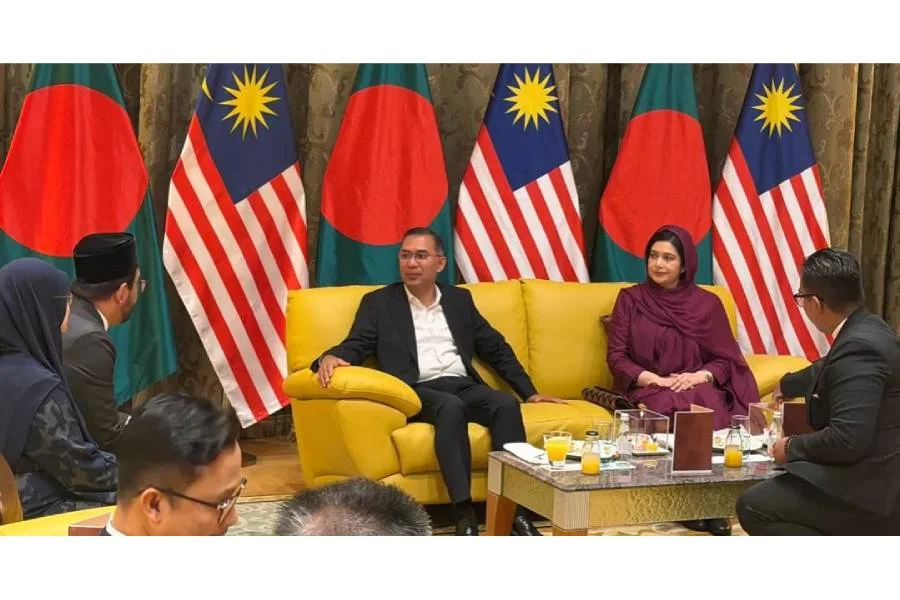
King's consort, Queen Raja Zarith Sofiah, and Bangladesh premier's spouse, Dr Zubaida Rahman, were also present.

Sultan Ibrahim was installed as the King of Malaysia on January 31, 2024. The Sultan of the state of Johor took the oath of office as King and is serving a five-year term.

Malaysia has a unique constitutional monarchy. Of the country's 13 states, nine have hereditary royal families. The King is elected on a rotational basis every five years from among these royal rulers.

The senior ruler of each royal family is eligible to assume the throne.

This practice has been in place since the country gained independence from Britain in 1948. Malaysia's monarchy is currently regarded as the world's largest rotational monarchy.

(Inputs also taken from BSS and UNB)​
 

Dhaka seeks Malaysian investment, eyes FTA

PM meets top business leaders, discusses energy ties

1782174276635.webp

Prime minister Tarique Rahman calls on Malaysia’s King Sultan Ibrahim ibni Almarhum Sultan Iskandar at the Royal Palace Istana Negara on Monday. | Focus Bangla photo

Prime Minister’s Office spokesperson Mahdi Amin has said the government’s primary objective is to secure investment from Malaysia, reports BSS.

‘Prime minister Tarique Rahman held meetings with the chief executives of five leading Malaysian companies to encourage them to invest in Bangladesh,’ he told a press conference at the Shangri-La Hotel on Monday.

The prime minister met with top executives of the Malaysian business groups- Petronas Group, Axiata, AirAsia, Perodua, and MMC Group.

Mahdi said, ‘We are moving toward economic liberalization through the signing of free trade agreements and pursuing deregulation policies. The main objective is to attract investment from different parts of the world. From our perspective, Malaysia is one of the key targets.’

Mahdi, also prime minister’s expatriates’ welfare and overseas employment adviser, said, senior executives of five major Malaysian companies in the meeting with the Prime Minister and they discussed investment opportunities in Bangladesh.’

He said, ‘Bangladesh has a large market base, and naturally there is significant consumer demand that the companies can help to meet.’

Mahdi further stated that there are tremendous opportunities for employment generation in Bangladesh.

‘On the one hand, our market demand is very high, and on the other, we have the capacity to provide a strong workforce. By combining the two strengths, we have assured potential investors that if they invest in Bangladesh, our government will provide policy support as much as possible and create a pro-business, pro-investment framework through deregulation.’

Prime minister’s foreign affairs adviser Humaiun Kabir, additional press secretary Atikur Rahman Ruman, deputy press secretary Jahidul Islam Rony and Bangladesh deputy high commissioner in Malaysia Shahanara Monica were present during the press conference.

Quoting the Ministry of Foreign Affairs, UNB reports: Bangladesh on Monday invited Malaysian companies to invest in its energy sector including in exploration of oil and gas in the Bay of Bengal, extraction of untapped minerals like coal, limestone, including renewable energy transition.

Both sides also encouraged cooperation between relevant national energy companies and private sector stakeholders to promote long-term, mutually beneficial partnerships that contribute to energy security, sustainability, and economic development in both countries.

Bangladesh and Malaysia recognised the importance of strengthening cooperation in the energy sector as a key pillar of bilateral economic relations, it said.

Both sides emphasize the importance of fully leveraging the agreed MoU between the governments of Bangladesh and Malaysia on co-operation in the field of Liquefied Natural Gas (LNG) supply, LNG infrastructure, petroleum products, and its infrastructure for direct bilateral LNG discussion between PETRONAS and PetroBangla, according to a joint statement shared by the ministry.

Earlier on the day, Bangladesh and Malaysia on Monday expressed their commitment to advancing the negotiations with a view to concluding the Free Trade Agreement (FTA) between the two countries in 2027 for a ‘mutually beneficial, comprehensive and forward-looking’ agreement that reflects current global trading practices.

The leaders - prime minister Tarique Rahman and Malaysian prime minister Anwar Ibrahim - welcomed the progress made towards the commencement of negotiations on the FTA between the two countries, according to a joint statement shared by the Ministry of Foreign Affairs.

Both leaders acknowledged the significance of bilateral trade and investment relations, noting that Bangladesh remains Malaysia’s second-largest trading partner in South Asia.

They expressed their commitment to further strengthening economic cooperation and facilitating two-way trade and investment.

The two prime ministers welcomed the progress made in the establishment of the Malaysia-Bangladesh Joint Business Council (JBC), which will serve as the key bilateral institutional mechanism for structured dialogue and the exchange of ideas to facilitate active collaboration between the private sectors of the two countries, thereby expanding bilateral economic, trade and investment ties.

Stressing the importance of enhancing trade, investment and sustainable economic partnership, the leaders encouraged greater collaboration across priority sectors including telecommunications, energy, infrastructure (e.g, roads, bridges, elevated expressways and digital public infrastructure), ports and logistics, halal industry, agro-processing, education and skills development, digital economy, semiconductor, smart manufacturing and other high-value across industries.

The leaders further encouraged closer cooperation between relevant government agencies, investment promotion agencies, industry players and business communities of both countries through investment facilitation, technical cooperation, capacity building, technology transfer, talent development, business matching and strategic partnerships, aiming to foster industrial upgrading, strengthen regional and global value chain participation, and create mutually beneficial investment opportunities for both nations.

They acknowledged the significant commercial potential of the global Islamic economy.

Recognising Malaysia’s expertise and extensive experience in the development of the halal ecosystem, they agreed to strengthen bilateral cooperation in support of Bangladesh’s development in its halal sector.

They acknowledged the Exchange of Notes on Cooperation in the Field of Halal Ecosystem and welcomed ongoing collaboration between the Department of Islamic Development Malaysia (JAKIM) and the relevant regulatory authorities of Bangladesh.

They reaffirmed their commitment to further enhance cooperation in areas including halal certification the development of regulatory frameworks, capacity building and training of professionals’ research and innovation, as well as institutional strengthening.​
 

Latest Posts

Back