The development has created panic among businesses as they apprehend difficulties in ensuring compliance with VAT and tax regulations when advertising directly with Meta.
www.thedailystar.net
Meta to deal directly with advertisers in Bangladesh
Meta logo is seen near computer motherboard in this illustration taken January 8, 2024. Photo: Reuters
Meta, the parent company of Facebook, plans to stop availing services of Httpool, its authorised sales partner in Bangladesh, from July and shift to a model where it will interact directly with advertisers.
"Meta has recently made the decision to standardise their advertiser service model worldwide," Aloke Panikar, regional director for Asia-Pacific at Aleph, the parent company of Httpool, said in a letter to advertisers in Bangladesh recently.
"…and in markets previously covered by an authorised sales partner, Meta will begin working with advertisers directly starting from July 1, 2024," the letter read.
"This means that Aleph will no longer be Meta's authorised sales partner."
The development has created panic among businesses as they apprehend difficulties in ensuring compliance with VAT and tax regulations when advertising directly with Meta.
"As a compliant company, we are worried," Fahim Mashroor, CEO of online job portal bdjobs.com, said.
"Advertising on Facebook with Httpool was easy as they took care of VAT and tax issues and we could pay in taka. Now, how Facebook will handle this remains unknown," he said.
To read the rest of the news, please click on the link above.
The goal of transforming the country into a software powerhouse remains as elusive as ever, even though successive governments have emphasised the issue. The Bangladesh Association of Software and Information Services (BASIS) raised the issue again on the opening day of Basis SoftExpo 2023 late las
www.thefinancialexpress.com.bd
R&D a prerequisite to developing the software sector Published: February 25, 2023 22:55:30
The goal of transforming the country into a software powerhouse remains as elusive as ever, even though successive governments have emphasised the issue. The Bangladesh Association of Software and Information Services (BASIS) raised the issue again on the opening day of Basis SoftExpo 2023 late last week and suggested that the ICT industry, academia and government devise a mechanism where the much-needed research and development (R&D) could be done. Such a move also needs to be supplemented by efforts to develop a qualified workforce for the software industry. Putting an efficient R&D network is imperative because the global software industry is fiercely competitive, where countries like India, Vietnam, the Philippines, Poland, Estonia and Ukraine are all vying for a share of the same pie.
The domestic software industry has been growing with government policy support, but much more needs to be done. One of the industry's Achilles Heels remains its lukewarm acceptance in the domestic market. Local companies are still facing an uphill task while selling their software to consumers at the corporate level. While smaller companies are slowly transitioning to a customised application made for their operations - whether it is payroll or inventory management, the prized contracts from the big conglomerates remain largely outside the purview of Bangladeshi software developers. The target is to raise the country's IT exports to US$5 billion by 2025 and $20 billion by 2030. But with the current state of affairs in the sector, it is doubtful the country would be able to go near the targets. Getting stakeholders like academia and software developers to collaborate with the relevant ministry is one part of that equation. But what will be the subjects of research? Data? That will not be easy. As far as big data is concerned, only the government can access that data: the NID database, credit information, and national household and health surveys, to name but a few.
To read the rest of the news, please click on the link below.
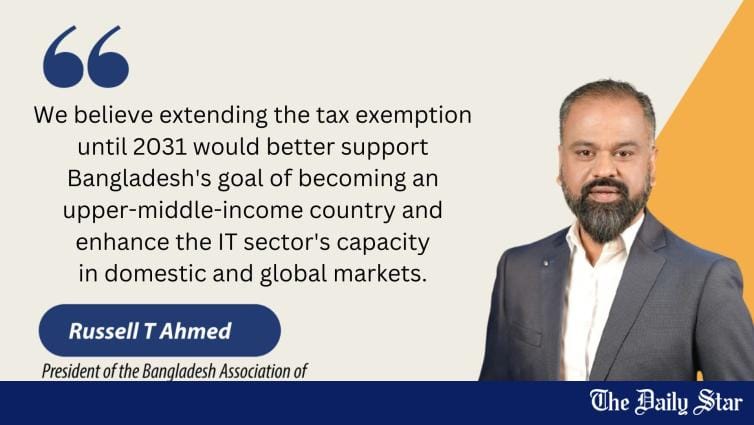
Extending the tax exemption until 2031 would better support Bangladesh's goal of becoming an upper-middle-income country and enhance the IT sector's capacity in domestic and global markets
www.thedailystar.net
ICT sector hails extension of tax exemption
Extending the tax exemption until 2031 would better support Bangladesh's goal of becoming an upper-middle-income country and enhance the IT sector's capacity in domestic and global markets
On behalf of the ICT sector, I thank honorable Prime Minister Sheikh Hasina for extending the tax exemption on the ICT sector by three years, aligning with BASIS's proposal for a Smart Bangladesh. I also thank the NBR for recognising the ICT sector's crucial role.
However, we believe extending it until 2031 would better support Bangladesh's goal of becoming an upper-middle-income country and enhance the IT sector's capacity in domestic and global markets.
Impact of Tax Exemption on Other Sectors
This tax exemption will significantly boost the IT sector and play a pivotal role as this sector can be the nucleus for building a Smart Bangladesh across education, healthcare, agriculture, banking, and manufacturing sectors.
These sectors are integral to the Fourth Industrial Revolution. Without it, development would be disrupted, hindering the prime minister's vision of a Smart Bangladesh by 2041. This initiative revives BASIS's efforts toward self-sufficiency in software and IT services.
BASIS Advocacy for Extension in Pre-Budget Discussions
During the pre-budget discussion with the honorable Prime Minister at the Gonobhaban on May 25, I emphasised the importance of extending the tax exemption for the IT sector.
BASIS also met with key figures, including State Minister for Finance Waseqa Ayesha Khan and Chairman of the Parliamentary Standing Committee on Ministry of Posts, Telecommunications, and Information Technology Kazi Nabil Ahmed to address this matter.
Future Goal: Bangladesh's Self-Sufficiency in ICT
Our future goal should be self-sufficiency in information technology. This budget sets the path to achieving it. Prioritising the domestic IT sector in government procurement is essential, and foreign institutions should partner with domestic ones if capacity is lacking for participating in the government tender.
As Bangladesh is set to become a developing country in 2026, we will face challenges. Establishing a recognised system of intellectual property valuation will help convert these challenges into opportunities, attracting foreign investment and enabling entrepreneurs to secure loans and investments from domestic banks.
To read the rest of the news, please click on the link above.
Committed to being 'Smart Bangladesh' by 2041, rampant in every sphere of the country's operation is being redacted, ultimately leading the country to enjoy economic freedom and phylogenetic transcendence. In the era of globalization, the touch of information technology (IT) has highly practicable
thefinancialexpress.com.bd
How can the women entrepreneurs in Bangladesh be well-equipped in the IT sector? TANJIM HASAN PATWARY
Published :
Jun 05, 2024 16:01
Updated :
Jun 05, 2024 16:01
Committed to being 'Smart Bangladesh' by 2041, rampant in every sphere of the country's operation is being redacted, ultimately leading the country to enjoy economic freedom and phylogenetic transcendence.
In the era of globalization, the touch of information technology (IT) has highly practicable implications, ranging from personal life to national or cross-cultural applications, for necessity or to compete in the competitive world.
Women of Bangladesh engage themselves in all sorts of work, and acclimatization to AI is becoming critical, especially while doing business regarding women's entrepreneurship.
According to the Bangladesh Bureau of Statistics (BBS), in 2019-20 FY, the number of registered wholesale and retail businesses was more than 2.5 million, with more than 10 million male and almost 200 thousand female entrepreneurs.
Though the number is comparatively lower than that of male entrepreneurs, the percentage is in the upward position, and it increased to 829 per cent, compared with 2002-03 FY.
According to the Time Use Survey (TUS)—2021 report conducted by the Bangladesh Bureau of Statistics (BBS) and UN Women Bangladesh, 21.25 per cent of internet users were women, compared to 35.15 percent for men.
Though the survey reports regarding women are somewhat disappointing, the upward trend of women's engagement with trade is gradually increasing.
A friendly business environment for both men and women requires comprehending the portfolio of ventures and stretching to enhance profitability.
To read the rest of the news, please click on the link above.
Information technology sector leaders on Sunday expressed their concerns over some provisions in the proposed budget for the 2024-25 financial year, saying that the removal of tax exemptions for cloud services and IT process outsourcing could hamper the sector’s journey toward achieving...
Information technology sector leaders on Sunday expressed their concerns over some provisions in the proposed budget for the 2024-25 financial year, saying that the removal of tax exemptions for cloud services and IT process outsourcing could hamper the sector's journey toward achieving self-reliance.
At a post-budget joint press conference held at the BASIS auditorium in the capital Dhaka, leaders of Bangladesh Association of Software and Information Services, Bangladesh Association of Contact Centre and Outsourcing, Internet Service Provider Association of Bangladesh and E-Commerce Association of Bangladesh sought policy support from the government to achieve self-reliance in this sector.
Finance minister Abul Hassan Mahmood Ali placed the proposed budget for the 2024-25 financial year before Jatiya Sangsad in the capital Dhaka on June 6.
BASIS president Russell T Ahmed urged the government to keep cloud services and web hosting tax-free to support the growth of local ICT service companies.
He also called for the reconsideration of the imposition of a 1-per cent import duty on capital equipment for high-tech park investors, urging the government to maintain the current duty-free status.
Russell thanked prime minister Sheikh Hasina for extending the tax exemption for the ICT sector for three years.
BACCO president Wahid Sharif criticised the proposal to increase supplementary duty on mobile SIM card usage by 5 per cent.
He also expressed concern over the removal of tax exemptions from sectors like cloud services, IT process outsourcing, medical transcription, search engine optimisation, system integration and NTTN services, saying that the initiative could negatively impact the ICT industry.
To read the rest of the news, please click on the link above.
At least 10 percent of the internal development budgets of all ministries and their affiliated bodies should be dedicated to the procurement of software and IT-enabled services (ITES) from domestic IT companies, according to Ahsan H Mansur, executive director at the Policy Research Institute of...
www.thedailystar.net
Procure more domestic software to boost ICT sector: expert
At least 10 percent of the internal development budgets of all ministries and their affiliated bodies should be dedicated to the procurement of software and IT-enabled services (ITES) from domestic IT companies, according to Ahsan H Mansur, executive director at the Policy Research Institute of Bangladesh.
Limited procurement of domestic software by the government restricts the growth and international recognition of local companies, the economist said.
He said joint ventures could be formed to implement big IT projects undertaken by the government, bolstering the survival and recognition of local software companies.
Mansur made the remarks while presenting the keynote at a roundtable, titled "Importance of ICT for Economic Growth in Bangladesh", organised by the Bangladesh Association of Software and Information Services (BASIS) at its auditorium in Dhaka.
The ICT sector has emerged as the nucleus of industrial manufacturing and exporting, agricultural progression, and service sectors' uninterrupted quality delivery processes, he said.
"ICT, as a cross-cutting sector, is the cornerstone upon which the efficiency and productivity of all other sectors depend. As the nucleus of every industry, ICT enables streamlined operations, enhanced data management, and innovative solutions that drive economic growth and competitiveness."
Speaking about the challenges facing the ICT sector in Bangladesh, Mansur highlighted the lack of digital literacy and infrastructure.
He said there is a significant gap in digital literacy within the population, which hampers the effective utilisation of ICT tools and services.
The social and economic return from public investment in this area would be huge and would help address the problem of unemployment among the educated youth.
Such a measure would also increase incomes through freelance and inflow remittances and increase household income across the country in defiance of the rural-urban bias.
On the other hand, inadequate ICT infrastructure, particularly in rural areas, limits the reach and impact of digital services as it leads to unstable internet connections and unreliable power supply.
Reducing this would help bridge the rural-urban digital divide.
To bolster women's entrepreneurship in the ICT sector, he proposed to form a Tk 300 crore fund through which loans can be offered at modest interest rates of 2-5 percent.
Mansur also urged the government, finance ministry and Bangladesh Bank to look at the ICT sector in a new light.
"ICT comes with no tangible assets. Valuation of its intangible assets requires a different approach. And I think Bangladesh Bank needs to guide our commercial banks and financial institutions to come forward and help the ICT sector."
In addition, he said the central bank and government can allocate resources in the form of a revolving fund.
He also opined that Bangladesh should develop the capacity to produce 1 lakh highly-skilled ICT graduates every year.
"Prepare a roadmap for that, select the universities, review their curriculum and make it of global standards. Try to bring out the best Bangladeshi students through that system."
Russell T Ahmed, president of the BASIS, said developing skilled human resources is the most important step towards growing the sector.
The only raw materials of the ICT industry are human resources. Unfortunately, we must pay 27.5 percent tax and VAT for any training we avail from an ICT organisation.
"If that is withdrawn, we will be able to contribute more and Bangladeshi IT companies will perform wonders," he added.
M Rashidul Hasan, BASIS senior vice-president, and Syed Mohammad Kamal, vice-president, were also present.
Logitech has launched the MK220 wireless Bangla keyboard and mouse combo in Bangladesh. The combo offers a compact keyboard and a mouse, both of which come with 2.4 GHz wireless connectivity that works up to 10 meters away, as per the company.
www.thedailystar.net
Logitech releases MK220 wireless Bangla keyboard and mouse combo
Logitech MK220
Logitech has launched the MK220 wireless Bangla keyboard and mouse combo in Bangladesh. The combo offers a compact keyboard and a mouse, both of which come with 2.4 GHz wireless connectivity that works up to 10 meters away, as per the company.
According to an official press release, this is the first Logitech wireless keyboard embedded in Bangla font (Bijoy layout). Logitech also states that the keyboard's battery can last up to 24 months, while the mouse's battery life can extend up to 12 months.
The keyboard and mouse combo works by plugging a USB receiver into the computer's USB port. It is compatible with Windows-based PCs and ChromeOS, as per Logitech.
The Logitech MK220 wireless Bangla keyboard and mouse combo is priced at BDT 2,249.

 Bangladesh Defense