
 Bangladesh Defense
Saif
Senior Member
- Jan 24, 2024
- 21,561
- 9,760
- Nation

- Residence
- Axis Group

Trans-boundary rivers to be managed based on shared interests: Humaiun
Staff Correspondent . Dhaka
PID photo
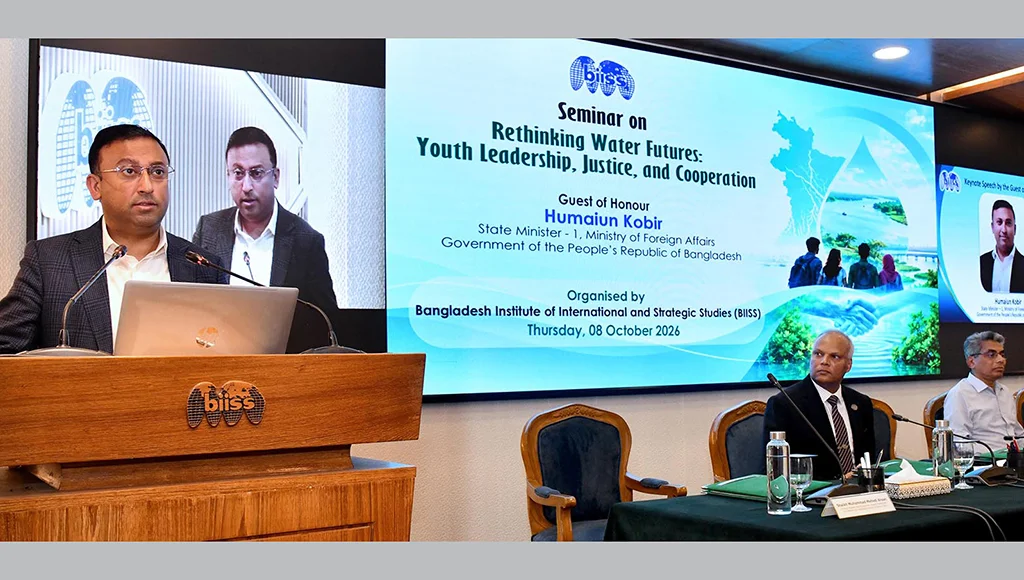
State minister for foreign affairs Humaiun Kobir on Thursday said that Bangladesh had consistently remained committed to the international law with the principle that trans-boundary rivers should be managed on the basis of shared interests.
Delivering his keynote speech at a seminar titled Rethinking Water Futures: Youth Leadership, Justice and Cooperation’, he said that more than 600 million people depended on 57 common rivers connecting Bangladesh with its neighbours and water security remained inseparable from the country’s national security and sustainable development.
Bangladesh Institute of International and Strategic Studies organised the seminar at its auditorium in the Dhaka city.
Humaiun’s remarks came out ahead of the expiry of the 30-year Ganges Water Sharing Treaty signed with India on December 12, 1996.
He said, ‘International water law provides an important foundation supporting equitable and reasonable utilisation, the obligation not to cause significant harm, and peaceful cooperation.’
‘These principles should guide the management of shared water resources,’ he added.
However, principles alone were not enough, Humaiun said, stressing the need for better data, scientific cooperation, regular dialogue, greater transparency and mechanisms through which riverine countries could better manage trans-boundary waters and realise shared benefits.
He said the present government was supporting Kazakhstan’s initiative to establish an international river organisation within the United Nations system.
Chief guest and water resources minister Shahiduddin Chowdhury Anee said Bangladesh would consider not only the quantity of water but also the timing and variability of the Ganges flows, flood management, sedimentation, river ecosystems and the livelihoods of river-dependent communities while proposing a ‘fresh’ version of the Ganges Water Sharing Treaty.
He said the government was working to renew the treaty in due time, incorporating a guarantee clause.
Regarding the Teesta, the minister said the river was extremely important to the people of northern Bangladesh.
‘Water shortages during the dry season and river erosion and flooding during the monsoon are among the major challenges associated with the Teesta,’ he said, adding that the government was prioritising the Teesta project and conducting feasibility studies and technical assessments.
Malik Fida Khan, former executive director of the Center for Environmental and Geographic Information Services, stressed the need for sustained dialogue involving India and China for the sustainable management of the Brahmaputra, Ganges and Meghna river basins.
He also called for greater representation of communities living along the rivers in such discussions.
Chaired by BIISS director general Major General ASM Ridwanur Rahman, urban planner Sheikh Muhammad Mehedi Ahsan, Oxfam International’s former technical coordinator, Zerin Ahmed, also spoke at the event.
Staff Correspondent . Dhaka
PID photo
State minister for foreign affairs Humaiun Kobir on Thursday said that Bangladesh had consistently remained committed to the international law with the principle that trans-boundary rivers should be managed on the basis of shared interests.
Delivering his keynote speech at a seminar titled Rethinking Water Futures: Youth Leadership, Justice and Cooperation’, he said that more than 600 million people depended on 57 common rivers connecting Bangladesh with its neighbours and water security remained inseparable from the country’s national security and sustainable development.
Bangladesh Institute of International and Strategic Studies organised the seminar at its auditorium in the Dhaka city.
Humaiun’s remarks came out ahead of the expiry of the 30-year Ganges Water Sharing Treaty signed with India on December 12, 1996.
He said, ‘International water law provides an important foundation supporting equitable and reasonable utilisation, the obligation not to cause significant harm, and peaceful cooperation.’
‘These principles should guide the management of shared water resources,’ he added.
However, principles alone were not enough, Humaiun said, stressing the need for better data, scientific cooperation, regular dialogue, greater transparency and mechanisms through which riverine countries could better manage trans-boundary waters and realise shared benefits.
He said the present government was supporting Kazakhstan’s initiative to establish an international river organisation within the United Nations system.
Chief guest and water resources minister Shahiduddin Chowdhury Anee said Bangladesh would consider not only the quantity of water but also the timing and variability of the Ganges flows, flood management, sedimentation, river ecosystems and the livelihoods of river-dependent communities while proposing a ‘fresh’ version of the Ganges Water Sharing Treaty.
He said the government was working to renew the treaty in due time, incorporating a guarantee clause.
Regarding the Teesta, the minister said the river was extremely important to the people of northern Bangladesh.
‘Water shortages during the dry season and river erosion and flooding during the monsoon are among the major challenges associated with the Teesta,’ he said, adding that the government was prioritising the Teesta project and conducting feasibility studies and technical assessments.
Malik Fida Khan, former executive director of the Center for Environmental and Geographic Information Services, stressed the need for sustained dialogue involving India and China for the sustainable management of the Brahmaputra, Ganges and Meghna river basins.
He also called for greater representation of communities living along the rivers in such discussions.
Chaired by BIISS director general Major General ASM Ridwanur Rahman, urban planner Sheikh Muhammad Mehedi Ahsan, Oxfam International’s former technical coordinator, Zerin Ahmed, also spoke at the event.

