[🇧🇩] India's Water Terrorism Against Bangladesh

[🇧🇩] India's Water Terrorism Against Bangladesh
314
15K
More threads by Saif

G Bangladesh Defense

Trans-boundary rivers to be managed based on shared interests: Humaiun
Staff Correspondent . Dhaka
1791510981377.webp

PID photo

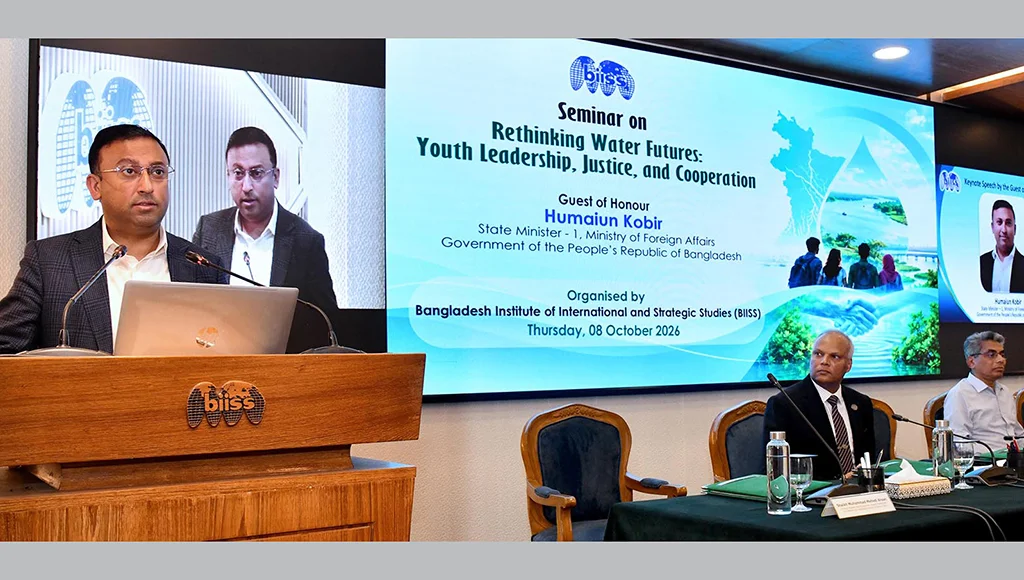
State minister for foreign affairs Humaiun Kobir on Thursday said that Bangladesh had consistently remained committed to the international law with the principle that trans-boundary rivers should be managed on the basis of shared interests.

Delivering his keynote speech at a seminar titled Rethinking Water Futures: Youth Leadership, Justice and Cooperation’, he said that more than 600 million people depended on 57 common rivers connecting Bangladesh with its neighbours and water security remained inseparable from the country’s national security and sustainable development.

Bangladesh Institute of International and Strategic Studies organised the seminar at its auditorium in the Dhaka city.

Humaiun’s remarks came out ahead of the expiry of the 30-year Ganges Water Sharing Treaty signed with India on December 12, 1996.

He said, ‘International water law provides an important foundation supporting equitable and reasonable utilisation, the obligation not to cause significant harm, and peaceful cooperation.’

‘These principles should guide the management of shared water resources,’ he added.

However, principles alone were not enough, Humaiun said, stressing the need for better data, scientific cooperation, regular dialogue, greater transparency and mechanisms through which riverine countries could better manage trans-boundary waters and realise shared benefits.

He said the present government was supporting Kazakhstan’s initiative to establish an international river organisation within the United Nations system.

Chief guest and water resources minister Shahiduddin Chowdhury Anee said Bangladesh would consider not only the quantity of water but also the timing and variability of the Ganges flows, flood management, sedimentation, river ecosystems and the livelihoods of river-dependent communities while proposing a ‘fresh’ version of the Ganges Water Sharing Treaty.

He said the government was working to renew the treaty in due time, incorporating a guarantee clause.

Regarding the Teesta, the minister said the river was extremely important to the people of northern Bangladesh.

‘Water shortages during the dry season and river erosion and flooding during the monsoon are among the major challenges associated with the Teesta,’ he said, adding that the government was prioritising the Teesta project and conducting feasibility studies and technical assessments.

Malik Fida Khan, former executive director of the Center for Environmental and Geographic Information Services, stressed the need for sustained dialogue involving India and China for the sustainable management of the Brahmaputra, Ganges and Meghna river basins.

He also called for greater representation of communities living along the rivers in such discussions.

Chaired by BIISS director general Major General ASM Ridwanur Rahman, urban planner Sheikh Muhammad Mehedi Ahsan, Oxfam International’s former technical coordinator, Zerin Ahmed, also spoke at the event.​
 

MOVE ON TEESTA MANAGEMENT PROJECT
Bangladesh to do feasibility study on its own


1791588593258.webp


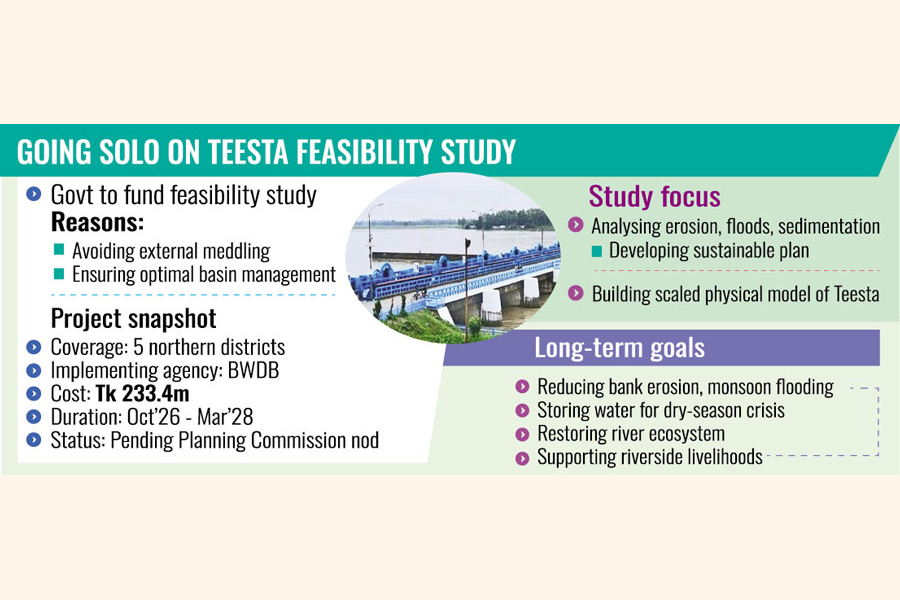
Bangladesh is set to conduct feasibility study on the long-stalled Teesta river-management project on its own to avoid any external meddling and get a better way of managing the cross-border water basin, officials said.

Since the proposed Teesta project is a geopolitically sensitive one, the Bangladesh government wants to conduct the feasibility study with its own funds for finding out viability and justification for the water-management project, they added.

"There some geopolitical issues involved in the Teesta river-management project. This time, the government itself wants to go for the feasibility," a senior official of the Ministry of Water Resources told The Financial Express.

Bangladesh Water Development Board (BWDB) has recently undertaken a Tk 233.40-million project for feasibility study and sent to the Planning Commission (PC) for approval.

"We have undertaken the feasibility-study project before going to develop the water-management system and river-restoration programme in the Teesta basin," said a senior BWDB official.

The proposed project for development of the river waters will cover five northern districts--Nilphamari, Lalmonirhat, Rangpur, Kurigram and Gaibandha.

Bangladesh has a stretch of 120-km water flow out of the total 315 kilometres in the Bangladesh-India cross-border Teesta River. The river originated in Sikkim, India.

The project is among the most closely watched infrastructure initiatives in the country, and it has drawn interest from major regional and global powers.

The past interim government last year sent a Preliminary Development Project Proposal (PDPP) to Chinese seeking necessary funds for the 1st phase of the "Teesta River Comprehensive Management and Restoration Project (TRCMRP)".

The government wanted to start project works in January next and complete the first phase within four years. It ultimately didn't proceed and the current BNP-led government now prepared the feasibility-study project for a better start-off.

Meanwhile, during Prime Minister Tarique Rahman's visit to China in June last, the two countries advanced cooperation on the Teesta project, including a new feasibility-study effort.

Besides, nearly a decade ago in September 2016, a memorandum of understanding (MoU) was signed between BWDB and China's state-owned Power Construction Corporation (Power China). But that project didn't advance either due to "shifting geopolitical circumstances".

Water resources ministry officials have said the fresh study would be crucial to taking the plan toward implementation, and that it would determine the precise locations and scope of the proposed works.

They stress that this is not the end of the planning stage. Environmental-impact assessment, final design, government approval, financing and field-level implementation would have to be done after the feasibility study.

According to the feasibility-study project proposal, the BWDB would conduct the study between October 2026 and March 2028.

Under the component-1 of the study project, the Board will analyse river erosion, flood, sedimentation and water-scarcity problem, and will develop "adaptive, integrated and sustainable plan".

In the componenent-2, the water development board will develop high-quality and scaled physical model representing the Teesta River focusing area under realistic hydrodynamics and sediment-transport condition, and prepare detailed data-sheet to support calibration, validation and performance evaluation of the models.

The Teesta originates in the Himalayas, flows through Sikkim and West Bengal and enters northern Bangladesh before falling into the Jamuna River.

Bangladesh's section of the river supports irrigation, agriculture, fisheries and the livelihoods of communities in the Rangpur region.

The proposed TRCMRP aims to manage the river as a basin-wide infrastructure and restoration project, with several objectives like reducing riverbank erosion and monsoon flooding, dredging sediment and improving river-channel management, storing and managing water to help address dry-season shortages.

Also, the project aims to reclaim land for agriculture and other economic activities; improve embankments, transport links and river access, restore the river ecosystem, and support communities along its banks.

The Teesta plan comes as the government commits heavily to water infrastructure. It recently approved the first phase of the Padma Barrage project, worth over Tk 330 billion.

Bangladesh and India have negotiated a proposed interim water-sharing agreement for years. A draft was finalised in 2011, but it was not signed. India's federal and state-level political considerations, including the position of West Bengal, have been major obstacles to reaching agreement.

In their September 2022 joint statement, the two countries reiterated the need to work towards a Teesta water-sharing agreement. India's official position has also referred to reaching an equitable agreement acceptable to all stakeholders.

The central issue is seasonal water availability. Bangladesh needs sufficient dry-season flow for irrigation and livelihoods, while farmers and water users in India's West Bengal also depend on the river.​
 

New Ganges waters treaty with guarantee clause emerges as priority for Dhaka

Treaty expires in December as Dhaka pushes for assured dry-season flows and stronger cooperation with India on shared rivers

1791592406377.webp

National flags of Bangladesh and India. Photo: Bigstock

Securing its fair share of the transboundary rivers' waters is likely to become a major issue for Bangladesh in the coming days, making effective water diplomacy, international cooperation and constructive engagement with India increasingly important, officials and experts have said.

The urgency is underscored by the Ganges Water Sharing Treaty, signed on December 12, 1996, which is due to expire on the same date this year. The government in Dhaka has been increasingly vocal in recent weeks, communicating a vision that Bangladesh will be seeking a new or revised agreement that safeguards its interests, particularly its share of dry-season flows, with the inclusion of a guarantee clause.

“Water could emerge as one of the major challenges for the entire world, including Bangladesh, in the future,” said Local Government, Rural Development and Co-operatives Minister Dr Abdul Moyeen Khan on Thursday, stressing the need to integrate proper water management into national development planning.

Bangladesh and India share 54 transboundary rivers, but the Ganges remains the only one covered by a bilateral water-sharing agreement between the two countries.

Guarantee clause a key priority

Water Resources Minister Shahiduddin Chowdhury Anee said Bangladesh wants a new or revised Ganges agreement rather than simply renewing the existing treaty, with provisions guaranteeing its required share of water during the dry season.

“Our main priority will be to bring back the guarantee clause that was included in the 1977 agreement,” he said on Thursday.

The 1977 agreement, negotiated by the BNP's founder Ziaur Rahman, included a safeguard stipulating that if the Ganges flow at Farakka fell below the level projected in the treaty to be provided to Bangladesh as its scheduled share during any 10-day period, the release to Bangladesh would not fall below 80% of that share.

An official also referred to Article III of the 1977 agreement, which stipulated that water released to Bangladesh at Farakka should not be reduced below Farakka, except for India's reasonable water uses, not exceeding 200 cusecs, between Farakka and the point where both banks of the Ganges lie within Bangladesh.

State Minister for Foreign Affairs Humaiun Kobir said Bangladesh would seek an outcome that safeguards its national interests and security, including through a possible guarantee clause.

Asked whether the existing treaty would be renewed or replaced with a new agreement, he said, “Whatever is best for Bangladesh’s interest will be done.”

Kobir said Bangladesh’s committee was ready and Dhaka was awaiting a final response from its Indian counterparts.

“Our committee is ready. We are just waiting for the final response from our Indian counterparts. So yes, we are hopeful,” he said.

He also stressed that international law was being taken into consideration in addressing the water-sharing issues.

The Indian government, through its Ministry of External Affairs spokesperson Randhir Jaiswal has said that issues concerning the Ganges treaty and other shared rivers would be discussed through the Joint Rivers Commission (JRC).

“On the Ganga Water Treaty, as also other rivers that we share between Bangladesh and India, we have a Joint Rivers Commission. All matters relating to rivers, river-related matters, will be discussed as part of this Joint Rivers Commission,” he said recently, adding that technical-level meetings on the Ganges treaty had continued.

Kobir said sincerity at the political and official levels in both countries was essential to finding an amicable resolution to the long-standing water-sharing issues.

He expressed optimism that the issues could be resolved positively if the leadership of both countries demonstrated a willingness to cooperate.

Cooperation key to water diplomacy

Anee said water diplomacy should focus on cooperation and mutual benefits rather than competition, stressing the need for sustained dialogue, scientific cooperation, data sharing and inclusive water governance.

“Cooperation should create mutual benefits rather than being framed explicitly as a competition over water,” he said.

He described water as closely linked to Bangladesh’s geography, economy, agriculture, culture, foreign policy and national security.

“We are a delta country shaped by rivers. Yet, we are also a riparian country dependent on water flows originating beyond our borders,” he said.

Anee called for stronger engagement through the JRC and multilateral water governance mechanisms, alongside greater international cooperation and scientific collaboration.

Bangladesh has joined the UN Water Convention, while the Delta Plan 2100 and national river-management initiatives provide a broader framework for addressing long-term water challenges.

“We need cooperation instead of confrontation, evidence instead of assumptions, participation instead of execution, and long-term planning instead of short-term responses,” he said.

“Our goal should not simply be to manage water crises when they occur; our goal should be to build a just, decent, and cooperative water future,” Anee added, calling for greater youth participation in water governance.

Teesta remains a major concern

Turning to the Teesta, Anee said the river was particularly important for people in northern Bangladesh, where seasonal variations cause water shortages during the dry season and erosion and flooding during the monsoon.

He said the government had placed considerable emphasis on the Teesta project, with feasibility studies and technical assistance underway.

State Minister Kobir also highlighted the importance of water diplomacy on multilateral platforms, stronger international partnerships, technology transfer and scientific cooperation to advance Bangladesh’s interests in transboundary water management.

With the Ganges treaty approaching expiry, Bangladesh faces the task of securing an equitable and sustainable water-sharing arrangement while strengthening cooperation on other shared rivers.

“I think it is very important for Bangladesh and India to renew the Ganges Treaty. But it has to be revised. The very simple reason is that the treaty was done almost three decades ago,” international affairs expert Prof Shahab Enam Khan told UNB recently.

Shahab, who is the executive director of Bangladesh Center for Indo-Pacific Affairs, strongly suggested that this should also come with arrangements such as revitalising the JRC and including a much more transparent and accountable data-sharing system, which will definitely build much more confidence over "hydro-diplomacy" and water management and water sharing, most importantly, between the two countries.

“This is very important that we should also go into the diplomatic negotiations not only from the diplomatic perspective, but also from engineering, science, and definitely economic perspectives,” he said.

Foreign Minister Dr Khalilur, while attending the ninth Indian Ocean Conference in Mauritius, said they would like to see that there is an arrangement and a new treaty, or a revised treaty, ensuring the essential needs of their people.

“These are common rivers, and we have common legacies here, common interests and, as I said, there's no other alternative but to seek a solution that is durable and will win public trust. And this will also be very important to lay the basis for the relationship over the next 25 to 50 years,” he told NDTV on the sidelines of the conference.

The foreign minister said they have done 55 years (of bilateral relations) already. “So, I don't think we should look at five years or ten years. We have to look at the very long term. So, mutual climate resilience as a priority in our foreign policies, our people policy, I should say, will actually be a key driver of the future.”​
 

Latest Posts

Back