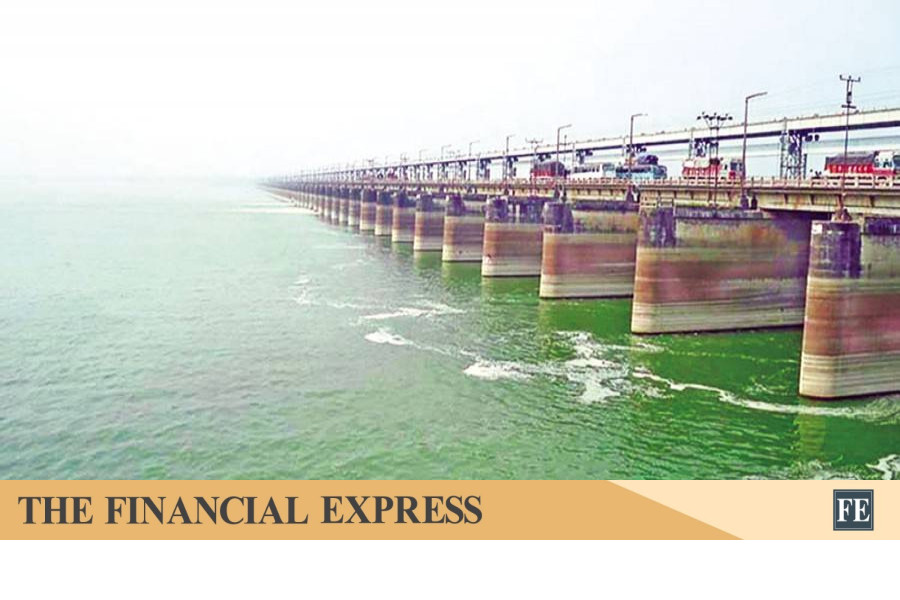
[🇧🇩] India's Water Terrorism Against Bangladesh

Quick Reply ✓ Posted!
[🇧🇩] India's Water Terrorism Against Bangladesh
321
16K
More threads by Saif

G Bangladesh Defense

Pilot project for Teesta master plan to begin soon: State Minister Azad
​
1786232708690.webp

​
State Minister for Water Resources Farhad Hossain Azad today spoke to the journalists at Chilmari river port area. Photo : BSS

State Minister for Water Resources Farhad Hossain Azad today (Saturday) said that the technical committee has been working on the implementation of the Teesta Master Plan and its consultations are also being held with the experts from different countries.

“A pilot project under the master plan will be launched within a short time,” he made the remarks while talking to the journalists at Chilmari river port area, BSS reports.

Earlier, the state minister visited several river erosion-hit areas at Chilmari, Ulipur, Roumari and Rajibpur upazilas of the district.

Responding to questions about the Teesta project, Azad said, “The Teesta is a major project. It is not possible to implement such a large project in a single day. Our government is only five months old. Give us some time. We will begin work on the Teesta Master Plan as a pilot project within a short time.”

Regarding the overall river erosion situation in Kurigram, the state minister said he had personally inspected the erosion-hit areas across the district including the Chilmari river port.

He said two projects have already been undertaken to construct permanent embankments and prevent river erosion in the district. The government is reviewing the progress of the projects and taking steps to ensure their speedy implementation.

Assuring that there would be no political discrimination in measures to prevent river erosion, Azad said the government stands beside people affected by erosion.

“The government has taken necessary measures so that the people do not lose their homes, markets, mosques, temples or educational institutions to river erosion,” he said.

He further said, “Following the prime minister’s instructions, we are conducting field-level visits together with local members of parliament and relevant officials to determine how quickly the projects can be implemented.”

The minister said emergency work is currently underway in around 100 erosion-prone areas of Kurigram. He added that instructions would be issued to take prompt measures wherever further intervention is required.

After his programme here, the state minister said he would travel to Gaibandha to inspect two ongoing projects funded by the World Bank.

Among others, lawmakers from Kurigram-4 constituency Mostafizur Rahman, Kurigram-3 constituency Barrister Mahbub Salehi, reserved seat women lawmaker Suraiya Jerin Roni, Bangladesh Water Development Board Director General Md Ruhul Amin, Kurigram Deputy Commissioner Annapurna Debnath and Kurigram Water Development Board Executive Engineer Rakibul Hasan, accompanied the state minister.

Excepting those officials, Kurigram district BNP convener Mostafizur Rahman, its member secretary Sohel Hossain Kaikobad, senior joint convener Shafiqul Islam Babu, joint convener Prof. Habibur Rahman Hasib, Convener of Chilmari upazila BNP freedom fighter Abdul Bari, its member secretary Assistant Prof. Abu Hanifa and joint convener Assistant Prof. Fazlul Haque, were also present at that time.​
 

Can the new political reality break the Teesta River deadlock?
Farzana Afroz & Tania Khatun

1786234149202.webp

Thousands of demonstrators step into the Teesta River water near the Teesta Rail Bridge in Lalmonirhat to protest against the “water aggression” of India against Bangladesh on 18 February 2025. Prothom Alo

For nearly four decades, Bangladesh and India have remained at loggerheads over the management of shared water resources. By controlling the upstream reaches of 54 transboundary rivers that originate in India and flow into Bangladesh, New Delhi enjoys a significant strategic advantage in regulating the flow of these rivers.

India enjoys greater leverage in negotiations over the Teesta and Ganges rivers due to its upstream position. It has increasingly used its control over shared water resources as a strategic instrument. A substantial portion of the Teesta's water is currently utilized within India. Moreover, more than 20 large dams and hydroelectric power projects have been constructed along the river, the vast majority of which are located in Indian territory. Approximately two-thirds of the Teesta River lies within India, while the remaining one-third flows through Bangladesh.

However, tensions over the Teesta River have intensified in recent years. China's proposal to invest in the Teesta River Comprehensive Management and Restoration Project has added a new geopolitical dimension to the dispute. For Bangladesh, accepting Chinese investment presents a strategic dilemma, as India views China's expanding presence in South Asia with considerable suspicion. Consequently, Dhaka must carefully balance its development needs with its foreign policy priorities. At the same time, many analysts argue that Bangladesh should avoid excessive dependence on any single external power and instead pursue a foreign policy that safeguards its national interests while maintaining constructive relations with both India and China.

The Teesta River dispute extends far beyond water sharing. It has significant implications for Bangladesh–India relations, regional cooperation, food security, agricultural productivity, and the livelihoods of millions who depend on the river.

Teesta originates in the Eastern Himalayas and flows through the Indian state of Sikkim and West Bengal before entering Bangladesh’s Rangpur Division, ultimately draining into the Bay of Bengal. The river is approximately 414 km long in total, of which about 151 km flows through Sikkim, around 283 km through West Bengal, and roughly 121 km through Bangladesh.

India has been unilaterally withdrawing water from the Teesta since 2011. The West Bengal government even took the initiative to dig two more canals upstream in 2023 to divert water, disregarding international norms regarding shared rivers.

The India–Bangladesh Joint Rivers Commission (JRC) was established in 1972, following initial discussions in the 1950s and 1960s.

A provisional understanding reached in 1983 reportedly allocated 39 per cent of Teesta waters to India and 36 per cent to Bangladesh, while 25 per cent remained unallocated. Bangladesh, however, has at times sought up to 50 per cent of the flow. The arrangement was never fully implemented.

According to the West Bengal Chief Minister Jyoti Basu, set an important precedent for water-sharing cooperation In 1996 The Ganges Water Treaty. However, the Teesta issue remained unresolved. Between 1997 and 2005, several joint technical committees failed to reach a consensus, particularly regarding dry-season water availability.

A draft agreement proposed in 2011 suggested allocating 42.5 per cent of Teesta waters to India and 37.5 per cent to Bangladesh. However, it was not finalized, reportedly due to objections from the West Bengal state government, which cited concerns over state-level water security. As a result, negotiations have since remained stalled.

India has been unilaterally withdrawing water from the Teesta since 2011. The West Bengal government even took the initiative to dig two more canals upstream in 2023 to divert water, disregarding international norms regarding shared rivers.

According to The Government of West Bengal, particularly Chief Minister Mamata Banerjee, has at various times expressed reservations regarding the Teesta Water Sharing Agreement. She has argued that the water flow in the Teesta basin has declined significantly due to climate change, including glacial retreat and changing rainfall patterns. According to this position, releasing additional water to Bangladesh during the dry season could adversely affect irrigation in northern West Bengal and impact local farmers.

The state government has also pointed out that agricultural expansion in Bangladesh following the commissioning of the Teesta Barrage in 1998 has increased water demand downstream, which, in its view, complicates additional water allocation.

Furthermore, West Bengal has ongoing irrigation and hydropower development plans in the Teesta basin, including projects intended to generate approximately 67.6 megawatts of electricity and provide irrigation coverage for about 922,000 hectares of land. Officials argue that any significant increase in downstream allocation could affect these planned developments and water availability within the state.

In recent years, Bangladesh has expressed concern over reduced dry-season flows, while discussions on upstream water use and diversion projects in India have continued at the subnational level. The issue remains sensitive and unresolved within the broader framework of bilateral river water cooperation.

The Teesta River is a crucial transboundary river for Bangladesh, as it is closely linked to agriculture, food security, and rural livelihoods. Its importance is particularly significant, with estimates suggesting that it contributes to the irrigation of around 14 per cent of the country’s arable land, while the livelihoods of approximately 7.3 per cent of the population are directly or indirectly dependent on it.

According to Bangladesh’s position, a substantial portion of Teesta waters is utilized upstream in India, and during the dry season the flow entering Bangladesh is significantly reduced. As a result, Bangladesh has consistently sought a fair and equitable share of the river’s dry-season flow, often cited as around 50 per cent, particularly between December and May when water levels decline sharply.

Due to India's excessive water withdrawal, about 100,000 hectares of land in the Rangpur region is not suitable for winter crop cultivation, which has a major impact on agricultural production.

Millions of people across five northern districts—Rangpur, Lalmonirhat, Nilphamari, Kurigram, and Gaibandha—depend on the Teesta River for irrigation, fishing, and seasonal employment. 750,000 hectares of land in Bangladesh depend on Teesta water for irrigation. Approximately 70 per cent of the population depends on agriculture, and the region contributes about 14 per cent of the country’s cultivable land. The Teesta Barrage Project in Bangladesh requires at least 4,500 cusecs of water during the dry season to effectively serve the region. However, recent reports suggest that the actual flow has dropped to around 400 cusecs.

In 1997, the Teesta River carried around 6,500 cusecs of water, which declined to approximately 1,348 cusecs by 2006, and further dropped to between 700 and 300 cusecs in the following decade. The Gazoldoba Barrage in West Bengal is reported to regulate and divert a significant portion of the river’s flow before it enters Bangladesh.

This deficit is not confined to official records. Water insecurity is visible in dried-up canals, empty fishing nets, and the fragile finances of char-area households, many of whom take loans against crops that may never be harvested.

The area faces severe seasonal extremes. During the monsoon, around 750,000 hectares of land are affected by flooding, while in the dry season (December to May), river flows can decline to as low as 300 cusecs. This seasonal scarcity contributes to reduced soil moisture, drying of croplands, and a reported annual decline in groundwater levels of about two feet in some areas.

These conditions exacerbate socio-economic vulnerability. According to World Bank estimates, around 40 per cent of households in the region live below the poverty line. Studies also suggest that improved irrigation could increase agricultural productivity by up to 25 per cent. In addition, the development of irrigation, transport, and industrial infrastructure linked to the basin could potentially generate employment opportunities for tens of thousands of people.

According to The Indian Constitution has given the power to enter into all kinds of communication and agreements with foreign countries to the Union Ministry of External Affairs. As a result, the central government can sign the agreement without the states. But it has political risks. And that is why neither the BJP nor the previous Congress government signed the Teesta Agreement.

Following the West Bengal elections in May 2026, a new state government took office after the change in leadership. With the transition, political constraints surrounding the Teesta water-sharing negotiations are widely seen as having shifted. However, analysts note that institutional and technical challenges in reaching a comprehensive agreement remain largely unchanged.

In this context, some observers argue that the removal of political obstacles should not be mistaken for an immediate restoration of normal river flows. While diplomatic space may have expanded, the physical reality of the Teesta has not significantly changed. A procedural breakthrough, they suggest, does not automatically translate into increased water availability downstream.

* Farzana Afroz is Assistant Professor, Department of International Relations, Jahangirnagar University

* Tania Khatun is a student of Department of International Relations, Jahangirnagar University​
 

Farrakka treaty to be renewed politically to ensure Bangladesh’s fair share of water: Water Resources Minister

1786317381659.webp


Water Resources Minister Md Shahid Uddin Chowdhury Anee has said the government will take political initiatives to ensure Bangladesh’s fair share of water from the 57 transboundary rivers shared with neighbouring countries.

He said the Farrakka Treaty would be renewed through political engagement while ensuring Bangladesh’s rightful share of water.

The minister made the remarks as the chief guest at a seminar titled “Transboundary Cooperation in South Asia: Prospects and Challenges” held at the auditorium of the Institution of Engineers, Bangladesh (IEB) in the capital on Sunday.

The minister said the shared rivers are not merely a matter of water management; they are closely linked to regional peace, food and water security, the environment, climate resilience and economic prosperity.

He also said the previous government had failed to ensure Bangladesh’s fair share of water from the Farrakka because of a lack of political foresight and what he described as a submissive policy.

Shahid Uddin Chowdhury said climate change risks, floods, river erosion, drought, salinity and water scarcity are increasingly posing major threats to South Asian countries.

He stressed the need to strengthen transboundary cooperation to address these common challenges.

According to him, such risks can be addressed by enhancing cooperation among countries in exchanging information on river flows and flood forecasts, conducting joint research, disaster management and building climate-resilient infrastructure.

The water resources minister also stressed the importance of strengthening transboundary cooperation among South Asian countries to address common challenges, including sustainable water management, climate change risks, energy and regional connectivity.

At the seminar, State Minister for Water Resources Farhad Hossain Azad said the government led by Prime Minister Tarique Rahman has been working for the country’s development since assuming office.

He said the Padma Barrage Project has already been approved and work on it would begin soon.

Referring to the Teesta Master Plan, the state minister said work on the project would begin soon after receiving the opinion of the technical advisory committee.

He expressed hope that a self-reliant Bangladesh envisioned by Shaheed President Ziaur Rahman would be built through the Padma Barrage, Teesta Master Plan and canal excavation projects.

Prime Minister’s Special Assistant for Environment, Forests and Climate Change Dr Saimum Parvez, Narsingdi-5 lawmaker Engineer Md Ashraf Uddin Bakul and others attended the seminar.

Engineer Shahrin Islam Tuhin, member secretary of the Association of Engineers Bangladesh, chaired the seminar.

Bangladesh Water Development Board’s Additional Chief Engineer Dr Mohammad Abul Hossain presented the keynote paper.

Former secretary Engineer ANH Akhter Hossain and others were also present at the event.​
 

What if Ganges Water Treaty is not renewed


1787526905676.webp


Thirty years is a long time for any treaty to hold. The Ganges Water Sharing Treaty, signed on December 12, 1996 in New Delhi, has quietly governed how much dry-season water reaches Bangladesh for three decades. It survived governments of both signatory countries. The treaty ends on December 12, 2026. Talks on what replaces it are underway in Dhaka and New Delhi, but talks and treaties are not the same thing, and there is no guarantee the second will exist by the time the first anniversary arrives.

It is thus worth asking, calmly and now, rather than in a panic come December -- what happens if it doesn't'? Does Bangladesh simply lose its claim to the river, and hope India feels generous? It's a fair worry. Roughly forty per cent of the country's people depend, one way or another, on what the Ganges offers them each dry season; irrigation, drinking water, fisheries, a coastline that salt water hasn't yet swallowed. But the worry rests on a misunderstanding of how international law actually works. A treaty is not the only mechanism standing between an upstream state and an unchecked hand on the tap. There is a body of law underneath it, one that applies whether or not any two governments have bothered to sign anything.

An old argument, long settled

In 1895, the American Attorney General (in Bangladesh terms the law minister) Judson Harmon, arguing with Mexico over the Rio Grande, put forward the idea that a country could do exactly as it liked with water flowing through its own soil; the consequences or repercussions downstream be damned. It is a seductive argument if you happen to be in the upstream. And for a while this macho doctrine had followers. It does not have any left. No court of good standing has ever upheld it and no serious government defends it today. Even the United States within a decade abandoned this position and negotiated a water sharing deal with Mexico instead, for whatever its worth. The opposite argument or extreme that a downstream county can demand the river's flow, untouched, forever, collapsed just as quickly for the obvious reason that it would leave upstream states unable to build so much as an irrigation canal.

What survived and what actually governs today, is somewhat in between. States sharing a river keep their sovereignty over the water within their own territory, but that sovereignty comes with strings attached, use it reasonably, and don't wreck it for the neighbours. This isn't a theory dreamed up by academics. The Permanent court of International Justice (PCIJ) said as much in 1929, ruling that an international river creates a "community of interest" among the states that share it, a shared stake that no single riparian gets to override (Territorian Jurisdiction of the International Commission of the River Oder). This laid down the groundwork for modern customary international law. An arbitral tribunal echoed similarly in 1957 in a dispute between France and Spain over a lake in the Pyranees -- an upstream state doesn't need the downstream state's permission to build, but it does have to consult honestly, in good faith and actually listen.

What the world court has ruled

The clearest word on this comes from the International Court of Justice (ICJ) itself in a 1997 case between Hungary and Slovakia over a dam on the Danube. The court held that every state sharing a river is entitled to "an equitable and reasonable share" of it. The ICJ made it clear that it is just not a matter of what a particular treaty happens to say, but a rule of international law generally. Thirteen years later, ruling on a dispute between Argentina and Uruguay over a paper/pulp mill, the court went a step further. It stated that any state planning works that could seriously affect a shared river now has to carry out a proper environmental study and notify its neighbour before going ahead (Construction of pulp mill near Fray Bentos 2010). In 2015, in a border dispute between Costa Rica and Nicaragua regarding construction of a road over the San Juan river, the Court confirmed the same duty again. This is thus not a fringe legal theory. It is what we call the world court keeps saying, case after case, decade after decade.

A warning from the Indus

If anyone doubts these rules matter, look next door. The Indus Water Treaty of 1960 between India and Pakistan is the closest example South Asia as to a model of water diplomacy. This treaty held through two wars and endless political hostility, and when India and Pakistan genuinely disagreed over a hydroelectric project on the Kishenganga, they did not rattle sabres. They went to arbitration at the Hague, which in 2013 set a minimum flow India had to guarantee downstream. Both sides accepted it. For decades, that treaty was cited around the worked as proof that even hostile neighbours can manage a shared river through law rather than force.

Then in April 2025, after the Pahalgum incident, casing death of 26 civilians in India administered Jammu-Kashmir, India put the treaty "in abeyance". This was never done before even in the midst of outright wars between the countries. India has held that line through 2026 brushing aside or ignoring a fresh arbitral ruling against them. Whatever one makes of the underlying dispute, the lesson for Dhaka is blunt: a treaty's age and reputation are not guarantee of its survival. Bangladesh should plan for the Ganges relationship with clear eyes -- not comfortable assumptions.

Where this leaves Bangladesh

None of this is an argument for easing up on the push for renewed treaty -- quite the opposite. A proper agreement, with an updated flow formula, joint monitoring and a real dispute resolution mechanism, beats reliance on general legal principles every time. Customary law is real. However, it is broad by nature and broad rules are harder to enforce in a specific dispute than a number written into a treaty. Renewal , on terms that reflect today's hydrology rather than data from the 1950s through the 1980s, should stay Dhaka's top priority. This must dominate their minds through the Joint River Commissions, and at the highest political level.

However, even if December comes and goes without a signed successor, Bangladesh is not left with nothing. India remains bound, under the customary international law and the principles of the International Court of Justice itself has repeatedly affirmed, to use the Ganges reasonably, to avoid causing serious harm to Bangladesh's own use of the river, to notify and consult before undertaking any new works that would affect its flow, and to carry out a proper environmental assessment first. These are not favours India might choose to extend. They are legal obligations. And Bangladesh should say so clearly, repeatedly and everywhere it has a voice including the UN General Assembly. From now through December, and beyond if it must.

A river does not read treaties. It rises and falls according to decisions made far upstream, regardless of what is written on paper. However, the states that share it remain bound by law all the same, treaty or no treaty. Between now and December, Bangladesh has to remain focussed on two issues, if I may put it in that way -- negotiate hard for a fair renewal and make it unmissable to India, and its rights to the Ganges water were never written entirely in the ink of 1996.

Muhammad Nawshad Zamir is a Member of Parliament and a Barrister-at-law.​
 

Renewing the Ganges Water Sharing Treaty: What should Bangladesh do?

S Nazrul Islam

The 30-year Ganges Sharing Treaty (GST), signed on 12 December 1996, is about to expire and needs to be renewed. Reaching an agreement on such a contentious issue, however, requires proper preparation. How well is Bangladesh doing in this regard?

The initiative has to come from Bangladesh because, in the absence of a treaty, India can use its upstream location to divert as much Ganges water as it wishes, subject to the 40,000-cusec capacity limit of the feeder canal. It is not in Bangladesh’s interest to be in that situation.

Bangladesh’s preparation should involve three tasks: (a) defining Bangladesh's position regarding the treaty; (b) taking the steps needed to ensure that its position is accepted; and (c) forming a competent team for the negotiations. It is not difficult to see that these tasks are interrelated.

1788047072013.webp

An aerial view shows a stretch of the Padma River where vast sandbars have emerged, signalling a serious water crisis largely blamed on the Farakka Barrage upstream. Photo: Rashed Shumon

Shifting from the commercial to the ecological approach

So far, river sharing negotiations between India and Bangladesh have been carried out on the basis of the "commercial approach" to rivers. Under this approach, rivers are viewed primarily as commercial assets, which are to be used up completely before any river water reaches the sea. The opposite is the "ecological approach", which emphasises rivers’ ecological functions while not neglecting their economic role. Among the ecological functions of rivers, the two most important are, first, serving as the vital link in the Earth's hydrological cycle and, second, fostering and sustaining unique ecosystems in their respective valleys.

It is clear that if Bangladesh engages in river sharing negotiations on the basis of the commercial approach, it is destined to lose because India will be able to put forward hundreds of commercial needs for river water, leaving nothing for Bangladesh. This was starkly demonstrated by Mamata Banerjee when she flatly declared that West Bengal needed all the Teesta water for irrigation and could not spare any for Bangladesh.

To counter India's commercial approach, Bangladesh may also try to follow this approach. In fact, that has been Bangladesh’s strategy so far. For instance, responding to India’s Farakka Barrage, it undertook the "Ganges-Kobadak (G-K) Project" in the 1950s to demonstrate that it, too, required Ganges water for irrigation. Similarly, facing India's construction of the Gajoldoba Barrage, Bangladesh built the Teesta Barrage at Dalia in the 1980s to demonstrate its own need for irrigation water.

However, this strategy has not succeeded. The G-K Project failed to halt India’s construction of the Farakka Barrage. Instead, Farakka itself prevented the G-K Project from going beyond the first unit of its first phase. The experience with the Teesta Barrage at Dalia has been even more dismal. The lack of steady flow devastated the entire Teesta river system downstream of Dalia, forcing Bangladesh to seek a billion-dollar Chinese grand project for the restoration of the Teesta.

To succeed in its negotiations with India, Bangladesh therefore needs to discard the commercial approach and embrace the ecological approach. This will help it in two ways. First, Bangladesh will be able to prioritise the necessity of preserving its riverine environment and ecosystems, including the Sundarbans, and it will be difficult for India to dismiss Bangladesh's arguments. Second, the ecological approach will help Bangladesh gain international support for its position because world opinion on rivers is increasingly shifting away from the commercial approach towards the ecological approach. (See the author’s book, Rivers and Sustainable Development, Oxford University Press, 2020, for details.)

Why Bangladesh should sign the 1997 UN Watercourses Convention

A prime example of this shift is the 1997 UN Convention on the Law of the Non-Navigational Uses of International Watercourses. This convention is beneficial for Bangladesh for two reasons. First, it emphasises the ecological functions of rivers. For instance, its Article 20 stipulates that "co-riparian states must, individually and, where appropriate, jointly, protect and preserve the ecosystems of international watercourses." Article 23 clarifies that the concept of a river ecosystem encompasses estuaries and coastal areas. Consequently, Bangladesh’s demand for an adequate flow of the Ganges will be grounded in the UN Convention.

Second, even regarding the economic (commercial) uses of rivers, the 1997 UN Convention imposes obligations that are favourable to Bangladesh. For instance, Article 7 stipulates that "a state utilising an international watercourse must ensure that no significant harm is caused to other riparian states. Should such harm occur, the state responsible must, in consultation with the affected state, take measures, including the provision of compensation, to redress the damage."

Furthermore, the Convention recognises "existing uses" of watercourses and specifies in Article 6 that, when assessing harm, "consideration must be given to whether the existing use of the watercourse by a riparian state has been impaired."

Clearly, viewed through the lens of the 1997 UN Convention, neither the Farakka nor the Gajoldoba barrage can be justified, because both have caused significant harm to Bangladesh’s ecology, agriculture, transportation, etc.

Hence, switching to the ecological approach and signing the 1997 UN Convention are two preliminary steps that Bangladesh needs to take to prepare itself for the negotiations. But what concrete position should Bangladesh adopt during the actual negotiations?

India’s homegrown movement against the Farakka Barrage

From the perspective of the ecological approach, the ideal demand from Bangladesh would be the removal of the Farakka Barrage and the restoration of the unimpeded flow of the Ganges. While this may seem like an impossible demand to many in Bangladesh, this is not the case for many in India itself. Public frustration with the Farakka Barrage has grown there over time because, first, it failed to fulfil the promise of preserving Kolkata's viability as a seaport. Second, Farakka caused upstream siltation, so that the river level at Farakka has increased by about 4.05 metres since 1974, despite some decrease in flow over the years. This has caused drainage congestion and severe floods in Bihar. Meanwhile, West Bengal has witnessed aggressive bank erosion, leaving tens of thousands of families destitute. Third, obstructed at Farakka, the Ganges is shifting channels and seems poised to adopt the neighbouring Pagla River as its main channel, bypassing Farakka entirely.

In view of these actual and potential dire consequences, a strong movement has emerged in India under the leadership of former Bihar Chief Minister Nitish Kumar, demanding the removal of the Farakka Barrage. In 2016, at the 11th meeting of India's Inter-State Council, chaired by Prime Minister Narendra Modi, Nitish Kumar declared that the Farakka Barrage had caused more harm than good and demanded its removal. At the "Abiram Ganges" conference held in Patna in February 2017, Rajendra Singh, the "Waterman of India", termed Farakka "sinister" and a "curse". The conference adopted an 11-point "Patna Declaration", with the primary demand being the restoration of the Ganges' natural flow through the removal of the Farakka Barrage and other dams. A follow-up conference held in Delhi in May 2017 adopted a similar declaration. (See the author’s book Water Development in Bangladesh – Past, Present and Future, Eastern Academic, 2022, for details.)

It is only natural that Bangladesh, the primary victim of the Farakka Barrage, should add its voice to India’s homegrown demand for the removal of Farakka. However, until this demand is fulfilled, Bangladesh has to ensure the renewal of the GST in a way that satisfies its minimum requirements.

Indo-Bangladesh Ganges sharing treaties so far

There have been three Indo-Bangladesh Ganges agreements. The first was the 1974 "Mujib-Indira Agreement", allowing India to withdraw 11,000 to 16,000 cusecs during the dry season (January-May), leaving approximately 40,500 to 44,500 cusecs for Bangladesh. Under the five-year agreement signed in 1977 during the Zia government, India agreed to limit its dry-season withdrawal to 20,000 cusecs, leaving approximately 35,000 cusecs for Bangladesh. It also included a "minimum guarantee clause (MGC)", ensuring a minimum flow of 27,600 cusecs for Bangladesh. Following the expiration of the 1977 agreement, there was no treaty for a long period. During these years, the dry-season flow of the Ganges entering Bangladesh depended largely on India's discretion.

Under the 1996 agreement, signed by the Sheikh Hasina government, India would withdraw 40,000 cusecs when the flow at Farakka exceeded 75,000 cusecs, leaving the rest for Bangladesh. When the flow at Farakka ranged between 70,000 and 75,000 cusecs, Bangladesh would receive 35,000 cusecs, with India receiving the rest. Finally, if the flow at Farakka fell below 70,000 cusecs, it would be shared equally between India and Bangladesh.

This agreement, however, did not contain any MGC. This was a matter of concern because the dry-season flow of the Ganges at Farakka has been steadily declining due to India's upstream diversion. Thus, the average dry-season flow of the Ganges under the Hardinge Bridge declined from 2,451 cumec during the pre-Farakka period (1934-74) to 1,295 cumec during the post-1996 Treaty years of 1997-2010. Consequently, without a guaranteed minimum flow, the volume of dry-season Ganges water entering Bangladesh often drops below the "minimum environmental flow" that is required to sustain the river and its ecosystem.

Necessity and feasibility of a 35,000-cusec minimum guarantee clause

It is therefore necessary that the renewed GST contain a guarantee of a minimum dry-season flow of 35,000 cusecs for Bangladesh. Ensuring this minimum should not be onerous for India because, as already noted, the navigability of Kolkata port does not depend on the Bhagirathi flow. As the legendary West Bengal Chief Engineer Kapil Bhattacharya pointed out about 60 years ago, the main reason for the siltation of Kolkata port was the dams that India had built on the Damodar and Rupnarayan Rivers without taking into consideration their effects on the sediments brought in by tidal flows. Bhattacharya was vilified for these "heretical" views and ultimately dismissed from his job by the authorities, who were intent on constructing the Farakka Barrage. However, subsequent experience vindicated his analysis and recommendations.

Nature shifted the main flow of the Ganges away from the Bhagirathi and towards Bangladesh many centuries ago. Attempting to reverse this shift using the Farakka Barrage runs counter to nature. This hubris has not proved its worth.

Thus, India has the option of increasing the flow of the Mayurakshi, Ajay, Damodar, Silai, Rupnarayan, Kangsabati (Kasai) and other tributaries that join the Bhagirathi-Hooghly River downstream of Farakka. By contrast, the Ganges flowing through Bangladesh has virtually no tributaries to boost its flow. Rather, it has numerous distributaries that rely on it for their water supply. In fact, the ecology and economy of Bangladesh's entire southwestern region depend on the Ganges. Nature shifted the main flow of the Ganges away from the Bhagirathi and towards Bangladesh many centuries ago. Attempting to reverse this shift using the Farakka Barrage runs counter to nature. This hubris has not proved its worth. It would therefore be better if India proactively agreed to the 35,000-cusec MGC. This decision may be beneficial for West Bengal too, because it would encourage the Indian central government to curb the ongoing, relentless pressure from its water lobby to construct structures for the withdrawal of water and thus allow more of the Ganges flow to reach Farakka, enabling more water to flow towards the Bhagirathi even after meeting the 35,000-cusec MGC for Bangladesh.
1788047192502.webp

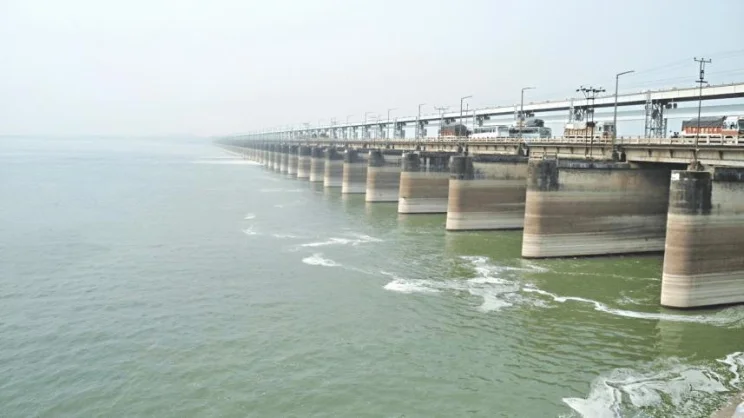
The Farakka Barrage on the Ganges in West Bengal, a key control point for upstream water diversion and central to the Ganges Water Sharing Treaty between India and Bangladesh. Photo: Star

India needs a broader perspective on river sharing

Despite India’s crucial support for Bangladesh’s War of Independence in 1971, public opinion in Bangladesh, to a large extent, quickly turned against India because of the Farakka Barrage. To this day, the Farakka Barrage and other diversionary barrages on shared rivers remain major obstacles to improving relations between Bangladesh and India. If these obstacles could be removed, cooperation between the two countries could blossom in many different directions. For example, Bangladesh could more willingly offer transit and transshipment facilities and opportunities for India’s seven northeastern states to use its seaports, thus aiding their accelerated development. Although the Sheikh Hasina government granted many of these privileges unilaterally, their long-term continuation is not guaranteed and could be affected by political changes in Bangladesh. India, therefore, has reason to consider river sharing issues within the broader context of its long-term relationship with Bangladesh.

Building ties with river activists in India

For Bangladesh's position to be accepted, it must garner support within India. Efforts to this end are required at both governmental and non-governmental levels. Organisations such as BAPA and BEN have been doing their best in this regard. They have held several conferences on water sharing issues, with significant participation by water experts and activists from India. A landmark event in this regard was the 2004 conference on the Indian Riverlinking Project (IRLP), in which about 50 participants, including leading river experts and activists from India, took part. The conference in 2013, titled "Water Resources of South Asia: From Conflict to Cooperation", was another such laudable event. Through these initiatives, a channel of communication has been established among river experts and activists from Bangladesh and India, and it can facilitate the dissemination of Bangladesh’s position and arguments regarding the GST. However, these efforts are not sufficient, and the Bangladesh government needs to do its part.

Ensuring support from the international community

Vigorous efforts are required in the international arena too. As noted above, signing the 1997 UN Convention should be the first step. Bangladesh can then explain its position to the countries that are signatories to the Convention. In particular, it may draw the attention of the international community to the necessity of an adequate dry-season Ganges flow in Bangladesh for the protection of the Sundarbans, a UNESCO-recognised World Natural Heritage Site. Several UNESCO delegations have previously noticed the degradation of the Sundarbans caused by the Farakka withdrawal and expressed concerns that a further decline in freshwater flow could seriously damage the health of the Sundarbans. Bangladesh can use UNESCO's observations to mobilise global public opinion in favour of its position.

1788047235664.webp

India’s withdrawal of water during the dry season leaves the riverbed near Hardinge Bridge almost dry. Photo: Star

Currently, the world community remains largely unaware of India's unfair treatment of Bangladesh regarding shared rivers. Since the Sundarbans is also shared by Bangladesh and India, the necessity of protecting it can help unite the two countries instead of driving them apart.

Proposed Ganges Barrage will weaken Bangladesh’s position in the negotiations

The Bangladesh government's recent approval of the project to build a barrage on the Ganges inside Bangladesh, apparently aimed at countering the Farakka Barrage, is a self-defeating move. First, Bangladesh will lose the moral ground for any criticism of the Farakka Barrage. Second, it will undercut Bangladesh’s rationale for demanding a greater share of the dry-season flow because India will be able to point to the proposed barrage as Bangladesh’s own solution to the Ganges water scarcity problem, thus absolving itself of the responsibility of agreeing to an MGC. The sooner the Bangladesh government recognises this folly, the better it will be for the country.

Bangladesh requires a competent negotiating team

Finally, Bangladesh requires a competent team to successfully renegotiate the GST with India. Currently, the Bangladeshi part of the Joint Rivers Commission (JRC) is heavily reliant on bureaucrats who lack the technical knowledge necessary for the task. Merely including engineers, however, is not the solution, because they generally lack sufficient knowledge and understanding of the broader ecological functions that rivers perform. Hence, the Bangladesh JRC needs to be reconstituted to include experts who can help conduct the negotiations from the perspective of the ecological approach, which is the only correct approach for Bangladesh, as explained at the very beginning of this essay.

Dr S. Nazrul Islam is a Professor at the Asian Growth Research Institute and a former Head of Development Research at the United Nations.​
 

PKDefense Forums: Country-by-Country Military Discussions

Log In Register Forums
Videos
Back