☕ Support Us
[🇧🇩] - Indo-Bangla Relation: India's Regional Ambition, Geopolitical Reality, and Strategic Options For Bangladesh | Page 57 | PKDefense

[🇧🇩] Indo-Bangla Relation: India's Regional Ambition, Geopolitical Reality, and Strategic Options For Bangladesh

Reply (Scroll)
Press space to scroll through posts
G Bangladesh Defense
[🇧🇩] Indo-Bangla Relation: India's Regional Ambition, Geopolitical Reality, and Strategic Options For Bangladesh
567
23K
More threads by Saif

BD-India trade in travel services

Asjadul Kibria
Published :
Dec 27, 2025 23:50
Updated :
Dec 27, 2025 23:50

1766882337210.webp

December is usually a month of holiday-making for most people in Bangladesh. A large number of people wait throughout the year for the month when they can travel home and abroad with their families and friends. For most outbound tourists from Bangladesh, neighbouring India is the first destination due to its geographical proximity. The improved connectivity, coupled with various travel facilitation measures over the last decade, has increased the number of Bangladeshi tourists in India. Besides leisure, a good number of Bangladeshis visit India for medical purposes. There are also travels for commerce and education, and the country becomes one of the top three source markets for India's Foreign Tourist Arrival (FTA). The other two top source markets are: the United States of America (USA) and the United Kingdom (UK).

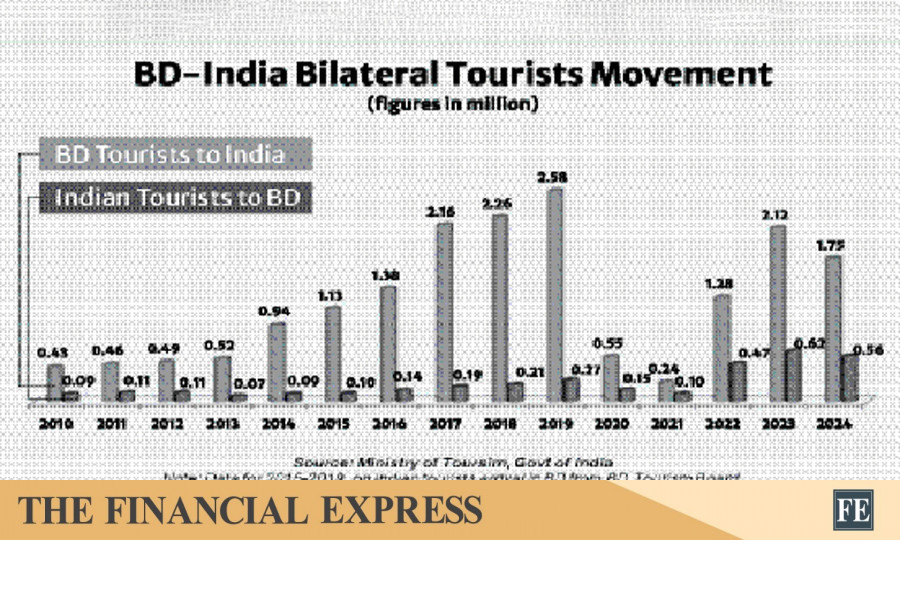
According to the Indian Ministry of Tourism, Bangladesh has ranked first or second in annual foreign tourist arrivals in India over the past 25 years. In 2001, approximately 0.43 million Bangladeshis visited India, with annual numbers remaining below 0.50 million on average until 2012, except in 2008. The figure rose to 0.92 million in 2014 and surpassed one million in 2015. In 2019, Bangladeshi tourist arrivals reached a record 2.58 million. The Covid-19 pandemic caused a sharp decline, with numbers dropping to 0.55 million in 2020 and 0.24 million in 2021. Arrivals rebounded to 1.20 million in 2022 and 2.12 million in 2023.

This growth was short-lived, as the number of Bangladeshi visitors to India fell to 1.75 million in 2024, primarily due to political changes. This decline slowed overall tourist growth in India. According to the India Tourism Data Compendium 2025, "Bangladesh, which emerged as India's leading source market post-2014 and peaked at 25.8 lakh arrivals in 2019, witnessed a sharp decline to 17.5 lakh in 2024-a drop by 8,27,562. Similarly, FTAs from China decreased from 3,39,442 in 2019 to 38,960 in 2024, a decline of 3,00,482. These instances of decline are likely influenced by factors such as policy shifts, geopolitical tensions, travel restrictions, and a shift in outbound tourism preferences."

Official statistics show that in the past year, 60 per cent of Bangladeshi tourists visited India in the first half, with the remaining 40 per cent traveling in the second half. Following a student-led uprising in July that led to Sheikh Hasina stepping down and seeking refuge in New Delhi, bilateral relations became strained. Rising anti-India sentiment prompted the Indian government to restrict visa issuance for Bangladeshis. Consequently, Bangladeshi tourist arrivals in India fell to 0.69 million in July-December 2024, down from 1.05 million in January-June. Overall, the total number of Bangladeshi tourists in India declined by 17.44 per cent last year, from 2.12 million in 2023 to 1.75 million.

This declining trend has continued into the current year, which ends next Wednesday. In the first quarter of 2025, Bangladeshi the number of Bangladeshi tourists dropped sharply, though official figures are pending. Estimates from the Quarterly Tourism Snapshot reports show a slight increase in the second and third quarters, with 0.09 million and 0.12 million visitors, respectively. However, the total number of visitors from Bangladesh is expected to decrease further in 2025 compared to 2024.

The sharp rise in travel to India from 2013 to 2019 was driven by several factors. The Hasina government, which was subservient to New Delhi, prioritised bilateral connectivity and introduced measures to ease cross-border movement. India relaxed its visa regime for Bangladeshis, recognizing the country's importance as a tourism market. The introduction of the friendship train between Dhaka and Kolkata in 2008, along with simplified travel procedures, attracted more visitors. Since 2017, point-to-point immigration and customs clearance has reduced waiting times. Two additional train services were later added. However, all three services have been suspended since July last year due to mass protests.

As 82 per cent of the India-bound visitors travel on road, infrastructure in a number of border ports have also been improved to facilitate the visitors. Bus services have also been increased to meet the growing demand from visitors. India Tourism Data Compendium 2025 said: "Travelling through air has also enhanced as reflected in number of flights growth. Land border travel remains significant-particularly for visitors from neighbouring countries such as Bangladesh, Bhutan, Nepal, and Sri Lanka."

In 2024, Bangladeshi tourists spent an average of two weeks in India. Approximately two-thirds visited for holidays and recreation, while about 27 per cent travelled for medical purposes. Economic growth and rise in per capita income over the years increased the number of travel services consumers in Bangladesh leading to rise in India-bound tourists.

Travel is one of the leading earning sources of India in terms of bilateral trade in commercial services. WTO statistics, compiled using the OECD Balanced Trade in Services (BaTIS), showed that in 2010, Indian export earnings in travel services with Bangladesh was $31 million which jumped to $177 million in 2023.

While Bangladesh sends a large number of visitors to India, Indian travel to Bangladesh is also significant. Last year, 0.55 million Indians visited Bangladesh, mainly for business and work, making it the 13th most popular destination for Indian nationals. About 1.80 per cent of Indian Nationals' Departures (IND) were to Bangladesh and more than two-thirds of all foreign tourist arrivals in Bangladesh are from India.

Bangladesh has yet to develop a comprehensive database on inbound and outbound visitors, making it difficult to obtain a clear picture of the trade in travel services with India as well as rest of the world.

Nevertheless, these statistics indicate that the dynamism in Bangladesh-India bilateral travel and tourism remains strong despite recent challenges. They also highlight the mutual reliance between the two neighbouring countries, although geopolitical tensions have begun to affect this relationship.​
 
Delhi must act responsibly
Editorial Desk
Updated: 26 Dec 2025, 13: 40

Developments over the past several days clearly indicate that tensions in Bangladesh–India diplomatic relations have reached an alarming level. Last Tuesday, on the same day, the two countries summoned each other’s high commissioners in Dhaka and Delhi—an unprecedented occurrence.

Moreover, within just 12 days, Bangladesh and India have summoned each other’s diplomats twice to lodge protests and express concerns over various issues.

The beginning of the deterioration in Bangladesh–India relations is well known. Unfortunately, the Indian government could not accept Bangladesh’s mass uprising and the fall of the autocratic Hasina regime. It is clear to the people of Bangladesh that it was largely due to India’s support that the Awami League government was able to maintain authoritarian rule in the country for so long.

We hope that India’s diplomatic and political policymakers will show respect for the anger, concerns, and aspirations of the people of Bangladesh. Only tolerance and responsible conduct can help ease diplomatic tensions.

India legitimised Sheikh Hasina’s misdeeds, including voter-less and one-sided elections. In July 2024, democracy-seeking people of Bangladesh brought an end to this autocratic rule through a mass uprising. By taking a position against Bangladesh’s mass uprising, India has effectively taken a stance against the people of Bangladesh.

Although the interim government led by Professor Yunus, which assumed responsibility through the mass uprising, has over the past year and a half taken various initiatives to keep relations with India normal as a neighboring country, there has been no positive response from India. From the state level to Indian media outlets, an extreme anti-Bangladesh campaign was launched. India has taken several negative steps in the commercial sphere and has also curtailed the normal visa process.

Most importantly, although the ousted autocrat Sheikh Hasina—now sentenced to death for crimes against humanity—has taken refuge in India and continues to engage in provocative statements and activities, the Indian government has made no effort to restrain her.

In addition, numerous figures from different levels of the Awami League government, along with thousands of leaders and activists who were involved in crimes such as killings, enforced disappearances, murder, and corruption while in power, are also staying in India and continuing to issue provocative statements. The people of Bangladesh have ample reason to believe that Indian territory is being used for anti-Bangladesh activities. It is not as if India’s diplomatic policymakers are unaware of these matters.

Recently, we have seen India’s extremist Hindutva organisations intensify their anti-Bangladesh activities. According to reports in Prothom Alo, last Tuesday several Hindutva groups held protests and rallies targeting Bangladesh missions in Delhi, Kolkata, and Mumbai.

Earlier, on Monday, a group of extremists attacked a Bangladesh visa center in Siliguri. On Saturday night, extremists entered a secured diplomatic zone in Delhi and threatened the security of the Bangladesh High Commission. Due to such violent protests, Bangladesh has been forced to suspend visa services in Delhi, Agartala, and Mumbai.

The fact that the killers allegedly found refuge in India has deeply angered the people of Bangladesh. Furthermore, India’s extremist right-wing groups have exploited the tragic and brutal killing of garment worker Dipu Chandra Das in Mymensingh—over allegations of blasphemy—to incite public outrage there for their own political interests.

These continued actions by India are increasing anger among Bangladeshi citizens—particularly among the youth—which in turn is heightening tension and violence in Bangladesh’s internal politics. Recently, investigators have claimed that the main accused in the murder of Sharif Osman Hadi, convener of the Inqilab Moncho, fled to India.

The fact that the killers allegedly found refuge in India has deeply angered the people of Bangladesh. Furthermore, India’s extremist right-wing groups have exploited the tragic and brutal killing of garment worker Dipu Chandra Das in Mymensingh—over allegations of blasphemy—to incite public outrage there for their own political interests.

We believe that stability in Bangladesh–India relations is essential for the economic development and security of both countries. Therefore, India must take into account the realities and political changes in Bangladesh. It must abandon its old mindset of interfering in Bangladesh’s internal politics or elections, attempting to exert influence, or keeping its preferred government in power against the will of the Bangladeshi people.

We hope that India’s diplomatic and political policymakers will show respect for the anger, concerns, and aspirations of the people of Bangladesh. Only tolerance and responsible conduct can help ease diplomatic tensions.​
 
Bangladesh expresses deep concern over ‘mass violence’ against minorities in India
Diplomatic Correspondent Dhaka
Published: 28 Dec 2025, 22: 18
1766970967844.webp

Spokesperson of the Ministry of Foreign Affairs, SM Mahbubul Alam Collected

The Bangladesh government has expressed deep concern over what it has described as “mass violence” against minority communities, including Muslims and Christians, in India.

It has also called for investigations into the brutal attacks on minorities across India during Christmas celebrations and for those responsible to be brought to justice.

Responding to questions from journalists on Sunday, the spokesperson of the Ministry of Foreign Affairs, SM Mahbubul Alam, outlined the position of the Bangladesh government on the issue of persecution of minorities in India.

At the same time, he rejected as “motivated” recent remarks by the spokesperson of India’s Ministry of External Affairs regarding the situation of minority communities in Bangladesh.

SM Mahbubul Alam also urged various quarters in India to refrain from spreading what he described as misleading narratives on minority issues in Bangladesh.

Bangladesh’s reaction comes two days after India’s Ministry of External Affairs expressed “deep concern” over the situation of minorities in Bangladesh.

At a regular press briefing in New Delhi last Friday, in response to a journalist’s question, India’s foreign ministry spokesperson Randhir Jaiswal said that continued violence by extremists against minorities, including Hindus, Christians and Buddhists, in Bangladesh was a matter of deep concern for India.

He strongly condemned the brutal killing of a Hindu youth in Mymensingh and expressed the expectation that those responsible would be brought to justice.

Responding to a journalist’s question on attacks against minority communities in India, the Bangladeshi foreign ministry spokesperson said, “We are deeply concerned about brutal killings, mob lynchings, arbitrary detentions and obstruction of religious observances committed against various minority communities in India, including Muslims and Christians. As you mentioned, earlier this month, there was the brutal killing of a Muslim youth, Jewel Rana, in Odisha; the brutal murder of Mohammad Azhar Hossain in Bihar; the killing of an innocent person in Kerala on suspicion of being Bangladeshi; and incidents of mob lynching and violence against Muslims and Christians in different places.”

Referring specifically to violence by extremist Hindu groups during Christmas celebrations in India, SM Mahbubul Alam said, “Bangladesh is also deeply concerned about the incidents of mob violence perpetrated against Christians across India during Christmas celebrations last week. We categorically reject these incidents and view them as hate crimes and targeted violence. We expect the relevant authorities in India to conduct impartial investigations into these incidents and to bring the perpetrators to justice. We believe that it is the responsibility of every country to protect and uphold the dignity of its minority communities, and every country should fulfil this obligation.”​
 
Bangladesh-India ties: A tragicomedy where populists take centre stage

1767057306908.webp

FILE VISUAL: ANWAR SOHEL

There is a tragicomedy in watching two neighbouring countries bound by geography drift apart like two sailors jumping ship in different directions, each convinced the other is sinking faster. This applies to both Bangladesh and India that have apparently decided, one more than the other, that centuries of shared culture, cuisine, and history are insufficient grounds to maintain even basic norms of engagement. What we are witnessing today is not merely a diplomatic crisis. It is a masterclass in how not to conduct foreign policy politically.

At the heart of prevailing tensions lies the narrative of extremism, a trusted old poison that keeps on giving. As Shakespeare would say, "A plague o' both your houses!" Mercutio's dying curse feels uncomfortably apt for what we are witnessing. Two nations seem determined to forgo civility in their relations, while extremists on both sides profit from the carnage. It is a show in which mobs replace politicians, and media and WhatsApp gladiators substitute for statesmen.

In India, saffron extremists and propaganda machines have found Bangladesh to be a convenient punching bag—a replacement for the increasingly inconvenient Pakistan or China cards. The "termites" rhetoric, periodic stray comments on Bangladesh's sovereignty, BJP's Mamata factor, and prime-time studio shouting champions have together achieved what decades of politics could not: they have united Bangladeshis across party lines in irritation with Delhi politics.

But let us not pretend that extremism flows only downstream from the Ganges. Bangladesh's interim government today presides over a landscape where the mob culture has become a lived reality, displaying a persistent inability to counter violence effectively. Whether helpless or an accomplice in this episode, the government cannot escape responsibility for the rise of these violent forces. To be fair, post-uprising volatility is hardly unprecedented. But prolonged inaction only emboldens those who thrive on chaos.

India's predicament, on the other hand, is self-inflicted. Having bet heavily on Awami League for so long, Delhi now faces genuine anti-Indian sentiment—not propaganda, just consequences. Meanwhile, India's political and social hysteria since July 2024 continues to feed on narratives repeatedly debunked by objective media, yet the religious card keeps being played. Of course, we cannot deny that minorities face some threats, but so do the general public.

Delhi's selective amnesia in this regard are almost amusing. It conveniently forgets that the demands of the July 2024 uprising were apolitical and met with state bullets before the eventual ouster of the Awami regime. Saffron politicians might do well to tally their own cards, assuming that they are still capable of moral self-reflection. The absurdity has peaked most recently when Siliguri hoteliers imposed a ban on Bangladeshi tourists. Apparently, extremism now checks passports at reception. One doesn't need to imagine what the Indian public have been fed about Bangladeshis all this time.

It is also evident that Indian politics is experiencing what diplomats might politely call "challenges." These challenges relate to some harsh reality checks. The Trump administration delivered reality check number one: Washington, it turns out, has little patience for hegemonic ambitions unsupported by regional clout. The trade imbalance with China offered reality check number two, as fiery anti-China rhetoric at domestic rallies does not equal decoupling. The Pahalgam fallout brought reality check number three, as political choruses solve nothing. And the fourth is a classic: Dhaka, once the BJP's favourite electoral dish, has left the table.

Is blaming Bangladesh fair, then? Let us not forget that Professor Muhammad Yunus had wanted to visit Delhi before Beijing, and has tried to engage politically on various occasions. Delhi's response? Continued disengagement, suggesting a preference for sulking over statesmanship until Bangladesh holds the elections. Diplomacy requires reading the room, but Delhi appears content to wait outside.

This inaction enabled mobs in Delhi's security heartland, Chanakyapuri, to stage an arrogant spectacle against the Bangladesh High Commission, following similar incidents in Agartala and Kolkata. High Commissioner Riaz Hamidullah's professional response to denial of mob activities by his counterparts deserves to be studied in diplomatic academies, as do the political failures that made such scenes possible in the first place. Indian High Commissioner Pranay Verma, it should be acknowledged, also showed professionalism, refraining from publicly sensationalising diplomatic summons.

Yes, some protesters attempted to march towards Indian diplomatic missions in Bangladesh. There have been regrettable incidents of stone-pelting as well. But the Indian response came from the same crowd peddling Akhand Bharat, while periodically questioning Bangladesh's sovereignty. Sanity has, however, prevailed for now. Both governments have taken steps to prevent further escalation and to protect diplomatic premises. The question worth asking is this: what did those who mobilised mobs against diplomatic missions expect to achieve?

Indians must accept the reality that they will have to maintain even-handed relations with Bangladesh regardless of which party governs in Dhaka. Bangladeshis, for their part, must accept that India cannot, and will not, de-securitise its relationship with its eastern neighbour given its national security compulsions. But there lies a political lesson, too. Delhi, having lectured Bangladesh on extremism for years, now finds itself courting the Taliban. When your diplomatic dance card includes the very extremists that your own rhetoric previously vilified, your moral high ground starts to look suspiciously like quicksand.

Meanwhile, Beijing and Washington watch from the balcony as two key partners in their respective Asian strategies squabble over the last samosa while the restaurant burns. Both know this antagonism serves neither their interests nor regional stability. They might have found it entertaining had geoeconomics not chosen this precise moment to redraw the geopolitical map.

What, then, must be done?

Bangladesh must ensure its domestic security ahead of the 2026 elections, which will determine its future stability. The armed forces, bureaucracy, and political parties must forge an immediate consensus to maintain order and neutralise extremism, wherever it originates. Bangladesh should remain open to normalisation with Delhi. Reciprocity, naturally, is non-negotiable.

India, meanwhile, should seriously consider whether its current approach serves any purpose beyond feeding nationalist television. Minority persecution in India, documented year after year in international religious freedom reports, has not gone unnoticed, while restricting people-to-people contact has only proved counterproductive. Walls may make headlines, but bridges make progress. For Delhi, the homework is simple: It has to understand where Dhaka's red lines on sovereignty, autonomy, and foreign policy now stand.

Both nations face a more or less similar reality on the ground. Crises continue to pile up while populists promote their own versions of the Crime Master Gogo, the hilariously delusional villain from Bollywood's cult classic Andaz Apna Apna, convinced of his immense power while the world laughs. The time has come for veteran politicians to decide whether to continue this tragicomedy or accept that geography is destiny, and as such must be managed through restraint and reciprocity—not out of affection, but rather cold pragmatism.

I remain optimistic that politicians and diplomats will eventually stumble upon pragmatism at some point. Until then, someone should tell the spokespersons, partisan hype merchants, and assorted Crime Master Gogos that they are not helping. At all.

Professor Shahab Enam Khan is executive director of Bangladesh Center for Indo-Pacific Affairs at Jahangirnagar University, and teaches at the Bangladesh University of Professionals.​
 
Jaishankar’s visit should not be read through political lens: Touhid

FE ONLINE REPORT
Published :
Jan 01, 2026 22:08
Updated :
Jan 01, 2026 22:08

1767314474212.webp

Foreign Affairs Adviser Md Touhid Hossain suggested not to interpret Indian External Affairs Minister S Jaishankar’s brief visit to Dhaka through an inter-state or political lens, saying it should be seen primarily as a gesture of courtesy.

He made the remarks on Thursday while speaking to journalists at the Ministry of Foreign Affairs.

He also suggested that whether the visit would help ease tensions between Bangladesh and India should be assessed in the future.

Jaishankar arrived in Dhaka on Wednesday to pay last respects to former prime minister and BNP chairperson Begum Khaleda Zia on behalf of the Indian government.

Pakistan’s National Assembly Speaker Sardar Ayaz Sadiq also visited Dhaka on the same day for the same purpose. Several other South Asian leaders and representatives were present, including Bhutan’s Foreign Minister D N Dhungel, Maldives minister Dr Ali Haidar Ahmed, Nepal’s Foreign Minister Bala Nanda Sharma, and Sri Lanka’s Foreign Minister Vijitha Herath.

“All South Asian countries were represented. India’s foreign minister also came. His visit was brief, but he attended the entire programme and then left,” Touhid Hossain said. “It was a good gesture—nothing more. It is better not to look for anything beyond that or view this visit from an inter-state or political perspective.”

The foreign affairs adviser said there was no one-on-one meeting with Jaishankar, nor was there an opportunity for such talks. “Other foreign guests were present. Pakistan’s speaker was also there, and Jaishankar shook hands with him as well. This was a matter of courtesy, which everyone observes,” he said.

He added that the limited exchange he had with Jaishankar was entirely non-political and took place in front of others, leaving no scope for discussing bilateral issues.

Asked whether Jaishankar’s visit could help defuse tensions between the two countries, Touhid Hossain said, “You will have to look for that answer in the days ahead.”

He also highlighted Khaleda Zia’s stature beyond Bangladesh, saying she enjoyed a positive image in neighbouring countries as well. “She reached a position that is well known to all. At home, she commanded acceptance and respect across party lines,” he said.

According to the adviser, this recognition is widely acknowledged across South Asia, making the presence of regional leaders at her funeral and condolence events both natural and appropriate.​
 
Jaishankar wishes Bangladesh well for polls, hopes deepened neighbourly ties

UNB
Published :
Jan 02, 2026 23:57
Updated :
Jan 02, 2026 23:57

1767401346248.webp


Wishing Bangladesh well for the upcoming national election, Indian External Affairs Minister Dr S Jaishankar on Friday said the sense of neighbourlyness in the region will grow once things settle down.

"Right now, they (Bangladesh) are heading for elections. We wish them well in that elections. We hope that once things settle down, the sense of neighbourlyness in this region will grow," he said.

The Indian External Affairs Minister made the remarks while responding to a question at an interactive session in in Chennai, India.

Highlighting the growth of India, Jaishankar said if India grows, all its neighbours will grow with them.

"We will have many more opportunities. I think that in a sense is the message that I took to Bangladesh," said Jaishankar who visited Bangladesh recently.

Indian Prime Minister Narendra Modi has recently personally written a letter as BNP Chairperson and three-time former Prime Minister Khaleda Zia was laid to rest beside her husband and late President Ziaur Rahman at Sher-e-Bangla Nagar in the capital on Wednesday afternoon.

External Affairs Minister Jaishankar, who represented the government and people of India at the funeral of Khaleda Zia, handed over a personal letter from Prime Minister Narendra Modi to BNP Acting Chairman and Khaleda’s son Tarique Rahman.

On arrival in Dhaka, Jaishankar met Tarique Rahman. “(I’ve) handed over to him a personal letter from Prime Minister Narendra Modi. (I’ve) conveyed deepest condolences on behalf of the government and people of India,” said the Indian Minister.

Jaishankar expressed the confidence that Khaleda Zia’s vision and values will guide the development of Dhaka-Delhi partnership.

BNP Standing Committee Member Amir Khosru Mahmud Chowdhury and Indian High Commissioner to Bangladesh Pranay Verma were, among others, present at the meeting.

Jaishankar spent four hours in Dhaka, said Bangladesh High Commissioner to India Riaz Hamidullah who is currently visiting Dhaka.

He said Bangladesh and India would look forward to script a new chapter in their ties, in shared interests driven by pragmatism and mutual interdependence, as indeed briefly discussed with BNP Acting Chairman.

Senior officials from the Ministry of Foreign Affairs and Indian High Commissioner to Bangladesh Pranay Verma were present at Hazrat Shahjalal International Airport to receive the Indian Minister.

Meanwhile, Indian Prime Minister Narendra Modi on Tuesday expressed deep sorrow at the death of Khaleda Zia and hoped that her vision and legacy will continue to guide Dhaka-Delhi partnership.

"I recall my warm meeting with her in Dhaka in 2015. We hope that her vision and legacy will continue to guide our partnership," he said.

Highlighting the importance of stability and inclusive elections in Bangladesh, India on December 26 said it wants close and friendly relations with the people of Bangladesh, which is rooted in the liberation struggle and strengthened through various development and people-to-people initiatives.

“We are in favour of peace and stability in Bangladesh and have consistently called for free, fair, inclusive and credible elections conducted in a peaceful atmosphere,” Randhir Jaiswal, official spokesperson at the Ministry of External Affairs (MEA) told reporters in New Delhi.

Responding to a question during a weekly briefing on Friday, Jaiswal said they support free, fair and inclusive elections in Bangladesh, and the return of BNP Acting Chairman Tarique Rahman from London should be seen in that context.

In response to another question, the MEA spokesperson said their point on Bangladesh has been very clear and consistent all throughout.

“India stands for strengthening our ties with the people of Bangladesh. We favor peace and stability in Bangladesh and also our point of view on elections, you are aware. We stand for free, fair, inclusive and participatory elections in Bangladesh, which is to be held in a peaceful atmosphere. So that is where we are. We stand for fair, free and inclusive and participatory elections in Bangladesh,” he said.​
 
Delhi eager to take bilateral relations forward

Raheed EjazDhaka
Published: 02 Jan 2026, 11: 55

1767402355689.webp


After nearly a four-year hiatus, India’s defence minister Rajnath Singh visited the Bangladesh High Commission in Delhi yesterday, Thursday afternoon. During his visit, he paid his last respects to former prime minister and BNP chairperson Khaleda Zia, writing that she had made a significant contribution to strengthening relations between Bangladesh and India. “Her notable contributions will always be remembered,” he wrote. Rajnath Singh conveyed this information after signing the condolence book with his own hand.

The brief visit of India’s foreign minister S Jaishankar to Dhaka over the past two days, along with the defence minister Rajnath Singh’s visit to the Bangladesh mission, is significant. Since the popular uprising of 5 August 2024, which led to the fall of the Awami League government and Sheikh Hasina’s flight to India, relations between the two countries have deteriorated.

Tensions were further exacerbated in the second half of December 2025, following a series of reciprocal summons of diplomats.Against this backdrop, the engagement of these two key Indian political figures signals a qualitative shift in the relationship with Bangladesh.

About ten days ago, tensions arose around a protest march called by the Vishwa Hindu Parishad (VHP) and several other Hindu nationalist groups heading toward the Bangladesh High Commission in Delhi. Ahead of that protest march on 23 December, a group of demonstrators on the night of 20 December reportedly shouted anti-Bangladesh slogans on the opposite side of the High Commissioner’s residence within the High Commission complex. There are also allegations that the High Commissioner was threatened with assassination that night. These incidents heightened bitterness and tension between the two countries.

Analysts suggest that there are indications of a possible BNP victory in the elections scheduled for February. Accordingly, India is placing emphasis on normalising and advancing its relations with BNP, using the opportunity of Khaleda Zia’s funeral.

Yet, barely a week later, Rajnath Singh’s visit to the Bangladesh High Commission to pay respects to Khaleda Zia, is significant. In addition to honouring the former Prime Minister of Bangladesh, his presence at the High Commission signals that Delhi is taking responsibility for ensuring the highest level of security at the mission.

1767402417810.webp

Indian foreign minister S Jaishankar conveying India's condolences to Tarique RahmanFrom the X handle of Riaz Hamidullah, Bangladesh's High Commissioner in Delhi

According to diplomatic analysts, in the context of recent tensions between the two countries, India’s Foreign Minister S. Jaishankar’s brief visit to Dhaka is significant. During the nearly four-hour whirlwind trip, he met with BNP Acting Chairman Tarique Rahman, paid respects to Khaleda Zia, and delivered a letter from Prime Minister Narendra Modi. In a discussion lasting about 20 minutes, the two spoke about the past and future of bilateral relations.

Analysts suggest that there are indications of a possible BNP victory in the elections scheduled for February. Accordingly, India is placing emphasis on normalising and advancing its relations with BNP, using the opportunity of Khaleda Zia’s funeral.

Notably, Delhi has repeatedly stated over the past six months that it is waiting to engage with whoever comes to power in Bangladesh through a democratic process in the upcoming elections. Conversations with diplomatic and government sources over the past two days suggest that the issue of “India’s engagement with the election-winning side” was also raised in the brief discussions last Wednesday. Analysts interpret the term “whoever comes to power” here as referring to the BNP. From this perspective, Rajnath Singh’s signing of the condolence book at the Bangladesh mission in Delhi, just a day after S. Jaishankar’s Dhaka visit, is a clear signal from India of its eagerness to advance relations.

Significance of Modi’s letter
Before early afternoon last Wednesday, India’s foreign minister S Jaishankar arrived in Dhaka and went directly from the BAF airbase to the National Parliament building. There, he held a brief discussion with BNP Acting Chairman Tarique Rahman and handed him a letter from Indian Prime Minister Narendra Modi.

In the letter, Narendra Modi referred to his personal acquaintance with Khaleda Zia. He expressed his respect by praising her leadership, her role in Bangladesh’s democracy, and her contributions to the people. At the same time, he conveyed optimism that the BNP will progress based on Khaleda Zia’s ideals. Modi also expressed confidence in Tarique Rahman’s leadership in guiding the BNP and in further enriching the “deep and historic partnership” between the two countries.

Diplomatic sources indicate that Modi’s letter hints that Tarique Rahman’s leadership could mark a new beginning in advancing the partnership between the two nations.

Hope for advancing relations
The significance of the letter from Narendra Modi to Tarique Rahman is hinted at in the remarks of Bangladesh’s High Commissioner to India, Riaz Hamidullah, in Delhi. Reporting on S. Jaishankar’s departure from Dhaka, Riaz Hamidullah wrote in his own hand that India’s Foreign Minister S Jaishankar had left Dhaka after a whirlwind four-hour visit. He noted that this visit could mark the drafting of a new chapter in Bangladesh–India relations. This new chapter might be based on interests, framed within the realities of mutual dependence. In this context, a brief discussion also took place between India’s Foreign Minister Jaishankar and BNP Acting Chairman Tarique Rahman.

Indian Defence Minister Rajnath Singh writes in the condolence book for former prime minister Khaleda Zia at the Bangladesh High Commission in New Delhi.

1767402477638.webp

Indian Defence Minister Rajnath Singh writes in the condolence book for former prime minister Khaleda Zia at the Bangladesh High Commission in New Delhi.From Rajnath Singh’s X post

It is reported that during the brief discussion with Tarique Rahman, the positive experiences of cooperation between the BNP and the BJP while in power in their respective countries (2001–2004) were mentioned. Against this backdrop, India’s foreign minister emphasised the potential for future collaboration between the two countries. He also expressed optimism that India wants free, fair, and participatory elections as Bangladesh moves toward democratic progress. S. Jaishankar made it clear that India is awaiting engagement with whoever comes to power in Bangladesh through the elections.

Referring to unresolved issues between the two countries, Jaishankar noted that problems may exist, but relations can be advanced through dialogue.


In discussions with India’s Foreign Minister, BNP Acting Chairman Tarique Rahman stressed the importance of advancing bilateral relations. According to him, sitting down and resolving problems through discussion is the way to move the relationship forward.

Discussion on democratic transition

Government sources reported that Delhi confirmed S Jaishankar’s visit to Dhaka to pay his last respects to former Prime Minister Khaleda Zia on Tuesday afternoon. That evening, a phone call took place between the national security advisers of the two countries.

After his discussion with Tarique Rahman, S Jaishankar held informal talks at the National Parliament building with legal adviser Asif Nazrul and national security adviser Khalilur Rahman. The discussions focused on the democratic transition in Bangladesh through free and fair elections scheduled for February. Diplomatic sources said that the talks also covered how bilateral relations could be restored and advanced through a process aligned with democratic transition.

When asked whether India’s foreign minister’s visit would ease tensions between the two countries, foreign adviser Touhid Hossain told journalists at his office yesterday, “You will have to look for the answer in the days ahead. In the coming days, you will see what happens.”​
 

Members Online

Latest Posts

Latest Posts