Bangladesh Defense
Saif
Senior Member
- Jan 24, 2024
- 20,623
- 9,644
- Nation

- Residence
- Axis Group

Bangladesh’s strategic tightrope in Rakhine
The proposal for a Bangladesh-Myanmar aid channel is rooted in a decade of failed diplomacy.
Bangladesh’s strategic tightrope in Rakhine

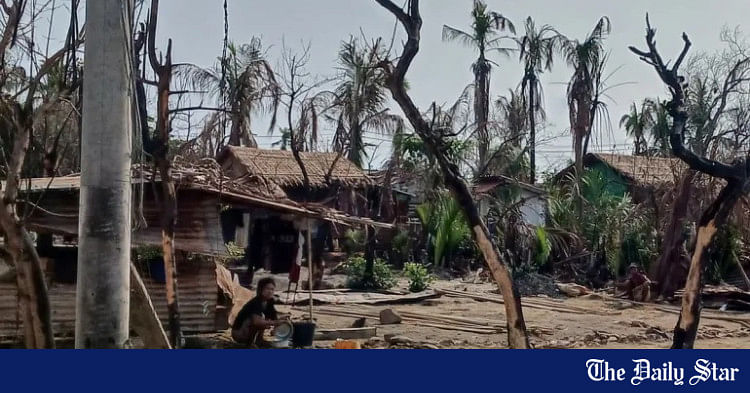
A woman cooks next to destroyed houses and burned trees following fighting between Myanmar's military and the Arakan Army in a village in Minbya Township in Rakhine State on May 21, 2024. FILE PHOTO: AFP
In Myanmar's Rakhine State, where the Arakan Army (AA) has consolidated control over significant swathes of territory, an estimated 1.2 million people—Rohingya Muslims and ethnic Rakhine Buddhists—face severe food shortages amid escalating conflict. The UN warns of famine-like conditions, exacerbated by Myanmar's military junta blocking humanitarian access since 2023. For Bangladesh, which already hosts over 960,000 Rohingya refugees (UNHCR, 2023), a proposal to open a cross-border aid channel has sparked fierce debate.
The channel, first proposed by the UN in early 2024, is framed as a lifeline for starving civilians. Yet critics argue it risks drawing Bangladesh into Myanmar's civil war, complicating relations with regional powers like China and India, and inflaming domestic political tensions. As former Bangladeshi Foreign Secretary Shahidul Haque noted in a 2024 interview with The Daily Star, "Humanitarian gestures can become geopolitical traps if divorced from hard-nosed realism."
This op-ed examines Bangladesh's precarious balancing act through the lens of offensive realism—the theory that states prioritise survival in an anarchic international system—while advocating for a strategy that blends principled aid with safeguards for sovereignty.
The origins of the channel: Humanitarianism or realpolitik?
The proposal for a Bangladesh-Myanmar aid channel is rooted in a decade of failed diplomacy. Since 2017, when Myanmar's military expelled over 740,000 Rohingya, Dhaka has repeatedly urged the UN Security Council to enforce repatriation. Instead, geopolitical gridlock—notably China and Russia shielding Myanmar from sanctions—has left Bangladesh bearing what former Prime Minister Sheikh Hasina called a "uniquely disproportionate burden."
By 2023, donor fatigue had set in. The UN's $876 million Rohingya response plan was only 40 percent funded (UNOCHA, 2023), forcing ration cuts in Cox's Bazar camps. Meanwhile, Myanmar's civil war escalated, with the AA seizing key towns in Rakhine and Chin States. The UN's 2024 appeal for cross-border aid from Bangladesh emerged as a pragmatic workaround, but one laden with risks.
Myanmar's junta, which brands the AA a terrorist group, has weaponised aid access. After Cyclone Mocha devastated Rakhine in May 2023, the military blocked relief to AA-held areas, worsening malnutrition rates. The AA, while claiming to welcome aid, faces allegations of diverting supplies. A June 2023 report by the International Crisis Group documented AA checkpoints taxing commercial goods in Chin State, raising fears that aid convoys could face similar exploitation.
For Bangladesh, the channel offers leverage. By conditioning aid on Rohingya repatriation talks, Dhaka seeks to shift global attention to Myanmar's atrocities. Yet as one security analyst warned, "Humanitarian aid cannot be transactional. If politicised, it will fail civilians and backfire on Bangladesh."
Stakeholders' chessboard: Who wins, who loses?
Bangladesh's interim government faces mounting pressure. Opening the channel could avert a new refugee wave—35,000 Rohingya fled to Bangladesh between January and December 2024, as per UNHCR. A full-scale famine might push thousands more across the border. However, opposition parties like the BNP argue the channel legitimises Myanmar's junta and the AA. "Why should Bangladesh clean up Myanmar's mess?" asked BNP leader Rumeen Farhana. Others fear entanglement in Myanmar's war. In February 2024, a mortar shell from AA-junta clashes landed in Bandarban, injuring two Bangladeshi farmers.
The junta vs the AA
Myanmar's junta, isolated since its 2021 coup, views Rakhine through a prism of paranoia. It has repeatedly blocked UN aid, fearing it would bolster AA influence. The AA, meanwhile, seeks recognition as Rakhine's de facto authority. For both, the channel is less about saving lives than asserting sovereignty.
The Kosovo 2.0 myth or reality?
Opposition claims comparing the channel to NATO's 1999 Kosovo intervention are hyperbolic but reflect valid anxieties. Kosovo's precedent, where humanitarian intervention led to state fragmentation, looms large in Dhaka. A more apt parallel is Syria's cross-border aid mechanism from Turkey (2014-2023), which sustained 4.1 million civilians but enabled Turkish influence over opposition zones. For Bangladesh, the lesson is clear: humanitarian access must be insulated from state-building ambitions.
A path forward
Drawing from political scientist Stephen Walt's balance-of-threat theory, Bangladesh should:
Demand tripartite oversight: Aid convoys require consent from Myanmar's junta, AA, and ASEAN monitors to prevent politicisation.
Secure regional guarantees: India and China must publicly oppose cross-border attacks on Bangladesh.
Link aid to accountability: Use the channel to pressure Myanmar into accepting a UN-supervised Rohingya repatriation process.
Sovereignty as the red line
Bangladesh's dilemma mirrors that of many small states: act as a responsible global citizen while avoiding entanglement in others' conflicts. The channel's success hinges on strict neutrality and multilateral oversight. As international relations scholar Hedley Bull argued, even in an anarchic world, states can cooperate through shared rules, but only if power asymmetries are acknowledged.
For Bangladesh, this means prioritising its constitution's mandate: "The state shall base its international relations on… respect for national sovereignty" (Article 25). Humanitarian imperatives must not override that principle.
Zakir Kibria is a writer and policy analyst.
A woman cooks next to destroyed houses and burned trees following fighting between Myanmar's military and the Arakan Army in a village in Minbya Township in Rakhine State on May 21, 2024. FILE PHOTO: AFP
In Myanmar's Rakhine State, where the Arakan Army (AA) has consolidated control over significant swathes of territory, an estimated 1.2 million people—Rohingya Muslims and ethnic Rakhine Buddhists—face severe food shortages amid escalating conflict. The UN warns of famine-like conditions, exacerbated by Myanmar's military junta blocking humanitarian access since 2023. For Bangladesh, which already hosts over 960,000 Rohingya refugees (UNHCR, 2023), a proposal to open a cross-border aid channel has sparked fierce debate.
The channel, first proposed by the UN in early 2024, is framed as a lifeline for starving civilians. Yet critics argue it risks drawing Bangladesh into Myanmar's civil war, complicating relations with regional powers like China and India, and inflaming domestic political tensions. As former Bangladeshi Foreign Secretary Shahidul Haque noted in a 2024 interview with The Daily Star, "Humanitarian gestures can become geopolitical traps if divorced from hard-nosed realism."
This op-ed examines Bangladesh's precarious balancing act through the lens of offensive realism—the theory that states prioritise survival in an anarchic international system—while advocating for a strategy that blends principled aid with safeguards for sovereignty.
The origins of the channel: Humanitarianism or realpolitik?
The proposal for a Bangladesh-Myanmar aid channel is rooted in a decade of failed diplomacy. Since 2017, when Myanmar's military expelled over 740,000 Rohingya, Dhaka has repeatedly urged the UN Security Council to enforce repatriation. Instead, geopolitical gridlock—notably China and Russia shielding Myanmar from sanctions—has left Bangladesh bearing what former Prime Minister Sheikh Hasina called a "uniquely disproportionate burden."
By 2023, donor fatigue had set in. The UN's $876 million Rohingya response plan was only 40 percent funded (UNOCHA, 2023), forcing ration cuts in Cox's Bazar camps. Meanwhile, Myanmar's civil war escalated, with the AA seizing key towns in Rakhine and Chin States. The UN's 2024 appeal for cross-border aid from Bangladesh emerged as a pragmatic workaround, but one laden with risks.
Myanmar's junta, which brands the AA a terrorist group, has weaponised aid access. After Cyclone Mocha devastated Rakhine in May 2023, the military blocked relief to AA-held areas, worsening malnutrition rates. The AA, while claiming to welcome aid, faces allegations of diverting supplies. A June 2023 report by the International Crisis Group documented AA checkpoints taxing commercial goods in Chin State, raising fears that aid convoys could face similar exploitation.
For Bangladesh, the channel offers leverage. By conditioning aid on Rohingya repatriation talks, Dhaka seeks to shift global attention to Myanmar's atrocities. Yet as one security analyst warned, "Humanitarian aid cannot be transactional. If politicised, it will fail civilians and backfire on Bangladesh."
Stakeholders' chessboard: Who wins, who loses?
Bangladesh's interim government faces mounting pressure. Opening the channel could avert a new refugee wave—35,000 Rohingya fled to Bangladesh between January and December 2024, as per UNHCR. A full-scale famine might push thousands more across the border. However, opposition parties like the BNP argue the channel legitimises Myanmar's junta and the AA. "Why should Bangladesh clean up Myanmar's mess?" asked BNP leader Rumeen Farhana. Others fear entanglement in Myanmar's war. In February 2024, a mortar shell from AA-junta clashes landed in Bandarban, injuring two Bangladeshi farmers.
The junta vs the AA
Myanmar's junta, isolated since its 2021 coup, views Rakhine through a prism of paranoia. It has repeatedly blocked UN aid, fearing it would bolster AA influence. The AA, meanwhile, seeks recognition as Rakhine's de facto authority. For both, the channel is less about saving lives than asserting sovereignty.
The Kosovo 2.0 myth or reality?
Opposition claims comparing the channel to NATO's 1999 Kosovo intervention are hyperbolic but reflect valid anxieties. Kosovo's precedent, where humanitarian intervention led to state fragmentation, looms large in Dhaka. A more apt parallel is Syria's cross-border aid mechanism from Turkey (2014-2023), which sustained 4.1 million civilians but enabled Turkish influence over opposition zones. For Bangladesh, the lesson is clear: humanitarian access must be insulated from state-building ambitions.
A path forward
Drawing from political scientist Stephen Walt's balance-of-threat theory, Bangladesh should:
Demand tripartite oversight: Aid convoys require consent from Myanmar's junta, AA, and ASEAN monitors to prevent politicisation.
Secure regional guarantees: India and China must publicly oppose cross-border attacks on Bangladesh.
Link aid to accountability: Use the channel to pressure Myanmar into accepting a UN-supervised Rohingya repatriation process.
Sovereignty as the red line
Bangladesh's dilemma mirrors that of many small states: act as a responsible global citizen while avoiding entanglement in others' conflicts. The channel's success hinges on strict neutrality and multilateral oversight. As international relations scholar Hedley Bull argued, even in an anarchic world, states can cooperate through shared rules, but only if power asymmetries are acknowledged.
For Bangladesh, this means prioritising its constitution's mandate: "The state shall base its international relations on… respect for national sovereignty" (Article 25). Humanitarian imperatives must not override that principle.
Zakir Kibria is a writer and policy analyst.