โ˜• Support Us โ˜•
[๐Ÿ‡ง๐Ÿ‡ฉ] - Insurgencies in Myanmar. Implications for Bangladesh | Page 38 | PKDefense

[๐Ÿ‡ง๐Ÿ‡ฉ] Insurgencies in Myanmar. Implications for Bangladesh

Reply (Scroll)
Press space to scroll through posts
G Bangladesh Defense
[๐Ÿ‡ง๐Ÿ‡ฉ] Insurgencies in Myanmar. Implications for Bangladesh
374
13K
More threads by Saif


Will Rohingya crisis be resolved in near future?

SYED FATTAHUL ALIM
Published :
Aug 18, 2025 01:03
Updated :
Aug 18, 2025 01:03


1755472267382.png


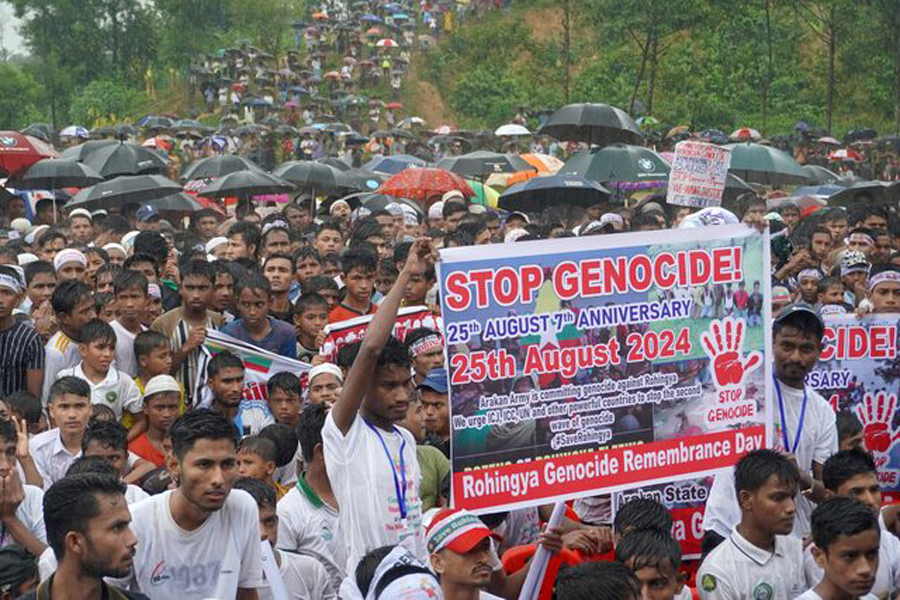
Rohingya refugees gather to mark the seventh anniversary of their fleeing from neighbouring Myanmar to escape a military crackdown in 2017, during heavy monsoon rains in Cox's Bazar, Bangladesh, August 25, 2024 โ€” REUTERS Photo

Myanmar's military junta has dissolved its State Administration Council (SAC) and replaced it with a new interim caretaker setup, the so-called 'State Security and Peace Commission (SSPC)'. On July 31,2025, the February, 2021's coup leader, Senior General Ming Aung Hlaing lifted the state of emergency he had extended seven times to continue his regime's grip on Myanmar since he had toppled the country's elected government four and a half years ago. The aim of this move is to hold what junta leader calls an election 'on the path to a multiparty democracy' in December 2025 and January 2026.Interestingly, the junta on August 1, declared a new state of emergency and martial law on 63 townships across Myanmar including areas where ethnic armed groups and the National Unity Government (NUG) comprising lawmakers and members of parliament of the elected government deposed earlier by coup are now in control.

Clearly, this is an attempt by the Naypyidaw junta to present itself before the world in a new-look package. The election it plans to hold is nothing but a gimmick to hoodwink the world into believing that the new government to be formed after the so-called election will be a democratic one. Now the fact remains that the military junta in Naypyidaw is losing control on substantial parts of the country, especially in the border regions, to the rebels including, for example, the Arakan Army (AA), Ta'ang National Liberation Army (TNLA), Myanmar National Democratic Alliance Army (MNDAA) etc. So, its authority over the country is increasingly coming into question. The rebel ethnic group armies already control large parts of the Rakhine, Shan, Kachin, Karen and Chin states. Also, a large chunk of Mandalay and Sagaingregions have gone under rebel occupation.

The Arakan Army (AA), for instance, controls some 270km of the Myanmar-Bangladesh border areas. It has meanwhile captured Paletwaand Buthidaungtowns bordering Bangladesh. In fact, the Naypyidaw junta still maintains control on major urban centres using its airpower such as in Sittwe, the capital of the Rakhine state.

Against this backdrop, the Bangladesh government has to rethink its strategy about who and how to deal with when it comes to repatriation of over 1.1 million Rohingya refugees in the overcrowded camps in Cox's Bazar with reports of arrivals of around 150,000 fresh waves of refugees during the last eighteen months. More importantly, until the ongoing civil war comes to an end, the authority of the current Naypyidaw government will remain questionable. So, even if any deal is reached with the Naypyidaw junta, its acceptability in the future will remain uncertain. Consider the offer made in April this year by the Myanmar authority on the sidelines of BIMSTEC meeting in Bangkok to take back 180,000 Rohingya refugees out of the list of some 800,000 Rohingya members that Bangladesh government submitted in six separate batches to the Myanmar authority between 2018 and 2020. But many Rohingya feared that the move by the Naypyidaw regime lacked necessary political will, security guarantees and restoration of citizenship as a prerequisite for their return. In response to that offer by Naypyidaw authority, King Maung, Executive Director of the Rohingya Youth Association (RYA), according to the news outlet, Rohingya Khobor, for instance, said, "We are not asking how many will return. If we are sent back without land, rights or recognition, it's not repatriation-it's re-persecution". 'We want justice, security, and our place in Arakan' Maung added.

Dr Muhammad Yunus, Chief Adviser to the interim government of Bangladesh, recently expressed his intention, as part of intensifying international efforts, to resolve the Rohingya crisis. To this end, three international conferences during this year would be held, he informed. Dr Yunus said this during a recent interview with the Malaysian national news agency, Bernama.

Dr Yunus is learnt to have further informed that the first of the conference would be held by the end of this August in Cox's Bazar, to mark the eighth year of the Rohingya's arrival on a large scale following 2017's ethnic cleansing campaign by the Myanmar government. The second conference will be held in September next on the sidelines of the UN General Assembly meeting. The third conference would be held by the year end in Doha, capital of Qatar.

Malaysia's leading role in Southeast Asia, especially as the head of the Association of Southeast Asian Nations, (ASEAN), Dr Yunus believes, can play an important role in resolving the Rohingya crisis. It is worthwhile to note that the interim government since its assumption of office in early August 2024 has made a number of efforts towards mobilising international support to resolve the Rohingya issue. Notably, in November 2024, the interim government's lobbying resulted in a UN General Assembly resolution calling for a 'high-level conference' in the second half of 2025 to a 'comprehensive, innovative, concrete and time-bound plan for the sustainable resolution of the crisis including voluntary, safe and dignified return of Rohingya Muslims to Myanmar".

Given the ever-worsening conditions of the Rohingya in the cramped refugee shelters of Cox's Bazar and the international assistance for their sustenance dwindling to a trickle, international conferences are, of course, necessary if only to draw the global community's attention afresh to the near-forgotten Rohingya refugees Bangladesh has been playing host to for too long.

But mere talk at conferences will not be enough to ensure resettlement of the Rohingya that sought refuge in Bangladesh as well as at other places in their ancestral homeland. The international community needs also to play a strong role in seeing that the Myanmar civil war ends with transition to a civil government. At the same time, the international community brokering such transition in Myanmar should also include in its talks with the political stakeholders of Myanmar in question the accommodation of the Rohingya refugees and their secure, dignified and rightful return and resettlement in their homeland.

Bangladesh has been hosting about 1.2 million Rohingya refugees not only for the last eight years, but for decades after then-Myanmar government-engineered large-scale violence against and persecution of Rohingya leading to similar repatriation efforts in 1978 and 1992. In fact, pushing Rohingya people into Bangladesh has been a sinister design of successive governments in Myanmar whether civil or military, which betrayed Bangladesh government's weakness in handling the situation. What is necessary is to face them from a position of strength. Of course, it must get the international community on its side through astute diplomacy.​
 

RAKHINE AND ROHINGYAS
Chinaโ€™s interests, Americaโ€™s dilemma


1763344644769.webp

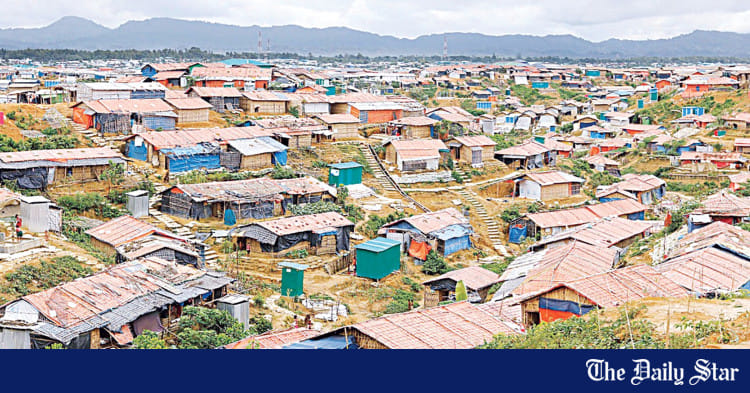
A view of the Kutupalong Rohingya camp in Ukhia, Coxโ€™s Bazar. | Agence France-Presse/Munir uz Zaman

THE rugged hills and the coastline of Myanmarโ€™s Rakhine State have become the stage for a complex geopolitical play beyond the borders. At the centre of this drama is the Arakan Army, an ethnic armed organisation that has evolved from a fledgling insurgent group in 2009 into a reckonable political and military force in 2025 with the control of 85 per cent of Rakhine State. Its rise has not only shifted the balance of power in Myanmarโ€™s long-running civil war but also drawn the attention of major external powers, each with their own strategic imperatives. The engagement between China and the Arakan Army, the potential calculus of the United States, the quiet anxieties of India and the profound dilemmas facing Bangladesh together constitute an intricate geopolitical puzzle. Understanding these interconnected relationships is crucial to deciphering the future of the Bay of Bengal region and the broader Indo-Pacific contest.

Conditional partnership

THE relationship between China and the Arakan Army is often characterised as a straightforward patron-client dynamic. In reality, it is a conditional engagement, dictated entirely by Beijingโ€™s core national interests, which can sometimes conflict.

The primary channel for this engagement, in the recent past, is the Brotherhood Alliance, a coalition of three powerful ethnic armed organisations โ€” the Arakan Army, the Myanmar National Democratic Alliance Army and the Taโ€™ang National Liberation Army. The latter two groups operate directly on the Chinese border and have deep historical, ethnic and logistical ties to Beijing. This alliance provides for a unified command structure through which China can exert influence, negotiate ceasefires and manage stability along its southern periphery. The Arakan Army benefits from this association by gaining political cover and access to Chinaโ€™s diplomatic weight and, perhaps, some material support funneled through its allies.

Chinaโ€™s paramount interest in Rakhine State is the protection of its massive infrastructure investments, which are central to its Belt and Road Initiative. The most critical of these is the Kyaukphyu deep-sea tank terminal on Madey Island and the accompanying dual pipelines that transport oil and natural gas across Myanmar to landlocked Yunnan province. An energy corridor involving $1.2 billion is a strategic asset for Beijing which allows it to reduce dependence on the Strait of Malacca and secure a direct route for crucial hydrocarbon imports from the Middle East and Africa.

Chinaโ€™s engagement with the Arakan Army is, therefore, fundamentally risk mitigation and stability assurance. Beijing may seek an Arakan Army that can have negotiating power but not so disruptive that it jeopardises Chinese assets to keep Naypyitaw at check in the western Myanmar. When fierce fighting between the Arakan Army and the Myanmar military threatened the vicinity of Kyaukphyu and other important sites in 2019, Chinese diplomats actively brokered temporary ceasefires.

China practises a policy of โ€˜dual engagementโ€™ or โ€˜multi-vector diplomacyโ€™ in Myanmar. Chinaโ€™s engagement with the Arakan Army demonstrates that Beijing views it as a de facto governing authority in large parts of Rakhine whose cooperation is essential for project security. It maintains robust military, economic and diplomatic ties with the Tatmadaw and the central government in Naypyidaw. This approach ensures that regardless of which party holds power in Rakhine, Chinaโ€™s interests will be protected. It is a delicate balancing act, empowering the Arakan Army enough to keep the Tatmadaw in check while also restraining the Arakan Army to prevent it from derailing the projects that China needs the central government to legitimise.

Beyond single patron

WHILE China is the most influential external actor the Arakan Army engages with, labelling Beijing as its โ€˜principal backerโ€™ oversimplifies the groupโ€™s sources of strength. The Arakan Armyโ€™s resilience stems from a powerful domestic foundation. Its most significant asset is the popular support among the ethnic Rakhine population. The Arakan Army has skillfully propagated the narrative of defending Rakhine identity and rights against decades of neglect and oppression by the Bamar-dominated central state. This grassroot legitimacy provides for a steady stream of recruits, intelligence and a social licence to operate.

The Arakan Army is widely considered one of the financially solvent ethnic armed organisations in Myanmar. It has reportedly developed a sophisticated self-funding model that includes: Control of economic zones: It taxes goods and movement through territories it controls. Natural resources: It exploits local resources, including timber and possibly minerals. Business conglomerates: It runs a network of legitimate and illicit business. Its financial solvency is a key differentiator allowing the Arakan Army to make strategic decisions without being beholden to a single foreign patronโ€™s demands.

Other sources of support include its formal and informal alliances with other ethnic armed organisations sand financial contributions from the Rakhine diaspora. Therefore, China acts as a strategic facilitator and a necessary geopolitical interlocutor, but the Arakan Armyโ€™s principal backer is, in many ways, its own cause and its disciplined, self-sustaining organisational model, which elevated it into a formidable force in Rakhine in a short span of time.

US strategic dilemma

OFFICIALLY and directly, the United States seems to have no engagement with the Arakan Army. The Burma Act is slated to support Myanmarโ€™s democratic forces, primarily the ousted National Unity Government and its armed wing, the Peopleโ€™s Defence Force. Engaging with the Arakan Army, which operates independently of the National Unity Government and pursues a distinctly ethno-nationalist agenda, would undermine this central pillar of US policy. Furthermore, the Arakan Armyโ€™s tactics, including allegations of abductions, extortion and illicit businesses, place it outside the bounds of the group that Washington would traditionally partner with. This leads to a compelling strategic dilemma. Would it be wise for the United States to engage the Arakan Army to reduce Chinaโ€™s influence and deny its access to the Indian Ocean?

Apparently, the logic is very attractive. By cultivating a relationship with the group that controls the coastline hosting Chinaโ€™s geopolitical and geoeconomic assets, the United States could theoretically threaten Beijingโ€™s strategic bypass of the Malacca Strait. It could be seen as a low-cost way to check Chinese expansion in the Indian Ocean. However, a different thought shows this to be a high-risk, low-reward strategy fraught with peril:

Moral and strategic hazard: In the present context, aligning with an armed ethno-nationalist group would undermine the US narrative of supporting federal democracy and human rights in Myanmar. It would betray the Nationbal Unity Government and risk fracturing the broader anti-junta resistance. However, the National Unity Government and Arakan Army alignment for democratic push may change the narrative.

Unpredictable outcomes: The Arakan Armyโ€™s primary loyalty is to the Arakan cause, not to US geopolitical interests. There is no guarantee that a stronger Arakan Army-controlled Rakhine State would not eventually cut a more favourable deal with China. In this context, the United States would be investing in a partner with potential blow back.

Blowback on regional allies: Any US support for the Arakan Army would trigger immediate concerns for other major powers in the region. China maintains an uncompromising stance in Myanmar, primarily focused on protecting its geostrategic assets, while India would view American intervention in Rakhine as potential threat to its own interests. Consequently, Bangladesh would find itself caught in a five-way struggle between China, the United States, India, the Tatmadaw and the Arakan Army.

Chinaโ€™s home-field advantage: Myanmar is Chinaโ€™s non-negotiable asset. China holds all the tactical cards: direct border access, long-standing relationships and immense economic leverage. The United States would be engaging in a proxy contest on Chinaโ€™s doorstep, a contest it is ill-positioned to win.

Alternatively, a US strategy could avoid direct engagement with the Arakan Army and, instead, double down on supporting an inclusive, federal democratic solution for all of Myanmar. A stable, democratic and decentralised Myanmar would naturally be less susceptible to Chinese dominance and a more reliable long-term partner for the United States and its allies. Yet, this vision remains a distant possibility. The path to democracy is fraught with immense obstacles, not least the Tatmadawโ€™s firm grip on power and the profound challenges of achieving a nationwide political settlement.

Indiaโ€™s calculations

CONFLICT in Rakhine State is a source of deep strategic anxiety for India. New Delhiโ€™s primary interest is the security, connectivity and development of its land-locked northeastern states. To create an opening into the Bay of Bengal, it has invested heavily in the Kaladan Multi-Modal Transit Transport Project, a connectivity initiative that runs from the Indian port of Kolkata to Sittwe in Rakhine State to Mizoram. The success of this project, intended to be Indiaโ€™s answer to Chinaโ€™s Belt and Road Initiative in the region, is entirely dependent on stability in Rakhine.

The Arakan Armyโ€™s ascendancy directly threatens the Kaladan project. Clashes near Sittwe and along the Kaladan River have repeatedly disrupted work and highlighted the projectโ€™s vulnerability. India is caught in a bind. It maintains cordial relations with the Tatmadaw, seen as a bulwark against Chinese influence. It cannot ignore the Arakan Armyโ€™s growing power and engaged the Arakan Army to reduce risks to its projects. A direct confrontation with the Arakan Army is not feasible. So, India is forced into a cautious, reactive stance, hoping for a political settlement that secures its infrastructure investments.

Furthermore, India fears that instability in Rakhine and Chin states could spill over its border, fuelling insurgencies in its north-east. Its complex and delicate relationship with Bangladesh also means that it must carefully calibrate its response to avoid alienating Dhaka. Indiaโ€™s role, therefore, is that of a concerned and heavily invested neighbour, watching the crossfire with anxiety, its own strategic ambitions held hostage by a conflict it cannot control.

Risks and Opportunities in Rohingya crisis

FOR Bangladesh, the situation in Rakhine State presents an acute and immediate national challenge centred on the presence of over a million Rohingya refugees. The geopolitical swirl surrounding Rakhine State adversely impacts the prospects for their safe and dignified repatriation.

The ongoing conflict makes repatriation a practical and political impossibility. The Tatmadaw which evicted the Rohingyas from their ancestral abode had no intention to take back refugees. The Arakan Army, while controlling the territory, is also not keen on seeing the Rohingyas return to their homeland. The groupโ€™s Rakhine nationalist ideology is historically at odds with the Rohingya community. This perpetual limbo poses severe risks for Bangladesh.

Humanitarian and economic burden: The refugee camps place an immense strain on local resources and the national economy.

Security degradation: The protracted crisis has led to rising crime, trafficking and the risk of radicalisation in the overcrowded camps and a demographic imbalance at Teknaf and Ramu.

Environmental disaster: The massive, makeshift camps have caused severe deforestation and environmental damage.

Fleeting opportunity

Paradoxically, the Arakan Armyโ€™s consolidation of power could eventually create a new, more stable political reality. If a credible political settlement, although extremely unlikely, is reached between the Arakan Army and Myanmarโ€™s central government, granting Rakhine significant autonomy, it could create a single, accountable authority with whom Bangladesh can negotiate. The Arakan Army, as a governing force, might see the value in resolving the refugee issue to gain international legitimacy and facilitate reconstruction.

However, this opportunity is fragile. The Arakan Army might also pursue policies that further marginalise the Rohingya, making the repatriation even more dangerous and effectively cementing the refugee crisis. Bangladeshโ€™s best hope is to engage in quiet, multilateral diplomacy, involving China and ASEAN, to push for a comprehensive political solution in Rakhine State that explicitly includes a credible road map for a refugee return. The status quo, however, remains the most likely and risky outcome.

The Arakan Army is no longer just a local insurgent group. It is an important node in the regional geopolitical system. Chinaโ€™s engagement is a calculated effort to secure its strategic corridors while the US abstention reflects the moral and strategic complexities of a distant power. India watches with anxiety as its regional ambitions are threatened and Bangladesh takes the direct shot of humanitarian and security consequences.

The interplay of the forces suggests that the conflict in Rakhine State is likely to be protracted and warring parties resistant to easy solutions. The great game being played out in its hills and along its coast is not one of clear alliances, but of shifting arrangements where local actors like the Arakan Army skilfully leverage their position to advance their own goals.

Lasting stability in the Myanmar or in Rakhine State will not come from picking sides in this crossfire, but from a concerted international effort to foster a political settlement that addresses the legitimate aspirations of all of Myanmarโ€™s peoples, a goal that remains as elusive as it is essential.

Mohammad Abdur Razzak-- a retired commodore of the Bangladesh Navy, is a security analyst and a research director at the Osmani Centre for Peace and Security Studies.​
 

UK, Qatar to provide $11.2 million to support Rohingyas
Joint funding to provide LPG for 647,000 people living in camps

1765156345721.webp

File photo

The United Kingdom and Qatar have jointly announced USD 11.2 million in funding to support more than 647,000 Rohingyas and Bangladeshi host communities in Cox's Bazar, strengthening humanitarian assistance and environmental protection efforts.

The joint funding will help provide LPG to vulnerable Rohingya households living in the camps, aiming to improve living conditions while reducing environmental degradation in and around the refugee settlements, said a British High Commission statement today.

Google News LinkFor all latest news, follow The Daily Star's Google News channel.
"Together, we are committed to creating safer, healthier, and more sustainable communities," the statement said.

The provision of LPG will reduce dependence on firewood, which has contributed to widespread deforestation in the surrounding areas over the past years, it added.

Since the influx of Rohingyas from Myanmar in 2017, Cox's Bazar has remained home to one of the largest displaced populations in the world.​
 

How the education vacuum is fuelling crimes in Rohingya camps

1765416922239.webp

Lack of learning opportunities fuels hopelessness and pushes many young people towards risky behaviours such as joining gangs, drug use, gambling and others. Photo: Aeer Shaad

Today, more than one million refugees live in the Rohingya camps in Cox's Bazarโ€”the largest refugee settlement in the world. Over 700,000 people from the community fled to Bangladesh following a violent military crackdown in August 2017, joining other refugees from previous raids. I was among the thousands.

The families in the camps struggle to survive with limited resources, and without access to education, the youth are among the most vulnerable. Lack of learning opportunities fuels hopelessness and pushes many young people towards risky behaviours, including joining gangs, drug use and gambling. Solving the education crisis would have deep ripple effects on camp safety, health, and prosperity.

The education system in the Rohingya refugee camps has suffered a major setback from the USAID funding cut. Many learning centres were forced to shut, leaving nearly 230,000 Rohingya children without access to education, according to Unicef. This closure has deeply affected both students and teachers, creating social and moral challenges within the camps.

Currently, classes from only grades 2-9 are operating at partial capacity, whereas before the crisis, all grades from 1 to 11 were operational. The disruption has led many students to drop out and join the workforce. Without classes to attend, youths spend more time outside of classrooms, where they are vulnerable to exploitation. As a result, cases of kidnapping, gambling, and child marriage have increased.

Budget cuts also mean loss of qualified teachers. As it is, camp teachers earn very low salariesโ€”not more than Tk 12,000 per month. Those who can earn Tk 20-30,000 are forced to find other work, leaving schools no choice but to hire unqualified teachers.

Even after the UN conference on Rohingya issues, we saw no sustainable solutions to the education crisis. The discussions mainly focused on food and humanitarian aid rather than long-term plans. Meanwhile, the situation in Myanmar worsened, with the Arakan Army (AA) controlling most of Rakhine State. Justice for the Rohingya remains stalled in the ICC, ICJ, and Argentine Court, leaving our community without hope or progress since the 2017 genocide.

I, myself, am a victim of the education crisis in the camps. The NGO-based education system is neither formal nor well-organised; most teachers are unable to properly guide or inspire students. Many learning centres feel more like play areas rather than real classrooms, with little follow-up or care for students' academic progress. Because of this, I decided to study in a community-based school, which is run and funded by camp residents and where qualified teachers provided me with a more structured and meaningful education.

After completing my 10th grade, I faced another barrier: there were no means for higher education. According to government policy, we are refugees and therefore not allowed to pursue formal higher studies. Even those who complete their 10th grade find no real job or livelihood opportunities, as "volunteer" is almost the only job available in the camps. Seeing no other path forward, many youths lose hope, drop out of school, and eventually are drawn towards unethical activities.

I was fortunate to have the support of my family, which helped me stay motivated, complete my schooling, and establish my own community organisationโ€”the Rohingya Youth Empowerment Network (RYEN). I founded it to make a difference for my community through quality initiatives. Today, through dedication and teamwork, our organisation runs various programmes focused on education, youth empowerment, and community services.

In the seven years since the exodus, thousands of young refugees like myself have grown up without access to proper schooling and higher education. When the learning centres remained closed for months, children turned them into playgrounds, and criminal groups used them as gambling compounds.

Girls face a different set of challenges due to societal norms and safety concerns. Many parents stop their daughters from attending classes after puberty, fearing harassment or social criticism. As a result, female literacy rates remain significantly lower than those of boys.

The 2022 youth report by the United Nations High Commissioner for Refugees (UNHCR) found that 78 percent of Rohingya youth "see no future," and this frustration often leads to depression, anxiety, and loss of ambition. In 2024, Human Rights Watch (HRW) warned that the community is on the verge of becoming a "lost generation" without access to secondary or higher education.

To reverse this crisis, education in the camps must be prioritised and better funded. Expanding access to formal education, vocational training, and digital learning can help the Rohingya youth build skills and hope. National and international stakeholders can provide livelihood programmes for both teachers and learners to ensure stability and sustainability. Community-led awareness campaigns against drugs and exploitation can further protect young people from unethical paths.

The Rohingya community continues to call for sustainable, dignified repatriation with full citizenship rights in Myanmar. Until that becomes possible, improving education and youth empowerment in the camps is the most powerful tool to prevent a generation from being lost to despair and unethical activities.

Yeasor Arfat is a Rohingya youth activist, poet, and founder of the Rohingya Youth Empowerment Network (RYEN), a nonprofit youth-led organisation and community-based school.​
 

Myanmar junta air strike on hospital kills 31
Agence France-Presse . Mrauk U, Myanmar 12 December, 2025, 00:51

1765502625612.webp

This picture shows a hospital damaged in a Myanmar military air strike that killed more than 30 people at a hospital in Mrauk U, western Rakhine state on Thursday. | AFP photo

A Myanmar military air strike killed more than 30 people at a hospital, aid workers said Thursday, as the junta wages a withering offensive ahead of elections beginning this month.

The junta has increased air strikes year-on-year since the start of Myanmarโ€™s civil war, conflict monitors say, after snatching power in a 2021 putsch ending a decade-long democratic experiment.

The military has set polls starting December 28 โ€” touting the vote as an off-ramp to fighting โ€” but rebels have pledged to block it from territory they control, which the junta is battling to claw back.

A military jet bombed the general hospital of Mrauk-U in western Rakhine state, bordering Bangladesh, on Wednesday evening, two aid workers said.

A junta spokesman could not be reached for comment.

At least 20 bodies were visible on the ground outside the hospital overnight, while daybreak revealed rubble covering ward beds, masonry peppered by shrapnel and the nearby ground cratered.

โ€˜This is an inhuman act. It is vile and violent,โ€™ said aid worker Wai Hun Aung โ€” who arrived on the scene on Thursday morning.

He said 31 people were killed and 68 wounded.

โ€˜They are saying that they will hold elections on December 28,โ€™ he added. โ€˜Even at this time, they are brutally killing the people.โ€™

Carpenter Maung Bu Chay said the strike killed three of his loved ones โ€” his wife, daughter-in-law and her father.

โ€˜When someone informed me they were in the completely destroyed building, I realised they hadnโ€™t survived,โ€™ said the 61-year-old.

โ€˜I feel resentful about their act. I feel strong anger and defiance in my heart.โ€™

Locals hammered together plywood coffins outside a funeral hall where bodies lay inside, as mourners wept on their knees in a frenzy of grief.

Hla Maung Oo, the chair of a local committee that organises free funerals, said the death toll of 31 included a months-old infant.

โ€˜We donโ€™t want this to happen again,โ€™ he said. โ€˜It should not happen like this.โ€™

Rakhine state is controlled almost in its entirety by the Arakan Army โ€” an ethnic minority separatist force active long before the military staged a coup toppling the civilian government of democratic leader Aung San Suu Kyi.

A statement by the AAโ€™s health department said 10 hospital patients were โ€˜killed on the spotโ€™ in the air strike on Wednesday night.

The AA has emerged as one of the most powerful opposition groups in the civil war ravaging Myanmar, alongside other ethnic minority fighters and pro-democracy partisans who took up arms after the coup.

Scattered rebels initially struggled to make headway before a trio of groups led a joint offensive starting in 2023, backfooting the military and prompting it to bolster its ranks with conscripted troops.

The AA was a key participant in the so-called โ€˜Three Brotherhood Allianceโ€™ but its two other factions this year agreed Chinese-brokered truces, leaving it as the last one standing.

While the military-run election has been widely criticised by monitors including the United Nations, Beijing has emerged as a key backer, saying it should โ€˜restore social stabilityโ€™ to its neighbour.

The AA has proven a powerful adversary for the junta and now controls all but three of Rakhineโ€™s 17 townships, according to conflict monitors.

But the groupโ€™s ambitions are largely limited to their Rakhine homeland, hemmed in by the coast of the Bay of Bengal and jungle-clad mountains to the north.

The group has also been accused of atrocities including against the mostly Muslim Rohingya ethnic minority from the region.

Meanwhile the military has blockaded Rakhine, contributing to a humanitarian crisis which has seen โ€˜a dramatic rise in hunger and malnutritionโ€™, the World Food Programme said in August.​
 

Members Online

No members online now.

Latest Posts

Latest Posts