[🇧🇩] Iran, US- Israel War: It's Impact On Bangladesh

[🇧🇩] Iran, US- Israel War: It's Impact On Bangladesh
48
613
More threads by Saif

G Bangladesh Defense

Global chokepoints and Bangladesh
Shihab Uddin
Published: 31 Mar 2026, 17: 17

1775003465074.webp

An oil tanker crosses the Strait of Hormuz File photo

On 23 March 2021, a sandstorm was tearing through the Suez Canal. Visibility was almost zero. At that moment, one of modern shipping’s worst disasters occurred. The ''Ever Given'', a massive container vessel—400 meters long and weighing over 200,000 tons—lost control and got wedged completely sideways. In fact, the ship was longer than the canal was wide. The busiest shipping lane between Asia and Europe ground to a halt in seconds.

Hundreds of vessels piled up on both sides. They were carrying everything from oil and gas to electronics and live animals. The math was terrifying: the blockage was costing global trade about $400 million every single hour. It took six days to free the ship. But by then, the world woke up to a harsh truth. Our modern tech, satellite navigation, and trillion-dollar trade all hang by a thread. They depend on just a few narrow, rocky, and sandy waterways. Geopolitics calls them ''chokepoints''.

The ocean is vast, which makes it easy to forget that 80 per cent of international trade relies on just a handful of narrow straits. They are the arteries of the global economy. If any of these arteries get blocked, a global economic heart attack is just a matter of time.

Hormuz Strait

Take a gander at a map of the Middle East. A narrow body of water between Oman and Iran named the Strait of Hormuz. At its narrowest point, it is just 21 miles across. But this 21-mile gap is the largest energy nerve center on the planet. About 20 per cent to 30 per cent of the world’s sea-borne oil, and a quarter of its liquefied natural gas (LNG), passes through here.

For years, we heard nothing but ‘threats’ to close the strait. But amid the new, heightened tensions of an Iran-Israel war, the world witnessed it come to life in a terrifying way. As the conflict reached its zenith Iran committed the unimaginable — they closed down the strait. It wasn’t just a ban, but they actually fired drones and missiles at commercial ships attempting to get through.

The result? Overnight, 80 per cent of oil tanker traffic stopped dead. Insurance companies ripped up their policies for ships in the area. This sudden collapse in fuel supply pushed global oil prices dangerously close to $200 a barrel. The shockwaves hit everywhere. Stock markets in rich countries crashed, while developing nations stared down the barrel of severe fuel shortages and historic inflation.

Bab el-Mandeb Straits

In Arabic, ''Bab el-Mandeb'' translates to the ''Gate of Tears''. Ancient sailors gave it this name because of its deadly currents and pirates. A thousand years later, the name suddenly makes perfect sense again. Perched between Yemen and Djibouti, this passage is the leading southern gateway to the Red Sea and the Suez Canal.

1775003516042.webp

Armed men stand on the beach as the Galaxy Leader commercial ship, seized by Yemen’s Houthis , is anchored off the coast of al-Salif, Yemen, on 5 December, 2023 Reuters

Recently, in the wake of the Gaza war, Houthi rebels in Yemen began firing rockets and drones at commercial ships here. What happened next? The world’s largest shipping firms just dropped the route. Now, their ships have to sail all the way around the southern part of the entire continent of Africa (the Cape of Good Hope) in order to get to Europe. That tacks on an extra 3,500 nautical miles and about two weeks’ time to the voyage. As a result, costs for container freight — and prices of everyday goods — are soaring.

Malacca Strait

If you flip through the history books, you’ll see that empires slogged for decades to control the Strait of Malacca, Setāun, an area between Indonesia and Malaysia and Singapore. The answer is simple: whoever controls the key to the waterway linking the Indian Ocean to the Pacific Ocean controls Asian trade.

1775003556682.webp

The tanker ‘Liberta’, carrying 62,000 tonnes of LNG from Qatar’s Ras Laffan, was scheduled to sail towards Chittagong. However, with the closure of the Strait of Hormuz by Iran, the vessel is now stranded in the Persian Gulf. Collected

Today, this strait is home to 25 per cent of global trade. For a superpower of China’s magnitude, this is a huge strategic headache, termed as the ‘Malacca Dilemma’. It is how around 80 per cent of China’s imported fuel comes in. It is also the major artery for shipping raw materials to factories in Japan and South Korea, and getting their cars and electronics to the rest of the world. If this strait is ever blocked, the wheels of China’s manufacturing industry will literally grind to a halt.

Panama Canal

Chokepoints don’t shut down only because of war or politics. Nature plays a part, too. Consider the Panama Canal in Central America. Linking the Atlantic and Pacific Oceans, it is an engineering marvel of mankind.

But in recent years, climate change brought a drought to Gatun Lake, the canal’s primary water source. As water levels receded, agencies were required to limit the number of ships sailing through and compel them to bear less weight. Ships waited for weeks to pass on either side of the canal. This little mood swing from Mother Nature was costing the US supply chain millions.

1775003597007.webp

Cargo ships navigate Panama Canal during organized media tour on the outskirts of Colon city. Reuters file photo

Bosphorus Strait

The Bosporus Strait connects the Black Sea with the Mediterranean in Turkey. Russia and Ukraine are among the world’s largest exporters of wheat, corn and sunflower oil. Their plants can only reach the world market through the Bosphorus. When the war between Russia and Ukraine cut off this route, it drove many countries in Africa and the Middle East straight to the brink of famine. It showed that even our most basic human right — food — is completely reliant on a narrow body of water.

How does this strike Bangladesh?

When a crisis erupts in these straits thousands of miles away, the shockwaves hit the factories in Gazipur and the corporate offices in Motijheel almost instantly. Bangladesh is an importing country, and lives through exports. The readymade garment (RMG) sector which is our economic lifeline is completely at the mercy of these chokepoints. Cotton and our factories’ yarn flow via the Malacca Strait. Our finished garments also go to Europe and America through the Suez or Panama Canals. On top of that the LNG and oil for the country to keep running also comes right on through the Strait of Hormuz.

The new Iran-Israel engagement in Hormuz is flying a pretty big red flag for us. With oil prices seeming to approach $200 a barrel, purchasing fuel on the spot market is not feasible. That directly interrupts our power generation, which in turn slows factory production. At the same time, with ships avoiding the Red Sea, it now requires 15 to 20 additional days for goods to reach Europe, and shipping costs have skyrocketed. Foreign buyers threaten to cancel orders; within the country, the cost of daily goods imported from abroad soars and crushes the commoner. Or, metaphorically speaking, when global chokepoints sneeze, an economy like Bangladesh gets pneumonia!

History teaches that who dominates at sea, owns the world. Ideally at its peak of globalisation, it taught us that we are still prisoners of geography and nature. If a stuck ship, one fired missile, or a dearth of rain can ice up international trade, that says something about how fragile our supply chains really are.

Countries also must wake up and prepare long-term alternatives. No longer can we depend on single routes. We must develop alternative shipping corridors, cross-border rail networks and robust emergency reserves. Global chokepoints are a reminder: the world is one thread, and that thread can fray at any moment.

* Md Shihab Uddin is an independent researcher and a student of Folklore and Social Development Studies at the University of Rajshahi.​
 

Iran allows 6 Bangladeshi fuel-carrying ships to pass through Hormuz: Ambassador

Diplomatic Correspondent
Dhaka
Published: 01 Apr 2026, 15: 42

1775102796904.webp

Jalil Rahimi Jahanabadi, Iran’s ambassador to Dhaka, speaks at a press conference held at the Iranian Embassy in Dhaka on 1 April Prothom Alo

Iran’s ambassador to Dhaka, Jalil Rahimi Jahanabadi, has said that Tehran has granted permission for six Bangladeshi fuel-carrying ships to pass through the Strait of Hormuz. There is no problem for Bangladeshi fuel vessels to navigate through this route.

He made this statement today, Wednesday, while responding to journalists’ questions at a press conference held at the Iranian Embassy in Dhaka. The press conference was organised by the embassy regarding the ongoing war in the Middle East.

Ambassador Jalil Rahimi Jahanabadi said that Iran has allowed six Bangladeshi fuel-carrying ships to cross the Strait of Hormuz. The Bangladesh government had requested permission for these vessels to pass through the strait and informed Tehran about the six ships. Iran’s National Security Council has approved assistance for these vessels. Tehran had initially been unable to identify the ships due to the lack of detailed information provided in advance.

“We asked the Bangladesh government to provide detailed specifications of the ships. We received those last week, and work is ongoing. There is no problem for Bangladeshi vessels to operate. We will provide full cooperation in this regard,” he said.

In response to another question, the ambassador said Iran is observing the situation arising from the energy crisis in Bangladesh. As a friendly country, Iran is attentive to ensuring that Bangladesh does not face an energy shortage. In that context, Iran will continue to allow Bangladeshi vessels to pass through the Strait of Hormuz.

Jalil Rahimi Jahanabadi also informed that 180 Bangladeshis who were stranded in Iran have already returned home. Those who are still there will receive all kinds of assistance from Iran if they wish to return.

‘Trump is looking for a way to escape the war’

Ambassador Jalil Rahimi Jahanabadi commented that US President Donald Trump is now looking for a way out of the war with Iran. He said Iran did not initiate any attack; rather, the United States and Israel started the war. However, even before a month has passed, Trump is now seeking an exit route.

He further said that the previous US president had not fallen into the trap of Zionist Israel, but the current president has. Now, the US president is making different statements in the morning, afternoon, and night regarding the war.

He added that while peace talks were ongoing in Oman and efforts were being made to find a solution, the United States initiated the war. Iran, he said, has become involved in the conflict in self-defense.​
 

Belt-tightening requires efficiency

Asjadul Kibria
Published :
Apr 05, 2026 00:23
Updated :
Apr 05, 2026 00:23

1775347704378.webp


As there is still no end to the Iran war in sight, countries across the world have rushed to implement various belt-tightening measures to deal with the looming socio-economic crises. The situation has already worsened, and Bangladesh is among the first countries to face a severe shock. A reduction in energy supply will reduce industrial and agricultural activities, ultimately lowering aggregate income and aggregate demand. The energy crisis will also flare up cost-push inflation, reducing the real income of millions of people. As a result, aggregate consumption will decline, and the economy is set to enter a recessionary cycle soon.

Against this backdrop, the new government has taken a number of measures to contain energy demand as its first priority. The extent to which the measures will be effective depends on the efficiency of the implementing agencies. Early indications already reflected mismanagement and a lack of coordination among the various agencies. Though it is not a new phenomenon, as people in the country have long been experiencing the non-performance on the part of a callous bureaucracy, the continuation of the same will take a heavy toll on the country.

Moreover, the measures to save power are still not sufficient. For instance, though the decision to cut government office hours by an hour and encouragement of the use of daylight is a good move, there should be strict instructions to reduce the use of air conditioning (AC) during office hours, rather than keeping it at least 25 degrees. Many government offices keep the AC running for 8 hours, and some even keep the temperature below 22 or 23 degrees. Over the years, office buildings are designed in such a way that there would be no shortage of power, and so there would be no problem running the AC for a longer period.

And no clear instructions are given on restricting the use of AC in private cars and microbuses for government employees. Earlier, Bangladesh Bank issued guidance asking bankers to use public transport rather than private cars to reduce power demand. Though the terrible condition of public buses in Dhaka and the rest of the country is not taken into consideration before issuing such advice, it rightly indicates that greater use of public transport is a good idea for belt-tightening.

It is unfortunate that the country has yet to make its public transport efficient so that the regular mobility of millions of people could be easy and smooth. Though public transport is largely bus-based, the condition of most buses is awful. Having no alternatives, most people struggle daily to use these buses, where seats are ragged and the space between the rows is insufficient, and windows are broken. Moreover, due to an inadequate number of buses on different routes, some commuters have to keep standing while travelling in these buses during peak hours. Finally, the sector is under the control of rent-seekers backed by the ruling political party. Over the decades, these rent-seekers have become so powerful that it appears almost impossible to restructure public transport by replacing the old, ramshackle buses, which are also a major source of noise and air pollution in Dhaka. The sector also became heavily criminalised during the autocratic regime of Hasina.

As ministers, lawmakers, policymakers, and bureaucrats do not use public buses, it seems they have little concern for the suffering of millions of commuters. So, advising bankers and other professionals to use public buses is a mockery when government officials continue to use private cars. It is thus time to reduce the number of private cars of government officials and compel them to use public transport, such as the metro rail. A dedicated shuttle bus service can also be introduced for them, as belt-tightening involves various steps to provide cheap alternatives for the time being, along with spending cuts at large.

In a similar vein, the use of AC must be restricted in homes, offices, commercial centres and other places. It is also a matter of changing behaviour and practice during the crisis, and there is a need to sensitise citizens across the board. As the summer heat rises slowly, demand for cooling machines will also increase. Many households have already started running AC at night, though it is possible to use ceiling and table fans and keep windows open, especially on upper floors of residential buildings. To protect against mosquito bites, the use of mosquito nets should be encouraged. Modest and casual office attire should be encouraged so people can feel comfortable in summer and avoid using AC. As the prime minister himself is accustomed to wearing smart yet plain clothes, this should be encouraging for others.

As a part of belt-tightening, the government has also curtailed expenditure on hospitality, training, meetings, and travelling, which is the right move. The 50 per cent cut may even be increased to 75 per cent for the time being, as in many cases a portion of this spending turns into waste. A ban on decorative lighting at private weddings and events is also the right step. The government also instructed all markets and shopping centres to close at 6pm, although the owners demanded a two-hour extension. As essential services such as kitchen markets, pharmacies, and food outlets will remain exempt from early closure, there is a scope for misuse of the provision. These outlets should be compelled to cut off power to lights and ACs and close after 10pm. An efficient vigilance is necessary to ensure compliance of the order. There is also the need to look for other areas to cut spending to save for the rainy day.

The current crisis also presents an opportunity to address a number of critical issues in the country. That may involve revamping of public transport by gradually introducing electric buses and replacing the ramshackle, dirty buses with new low-floor buses. The use of AC can be rationalised smartly, such as by adding an auto-stop device centrally.

As the country has already entered a cycle of big uncertainty, almost like the time of Covid pandemic, a combined effort is necessary to fight the crisis. To do so, there is an urgent need to prioritise work agendas and suspend less important tasks for the time being. Citizens also need to cooperate with the government and have some patience to overcome the crisis. They must not pay heed to the misleading information and propaganda of the beneficiaries and adulators of the ousted regime. They also need to keep in mind that the ousted tyrant and her advisers turned the country's energy sector highly import-dependent, while ignoring offshore gas exploration. If there were a well-planned move toward exploration, it would be easier to fight today's severe energy crisis.​
 

Macroeconomic fallout from Iran conflict: Bangladesh’s exposure and required policy interventions

Muhammad Mahboob Ali

Published :
Apr 04, 2026 19:31
Updated :
Apr 04, 2026 19:31

1775348119852.webp


Nobel Laureate Paul Krugman has contended that the Iran war could be the "straw that breaks the camel's back" for a delicate U.S. economy, resulting in a "fresh level of massive uncertainty” due to current stresses. Contrary to what Nobel Laureate Joseph Stiglitz has cautioned, the US faces a risk of stagflation due to the economic consequences of the conflict. Furthermore, another Nobel prize winner, Simon Johnson, emphasised the harshness of the oil supply disruption, noting that 20 million barrels of oil a day go through the Strait of Hormuz.

In comparison, a small country like Bangladesh has already started facing problems. The onset of the Iran conflict in early 2026 has precipitated a pronounced macroeconomic shock across the global economy, driven primarily by energy price volatility, strategic contest ability over the Strait of Hormuz, and an escalating shift toward a protracted war of attrition. This external upheaval could not have come at a more fragile time for many emerging economies. Consequently, for an energy-import-dependent nation like Bangladesh—coupled with its large migrant workforce concentrated in the Middle East—these external disruptions have translated into severe domestic vulnerabilities that demand immediate and coordinated policy responses. The government is now under mounting pressure to shield the broader population from the cascading effects of this geopolitical crisis. Nature of the Supply-Side Shock to understand the gravity of the situation, one must first examine the nature of the economic shock. This geopolitical confrontation has generated a difficult stagflationary mix for global markets, as oil-driven cost-push inflation rises concurrently with slowing aggregate demand, particularly in energy-importing regions such as Europe and emerging Asia.

In other words, Bangladesh is facing the worst of both worlds: rising prices and decelerating growth. In tandem, the war has forced maritime rerouting and spiked freight costs, with bunker fuel prices elevating container shipping rates significantly. For a country whose export competitiveness rests on narrow logistics margins, this is a severe blow. Behind the scenes, major powers including China, Russia, and India are quietly formulating strategic hedge positions, suggesting that the battle is increasingly viewed as a persistent structural shock rather than a temporary price spike. For Bangladesh, the most immediate transmission mechanism is the external energy bill. With annual energy imports near $12 billion, analysts estimate that every $10 increase in global oil prices adds roughly $900 million to import costs. Given that oil prices have surged to $121 per barrel—up from approximately $72 a year ago—the macroeconomic pressure is acute. The country’s current account, already under strain, is now bleeding further.

Impact on Bangladesh’s Macroeconomic Stability

This external shock poses severe risks to Bangladesh’s key macroeconomic aggregates. Economists project a potential GDP growth reduction of 1.2 to 3 percentage points if the conflict persists through the fiscal year. Simultaneously, soaring LNG and fuel costs are feeding directly into heightened consumer price inflation via pass-through effects. The Bangladesh bank’s monetary policy target, already missed last quarter, now appears increasingly unattainable. Another major concern is the strain on foreign exchange reserves from widening current account deficits. As import bills balloon, the central bank may be forced to intervene more heavily in the foreign exchange market, drawing down reserves at an accelerated pace. Moreover, remittance flows—a critical buffer for the balance of payments—remain vulnerable should Middle Eastern host economies contract or impose new levies on foreign workers. Bangladesh’s export competitiveness, especially in the ready-made garment sector, is also eroding due to elevated logistics and insurance premiums. International shipping lines have added a geopolitical risk surcharge for cargo moving through the Arabian Sea, further squeezing profit margins of exporters. Indeed, the pressure has already manifested visibly on the ground. Fuel rationing is now in effect across several districts. Diesel sales restrictions have been imposed on non-essential transport. Gas conservation measures have led to load-shedding in industries. In a drastic move, four out of five state-run fertiliser plants have been shut down to protect electricity generation for residential areas. Universities have closed early for the semester to save power, and the government has turned to emergency spot-market LNG purchases at sharply higher prices, further eroding the fiscal space.

Social Implications: Beyond the Numbers

While the macroeconomic numbers paint a grim picture, the social implications are even more troubling for ordinary Bangladeshis. Rising energy costs directly translate into higher transportation fares, which then cascade into food prices. Vegetable, fish, and poultry prices have already increased by 15 to 20 per cent in major city markets over the last month alone. Lower-income households, which spend nearly 60 per cent of their income on food and fuel, are being hit hardest. There are emerging reports of reduced meal frequency in rural areas—a classic distress indicator. The shutdown of fertiliser plants also carries a delayed social cost. Farmers now face a shortage of urea ahead of the critical harvest season. If agricultural output falls, the country may be forced into large-scale food imports, further pressuring the reserve and triggering a secondary inflation wave. Additionally, the early closure of universities has disrupted the academic calendar, potentially delaying graduations and creating a bulge in the job market next year. Women and children, often the last to receive household resources, are disproportionately affected as household budgets shrink. Furthermore, the migrant worker community in the Middle East is living in a state of acute anxiety. Many Bangladeshi workers in Iran, Iraq, and the Gulf States face job insecurity as the construction and service sectors slow down. A sudden repatriation of even 10 per cent of the two million workers in the region would unleash a domestic unemployment shock that the economy is ill-prepared to absorb. Remittance inflows, which stood at $22 billion last fiscal year, could decline by up to 20 per cent, destabilising rural economies that depend on this steady income stream.

Government Response to Date

Recognising the severity, the government has moved beyond ad-hoc rationing toward a broader containment strategy. In recent weeks, policymakers have focused on diversification of fuel supply sources, including renewed interest in coal and hydropower imports from neighbouring countries. The government has also successfully negotiated deferred payment arrangements with several oil-producing nations, easing immediate liquidity pressures. Parallel, there has been a visible push for accelerated renewable energy adoption, with new solar parks fast-tracked for approval. Most notably, the government is actively pursuing over $2 billion in external financing from the IMF and World Bank to secure fuel and LNG imports. However, these measures, while necessary, remain insufficient given the uncertainty surrounding the conflict’s duration and intensity.

A piecemeal approach risks being overtaken by events on the ground. Required steps and the role of a high-level macroeconomic coordination committee to address these multifaceted challenges cohesively, the government should establish a dedicated National Macroeconomic Crisis Coordination Committee. This body, comprising the finance minister, some members of parliament from all parties, economists, Bangladesh Bank’s governor, energy secretary, commerce secretary, labour secretary, foreign secretary, journalists, trade representatives, and a social protection adviser, would be empowered to implement integrated policy responses across seven critical areas. First, in terms of monetary policy adjustment, the central bank should preemptively hike policy rates to re-anchor de-anchoring inflation expectations. Given the tight labour market and elevated starting inflation point, delaying rate action would only worsen real interest rate negativity. Second, regarding exchange rate management, the committee would oversee a managed float, allowing gradual exchange rate adjustment while intervening to prevent sharp depreciation and currency overshoot. A sudden crash would spike import costs further. Third, fiscal discipline must be maintained. The government should avoid broad-based energy subsidies, which are fiscally unsustainable and often regressive. Instead, deploy targeted cash transfers to vulnerable households using existing digital payment platforms. This would contain the fiscal deficit while protecting the poor. Fourth, trade and logistics support is essential. The committee can provide temporary trade facilitation measures for garment exports—such as reduced port charges and expedited customs clearance—to counter rising shipping costs. Fifth, energy diversification must be treated as a national security priority. The committee should mandate accelerated investment in domestic gas exploration, regional energy connectivity, and utility-scale renewables to reduce long-term import dependency. Sixth, remittance facilitation requires diplomatic engagement with Middle Eastern host countries to protect worker welfare, alongside the development of lower-cost digital remittance channels.

Finally, reserve management calls for prioritising essential imports and securing contingency external financing from multilateral sources like the IMF, World Bank, and Asian Development Bank to buffer reserve drawdowns. Long-Term Structural Perspective in periods of elevated geopolitical uncertainty, diversification across economic exposures is paramount, as concentration in a single energy source or trade route carries systemic risk. Even if the current conflict proves to be an elongated episodic issue rather than a permanent rupture, diversification remains essential for macroeconomic resilience. The government must use this crisis to accelerate import substitution in energy and reduce the economy’s high energy intensity per unit of GDP. While near-term volatility will likely persist, long-term outcomes remain anchored to fundamentals: productivity growth, inflation credibility, and fiscal discipline. For Bangladesh, the deeper structural problem remains unchanged regardless of whether oil prices temporarily retreat or spike again—macroeconomic stability remains excessively sensitive to external energy and shipping disruptions. Therefore, the government must treat this moment as a catalyst for structural transformation, not merely a transient shock to be weathered. The cost of inaction, measured in lost growth, social distress, and eroded external buffers, is simply too high to bear.

The writer is a Professor at the Department of Economics of the Bangladesh University of Business and Technology.​
 

Frugality is key to withstanding the energy and economic shocks

6 April 2026, 12:00 PM

Nazmun Naher

1775524228999.webp

'Balancing economic development with energy conservation is delicate but essential.' PHOTO: CANVA

Given the current worldwide energy crises, economic uncertainties, and rising geopolitical tensions, the principles of frugality and sustainable consumption are essential measures for preparing for major crises and conflicts. Practising mindful consumption today can strengthen us to withstand the shocks of tomorrow.

Frugality begins at home. Simple actions such as turning off lights and appliances when not in use, choosing energy-efficient devices, and minimising water wastage can reduce household energy consumption and contribute to broader resource conservation. Sustainable consumption also urges us to reconsider our purchasing habits, given that each unnecessary purchase carries hidden environmental costs such as the energy used in production, transportation, packaging, and disposal. Prioritising essential needs over wants can not only conserve resources but also builds financial resilience, which is crucial in times of crisis.

The government has already taken several measures to address energy shortages and resource management issues. Policies promoting energy efficiency, renewable energy adoption, regulated peak-hour electricity use, and public transport initiatives are steps in the right direction. However, the challenge lies in implementing and managing these measures effectively. Policies alone cannot achieve sustainable outcomes. Individuals must internalise these principles, ensuring that energy-saving behaviours, mindful consumption, and resource-conscious choices are practised consistently. Balancing economic development with energy conservation is delicate but essential. Of course, growth is necessary, but it must not come at the cost of depleting vital resources or weakening national resilience.

Travel, a significant contributor to energy consumption and carbon emissions, is another area where frugality matters. While mobility is important, frequent long-distance trips or luxury travel during crises place additional strain on already struggling resources. Opting for local trips, combining journeys, or postponing non-essential travel reduces energy use, saves costs, and mitigates environmental impact. Using public transport, cycling, and carpooling further enhances sustainability practices while fostering collective preparedness.

Frugality is also a preparatory strategy for crisis management during wars or periods of geopolitical instability. Global conflicts often disrupt supply chains, increase resource scarcity, and create sudden pressures on energy or finances. Individuals and communities that practise frugality by conserving energy, limiting unnecessary consumption, and focusing on essential needs are naturally better equipped to withstand such shocks. Sustainable consumption becomes a form of strategic resilience, ensuring that families and societies can maintain stability even in extreme circumstances.

It should be noted that frugality does not equal deprivation. It is a deliberate, ethical approach to consumption that is guided by necessity, sustainability, and foresight. Every choice—from energy use to shopping habits to travel decisions—contributes to a better collective capacity for managing crises. Minimising food waste, choosing reusable products, and supporting local goods reduce environmental pressures while building economic and social resilience. Each small action compounds to protect energy resources, reduce emissions, and maintain essential supply systems. Moreover, frugality reinforces national resilience. By limiting unnecessary expenditure and adopting energy-efficient practices, citizens contribute to the stability of the economy and the conservation of critical resources. In periods of conflict, the merit of these habits is felt strongly as they reduce dependence on strained supply chains and help create a buffer against sudden shortages.

Ultimately, sustainable consumption and frugality are essential acts of foresight and responsibility. Small, consistent choices can have far-reaching effects. The ongoing energy crisis, combined with global instability, demands that we embrace frugality as a guiding principle. By adopting sustainable consumption habits, supporting relevant policy measures, and prioritising essential needs, we can balance economic development with energy conservation while preparing for potential crises and conflicts. We must commit to frugality not as deprivation, but as a conscious strategy to ensure environmental sustainability, personal resilience, and societal preparedness.

Nazmun Naher is a water resources expert with extensive experience in regional and international integrated water resources management.​
 

Middle East war may push 1.2m more people into poverty in Bangladesh

Special Correspondent
Dhaka
Published: 08 Apr 2026, 21: 05

1775694546590.webp


World Bank Division Director (Bangladesh and Bhutan) Jean Pesme speaks at a press conference held on Wednesday morning at the World Bank’s Dhaka office marking the release of the Bangladesh Development Update report on 8 April 2026. Prothom Alo

Due to the Middle East war, around 1.2 million more people in Bangladesh may fall into poverty this year. Their real income may decline because of high inflation, preventing them from rising above the poverty line, according to the World Bank.

The World Bank released the April edition of its Bangladesh Development Update report today, Wednesday. It includes an estimate of how many people may fail to rise above the poverty line due to the Middle East conflict. Currently, any working individual earning less than $3 per day is considered poor.

A press conference was held on Wednesday morning at the World Bank’s Dhaka office to mark the release of the report. Various aspects were presented by World Bank Senior Economist Dhruv Sharma.

The World Bank also says that due to the global situation, Bangladesh’s GDP growth for the current 2025–26 fiscal year may decline to 3.9 per cent.

War may increase poverty

The report states that poverty is rising due to high inflation and other factors. The poverty rate was 18.7 per cent in 2022, which increased to 21.4 per cent in 2025. In 2025, an additional 1.4 million people fell into poverty.

The World Bank further notes that before the Middle East war, it was estimated that 1.7 million people would rise above the poverty line this year. However, due to the war, only 500,000 people may do so. This means that around 1.2 million people will remain in poverty this year. Without the war, the poverty rate could decline to 19.3 per cent by 2028.

The report identifies several reasons for rising poverty, including high inflation, low wages, and slowing employment growth. It also forecasts rising inequality. According to the World Bank, due to the Iran war, poverty will decline by only 0.7 percentage points this year, whereas typically it decreases by more than 1 percentage point annually.

World Bank Division Director (Bangladesh and Bhutan) Jean Pesme said Bangladesh is not achieving expected revenue collection. Trade is being affected by reciprocal tariffs from the United States. He also noted that the pace of poverty reduction has slowed in recent years and emphasized the need to improve the investment climate for decent job creation.

Jean Pesme added that reform initiatives taken in the past must continue, although they will be challenging. He stressed the need for quick short-term measures after assessing different aspects of the Middle East crisis.

Impact of Middle East war on six sectors

The report says the Middle East war may affect at least six sectors in Bangladesh: (1) Stability of the current account balance may be disrupted due to impacts on imports, exports, remittances, and currency depreciation. (2) GDP growth may slow due to negative effects on consumption and investment. (3) Inflation may rise further if fuel prices and transport costs increase. (4) Around 1.2 million people may newly fall below the poverty line. (5) Fiscal pressure may increase, such as higher subsidies for fertiliser and fuel; and (6) Inequality may rise, with the Gini index projected to increase by 0.2 percentage points in 2026.

GDP growth at 3.9 per cent

The World Bank forecasts Bangladesh’s GDP growth at 3.9 per cent for the 2025–26 fiscal year.

Earlier in January, the World Bank had projected 4.6 per cent growth for the same fiscal year. This forecast has now been revised downward due to the Iran war.

The outgoing interim government set the growth target at 5.5 per cent for the current fiscal year. The new government has not yet revised its projection. According to the Bangladesh Bureau of Statistics (BBS), growth was 3.8 per cent in the 2024–25 fiscal year.

The World Bank notes that Bangladesh continues to face four key economic challenges: high inflation, low revenue collection, financial sector risks, and external pressures. These challenges have intensified due to the Middle East war.

The report also states that Bangladesh is in a vulnerable position with limited scope for immediate macroeconomic stabilization. This is due to constraints in increasing revenue, limited monetary policy space to control inflation, a fragile banking sector, and insufficient foreign exchange reserves.

Inflation may rise

The World Bank says that if the ongoing conflict in the Middle East persists, rising fuel prices and import costs may push inflation higher in Bangladesh. Inflation is currently around 8.5 per cent, which is already burdening low-income people.

The World Bank believes Bangladesh has limited capacity to withstand prolonged shocks due to constrained foreign reserves, tight fiscal and monetary policies, and a fragile banking sector. The most vulnerable populations are likely to be the hardest hit.

The organisation adds that economic recovery is possible if political stability is maintained after the 2026 elections and structural reforms progress quickly. It emphasizes restoring macroeconomic stability, increasing revenue, strengthening the financial sector, and improving the business environment.

Focus needed on reforms

The World Bank has urged a strong focus on reforms. It says that short-term priority reforms are needed to stabilize the economy and build the foundation for structural reforms, alongside expanding decent job opportunities.

Key reform priorities include strengthening macroeconomic fundamentals. When import costs rise, financial support should be provided to vulnerable groups. Inflation should be controlled through tight monetary policy targeting demand, while supply-side issues should be addressed through ensuring adequate supply and preventing corruption. Stability in the banking sector must also be restored.

The report notes that while large export-oriented sectors like ready-made garments contribute to growth, small and medium enterprises face high costs, weak infrastructure, and limited access to finance. To boost private sector-led growth and employment, it recommends easing targeted regulations, strengthening competition policy, ensuring a level playing field for state-owned enterprises, simplifying trade policies, and improving the reliability of electricity supply.

World Bank Senior Economist Dhruv Sharma said improving the business environment is crucial to absorb the rapidly growing workforce and sustain growth. Reducing regulatory uncertainty, increasing competition, and removing barriers for entrepreneurs would help boost private investment and employment.​
 

Bangladeshi ship sets sail to cross Strait of Hormuz after ceasefire

Masud Milad
Chattogram
Published: 08 Apr 2026, 13: 38

1775696137371.webp

Bangladeshi-flagged vessel MV Banglar Joyjatra Collected

Bangladeshi-flagged vessel MV Banglar Joyjatra had been stranded in the Persian Gulf within the Strait of Hormuz due to the outbreak of war in Iran.

However, following a ceasefire, the ship weighed anchor to cross the strait early Wednesday. The vessel, owned by Bangladesh Shipping Corporation (BSC), carries 31 Bangladeshi sailors.

According to the MarineTraffic website, as of 12:00 pm, the ship had departed from Ras Al Khair port in Saudi Arabia and was positioned off the outer anchorage of Dammam port, moving at a speed of 8.3 knots. The ship’s draft measures 10.8 metres.

Rashedul Hasan, Chief Engineer of the vessel, told Prothom Alo around 12:00 pm on Wednesday, “We were off the outer anchorage of Dammam port, loaded with approximately 37,000 tonnes of fertiliser from Ras Al Khair port. Following the ceasefire, we have weighed anchor and are heading toward Hormuz. After passing Hormuz, the ship will proceed to Cape Town port in South Africa.”

1775696178605.webp


After the ceasefire, the Bangladeshi-flagged vessel MV Banglar Joyjatra, which had been stranded in the Persian Gulf, weighed anchor to cross the Hormuz Strait. The ship set sail at noon today (8 April 2026). Courtesy a sailor of the ship.

He added that the vessel was 425 nautical miles from Hormuz during the time of this conversation and that it might take at least another two days (around 40 hours) to cross the strait.

BSC sources stated that the Banglar Joyjatra entered the Persian Gulf via the Hormuz Strait on 2 February, carrying goods from India. It then transported steel coils from a Qatari port to Jebel Ali port in the United Arab Emirates on 27 February. The following day, the United States and Israel launched attacks in Iran, prompting retaliatory strikes by Iran across multiple locations in the Middle East, rapidly escalating the conflict.

The BSC officials said that cargo unloading at Jebel Ali port was completed on 11 March, with plans to load new goods at a port in Kuwait. However, due to ongoing conflict in the region, BSC decided to return the vessel to a safer location. After the ceasefire, the ship has now resumed its journey toward the Hormuz Strait.​
 

ME crisis threatens BD energy security, economic stability
SANEM warns of supply shocks, higher inflation, GDP slowdown as LNG routes face disruption

FE REPORT
Published :
Apr 10, 2026 00:50
Updated :
Apr 10, 2026 00:50

1775779981831.webp


An escalating conflict in the fuel-hub Middle East is emerging as a major risk to Bangladesh's energy security with potential ripple effects across the broader economy.

Suggesting a number of must-dos to save the situation, a new assessment warns that disruptions to key fuel-supply routes could intensify existing vulnerabilities and trigger inflationary and growth-related pressures.

As global energy markets confront renewed instability, Bangladesh's heavy reliance on LNG import, particularly from the Gulf, has left it exposed to a "deepening supply shock with far-reaching consequences".

The South Asian Network on Economic Modeling (SANEM), in its evaluation, has observed that the developments in the Gulf have significantly affected energy production, tanker movements and maritime security.

In a statement issued Thursday on its situation assessment, the think-tank says the unprecedented closure of the Strait of Hormuz has triggered a major supply shock, putting nearly 20 per cent of global liquefied natural gas (LNG) shipments at risk, while production setbacks in Qatar have further intensified the crisis.

Bangladesh is particularly vulnerable as around 72 per cent of its LNG imports come from Qatar and the United Arab Emirates-supply chains that are now effectively disrupted.

The assessment highlights that this shock comes at a time when the country is already facing a structural gas deficit due to declining domestic production.

The SANEM analysis identifies three major transmission channels - energy, remittance, and trade and logistics - through which the conflict could affect the Bangladesh economy.

It warns that rising global fuel prices would increase import and production costs, widen the country's current-account deficit and exacerbate inflationary pressures.

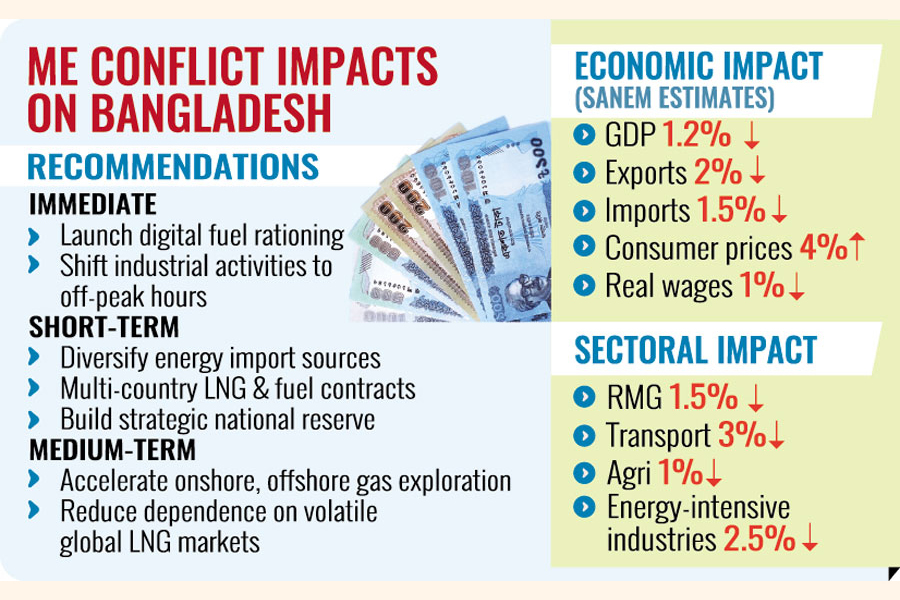
Using the Global Trade Analysis Project computable general equilibrium model, the study estimates that a 40-percent increase in global crude-oil prices and a 50-percent rise in LNG prices could reduce Bangladesh's real GDP by around 1.2 per cent.

Exports may decline about 2.0 per cent while imports could fall 1.5 per cent.

Inflationary pressures are expected to intensify, with consumer prices likely to rise by nearly 4.0 per cent and real wages projected to fall by close to 1.0 per cent, indicating a weakening of household purchasing power.

Sectoral impacts are also significant, with output in the readymade garment sector expected to decline by roughly 1.5 per cent, transport by almost 3.0 per cent, agriculture around 1.0 per cent, and energy-intensive manufacturing about 2.5 per cent.

The study observes that government response, including austerity measures and fuel rationing, has drawn mixed reactions due to inconsistencies between official claims and the situation on the ground.

To address the crisis, SANEM recommends accelerating the development of renewable energy, particularly rooftop solar, by streamlining net-metering approvals and encouraging private-sector participation.

It also calls for increased budgetary allocations and fiscal incentives, including tax exemptions on renewable-energy equipment and improved access to affordable financing.

On short-term dos, the report stresses the need to diversify energy-import sources through multi-country contracts and bilateral arrangements for crude oil, refined fuel and LNG.

It also underscores the importance of building a strategic national reserve to cushion against future global supply disruptions.

For immediate crisis management, the study suggests introducing digital fuel- rationing systems, shifting industrial activities to off-peak hours and prioritising fuel allocation to high-value sectors such as agriculture and export-oriented industries. In the medium term, SANEM underscores the need to accelerate both onshore and offshore gas exploration to ensure reliable baseload power generation and reduce dependence on volatile global LNG markets.​
 

Latest Posts

Back