[🇧🇩] Iran, US- Israel War: It's Impact On Bangladesh

[🇧🇩] Iran, US- Israel War: It's Impact On Bangladesh
66
1K
More threads by Saif

G Bangladesh Defense

State Minister Shama Obaed voices concern, hopes for peace in West Asia

UNB

Published :
May 11, 2026 00:27
Updated :
May 11, 2026 00:27
1778464739100.webp


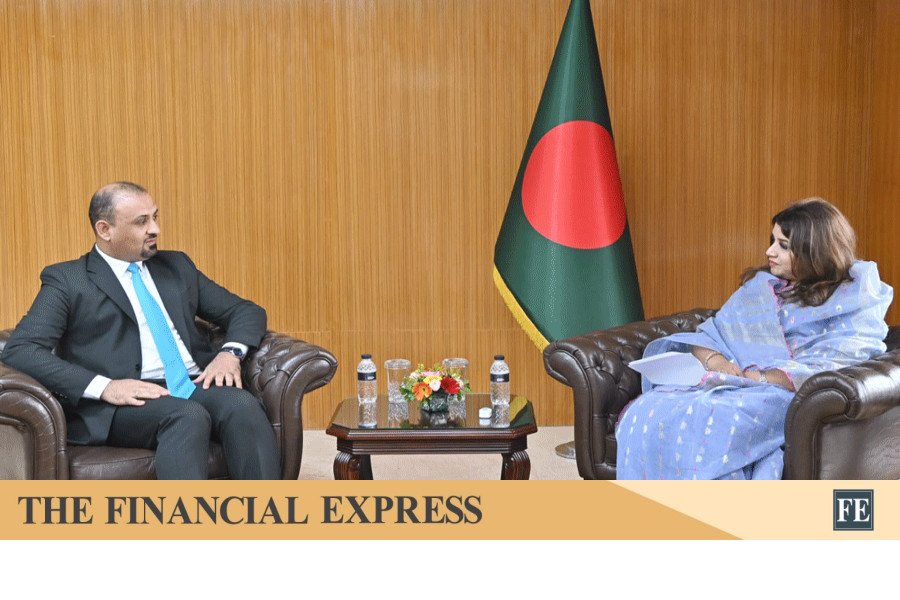
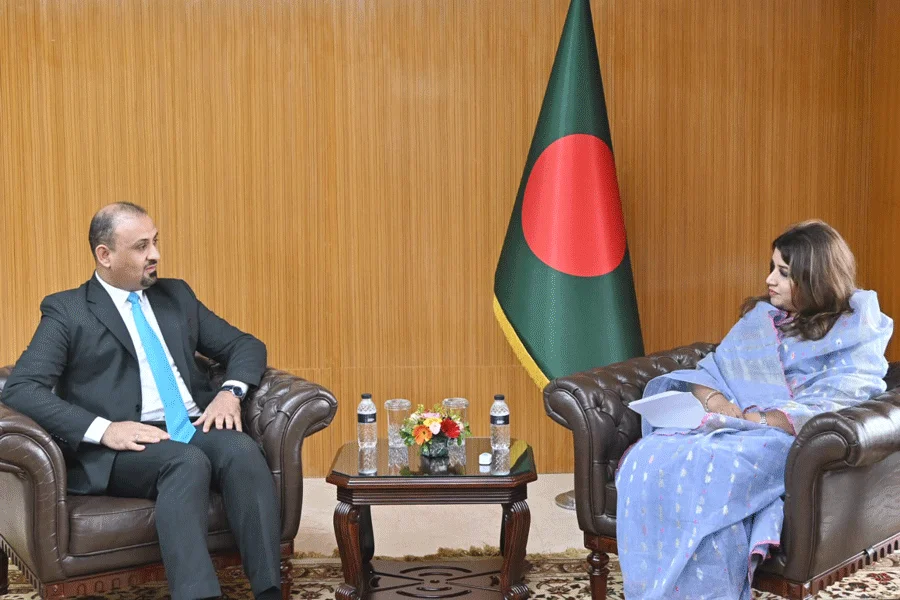
State Minister for Foreign Affairs Shama Obaed Islam on Sunday expressed concern over the ongoing conflict in West Asia/Middle East, and hoped for the early restoration of peace and stability in the region.

She made the remarks when Dr Wisam Hussein Ali Al Ithawi, Chargé d’Affaires of the Embassy of Iraq in Dhaka, paid a courtesy call on her at the Foreign Ministry.

The state minister appreciated the Government of Iraq for hosting Bangladeshi nationals and ensuring their welfare and safety.

She also conveyed appreciation to the Iraqi leadership and government for congratulating the BNP-led government following its victory in the 13th parliamentary election. Shama Obaed recalled with gratitude Iraq’s recognition of Bangladesh in 1972 as the first Arab country to do so.

During the meeting, the two sides discussed bilateral cooperation, manpower, trade and regional issues.

They also explored ways to enhance bilateral trade and economic cooperation in sectors including pharmaceuticals, leather goods, ready-made garments, ceramics and agro-products.

The state minister thanked Iraq for supporting Bangladesh’s candidacy for the presidency of the 81st session of the United Nations General Assembly (UNGA).

Both sides reaffirmed their commitment to further strengthening Bangladesh-Iraq relations and cooperation at bilateral and multilateral forums.​
 

Labour migration drops by 50pc due to ME war: RMMRU
Staff Correspondent 13 May, 2026, 23:51

1778718813325.webp


Overseas jobs decreased by 50 per cent in March 2026 compared with the same period past year amid conflicts across the Gulf states, the Refugee and Migratory Movements Research Unit, a non-governmental organisation, said on Wednesday.

At a press conference at the National Press Club in the capital Dhaka, the RMMRU also said that the migrant workers staying in the Gulf countries were facing uncertainty over their jobs and safety due to the war on Iran.Maps

RMMRU founding chair Tasneem Siddiqui urged the government special initiatives to safeguard migrant workers during the war.

‘There should be a separate line in the government budget to support expatriate workers in wartime situations. There needs to be a specific fund or budget structure, which would be state-run, to ensure rapid assistance in such crises,’ she said.

RMMRU research fellow Mohammad Jalal Uddin Sikder, also associate professor at North South University, read out the written statement in which he placed short-, mid- and long-term recommendations.

The recommendations included special migrant crisis response cells at Bangladeshi embassies in GCC countries, along with 24/7 Bangla-language hotlines, emergency food, shelter and mental health support for stranded workers, crisis alert systems in Bangla via WhatsApp and SMS and diversification of Bangladesh’s overseas labour markets beyond the Gulf in the long term.Cultural Event Listings

The RMMRU said that prolonged conflict could trigger widespread instability in the Gulf labour market, threatening employment opportunities for lakhs of Bangladeshi workers.

An estimated 70 lakh Bangladeshi migrant workers are staying in the Middle East countries, including the Kingdom of Saudi Arabia, the United Arab Emirates, Qatar, Kuwait, Bahrain and Lebanon.

‘The number of overseas job clearances from Bangladesh declined by 50 per cent in March compared with the same period past year,’ the RMMRU said quoting Bureau of Manpower Employment and Training data.

At least 10 Bangladeshi migrants have so far died and over 35 have been injured in the war that began on February 28 with the United States and Israel launching attacks on Iran and Tehran’s retaliatory strikes on the US bases across the Arab Gulf states.

The RMMRU said that the war had already disrupted business and economic activities across the Gulf areas.

‘The uncertainty could affect Saudi Arabia’s Vision 2030 mega projects which were expected to generate long-term jobs for Bangladeshi workers in construction and services,’ according to the RMMRU.

The RMMRU also expressed concern over the possible expansion of the conflict to the UAE, noting that its involvement alongside the US and Israel could expose it to retaliatory attacks from Iran, which could put the lives and livelihoods of nearly two million Bangladeshis in the UAE at risk.

The RMMRU criticised the government for lacking a comprehensive crisis response mechanism, saying there was no dedicated emergency fund for migrant workers affected by the war, including those who lost jobs, were injured or forced to return home.

The RMMRU also raised concern over domestic workers, describing them as among the most isolated and vulnerable migrant groups, often outside emergency communication networks.​
 

The U.S. war on Iran pushing global economy to the brink

Muhammad Mahmood

Published :
Jun 06, 2026 23:52
Updated :
Jun 06, 2026 23:52

1780876568147.webp


The 2026 war with Iran has triggered a global energy shock, disrupted international trade, and increased the risk of a broad recession. Now inflation rates are surging, interest rates are rising and growth is faltering. Sparked by joint U.S. and Israeli strikes on Iranian infrastructure, the conflict has interrupted key trade routes and sent economic shockwaves far beyond the Middle East. It is difficult to be certain, but the impacts could persist for years. What is already clear is that economic, political and geopolitical consequences will last for at least several years.

The main driver of the crisis is the disruption of energy transit routes. Even before the full effects of the impact of Trump's war on Iran flow through the global economy, it is already showing signs of the stresses of the global energy shock the war precipitated. According to the International Energy Agency (IEA), Iran's suppression of oil traffic through the Strait of Hormuz has removed over 10 million barrels per day, or roughly 10 per cent of total global supply, from the world market-the largest supply disruption ever recorded.

The war with Iran has ushered acute uncertainty into global energy markets, disrupting flows through the Strait of Hormuz and triggering sharp price volatility and supply shocks. Beyond hydrocarbons, the conflict is reverberating across a wider set of commodities, exposing the depth of global dependence on Gulf supply chains.

While oil prices have fallen back from their post-war highs as the talks about a deal to end the war drag on, the full effect of the war on oil prices have yet to be reflected in the currently available data. Even if the war were to end this week, there could be massive depletion of global oil inventories.

Last week, the heads of the IEA, IMF, WTO, and World Bank said global oil inventories were being depleted at a record pace, posing a serious threat to the world economy. The oil shock continues to intensify, pushing up fuel prices and raising the cost of everyday goods.

Trump and his ally, Israeli Prime Minister Benjamin Netanyahu, failed to topple the government that came to power after Iran's 1979 revolution. Instead, they strengthened it by enabling Tehran to turn its control of the Strait of Hormuz into a strategic weapon capable of triggering a global energy crisis and worldwide recession. Economists are now increasingly warning of stagflation-slowing growth, rising unemployment, and persistent inflation. The self-proclaimed dealmaker appears unable to stop undermining his own negotiations.

Consumer prices in the US and elsewhere, even before the war, are edging up because of Trump's tariffs on everyone and almost everything. Central banks are struggling to manage the sudden strain on an interconnected global economy. Rising inflation has forced lenders to raise mortgage rates repeatedly, crimping consumer spending and threatening a combination of high inflation and weak growth.

The World Trade Organisation (WTO) estimates that persistently high energy prices could cut projected global GDP growth in 2026 by 0.3 per cent. The WTO estimates that prolonged high energy prices could shave 0.3 per cent off 2026 forecast of global GDP growth. Rising global tensions, strategic decisions and geopolitical pressure may create serious uncertainty moving forward.

The U.S. is the world's leading oil producer-and a net petroleum exporter-but U.S. consumers are just as exposed to the Iran war oil price shock as everyone else, thanks to the global nature of the oil market. The U.S. economy that shows that the prolonged war in the Middle East is reigniting inflation, disrupting supply chains, and dampening hopes of a tax-cut-fuelled growth spurt this year.

Workers' share of US economic output has fallen to its lowest level since the government began keeping records in 1947, according to data released by the US Commerce Department recently. The share captured by corporate profits rose to the highest since 1950.

For the first time since the Second World War, excluding the COVID-19 pandemic, public debt in the United States has surpassed the entire economy's GDP. As of late March, debt held by the public reached $31.27 trillion, just ahead of the GDP of $31.22 trillion. This threshold is often treated as a long-term fiscal issue, but the economic costs of this debt are now moving to the forefront. The most immediate pressure comes from the possibility that major foreign holders of American assets begin pulling capital out of U.S. markets.

The U.S. economy relies heavily on stretched asset valuations-elevated prices in stocks, bonds, and real estate that far exceed their underlying fundamentals. When confidence breaks and these inflated markets correct, prices can collapse rapidly-just as they did during the 2008 financial crisis-and the real economy ultimately bears the cost.

The U.S. has limited options to prevent foreign investors from selling. The freedom to enter and exit what the Federal Reserve Bank calls "the deepest and most liquid fixed income market in the world" is exactly what makes U.S. assets attractive. That same openness creates a structural vulnerability. As leveraged institutions see their balance sheets weaken, they cut borrowing and sell assets. This pushes prices down further, setting off a chain reaction that spreads financial stress globally.

Iran has openly tried to bypass U.S. sanctions by trading oil and gas in alternative currencies. It has notably accepted Chinese yuan for transit through the Strait of Hormuz. The U.S. and Israeli war against Iran are putting growing pressure on the petrodollar system-the decades-old arrangement under which global oil is priced in U.S. dollars and revenues are recycled into U.S. Treasury securities.

This arrangement sustains global demand for the dollar, reduces U.S. borrowing costs, and strengthens its status as the world's reserve currency. It also enables the United States to borrow cheaply and run large deficits without triggering rapid currency depreciation. If this system weakens, the result could be higher inflation, sharply rising interest rates, and a diminished U.S. global position.The war is also driving broader shifts across global energy and financial markets.

The end of the petrodollar era would have major consequences for both the U.S. and the global economy: higher domestic interest rates would raise borrowing costs and mortgage payments; a weaker dollar would increase living costs by making imported goods, food, and energy more expensive for U.S. households, adding to inflation; geopolitical leverage would decline and the world would likely shift towards a more multipolar system where the global economy would become more fragmented, with different regions relying on the euro, yen, or local currencies for energy trade and other commerce.

The underlying US economic picture now is not different from that of the EU and UK or indeed much of the rest of the world where Trump's trade war or his war on Iran have lowered growth prospects and pushing up inflation rates.

Import-dependent countries such as Bangladesh have been forced to expand fuel subsidies despite already strained public finances. Since the outbreak of the war with Iran, Bangladesh's energy sector has come under severe pressure. Because the country imports about 95 per cent of its oil and liquefied natural gas (LNG), the rise in global oil prices to more than $100 a barrel has created an unprecedented subsidy burden. To help offset those costs, the government has raised fuel prices several times, including two recent increases that significantly lifted petrol and diesel prices.

The Bangladesh government is significantly dependent on migrant workers' remittances as merchandise exports have slowed due to weak global demand. Around 15 million Bangladeshis live and work abroad, with significant concentrations in the Middle East. Although remittances have not yet been severely affected, there is growing concern that a wider war with Iran could cause job losses and major disruptions.

Rising fuel and fertiliser import costs are putting heavy pressure on Bangladesh's foreign exchange reserves. The government faces an estimated $1.07 billion in LNG subsidies for a single quarter. To avoid defaulting on energy bills and to fund these subsidies, Bangladesh has sought approximately $2 billion in emergency loans from multilateral agencies like the World Bankand the International Monetary Fund (IMF).

According to 2026 reports from the World Bank and IMF, although agricultural production in Bangladesh is stabilising, high food prices and climate vulnerability continue to threaten food security for low-income households. According to the World Food Programme (WFP) roughly 15-16 million people in Bangladesh face high levels of acute hunger, placing Bangladesh among the top 10 countries with the most severe food crises.

The U.S. war on Iran is harming people worldwide by driving up food and fuel costs and pushing more households into poverty. Higher borrowing costs will have a disruptive impact on almost every country, business and household. A rise in interest rates hits financial markets already experiencing a degree of fragility due to surge in government debt. Higher oil prices have increased transport and production expenses, while fertiliser shortages threaten crop yields and rural livelihoods. The crisis is also weakening labour markets, with low-skilled and informal workers losing income. Energy shortages have forced industrial shutdowns and caused job losses.​
 

Latest Posts

Back