[🇧🇩] Iran, US- Israel War: It's Impact On Bangladesh

[🇧🇩] Iran, US- Israel War: It's Impact On Bangladesh
67
1K
More threads by Saif

G Bangladesh Defense

State Minister Shama Obaed voices concern, hopes for peace in West Asia

UNB

Published :
May 11, 2026 00:27
Updated :
May 11, 2026 00:27
1778464739100.webp


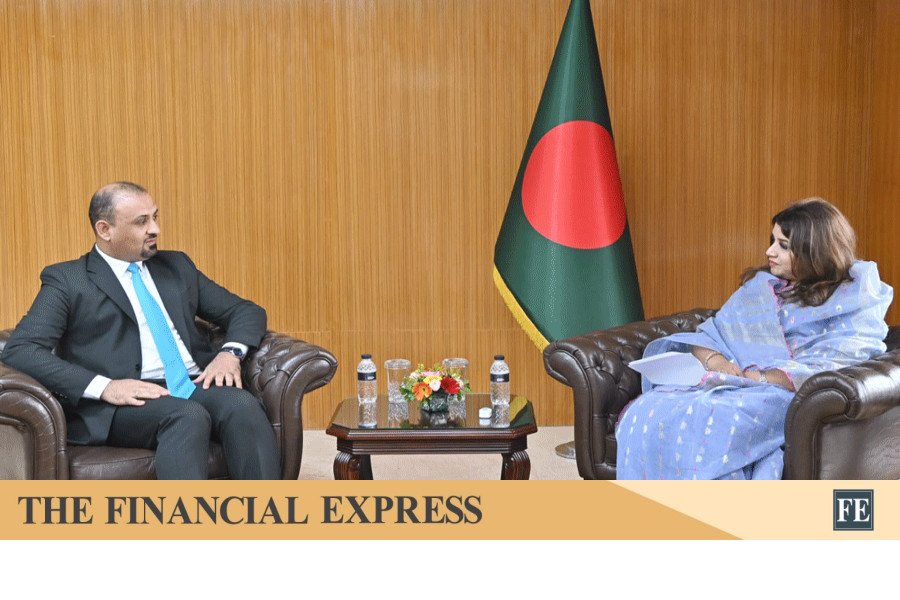
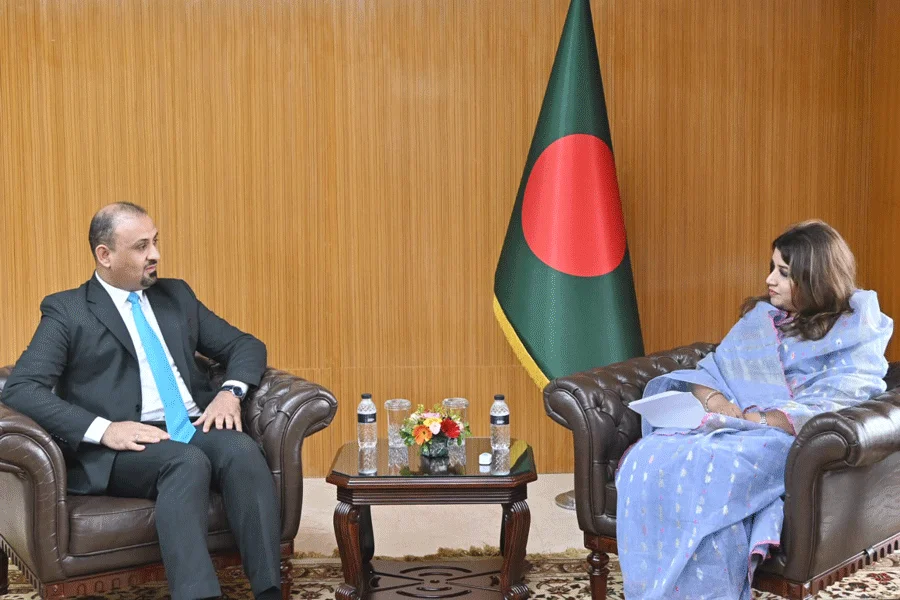
State Minister for Foreign Affairs Shama Obaed Islam on Sunday expressed concern over the ongoing conflict in West Asia/Middle East, and hoped for the early restoration of peace and stability in the region.

She made the remarks when Dr Wisam Hussein Ali Al Ithawi, Chargé d’Affaires of the Embassy of Iraq in Dhaka, paid a courtesy call on her at the Foreign Ministry.

The state minister appreciated the Government of Iraq for hosting Bangladeshi nationals and ensuring their welfare and safety.

She also conveyed appreciation to the Iraqi leadership and government for congratulating the BNP-led government following its victory in the 13th parliamentary election. Shama Obaed recalled with gratitude Iraq’s recognition of Bangladesh in 1972 as the first Arab country to do so.

During the meeting, the two sides discussed bilateral cooperation, manpower, trade and regional issues.

They also explored ways to enhance bilateral trade and economic cooperation in sectors including pharmaceuticals, leather goods, ready-made garments, ceramics and agro-products.

The state minister thanked Iraq for supporting Bangladesh’s candidacy for the presidency of the 81st session of the United Nations General Assembly (UNGA).

Both sides reaffirmed their commitment to further strengthening Bangladesh-Iraq relations and cooperation at bilateral and multilateral forums.​
 

Labour migration drops by 50pc due to ME war: RMMRU
Staff Correspondent 13 May, 2026, 23:51

1778718813325.webp


Overseas jobs decreased by 50 per cent in March 2026 compared with the same period past year amid conflicts across the Gulf states, the Refugee and Migratory Movements Research Unit, a non-governmental organisation, said on Wednesday.

At a press conference at the National Press Club in the capital Dhaka, the RMMRU also said that the migrant workers staying in the Gulf countries were facing uncertainty over their jobs and safety due to the war on Iran.Maps

RMMRU founding chair Tasneem Siddiqui urged the government special initiatives to safeguard migrant workers during the war.

‘There should be a separate line in the government budget to support expatriate workers in wartime situations. There needs to be a specific fund or budget structure, which would be state-run, to ensure rapid assistance in such crises,’ she said.

RMMRU research fellow Mohammad Jalal Uddin Sikder, also associate professor at North South University, read out the written statement in which he placed short-, mid- and long-term recommendations.

The recommendations included special migrant crisis response cells at Bangladeshi embassies in GCC countries, along with 24/7 Bangla-language hotlines, emergency food, shelter and mental health support for stranded workers, crisis alert systems in Bangla via WhatsApp and SMS and diversification of Bangladesh’s overseas labour markets beyond the Gulf in the long term.Cultural Event Listings

The RMMRU said that prolonged conflict could trigger widespread instability in the Gulf labour market, threatening employment opportunities for lakhs of Bangladeshi workers.

An estimated 70 lakh Bangladeshi migrant workers are staying in the Middle East countries, including the Kingdom of Saudi Arabia, the United Arab Emirates, Qatar, Kuwait, Bahrain and Lebanon.

‘The number of overseas job clearances from Bangladesh declined by 50 per cent in March compared with the same period past year,’ the RMMRU said quoting Bureau of Manpower Employment and Training data.

At least 10 Bangladeshi migrants have so far died and over 35 have been injured in the war that began on February 28 with the United States and Israel launching attacks on Iran and Tehran’s retaliatory strikes on the US bases across the Arab Gulf states.

The RMMRU said that the war had already disrupted business and economic activities across the Gulf areas.

‘The uncertainty could affect Saudi Arabia’s Vision 2030 mega projects which were expected to generate long-term jobs for Bangladeshi workers in construction and services,’ according to the RMMRU.

The RMMRU also expressed concern over the possible expansion of the conflict to the UAE, noting that its involvement alongside the US and Israel could expose it to retaliatory attacks from Iran, which could put the lives and livelihoods of nearly two million Bangladeshis in the UAE at risk.

The RMMRU criticised the government for lacking a comprehensive crisis response mechanism, saying there was no dedicated emergency fund for migrant workers affected by the war, including those who lost jobs, were injured or forced to return home.

The RMMRU also raised concern over domestic workers, describing them as among the most isolated and vulnerable migrant groups, often outside emergency communication networks.​
 

The U.S. war on Iran pushing global economy to the brink

Muhammad Mahmood

Published :
Jun 06, 2026 23:52
Updated :
Jun 06, 2026 23:52

1780876568147.webp


The 2026 war with Iran has triggered a global energy shock, disrupted international trade, and increased the risk of a broad recession. Now inflation rates are surging, interest rates are rising and growth is faltering. Sparked by joint U.S. and Israeli strikes on Iranian infrastructure, the conflict has interrupted key trade routes and sent economic shockwaves far beyond the Middle East. It is difficult to be certain, but the impacts could persist for years. What is already clear is that economic, political and geopolitical consequences will last for at least several years.

The main driver of the crisis is the disruption of energy transit routes. Even before the full effects of the impact of Trump's war on Iran flow through the global economy, it is already showing signs of the stresses of the global energy shock the war precipitated. According to the International Energy Agency (IEA), Iran's suppression of oil traffic through the Strait of Hormuz has removed over 10 million barrels per day, or roughly 10 per cent of total global supply, from the world market-the largest supply disruption ever recorded.

The war with Iran has ushered acute uncertainty into global energy markets, disrupting flows through the Strait of Hormuz and triggering sharp price volatility and supply shocks. Beyond hydrocarbons, the conflict is reverberating across a wider set of commodities, exposing the depth of global dependence on Gulf supply chains.

While oil prices have fallen back from their post-war highs as the talks about a deal to end the war drag on, the full effect of the war on oil prices have yet to be reflected in the currently available data. Even if the war were to end this week, there could be massive depletion of global oil inventories.

Last week, the heads of the IEA, IMF, WTO, and World Bank said global oil inventories were being depleted at a record pace, posing a serious threat to the world economy. The oil shock continues to intensify, pushing up fuel prices and raising the cost of everyday goods.

Trump and his ally, Israeli Prime Minister Benjamin Netanyahu, failed to topple the government that came to power after Iran's 1979 revolution. Instead, they strengthened it by enabling Tehran to turn its control of the Strait of Hormuz into a strategic weapon capable of triggering a global energy crisis and worldwide recession. Economists are now increasingly warning of stagflation-slowing growth, rising unemployment, and persistent inflation. The self-proclaimed dealmaker appears unable to stop undermining his own negotiations.

Consumer prices in the US and elsewhere, even before the war, are edging up because of Trump's tariffs on everyone and almost everything. Central banks are struggling to manage the sudden strain on an interconnected global economy. Rising inflation has forced lenders to raise mortgage rates repeatedly, crimping consumer spending and threatening a combination of high inflation and weak growth.

The World Trade Organisation (WTO) estimates that persistently high energy prices could cut projected global GDP growth in 2026 by 0.3 per cent. The WTO estimates that prolonged high energy prices could shave 0.3 per cent off 2026 forecast of global GDP growth. Rising global tensions, strategic decisions and geopolitical pressure may create serious uncertainty moving forward.

The U.S. is the world's leading oil producer-and a net petroleum exporter-but U.S. consumers are just as exposed to the Iran war oil price shock as everyone else, thanks to the global nature of the oil market. The U.S. economy that shows that the prolonged war in the Middle East is reigniting inflation, disrupting supply chains, and dampening hopes of a tax-cut-fuelled growth spurt this year.

Workers' share of US economic output has fallen to its lowest level since the government began keeping records in 1947, according to data released by the US Commerce Department recently. The share captured by corporate profits rose to the highest since 1950.

For the first time since the Second World War, excluding the COVID-19 pandemic, public debt in the United States has surpassed the entire economy's GDP. As of late March, debt held by the public reached $31.27 trillion, just ahead of the GDP of $31.22 trillion. This threshold is often treated as a long-term fiscal issue, but the economic costs of this debt are now moving to the forefront. The most immediate pressure comes from the possibility that major foreign holders of American assets begin pulling capital out of U.S. markets.

The U.S. economy relies heavily on stretched asset valuations-elevated prices in stocks, bonds, and real estate that far exceed their underlying fundamentals. When confidence breaks and these inflated markets correct, prices can collapse rapidly-just as they did during the 2008 financial crisis-and the real economy ultimately bears the cost.

The U.S. has limited options to prevent foreign investors from selling. The freedom to enter and exit what the Federal Reserve Bank calls "the deepest and most liquid fixed income market in the world" is exactly what makes U.S. assets attractive. That same openness creates a structural vulnerability. As leveraged institutions see their balance sheets weaken, they cut borrowing and sell assets. This pushes prices down further, setting off a chain reaction that spreads financial stress globally.

Iran has openly tried to bypass U.S. sanctions by trading oil and gas in alternative currencies. It has notably accepted Chinese yuan for transit through the Strait of Hormuz. The U.S. and Israeli war against Iran are putting growing pressure on the petrodollar system-the decades-old arrangement under which global oil is priced in U.S. dollars and revenues are recycled into U.S. Treasury securities.

This arrangement sustains global demand for the dollar, reduces U.S. borrowing costs, and strengthens its status as the world's reserve currency. It also enables the United States to borrow cheaply and run large deficits without triggering rapid currency depreciation. If this system weakens, the result could be higher inflation, sharply rising interest rates, and a diminished U.S. global position.The war is also driving broader shifts across global energy and financial markets.

The end of the petrodollar era would have major consequences for both the U.S. and the global economy: higher domestic interest rates would raise borrowing costs and mortgage payments; a weaker dollar would increase living costs by making imported goods, food, and energy more expensive for U.S. households, adding to inflation; geopolitical leverage would decline and the world would likely shift towards a more multipolar system where the global economy would become more fragmented, with different regions relying on the euro, yen, or local currencies for energy trade and other commerce.

The underlying US economic picture now is not different from that of the EU and UK or indeed much of the rest of the world where Trump's trade war or his war on Iran have lowered growth prospects and pushing up inflation rates.

Import-dependent countries such as Bangladesh have been forced to expand fuel subsidies despite already strained public finances. Since the outbreak of the war with Iran, Bangladesh's energy sector has come under severe pressure. Because the country imports about 95 per cent of its oil and liquefied natural gas (LNG), the rise in global oil prices to more than $100 a barrel has created an unprecedented subsidy burden. To help offset those costs, the government has raised fuel prices several times, including two recent increases that significantly lifted petrol and diesel prices.

The Bangladesh government is significantly dependent on migrant workers' remittances as merchandise exports have slowed due to weak global demand. Around 15 million Bangladeshis live and work abroad, with significant concentrations in the Middle East. Although remittances have not yet been severely affected, there is growing concern that a wider war with Iran could cause job losses and major disruptions.

Rising fuel and fertiliser import costs are putting heavy pressure on Bangladesh's foreign exchange reserves. The government faces an estimated $1.07 billion in LNG subsidies for a single quarter. To avoid defaulting on energy bills and to fund these subsidies, Bangladesh has sought approximately $2 billion in emergency loans from multilateral agencies like the World Bankand the International Monetary Fund (IMF).

According to 2026 reports from the World Bank and IMF, although agricultural production in Bangladesh is stabilising, high food prices and climate vulnerability continue to threaten food security for low-income households. According to the World Food Programme (WFP) roughly 15-16 million people in Bangladesh face high levels of acute hunger, placing Bangladesh among the top 10 countries with the most severe food crises.

The U.S. war on Iran is harming people worldwide by driving up food and fuel costs and pushing more households into poverty. Higher borrowing costs will have a disruptive impact on almost every country, business and household. A rise in interest rates hits financial markets already experiencing a degree of fragility due to surge in government debt. Higher oil prices have increased transport and production expenses, while fertiliser shortages threaten crop yields and rural livelihoods. The crisis is also weakening labour markets, with low-skilled and informal workers losing income. Energy shortages have forced industrial shutdowns and caused job losses.​
 

Iran war & rising cost of living in Bangladesh

Muhammad Mahmood

Published :
Jun 13, 2026 23:37
Updated :
Jun 13, 2026 23:37

1781407432157.webp


Bangladesh’s point-to-point inflation rose to 9.42 per cent in May 2026 from 9.04 per cent in April and 8.71 per cent in March, driven by higher prices for food, housing, and transport. According to the Bangladesh Bureau of Statistics (BBS), the increase was mainly due to rising global energy costs, which pushed up imported fuel prices. Food inflation reached 9.04 per cent in May from 8.39 per cent in April while non-food inflation rose to 9.71 per cent from 9.57 per cent.

BBS data showed that inflation in Bangladesh eased to 8.71 per cent in March 2026, down from 9.13 per cent in February, despite severe fuel shortages that affected the prices of food and other essential goods. Food inflation also fell, dropping to 8.24 per cent in March from 9.30 per cent the previous month. This decline in the Consumer Price Index (CPI) came at a time when inflation was rising in most advanced economies like the United States, prices increased by 0.9 per cent on a seasonally adjusted basis from February to March 2026, while annual inflation reached 3.3 per cent, up from 2.4 per cent in February. In the United Kingdom, inflation rose to 3.3 per cent in March as higher fuel prices linked to the Middle East crisis pushed up supply costs.

Despite the monthly increase, inflation in April 2026 remained slightly below the 9.17 per cent recorded in April 2025. BBS data, like most government statistics, are often seen as questionable and may not fully reflect conditions on the ground. This perception is reinforced by the worsening living conditions of Bangladesh’s workers and the rural and urban poor.

Although rising global energy prices and supply disruptions have contributed to domestic inflation, governance failures have also played a major role, particularly the failure to curb market cartels that manipulate the supply and prices of essential goods. By creating artificial shortages and fixing prices, these groups often cause sudden increases in the cost of living. Additional costs also stem from protection rackets linked to whichever political party is in power. Together, these factors have pushed up the prices of essential goods and services.

Bangladesh’s food outlook for 2026 is under pressure from high fertiliser prices, climate-related production challenges, and rising grain import needs, especially for wheat. The country also faces long-term food security risks driven by rapid population growth, shrinking arable land, and climate-related disasters such as floods and salinity, compounded by the current global energy and fertiliser crisis.

According to 2026 reports from the World Bank and IMF, although agricultural production in Bangladesh is stabilising, high food prices and climate vulnerability continue to threaten food security for low-income households. According to the World Food Programme (WFP) roughly 15-16 million people in Bangladesh face high levels of acute hunger, placing Bangladesh among the top 10 countries with the most severe food crises.

Bangladesh is now facing a severe fuel supply crisis and increased import costs due to Trump’s war on Iran forcing the government to seek alternative sources to ensure energy security and support agriculture. It is estimated that $2.61 billion in extra foreign exchange is required by June 2026 for surging fuel and fertiliser imports. Bangladesh imports 80-90 per cent of its refined fuel, amounting to over 6 million tonnes of petroleum products per year. About 23 per cent of fuel imports pass through the Strait of Hormuz, where war-related disruptions have caused shipment delays. Elevated dependence on imported fossil fuels has boosted electricity generation costs by 83% over the past five years. The diesel crunch for irrigation poses a 20-30 per cent reduction risk to rice yields.

Bangladesh is a major global fertiliser importer, importing roughly $2.04 billion in 2024 (9th largest globally) and requiring about 7 million tons annually, with domestic production covering only about 1 million ton. Farmers in Bangladesh, like their counterparts across the world, are confronting soaring fuel and fertiliser costs that threaten to slash agricultural production and deepen the food security crisis affecting millions.

Rising fuel and fertiliser import costs are putting heavy pressure on Bangladesh’s foreign exchange reserves. To secure fuel and LNG imports, the country is seeking more than $2 billion in urgent external financing from lenders such as the IMF and ADB amid an energy crisis worsened by Trump’s war on Iran. The package is expected to include $1.3 billion from the IMF and about $250 million to $500 million in additional funding from the ADB.

The Bangladesh government is significantly dependent on migrant workers’ remittances as merchandise exports have slowed due to weak global demand. Around 15 million citizens live and work abroad, with significant concentrations in the Middle East. $32.8 billion was remitted in 2025, a 22 per cent increase from 2024, aided by increased use of formal banking channels. Expatriate income is a crucial, high-volume source of foreign exchange. Remittances act as a major pillar alongside exports to bolster foreign exchange reserves.

Although remittances have not yet been severely affected, there is growing concern that a wider war with Iran could cause job losses and major disruptions. Bangladesh’s heavy reliance on expatriate income also highlights deeper structural weaknesses in the economy. Since independence, these weaknesses have been rooted in a state-controlled system that has shaped the market through so-called economic planning, largely directed by the bureaucracy.

This state-led model of managing the market and directing development is also weakened by Bangladesh’s political patronage system, which rewards personal loyalty over merit and leads to corruption and inefficient use of resources. In this clientelist system, benefits are distributed to supporters, undermining long-term development goals.

Overall, the state-managed market system failed to build either a competitive manufacturing base or a strong agricultural sector, leaving the country dependent on exporting poorly protected labour, including women employed as domestic workers, mostly to medieval Gulf monarchies.

The latest World Bank Bangladesh Development Update projects growth to slow to 3.9 per cent in FY26, though this forecast may prove too optimistic. ADB President Masato Kanda warned that the region is facing a “deepening crisis,” saying, “We are confronting systemic, long-lasting disruption to global energy and trade networks, not just temporary volatility.”

In its Update the World Bank has further added that a protracted conflict in the Middle East could have significant implications for Bangladesh, including higher inflation, reduced fiscal space from rising energy subsidies, and a weaker current account due to higher import costs, weaker exports, and lower remittances. With thin foreign exchange buffers, tight fiscal and monetary conditions, and a fragile banking sector, Bangladesh has limited capacity to absorb a prolonged shock and to mitigate its impact on its people, notably the most vulnerable.

In the first half of the 2025-26 fiscal year (July–December 2025), Bangladesh’s food grain imports surged by 42 per cent compared to the same period the previous year and the data shows substantial increases in imported volumes, particularly wheat, which was 84 per cent of food grain imports. In 2024, Bangladesh imported $2.26 billion worth of foodstuffs.

Now the closure of the Strait of Hormuz which handles about 30 per cent of globally traded fertiliser poses a very significant challenge for Bangladesh. Shortages and rising fertiliser prices could lead to reduced usage causing lower crop yields. Already global food prices are showing a rising trend, especially for basic staples like wheat, rice and vegetable oil and this will pose very a serious challenge for a food importing country like Bangladesh.

The closure of the Strait of Hormuz has created an energy crisis, escalating transportation costs and feeding into high cost-push inflation. Poor households, which spend a large portion of their income on food are hit hardest underscoring the sharp erosion of living standards.

As of 2026, the taxation system in Bangladesh is characterised by a reliance on indirect taxes, weak administrative capacity, and high levels of exemption. Bangladesh’s tax-to-GDP ratio was only 6.7 per cent in FY25, less than half of the 15 per cent widely considered the minimum needed to meet essential development needs. The country’s tax system is complex and distortionary, with multiple rates and large, regressive exemptions on consumption (VAT) and income taxes. Its heavy reliance on trade-related taxes also discourages trade, a key driver of economic growth. High tariffs and supplementary duties further create an anti-export bias, helping keep Bangladesh’s tax-to-GDP ratio among the lowest.

In the 2026–27 budget, Bangladesh aims to raise its tax-to-GDP ratio to 8 per cent. To cut the budget deficit and increase revenue, the government is likely to raise tax rates, widen the tax base, and rely more on indirect taxes, including higher VAT on staple foods such as rice, wheat, potatoes, and lentils, alongside changes to direct taxes. However, heavier reliance on indirect taxes would place an even greater burden on an already impoverished population.

While Bangladesh has achieved reductions in poverty, with extreme poverty dropping to 5.6 per cent and moderate poverty to 18.7 per cent by 2022, yet roughly one-third of the population (about 62 million people) remains vulnerable to falling back into poverty due to economic shocks or natural disasters. Recent reports indicate an economic slowdown has raised extreme poverty to approximately 9.3 per cent by 2025. Growth has become less inclusive, with income benefits favouring wealthier families, and the pace of poverty reduction slowing down post-2016.

The Iran war is severely affecting people in Bangladesh by driving up food and fuel prices and pushing more households into poverty. Higher oil prices have raised transport and production costs, while fertiliser shortages threaten crop yields and rural livelihoods. The crisis is also hurting the labour market, with low-skilled and informal workers losing income. Energy shortages have led to industrial shutdowns and job losses, and conflict in the Gulf could further reduce remittance inflows, a vital source of support for many low-income Bangladeshi families.​
 

Latest Posts

Back