Bangladesh Defense
Saif
Senior Member
- Jan 24, 2024
- 21,680
- 9,794
- Nation

- Residence
- Axis Group


Export competitiveness, inclusive growth key to economic drive
Policymakers on Saturday said Bangladesh must sharpen its export edge and extend economic opportunity to historically excluded groups, as the country navigates slowing global demand, rising trade barriers, and structural financing pressures that threaten to constrain growth...
 www.newagebd.net
Export competitiveness, inclusive growth key to economic drive
Staff Correspondent 14 June, 2026, 03:30
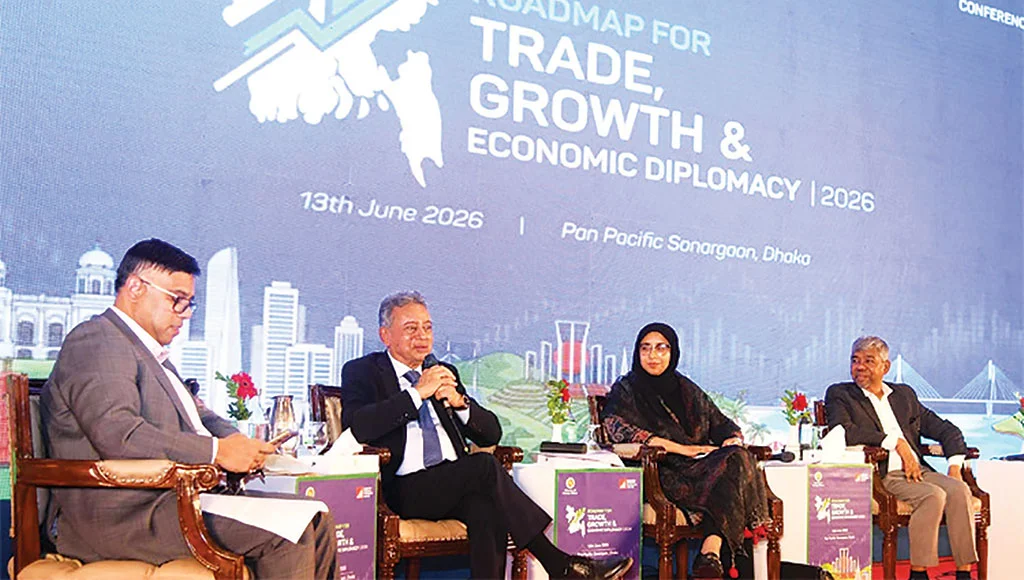
Finance minister Amir Khosru Mahmud Chowdhury addresses a conference held at a hotel in the capital on Saturday. | PID photo
Policymakers on Saturday said Bangladesh must sharpen its export edge and extend economic opportunity to historically excluded groups, as the country navigates slowing global demand, rising trade barriers, and structural financing pressures that threaten to constrain growth.
They were speaking at the conference titled ‘Roadmap for Trade, Growth and Economic Diplomacy 2026’, organised jointly by the Ministry of Foreign Affairs and the Bangladesh Investment Development Authority at a hotel in the capital.
Senior policymakers, heads of diplomatic missions, development partners, and private sector representatives participated in the event.
In the opening session, foreign minister Khalilur Rahman said Bangladesh’s export position could not be taken for granted in the current global environment, characterised by geopolitical tensions, shifting supply chains and trade policy uncertainty.
He warned that moderate growth in major export markets was likely to dampen consumer demand and weigh on export volumes.
‹We would need to compete ever more fiercely in order to maintain and expand our export position,’ he said, adding that the government’s strategic response to these challenges rested on three goals articulated by prime minister Tarique Rahman — stabilise, reform and elevate.
Converting the vision into concrete action on trade and economic diplomacy was the immediate task, he added.
He also drew attention to the structural financing disadvantage faced by countries like Bangladesh, noting that while advanced economies typically borrow at interest rates of between one and four per cent, developing nations often face costs of six to twelve per cent or more.
Citing findings from a recent UNCTAD Investment Policy Review, he said climate-vulnerable nations pay an additional $20 billion annually in interest attributable to climate-related risks.
‘External debt and the climate crisis are becoming intertwined,’ he said, warning that the ongoing global energy crisis — which he said could surpass the scale of the oil shocks of the 1970s — was already raising Bangladesh’s import bill for fuel and increasing production costs and competitiveness.
On structural reform, the foreign minister said Bangladesh’s embassies and high commissions abroad were being restructured to serve as proactive facilitators of trade and investment, tasked with modernising trade agreements, pursuing reciprocal market access and supporting economic integration.
He pledged that domestic reforms would improve the ease of doing business, replace systemic bottlenecks with policy predictability and create a level playing field for enterprises of all sizes.
He also flagged the transformative implications of what he termed Trade Tech, the convergence of trade, investment and emerging technologies including artificial intelligence, blockchain, the Internet of Things and 5G connectivity, calling it both a risk and an opportunity depending on Bangladesh’s speed of adaptation.
Finance minister Amir Khosru Mahmud Chowdhury said the proposed national budget for FY2026–27 had been designed to be as inclusive as possible, with an explicit focus on bringing historically excluded groups into the mainstream of economic life.
He also announced sweeping reforms in public financing and business regulation, including a pledge to issue all business approvals within seven days, as the government moves to improve the investment climate and ease fiscal pressures.
Under the new approval system, businesses, currently required to obtain permissions from 19 to 40 separate agencies, would submit applications through a central mechanism. Agencies that fail to respond within seven days will be deemed to have granted approval automatically.
A dedicated website would allow businesses to flag delays or harassment for review by a task force formed specifically to monitor deregulation progress, he added.
He also said that the government would restructure the public financial architecture, adding that state-owned enterprises would no longer rely on the national treasury for operational funding and would instead have to raise resources from the market.
Bangladesh’s low tax-to-GDP ratio had further squeezed fiscal space, with approximately Tk 1.25 lakh crore now allocated to interest payments alone, sharply curtailing development expenditure, he said.
Structural weaknesses in the banking sector, particularly the mismatch between short-term deposits and long-term lending, also needed to be addressed, he said, stressing the importance of deepening the capital market so that entrepreneurs could access equity and bond financing rather than relying solely on bank credit.
Local government minister Mirza Fakhrul Islam Alamgir said the government’s overarching ambition was to build a self-reliant, stable and industrially developed Bangladesh in which every citizen enjoyed the benefits of prosperity and dignity.
Ensuring economic equity and dismantling entrenched oligarchic structures were among its central goals, he added.
BIDA executive chairman Chowdhury Ashik Mahmud Bin Harun said the government was pushing ahead with structural reforms to attract investment and cut bureaucratic delays.
He also said that Bangladesh had crossed the $500 billion economic threshold with strong FDI performance, but the government›s ambition — generating 10 million jobs — required large-scale private sector investment, not state commercial activity.
Around 20 loss-making state-owned enterprises have been identified for privatisation or public-private partnership arrangements, to be offered through investor roadshows, he added.
On energy, Ashik acknowledged a five-to-ten-year infrastructure gap while citing progress on solar expansion, LNG terminal development and fuel source diversification.
Port competitiveness and logistics reform, he said, would show visible results within a year, with internationally experienced operators being sought.
Progress on special economic zones, including the proposed Chinese Economic Zone in Anwara, was also noted.
Prime minister›s foreign affairs adviser Humaiun Kobir said Bangladesh’s foreign policy was no longer confined to traditional political relations but was increasingly being reshaped around economic diplomacy, investment facilitation and export diversification.
‘Bangladesh’s foreign policy framework is moving beyond conventional bilateral diplomacy to a more integrated economic statecraft approach aimed at maximising national economic interests,’ he said.
‘We want cooperation with India, but it must be based on mutual respect. We should have a good working relationship with India,’ he added.
NBR chairman Abdur Rahman Khan said digitalisation measures — including the eVAT system for online registration, return filing and payment, the eReturn platform and the National Single Window — would play a pivotal role in expanding the revenue net and improving transparency.
Ministers, government officials, and private-sector representatives also spoke at the event during different plenary sessions.
Staff Correspondent 14 June, 2026, 03:30
Finance minister Amir Khosru Mahmud Chowdhury addresses a conference held at a hotel in the capital on Saturday. | PID photo
Policymakers on Saturday said Bangladesh must sharpen its export edge and extend economic opportunity to historically excluded groups, as the country navigates slowing global demand, rising trade barriers, and structural financing pressures that threaten to constrain growth.
They were speaking at the conference titled ‘Roadmap for Trade, Growth and Economic Diplomacy 2026’, organised jointly by the Ministry of Foreign Affairs and the Bangladesh Investment Development Authority at a hotel in the capital.
Senior policymakers, heads of diplomatic missions, development partners, and private sector representatives participated in the event.
In the opening session, foreign minister Khalilur Rahman said Bangladesh’s export position could not be taken for granted in the current global environment, characterised by geopolitical tensions, shifting supply chains and trade policy uncertainty.
He warned that moderate growth in major export markets was likely to dampen consumer demand and weigh on export volumes.
‹We would need to compete ever more fiercely in order to maintain and expand our export position,’ he said, adding that the government’s strategic response to these challenges rested on three goals articulated by prime minister Tarique Rahman — stabilise, reform and elevate.
Converting the vision into concrete action on trade and economic diplomacy was the immediate task, he added.
He also drew attention to the structural financing disadvantage faced by countries like Bangladesh, noting that while advanced economies typically borrow at interest rates of between one and four per cent, developing nations often face costs of six to twelve per cent or more.
Citing findings from a recent UNCTAD Investment Policy Review, he said climate-vulnerable nations pay an additional $20 billion annually in interest attributable to climate-related risks.
‘External debt and the climate crisis are becoming intertwined,’ he said, warning that the ongoing global energy crisis — which he said could surpass the scale of the oil shocks of the 1970s — was already raising Bangladesh’s import bill for fuel and increasing production costs and competitiveness.
On structural reform, the foreign minister said Bangladesh’s embassies and high commissions abroad were being restructured to serve as proactive facilitators of trade and investment, tasked with modernising trade agreements, pursuing reciprocal market access and supporting economic integration.
He pledged that domestic reforms would improve the ease of doing business, replace systemic bottlenecks with policy predictability and create a level playing field for enterprises of all sizes.
He also flagged the transformative implications of what he termed Trade Tech, the convergence of trade, investment and emerging technologies including artificial intelligence, blockchain, the Internet of Things and 5G connectivity, calling it both a risk and an opportunity depending on Bangladesh’s speed of adaptation.
Finance minister Amir Khosru Mahmud Chowdhury said the proposed national budget for FY2026–27 had been designed to be as inclusive as possible, with an explicit focus on bringing historically excluded groups into the mainstream of economic life.
He also announced sweeping reforms in public financing and business regulation, including a pledge to issue all business approvals within seven days, as the government moves to improve the investment climate and ease fiscal pressures.
Under the new approval system, businesses, currently required to obtain permissions from 19 to 40 separate agencies, would submit applications through a central mechanism. Agencies that fail to respond within seven days will be deemed to have granted approval automatically.
A dedicated website would allow businesses to flag delays or harassment for review by a task force formed specifically to monitor deregulation progress, he added.
He also said that the government would restructure the public financial architecture, adding that state-owned enterprises would no longer rely on the national treasury for operational funding and would instead have to raise resources from the market.
Bangladesh’s low tax-to-GDP ratio had further squeezed fiscal space, with approximately Tk 1.25 lakh crore now allocated to interest payments alone, sharply curtailing development expenditure, he said.
Structural weaknesses in the banking sector, particularly the mismatch between short-term deposits and long-term lending, also needed to be addressed, he said, stressing the importance of deepening the capital market so that entrepreneurs could access equity and bond financing rather than relying solely on bank credit.
Local government minister Mirza Fakhrul Islam Alamgir said the government’s overarching ambition was to build a self-reliant, stable and industrially developed Bangladesh in which every citizen enjoyed the benefits of prosperity and dignity.
Ensuring economic equity and dismantling entrenched oligarchic structures were among its central goals, he added.
BIDA executive chairman Chowdhury Ashik Mahmud Bin Harun said the government was pushing ahead with structural reforms to attract investment and cut bureaucratic delays.
He also said that Bangladesh had crossed the $500 billion economic threshold with strong FDI performance, but the government›s ambition — generating 10 million jobs — required large-scale private sector investment, not state commercial activity.
Around 20 loss-making state-owned enterprises have been identified for privatisation or public-private partnership arrangements, to be offered through investor roadshows, he added.
On energy, Ashik acknowledged a five-to-ten-year infrastructure gap while citing progress on solar expansion, LNG terminal development and fuel source diversification.
Port competitiveness and logistics reform, he said, would show visible results within a year, with internationally experienced operators being sought.
Progress on special economic zones, including the proposed Chinese Economic Zone in Anwara, was also noted.
Prime minister›s foreign affairs adviser Humaiun Kobir said Bangladesh’s foreign policy was no longer confined to traditional political relations but was increasingly being reshaped around economic diplomacy, investment facilitation and export diversification.
‘Bangladesh’s foreign policy framework is moving beyond conventional bilateral diplomacy to a more integrated economic statecraft approach aimed at maximising national economic interests,’ he said.
‘We want cooperation with India, but it must be based on mutual respect. We should have a good working relationship with India,’ he added.
NBR chairman Abdur Rahman Khan said digitalisation measures — including the eVAT system for online registration, return filing and payment, the eReturn platform and the National Single Window — would play a pivotal role in expanding the revenue net and improving transparency.
Ministers, government officials, and private-sector representatives also spoke at the event during different plenary sessions.