[🇧🇩] Israel and Hamas war in Gaza-----Can Bangladesh be a peace broker?

Afghanistan Albania Algeria Andorra Angola Antigua Austria Azerbaijan Bahamas Bahrain Bangladesh Barbados Canada China Egypt Finland Germany India Iran Israel Japan Lebanon North Macedonia Pakistan Palestine Qatar Russia Syria Turkey Ukraine United Kingdom United States Yemen
[🇧🇩] Israel and Hamas war in Gaza-----Can Bangladesh be a peace broker?
999
36K
More threads by Saif

G Bangladesh Defense

Israeli strikes kill two Hamas commanders
Dozens of Palestinians killed or missing as IDF presses its north Gaza offensive

Israel's military said yesterday it had killed two Hamas commanders, pressing its north Gaza offensive a day after the International Criminal Court (ICC) issued arrest warrants over the offensive.

The Israeli Defense Forces (IDF) said an air strike on the territory's north killed five Hamas members including two company commanders "who participated in the October 7 massacre" last year.

Medics said dozens were killed or missing after an overnight Israeli raid on Beit Lahia and nearby Jabalia, which are among the targets of a sweeping Israeli assault on north Gaza.

A separate air attack targeted the Kamal Adwan Hospital – one of the few partially functioning medical facilities in the besieged territory's north.

Residents claimed that Israeli soldiers yesterday set fire to residential buildings in Beit Lahiya to prevent families from returning to the area.

Israeli gunboats have also fired at a fishing boat off the coast of Gaza City, killing one person and wounding another, report Al Jazeera online.

Biden, in a statement later on Thursday responding to the ICC's arrest warrants for Israeli leaders, called them "outrageous", vowing to "always stand with Israel against threats to its security".

China, which like Israel and the United States is not a member of the ICC, urged the court to "uphold an objective and just position". The Palestinian Authority and Hamas both welcomed the warrants, reports AFP.

However, Irish Prime Minister Simon Harris said yesterday that Netanyahu would be detained if he arrives in Ireland.

The head of Iran's Revolutionary Guards yesterday described the arrest warrant as the "end and political death" of Israel, in a speech.

More than 44,056 people have been killed in Gaza in more than 13 months of offensive.​
 

Hundreds flee Gaza as IDF orders evacuations

1732494591296.webp


The Israeli military issued new evacuation orders to residents in areas of an eastern Gaza City suburb, setting off a new wave of displacement yesterday, and a Gaza hospital director was injured in an Israeli drone attack, medics said.

The new orders for Shejaia suburb posted by Israeli army spokesperson on X on Saturday night were blamed on Hamas firing rockets from that heavily built-up district in the north of Gaza.

"For your safety, you must evacuate immediately to the south," the military's post said. The rocket volley on Saturday was claimed by Hamas' armed wing, which said it had targeted an Israeli army base over the border.

Footage circulated on social media showed residents leaving Shejaia on donkey carts and rickshaws, with others, including children carrying backpacks, walking.

"I had hoped for a more ambitious outcome – on both finance and mitigation – to meet the great challenge we face. But this agreement provides a base on which to build. It must be honoured in full and on time. Commitments must quickly become cash."— UN chief Antonio Guterres on COP29 deal.

Families living in the targeted areas began fleeing their homes after nightfall on Saturday and into yesterday's early hours, residents and Palestinian media said - the latest in multiple waves of displacement since the offensive began 13 months ago.

In central Gaza, at least 10 Palestinians were killed in Israeli airstrikes on the camps of Al-Maghazi and Al-Bureij since Saturday night.​
 

11 Palestinians killed in Israeli strikes, shelling
Says Gaza’s civil defence, warns rescue vehicles not working in north of enclave for lack of fuel

1732665845637.webp


Gaza's civil defence agency said yesterday that 11 people were killed in nighttime Israeli air strikes and artillery shelling across the Palestinian territory.

In the northern city of Jabalia, seven people were killed and several others wounded in an air strike on a residential building, civil defence spokesman Mahmud Bassal told AFP.

Another person was killed in a strike on a house in nearby Beit Lahia, which along with Jabalia has been the site of an intensive Israeli military operation since October 6.

Two people were killed by artillery shelling on Nuseirat camp in central Gaza, Bassal said. In the southern city of Rafah, an air strike killed one and wounded several, he added.

Israel's campaign has killed 44,249 people in Gaza, according to figures from the Hamas-run territory's health ministry that the United Nations considers reliable.

Meanwhile, Gaza's civil defence agency warned yesterday that its vehicles had stopped working in the Palestinian territory's north due to a lack of fuel, warning it could not respond to emergencies.

"All our fire, rescue, and ambulance vehicles have stopped working in Gaza governorate due to the Israeli occupation's continued refusal to provide the necessary diesel to operate them," the rescue agency said in a statement.

"Our crews will not be able to respond to citizens' calls until the Israeli occupation allows humanitarian organisations to bring in the necessary quantities of diesel," it added.

The UN rights chief is gravely concerned over the escalating conflict between Israel and Hezbollah in Lebanon and wants a "permanent ceasefire" there and in war-ravaged Gaza, his spokesman said yesterday.

"The high commissioner reiterates his call for an immediate ceasefire to put an end to the killings and the destruction," Jeremy Laurence, a spokesman for Volker Turk, told reporters in Geneva.​
 

Gazans at long-term risk from war remnants
Agence France-Presse . Jerusalem 26 November, 2024, 22:32

1732667420410.webp

Displaced Palestinians wait in line to receive food at a distribution centre in Deir el-Balah in the central Gaza Strip on Tuesday, amid the on-going war between Israel and Hamas. | AFP photo

International humanitarian NGO Danish Refugee Council warned on Monday that Gazans are at long-term risk from unexploded and unused ordnance in the densely populated Palestinian territory.

‘These remnants of war, which fail to detonate upon impact or may have been abandoned during warfare, pose a long-term threat to civilian populations, often causing injuries and deaths long after the fighting ceases,’ said DRC’s Corinne Linnecar.

The NGO, which has a presence in the Gaza Strip, said in a report that ammunition, exploded or otherwise, can be found in many populated areas of the territory.

The report said 70 per cent of Gazans have returned to areas where there has been active combat, raising the risk of their coming into contact with explosive materiel.

With the territory in the grip of a humanitarian crisis and very little aid getting in, Gazans in desperate need of basic goods have ‘sifted through rubble for essential supplies’ but where they can also encounter munitions.

Longer-term healthcare services are also nearly non-existent, DRC said.

‘Only 19 per cent of explosive ordnance victims receive emergency first aid, and long-term medical support is virtually non-existent,’ the report said, noting that children are especially at risk because they can confuse munitions with toys.

‘Israel is using weapons indiscriminately in civilian areas over and over again, in a way that is in violation of international humanitarian law,’ Linnecar said.

Even before the current war, explosive ordnance was already a problem in Gaza, after repeated Israeli bombardment over the years.

‘The remnants of war will continue to claim lives long after the fighting ceases,’ DRC said.

The war in Gaza erupted after Hamas’s attack on Israel on October 7, 2023, which resulted in the deaths of 1,206 people, mostly civilians, according to an AFP tally of Israeli official figures.

Israel’s retaliatory campaign in Gaza has killed at least 44,235 people, most of them civilians, according to data from the Hamas-run territory’s health ministry, which the United Nations considers reliable.​
 

Anatomy of erasure: The unmaking of Palestine

1732925745138.webp

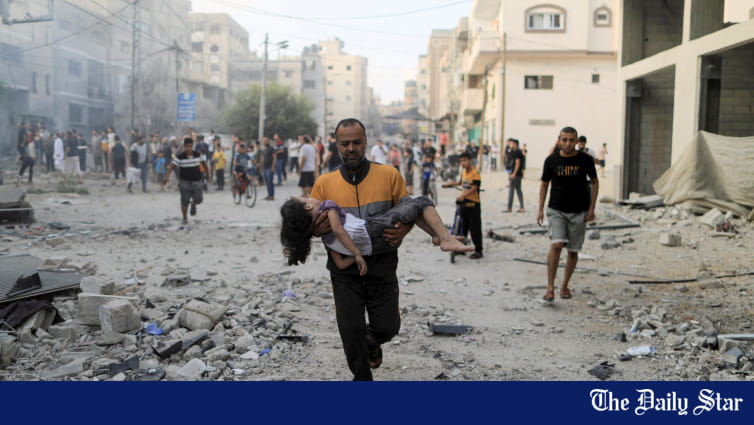
A Palestinian man carries a wounded girl at the site of Israeli strikes, in Khan Younis in the southern Gaza Strip on October 14, 2023. FILE PHOTO: REUTERS

"The project of settler colonialism eventually was a simple one. Colonisers wanted the land and everything else the Indigenous people are burdened with daily, the legal or policy or economic or social discrimination the residential schools or gender violence are all part of the machinery that was designed, to create a perfect crime, a crime where the victims were unable to see or name the crime itself as a crime." — Leanne Betasamosake Simpson, an Indigenous scholar from Turtle Island, known to us as Canada.

Every time I open a YouTube video, it's there—ads asking my help, a Palestinian mother, a child, sometimes a girl—framed by rubble. They start to talk: "Don't skip." Or softer: "Skip if you must."

I skip. Quickly.

After dealing with news all day when my midnights march in I feel angry, I don't know at whom; I feel shame, for not listening to the mothers of ruin. I tell myself it's exhaustion. I tell myself I need mindless joy, a brief escape. Everyone has their reasons, I suppose. I know why the algorithm sends me these, I know if I skip enough times it'll stop.

Today is the International Day of Solidarity with the Palestinian People. It was established by the United Nations General Assembly in 1977. The interesting thing is the date was chosen as it marks the anniversary of the UN General Assembly's adoption of Resolution 181 in 1947, which proposed the partition of Palestine into separate Jewish and Arab states. The decision that started all this.

The war since then spiralled, seemingly merging into genocide. Lands, as Edward Said once described, "lived on and owned by others," are stripped away under the guise of right, erasing histories etched into the soil. The denial from the West is not accidental, it is deliberate, woven into the fabric of imperial complicity. What unfolds is not chaos, but a design—a slow, systematic unmaking of a people.

Using law as a weapon of subjugation, Palestine has become a grim textbook: "Genocide for Dummies," an oral chronicle of annihilation. In Bethlehem, Eid, Christmas, and Hanukkah now share a shroud—wrapped in kafon, the white cloth of the dead. Last year, Christmas was cancelled in Gaza, and oh goody another one is coming up!

Statistics lay bare the scale of a tragedy, yet I am exhausted by the endless numbers—the steady, grim count of lives lost as time in Palestine flows only to measure death. What's the point of anything anymore, if the slaughter of thousands of children cannot extinguish the flames of violence? Must it fall upon Palestinian mothers to cry the fire away with their tears?

Since October 7, 17,000 children have been killed, including 700 infants under the age of one, as reported by the UN. What do you call it if not extermination? When 700 babies, still learning to coo, are killed before they can crawl—how do you process that? What do you do with 17,000 childless mothers? How do they carry on knowing that their crawling babies were deemed dangerous to an Israeli existence?

Nothing exemplifies gross human rights violations more starkly than the reality of Palestinian women, stripped of their dignity and subjected to unimaginable horrors. But where is the West's indignation now? These same voices, so quick to condemn and paint Muslim men as oppressors who apparently all cover their women in burqas, are deafeningly silent when Palestinian women are raped, murdered, and buried in shrouds. Is it more palatable to drape them in kafons than burqas? But I guess one has to be in a hurry to judge, but slow to act when the perpetrators of violence do not fit their convenient narrative of barbarism.

I shouldn't have to seek the West's condemnation, nor wait for permission to call the deaths what they are—genocide! I shouldn't need anyone's approval to count my own loss. I can see with my own eyes that my mothers and brothers are gone. Yet this is the world we live in, where the veto-wielding powers must grant me the right to mourn my unbloomed sisters, my brothers who will never fulfil their potential.

Under the scorching Gazan sun, a body decomposes—does it rot slowly or swiftly? How many passersby stop to look each day? Isn't it "nice," this grotesque ease with which a human is reduced to an "it," stripped of names?

This abandonment is emblematic of a world that thrives on deliberate chaos—a human-made catastrophe designed with precision. Patterns of violence replicate geometrically, spreading like a virus. Mass arrests without charge or trial—because what greater crime exists than being Palestinian? That alone is charge enough. This isn't collateral damage; it's sacrifice on the altar of supremacy. And chaos, as we know, is a ladder.

In March 2024, Francesca Albanese, an international lawyer and expert in Middle Eastern human rights serving as the UN Special Rapporteur on Palestinian human rights since 2022, presented her fourth report to the United Nations, titled, "Anatomy of a Genocide." Supported by three prominent Israeli scholars of genocide and the Holocaust—Professors Raz Segal, Amos Goldberg, and Omar Bartov—the report concluded that Israel is committing genocide. The challenge lies not merely in acknowledging that genocide is taking place but in proving it to a world that demands evidence while turning a blind eye to the atrocities unfolding.

Simply labelling these acts as "crimes against humanity" is insufficient now, that term has echoed ineffectively since 1949, long before the recent surge in violence.

The erasure of suffering is no accident, it is essential to sustaining the colonial and imperial systems. If we cannot see it, we cannot confront it. This is not just a genocide—it is a settler-colonial genocide, built on breaking the people to take the land. And yet, for those of us who have been reduced to "it" in the past, it is all too easy to see the pattern. The machinery of power dehumanises and disposes, ensuring that many more will become "it" in the future under the guise of neoliberal progress. The erasure is the weapon, the silence is its accomplice, and the land its ultimate prize.

Francesca said accurately in a lecture that contrary to the somewhat detached and logical Western mind thinking land is where people live, to the Easterners the land is who they are.

Capitalism, in its imperial form, doesn't just exploit, it erases. It forces us into the conditioned acceptance of the unthinkable—turning atrocities into mere statistics, suffering into background noise.

And as I think all struggles are interconnected, bound by the same system, I can look at my own country and trace the parallels. I see and understand the pain of Palestinians—one once colonised to another still enduring the chains of colonisation.

Holocaust survivor Primo Levi said that at the root of everything is "a colossal cowardice which masks itself as worrying virtue, love of country and faith in an idea." What should be the idea of our future? Standing in the Global South, can we dream that future for ourselves?

A murderer is an individual, but genocide? Genocide is systemic, calculated, a machine of annihilation. And there's no parallel to the devastation of Palestine in world history. Leaders change, names shift, but policies remain the same. And I see no difference between Trump, Biden, and Obama when it comes to the issue of Palestine. It's all a revolving door of empty talk, their "concern" wrapped in pretty language that means nothing. The truth is clear: words are powerless against the weight of history when action never follows.

As Gaza has been turned into an Israeli wasteland, how do you even begin to mourn 17,000 children? I can barely process the loss of the children killed in our July-August uprising. All these lives stolen—how do you grieve without being consumed by guilt? I feel it—an unbearable, gnawing guilt that cuts deeper than the crashing sadness I once felt for Palestine. It's more than grief now. I feel complicit, part of the machine that lets this happen. This survivor's guilt is a weight I can't shed, it's not washable and is pointless.

I'm done trying to process any of it anymore. We're already drowning in this endless saga of death that defines our time. So, let's just let Ghassan Kanafani speak for us, shall we?

"I wish children didn't die. I wish they would be temporarily elevated to the skies Until the war ends. Then they would return home safe, And when their parents ask them: 'Where were you?' They'd say: 'We were playing with the clouds.'"

Sumaya Mashrufa is sub-editor at The Daily Star.​
 

Israeli strikes kill 15 in Gaza
Cairo holds fresh talks with Hamas to reach a ceasefire deal

Israeli military strikes killed at least 15 Palestinians in Gaza yesterday, medics said, as Israeli forces kept up bombardments across the enclave and blew up houses on its northern edge.

As fighting raged almost 14 months into the offensive, the head of the United Nations Palestinian refugee agency (UNRWA) said it had to halt aid deliveries through one crossing a day after armed gangs inside Gaza seized food from a convoy of trucks.

"This difficult decision comes at a time hunger is rapidly deepening," UNRWA's Philippe Lazzarini said in a post on X.

In the central Gaza camp of Nuseirat, an Israeli airstrike killed six people in a house, and another attack killed three in a home in Gaza City, medics said.

Two children were killed when a missile hit a tent encampment in Khan Younis in the southern Gaza Strip, while four other people were killed in an airstrike in Rafah, near the border with Egypt, medics told Reuters.

Residents said the military blew up clusters of houses in the northern Gaza areas of Jabalia, Beit Lahiya and Beit Hanoun, where Israeli forces have operated since October this year.

Israel's military campaign in Gaza has killed at least 44,429 people and displaced nearly all of the enclave's population, Gaza officials said yesterday. In Cairo yesterday, Hamas leaders held talks with Egyptian security officials to explore ways to reach a deal with Israel that could secure the release of hostages in return for Palestinian prisoners. The visit was the first since the US announced on Wednesday it would revive efforts in collaboration with Qatar, Egypt and Turkey to negotiate a ceasefire in Gaza.​
 

Kuwait urges ‘immediate ceasefire’ for Gaza at Gulf summit
Agence France-Presse . Kuwait City 02 December, 2024, 00:03

Kuwait’s ruler on Sunday urged an immediate ceasefire in Gaza, as he addressed a summit of the Gulf Cooperation Council held after nearly 14 months of war in the Palestinian territory.

Emir Sheikh Meshal al-Ahmad al-Sabah called on the international community to implement ‘an immediate ceasefire, providing international protection for innocent civilians and ensuring the opening of safe corridors and the arrival of urgent humanitarian aid’.

The meeting of the six-member GCC comes at a time of acute and on-going uncertainty for the Middle East following Hamas’s October 7, 2023 attack on Israel and a subsequent war on Gaza, which has repeatedly threatened spill-over into a wider regional conflagration.

The Palestinian health ministry said the Israeli army killed two people in the occupied West Bank on Sunday, after Israel’s military announced a strike in the area of Jenin.

The ministry said in a statement two people were killed ‘due to the occupation’s aggression on the village of Siir in the Jenin district’, referring to Israel.

Sheikh Meshal hit out at what he characterised as the ‘double standards in the application of relevant international laws, charters and resolutions’ which he said had undermined ‘the region’s security and stability’.

He said Kuwait was ‘optimistic’ about a ceasefire agreed between Israel and Hezbollah in Lebanon that he said would contribute ‘to reducing escalation in the region’.

Saudi Arabia, the United Arab Emirates and Qatar and other countries also welcomed last week’s a truce after a year of conflict that killed thousands in Lebanon and caused mass displacement on both sides of the border.

Fighting escalated in September after continuous cross-border strikes, initiated by Iran-backed Hezbollah in support of Hamas.

The Kuwaiti ruler spoke in support of Saudi’s work to form a global body pushing for an independent Palestinian state and lauded ‘positive and constructive’ work by Iran and the GCC.

Saudi Arabia had appeared close to a normalisation deal with Israel prior to October 2023 but Riyadh indicated it was unwilling to move ahead while Israel pursued its campaign in Gaza, hardening its position in recent months saying it would not recognise Israel without an independent Palestinian state.

Anxious about being drawn into tit-for-tat strikes between Israel and nearby Iran, also precipitated by fighting in Gaza, the wealthy and traditionally western-allied Gulf monarchies have sought to cultivate improved relations with Tehran.

An Israeli air raid on Iran in October was the most recent in a series of retaliatory attacks between the two countries.

Meanwhile, Hamas’s armed wing published a video Saturday of an American-Israeli hostage held in Gaza since the October 7, 2023 attack on Israel.

In the video, whose date cannot be verified, Edan Alexander addresses US president-elect Donald Trump in English and Israeli prime minister Benjamin Netanyahu in Hebrew.

He calls on Israelis to put pressure on the government to secure the release of the hostages seized on October 7.

‘This video has upset me, but beyond the hope it gives us, it shows how bad the situation is for Edan and the other hostages and how much they are crying out and hoping to be saved now,’ his mother, Yael Alexander, said during a speech at a rally for the hostages in Tel Aviv Saturday evening.​
 

Hamas says delegation discussed Gaza truce with Egypt
Agence France-Presse . Cairo 03 December, 2024, 01:04

1733209530761.webp

Palestinians inspect the destruction at the site of an Israeli strike that targeted a house in the Bureij refugee camp in the central Gaza Strip on Monday, amid the on-going war between Israel and the Palestinian Hamas group. | AFP photo

A Hamas delegation discussed a ceasefire in Gaza with Egyptian intelligence officials, two officials from the Palestinian Islamist group said on Monday.

The ‘delegation met with the head of the Egyptian general intelligence, Major General Hassan Rashad, and a number of Egyptian intelligence officials, and discussed ways to stop the war and aggression, bring in aid, and open the Rafah crossing’ at Gaza’s border with Egypt, said a senior Hamas official who was part of the Cairo meeting on Sunday evening.

A second Hamas official also present in Cairo said that ‘Egypt, Qatar and Turkey are making great efforts to reach an agreement for a ceasefire and prisoner exchange’.

‘Our Palestinian people are waiting for American and international pressure on Israeli prime minister Benjamin Netanyahu to stop the war and reach an agreement as happened in Lebanon,’ the official said.

The meeting came shortly after Israel and Lebanese group Hezbollah agreed on a ceasefire in Lebanon with mediation from the United States and France.

US president Joe Biden would launch a renewed drive for a ceasefire, his national security adviser Jake Sullivan said last week, adding Biden told his envoys to engage with Turkey, Qatar, Egypt and other actors in the region.

Egyptian authorities did not publicly comment on any meetings with Hamas on Sunday.

The first official said any deal Hamas agrees to should include the conditions the movement has brought forward since the start of the war.

These include a full ceasefire, complete Israeli military withdrawal, unimpeded entry of humanitarian aid into Gaza, the return of displaced Palestinians to their homes, ‘a serious deal to exchange prisoners in one go or in two stages’, and reconstruction of the war-ravaged Palestinian territory.

Israel has also repeatedly accused Hamas of delaying talks and not sincerely wanting to reach a deal.

The Hamas senior official also said that ‘under Egyptian sponsorship’ the Hamas delegation met Sunday evening with a delegation from the Fatah movement, Hamas’s long-term rival currently in power in the occupied West Bank under the Palestinian Authority.

He said that the meeting focused on ‘arrangements for the internal Palestinian situation and the management of the Gaza Strip once the war ends’.

The talks aimed to agree on the shape of ‘an independent administrative committee to manage the strip and supervise aid, crossings and reconstruction, in agreement with all Palestinian factions’.

Jamal Obeid, a member of Fatah’s leadership in Gaza, said that Egypt was making intensive efforts to stop the war.

‘The first priority is the withdrawal of Israeli forces, the return of the displaced, the opening of the crossings, relief for our afflicted people, and reconstruction under the management and supervision of the Palestinian National Authority,’ he said.

Obeid said meetings in Cairo between Fatah and Hamas were crucial in order ‘to stop the war and put the Palestinian house in order’, and agree on what shape governance will take in Gaza after the war ends.

Hamas’s October 7, 2023 attack on Israel resulted in 1,208 deaths, mostly civilians, according to an AFP tally of Israeli official figures.

Israel’s retaliatory campaign has killed 44,466 people in Gaza, according to figures from the territory’s health ministry that the United Nations considers reliable.​
 

Latest Posts

Back