โ˜• Support Us โ˜•
[๐Ÿ‡ง๐Ÿ‡ฉ] - Israel and Hamas war in Gaza-----Can Bangladesh be a peace broker? | Page 50 | PKDefense

[๐Ÿ‡ง๐Ÿ‡ฉ] Israel and Hamas war in Gaza-----Can Bangladesh be a peace broker?

Reply (Scroll)
Press space to scroll through posts
G Bangladesh Defense
[๐Ÿ‡ง๐Ÿ‡ฉ] Israel and Hamas war in Gaza-----Can Bangladesh be a peace broker?
941
24K
More threads by Saif


Displaced Gazans head home through rubble as Israel-Hamas truce begins
AFP
Published: 19 Jan 2025, 17: 55

1737335052892.png

This aerial view shows displaced Palestinians returning to the war-devastated Jabalia refugee camp in the northern Gaza Strip on January 19, 2025, shortly before a ceasefire deal in the war between Israel and the Palestinian militant group Hamas was implemented. Mediator Qatar on June 19 confirmed the start of a truce between Israel and Hamas and said some of the initial three hostages to be freed hold foreign citizenship. AFP

Thousands of displaced, war-weary Gazans set off across the devastated Palestinian territory to return to their homes on Sunday, after a long-awaited truce between Israel and Hamas went into effect following an initial delay.

The ceasefire began nearly three hours later than scheduled, during which time Israel's military said it was continuing to operate in Gaza, with the territory's civil defence agency reporting 19 people killed and 25 wounded in bombardments.

Thousands of Gazans carrying tents, clothes and their personal belongings were seen heading back to their homes, after more than 15 months of war that displaced the vast majority of the territory's population, in many cases more than once.

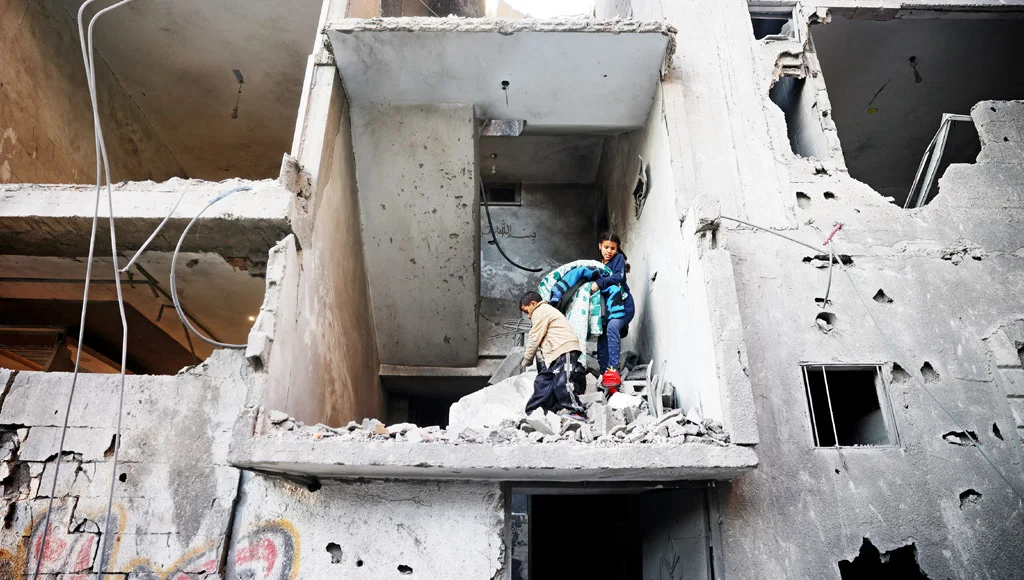
In the northern area of Jabalia, hundreds of Gazans streamed down a sandy path, returning to an apocalyptic landscape dotted with piles of rubble and destroyed buildings.

And in the main southern city of Khan Yunis, people celebrated their pending homecoming.

"I'm very, very happy," said Wafa al-Habeel. "I want to go back and kiss the ground and the soil of Gaza. I am longing for Gaza (City) and longing for our loved ones."

The truce had been scheduled to begin at 0630 GMT (8:30 am) but a last-minute dispute over the list of hostages to be freed on the first day led to the holdup.

Qatar, a mediator of the truce, later confirmed it had gone into effect.

The Hostage and Missing Families Forum campaign group identified the three women set to be released as Emily Damari, Romi Gonen and Doron Steinbrecher.

Hamas, meanwhile, said it was waiting for Israel to furnish "a list containing the names of 90 prisoners from the categories of women and children" also to be released on the first day.

A total of 33 hostages taken by militants during Hamas's October 7, 2023 attack on Israel will be returned from Gaza during an initial 42-day truce, in exchange for around 1,900 Palestinians in Israeli custody.

The truce is intended to pave the way for a permanent end to the war, but a second phase has yet to be finalised.

It follows a deal struck by mediators Qatar, the United States and Egypt after months of negotiations.

In a televised address on Saturday, Netanyahu called the 42-day first phase a "temporary ceasefire" and said Israel had US support to return to the war if necessary.

'Full of hope'

In Gaza City, well before the ceasefire went into effect, people were already celebrating, waving Palestinian flags in the street.

But when it became clear the truce had been delayed, the joy gave way to desperation for some.

"Enough playing with our emotions -- we're exhausted," said Maha Abed, a 27-year-old displaced from Rafah.

The Israeli army warned Gaza residents early Sunday not to approach its forces or Israeli territory.

"We urge you not to head towards the buffer zone or IDF forces for your safety," military spokesman Avichay Adraee said on Telegram, adding that "moving from south to north via Gaza Valley puts you at risk".

In Israel, the ceasefire was met with guarded optimism.

"I don't trust our side or their side," said taxi driver David Gutterman. "Always at the last moment something, a problem, can pop up, but all in all I'm really happy."

Shai Zaik, an employee at Tel Aviv's art museum, said he had "mixed feelings", but was "full of hope" that the hostages would return.\


"We had so many disappointments in the last year," he said, "so we won't believe it until it really happens, until we see them (the hostages) with our own eyes, and then we will be happy I hope."

Israel has prepared reception centres to provide medical treatment and counselling to the freed hostages before they return to their families after their long ordeal.

Trucks waiting

Hundreds of trucks waited at the Gaza border, poised to enter from Egypt as soon as they get the all-clear to deliver desperately needed aid. Some trucks were loaded with prefabricated houses.

Egyptian Foreign Minister Badr Abdelatty said 600 trucks a day would enter Gaza after the ceasefire took effect, including 50 carrying fuel.

The war's only previous truce, for one week in November 2023, also saw the release of hostages held by militants in exchange for Palestinian prisoners.

Hamas's October 7 attack, the deadliest in Israel's history, resulted in the deaths of 1,210 people, mostly civilians, according to an AFP tally of Israeli official figures.

Of the 251 people taken hostage, 94 are still in Gaza, including 34 the Israeli military says are dead.

Israel's retaliatory campaign has destroyed much of Gaza, killing at least 46,899 people, most of them civilians, according to figures from the Hamas-run territory's health ministry that the United Nations considers reliable.

The truce took effect on the eve of Donald Trump's inauguration for a second term as president of the United States.

Trump, who claimed credit for the ceasefire deal after months of effort by the outgoing administration of President Joe Biden, told US network NBC on Saturday that he had told Netanyahu the war "has to end".

"We want it to end, but to keep doing what has to be done," he said.

Brett McGurk, the pointman for outgoing President Joe Biden, was joined in the region by Trump envoy Steve Witkoff in an unusual pairing to finalise the agreement, US officials said.

Under the deal, Israeli forces will withdraw from densely populated areas of Gaza and allow displaced Palestinians to return "to their residences", Qatar's prime minister said in announcing the deal.​
 

Hamas, Israel free hostages, prisoners
Agence France-Presse . Jerusalem, Undefined 21 January, 2025, 01:05

1737419609289.png


A fragile ceasefire in the Israel-Hamas war was holding Monday, following the dramatic exchange of three hostages for 90 Palestinian prisoners in an agreement aimed at ending more than 15 months of war in Gaza.

The three hostages released Sunday, all women, were reunited with their families and taken to hospital in central Israel where a doctor said they were in stable condition.

Hours later in the Israeli-occupied West Bank, Palestinian prisoners released by Israel left Ofer prison on buses, with jubilant crowds celebrating their arrival.

As the ceasefire took effect, thousands of displaced, war-weary Palestinians set off across the devastated Gaza Strip to return home.

The truce began on the eve of the Donald Trumpโ€™s inauguration for a second term as US president, who has claimed credit for the agreement after months of fruitless negotiations.

If all goes according to plan, the implementation of the truce will take weeks if not months, with only the first phase of the truce agreed so far by all the parties.

Despite the risks, hundreds of Palestinians were streaming through an apocalyptic landscape in Jabalia in northern Gaza, one of the worst-hit areas in the war.

โ€˜We are finally in our home. There is no home left, just rubble, but itโ€™s our home,โ€™ said Rana Mohsen, 43.

The initial 42-day truce was brokered by mediators Qatar, the United States and Egypt.

It should enable a surge of sorely needed humanitarian aid into Gaza, as more Israeli hostages are released in exchange for Palestinians in Israeli custody.

Under the agreement, Israeli forces should leave some areas of Gaza as the parties begin negotiating the terms of a permanent ceasefire.

During the initial truce, Israeli hostages, 31 of whom were taken by militants during Hamasโ€™s October 7, 2023 attack, are due to be returned from Gaza in exchange for around 1,900 Palestinians.

The first three released hostages, Emily Damari, Romi Gonen and Doron Steinbrecher, returned home to Israel after Hamas fighters handed them over to the Red Cross in a bustling square in Gaza City, surrounded by gunmen in fatigues and balaclavas.

โ€˜In Emilyโ€™s own words, she is the happiest girl in the world; she has her life back,โ€™ Damariโ€™s mother Mandy said on Monday, adding that she was โ€˜doing much better than any of us could have expectedโ€™, even after she had lost two fingers.

Damari, a British-Israeli dual national, was at home in Kfar Aza in southern Israel when Hamas gunmen stormed her home on October 7, 2023, injuring her hands and legs and taking her hostage.

Steinbrecherโ€™s family said in a statement that โ€˜our heroic Dodo, who survived 471 days in Hamas captivity, begins her rehabilitation journey todayโ€™.

In Tel Aviv, there was elation among the crowd who had waited for hours for the news of their release, with the Hostages and Missing Families Forum campaign group hailing their return as โ€˜a beacon of lightโ€™.

On Monday, however, there was anxiety in Israel over the next phases of the truce, with columnist Sima Kadmon warning in the Yedioth Ahronoth daily that the coming hostage releases may be more painful.

โ€˜Some of them will arrive on gurneys and wheelchairs. Others will arrive in coffins. Some will arrive wounded and injured, in dire emotional condition that will prevent some of the footage from being broadcast,โ€™ she wrote.

Journalist Avi Issacharoff, one of the creators of hit series Fauda, lashed out against the Israeli government for what he said was its failure โ€˜to engage in any way on the โ€˜day afterโ€™ the war.โ€™

Following the return of the three women hostages, the Israel Prison Service confirmed the release of 90 Palestinian prisoners early Monday.

In the town of Beitunia, near Ofer prison, Palestinians cheered and chanted as buses carrying them arrived, with some climbing atop and unfurling a Hamas flag.

โ€˜All the prisoners being released today feel like family to us. They are part of us, even if theyโ€™re not blood relatives,โ€™ Amanda Abu Sharkh, 23, said.

One freed detainee, Abdul Aziz Muhammad Atawneh, described prison as โ€˜hell, hell, hellโ€™.

The next hostage-prisoner swap should take place on Saturday, a senior Hamas official said.

International Committee of the Red Cross president Mirjana Spoljaric called on all sides to โ€˜adhere to their commitments to ensure the next operations can take place safelyโ€™.

UN relief chief Tom Fletcher said 630 trucks carrying desperately needed aid had entered into Gaza in the hours after the start of the truce, with 300 of them headed to the north of the territory.

The truce is intended to pave the way for a permanent end to the war, but a second phase has yet to be finalised.

Thousands of Palestinians carrying tents, clothes and their personal belongings were seen going home on Sunday, after the war displaced the vast majority of Gazaโ€™s population of 2.4 million.

The World Food Programme said it was moving full throttle to get food to as many Gazans as possible.

โ€˜Weโ€™re trying to reach a million people within the shortest possible time,โ€™ said its deputy executive director, Carl Skau.

The warโ€™s only previous truce, for one week in November 2023, also saw the release of hostages held by militants in exchange for Palestinian prisoners.

Hamasโ€™s October 7 attack, the deadliest in Israelโ€™s history, resulted in the deaths of 1,210 people, mostly civilians, according to an AFP tally of Israeli official figures.

Of the 251 people taken hostage, 91 are still in Gaza, including 34 the Israeli military says are dead.

The health ministry in Hamas-run Gaza said Sunday that the death toll in the war between Israel and Hamas had reached 46,913.​
 

WHO says needs full Gaza access during Israel-Hamas truce
Agence France-Presse . Geneva 20 January, 2025, 22:43

1737419729561.png


Relatives of Palestinian teenager Ahmad Rushdi, who was killed during an Israeli military operation in the village of Sebastia in the north of occupied West Bank, react during his funeral in Sebastia on Monday. | AFP photo

The World Health Organisation said Sunday it was ready to pour much-needed aid into Gaza during the Israel-Hamas truce, but that it would need โ€˜systematic accessโ€™ across the territory to do so.

Much of the Gaza Stripโ€™s health infrastructure has been destroyed by the more than year-long war between Israel and Palestinian militant group Hamas before a ceasefire took hold on Sunday.

WHO chief Tedros Adhanom Ghebreyesus welcomed the ceasefire, posting on social media that it would โ€˜bring great hope for millions of people whose lives have been ravaged by the conflictโ€™.

But he added that โ€˜addressing the massive health needs and restoring the health system in Gaza will be a complex and challenging task, given the scale of destruction, operational complexity and constraints involvedโ€™.

While the United Nationsโ€™ health body was โ€˜ready to scale up the responseโ€™ to address the territoryโ€™s critical needs, it said in a statement that โ€˜it is critical that the security obstacles hindering operations are removedโ€™.

โ€˜WHO will need conditions on the ground that allow systematic access to the population across Gaza, enabling the influx of aid via all possible borders and routes, and lifting restrictions on the entry of essential items,โ€™ the agency said in a statement.

Until the truce, Israel had complete control over the volume and nature of aid allowed into Gaza.

Warning that the โ€˜health challenges ahead are immenseโ€™, the Geneva-based agency estimated the cost of rebuilding Gazaโ€™s battered health system in the years to come at โ€˜billions in investmentโ€™.

Last week the WHO put the figure at more than $10 billion.

โ€˜Only half of Gazaโ€™s 36 hospitals remain partially operational, nearly all hospitals are damaged or partly destroyed, and just 38 per cent of primary health care centres are functional,โ€™ the WHO said.

Basing its figures on those provided by the health ministry in the Hamas-run territory, which the UN considers reliable, the WHO put the warโ€™s toll in Gaza at more than 46,600 people killed and over 1,10,000 wounded.

A quarter of those wounded โ€˜face life-changing injuries and will need on-going rehabilitation,โ€™ the UN body estimated.

Around 12,000 people need to be evacuated for urgent treatment elsewhere, it added, while warning the destruction of health infrastructure had had knock-on effects.

The WHO also expressed concern over the โ€˜breakdown of public order, exacerbated by armed gangsโ€™ interfering with aid deliveries to Gaza.​
 

What does lie ahead for Gazans?
SYED FATTAHUL ALIM
Published :
Jan 20, 2025 21:46
Updated :
Jan 20, 2025 21:46

1737420577910.png


There was euphoria in Gaza following the announcement of ceasefire deal between the Palestinian militant group, Hamas, and Israel on Wednesday. The ceasefire deal that came into effect on Sunday (January 19) following approval by the Israeli cabinet was brokered by the US, Qatar and Egypt. However, the ceasefire took effect at 9:15 GMT on Sunday after about three hours' delay. The delay, as expected, was caused by Israeli prime minister Benjamin Netanyahu who claimed that Hamas had not sent the list of the Israeli hostages to be released on Sunday. The Palestinian militant group Hamas explained the matter saying that it was due to 'technical reasons' and complexity of the field situation marked by continued Israeli bombing that caused the delay in disclosing the names of three female hostages.

Netanyahu, who would use any excuse to spill Palestinian blood did kill at least 19 Gazans during the delay. According to the Hamas, 120 people were killed in Israeli bombing since Wednesday (January 15) when the announcement of the ceasefire deal was made. Now, as agreed in document for 42 days' temporary suspension of hostilities, a total of 33 Israeli hostages will be released in exchange for 1890 Palestinians held in Israeli jails. Also, as per the truce deal, Israel will gradually withdraw its army from Gaza. At the end of the second week of the truce, the second phase of the ceasefire is set to start. Though details of the second phase are yet to be worked out in full, it is expected that during this phase, the remaining Israeli hostages would be released by Hamas. Israel, on its part, will also free many more Palestinians from Israeli jails. The understanding is that Israel will fully withdraw its troops from Gaza. Meanwhile, UN relief trucks will flow into Gaza with emergency supply of foods, medicines and other necessities for the famished residents of the enclave.

Notably, the residents of Gaza were subjected not only to non-stop aerial bombardment and artillery shelling on the ground by Israeli military during its last fifteen months' campaign against the Hamas, they were also denied food, water and other necessities as entry of any UN relief materials was blocked by Netanyahu government and his political thugs.

Indeed, it all sounds good at a time when the Palestinians were facing the dark prospect of total annihilation or expulsion from Gaza. For with the collapse of the Assad regime in Syria, which was a conduit for supplying mostly Iranian arms and weapons to Hezbollah, was cut off unexpectedly throwing the Lebanese militant group's war of attrition against Israel into disarray. As a result, Hamas was left to fight the Israeli forces alone without any help from outside. The fall of Syria also presented an unforeseen opportunity before Israel's Netanyahu to finally fulfil his dream of creating greater Israel as encapsulated in the slogan, 'from the river to sea'. And that would be done by annexing West Bank, clearing Gaza of its population and occupying parts of Lebanon and Syria. With unconditional support from the USA, Netanyahu saw no problem going ahead with his mission to kill all Palestinians and grab all their lands. Things were progressing according to plan as Gazans were being exterminated without any outcry raised by the Western powers, the so-called champions of morality, humanity and all that is noble on earth! But suddenly came this idea of ceasefire to stop Mr Netanyahu's grand mission in its tracks.

It appears the US, with its new team for the White House, has a different plan. So, the ceasefire deal, which could not be reached during the last eight months, thanks to Mr Netanyahu and his extremist cabinet colleagues like Ben-Gvir's stiff opposition to it, is, in all probability, now forced upon them. The real picture of what is happening behind the scene is yet to unfold fully. Meanwhile, the people of Gaza and the rest of Palestine will be left wondering what the future holds in store for them.​
 

FIGHT FOR DIGNITY: Reshaping Gazaโ€™s post-war narrative
Ramzy Baroud 22 January, 2025, 00:00

1737505892208.png

Counter Punch

FOLLOWING every Israeli war on Gaza, numerous narratives emerge. Some claim victory for one side and defeat for the other, while others โ€” knowingly or unknowingly โ€” attempt to exploit the aftermath for their own purposes.

The latter is not always nefarious, as the humanitarian calamities resulting from Israelโ€™s actions are undeniable โ€” especially as Israel and its allies often use aid to Palestinians as bargaining chips for political concessions or to exert pressure on the Strip and its leadership.

This dynamic often results in the exploitation of Palestinian suffering to raise funds, sometimes by organisations with high overhead costs, leaving independent researchers puzzled over the discrepancies between the funds collected and the funds allocated.

Additionally, Gaza lacks an independent commission to track all received funds and their usage, which leads to controversies and public accusations at times.

Exploiting Gaza

HOWEVER, this is a topic for another discussion. The issue at hand here is the portrayal of Gazaโ€™s victims โ€” particularly children โ€” without dignity or respect for their privacy, all in the name of helping Palestinian victims.

Throughout the latest Israeli assault on Gaza, the desperation of many Palestinian families, faced with famine and extermination, led them to seek help from international donors, often turning to online donation platforms.

Many of these personal fundraisers were, of course, legitimate, as Gaza was entirely pushed past the point of starvation. Yet, suspicious accounts also appeared, raising money for individuals โ€” real or imagined โ€” who had not sought assistance.

Perhaps future researchers will uncover how Gaza has been exploited by online profiteers and determine how to regulate such practices.

We hesitated to raise this issue during the war, fearing that a single misstep could have dire consequences for an individual or a family. Now that a ceasefire has been signed, it is crucial to open the conversation to scrutiny.

Reclaiming the narrative

THE latest Israeli war on Gaza was not ordinary, but then, no previous wars have been anything but destructive and lethal. For Israel, it was a genocide โ€” a war aimed at exterminating Gazaโ€™s population through mass killings and driving the survivors into Egypt.

Thanks to the legendary steadfastness of Gazaโ€™s resistance and the unbending spirit of its people, Israel failed. As Israeli writer David K Rees said, โ€˜For the first time, Israel just lost a war.โ€™

This is the Gaza that most Palestinians want us to know and remember โ€” a symbol of collective strength and resistance. Their hope is that this message can reverberate around the world, not only to elevate the centrality of Gaza and Palestine in all political discourse but also to inspire oppressed groups globally to fight for their rights unapologetically.

Sadly, though sometimes understandably, that message is not one many are eager to champion.

Many will continue to see Palestinians only as victims. While this narrative may hold Israel accountable for its genocide, it fails to recognise the agency Palestinians have earned and deserve.

However, at times, this viewpoint can be understandable, especially in charitable causes, where the immediate need for aid must be addressed. Yet, it is possible to strike a balance โ€” between meeting the urgent needs of victims and honoring their dignity, resilience, and collective power.

Not hapless victims

THE exploitation of Palestinians, especially their children, as tools for fundraising must end. Gazaโ€™s children, many of whom are amputees, should not be paraded in the most degrading manner to appeal to wealthy donors. The world already knows what Israel has done to the Palestinian people โ€” especially the children of Gaza, who suffer the highest rate of child amputations globally.

This is not to deny the suffering. We are proud and humbled by every Palestinian child โ€” whether martyred, injured, amputated, or emotionally scarred. However, instead of portraying them as helpless victims, we must celebrate them as poets, artists, reporters, and representatives of their people.

The time has come for a new narrative, one fundamentally different from those that have emerged in the wake of previous wars. The new narrative must position Gaza as the heart of the Palestinian struggle, as a model for humanity, and as the central path for the liberation of Palestine โ€” which, thanks to Gaza, now seems closer than ever.

Donโ€™t help Israel

TO BETRAY this fact is to betray Gaza and all its sacrifices. A victim-only narrative that ignores the larger political context risks undoing the gains made by Palestinian popular resistance in Gaza and inadvertently helping Israel reintroduce a fear-driven discourse. After 15 months of relentless genocide, Israel has failed to instill fear in Gazaโ€™s population โ€” and it must not succeed in rebuilding it.

Yes, we must spare no effort to help Gaza rebuild and resume its historical role as the leader of the Palestinian liberation movement. But we must do so with sensitivity, compassion, and above all, respect for Gaza and its unparalleled sacrifices.

CounterPunch.org, January 21. Ramzy Baroud is a journalist and the editor of the Palestine Chronicle. He is the author of five books.​
 

Hamas will free four women hostages in next swap
Agence France-Presse . Jerusalem 22 January, 2025, 00:24

Hamas said on Tuesday it will release four women hostages in the next swap with Israel under the terms of a fragile truce intended to bring to an end to 15 months of war in Gaza.

US president Donald Trump, who claimed credit for the hard-won ceasefire agreement, said he doubted the deal would hold as he took office for a historic second term.

Desperately needed humanitarian aid has begun to flow into Gaza as Palestinians displaced by the war headed back to devastated areas of the territory, hopeful the agreement would hold.

The ceasefire took effect on Sunday, and saw Israel and Hamas conduct their first exchange of hostages for prisoners.

Hamas official Taher al-Nunu said that four Israeli women hostages will be freed on Saturday in exchange for a second group of Palestinian prisoners.

In Washington, newly-inaugurated Trump cast doubt on whether the truce would hold.

โ€˜Thatโ€™s not our war; itโ€™s their war. But Iโ€™m not confident,โ€™ he said.

Trump had claimed credit for the three-phase ceasefire agreement announced ahead of his return to the White House by Qatar and the United States, following months of fruitless negotiations under his predecessor Joe Biden.

Qatar was confident in the ceasefire deal it helped mediate โ€˜when it comes to the language of the deal, when it comes to the fact that we hashed out all the major issues on the tableโ€™, its foreign minister spokesman said on Tuesday.

The new US president has made clear he would support Israel, and in one of his first acts as president, he revoked sanctions on Israeli settlers in the West Bank imposed by the Biden administration over attacks against Palestinians.

Israeli prime minister Benjamin Netanyahu congratulated Trump on his return, while far-right finance minister Bezalel Smotrich thanked him for lifting the sanctions.

โ€˜I look forward to working with you to return the remaining hostages, to destroy Hamasโ€™s military capabilities and end its political rule in Gaza, and to ensure that Gaza never again poses a threat to Israel,โ€™ Netanyahu said.

โ€˜Mr. President, your unwavering and uncompromising support for the State of Israel is a testament to your deep connection to the Jewish people and our historical right to our land,โ€™ Smotrich wrote on X.

Displaced Gazan Ghadeer Abdul Rabbo, 30, said she hopes that โ€˜with or without Trumpโ€™, the ceasefire will hold and world governments will help โ€˜maintain this calm, because we are afraidโ€™.

If all goes to plan, during the initial, 42-day phase of the truce that began Sunday, a total of 33 hostages are to be returned from Gaza in exchange for around 1,900 Palestinians.

Over those six weeks, the parties are meant to negotiate a permanent ceasefire.

In Rafah, in southern Gaza, Ismail Madi said that โ€˜we have endured immense hardships, but we will stay here. We will rebuild this place.โ€™

Three Israeli hostages, all women, were reunited with their families on Sunday after more than 15 months in captivity.

Hours later, 90 Palestinian prisoners were released from an Israeli jail.

In Israel, there was elation as Emily Damari, Romi Gonen and Doron Steinbrecher returned home and appeared to be in good health.

โ€˜In Emilyโ€™s own words, she is the happiest girl in the world; she has her life back,โ€™ Damariโ€™s mother Mandy said on Monday, adding that her daughter was โ€˜doing much better than any of us could have expectedโ€™ even after losing two fingers.

The first group of Palestinians released under the deal left Ofer prison in the West Bank early Monday, with jubilant crowds celebrating their arrival in the nearby town of Beitunia.

One freed detainee, Abdul Aziz Muhammad Atawneh, described prison as โ€˜hell, hell, hellโ€™.

Another, Khalida Jarrar of the Popular Front for the Liberation of Palestine โ€” proscribed as a โ€˜terroristโ€™ group by Israel and some Western governments โ€” said she had been kept โ€˜in solitary confinement for six monthsโ€™.

The relatives of the three Israeli ex-hostages called for the release of the remaining 91 captives seized during Hamasโ€™s October 7, 2023, attack that sparked the war, including 34 the military says are dead.

Meirav Leshem Gonen, mother of Romi Gonen, said: โ€˜We got our Romi back, but all families deserve the same outcome, both the living and the dead.โ€™

There was anxiety in Israel over the next phases of the truce, with columnist Sima Kadmon warning in the Yedioth Ahronoth daily that the coming hostage releases may be more painful than the first.

โ€˜Some of them will arrive on gurneys and wheelchairs. Others will arrive in coffins. Some will arrive wounded and injured, in dire emotional condition,โ€™ she wrote.

In southern Gaza, Ammar Barbakh, 35, spent the truceโ€™s first night in a tent on the rubble of his home.

โ€˜This is the first time I sleep comfortably and Iโ€™m not afraid,โ€™ he said.

โ€˜Itโ€™s a beautiful feeling, and I hope the ceasefire continues.โ€™

The war has devastated much of the Gaza Strip and displaced the vast majority of its population of 2.4 million.

More than 900 trucks carrying humanitarian aid entered Gaza on Monday, the United Nations said.

The day the deal came into force, 630 trucks entered Gaza.

Qatar, which played a key role in negotiating the truce, said that 12.5 million litres of fuel would enter Gaza over the first 10 days.

Hamasโ€™s October 7 attack resulted in the deaths of 1,210 people, mostly civilians, according to an AFP tally of Israeli official figures.

The health ministry in Hamas-run Gaza said Sunday that the death toll in the war had reached 46,913, a majority civilians, figures the United Nations has said are reliable.​
 

The ceasefire that couldn't heal: Reflections from a survivor

1737613638664.png

Kamelโ€™s family home, captured from a video of a drone passing through the sky, on January 19, 2025. PHOTO COURTESY: KAMEL ABU AMSHA

Late September 2023, I returned to Gaza from Faridpur to see my family. It was my 24th birthday. I have been studying medicine in Bangladesh, and it was the first time in four years that I visited them. A few days later, we all knew what had happened. After seven months of genocide, I left Gaza and my family behind. My story of surviving the genocide was covered by The Daily Star in May 2024. I am not one to share my sorrow or pain, but I agreed to let a journalist document what happened to me so that Israel could not achieve its final victoryโ€” erasing these atrocities from human memory.

During those weeks when I shared what I went through in Gaza, there was talk of a ceasefire, but it never seemed likely as things only worsened. I was in Gaza during a temporary truce, which was reported as a "halt in fighting," but it was a farce. We went to our house, already bombed once, to retrieve food for the camps. We left quickly as the house was bombed again during that pause.

Months passed, and I have lost 35 family members to date. I lost my cousin Jamal, who was like a brother to me. The day he was killed by Israeli airstrikes, my uncle, Jamal's father, tried to bury him in Jabalia. But the Israeli had sieged the area. Jamal's body was left with a cloth, and today, five months later, he has still not been buried. As I write this, I wonder what Jamal did in this cruel world, to not even get the chance to rest peacefully and with dignitu, even after he was killed.

My immediate family have been displaced almost daily and injured. Changes happened around the world but things remained the same in the north of Gaza: in horror. The government changed in Bangladesh, where I've been since leaving my family in Gaza. Similar to the internet blackout during the last days of the previous regime here, my family still goes without internet for five to seven days at a stretch.

On a random Wednesday, January 15, 2025, we all got the news that a ceasefire had been reached. My first reaction was an overwhelming urge to celebrate with my family, just as I had suffered the flames of war with them. Then a strange feeling overtook me. Seven months of genocide flashed across my mind like a reel. I can't forget October 7, the day I had been asleep in Gaza for just seven days before the war began. I understood nothing back then and could not, in my worst nightmare, imagine all that followed: displacement after displacement, hunger, fear, thirst, and exhaustion.

I can't forget the days in Gaza's hospitalsโ€”the sight of dismembered children and the cries from phosphorus burns. I can't forget escaping Gaza through an Israeli checkpoint, fearing every moment that I would be shot or bombed. I can't forget the bitter cold of the night we slept in an open tent, with torn clothes and no blankets. I hugged my brother just to keep warm. I can't forget returning to our first camp, Al-Falluja, where decaying corpses were everywhere.

1737613686272.png

Kamelโ€™s nephew and father in front of the camp where they were staying in North Gaza, three weeks before the ceasefire. PHOTO COURTESY: KAMEL ABU AMSHA

The feeling of joy dissipated, and I did not believe the ceasefire would hold. Growing up in Gaza, always fearing Israeli attacks and enduring the genocide, has eroded my trust in everything. I never trusted anything the Israeli government said. They killed, destroyed, and ruined my life as I knew it. Frankly, I don't remember what my beloved city, Gaza, looked like before the war or what it felt like without the smell of death. So, how can I believe they would stop killing now?

Just days before the ceasefire, my parents were taking refuge with other stranded residents in a small room of a broken house in southern North Gaza. I could not reach my family when the ceasefire was announced, and at the time of this writing, I still haven't been able to talk to them, as they do not have internet. But I heard there was relentless shelling. Until the ceasefire came into effect on Sunday, I worried my family would not live to see it. The Israeli army indiscriminately bombed everywhere to claim more so-called "victories." We had been lucky, by God's grace, to survive so far. I always prayed but feared that luck would run out.

My cousin Sayed, who has periodic internet access and updates me on my family's whereabouts, informed me they evacuated their shelter but made it out safely.

Now that the ceasefire is in effect, people ask if I am happy. But how could anyone from Gaza, especially those who lived through the genocide, relate to the word "happiness"? The house I grew up in has been destroyed. My family takes shelter wherever they canโ€”in rooms of houses that survived the bombings. Many residents from the North fled to the South, and when they return, my family will be homeless. The streets of North Gaza have been destroyed with such depravity that even a tent cannot be set up.

I truly believe no one can understand how terrible it is unless they see it with their own eyes. Yet still, I feel a sense of relief that the bombing has stopped, even if temporarily, and people have stopped dyingโ€”a thought that once seemed too distant. In Gaza, "peace" now means not hearing the thunderous sound of bombs, and a pause in the constant struggle for survival.

Thinking of my family's condition has made me feel like giving up, but I returned to Bangladesh alive, with the dream of becoming a doctor. I continued studying, but it was not without challenges. After returning, I would suffer severe trauma shocks. They would start with chest pain, and I would fall unconscious, on the verge of heart attacks. My roommates, who took me to the CCU, later told me I hallucinated snipers and blood. But I am one of the lucky ones. I made it out alive after seven months. For my family members and friends who lost their children and parents, the psychological trauma is immense.

News stories now focus on Israeli hostages being reunited with their families, while Palestinians are referred to as "prisoners." The Israeli army has randomly and arbitrarily arrested people. The worst day of my life was December 18 last year, during the second paper of my final medical exams. I woke up to messages from my cousin Sayed that the Israeli army had besieged the shelter where my family was in Beit Hanoun. Their neighbours were killed. My mother was injured by shrapnel while escaping.

They arrested my brothers Nahid, 21, and Mohammad, 22, my grandfather, who is over 70, and my father. None of my brothers had any affiliation with Hamas. What crime did they commit other than trying to survive? My father was released, thankfully, but my brothers and grandfather remain in an Israeli prison, enduring torture. Everyone in Gaza knows what the prisons are likeโ€”prisoners are given no place to sleep, nothing to eat, and are beaten as though they are not human beings.

I don't know why my father was released but my brothers weren't. The way the Israelis imprison Palestinians is arbitrary and ruthless. Each time I see the news, I hope to see my brothers freed before the next tragedy strikes. I don't trust the ceasefire will last or that the war will permanently end. The perpetrators' nature is betrayal.

The Israeli army told us to go to "safe zones," only to bomb them. They tricked people, even children, into death. I fled to so many such zones only to be forced to leave again. Many escaped aliveโ€”if they were luckyโ€”while thousands died.

The hope that the US, with the transition from Biden to Trump, will make the ceasefire last does not inspire trust. The US has always supported Israel's killings, as have other powerful countries. At 25, I have lived through five flare-ups caused by the Israeli army, armed by countries that support their actions. In Gaza, the world showed no mercy to the elderly, children, women, youth, homes, streets, mosques, schools, or universities. They tried to annihilate us, but they cannot destroy our determination to not give up.

We Gazans dream that one day the sun will rise for us and never set again. Until then, we keep going, even if it means dying in the process. There may be a ceasefire now, but any form of trust that lives will be spared has ceased to exist.

When I left for Bangladesh, my father told me, "We know our fate, but you have a different fate. Go and become a doctor." Every day I wake up, I remember those words with a sinking feeling in my chest, and I go on with life. Because what else can I do? In Gaza, we are hardwired to keep goingโ€”and so, that's what we do.

Kamel Abu Amsha is a Palestinian medical student in Faridpur Medical College.​
 

Ceasefire in Gaza: what next?
Hasnat Abdul Hye
Published :
Jan 24, 2025 21:00
Updated :
Jan 24, 2025 21:00

1737764371239.png

A member of the Palestinian Hamas police directs traffic on a street in the southern Gaza Strip city of Khan Younis, on January 20, 2025. Gaza's Hamas-run interior ministry said Saturday in a statement that its security forces will begin deploying across the Gaza Strip as soon as the ceasefire-for-hostage release deal takes effect on January 19. Photo : Xinhua/Files

For the second time, in the one and a half year long war of attrition unleashed by Israel, a ceasefire has come into effect from January 19, one day before the inauguration of Donald Trump as the president of United States. This time the ceasefire is broader in scope and has a longer timeframe than the first one that took place for a week, from 24 November to 30 November in 2023. A total of 70 Israeli hostages were released by Hamas then, against 210 Palestinian prisoners held by Israelis. At the end of the truce on 30 November, another one day extension was agreed upon by both sides for further release of Israelis and Palestinians but the truce ended with Hamas blaming the Israelis for violation of terms of agreement.

In May, 2024, as the war in Gaza entered eight months, Egyptian and Qatari officials, working with American counterparts, worked out a ceasefire deal which was accepted by Hamas but rejected by Israel. Later, President Biden announced that Israel had agreed to a three- phase ceasefire and this time the American proposal was placed before the UN Security Council which adopted the same. But the Israeli prime minister rejected the deal and continued with the war.

On December 2, 2025, the president-elect, Donald Trump, posted in social media that hostages held by Hamas have to be released before his inauguration on January 20 or else 'all hell will break lose'. It was a very unusual statement coming from the president incumbent, using strong-arm tactics of underworld characters. It was obvious that his threat was directed at Hamas. There was gallows' humour in the threat because the Palestinians, including Hamas, were already living in hell, courtesy the devastations wrought by Israeli defence force (IDF) in Gaza.

As the interminable negotiations continued in the Qatari capital and in Cairo, representatives of the incoming Trump administration joined the Biden-era American officials. In addition, president-elect Trump sent his middle-east trouble-shooter, Steve Witcoff, to hold talks with Netanyahu and other stake-holders. It requires little imagination to conclude that the input by president elect Trump, particularly through backdoor diplomacy, using carrot and stick, pulled off the elusive ceasefire deal. Discussion on what may be embodied in the 'carrot and the stick' policy can be postponed until the terms of the present ceasefire agreement are briefly reviewed.

The present ceasefire, like the one negotiated in May last year, has three phases. During the first phase, covering six weeks from January 19, Hamas will release 33 hostages in several batches. In return, Israel will release several hundred Palestinians kept in prison, also in batches. Both sides will release children and women on priority basis. The lists of persons to be released have to be sent in advance for vetting by each side.

The second term in the agreement for the first phase provides for withdrawal of Israeli army from densely populated areas like northern Gaza and allowing displaced Palestinians to return to their former places of residence.

Under the third clause, about 600 trucks would be allowed to enter Gaza, carrying food, fuel, medicine and other essential items.

Except the second, the other two terms can be complied with by both parties without much hitch. The second is somewhat sensitive because Israeli army may regard withdrawal as surrender to Hamas. Here political leadership will play a big role. The Israeli cabinet, comprising extreme rightists, is divided over the ceasefire issue. One coalition party has already resigned from the cabinet. The second extremist party in the coalition has given notice and is bidding for time. Much depends on the political will of prime minister Netenyahu and his skill for manoeuvring. This, in turn, will depend on his motivation. If he is concerned with only saving his skin by staying in power with the help of extremists, he may renege on the ceasefire even during the first phase. But it is quite probable that he will take a chance during the first phase on this issue hoping to counter the pressure from coalition extremist parties with the release of Israelis kept as hostages for nearly a year and a half. The demand for their release has become a popular movement which none of the political parties can go on ignoring. So, the willingness of Israeli politicians, even if with reservations, can be expected to play a role in keeping the ceasefire alive and well. As regards Hamas, there is no problem for them with releasing the hostages if there is reciprocity from the Israeli side in releasing Palestinian prisoners according to agreed numbers. But their compliance with the terms of ceasefire deal will also depend on the withdrawal of Israeli army from northern Gaza.

The second phase of the ceasefire agreement gains in complexity as it envisages release of remaining Israeli hostages and of Palestinian prisoners by concerned parties, complete withdrawal of Israeli army from Gaza, including Philadelphi corridor and holding discussions on establishment of permanent peace in the region. Here again, the withdrawal of Israeli army completely from Gaza is problematic for the same reason mentioned above. The question of who will represent the Palestinians in the peace talks can become a stumbling bloc as Hamas is likely to assert its right to represent the Gazan Palestinians. The fact that there has been no popular protest against their role in the war in Gaza strengthens their case. By all appearances, the Palestinians feel proud of their patriotism and determination to resist Israeli occupation. In contrast, the Palestinian Authority (PA) in the West Bank lacks popular support for its submissive role vis-ร -vis Israel and rampant corruption. America and Israel should realise that without Hamas participation in peace talks a permanent political settlement will be elusive.

During the third and final phase the remains of the dead hostages will be returned by Hamas and reconstruction of Gaza will take place. For the implementation of the first part, no problem is foreseen other than the wilful scuttling of the ceasefire deal by Israel. As regards reconstruction of Gaza, since it will take years for completion, temporary shelters for Gazans have to be provided, complete with civic and medical facilities. Several tent towns, each self-sufficient to meet the needs of its residents, have to be built in various parts of Gaza strip. Any idea of relocating the Gazans elsewhere, as is being casually bandied about now, runs into the face of reality. If not a single Gazan family tried to leave their homeland under round the clock bombing by Israelis during the past one year and a half, how can they be expected to be willing to go to another place now? The Palestinians in Gaza love their homeland and no amount of inducement or coercion will succeed in weaning them away from their soil. This should be recognised as a tribute to their sufferings, courage and fortitude. The heroism of ordinary Palestinians that has made them survivors of one of the horrifying genocide in history is of epic proportions. To ask them to move out in the name of reconstruction of Gaza would be a humiliation and agony that they do not deserve.

Now an attempt can be made to answer the question as to what led prime minister Natanyahu to accept the ceasefire deal that he had rejected in May last year. President Trump is a transactional man, having learnt the essence of deal making in his real estate business. At the heart of deal making is give and take. In the ceasefire deal not only carrots were used but also stick. Using the latter, Trump may have told Netanyahu through his emissary that unless he agreed to the deal arms shipment would be halted and his government would go along with the order of the International Criminal Court (ICC) and arrest him. But more than the stick, President Trump may have used the carrot of recognising the annexation of West Bank just as he did in the case of Golan Heights during his first term. That this is not a figment of imagination is borne out by the fact that on the first day in office as President he reversed the decision of President Biden and cancelled imposition of sanctions on 17 settlers and 16 entities in the occupied West Bank. This clearly paves the way to the annexation of West Bank, as a whole or in part, by Israel and anointing of the same by Trump administration. If Netanyahu is rewarded with this 'crown in the jewel', he can entice back the right-wing members of Knesset who have revolted over the ceasefire. The world will not have to wait for long to see if this is going to happen.

This write-up may be concluded by referring to the familiar reactions of Israeli government about the maltreatment of Israeli hostages at the hands of Hamas during their captivity. This would be a blatant lie, not substantiated by evidence. On the contrary, the smiling faces of the first three female hostages, in good health and clean clothes, prove that even under the most trying circumstances of constant bombardment and disruption of food and medicine supplies, the hostages were well looked after. The three hostages released looked cheerful and not at all indignant at their captors. They even accepted the small bag of gift given by Hamas gracefully and not perfunctorily and carried it all the way home. What better evidence can be there about the humane treatment of hostages by a group constantly being hunted down and forced to be on the run.

A ceasefire has been reached in Gaza. After a prolonged armed conflict that saw 47,000 Palestinians dead and hundreds of thousands injured and ninety per cent of infrastructures in Gaza reduced to rubbles, a window of opportunity has opened to make a clean break with the past. Whether this will happen depends largely on the goodwill of America and good sense of Israel. The Palestinians, as usual, are at the receiving end.​
 

Members Online

Latest Posts

Latest Posts