โ˜• Support Us โ˜•
[๐Ÿ‡ง๐Ÿ‡ฉ] - July uprising | Page 7 | PKDefense

[๐Ÿ‡ง๐Ÿ‡ฉ] July uprising

Reply (Scroll)
Press space to scroll through posts
G Bangladesh Defense
[๐Ÿ‡ง๐Ÿ‡ฉ] July uprising
65
1K
More threads by Saif

Hasina has been sentenced to death for her crimes against humanity. She will rot in hell for killing so many students during July uprising.
 

Mass uprising wasnโ€™t to impose religious dominance or any particular ideology: Zonayed Saki
Staff CorrespondentChattogram
Published: 05 Dec 2025, 21: 39

1764982980133.webp

Ganosamhati Andolan chief coordinator Zonayed Saki addresses a pre-procession rally in Chattogram city on 5 December 2025 Prothom Alo

The mass uprising of 5 August (2024) did not take place to impose any form of religious dominance or any particular ideology, Ganosamhati Andolan chief coordinator Zonayed Saki stated on Friday.

He made the remarks during a pre-procession rally in Chattogram city this afternoon.

Zonayed Saki said that the Julyโ€“August uprising occurred to establish democracy. Thousands of youths sacrificed their blood for a new political settlement.

As part of Ganosamhati Andolanโ€™s nationwide series of โ€œmathal marchesโ€, todayโ€™s programme was organised jointly by the organisationโ€™s Chattogram north, south and city units.

Addressing the gathering as the chief guest, Zonayed Saki spoke on the constitution, reforms, elections, fascist politics and several other issues. He also introduced to party activists the Ganosamhati Andolan leaders who are contesting as candidates in the upcoming national election.

The Ganosamhati Andolan chief coordinator said that Sheikh Hasina had tried to suppress the movement through various machinations, conspiracies, attacks, lawsuits, repression and killings. Students took to the streets in Julyโ€“August. Students were shot dead in broad daylight. That was why the people of Bangladesh united.

Pointing out that the students played the leading role in this struggle, uniting people across the country, he further said that the political parties, various professional groups and citizens from all walks of life took to the streets during this period. The uprising took place to establish democracy and build a state free from fascism.

Speaking on the matter of ports, Zonayed Saki said that the interim government survives on the support of political parties and stakeholders. Before taking decisions on any major national issue, it should have consulted political parties and stakeholders from different sectors. Instead, the government signed agreements on ports without any such consultation.

Regarding the upcoming parliamentary election, the Ganosamhati Andolan leader said, โ€œWe want to stand tall with dignity on the world stage. With that goal in mind, we have charted the course of our politics. Let us work together to ensure that Bangladeshโ€™s new democratic journey, through the upcoming election, becomes successful. We need political rights. Without political rights, our freedom of speech, our freedom to raise demands, and each individualโ€™s right to survival will not be secured.โ€

Zonayed Saki further said, โ€œFrom the very beginning, Ganosamhati Andolan has continued its struggle to establish the rights and dignity of workers, peasants, labouring and marginalised people, including the majority in this country. The state established through the Liberation War, built upon the blood of hundreds of thousands of martyrs, had pledged to ensure equality, human dignity and social justice for all citizens. But regrettably, in the past 54 years, we have not seen that equality, dignity or social justice realised.โ€

Drawing on the constitution, Zonayed Saki said, โ€œThe foundation of authoritarianism, fascism and autocracy in Bangladesh lies in the constitutional power structure. The Constitution of 1972 gave the prime minister far greater power than any head of government in the world. With that power, successive governments placed all institutions in their pockets and oppressed the people. That is why we have said clearly: merely changing the ruler or the government will not be enough. The system of governance and the constitutional power structure must be changed, otherwise the democratic rights of the people will not be established.โ€

Zonayed Saki elaborated on various stages of state reform. โ€œWe have presented specific proposals for fundamental reforms to the governance system. Among these are the abolition of Article 70 of the Constitution. This article has turned elected representatives into mere hand-raising MPs.โ€

He continued, โ€œWe have demanded that no individual should be allowed to serve more than two terms as prime minister. We have also called for the formation of a constitutional commission to oversee appointments to all constitutional bodies, including the election commission, Anti-Corruption Commission and Public Service Commission. We have long demanded that the judiciary be made fully independent so that it cannot be influenced, that parliament become bicameral to ensure balance of power through proportional representation, and that power be balanced between the president and the prime minister.โ€

Zonayed Saki said that securing political rights alone does not ensure that people will have food to eat. โ€œIf the countryโ€™s economy is an economy of plunder, there will be exploitation of resources, extreme inequality, and money laundering; but there will be no liberation for the people. That is why we believe that alongside political rights, the fair share of labouring people and the rights of every citizen must be established.โ€

Among the speakers at the pre-procession rally were Ganosamhati Andolanโ€“endorsed candidates, including: Mizanur Rahim Chowdhury (Chattogram-2), Zahidul Alam (Chattogram-4), Koli Akter (Chattogram-5), Nasir Uddin Talukder (Chattogram-6), Hasan Maruf Rumi (Chattogram-9), Apurba Nath (Chattogram-10) and Syed Salauddin Shahid Shimul (Chattogram-11).

After the rally, the procession began at Kazir Dewri in the city and concluded with a brief rally at Andarkilla intersection.​
 

July revolution did not seek to overturn constitution: Chief Justice
Outgoing CJ Refaat says movement aimed to purify constitutional engagement

1766107935857.webp

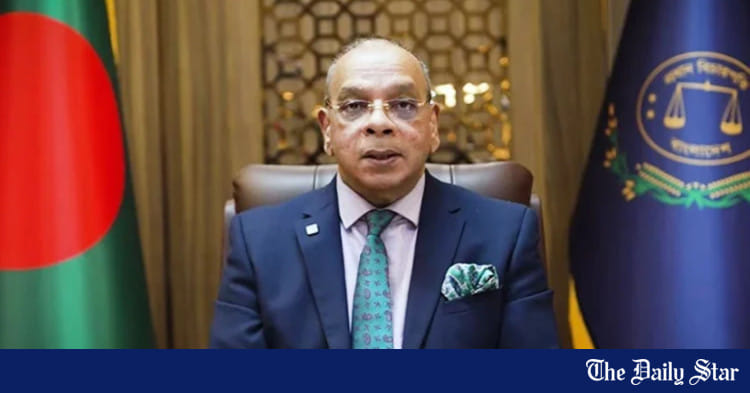
File photo: Collected

Chief Justice Syed Refaat Ahmed today said the July revolution did not propose to overturn the constitution; rather, it sought to purify the nation's engagement with it.

"Transparency, accountability, and responsiveness -- these three virtues became the leitmotif of the public conscience," he said.

He added that during those uncertain months, the judiciary remained the only fully functional constitutional organ. As a result, it had to act with both humility and firmness.

"Yet the judiciaryโ€ฆ was compelled to adopt a posture at once humble and resolute -- humble in acknowledging that it cannot exceed the boundaries of the text that gives it life, and resolute in ensuring that within those boundaries no right is rendered illusory, no institution made captive, and no citizen abandoned," he said.

Syed Refaat Ahmed, who will retire on December 27, made the remarks while delivering a speech in response to a farewell felicitation accorded to him by Attorney General Md Asaduzzaman and Supreme Court Bar Association (SCBA) President AM Mahbub Uddin Khokon.

The event was held this morning at the Chief Justice's Courtroom of the Appellate Division of the Supreme Court.

Judges and lawyers from both the Appellate Division and the High Court Division were present at the function.

In his speech, the chief justice said, "Together, through mutual respect, shared responsibility, and an unshakeable commitment to constitutionalism, we reaffirm that the strength of our judiciary lies not in any single office, but in our collective resolve to serve justice with integrity, balance, and foresight."

Addressing the chief justice, AG Asaduzzaman praised his leadership during a challenging period.

"During your short tenure as chief justice, through your wisdom, intellect, and foresight, you have established a unique judicial standard," he said.

SCBA President Mahbub said Refaat Ahmed made his utmost efforts to protect the constitutional and fundamental rights of citizens.

He added that the chief justice continued to uphold justice by removing delays in the disposal of cases.

Chief justice calls on president

Chief Justice Syed Refaat Ahmed paid a courtesy call on President Mohammed Sahabuddin at Bangabhaban at 2:00pm today.

During the meeting, the president exchanged pleasantries with the chief justice and highly appreciated the various initiatives taken by him to ensure the institutional independence of the judiciary.

The president also praised the successful implementation of those initiatives.

He particularly commended the chief justice's tireless efforts to establish a separate Supreme Court Secretariat for the judiciary.

The chief justice, in turn, expressed his sincere gratitude to the president for his special cooperation in implementing measures aimed at ensuring the judiciary's institutional independence, according to a Supreme Court press release.

Law adviser meets chief justice

Later in the day, Law Adviser Asif Nazrul paid a farewell call on Refaat Ahmed at his Supreme Court office.

During the meeting, the law adviser expressed concern to the chief justice over "terrorists being granted bail by the High Court".

After the meeting, Asif Nazrul spoke to journalists and said it was the chief justice's last working day.

"Today was the last working day of Chief Justice Dr Syed Refaat Ahmed. I came to express my thanks and gratitude to him," he said.

He said the chief justice took office at a critical moment for the country. He added that the chief justice played a key role in advancing judicial reforms in line with the expectations of the July mass uprising.

"Who will be the next chief justice is a matter of government policy. I do not have the authority to say anything unilaterally on this policy matter," he said.

"However, I can tell you that you will likely know it within the next three to four days," he added.​
 

Does the fall of autocracy automatically restore democracy?

The fall of autocracy does not automatically usher in freedom. It simply gives the citizens a chance. Mohammad Sajjadur Rahman writes about the fall of the autocrat and thereafter.

Mohammad Sajjadur Rahman
Published: 26 Dec 2025, 17: 07

1766797852454.webp


The end of the old autocratic system may not be the last chapter in the struggle for democracy, but may start a dangerous new chapter. The fall of autocracy does not automatically usher in freedom. It simply gives the citizens a chance. Mohammad Sajjadur Rahman writes about the fall of the autocrat and thereafter.

The colossal bronze statue has been pulled down by cranes. Towering pillars are now plastered with rebellious graffiti. Disreputable police headquarters lie in ruins, gutted by the fire of public rage.

These moments immediately following the fall of a despot are often described by international media, observers, and urban society with a kind of romantic optimism as the โ€œearly daysโ€ or โ€œDay Oneโ€, as if the transition from a dark tunnel to the sunny boulevard of liberal democracy were a straightforward and inevitable journey.

Yet from the beer halls of Weimar Germany to the battered thoroughfares of post-Saddam Baghdad, history has repeatedly warned us that the vast vacuum of political authority left in the wake of a dictatorโ€™s fall is rarely filled by reasoned parliamentary debate or a revised constitution.

Borrowing from the Italian Marxist theorist Antonio Gramsci, this interim period can be described as an 'interregnum', an in-between. As he wrote, the old is dying, but the new cannot yet be born. It is in this shadowy span of time that a host of morbid symptoms emerge.

Prolonged authoritarian rule leaves deep and lasting scars on the public psyche, particularly on the psychology of young people. In The Origins of Totalitarianism, Hannah Arendt shows that the core strength of totalitarian rule lies not merely in police repression or the reign of fear, but rather in its profound strategy of โ€œatomizingโ€ societyโ€”breaking it into isolated individuals.

Rulers deliberately destroy mutual trust, social bonds, and the capacity for collective organization, turning each person into a detached and lonely being. As a result, individuals afflicted by extreme isolation and a sense of meaninglessness surrender themselves blindly to the ideology of the leader or the state as their sole means of survival, and, lacking mutual trust, fail to build any form of collective resistance.

This becomes even clearer through the metaphor of the ordinary greengrocer in Czech thinker and statesman Vรกclav Havelโ€™s classic essay 'The Power of the Powerless'. Every day, the shopkeeper hangs a slogan in his store, โ€œWorkers of the world, unite.โ€ Yet he does not believe in this slogan for a moment, and he knows that passers-by do not believe in it either.

Still, he displays it simply to avoid trouble, to keep himself safe. According to Havel, modern authoritarianism does not merely demand obedience from citizens; it demands that they live โ€œwithin a lie.โ€

In this context of a culture of falsehood, we may also recall the concept of โ€œKetmanโ€ developed by the Nobel Prize-winning Polish poet Czesล‚aw Miล‚osz. Miล‚osz borrowed the term from the travel writings of the nineteenth-century French diplomat Gobineau and employed it in his classic work The Captive Mind.

It was said that in ancient Iran, religious dissenters concealed their true beliefs in public in order to survive or to protect themselves from enemies, outwardly conforming to the surrounding society. Miล‚osz transposed this strategy of religious self-preservation into the modern political context, showing that under authoritarian or totalitarian regimes, some people practice โ€œKetman.โ€ That is, they openly display blind loyalty to the rulerโ€™s ideology and enthusiastically sing the rulerโ€™s praises, while deep within they harbour entirely different beliefs and continue to despise the regime.

This is not mere cowardice; rather, it is a refined form of intellectual performance, a kind of double life. The practitioner of Ketman derives a secret sense of pride or superiority from the belief that, through outward falsehood, he is deceiving the machinery of the state while keeping his inner โ€œfree selfโ€ untouched.

Citizens display blind devotion to the rulerโ€™s supposed miraculous powers and greatness in public gatherings and in everyday life, behaving as if they genuinely believe in it. Yet behind this spectacle, both ruler and ruled know perfectly well that this devotion is nothing more than a farcical charade.

But Miล‚osz issues a brutally sharp warning: over time, as one continues this game of deception and performance against oneโ€™s own conscience, the true face and the mask gradually merge, and the individual loses his authenticity and moral integrity, ultimately becoming a slave to the very system of lies he once believed he was outwitting.

To understand how authoritarianism corrodes mutual trust and confidence among citizens, we can turn to political scientist Lisa Wedeenโ€™s 'Ambiguities of Domination', which dissects the regime of Hafez al-Assad in Syria. Through the concept of โ€œas if politics,โ€ Wedeen presents a chilling picture that stands as documentary evidence of psychological domination in modern authoritarianism.

Wedeen shows that under this system, citizens display blind devotion to the rulerโ€™s supposed miraculous powers and greatness in public gatherings and in everyday life, behaving as if they genuinely believe in it. Yet behind this spectacle, both ruler and ruled know perfectly well that this devotion is nothing more than a farcical charade and an exercise in falsehood.

According to Wedeen, shrewd authoritarian rulers do not actually expect love or genuine belief from the populace. Instead, by forcing people to perform these bizarre and false rituals, they seek to crush their moral backbone and their courage to speak the truth. As a result, living day after day in compulsory performance and a double life against oneโ€™s own conscience, an entire generation becomes psychologically โ€œschizophrenic,โ€ fragmented and divided selves.

The long-term consequences of this process are profoundly terrifying. It erodes the most fundamental human quality, trust, to such an extent that people later find themselves unable to place deep faith in any political ideology at all. They begin to see politics and state institutions merely as staged performances or elaborate deceptions.

Thus, in the power vacuum and social chaos that follow the fall of authoritarian rule, clandestine pathways for extreme ideologies such as fascism can open anew. If authoritarianism is a sedative, a sleeping pill, then fascism is an explosive โ€œstimulant,โ€ akin to gunpowder.

Authoritarian comfort lies in popular passivity: it wants people to forget politics and lock themselves inside their homes. Fascism, however, has a different appetite. It does not seek passivity but collective frenzy. A fascist system wants masses of people to flood the streets with torches in hand and to sacrifice themselves to a bloody mission of โ€œpurifyingโ€ the nation.

The tragic irony of this cycle is that the crowd believes it is making a revolution, while in reality it is rapidly descending into darkness and even greater instability. By hollowing out civil society and stunting the moral development of the young, the authoritarian ruler unknowingly serves as the โ€œmidwifeโ€ to the fascist monster.

The most profound psychological explanation of why people, in the aftermath of authoritarianism, yearn once again for subjugation was offered by Erich Fromm, the Frankfurt School psychologist. In his classic work 'Escape from Freedom,' Fromm argues that modern individuals desire freedom, yet are unable to bear the loneliness, uncertainty, and burden of responsibility that freedom entails.

Most people lack personalities strong enough to withstand this psychological strain. As a result, they choose the โ€œcertainty of bondageโ€ and the warmth of security over uncertain freedom. They come to believe that surrendering their selfhood at the feet of a leader is the only way to escape this cosmic loneliness.

Prolonged rule by fear and a culture of performance erase individuality from within and give rise to a peculiar slave mentality. The Russian sociologist Aleksandr Zinoviev gave this pathological human type a name, 'Homo Sovieticus'.

Such people may loathe the state with all their hearts, yet for the sake of livelihood or security they cling to that very state like parasites. They fear personal initiative and shirk responsibility for their own lives. Consequently, when authoritarian rule collapses, this suddenly acquired freedom becomes an unbearable burden for an โ€œorphanedโ€ society.

Post-Saddam Iraq and the history of the Arab Spring remind us of this brutal truth: freedom does not arrive simply by removing the โ€œiron manโ€ or dictator from his throne. Societies crippled by long subjugation often fail to celebrate freedom and instead plunge into a profound existential crisis and the abyss of chaos.

The French sociologist Gustave Le Bon, in 'The Crowd: A Study of the Popular Mind,' showed how an individualโ€™s conscience dissolves within a crowd. The most dangerous aspect of collective frenzy is the disappearance of personal responsibility: a harmless individual who would be incapable of even imagining a crime when alone can, under the excitement of the crowd, set fire to a library. This happens because, under the cover of anonymity, he convinces himself that it is not his personal crime, but rather a reflection of the so-called โ€œwill of the people.โ€

Le Bon himself was a conservative and hostile to democracy, and history bears witness to the fact that it was by exploiting this very โ€œfear of the massesโ€ that dictators such as Hitler and Mussolini designed their propaganda. From Le Bon they learned that crowds are not subdued through reason, but through emotion and hypnosis.

Yet viewing the masses merely as a manipulable entity, as Le Bon did, offers no solution to crises in times of transition. Fascism wants people to remain a mob, an unthinking, frenzied mass. Democracy, by contrast, wants the masses to become citizens.

The collapse of an old authoritarian system, therefore, may not mark the final chapter of the long novel of democratic struggle; it may instead signal the beginning of a dangerous one. The fall of authoritarianism does not automatically bring freedom, it merely creates an opportunity for citizens to attain it.

* Mohammad Sajjadur Rahman is part-time lecturer, IUB​
 

Members Online

Latest Posts

Latest Posts