Home Watch Videos Wars Movies Login

[🇧🇩] Israel and Hamas war in Gaza-----Can Bangladesh be a peace broker?

Latest Posts Countries Wars Q&A

[🇧🇩] Israel and Hamas war in Gaza-----Can Bangladesh be a peace broker?
963
28K
More threads by Saif

G Bangladesh Defense

Terrible thirst hits Gaza with polluted aquifers and broken pipelines

REUTERS
Published :
Aug 06, 2025 17:16
Updated :
Aug 06, 2025 17:16

1754527900820.webp

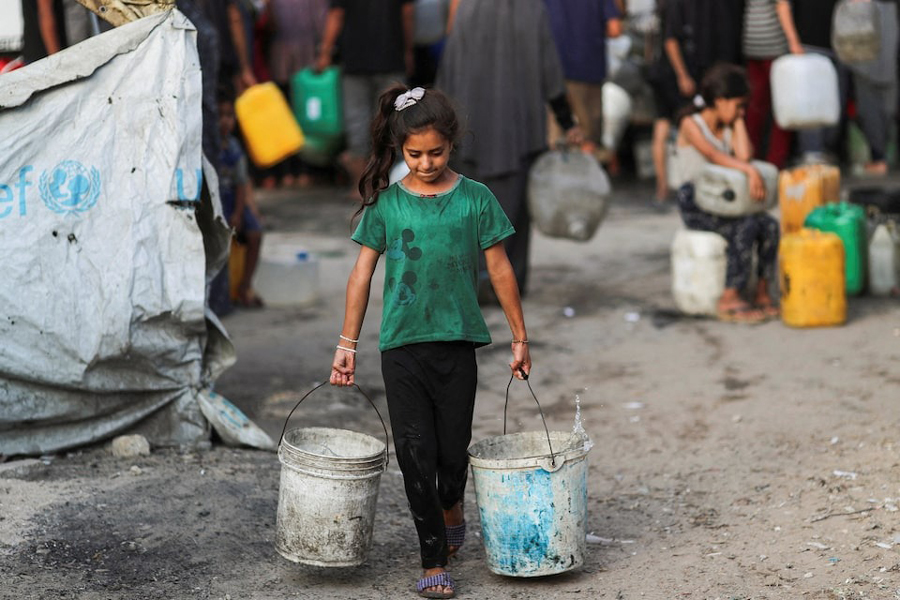
A Palestinian girl carries buckets of water amid shortages, in Gaza City August 6, 2025. Photo : REUTERS/Mahmoud Issa

Weakened by hunger, many Gazans trek across a ruined landscape each day to haul all their drinking and washing water - a painful load that is still far below the levels needed to keep people healthy.

Even as global attention has turned to starvation in Gaza, where after 22 months of a devastating Israeli military campaign a global hunger monitor says a famine scenario is unfolding, the water crisis is just as severe according to aid groups.

Though some water comes from small desalination units run by aid agencies, most is drawn from wells in a brackish aquifer that has been further polluted by sewage and chemicals seeping through the rubble, spreading diarrhoea and hepatitis.

COGAT, the Israeli military agency responsible for coordinating aid in the Israeli-occupied Palestinian territories, says it operates two water pipelines into the Gaza Strip providing millions of litres of water a day.

Palestinian water officials say these have not been working recently.

Israel stopped all water and electricity supply to Gaza early in the war but resumed some supply later though the pipeline network in the territory has been badly damaged.

Most water and sanitation infrastructure has been destroyed and pumps from the aquifer often rely on electricity from small generators - for which fuel is rarely available.

COGAT said the Israeli military has allowed coordination with aid organisations to bring in equipment to maintain water infrastructure throughout the conflict.

Moaz Mukhaimar, aged 23 and a university student before the war, said he has to walk about a kilometre, queuing for two hours, to fetch water. He often goes three times a day, dragging it back to the family tent over bumpy ground on a small metal handcart.

"How long will we have to stay like this?" he asked, pulling two larger canisters of very brackish water to use for cleaning and two smaller ones of cleaner water to drink.

His mother, Umm Moaz, 53, said the water he collects is needed for the extended family of 20 people living in their small group of tents in Deir al-Balah in the central Gaza Strip.

"The children keep coming and going and it is hot. They keep wanting to drink. Who knows if tomorrow we will be able to fill up again," she said.

Their struggle for water is replicated across the tiny, crowded territory where nearly everybody is living in temporary shelters or tents without sewage or hygiene facilities and not enough water to drink, cook and wash as disease spreads.

The United Nations says the minimum emergency level of water consumption per person is 15 litres a day for drinking, cooking, cleaning and washing. Average daily consumption in Israel is around 247 litres a day according to Israeli rights group B'Tselem.

Bushra Khalidi, humanitarian policy lead for aid agency Oxfam in the Israeli-occupied Palestinian territories said the average consumption in Gaza now was 3-5 litres a day.

Oxfam said last week that preventable and treatable water-borne diseases were "ripping through Gaza", with reported rates increasing by almost 150 per cent over the past three months.

Israel blames Hamas for the suffering in Gaza and says it provides adequate aid for the territory's 2.3 million inhabitants.

QUEUES FOR WATER

"Water scarcity is definitely increasing very much each day and people are basically rationing between either they want to use water for drinking or they want to use a lot for hygiene," said Danish Malik, a global water and sanitation official for the Norwegian Refugee Council.

Merely queuing for water and carrying it now accounts for hours each day for many Gazans, often involving jostling with others for a place in the queue. Scuffles have sometimes broken out, Gazans say.

Collecting water is often the job of children as their parents seek out food or other necessities.

"The children have lost their childhood and become carriers of plastic containers, running behind water vehicles or going far into remote areas to fill them for their families," said Munther Salem, water resources head at the Gaza Water and Environment Quality Authority.

With water so hard to get, many people living near the beach wash in the sea.

A new water pipeline funded by the United Arab Emirates is planned, to serve 600,000 people in southern Gaza from a desalination plant in Egypt. But it could take several more weeks to be connected.

Much more is needed, aid agencies say. UNICEF spokesperson James Elder said the long-term deprivations were becoming deadly. "Starvation and dehydration are no longer side effects of this conflict. They are very much frontline effects."

Oxfam's Khalidi said a ceasefire and unfettered access for aid agencies was needed to resolve the crisis.

"Otherwise we will see people dying from the most preventable diseases in Gaza - which is already happening before our eyes."​
 
Analyze

Analyze Post

Add your ideas here:
Highlight Cite Respond

Genocidal starvation in Palestine
Mohammad Mahfuzul Islam 07 August, 2025, 00:00

WEAPONISATION of starvation is going on in Palestine to evict the remaining population to make more room for Israeli settlers. The unlawful transformation of Palestinians into refugees raises questions about the legitimacy of the genocidal starvation. This is a violation of the basic human right to access food. Palestinians are perishing silently, and their resistance is crumbling to the ground. International media can do nothing but display malnourished bodies to seek sympathy from viewers. The reluctant silence of the conscientious individuals unleashes a deadly punch on the face of the Palestinians. As a result, debilitating feelings control our exposure to images.

Imposed hunger is everywhere; not a single strip of land is spared from its ominous effect. Food is the most precious item on a land devoid of fuel for the body. Our bodies are designed to consume food and water to produce energy. The basic design of human anatomy, used to create enthusiasm to fight, is forced to sag. A child carrying a heavy sack of flour knows the harsh reality of life, penned by remorseless monsters. Infants without baby food pass away from this unjust world. Our conscience does not wake up even after seeing the emaciated bodies of children. We can neither help nor remain silent in this situation. Our helplessness consumes our existence as human beings when we see the perpetrators get away with their war crimes for the time being.

Animals are also starving in Palestine due to the artificial crisis created by the Israeli settlers. When humans are deprived of food, animals do not receive their share. Animals have become mere skin and bone. They have nowhere to go or escape. The severity of starvation is taking its toll on both human and animal lives. Ribcages and the backbones of humans and animals become prominent under the skin and declare the oppression and tyranny of Zionist genocide. An oppression of any kind is a reversible zero-sum game. The accumulated cases of victims make the ground fertile for future oppression by the oppressed. If allowed to continue, the vicious cycle will find its victims among the oppressors.

The systematic annihilation of a populace before the entire world does not meet any resistance from any country. The Zionists, being historically informed of the Jewish people who faced starvation in Nazi Germany, are replicating the same model in Palestine. Palestinians wait for planes to drop relief from above. If they see one, they look up at the sky until it vanishes into the horizon. Relief tied to parachutes falls to the ground, apparently providing relief from the pangs of hunger. Armed Israeli soldiers shoot down those who gather to collect relief. The victims, according to the plan, are first lured by the food and then mowed down by the merciless settlers.

If they succeed in getting a portion of relief, then they consider themselves fortunate. Those who fail would go hungry due to the fault of the Zionist agenda in this world. To make one’s selfish life prosper, one cannot step on the shoulders of the downtrodden people. The Palestinians are forced to experience atrocious famine to eliminate them from the so-called promised land. One’s promised land becomes someone else’s nightmare. When children die of malnutrition, the remaining people wait for the silver lining in the cloud. But the Zionist colonisers forget that no matter how hard they try, they cannot obliterate the population. The Palestinians will rise from the ashes of hunger and famine to reclaim their motherland.

Bottles full of grains and lentils with written notes are thrown into the ocean to find the shore of Palestine. Hope keeps the dream of feeding the hungry alive in the age of toxic Zionism. The ocean waves help bottles reach the Palestinian coast to assuage the hunger of helpless civilians. The minimal help the fortunate people can provide becomes the lifeline for the victims. If we all threw bottles of grain into the ocean to help fight starvation in Palestine, then it would be a significant step towards humanity’s triumph.

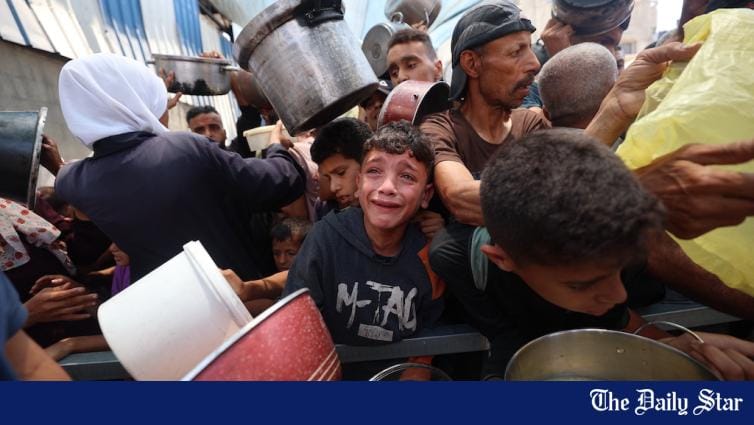
The Palestinian people do not want any relief. They want to be free from the shackles of oppressive occupation. They want a dignified life with their rights safeguarded as human beings. When they are turned into scavengers, we are emotionally shocked and intellectually castrated. When respect is taken away from them, we become speechless. When we see them jostle for scanty relief, we look for a place to hide our shame and inability to act. The survival of the fittest game is being run in Palestine. The conscientious individuals curse the Israeli government for their deliberate food scarcity created in Palestine.

Zionism is a big threat to the security and existence of the Palestinians. It is spreading like malignant tumours in the world. The cancerous growth destroys healthy human relationships. Inter-ethnic and inter-religious relationships are jeopardised by Zionism’s deadly sting. Like racism, it demolishes human equality and tries to establish a hierarchy of ascribed identity. The subscriber of this spiteful ideology should realise that this world needs compassionate companions, not murderers, to unlock a better future.

The Israeli settlers apply the method of European colonisers to dispossess the Palestinians. Having killed many colonised people, the descendants of European colonisers now chant the slogan of human rights. Israel, being an illegal state, unleashes the reign of terror to cultivate the culture of fear and anxiety. The atrocities inflicted on the Palestinians will wait for their turn for vengeance. The settlers seem to forget the old saying that what goes around comes around.

We protest against Israeli occupation and genocide through starvation in Palestine. We say: stop genocide through starvation. Stop the oppression of helpless victims. Stop the stupidity against humanity. Stop the annihilation of humans based on identities. Stop plundering the resources of someone else’s land. Stop the dispossession of one’s motherland. Stop the cruel drama. Stop the silence and indifference. We invite the whole world to rise against normalised monstrosity in Palestine, break the silence, and restore the rights of Palestinians as humans.

Mohammad Mahfuzul Islam is an anthropologist and a faculty member at Independent University Bangladesh.​
 
Analyze

Analyze Post

Add your ideas here:
Highlight Cite Respond

20 killed by overturned aid truck in Gaza
Agence France-Presse . Gaza City 07 August, 2025, 00:26

Gaza’s civil defence agency said Wednesday that 20 people were killed when an aid truck overturned on a crowd of aid seekers in the central Gaza Strip.

‘Twenty people were killed and dozens injured around midnight last night in a truck carrying aid overturned while hundreds of civilians were waiting for aid,’ the agency’s spokesperson Mahmud Bassal said.

The incident took place near the Nuseirat refugee camp, as the truck was driving on an unsafe road that Israel had previously bombed, Bassal added.

The Israeli military said it was looking into the reports.

Hamas accused Israel of forcing truck drivers to take dangerous routes to reach aid distribution centres, and to ‘intentionally engineer starvation and chaos.’

Israel ‘forces drivers to navigate routes overcrowded with starving civilians who have been waiting for weeks for the most basic necessities,’ Hamas’s media office said in a statement.

‘This often results in desperate crowds swarming the trucks,’ it added.

Meanwhile, the Israeli military will have to execute any government decisions on Gaza, the defence minister said Wednesday after reported disagreements over the prospect of a full occupation of the Palestinian territory.

Signs of a rift over strategy emerged as prime minister Benjamin Netanyahu prepared to announce a new phase in the war, after he said Israel must ‘complete’ the defeat of Hamas in order to secure the release of hostages still held in Gaza.

The Israeli press has predicted an escalation of operations, including in densely populated areas where hostages are believed to be held, such as Gaza City and refugee camps.

The reports also said Netanyahu and his cabinet would order a full military occupation of Gaza, sparking dissension from the army’s Chief of Staff, Eyal Zamir.

On Tuesday, Netanyahu held a restricted three-hour meeting with security chiefs to discuss options for the continuation of the war, his office said in a statement.

At the meeting, Zamir reportedly warned that a full occupation would be like ‘walking into a trap,’ according to public broadcaster KAN.

The army chief suggested alternatives to a full occupation, such as an encirclement of specific areas where Hamas is believed to be hunkering down, according to the Channel 12 broadcaster.

But defence minister Israel Katz hit back with a clear message.

‘It is the right and duty of the chief of staff to express his position in the appropriate forums,’ he wrote on X.

‘But once decisions are made by the political echelon, the IDF will execute them with determination and professionalism until the objectives of the war are achieved,’ he added, using an acronym for the Israeli military.

Netanyahu is expected to convene the security cabinet on Thursday to finalise a decision on the expansion of the offensive, local media reported.

US president Donald Trump told reporters on Tuesday he was not aware of reported plans to occupy the entire Gaza Strip, but said that such a decision would be ‘up to Israel’.

At war with Hamas since the unprecedented attack by the Palestinian Islamist movement on Israel on October 7, 2023, the Israeli government is under growing pressure to bring the conflict to an end.

Israelis are increasingly alarmed about the fate of the dozens of hostages in Gaza.

Of the 49 still held there, the Israeli military says 27 are dead.

The UN Security Council held a special session on Tuesday to discuss Israeli hostages in Gaza, as the country seeks to keep the issue on top of the global agenda.

On Tuesday, Trump described a recent video released by Hamas of emaciated Israeli hostage Evyatar David purportedly digging his own grave as ‘horrible.’

In parallel, international criticism has surged over the suffering of over two million Palestinians, who the UN warns are at risk of widespread famine.​
 
Analyze

Analyze Post

Add your ideas here:
Highlight Cite Respond

Starvation in Gaza: Israeli lies and the tail that wags the dogs

1754532895277.webp

The engineered starvation in Gaza, supported by the US, has always been a central pillar of Israel’s psychological warfare. FILE PHOTO: AFP

Whenever Israel yields to international pressure and allows aid trucks into Gaza, it devises other methods to ensure that food is never delivered. On July 26, Israel announced airdrops and "humanitarian corridors" for the United Nations convoys. Its forces also murdered 53 people seeking aid in those corridors on the same day. Rather than feeding the starving population, Israel turns the aid distribution points into killing zones. Time and again, Palestinians have been paying with blood for a loaf of bread or a bottle of water.

In less than two months, death by Israeli bullets at the so-called Gaza Humanitarian Foundation (GHF) has reached over 1,054, averaging about 20 killings daily. Since July 26, when Israel announced the new "humanitarian corridors," the death toll has more than doubled—325 last week alone—from the number of Palestinians killed daily at GHF distribution centres. Meanwhile, the tokenistic airdrops by Arab collaborators are nothing short of a disgrace.

The $60 million that Donald Trump brags about giving to GHF is funding the deaths of hungry Palestinians. For the starved, GHF stands for Gaza Humiliation Front—not a lifeline, but an Israeli murder-line. Instead of wasting American taxpayer money on these death traps, Trump should consider restoring US funding to the United Nations Relief and Works Agency (UNRWA), the only agency that has offered real hope to Palestinian children for more than 75 years.

Trump's envoy Steve Witkoff's visit to a GHF centre in Gaza, followed by his statement that there is no starvation, was a textbook case of confirmation bias. His tour did not reveal the absence of starvation, but rather his willful blindness to see it. Witkoff sought out information that would reinforce his predetermined narrative to whitewash starvation.

To be honest, no one had seriously expected him to witness starvation at a carefully staged (safe) site, far removed from the people. He declined an invitation to visit a hospital in Gaza to see the starved children and hear directly from the life-saving medical professionals. Instead, he chose a photo op and listened to the mercenaries of death at GHF.

The engineered starvation in Gaza, supported by the US, has always been a central pillar of Israel's psychological warfare; a calculated strategy aimed at expelling the population or driving them into a survivalist frenzy. Israel and the US-funded GHF have become the perfect linchpin of this Israeli-designed contraption. Replacing a well-established UN infrastructure that operated 400 distribution centres, GHF offered only four aid points. These limited sites made it easier for Israel to surveil, shoot at the starving, and leave the survivors to fight over the meagre crumbs that remained.

GHF's role was exposed by Anthony Aguilar, a retired US Special Forces officer and recipient of the Purple Heart and Bronze Star. Choking back tears, Lt Col Aguilar recounted the story of a child who "walked 12 kilometres to reach" one of GHF's food distribution sites. "He got nothing but scraps, thanked us for it…" and then he was shot dead by the Israeli army.

Still, the "free" Western media has too often acted as Israel's public relations arm. It downplays Israel's horrific crimes and markets Israeli falsehoods, such as the baseless claim that Hamas steals food aid. This narrative persisted even after USAID concluded that Israel failed to provide any evidence supporting that food aid was being diverted. Other than for Israeli military hindrance, under UN oversight, there have been no issues delivering food to all of Gaza. Israel's objective is simple: deflect responsibility by blaming the starving for their own starvation.

Early last June, I wrote on the Israeli scheme to "lie, deny, and distort the truth." In the article, I detailed a long list of Israeli lies and how the US media disseminated the disinformation with little to no effort to verify or challenge. You see, Israel does not just enjoy political impunity from the US administration; it also has the freedom to lie with complete immunity from the US media.

The daunting question remains: how many lies must Israel tell before the media call them out, just as they do with the US President Donald J Trump, or other leaders and nations?

A recent example of how the Israeli-managed "free" media misrepresents facts is the failed ceasefire talks. Listening to the Western media, one might conclude that the Palestinian negotiators rejected a "generous" offer for a ceasefire. In reality, the talks collapsed because Netanyahu sought only a pause to secure the release of captive Israeli soldiers, refusing to agree to end the war or the starvation blockade.

No rational party would accept, let alone consider, such a half-measure. When Palestinians rejected a proposal short of a lasting ceasefire, Netanyahu cried foul. President Trump and Witkoff rushed to absolve Netanyahu's intransigence to accept a permanent ceasefire, and then blamed the Palestinians.

The reluctance, and perhaps intimidation, of Arab mediators like Qatar and Egypt to publicly challenge Washington's pro-Israel stance has only deepened the media distortions. The mediators' silence allowed Netanyahu's false narratives to dominate international discourse.

Nonetheless, the tide could be turning. France and the UK's recent promise to recognise the state of Palestine, although long overdue, signals the growing frustration with Netanyahu's lies and deceit. The European officials made it clear, they were no longer willing to tolerate the Israeli farce. The symbolic act, however, would never atone for Britain's original sin—the 1917 Balfour Declaration, which promised European settlers a homeland in Palestine while failing to enshrine the rights of the indigenous Palestinians on their land. Nor does it exonerate France, which conspired with Britain in the secret 1916 Sykes-Picot Agreement to carve up the eastern part of the Arab world.

Still, recognition matters. Fourteen other countries are poised to follow France's lead next month. The growing calls demanding Netanyahu agrees to a ceasefire are also telling. These governments have finally realised what their subjects had long known, that the absence of peace is not due to Palestinian rejectionism, but to Netanyahu's deception and insatiable thirst for the never-ending wars.

Despite the dominance of Israeli-embedded journalists and pundits in Western media, the world is finally waking up to the true face of Israel. Alternative media has, to a great extent, succeeded in piercing through the wall of Israeli lies, offering an unfiltered view into the lived horrors of starvation and genocide. No amount of Israeli propaganda can obscure the images of skeletal ribs jutting from the bodies of dying children. The sight of starving infants suckling on their bony fists indicts the liars.

To that end, a recent Gallup poll shows a clear shift in the US, where American support for the Israeli military action in Gaza has dropped to 32 percent, and disapproval has soared to 60 percent. For a while, Israel was enabled to "fool all the people some of the time," and it continues to "fool some of the people all the time," but ultimately, and as the latest poll shows, it "cannot fool all the people all the time."

Yet, babies are starving, the genocide continues, and there is no ceasefire in sight. This is only possible because Netanyahu and AIPAC continue to wag the dogs of Washington.

Jamal Kanj is the author of Children of Catastrophe: Journey from a Palestinian Refugee Camp to America, and other books. He writes frequently on Arab world issues.​
 
Analyze

Analyze Post

Add your ideas here:
Highlight Cite Respond

Netanyahu says he wants Israel to take control of all of Gaza

REUTERS
Published :
Aug 07, 2025 21:52
Updated :
Aug 07, 2025 21:52

1754611625045.webp


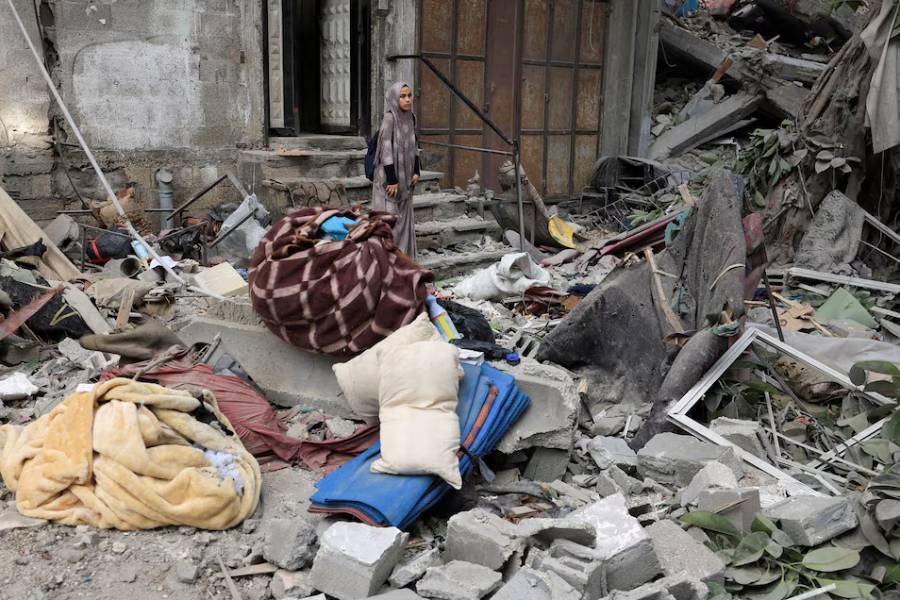
A Palestinian woman inspects the site of an overnight Israeli strike on a house, in Gaza City August 7, 2025. Photo : REUTERS/Dawoud Abu Alkas/Files

Israeli Prime Minister Benjamin Netanyahu said on Thursday Israel intends to take military control of all of Gaza, despite intensifying criticism at home and abroad over the devastating almost two-year-old war in the Palestinian enclave.

“We intend to,” Netanyahu said in an interview with Fox News when asked if Israel would take over the entire coastal territory. “We don’t want to keep it. We want to have a security perimeter. We don’t want to govern it. We don’t want to be there as a governing body.”

He said that Israel wanted to hand over the territory to Arab forces that would govern it.

Netanyahu made his comments to Fox News before the outcome of a meeting he was due to have on Thursday with a small group of senior ministers to discuss plans for the military to take control of more territory in Gaza.

The security cabinet session follows a meeting this week with the head of the military, which Israeli officials have described as tense, saying the military chief had pushed back on expanding the campaign.

Opinion polls show that most Israelis want the war to end in a deal that would see the release of the remaining hostages held by Hamas-led Palestinian militants.

Netanyahu’s government has insisted on total victory over Hamas, which ignited the war with its deadly October 2023 attack on Israel from Gaza.

The idea, pushed especially by far-right ministers in Netanyahu’s coalition, of Israeli forces thrusting into areas they do not already hold in the enclave has generated alarm in Israel.

The mother of one hostage urged people on Thursday to take to the streets to voice their opposition to expanding the campaign.

The Hostages Families Forum, which represents captives held in Gaza, urged military Chief of Staff Eyal Zamir to oppose widening the war and the government to accept a deal that would bring the war to an end and free the remaining hostages.

Defence Minister Israel Katz said on Wednesday that the military would carry out the government’s decisions until all war objectives were achieved.

Israeli leaders have long insisted that Hamas be disarmed and have no future role in a demilitarised Gaza and that the hostages be freed.

The U.N. has called reports about a possible expansion of Israel’s military operations in Gaza “deeply alarming” if true.

There are 50 hostages still held in Gaza, of whom Israeli officials believe 20 are alive. Most of those freed so far emerged as a result of diplomatic negotiations. Talks toward a ceasefire that could have seen some more hostages released collapsed in July.

A senior Palestinian official said Hamas had told Arab mediators that an increase in humanitarian aid entering Gaza would lead to a resumption in ceasefire negotiations.

Israeli officials accuse Hamas of seizing aid to hand out to its fighters and to sell in Gazan markets to finance its operations, accusations that the militant group denies.

Videos released last week of two living hostages showed them emaciated and frail, stirring international condemnation.

Hamas, which has ruled Gaza for nearly two decades but now controls only fragmented parts, insists any deal must lead to a permanent end to the war. Israel says the group has no intention of going through with promises to give up power afterwards.

MULTIPLE DISPLACEMENTS

The Israeli military says it controls about 75% of Gaza. Most of Gaza’s population of about 2 million has been displaced multiple times over the past 22 months and aid groups are warning that the enclave’s residents are on the verge of famine.

“Where should we go? We have been displaced and humiliated enough,” said Aya Mohammad, 30, who, after repeated displacement, has returned with her family to their community in Gaza City.

“You know what displacement is? Does the world know? It means your dignity is wiped out, you become a homeless beggar, searching for food, water and medicine,” she told Reuters.

Close to 200 Palestinians have died of starvation in Gaza since the war began, nearly half of them have been children, according to Gaza’s health ministry.

Rabeeha Jamal, 65, a mother of six, has remained in her house in Gaza despite warnings in the past from the Israeli military to leave. For now, she said she intends to stay.

“Not until they force us, if the tanks roll in, otherwise, I will not go running in the street to be killed later,” she said, calling for an end to the war. “We don’t have anywhere to go.”

Netanyahu is under intense international pressure to reach a ceasefire agreement, but he also faces internal pressure from within his coalition to continue the war.

Some far-right allies in his government have advocated a full occupation of Gaza and for Israel to re-establish settlements there, two decades after it withdrew.

Far-right Finance Minister Bezalel Smotrich told reporters Wednesday that he hoped the government would approve the military taking control over the rest of Gaza.

About 1,200 people were killed and 251 hostages taken to Gaza in the October 7, 2023 Hamas attack on southern Israeli communities.

More than 61,000 Palestinians have been killed by Israel’s assault on Gaza, according to the Gaza health ministry, which said 98 Palestinians have been killed by Israeli fire across the enclave in the past 24 hours.​
 
Analyze

Analyze Post

Add your ideas here:
Highlight Cite Respond
Ager ye drama bund kara Iran nay doc........Pitting de hapless Colludz (which Iran backs as human beings worthy of being kept alive) vs the Zionists.........Main Khamenei ko nahi bakhshon ga phir........

This is a beautiful epic Biblical failure of the powerful vs da dalit colludz which Iran is casting out there as a struggle. :p

Lund lugga diye hain Iranio ne saaray global order k........🤣

Aaaaaaaahahahahhahahahahaaaaaaaaaaa..........

There's a few thousand Sassanid priests still very active within da IRGC........otherwise dis is impossible no?

Muzlim mofo pimps out his daddy at the slightest pretext no?

Actually, he'd play cuck baby watchin his daddy get ass fukked like in porno filumms. :p

How can anyone trust muzz-Lims?
 
Analyze

Analyze Post

Add your ideas here:
Highlight Cite Respond

US and UK differ on Gaza but share goal to end crisis, Vance says

REUTERS
Published :
Aug 08, 2025 22:58
Updated :
Aug 08, 2025 22:58

1754699017168.webp

US Vice President JD Vance and British Foreign Secretary David Lammy react as they meet at Chevening House in Sevenoaks, Britain, Aug 8, 2025. Photo : REUTERS/Suzanne Plunkett/Pool

Britain and the United States may disagree about how to address the crisis in Gaza but they share a common goal in resolving it, Vice President JD Vance said as he met British Foreign Secretary David Lammy on Friday in southern England.

Vance, who has previously criticised Britain and its governing Labour Party, landed with his wife Usha and their three children in London before heading to Chevening, the large country residence used by the British foreign minister in Kent.

The visit comes amid increased attention on Vance's foreign policy views as he emerges as a key figure in President Donald Trump's administration and his possible pick as successor.

Asked about Britain's plan to recognise a Palestinian state, Vance said the US and Britain had a common objective to resolve the crisis in the Middle East, adding: "We may have some disagreements about how exactly to accomplish that goal, and we'll talk about that today."

Vance reiterated that the US had no plans to recognise a Palestinian state, saying he did not know what recognition actually meant, "given the lack of a functional government there".

Britain, by contrast, has taken a harder stance against Israel, declaring its intention to recognise a Palestinian state along with France and Canada to put pressure on Israeli leader Benjamin Netanyahu over the continuing conflict and humanitarian crisis in Gaza.

Close to Chevening House, a small group of protesters had gathered, some waving Palestinian flags and one holding up a sign showing a meme of Vance. Other protests are also planned during the visit.

Asked by a reporter about Trump's suggestion this week that Vance was his likely heir apparent for the 2028 presidential election, the vice president said his current focus was to do a "good job" for Americans.

"I'm not really focused even on the election in 2026, much less one, two years after that," he said, referring to the midterm election next year.

FISHING TRIP

Earlier on Friday, Vance and Lammy went fishing in the lake behind Chevening House, appearing relaxed in blue button-down shirts and sharing a laugh.

Vance joked to reporters that the "one strain on the special relationship" between Britain and the US was that all his children had caught fish but that the British foreign minister had not.

"Before beginning our bilateral, the Vice President gave me fishing tips, Kentucky style," Lammy said in a post on X.

The pair have developed a warm friendship, bonding over their difficult childhoods and shared Christian faith, according to two officials familiar with the relationship.

"I have to say that I really have become a good friend, and David has become a good friend of mine," Vance told reporters, sitting beside Lammy.

After spending two nights in Chevening with Lammy, the Vances will travel to the Cotswolds, a picturesque area that is a popular retreat for wealthy and influential figures, from footballers and film stars to media and political figures.

Vance has championed an America First foreign policy and once said last year's election victory for Lammy's centre-left Labour Party meant Britain was "maybe" the first "truly Islamist” country with a nuclear weapon.

Lammy once called Trump a "far right extremist" and a "neo-Nazi" but since coming to power has brushed off his remarks as "old news".

Vance's trip will include several official engagements, meetings and visits to cultural sites and a likely meeting with US troops, a source familiar with the planning said.

Trump, who travelled to Scotland for a private visit, is also scheduled for a historic second state visit to Britain next month.​
 
Analyze

Analyze Post

Add your ideas here:
Highlight Cite Respond

Israeli strike kills 18 in Gaza
Agence France-Presse . Palestinian Territories 10 August, 2025, 00:01

1754792801159.webp

Palestinians hustle around a humanitarian parcel dropped by a military aircraft in Jabalia in the northern Gaza on Saturday. | AFP photo

Gaza’s civil defence agency said at least 18 people were killed across the Palestinian territory on Saturday, including civilians who were waiting to collect aid.

Civil defence spokesman Mahmud Bassal told AFP that at least six people were killed and 30 wounded after Israeli troops targeted civilians assembling near an aid point in central Gaza.

The spokesman said strikes hit areas elsewhere in central Gaza, resulting in multiple casualties.

He later added that a drone attack near the southern city of Khan Yunis killed at least three people and injured several others.

Media restrictions in Gaza and difficulties accessing swathes of the territory mean AFP is unable to independently verify the tolls and details provided by the civil defence and the Israeli military.

Thousands of Palestinians congregate daily near food distribution points in Gaza, including four managed by the US- and Israeli-backed Gaza Humanitarian Foundation.

Since launching in late May, its operations have been marred by almost-daily reports of Israeli forces firing on those waiting to collect aid.

Israeli restrictions on the entry of supplies into Gaza since the start of the war nearly two years ago have led to shortages of food and essential supplies, including medicine and fuel, which hospitals require to power their generators.

Prime minister Benjamin Netanyahu faces mounting pressure to secure a ceasefire to bring the territory’s more than two million people back from the brink of famine and free the hostages held by Palestinian militants.

But early Friday, the Israeli security cabinet approved plans to launch major operations to seize Gaza City, triggering a wave of outrage across the globe.

Despite the backlash and rumours of dissent from Israeli military top brass, Netanyahu has remained defiant over the decision.

In a post on social media late Friday, he said “we are not going to occupy Gaza—we are going to free Gaza from Hamas”.

The Palestinian militant group, whose October 7, 2023 attack triggered the war, has slammed the plan to expand the fighting as a “new war crime”.

Israel’s offensive has killed more than 61,000 Palestinians, according to Hamas-run Gaza’s health ministry, figures the UN says are reliable.

Hamas’s 2023 attack on Israel resulted in the deaths of 1,219 people, according to an AFP tally based on official figures.​
 
Analyze

Analyze Post

Add your ideas here:
Highlight Cite Respond

Members Online

Latest Posts

Back
 
G
O
 
H
O
M
E