[🇮🇱] Israel and the USA Relation

[🇮🇱] Israel and the USA Relation
10
472
More threads by Saif

G  Israeli Defense

Trump confirms using foul language with Israel’s Netanyahu
Agence France-Presse . Washington 03 June, 2026, 18:51
1780535588258.webp

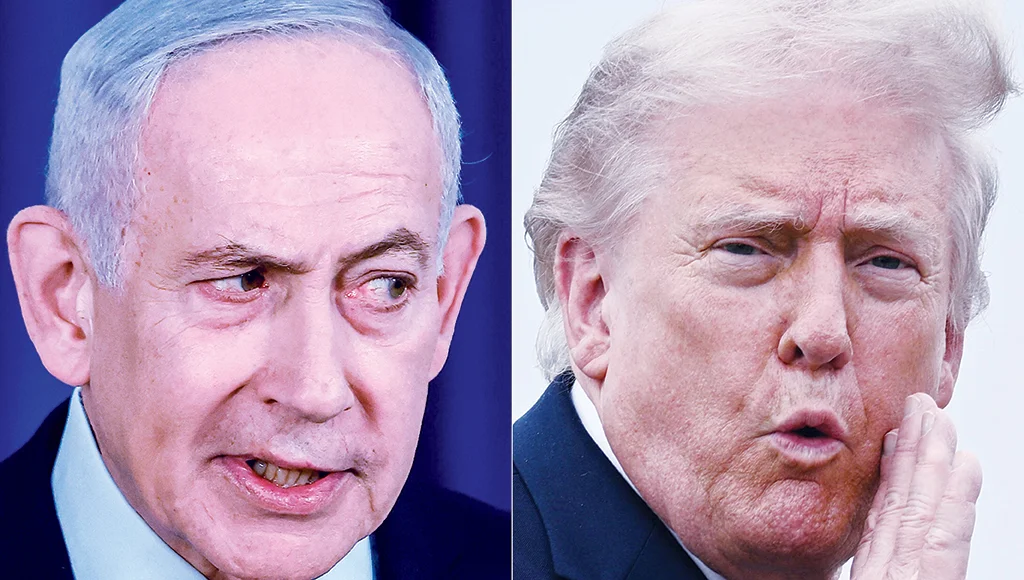
From left, Benjamin Netanyahu and Donald Trump | AFP photo

US president Donald Trump has confirmed a tense exchange with Israel’s prime minister Benjamin Netanyahu in which he reportedly berated his close ally with expletives.

In an interview published Wednesday in the New York Post, Trump was asked about the conversation he had with Netanyahu over the phone on Monday.

‘You said, ‘Are you f-ing crazy? What are you f-ing doing? I helped you stay out of jail.’ Is that true? Did you speak to him in those terms?’ the interviewer asked.

‘I did,’ Trump responded. ‘I was a little bit perturbed at his constantly fighting with Lebanon.’

‘I said, ‘Bibi, we gotta stop this.’

Trump went on to say he had a ‘very good relationship’ with Netanyahu. ‘We’ve done well together... I like Bibi a lot.’

Trump unleashed the profane tirade over Israel’s threats to bomb the Lebanese capital Beirut, fearing it would undermine talks with Tehran to end the war in the Middle East, the Axios news outlet and ABC News reported.

The exchange underscored the shaky ties between two right-wing allies who started the war by launching an attack on Iran in late February that spread to Israel striking Lebanon.

Israeli media have rejected the account of the conversation.

A White House official referred AFP to Trump’s Truth Social posts from Monday in which he thanked Netanyahu for what he said was an agreement to pull troops back from Beirut.

Iran had reportedly halted peace talks because of Israel’s attacks on Lebanon.​
 

Israel-First: U.S. Congress is quietly merging America's military with Israel's

Jamal Kanj

When Congress wants to do something that it knows the American public would object to, it buries it. That is exactly what it did with Section 224 of the House Armed Services Committee’s draft Fiscal Year 2027 National Defense Authorization Act. It is a sinister, Israel-first, AIPAC-backed insertion designed to merge American military industries with the military of a country, Israel, that has been caught spying on and stealing American technology. The proposed section is hidden inside a $1.15 trillion defence bill, advanced with virtually no public debate.

The provision, titled the “United States-Israel Defense Technology Cooperation Initiative,” goes far beyond traditional military aid. It authorises joint weapons co-production, bilateral research and development, technology licensing, and deep integration across artificial intelligence, cyberwarfare, autonomous systems, and biotechnology. Most extraordinarily, it would create a permanent Pentagon executive agent dedicated exclusively to coordinating military cooperation with Israel.

In advancing this legislation, members of the House and Senate are not representing their constituents; they are defying them. According to a Pew Research Center survey conducted in March 2026, a month into the U.S.-Israeli war on Iran, 60 per cent of American adults now hold an unfavourable view of Israel, up seven points in a single year and nearly twenty points since 2022. Among Democrats, the figure is even 80 per cent. In both political parties, majorities of adults under fifty now rate Israel and Netanyahu negatively.

The gulf between congressional action and public reality extends far beyond American borders. A separate Pew survey published in June 2026, spanning thirty-six countries and more than 44,000 respondents, found that a median of 67 per cent of people worldwide hold an unfavourable view of Israel. Unfavourable majorities exist across every European country surveyed, including Spain and Sweden at 78 per cent, the Netherlands at 76 per cent, Germany at 73 per cent, and Poland at 70 per cent. In Japan, 93 per cent of respondents viewed Israel unfavourably. At a moment when America's global standing depends on the credibility of its alliances and the integrity of its foreign policy, Congress is moving to cement an institutional merger with a government that two-thirds of humanity views as a pariah.


1781593126159.webp

U.S. House Speaker Mike Johnson (R-LA) and Senate Foreign Relations Chair, Senator Ben Cardin (D-MD), listen as Israeli Prime Minister Benjamin Netanyahu addresses a joint meeting of Congress at the U.S. Capitol in Washington, U.S., July 24, 2024. Photo: REUTERS

Beyond defying the will of American voters, Congress has recklessly ignored the national security consequences of its own legislation. By granting Israel direct leverage over American defence priorities and supply chains, Section 224 ties U.S. military readiness to Israel's endless regional wars. Every stockpile drawn down and every weapons system co-opted in service of those conflicts is a direct cost to American defence preparedness. This does not make America safer. It makes America a subordinate, binding its military might to the endless wars of a foreign government that answers to no American voter.

This comes days after the Pentagon's own Defense Intelligence Agency rated Israel's espionage threat against the U.S. as 'critical', the highest designation, surpassing even enemy states. The seven-page internal brief documented Israeli spying that was more aggressive than anything expected between allied nations or adversaries. U.S. counterintelligence officials found that Israel had planted spyware on the phones of American negotiators with Iran and attempted to plant a listening device inside a U.S. Secret Service vehicle.

This is the “partner” Congress proposes to merge America's military with. If Israel is already planting spyware on American officials who report directly to the president and probing Secret Service vehicles for listening devices, Section 224 would not merely open all doors to Israeli spies; it would hand them the keys through institutionalised intelligence access that is far harder to restrict and virtually impossible to reverse.

The history of Israeli technology transfers to China makes this risk real, not hypothetical. In the 1990s, Israel sold its Harpy loitering drones to China and moved to upgrade those same systems for Beijing despite direct American objections. The Pentagon investigated Israel’s covert transfer of U.S. Patriot missile technology to China. American intelligence officials were convinced that the transfer had taken place. U.S. pressure forced Israel to cancel the sale of Phalcon airborne radar systems to China, at a cost of $350 million in compensation payments to Beijing. The pattern is consistent: Israel obtains American technology, and American technology finds its way to China. Deeper integration will only widen that pipeline.

1781593162684.webp

U.S. Secretary of State Antony Blinken delivers remarks at the American Israel Public Affairs Committee (AIPAC) policy Summit in Washington, U.S., June 5, 2023. Photo: REUTERS

When the Pentagon's own intelligence apparatus rates Israel's espionage threat against the U.S. at its highest possible level, the answer is not to reward Israel with open access to every layer of American military technology. Yet that is precisely what Congress is doing. As public support for Israel collapses, Israel-first Zionists are migrating their agenda into Pentagon procurement channels and, backed by both parties, burying it from public scrutiny. Democrats and Republicans fight each other over America First. On Israel First, they unite.

If you're an American citizen, don't get mad, get loud. Call Congress at (202) 224-3121 and tell your representative that you are part of the sixty per cent. They work for you, not for Zionist billionaires and the Israeli lobby.

Jamal Kanj is a commentator on Arab affairs whose work appears regularly in national and international publications. He is the author of Children of Catastrophe: Journey from a Palestinian Refugee Camp to America and several other books.​
 

Will Netanyahu derail Trump's Iran peace deal?

Martin Kear

The peace deal between the US and Iran calls not just for the cessation of hostilities between the two countries, but also between Israel and Hezbollah. It also calls for Lebanese territorial integrity and sovereignty to be respected.

This places Israeli Prime Minister Benjamin Netanyahu in a political conundrum, because ceasing hostilities against Hezbollah runs contrary to his government’s determination to finally crush its nemesis.

Netanyahu now faces difficult decisions. Does he kowtow to the US, Israel’s longstanding ally and security guarantor, in an election year? Or does he defy the US and continue Israel’s military onslaught against Hezbollah?

An answer to these questions seemed to come in part on June 19, when Israel and Hezbollah agreed on yet another ceasefire. However, the next day Israel bombed Lebanon, and Iran once again closed the Strait of Hormuz.

Elections at home

Since the beginning of Israel’s current war against Hezbollah in March 2026, the Israeli Defence Force (IDF) has advanced into southern and eastern Lebanon. In the process, the IDF has pushed Hezbollah out of its traditional strongholds and bombed targets in southern Beirut.

To date, the war has killed more than 4,000 Lebanese people and forced another 1 million to flee their homes. On June 1, IDF units captured the strategically important Beaufort Castle, allowing the IDF to control most of southern Lebanon, including Hezbollah strongholds in the Bekaa Valley in eastern Lebanon.

The war is immensely popular in Israel. An April 2026 poll revealed 80% of respondents favoured continuing the war against Hezbollah, even if that created friction with the US. The war’s popularity is crucial for Netanyahu, with national elections due to be held by October. He is desperate to win another term as prime minister to forestall his long-running corruption trial and stifle debates over his culpability for the intelligence failures that lead to Hamas’s devastating October 7 attacks.

Within the areas it now occupies, the IDF has issued “don’t come back” orders, forcibly displacing thousands of Lebanese residents from their homes. On June 15, Israeli Defence Minister Israel Katz stated, “Israeli forces will remain in the security zones in Lebanon, Syria, and Gaza without any time limit” and the zones “would be cleared of local residents and all terror infrastructure including the houses”.

The war is immensely popular in Israel. An April 2026 poll revealed 80% of respondents favoured continuing the war against Hezbollah, even if that created friction with the US. The war’s popularity is crucial for Netanyahu, with national elections due to be held by October. He is desperate to win another term as prime minister to forestall his long-running corruption trial and stifle debates over his culpability for the intelligence failures that lead to Hamas’s devastating October 7 attacks.

In their aftermath, Netanyahu vowed to dramatically change the political landscape of the Middle East. He did this with wars on Hamas, Iran, and Hezbollah.

But while these wars have significantly degraded the ability of his nemeses to threaten Israel, they have not been defeated as promised. This means while Netanyahu has indeed changed the political landscape of the Middle East, his wars have arguably made Israel less, rather than more, secure.

Criticism of Netanyahu’s handling of these wars has been growing, with Opposition politician Yair Golan declaring:

Netanyahu lied. He promised a historic victory and security for generations, and in practice, we got one of the most severe strategic failures Israel has ever known.

Netanyahu needs continuing military successes in Lebanon to sustain his narrative that he is making Israel safer by defeating its enemies.

Israel also needs ongoing US diplomatic support to shield it from any future United Nations Security Council (UNSC) sanctions. These may come from the concurrent investigations by the International Court of Justice (ICJ) and International Criminal Court (ICC) into allegations of Israel committing genocide, war crimes, and crimes against humanity in its wars against Hamas and Hezbollah.

Elections abroad

However, US President Donald Trump is also facing an unfavourable domestic political environment in the lead up to US mid-term elections. Trump needs an end to an unpopular war to try to create a positive political narrative to stave off potentially losing control of the House and the Senate.

He does not want Israeli truculence to make already tense negotiations with Iran harder. For their part, the Iranians have made the cessation of Israel’s war on Hezbollah and its withdrawal from southern Lebanon the central issue in deciding whether to continue negotiating with the US. This is why Iran again closed the vital Strait of Hormuz after Israel bombed Lebanon on the weekend.

So while Israel and the US may be allies, it is not an equal relationship. The geopolitical needs and desires of the US as the great power will always eclipse those of Israel as the middle power.

Therefore, as prime ministerial aspirant Yair Lapid, puts it, Netanyahu faces “either a direct and destructive confrontation with our greatest ally or a submissive surrender of Israeli interests”.

Evidence of how strained the relationship between Trump and Netanyahu is came just before the president signed the Memorandum of Understanding (MoU) with Iran. Trump castigated Netanyahu for ordering the bombing of Hezbollah targets in southern Beirut. He later suggested Syria would do a better job at fighting Hezbollah stating:

I’m not happy with the way Israel has handled themselves with Lebanon and with Hezbollah. It just goes on forever and it throws a negative light on the big deal, and that’s the deal with Iran.

So while Israel and the US may be allies, it is not an equal relationship. The geopolitical needs and desires of the US as the great power will always eclipse those of Israel as the middle power. Therefore, as prime ministerial aspirant Yair Lapid, puts it, Netanyahu faces “either a direct and destructive confrontation with our greatest ally or a submissive surrender of Israeli interests”.

Despite the president’s frustrations there has been push-back from senior Israeli ministers. National Security Minister Ben Gvir said:

The prime minister should have told President Trump: We appreciate you, but Israel is a sovereign and independent state that cannot accept the strengthening, or even the existence, of a terrorist organisation on its borders.

In response US Vice President JD Vance stated bluntly that Israeli critics of the US-Iran deal, “need to wake up and smell the reality of the situation that country is in”.

In other words, Israel needs the US more than the US needs Israel. Israel relies on US financial and military support for its security, with the two allies recently signing their own MoU that guarantees the US giving Israel US$3.8 billion per year, including US$500 million for missile defence.

Israel also needs ongoing US diplomatic support to shield it from any future United Nations Security Council (UNSC) sanctions. These may come from the concurrent investigations by the International Court of Justice (ICJ) and International Criminal Court (ICC) into allegations of Israel committing genocide, war crimes, and crimes against humanity in its wars against Hamas and Hezbollah.

The situation in Lebanon remains highly volatile, the Israeli people are due to cast their votes before October, and the US is finalising a deal with Iran that will likely run contrary to Israel’s interests. The question now is what Israel is going to do about it.

This article was first published under the title “With Iran and the US signing a peace deal, where does that leave Benjamin Netanyahu?” in The Conversation, on June 21, 2026.

Martin Kear is a Lecturer, Department of Government and International Relations at University of Sydney.​
 

Latest Posts

Back