[🇧🇩] Monitoring Bangladesh's Economy

[🇧🇩] Monitoring Bangladesh's Economy
1K
38K
More threads by Saif

G Bangladesh Defense

How new tax structure will squeeze the middle class

Atiqul Kabir Tuhin

Published :
Jun 18, 2026 00:24
Updated :
Jun 18, 2026 00:24
1781758177109.webp


The national budget for fiscal year 2026-27 reveals the scale of the country's fiscal dilemma. On the one hand, the government is offering tax relief to ease inflationary pressures and reduce the cost of doing business. On the other, it has set an ambitious revenue collection target of Tk 6.04 trillion for the National Board of Revenue (NBR), nearly Tk 1 trillion higher than the target for the outgoing fiscal year. Moreover, as revenue collection is running far below target, the NBR will need to increase collections by around 50 per cent over this year's actual receipts to meet its target for next fiscal, starting from July 1. Whether such a dramatic increase is realistically attainable remains open to question. However, the target itself creates pressure for more aggressive revenue mobilisation through stricter enforcement and policy adjustments. Given Bangladesh's persistently narrow tax base, which successive governments have failed to broaden meaningfully, it is feared that the burden could ultimately fall on the already compliant, taxed and inflation-hit segments of the population and businesses.

This policy paradox is evident in the new tax structure, where tax-free income threshold has been raised by Tk 25,000 from existing 3.5 lakh, which the authorities claim will provide some relief to taxpayers amid persistently high inflation. However, the lowest tax slab of five per cent has been abolished and replaced with a 10 per cent rate. As a result, many taxpayers will ultimately face a higher overall income tax burden despite the proposed increase in the tax-free income threshold.

Moreover, the new tax structure is likely to place a disproportionately heavier burden on lower- and middle-income earners than on higher-income taxpayers. An analysis by SMAC Advisory Services Ltd shows that an individual earning around Tk 74,000 per month would face a 49 per cent increase in tax liability under the proposed structure, whereas someone earning Tk 250,000 or more per month would see an increase of only about 10.5 per cent. At a time when ordinary households are already struggling with inflation and stagnant purchasing power, such disparities raise questions about the equity and fairness of the proposed tax measures.

The burden on taxpayers is further compounded by changes to investment-related tax incentives. Under the existing system, taxpayers can claim a rebate equal to 15 per cent of eligible investments, subject to a maximum investment limit of 20 per cent of taxable income or Tk 6.67 million, whichever is lower. The proposed Income Tax Act 2027 increases the eligible investment ceiling to 30 per cent of taxable income but reduces the rebate rate from 15 per cent to 10 per cent. It also lowers the maximum annual tax rebate from Tk 1 million to Tk 750,000. As a result, taxpayers will receive Tk 5,000 less in tax relief for every Tk 100,000 invested. Although the proposal allows a larger share of income to be invested in eligible instruments, the lower rebate rate will diminish the tax-saving benefit of such investments for many taxpayers. The changes are likely to affect salaried employees in particular and discourage savings.

The proposed budget worth Tk 9.38 trillion has been widely praised for prioritising healthcare, education and social protection. The challenge however lies in revenue collection. Many argued that revenue targets should have been set realistically, taking into account the economy's current weaknesses. Under these circumstances, greater emphasis should have been placed on reducing wasteful expenditure and improving the efficiency of public spending. Failure to meet overly ambitious targets could force the government to rely more heavily on bank borrowing, crowding out private-sector credit and slowing investment. In the worst case, persistent fiscal shortfalls could increase pressure for monetary financing of deficits, adding further fuel to inflation.

There are indeed scopes for significantly boosting revenue collection. Recent data show that Bangladesh's revenue collection has not kept pace with economic growth over the past decade, indicating substantial untapped potential. Experts have identified several structural weaknesses behind the country's poor revenue performance. These include corruption and inefficiency within the tax administration, the failure to identify and bring new taxpayers into the system, and the absence of a unified digital platform linking income tax, VAT and customs authorities. Comprehensive digital integration of tax administration could significantly reduce tax evasion, improve compliance and broaden the tax base without placing additional burdens on existing taxpayers.

The finance minister's budget speech outlined several measures aimed at expanding the tax net and automating revenue collection, which is welcome. However, the minister mentioned nothing about the much-anticipated reform of the National Board of Revenue (NBR), particularly the move initiated by the interim government to separate tax policy formulation from revenue collection and enforcement. Critics have long argued that the NBR's dual role as both policymaker and enforcer creates an inherent conflict of interest, which serves as a potent source of irregularities and corruption that plague the revenue administration.

The question, therefore, is not whether tax revenue should increase, but how it should be raised. Will the government boost revenue by curbing tax evasion among wealthy individuals and businesses that are often politically difficult to tax, or will it continue to squeeze those already within the tax net and easiest to tax? Will higher revenue come from broadening the tax base or from greater reliance on indirect taxes, which disproportionately affect lower- and middle-income households? A wider and more equitable tax base, along with an efficient and corruption-free revenue department, could strengthen fiscal stability while reducing distortions in the economy.

That said, the budget contains several measures aimed at easing inflation. Source taxes on nearly 60 agricultural and essential commodities, including rice, wheat, flour, edible oil, sugar, fish, meat, onions and ginger, have been reduced. Existing rates of five per cent, two per cent and one per cent will be lowered to just 0.5 per cent. If these reductions are reflected in retail prices, they could help moderate inflation and provide some relief to consumers. However, the benefits will materialise only if strict market monitoring ensures that lower tax costs are passed on to consumers rather than absorbed as additional profit by intermediaries.​
 

Amid rising debt pressures, a case for sukuk to ease the burden

Mezbah Uddin Ahmed

1781762514216.webp

VISUAL: ANWAR SOHE

The government’s proposed Tk 9.38 lakh crore budget for FY2026-27 is the largest in Bangladesh’s history. The budget frames economic democratisation, deregulation, and the empowerment of the people as priorities on Bangladesh’s path to becoming a trillion-dollar economy. Funding it, however, will rely heavily on debt. To this end, the government plans to borrow Tk 2.43 lakh crore during the fiscal year, of which Tk 1.16 lakh crore will be from foreign sources. The remainder will be raised domestically, with Tk 1.12 lakh crore from the banking system and Tk 15,000 crore from national savings certificates. Economists warn that heavy reliance on domestic borrowing could crowd out private sector credit. Interest payments alone will reach Tk 1.05 lakh crore on domestic loans and Tk 22,500 crore on foreign loans.

The Asian Development Bank (ADB) and the IMF-World Bank debt sustainability assessment both classify Bangladesh as being at moderate risk of external and overall debt distress. Both warn that rising domestic debt-servicing costs are already eroding fiscal space, and that any major shock (climatic, geopolitical, or otherwise) could turn a still-manageable debt burden into an unmanageable one.

The months-long closure of the Strait of Hormuz is the latest example of this warning. Still, such shocks do not change what the state owes its lenders; its debt-servicing obligations remain the same. Risk-free fixed payments are precisely what make sovereign debt cheaper, but they also place the entire burden of adjustment on the state. When a shock erodes the economy’s capacity to pay while its obligations hold firm, the fiscal cushion thins and the government loses room to manoeuvre. The present is a good time for Bangladesh to rethink how it borrows.

One option would be to tie the government’s payment obligations to its capacity to meet them. This is the idea behind state-contingent debt instruments (SCDIs): securities whose repayments adjust in line with a measurable indicator of the state’s ability to pay. Encouragingly, Bangladesh has already laid the groundwork for such instruments.

Since 2020, the government has been issuing investment sukuk, all of which have been oversubscribed, the most recent by 12.30 times, despite offering lower returns than comparable conventional treasury instruments. This indicates that a sizeable Shariah-sensitive investor base already exists in the market. With Shariah-compliant options still scarce, depositors unsettled by uncertainty in parts of the Islamic banking sector, and Islamic pension schemes under development at the National Pension Authority likely to require such options once launched, demand for sovereign sukuk is set to deepen in the coming years.

The investment sukuk issued has so far financed clearly identified socioeconomic projects—such as safe water supply, schools, rural roads, and bridges—rather than merely covering general budget gaps. Each issuance carries its own prospectus, setting out the purpose of issuance, the use of proceeds, and the expected impact of the underlying projects. In some cases, the economic internal rate of return (EIRR) of those projects is assessed to confirm that their economic benefits exceed their funding costs.

Yet, for all their merits, these remain fixed-rate structures that closely track comparable conventional treasury bonds. Neither is the actual performance of the underlying projects measured, nor do payments to investors vary with it. The government’s obligation stays the same regardless of how the projects actually perform. For investors, this means a safe investment. But from a debt-management perspective, they are no more than conventional debt, offering no relief from the rigidity of debt servicing.

This is where an alternative sukuk design becomes an opportunity. Short-term, trade-based sukuk, for instance, could finance recurring commodity purchases by the government and its agencies, tying issuances to the genuine trading activities of the state. Long-term, performance-linked sukuk could fund profitable state enterprises or their viable segments, with returns tagged to actual performance. Sukuk could likewise be issued against revenue-generating public assets such as tolled bridges, power plants, ports, and transport networks. Impact-linked sukuk could support public welfare projects that generate no revenue, with payments tied to verified outcomes such as improvements in air quality, traffic, education, healthcare, and employment generation. Waqf resources could complement this welfare financing, while zakat funds could support eligible beneficiaries in the social sector. Together, these structures would bind government spending more closely to performance-oriented economic activity.

If a growing share of government financing were channelled through sukuk whose payouts track the actual performance of the underlying assets, or clearly defined indicators of the state’s capacity to pay, the government’s debt-servicing burden would adjust accordingly. If scaled sufficiently, this could provide greater fiscal flexibility at the sovereign level. These structures would also be more than financing tools and, done properly, they would serve as accountability mechanisms. Since payouts would depend on performance, investors can gain a direct stake in how each project is run and would press for fuller disclosure—a form of scrutiny rarely associated with conventional debt. Done well, sukuk could quietly strengthen the country’s broader governance.

Of course, such structures would not be easy to introduce. Given limited trust in the performance of government agencies, investors may initially demand a government guarantee or a premium for bearing performance risk, while the agencies themselves may resist stronger monitoring and disclosure. Because of the performance link, every element of the structure would need careful design. The supporting infrastructure would also be essential: tax neutrality, streamlined issuance, strong oversight, an active trustee, Shariah-compliant segregation of income, honest and verifiable impact reporting, and effective coordination among the central bank, the finance ministry, and project-implementing agencies.

Issuances could begin with structures closest to the familiar fixed-rate profile while still carrying a performance-linked element, then move towards fuller performance-based forms as investors grow comfortable. To build confidence early on, a government guarantee may be offered—but not in a blanket form that severs the link between performance and payout. Instead, it should be transitional, paired with full disclosure, and withdrawn as the market matures. Over time, this approach could diversify the government’s financing mix, reduce its reliance on entirely fixed obligations, and embed stronger accountability in public projects.

Conventional borrowing, or a plain debt-based sukuk, is easy to issue. But it also locks in the rigidity already burdening debt management. Genuinely performance-linked sukuk may be harder to launch, but that difficulty is the price of fiscal flexibility and gives everyone involved a built-in reason to care about how an underlying project (or the economy itself) performs.

The shift need not be abrupt. We could begin with small-scale projects and early-stage structures that stay close to today’s fixed-rate profile, while carrying some performance-accountability elements, and then scale up and shift towards fuller performance linkage as the market matures. Debt management reimagined in this way has the potential to become not merely a means of covering the deficit but also a lever for a stronger, more transparent economy.

Mezbah Uddin Ahmed is research fellow at ISRA Institute of INCEIF University in Malaysia.​
 

Establishment of FTZs approved
Staff Correspondent 18 June, 2026, 00:09

The cabinet committee on economic affairs in a meeting on Wednesday agreed in principle with a proposal to establish the country’s first free trade zones in Chattogram.

One will be established adjacent to the sea port on around 3000 acres of land and the other on the same portion of land at Matarbari in Cox’s Bazar.

Finance and planning minister Amir Khosru Mahmud Chowdhury presided over the meeting at secretariat that also agreed in principle for a development agreement and a land lease agreement to be signed between Bangladesh and Chinese Economic and Industrial Zone Company Ltd on establishment of a Chinese Export Processing Zone at Anwara.

On Tuesday, the Executive Committee of the National Economic

Council approved a Tk 4,189 crore project to help supporting infrastructure for the CEIZ.

Conceived in 2016, the project did not get approval for various reasons, including delay in land acquisition.

Once implemented in 2031, the project will create scopes for at least 1,00,000 direct and indirect jobs and attract approximately $500 million in foreign investment.

Of the total project cost, the government will provide Tk 1,722 crore, while Tk 2,467 crore will come from project loans from China.

Cabinet secretary Nasimul Gani told reporters after the meetings that main aims of establishing free trade zones under the Bangladesh Economic Zones Authority to attract foreign investment and boost local economy up.

Calling the project is now at conceptual levels he said detailed project plans, investment structures, and operational modalities would be finalised in next phases.

Earlier on January 26, BEZA in a board meeting chaired by then the chief adviser Muhammad Yunus decided to establish the country’s first FTZ.

BEZA executive chairman Chowdhury Ashik Mahmud Bin Harun said the proposed zone would function as an offshore territory regarding customs regulations.

There will be no customs obligations, goods can be re-exported, stored, or manufactured there, he said, adding that the setup was expected to resolve the time-to-market constraints significantly.

Inspired from the Jebel Ali Free Zone in Dubai, the BEZA chief said the Dubai free zone handled a trade volume of $190 billion and contributed approximately 36 per cent of Dubai’s GDP.​
 

Surge in distressed loans cause for serious concern

Published :
Jun 18, 2026 23:26
Updated :
Jun 18, 2026 23:26

1781826180218.webp


The latest figures of distressed loans in the country's banking sector paint a deeply troubling picture of a financial system struggling under the weight of accumulated weaknesses. A sharp rise in distressed assets is not merely a banking-sector concern; it is a matter of national economic significance. According to the central bank's latest Financial Stability Report (FSR) 2025, distressed loans across most scheduled banks surged by more than 47 per cent to Tk 10.08 trillion by the end of 2025. The sheer magnitude of the figure is striking. It exceeds the size of the country's proposed national budget and underscores the scale of vulnerabilities embedded within the financial system. Even more alarming is the fact that distressed loans now account for over 55 per cent of total outstanding loans and advances. If written-off loans are included, the volume rises to Tk 10.87 trillion, representing nearly 60 per cent of the banking sector's total loan portfolio.

Distressed loans encompass not only non-performing loans (NPLs) but also rescheduled loans, loans under court stay-orders, and written-off loans. Together, they offer a dismal picture of deteriorating asset quality. The FSR attributes the worsening situation largely to imprudent lending practices, inadequate oversight and the slow recovery of defaulted loans. External shocks, including the prolonged effects of the Russia-Ukraine conflict, global economic uncertainties and domestic economic pressures, have further weakened borrowers' repayment capacity. What makes the situation particularly concerning is that the deterioration is visible across multiple categories of banks. State-owned commercial banks, specialised development banks, private commercial banks and Islamic banks have all experienced significant strain. Profitability indicators have also weakened considerably, with both return on assets (ROA) and return on equity (ROE) declining sharply. Such trends indicate that many banks are finding it increasingly difficult to generate sustainable earnings while carrying the burden of problematic assets.

Equally worrying is the erosion of the banking sector's capital base. The capital-to-risk-weighted assets ratio (CRAR), a key measure of financial resilience, fell dramatically from 3.08 per cent in 2024 to a negative 2.64 per cent in 2025. This is far below the regulatory minimum requirement of 10 per cent under the Basel III framework. Yet, amid these grim statistics, there are some encouraging signs. A number of banks have managed to maintain distressed asset ratios below 5.0 per cent, demonstrating that prudent lending, effective risk management and strong governance can still yield positive outcomes even in a challenging environment. Their performance offers valuable lessons for the wider sector.

The current crisis calls for more than temporary remedies. It demands comprehensive reforms aimed at strengthening governance, improving loan appraisal and monitoring, accelerating recovery mechanisms and ensuring accountability in lending decisions. Restoring confidence in the banking system is essential not only for financial stability but also for sustaining economic growth. The surge in distressed loans should therefore serve as a wake-up call -- one that policymakers, regulators and bank managements cannot afford to ignore.​
 

From ambition to execution
What Bangladesh can learn from global creative economies

Tariq Alam

Published :
Jun 18, 2026 23:13
Updated :
Jun 18, 2026 23:13

1781826319967.webp


The Government of Bangladesh's decision to place the creative economy among its emerging economic priorities is a significant and welcome development. The national budget outlines an ambitious vision encompassing creative hubs, production facilities, international promotion, digital creators and the "Created in Bangladesh" initiative. The objective is clear: to transform creativity, culture and content into drivers of growth, employment, exports and investment.

Around the world, governments increasingly recognise that intellectual property, media, entertainment, design and digital content can become important contributors to economic growth. The more important question is how such ambitions are translated into sustainable economic outcomes.

A common feature of successful creative economies is that they recognise creativity not only as a cultural asset, but also as an economic sector capable of generating long-term value. Several lessons emerge that may be relevant as Bangladesh moves from policy announcement to implementation.

South Korea is perhaps the most cited modern success story. Today, its content and cultural industries support more than 650,000 jobs and generate over US$15 billion in exports annually. Yet this success was not built overnight. The foundations were laid over more than two decades through sustained investment in talent development, production capabilities, export promotion and international distribution. The global success of K-pop and Korean television dramas is often viewed as a cultural phenomenon. In reality, it reflects the deliberate development of an ecosystem that connected creators, investors, distributors and international markets. The lesson from Korea is not simply that creative industries can succeed, but success requires long-term commitment and patience. Creative economies are built over decades, not budget cycles.

A recurring theme is the importance of talent development. Creative industries depend on a continuous pipeline of writers, producers, designers, technicians, performers and digital creators. Countries that have successfully scaled their creative sectors have typically invested not only in infrastructure, but also in education, training and professional development to ensure that creative talent can compete in both domestic and international markets.

The United Kingdom offers an equally important lesson. Britain's creative industries have become one of the country's most valuable economic sectors, contributing more than £100 billion annually and supporting millions of jobs. This success has been underpinned by strong intellectual property protections, predictable regulation, specialised financing and export support. The UK experience demonstrates that intellectual property is not merely a legal concept. It is economic infrastructure. Investors are more willing to finance creative projects when ownership rights are clear, contracts are enforceable and commercial returns can be realised. Creative industries flourish when creators and businesses can confidently invest in the future.

India provides another perspective that may be particularly relevant. As one of the world's largest producers of films and entertainment content, India demonstrates that audience scale alone does not guarantee economic success. For many years, widespread piracy, fragmented distribution and weak monetisation limited the industry's ability to capture the full value of its content. The growth of digital platforms, subscription services and more formal rights management systems has helped improve commercial outcomes. India's experience highlights an important reality that large audiences do not automatically create a thriving creative economy. Protecting intellectual property and reducing piracy are equally important, as sustainable revenues are essential to supporting future investment, innovation and content creation.

Turkey offers another instructive example. Turkish television dramas have evolved from a domestic entertainment product into a major export industry reaching audiences across multiple continents. Beyond direct revenues, these productions have strengthened tourism, international branding and cultural influence. The Turkish experience demonstrates how successful content industries can create economic benefits far beyond the screen itself.

What many of these examples have in common is that they create connections between industries rather than treating them as isolated sectors. Korean entertainment supports tourism, consumer brands and exports. British film and television contribute to tourism, international branding and global visibility. Indian cinema and Turkish dramas have become powerful platforms for promoting culture, destinations and consumer products.

This broader ecosystem perspective may be particularly relevant for Bangladesh. The country's strategy spans film, television, music, sports, digital creators, tourism and national branding. The real opportunity lies in creating synergies between them. A successful television drama can promote tourism, digital creators can help build international awareness of Bangladeshi products and culture, and sporting events can support media, hospitality and advertising industries.

A consistent pattern is that export success is usually built on strong domestic foundations. South Korean entertainment, Turkish dramas, British media and Indian cinema all established sustainable domestic industries before expanding internationally. Global audiences often follow local success rather than precede it. For Bangladesh, this suggests that efforts to build international reach and creative exports should be accompanied by measures that strengthen the domestic creative ecosystem, enabling creators and businesses to develop commercially sustainable models at home before scaling abroad.

Access to financing is another recurring characteristic of successful creative economies. While Bangladesh's strategy rightly focuses on infrastructure, promotion and creator development, creative industries often require specialised funding mechanisms that recognise intellectual property and future royalty streams as economic assets. Given the significant upfront costs, long development cycles and uncertain returns that characterise many creative ventures, access to capital can be a critical constraint on growth. As Bangladesh's creative economy evolves, ensuring that financing, taxation and industrial policies are aligned with the objective of encouraging investment and growth will be critical to attracting private investment and scaling the sector.

Bangladesh has established an ambitious vision for its creative economy. The next challenge is execution. Sustainable creative sectors are typically built on five foundations: talent, intellectual property, financing, distribution and market access. If these elements can be successfully combined, creativity can evolve from a cultural asset into a significant driver of growth, employment, exports and international competitiveness.

Tariq Alam is a strategic consultant across technology, media and infrastructure industries.​
 

CLEARING DECKS FOR BUSINESS, INVESTMENT REBOUND
Anyone hindering deregulation drive to face tough action
Fin minister conveys govt warning from a budget dialogue

FE Report

Published :
Jun 22, 2026 00:23
Updated :
Jun 22, 2026 00:23

1782085445445.webp


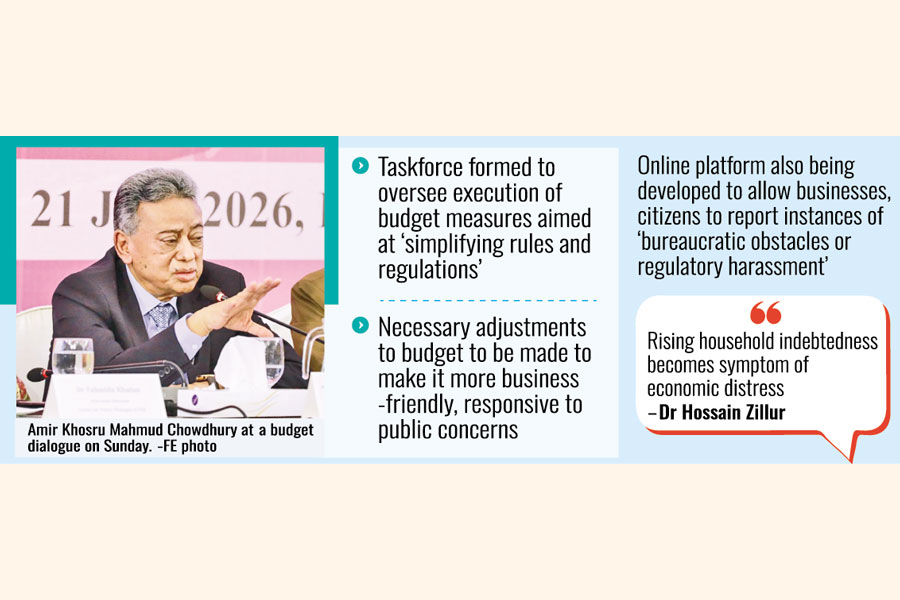
Anyone trying to obstruct the government-adopted deregulation agenda would face tough action as the new administration is bent on simplifying business regulations and improving the investment climate, says the finance minister.

"If anybody obstructs the deregulation process, he or she will be shown the door," Finance and Planning Minister Amir Khosru Mahmud Chowdhury told his audience at a budget dialogue organised Sunday by the Centre for Policy Dialogue (CPD) at a Dhaka hotel.

Delivering an extended address focused on regulatory reforms, meant for unblocking business and investment, he argued that the country had become "overregulated", creating unnecessary barriers to businesses and citizens.

"The government has been elected with commitments to the people. We intend to fulfill those commitments," he says in clear terms.

Mr. Khosru announces the formation of a taskforce to oversee the implementation of budget measures aimed at simplifying rules and regulations.

A dedicated online platform is also being developed to allow businesses and citizens to report instances where bureaucratic obstacles or regulatory harassment persist despite the government's reform initiatives.

"If any citizen or businessman feels that they are being hindered because of the violation or improper implementation of these reforms, they will be able to report it through the website," Mr. Khosru says about the government's vow.

The minister acknowledges that the proposed budget remained a work in progress and says the government is reviewing feedback from stakeholders.

"We are reviewing the budget. I am not claiming that this is a perfect budget," he says, adding that adjustments would be made to make it more business-friendly and responsive to public concerns.

Mr. Khosru feels that it could take at least two years to restore the economy to a fully stable footing following years of accumulated challenges.

"We expect to reach a turnaround point in the third year and subsequently move towards sustained prosperity."

Addressing concerns over energy shortages, the minister describes gas and electricity supply as among the country's most pressing economic constraints.

"I cannot solve these problems in three months. Even with money, everything cannot be fixed immediately," he says.

He criticises the previous administration for failing to pursue sufficient gas exploration and says the current government has begun new initiatives.

However, the finance minister mentions that bringing additional gas supplies into the system would take time. "It will take at least 18 months to secure, store and distribute additional gas supplies."

Reaffirming the government's ambition to transform Bangladesh into a trillion-dollar economy, Mr. Khosru says reliable gas, electricity and robust internet connectivity are essential prerequisites for sustained growth.

"We are investing in all three areas."

The minister also announces the introduction of a digital dashboard from early July to strengthen monitoring of public development projects.

"Instead of quarterly reviews, every project will be monitored daily through a digital dashboard," he told the meet, adding that the system is designed to tackle long-standing delays and inefficiencies in project implementation.

On trade policy, the finance minister says the government had reduced customs duties and taxes on imported industrial raw materials and expanded export incentives beyond the readymade garments sector.

Under the revised framework, exporters across industries will be able to access bonded-warehouse facilities or import raw materials duty-free against bank guarantees.

The requirement to open letters of credit (LCs) for certain imports has also been eased.

Also, the government is exploring ways to raise the tax-to-GDP ratio by bringing more small retail businesses onto the tax net through a simplified minimum tax regime.

"You will not need to fill out complicated paperwork. Many small businesses are afraid of tax procedures and tax officials," he says.

Responding to criticism over the size of block allocations in the proposed budget, Mr. Khosru insists that the funds are intended solely for development purposes. "We have not kept block allocations for operating expenditure. Whatever has been allocated is for development work."

The minister says the government inherited around 1,300 ongoing projects, claiming that many had been designed without adequate economic justification.

He also defends the government's family card social-protection programme, saying that pilot projects had found a low rate of targeting errors and that further efforts were underway to improve beneficiary selection.

On public borrowing, the chancellor of exchequer reiterates concerns about the crowding-out effect of government financing on private-sector investment.

"The bank borrowing rates are too high and even many private-sector borrowers to survive. Under such rates, how to survive by relying on expensive bank borrowing," he wonders.

He mentions that debt servicing for the next fiscal year are estimated at around Tk 1.25 trillion, stressing the need for alternative cheap financing mechanisms and reforms in public finance management.

State Minister for Planning Jonayed Abdur Rahim Saki told the function that the government was examining why development projects frequently fail to meet implementation schedules and budget targets.

"A comprehensive action plan will be prepared within the next one to two months."

Akhtar Hossain, a Member of Parliament from the National Citizens Party (NCP), describes the proposed budget as "unrealistic" and excessively dependent on deficit financing and borrowing in the current economic environment.

He also calls for greater transparency in budget implementation and urges the government to provide regular public reporting on the utilisation of sectoral allocations.

Among other speakers, PPRC Executive Chairman Dr. Hossain Zillur Rahman says rising household indebtedness became a symptom of economic distress rather than investment.

"Low-income households are cutting food consumption, postponing healthcare and taking on multiple jobs. New challenges, including mental health concerns, are emerging."

Dr. Rahman has identified three major weaknesses in the government's economic strategy: an employment crisis, an investment crisis and deterioration in the quality of education.

RAPID Chairman Dr MA Razzaque presents his organisation's estimates that suggest that the wealthiest 1.0 per cent of the population controlled nearly half of the country's total wealth.

Economist Professor Barkat-e-Khuda argues that structural reforms are essential for achieving the objectives outlined in the budget and cautions that the proposed revenue target appeared overly ambitious.

Montu Ghosh, president of the Garment Workers Trade Union Centre, urges the government to strengthen social-protection measures, including the provision of rationing support for workers.

Executive Director of the CPD Dr. Fahmida Khatun presented the keynote paper at the event, which was chaired by CPD distinguished fellow Dr. Mostafizur Rahman.

Other participants included representatives from business organisations and associations. Among them were Grameen Phone CEO Mr. Yasir Azman and BGMEA Senior vice-president Mr. Inamul Haq Khan.​
 

Bangladesh's FDI gamble
A bold bet that needs more than incentives

Suborna Akther Laboni

Published :
Jun 23, 2026 00:12
Updated :
Jun 23, 2026 00:12

1782171497816.webp


Bangladesh's budget for 2026-27, a historic Tk 9.38 trillion, arrived with fanfare and a striking new promise: anyone, citizen or expatriate, who successfully brings foreign direct investment into the country will receive a 1.5 per cent consultancy fee or commission as an incentive. The cabinet had already formalised this under the Foreign Direct Investment (FDI) Incentive Scheme Policy 2026 on June 4, and Finance Minister Amir Khosru Mahmud Chowdhury announced an even more ambitious goal in parliament: raising FDI from its current 0.45 per cent of GDP to 2.7 per cent, a near six-fold rise, within the budget cycle. The government has also published an investment heat map identifying 19 promising sectors, and Prime Minister Tarique Rahman has personally championed simplified profit repatriation and online trade registration.

On paper, the intention is sound. Bangladesh desperately needs fresh capital. The country requires at least $8 billion in FDI annually to push GDP growth by even one percentage point, yet actual inflows have hovered below 1 per cent of GDP for years. For comparison, Vietnam attracts 4.2 per cent of its GDP in FDI; India, 0.7 per cent. Bangladesh, at 0.33 per cent in 2024, is being outpaced even by neighbours with far heavier regulatory burdens. With LDC graduation looming and the ever-present danger of a middle-income trap, the urgency to act is real, and the budget's direction is correct. Saying so is not flattery; it is just acknowledging a fact.

But here is where honesty must enter the room. The 1.5 per cent commission scheme, for all its creativity, is essentially a finder's fee. It rewards the act of bringing investors to the table. It does nothing about what happens when those investors sit down. A foreign manufacturer from South Korea or a tech firm from Singapore does not decide against Bangladesh because no one offered to introduce them. They decided against Bangladesh because setting up a factory requires navigating up to 42 government approvals. Because the banking sector carries a mountain of non-performing loans and offers few reliable exit routes for capital. Because power supply remains unreliable, port logistics are costly, and the judicial system resolves commercial disputes at a pace that discourages long-term commitment.

The structural problems are not new and are well-documented. Bureaucratic red tape, weak contract enforcement, currency instability, and the persistent shadow of corruption have together kept Bangladesh's FDI stuck in low gear for decades. No commission scheme, however generous, addresses these root causes. It is a little like offering a reward to anyone who brings guests to a hotel while the plumbing is broken. Guests might arrive; few will stay.

There is also a design concern worth raising. The scheme sets a minimum investment threshold of $1 million to qualify for the incentive. This is a reasonable floor, but it means the policy is almost entirely oriented towards large-ticket foreign investors, precisely the investors who conduct the most rigorous due diligence before committing capital. Such investors hire their own advisers. They commission feasibility studies. A 1.5 per cent referral fee is unlikely to be the decisive factor in their decision-making. The investors most likely to be influenced by a commission incentive are smaller or more speculative, and a $7.5 million fund earmarked for the scheme suggests the government itself does not expect it to generate enormous volume.

What would actually move the needle? The budget does gesture at some right answers, online trade registration, removal of non-tariff barriers, revision of the Import Policy Order, and a declared ambition to build a genuine one-stop investment service. These are the reforms that investors cite repeatedly when asked why they chose Vietnam over Bangladesh, or Malaysia over Dhaka. The question is not whether to announce them, it is whether they will be implemented with the urgency and administrative seriousness that foreign investors watch for. Bangladesh has made such announcements before. The gap between policy declaration and institutional follow-through is a wound that keeps reopening.

Three things deserve particular attention in the months ahead. First, the banking sector must be stabilised. High non-performing loans are not merely an internal financial concern; they signal to foreign equity investors that exits will be difficult and profits hard to repatriate cleanly. The Bangladesh Bank's recently established Tk 600 billion fund for distressed industries is a step, but deeper governance reform in the financial sector cannot be deferred. Second, the one-stop investment service must become genuinely functional, not ceremonially so. Every week that a foreign investor waits for a licence approval is a week they are reconsidering. Third, the skills gap must be treated as an investment priority, not an afterthought. Bangladesh's young population is an asset, but it becomes a competitive advantage only when matched with technical and vocational training aligned to what investors actually need.

The budget's theme, "Economic Democratisation and Deregulation: Bangladesh's Journey Towards a Trillion-Dollar Economy," is aspirational in the best sense. Aspiration is not the problem. The problem is that aspiration without institutional backing is a slogan, and foreign capital has learned to distinguish between the two. The 1.5 per cent commission is a creative nudge. It may generate some leads. But the real FDI story of 2026-27 will be written not in commission payouts but in whether the approvals are faster, the courts are fairer, the banks are cleaner, and the power stays on. Bangladesh has the potential, the population, the geography, and the global moment. What it must now demonstrate is the institutional will to match its ambition.

Suborna Akther Laboni, Researcher, Dacca Institute of Research and Analytics (daira).​
 

Latest Posts

Back