[🇧🇩] Budget For 2026-2027

[🇧🇩] Budget For 2026-2027
86
927
More threads by Saif

G Bangladesh Defense

Challenges of decoding the budget

Tanim Asjad

Published :
Jun 19, 2026 23:41
Updated :
Jun 19, 2026 23:41
1781912976124.webp


People of Bangladesh witnessed the presentation of another national budget on June 11. Since then, analysing the positive and negative sides of the budget has been ongoing, and it will continue for a few weeks, though many parts of the budget remain ambiguous. The way the budget has been designed and structured carries the legacy of the British colonial era in South Asia. Though the structure of the national budget has changed over the decades, the budget documents remain complex and difficult to decode to some extent. Bangladesh alone is not responsible for keeping the national budget ambiguous. Governments in many countries, especially developing ones, do not feel comfortable making their national budgets transparent so that stakeholders can easily understand them. The governments' attitudes to keep different aspects of the budget hazy have become a matter of concern.

Against the backdrop, two comprehensive review reports on public finances, prepared and published by the Organisation for Economic Co-operation and Development (OECD) in the last month, clearly reflect the concern. The main report titled 'Restoring Public Finances: Enabling Effective Government' focuses on the various efforts by governments across the world to become more efficient. It also outlines how digital technologies, alongside 'bureaucratic simplifications', can work in this context. The report is intended to serve as a 'knowledge base for policymakers, public servants, and civil society to make the most effective choices in managing public finances'. It argued that, due to higher debt servicing costs, growing public spending requirements, and various support measures for businesses and households in the wake of recent energy price shocks, public spending has increased. So, it is necessary to manage public spending efficiently and prudently.

The companion report, titled 'The People and the Budget: Empowering Public Understanding of Public Finances,' underscores the need for different stakeholders to understand the budget. Although the reports are concentrated on OECD nations, 38 developed countries of the world, the findings and analyses of the reports, along with the recommendations, are relevant to countries, including Bangladesh.

For instance, the report noted that, as public finance is complex, parliamentarians play a key role in demystifying the budget for the public. The challenge, however, is that most lawmakers in Bangladesh have yet to grasp the budget documents, and many have no interest in doing so. In such a case, how can they communicate with people to make the budget easy? The OECD report strongly recommended starting with the fundamentals, meaning that, rather than focusing on the entire budget process, a deeper understanding of fiscal fundamentals is needed. "Efforts need to shift away from a narrow focus on the mechanics of the budget to a broader understanding of fiscal sustainability, pressures and choices," it added.

Over the decades, there has also been an effort in Bangladesh to demystify budgets, mainly by civil society organisations, whereas the government has largely remained indifferent to such exercises. That's why, budget documents remain a mystery even to many economists and experts. The discussions and analyses of the budget are also focused on the budget summary documents and fiscal measures. Key documents, such as the Annual Financial Statement, do not receive the necessary focus because they remain difficult to understand. Even the officials involved in the budget-making process sometimes find it hard to explain the various things in the statement, which is the constitutional document.

So, when the Finance and Planning Minister Amir Khosru Mahmud Chowdhury presented the Tk 9.38 trillion budget for the fiscal year 2026-27 (FY27) in parliament on June 11, the focus went on the budget numbers on revenue, spending and deficit. Media, with limited time to capture the many critical measures skilfully concealed in budget documents, struggle to expose what's inside the budget within a short time. For more than five decades, the practice of presenting the budget in parliament in the afternoon has not changed. Despite repeated requests, the bureaucratic rigidity has yet to be flexible enough to allow the budget to be unveiled in the morning or pre-noon session of parliament. This also reflects the unwillingness to decode the budget for the people. The newly democratically elected government, under the premiership of Tariq Rahman, doesn't break the tradition which is no longer useful today. The July 2024 uprising that ousted the autocratic regime of Sheikh Hasina has yet to inspire change and transparency in the people's favour.​
 

Turning the budget’s ambitions into reality will be a major test

Md Main Uddin

1781914779796.webp

FILE VISUAL: ANWAR SOHEL

The size of the proposed budget for fiscal year 2026-27 is Tk 9,38,000 crore, of which Tk 3,16,075 crore has been earmarked for development spending and Tk 6,05,740 crore for operating expenditure. The revenue target is Tk 6,95,000 crore, resulting in an overall deficit of Tk 2,43,000 crore. In comparison to the FY2025-26 budget, the proposed budget for the upcoming fiscal year has been increased by 18.7 percent, while development spending, operating expenditure, as well as the revenue target have been raised considerably.

There is no doubt about some of the budget’s priorities, such as development for all, support for SMEs, family and farmers’ cards, bonded warehouse benefits, investment, education, health, social protection, energy security, and financial sector reform. But there is always many a slip between the cup and the lip, which reminds us of the budget’s implementation challenges.

The first challenge revolves around the GDP growth target of 6.5 percent, which is 2.36 percentage points higher than the provisional growth rate for FY2025-2026 of 4.14 percent. An economy generally grows steadily, not abruptly, if no miracle happens. To achieve this target, the private investment must increase rapidly. But the reality is that investment in FY2024-25 was merely 22.03 percent, the lowest level in 11 years.

Furthermore, investment is primarily dependent on the interest rate, determined mainly by the risk-free interest rate, inflation and premiums for various risks. The inflation rate was 8.63 percent as of May 2026, which pushed the average interest rate to around 12 percent. This high interest rate or the cost of borrowing for businesses is bound to squeeze investment. Therefore, in addition to lowering the interest rate, bureaucratic red tape must be reduced, smooth utility supply must be ensured, law and order situation should be improved significantly, and investors’ confidence needs to be restored. Otherwise, the investment will not increase as hoped in the proposed budget.

Meanwhile, the goal to bring inflation down to 7.5 percent, although it reached 8.63 percent as of May 2026, might prove challenging. This target may appear logical, but it must be noted that the sources of inflation in our country are driven largely by imports. The high dollar price, combined with the recent rise in fuel prices, will have a long-term effect on inflation. Moreover, local syndicates and extortion at different points of the supply chain will also impact inflation. Without considerable improvement in these areas, there is little hope that inflation will come down.

Furthermore, the private sector credit growth target has been set at 9.4 percent, which is almost double the rate as of April 2026: 4.75 percent. To reach the target, a lower cost of borrowing, minimum government borrowing from banks, and a robust banking system with low non-performing loans will be required. Whether such a conducive environment to boost private credit growth can be achieved remains a question. Even the export growth targeted at 8.7 percent is highly inconsistent with ground realities; exports fell by 2.60 percent year-on-year in the July-May period of the current fiscal year.

In general, the budget deficit should be within 5 percent of GDP and the proposed budget’s deficit is 3.6 percent of GDP. As the volume of deficit increases with the increase in budget size, the ability to finance the deficit remains a major challenge for the government. The plan is to finance the deficit from local and foreign sources. The expected loans from local banks and foreign sources are 46 percent (Tk 112,000 crore) and 45 percent (Tk 109,850 crore), respectively. The target borrowing from banks may increase in the end because in the current fiscal year, the government already borrowed more than Tk 125,000 crore from the banking sector due to revenue shortfalls.

In contrast, the foreign loans are less expensive, but they come with many terms and conditions that often require strict compliance. Compared to the previous year’s foreign loans, this year’s target is almost double. The actual challenge is to mobilise these funds.

In the FY2025-26, the government failed to collect the target revenue and had to borrow more from banks. Without fundamental institutional reforms, how would the target revenue of Tk 6,95,000 crore be collected in the upcoming fiscal year? If the National Board of Revenue fails to collect this targeted revenue again and foreign loans do not come as expected, the alternative financing choice could either increase borrowing from local banks or the Bangladesh Bank. The former will crowd out private sector credit flow and the latter will increase inflation.

Besides, there will be inflationary pressure due to the new pay scale for which Tk 44,000 crore has been set aside. The prices of goods and services have already started rising in the market. The general mass living on fixed income will primarily face the heat of inflation. The higher pay scale is expected to reduce public sector corruption. However, there is no historical record of that happening in the country. Then how can it be expected that a higher pay scale would reduce corruption this time? To avoid inflationary pressure, wage indexation could be put in place to automatically adjust wages to keep pace with inflation every year, so that purchasing power remains unchanged as the cost of living rises.

Meanwhile, the banking sector, through which about 86 percent of the country’s financial intermediation is conducted, is currently burdened with abnormally high non-performing loans. Besides, the sector’s weak capital base and fresh unrest in the Islami Bank Bangladesh PLC may spread the systemic risk, affecting the entire banking sector. Without bringing stability in banking, the budget implementation will be difficult because our economy is exceedingly dependent on this sector.

Also, the effectiveness of social security programmes will depend on reaching the intended people, administrative efficiencies and prevention of leakages. Developing beneficiary databases without duplication is a precondition to attaining competence in this regard. When a slum-dweller or a rickshaw puller says that budgets come and go, but they don’t get the benefits, it speaks a lot about the failure of the budget implementation process.

The philosophy of the budget should be driven by the concept that the rich will pay more taxes than the poor. Hence, more revenues must be collected from direct taxes rather than indirect taxes to make the process equitable. The implementation of the budget must focus on the efficiency of spending the allocations, ensuring it is not hindered by corruption, bureaucratic red tape and governance failure.

The increased allocation in priority sectors is only the first step. It does not guarantee proper implementation. The successful execution of the budget ultimately depends on institutional capacity, efficient use of funds, and evaluating and monitoring whether the programmes are delivering the expected results. A budget becomes successful only when it can improve the lives of people, particularly the poor.

Dr Md Main Uddin is professor and former chairman of the Department of Banking and Insurance at the University of Dhaka.​
 

Budget targets face credibility questions
Experts urge stronger institutions, accountability and implementation capacity to translate budget allocations into meaningful outcomes

FE REPORT

Published :
Jun 21, 2026 08:46
Updated :
Jun 21, 2026 08:46

1782085170228.webp


Economists, business leaders and academics have questioned the realism of the proposed budget's revenue targets and growth assumptions, warning that stronger institutions, accountability and implementation capacity will be critical to achieving its objectives.

They also questioned whether increased allocations for agriculture, health, education and gender inclusion would translate into tangible outcomes without stronger institutions, accountability and monitoring mechanisms.

The issues were discussed during the latest episode of the Policy Research Institute Centre's (PPRC) flagship policy dialogue series Ajker Agenda, titled "PPRC Budget Analysis", held virtually on Friday and moderated by PPRC Executive Chairman Hossain Zillur Rahman.

The discussion brought together former National Board of Revenue (NBR) Chairman Muhammad Abdul Mazid, former President of BKMEA Md Fazlul Haque, former Vice-Chancellor of Bangladesh Agricultural University M A Sattar Mandal, ActionAid Bangladesh Country Director Farah Kabir, Dean of the Faculty of Social Sciences at the University of Dhaka Mohammad Mainul Islam, and former Country Representative of the Malala Fund Musharraf Tansen.

Focusing on revenue mobilisation, fiscal accountability and NBR reforms, Muhammad Abdul Mazid questioned whether the government's ambitious revenue targets could be achieved without a stronger economic base and greater transparency within the tax administration.

He argued that revenue collection ultimately depends on economic activity and productive investment.

"Revenue ultimately comes from a functioning economy. If productive sectors and private enterprises receive the necessary support, revenue collection will naturally improve," he said, expressing concern about the pace and effectiveness of the proposed reforms within the revenue administration.

Examining the budget from the perspective of business competitiveness and implementation feasibility, Md Fazlul Haque observed that many of the government's projections appeared to be based on expectations of a rapid economic rebound.

While welcoming several business-friendly administrative measures, he stressed that sustainable recovery would require stability in the banking sector, uninterrupted energy supplies and further improvements in law and order.

"The budget appears to assume that the economy will recover quickly, but recovery requires time. Achieving the expected outcomes will depend on creating an environment where businesses have confidence to invest and expand," he said.

Turning to agriculture and rural livelihoods, Prof Dr M ASattar Mandal questioned whether the proposed measures adequately reflected the realities faced by millions of smallholder farmers across the country.

He noted that previous initiatives had often encountered difficulties in identifying genuine beneficiaries and ensuring effective implementation at the grassroots level.

While acknowledging the government's continued focus on agriculture, he argued that the budget lacked a comprehensive strategy for transforming the sector through innovation, mechanisation and technology adoption.

"Agriculture requires a comprehensive long-term strategy. Alongside supporting farmers, we must also focus on modernisation, technological adaptation and the transition towards smart agriculture," he said.

Assessing the budget from the perspectives of gender equality, climate vulnerability and economic inclusion, Farah Kabir questioned whether increased allocations under gender-related programmes would generate meaningful opportunities for women and vulnerable communities.

She emphasised the need for greater investment in skills development, care services and access to emerging economic sectors.

"The real challenge is ensuring that budget allocations create opportunities. Women need access to skills, new sectors and support systems that enable meaningful economic participation," she said.

On healthcare financing and demographic challenges, Prof Dr Mohammad Mainul Islam examined whether the proposed allocations were sufficient to address Bangladesh's evolving health needs.

He highlighted the importance of family planning within the broader public health agenda and expressed concern that dedicated allocations for this area remained insufficiently visible despite mounting demographic pressures.

"Increasing health spending is important, but ensuring effective utilisation is equally critical. Population health and family planning require sustained attention if Bangladesh is to maintain its development gains," he said.

Despite a significant increase in education spending, Musharraf Tansen questioned whether additional allocations would lead to measurable improvements in learning outcomes.

Referring to persistent deficiencies in literacy and numeracy among schoolchildren, he argued that the central challenge lay not in the volume of expenditure but in the effectiveness of its utilisation.

"The real challenge is not the size of the budget but how it is used. Unless investments improve learning outcomes through better teaching and effective implementation, increased allocations may not deliver the expected results," he said.

Concluding the discussion, Hossain Zillur Rahman stressed that the success of the FY2026-27 budget would depend less on policy declarations and more on implementation performance.

"The real test of any budget lies not in its promises but in its implementation. Strong institutions, accountability and evidence-based policymaking will determine whether these ambitions deliver meaningful benefits for citizens," he said.

He further argued that budget implementation should be accompanied by a structured three-month monitoring framework within the country's governance system to ensure timely execution and corrective action where necessary.

The economist also highlighted the need to address persistent inequalities in peripheral regions, improve doctor-patient relationships in primary healthcare services, and recognise that technology alone cannot overcome deep-rooted weaknesses in the education system.

"All our ambitions are undermined by three institutional diseases-corruption, implementation delays and failures, and institutional waste arising from the proliferation of unnecessary offices and projects," he observed.

The discussion underscored a common concern among participants that while the proposed budget contains ambitious targets and expanded allocations across several priority sectors, its success will ultimately hinge on effective implementation, institutional reform and rigorous monitoring.

Without addressing longstanding governance weaknesses, they warned, the gap between budgetary commitments and real-world outcomes may continue to persist.​
 

Can social protection budget deliver?

ASAD ISLAM

Published :
Jun 22, 2026 00:23
Updated :
Jun 22, 2026 00:23

1782085744871.webp


The FY2026-27 social security budget is the largest in Bangladesh's history. At Tk 1,44,338 crore ( or Tk 1.44 trillion), it represents a 14 per cent nominal increase, presented by Finance Minister Amir Khosru Mahmud Chowdhury in Parliament as evidence of decisive movement toward the government's commitment to raise social protection spending to 3 per cent of gross domestic product (GDP) by FY2027-28. The reported figure this year is 2.11 per cent of GDP.

The right question is not whether this budget is large. It is whether it is strategic and fiscally credible, whether it moves Bangladesh structurally closer to that 3 per cent target, or whether it is largely reclassification and a new flagship programme without a clear financing roadmap.

HOW MUCH OF THIS IS ACTUALLY SOCIAL SECURITY: Of the 90 programmes in this year's budget, the Finance Division's own classification identifies only 48 as genuinely "pro-poor": programmes whose primary design is poverty reduction through direct benefits to identified poor households. These 48 receive Tk 562.29 billion, just 38.9 per cent of the headline allocation. The largest item outside this block is Pension Management, with Tk 353.79 billion for 9.59 lakh retired civil servants, consuming roughly two thirds of what all 48 pro-poor programmes receive combined.

There is nothing inherently wrong with a civil service pension. It is a contractual obligation, no different in kind from a private firm's pension liability. The problem is presenting it as social security, which obscures the true scale of anti-poverty spending. When citizens hear Bangladesh spends Tk 1.44 trillion on social security, they reasonably imagine support reaching poor households. In reality, less than 40 per cent of that envelope does.

This changes the denominator. If genuine anti-poverty spending is roughly 39 per cent of a 2.11 per cent of GDP envelope, the share actually reaching poor households is likely in the 0.8 to 1 per cent range, far from the 3 per cent target set for the entire social security envelope, pensions included. Bangladesh does not only need a larger social protection budget; it needs a clearer one, so the public, investors, and development partners can distinguish poverty reduction spending from a legitimate but separate pension obligation.

The harder question is what closing the gap to 2 or 3 per cent would cost, and where the money comes from. As I have argued elsewhere, raising Bangladesh's tax to GDP ratio by around two percentage points would, in principle, generate additional revenue equivalent to roughly 2 per cent of GDP, enough to finance that expansion without deficit financing. Reallocation and borrowing are the other two channels, but each carries a cost. Reallocation means explicit, currently unstated trade-offs against other ministries, and sustained borrowing raises debt-servicing burdens for future budgets. None of the three paths is named in this year's budget.

A PORTFOLIO BEING REBALANCED WITHOUT AN EXPLANATION: Within the pro-poor block, this year represents a sharp rebalancing, not a uniform expansion. The Family Card Programme rises from a pilot allocation of Tk 866.10 million to Tk 145 billion in a single cycle. Financing that scale-up required reallocating shares within the pro-poor envelope: public workfare fell from 6.85 to 4.89 per cent of social assistance, education stipends from 10.64 to 8.06 per cent, and food distribution from 9.80 to 7.13 per cent. The Household-Shock category, which buffers families against floods and crop failures, was cut by about 7 per cent, and school-age children's funding fell by about 4 per cent.

The more useful way to read this is as a change in the portfolio's risk profile. Workfare and food distribution are countercyclical instruments that expand when shocks hit. Stipends and early childhood spending are human capital investments with long payoff horizons. Household cash transfers, by contrast, are recurring entitlements with a fixed monthly cost, largely independent of whether a shock has occurred. Shifting the centre of gravity from the first two toward the third means less automatic disaster buffering, less investment in future productivity, and more fixed recurring liability.

That trade-off may well be right. International evidence shows well designed cash transfers can reduce poverty efficiently while giving households flexibility. But the budget offers no visible analysis of why these particular programmes were chosen for contraction, or what happens to the households who depended on them.

THE MISSING MEDIUM-TERM PLAN: The budget document is unusually candid about the scale of the remaining task. Its review of a decade under the National Social Security Strategy (NSSS, 2015 to 2026) shows budget adequacy as the one dimension where progress has been negligible. The target was 3 per cent of GDP; the outturn is 2.11 percent. It also confirms that targeting remains weak, with only about half of poor households receiving assistance in 2022 while 22 percent of benefits went to the wealthiest fifth, and that contributory social insurance for the 85 percent employed informally remains, in the document's own words, "near total absence."

What is missing is the bridge between diagnosis and delivery. The current allocation covers 4.10 million households. But the government's own Family Card Piloting Implementation Guideline, 2026, envisions gradual expansion to 20 million households, evolving into a "Universal Social ID" by 2030. As I noted in earlier commentary on this programme, that scale of rollout would cost roughly Tk 600 billion a year, about 1 per cent of GDP on its own, even before health, education, and ageing-related pension pressures are factored in.

None of this costing appears in the budget itself, and there is no expenditure framework linking the 3 per cent target to specific revenue measures, nor any account of how much of the path will come from new revenue versus reclassification. The government's own NSSS-II framing (FY2026-27 to FY2035-36), covering consolidation, full PMT deployment, CPI-linked indexation, and contributory extension, is, in substance, the right agenda. What it lacks is a financing plan with dates attached.

BUILDING SYSTEMS, NOT JUST PROGRAMMES: The Family Card could become the foundation of a more integrated system built around a dynamic registry, digital payments, and transparent eligibility. That would be a meaningful shift from a system that has historically evolved programme by programme. But building systems requires governance, and two choices will determine whether it becomes durable infrastructure.

The first is registry governance. The Family Card combines PMT with ward-level verification committees, which is sensible, since PMT is more accurate using observable assets while local input catches households whose circumstances change suddenly. But the design is only as credible as the separation between who sets the rules and who disburses the money. Large social protection systems work best when targeting methodologies and registries are subject to independent oversight and regular scrutiny. Brazil and Indonesia have both refined their social registries through audits and institutional reform to improve transparency and reduce inclusion and exclusion errors.

Bangladesh's Dynamic Social Registry, according to the budget documents, remains closely linked to the Finance Division and implementing ministries. What Bangladesh needs is a genuinely independent body, established by statute and insulated from both, to own the targeting methodology and publish the rules. Accuracy should not be assessed internally; it should be evaluated by independent experts of recognised calibre, with findings published in full.

The second is the contributory pillar, left almost untouched. Every mature system rests on two pillars: social assistance, which protects the poor, and social insurance, which protects workers against old age, disability, and income loss. Bangladesh has progressed on the first. On the second, almost all contributory effort remains confined to civil service pensions, while the 85 percent employed informally have no meaningful access to contribution-based insurance. Vietnam combines compulsory formal-sector coverage with a voluntary scheme for informal workers. Indonesia's JKN subsidises premiums for poor households, reaching close to universal coverage. Bangladesh has neither.

FIVE CONCRETE STEPS: Publish a clear social protection number each year, stripping out pensions, savings certificate interest, and broad subsidies, and reporting separately the share of GDP reaching genuinely targeted assistance.

Adopt a no-erosion floor for pro-poor spending: a minimum GDP share that rises on a published schedule toward 2028, so new flagship schemes cannot be financed by quietly squeezing workfare, stipends, and food programmes.

Introduce a three-year social protection expenditure framework, linking the 3 percent commitment to specific revenue measures and explicit Family Card scaling assumptions.

Establish an independent body to govern the Dynamic Social Registry, created by statute, insulated from the Finance Division and implementing ministries, with published targeting rules, a statutory grievance mechanism, and regular independent evaluations of targeting accuracy.

Open the contributory reform conversation now, with a pilot for informal-worker micro-pensions alongside parametric reform of a civil service pension scheme that absorbs more than the entire pro-poor portfolio combined.

None of this requires abandoning the Family Card. It requires placing it inside a financing architecture credible enough to survive beyond a single budget cycle. The government has shown it can mobilise Tk 14,500 crore for one flagship programme in twelve months. The harder test is whether it can build the scaffolding, a published expenditure plan, an independent registry, and a functioning contributory pillar, that determines whether 2.11 per cent of GDP becomes 3 per cent by design, or simply drifts there through relabeling.

Dr Asad Islam is Professor of Economics at Monash Business School, Monash University, Australia. He has written extensively on social protection, poverty, and development policy in Bangladesh.​
 

NBR staring at Tk 880 billion shortfall from revised target

UNB

Published :
Jun 21, 2026 23:36
Updated :
Jun 21, 2026 23:36

1782086201014.webp


The National Board of Revenue (NBR) expects to collect a record Tk 4.15 trillion (Tk 4.15 lakh crore) in revenue in the outgoing 2025-26 fiscal year, although the figure is likely to fall short of the revised target by around Tk 880 billion (Tk 88,000 crore).

According to an NBR press release, the revised revenue collection target for FY2025-26 was set at Tk 5.03 trillion (Tk 5.03 lakh crore).

However, revenue collection stood at Tk 3.606 trillion (Tk 3,60,642 crore) during the first 11 months of the fiscal year up to May 2026.

During the July-May period, the revenue authority achieved 81.58 per cent of its target of Tk 4.421 trillion (Tk 4,42,084 crore), leaving a shortfall of Tk 814.42 billion (Tk 81,442 crore).

Despite the gap, the NBR said revenue collection during the first 11 months of the fiscal year reached an all-time high for the corresponding period.

Revenue receipts during the July-May period of FY26 increased by Tk 328.56 billion (Tk 32,856.22 crore) from Tk 3.278 trillion (Tk 3,27,785.78 crore) collected in the same period of FY25, registering a growth of 10.02 per cent.

Among the major revenue wings, customs revenue grew by 7.08 per cent, value-added tax (VAT) revenue by 10.05 per cent and income tax revenue by 12.54 per cent during the first 11 months of the fiscal year.

The NBR said Tk 293.11 billion (Tk 29,311 crore) was collected during the first 20 days of June, taking total revenue collection to Tk 3.900 trillion (Tk 3,89,953 crore) as of June 20.

This has already surpassed the total revenue collection of Tk 3.708 trillion (Tk 3,70,843.03 crore) recorded in the whole of FY2024-25.

The revenue authority expressed optimism that an additional Tk 250 billion (Tk 25,000 crore) could be collected during the remaining 10 days of June, enabling total revenue collection to reach a historic Tk 4.15 trillion (Tk 4.15 lakh crore) by the end of the fiscal year.

If achieved, the collection would exceed the previous fiscal year’s total by Tk 431.57 billion (Tk 43,157 crore), although it would remain below the revised target.

To accelerate revenue mobilisation, the NBR has formed three separate task forces comprising field-level officials from the income tax, VAT and customs wings.

The task forces have undertaken a range of measures, including expediting cases pending before appellate authorities, tribunals, the High Court and the Supreme Court, as well as strengthening alternative dispute resolution mechanisms.

The NBR said efforts to detect tax evasion, recover unpaid revenue, expedite audit-based assessments, enhance monitoring of withholding tax and VAT collections, strengthen post-clearance audits and risk management activities, and conduct joint income tax and VAT audits of high-risk taxpayers have helped improve overall revenue administration.

The board said its efforts to mobilise the revenue required for the country’s development and public expenditure programmes would continue.​
 

Govt needs 2 yrs to stabilise fragile economy: Finance Minister

Staff Correspondent
Dhaka
Published: 21 Jun 2026, 19: 25

1782087169830.webp

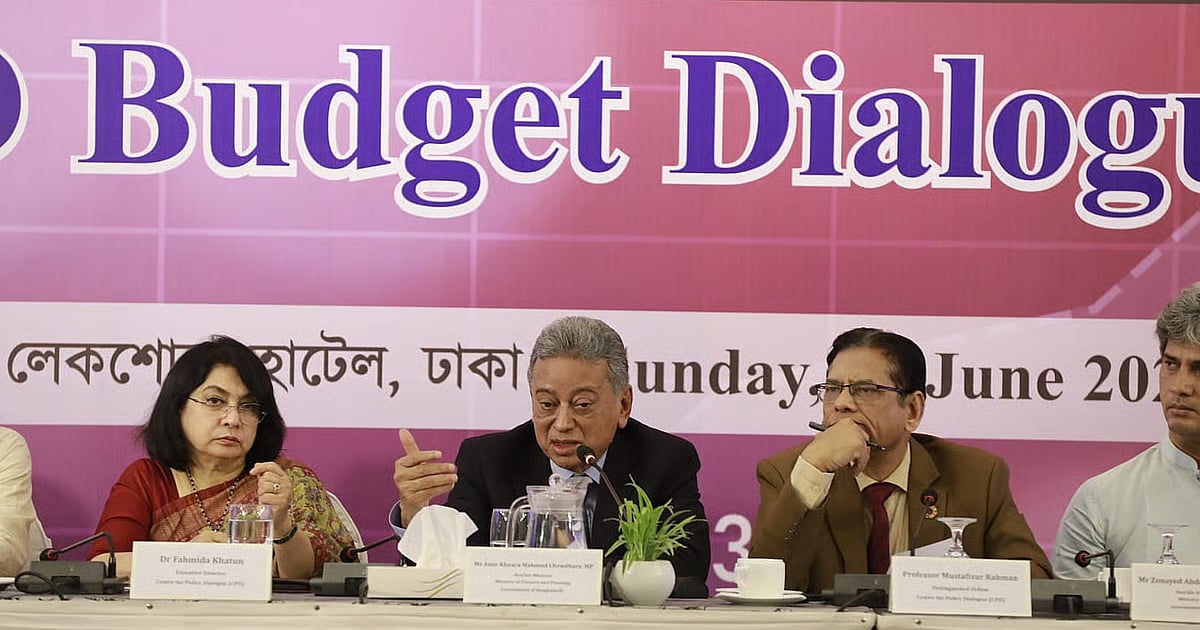
Finance and Planning Minister Amir Khasru Mahmud Chowdhury speaks as chief guest at a budget dialogue organised by the private research organisation Centre for Policy Dialogue (CPD) at the Lakeshore Hotel in Gulshan, Dhaka on 21 June 2026 Prothom Alo

The government will need at least two years to fully stabilise the country’s fragile economy and put it back on the path to prosperity, Finance and Planning Minister Amir Khasru Mahmud Chowdhury has said.

Describing the current economic situation as a major challenge, he said, “Given the overall situation, we need to be given two years.”

The minister made the remarks while speaking as chief guest at a budget dialogue organised by the private research organisation Centre for Policy Dialogue (CPD) at the Lakeshore Hotel in Gulshan, Dhaka on Sunday.

The event was chaired by CPD Distinguished Fellow Mustafizur Rahman. Minister of State for Planning, Zonayed Abdur Rahim Saki attended as special guest, while Akhter Hossen, a member of parliament elected from the National Citizen Party (NCP), was present as an honoured guest.

Hossain Zillur Rahman, executive chairman of the Power and Participation Research Centre (PPRC); MA Razzaque, chairman of Research and Policy Integration for Development (RAPID); Anwar-ul-Alam Chowdhury, president of the Bangladesh Chamber of Industries (BCI); Enamul Haque Khan; and Montu Ghosh, president of the Garments Workers Trade Union Centre discussed the budget from various sides.

CPD Executive Director Fahmida Khatun presented the keynote paper.

Speaking at the event, Amir Khasru Mahmud Chowdhury said, “We believe that within two years the economy will move from a fragile state towards stability. From the third year, the country’s economy will begin to recover, and in the fourth and fifth years it will advance towards prosperity.”

Referring to the current gas and electricity situation as the country’s principal problem, the finance minister said, “I cannot solve these problems in three months. Even with money, these problems cannot be resolved that quickly. Although the previous government did not take the initiative to explore for gas, the current government has started doing so. However, it will take at least 18 months to import gas from abroad, store it and supply it.”

PPRC Executive Chairman Hossain Zillur Rahman said that for ordinary people, borrowing had ceased to be a means of investment and had instead become a tool for survival.
Reiterating the government’s target of building a trillion-dollar economy by 2041, Amir Khasru Mahmud Chowdhury said, “The country cannot develop without gas, electricity and strong internet connectivity. We are investing in these three areas.”

‘Dashboard’ to monitor projects

At the event, PPRC Executive Chairman Hossain Zillur Rahman advised the government to introduce a three-month progress monitoring mechanism for budget implementation.

In response, the finance minister said a special digital dashboard would be launched in the first week of July to address the historic stagnation and delays in project implementation.

“We are not opting for quarterly reviews; we are creating a dashboard. Through the dashboard, every project will be monitored on a daily basis,” he said.

CPD Executive Director Fahmida Khatun questioned the large lump-sum allocations made in various sectors in the budget. In reply, the finance minister said, “We have not kept any lump-sum allocation for operational expenditure. Whatever is there is entirely for development work.”

Amir Khasru Mahmud Chowdhury also said a taskforce was being formed to ensure that the decisions taken in the budget to simplify rules and regulations are properly implemented by all concerned. At the same time, a website is being developed.

“If any citizen or businessperson feels they are facing obstacles or harassment because these rules are being violated or not properly implemented, they will be able to report it on this website. The taskforce will be responsible for overseeing the entire matter. It is hoped that this will help improve the situation,” he said.

We believe that within two years the economy will move from a fragile state towards stability. From the third year, the country’s economy will begin to recover, and in the fourth and fifth years it will advance towards prosperity.
Amir Khasru Mahmud Chowdhury, Finance Minister.

The finance minister further said the government had significantly reduced customs duties and taxes on the import of industrial raw materials. All kinds of incentives and facilities had also been opened up to diversify products in the export sector.

As a result, he said, not only the readymade garment sector but businesses in any sector wishing to export products would now be able to access bond facilities, allowing duty-free import of raw materials. Businesspeople would be able either to use the bond facility directly or, if they chose not to, import raw materials completely free of customs duties and taxes by providing a bank guarantee and then manufacture and export goods.

He added that opening letters of credit (LCs) for importing raw materials would no longer be mandatory.

State Minister for Planning, Zonayed Abdur Rahim Saki said work was under way to identify the specific reasons why development projects had failed to stay within their allocated budgets and set timelines, and to determine solutions.

A full roadmap or action plan in this regard would be prepared within the next one to two months, he said.

NCP lawmaker Akhter Hossen described the newly announced budget as “unrealistic” and “deficit- and debt-dependent” in the context of the country’s current fragile economic situation.

He also called for transparency in budget implementation, saying that a clear account of allocations made to different sectors should be presented to parliament and the nation in due course.

3 crises the government facing

PPRC Executive Chairman Hossain Zillur Rahman said that for ordinary people, borrowing had ceased to be a means of investment and had instead become a tool for survival.

Low-income families, he said, were cutting food consumption and other household spending, postponing medical treatment, and taking on multiple jobs or forms of work at the same time. As a result, new realities such as mental health problems were emerging among them.

According to Hossain Zillur Rahman, the government’s economic planning currently faces three major crises: a crisis of employment, a crisis of investment, and a crisis in the quality of education.

RAPID Chairman MA Razzaque said the organisation’s estimates showed that just 1 per cent of the population currently held nearly 50 per cent of the country’s total wealth.

“In other words, we have created an unequal society, and correcting that is imperative. For that, a properly planned wealth tax system is essential,” he said.

MA Razzaque further said the existing surcharge system, which is currently used in considering wealth distribution, was not the right approach for imposing a wealth tax. To tackle the growing inequality, an inheritance tax should be introduced; otherwise, these problems would not be resolved, he said.

Energy crisis a major problem for industry

BCI President Anwar-ul-Alam Chowdhury said the energy crisis had become a major problem, to the extent that existing industries were struggling to survive. High bank interest rates were another headache, he said.

“In this reality, growth is not the main issue; the central issue is keeping existing industries alive. For that, energy is the biggest concern. But we are not seeing a realistic action plan on this,” he said.

Anwar-ul-Alam Chowdhury also said, “We have still not been able to come out of the culture of mob violence. We still do not feel secure about the law and order situation. Yet we can see that the home minister appears highly self-satisfied.”

Garments Workers Trade Union Centre President Montu Ghosh said the budget had brought no meaningful change to workers’ lives.

He said workers had long been demanding ration support because their wages were not sufficient to cope with the current economic situation. However, the budget had said nothing on the matter.​
 

Budget in challenging times

Hasnat Abdul Hye

Published :
Jun 23, 2026 00:06
Updated :
Jun 23, 2026 00:06

Formulating an annual budget has never been easy in Bangladesh, given the plethora of demands and paucity of resources. But 2026-2027 fiscal is perhaps the most challenging time for balancing the two sides of the economy embedded in the annual estimate. A brief resume of the backdrop of the challenges can give some idea about the complexity of the exercise and explain why the budget proposal made for next fiscal year cannot take the task as ' business as usual'.

First of all is the lingering impact of the pandemic of 2022-2023 from which the economy is yet to fully recover. The small and medium enterprises (SME) that were battered during the period have not yet recovered and some of them may have become permanent casualties, impinging on production and employment. The economic doldrums caused by the virus catastrophe took a heavy toll on those hovering just above the poverty line. Recovery from the ravages of the pandemic required resuscitation of the SME sector and amelioration of the poverty situation after the crisis petered out but none of which can be said to have been accomplished adequately. In the midst of the uneasy transition after the tapering of the pandemic, the Bangladesh economy, once again as part of the global economic architecture, was exposed to the shocks of the Ukraine war that transmitted through the already fragile supply chains and resultant inflationary pressure. The continuance of the war has been reflected in higher prices of foodgrains, edible oil and fertiliser, making inflation intractable for the vulnerable countries that include Bangladesh. The third shock received by Bangladesh economy is home grown, the autocratic regime that ruled over 15 years, haemorrhaging the economy through kleptrocracy (looting of banks and rampant rent seeking) and its most pernicious consequence, money laundering. The mass uprising against the venal regime succeeded in getting rid of it but the process created a vacuum in lost investment and employment. The interim government that replaced the autocratic regime did not have either time or stomach to adopt a strategy for the recovery of the lost momentum of the economy. As a result, the cumulative legacy of all these setbacks and shocks has been inherited by the present government. As if this was not adverse enough, the war in Iran was unleashed on February 28, upending the trading and transportation of oil, gas and fertiliser, the brunt of which had to be borne by import dependent countries like Bangladesh. Added to these adverse factors is the growing burden of debt servicing that will claim a big chunk of the revenue income of the government during the next fiscal. This is an unenviable situation for any government and all the more so for one kept out of touch with the process of governance for over 17 years.

Guiding and managing an economy subject to one shock after another over such a long period can hardly be seen as an annual ritual of routine nature. This is nothing less than running an intractable gauntlet the like of which almost no country and government in the world has confronted before. While discussing the draft budget this harsh reality has to be kept in mind.

AN AMBITIOUS BUDGET: The overview of the economic context based on domestic and external developments and changes points to the need for an austerity budget this fiscal that reduces non- development expenditures to the minimum. As investment and employment lost during the recent past took place mostly in the private sector all possible incentives have to be given to it to recover. This is likely to take time as many of the entrepreneurs and businessmen patronised by the autocratic regime are either in jail facing criminal charges or have left the country. The government has to take up programmes for short term employment and widen the coverage of social safety net for deserving unemployed. Canal digging and enlistment of families under 'Family Card' are steps in the right direction. The latter should be integrated with the various social welfare programmes of the previous government after necessary scrutiny.

As an austerity budget requires squeezing of revenue expenditures the focus of this exercise has to be on reducing the size of the revenue budget. Except health, education and agriculture revenue expenditures in the other sectors should be reined in. Unfortunately, the draft budget does not reflect this exigency. Public administrative sector has been allocated Tk 0.85 trillion in the budget marking an annual increase of 13 per cent. Police and security have claimed Tk 0.26 trillion, an increase of 18 per cent over the previous year. On top of these annualised increase to these sectors, the budget has declared a new pay-scale for all government employees entailing a hefty public expenditure this fiscal. Granted, the fixed income group in the public sector are hard pressed to make both ends meet and needs relief. This could be met by announcing the new payscale now and giving it effect next year.

After years of mega project driven annual development programme (ADP) that saw the burden of foreign debt servicing ballooning from year to year an austerity budget required a moratorium, keeping ongoing infrastructure projects. But the proposed budget provides for Tk 3 trillion for ADP, a 43 per cent increase in allocation for public sector led development programmes. The austerity imperative has not been reflected in this part of the budget for next year.

The Tk 9.38 trillion budget proposal is highly ambitious and unrealistic because it envisages a revenue collection of Tk 6.2 trillion, an amount that cannot be justified by previous achievement that has stagnated at 8-9 per cent Tax-GDP ratio. As a result of very optimistic projection of revenue collection the budget deficit is likely to be higher than estimated at Tk 2.36 trillion. In the absence of foreign assistance forthcoming as budgetary support the more than estimated deficit will have to be financed through bank borrowing crowding out private borrowing . As the private sector contributes about 80 per cent of the GDP, this will make the target of 6.5 per cent GDP growth unattainable. The World Bank has already reduced the GDP growth performance for the current fiscal from 4.6 per cent to 3.8 per cent and its estimate for 2026-2027 is at a modest 4.6 per cent.

There is nothing wrong with an ambitious budget provided its financing is assured by the availability of resources from domestic and external sources. But neither the past experience nor the present economic environment suggests that the financing requirement will be met as expected. This appears to have been taken note of by the finance minister when he said in his budget speech that "the country's economy will need two years from where it stands now. After that, the economy will stabilise and fully turn around in the fourth and fifth years." These are words of pragmatism that take account of the prevailing reality. Their disconnect from the budget proposals in terms of taka cannot but come as a surprise.

The most encouraging and praiseworthy aspect of the proposed budget is the grand plan for employment creation. An incentive fund with Tk 6 billion has been proposed for the creation of 2.5 million jobs. Rural development programmes have been envisaged to provide employment to 0.37 million rural workers. In high tech sector 0.21 million educated youths are expected to be employed. In addition to these direct job creation, 0.55 million will be given training in different trades. The proposal to set up 'Employment Exchange' program at the district and upazila levels is in line with the importance given to employment in the budget.

Another redeeming feature of the budget is recognising the importance of SME sector and making a provision of Tk 2 billion to be given as loan to new entrepreneurs in this sector. Alongside SME, the other industries, particularly export-oriented ones, will also enjoy fiscal incentives in different forms, according to the budget proposal. This indicates that though the revenue and ADP budget has swollen, the underlying growth strategy is private sector-led.

But the most encouraging part of the proposed budget is the allocation for social safety net programmes. It has been proposed to allocate Tk 1.44 trillion, equivalent to 15.4 per cent of total budget outlay, for social safety net, protection programmes and inclusive development initiatives. The allocation marks an increase of Tk 180 billion compared to the outgoing year. This shows that helping the poor was not an election rhetoric but a firm commitment of the government to make economic development inclusive in every sense of the word.

The budget proposal for the next fiscal has been made in exceptionally difficult circumstances. In critiquing it this overriding consideration cannot be ignored. But looking at some sectoral allocations it will not be irrelevant to wonder who has played a dominant role in budget preparation, the politicians or the bureaucrats?​
 

Latest Posts

Back