[🇧🇩] July Memorial Museum

[🇧🇩] July Memorial Museum
3
183
More threads by Saif

G Bangladesh Defense

Saif

Senior Member
Joined
Jan 24, 2024
Messages
18,283
Likes
8,622
Nation

Residence

Axis Group

Date of Event: Jul 15, 2025
July Memorial Museum to be inaugurated on 5 August

BSS Dhaka
Published: 14 Jul 2025, 20: 28

1752537389176.webp


Cultural affairs adviser Mostofa Sarwar Farooki addresses a press conference at the Ganobhaban on Monday afternoon BSS

The July Memorial Museum will be inaugurated on August 5 as the work of the museum is almost at its final stage.

"Preparations are underway accordingly (to open the museum on 5 August August)," cultural affairs adviser Mostofa Sarwar Farooki told a press conference at Ganabhaban in the capital on Monday.

He said: "The July Memorial Museum will be inaugurated on 5 August. However, the museum will be made open for visitors later."

Women and Children Affairs Adviser Sharmeen S Murshid, chief adviser's press secretary Shafiqul Alam and deputy press secretary Abul Kalam Azad Majumder were, among others, present at the press conference.

Farooki said after entering the museum, a visitor will be able to understand why the July Revolution happened, and the memories of the Awami League's misrule and the mass uprising.

He said the court will hold the trial of Sheikh Hasina and her cohorts, but "our aim is that a visitor can judge Sheikh Hasina's crimes with his own conscience when he or she visits the museum".

The cultural affairs adviser said a legal framework will be established to maintain the July Memorial Museum.

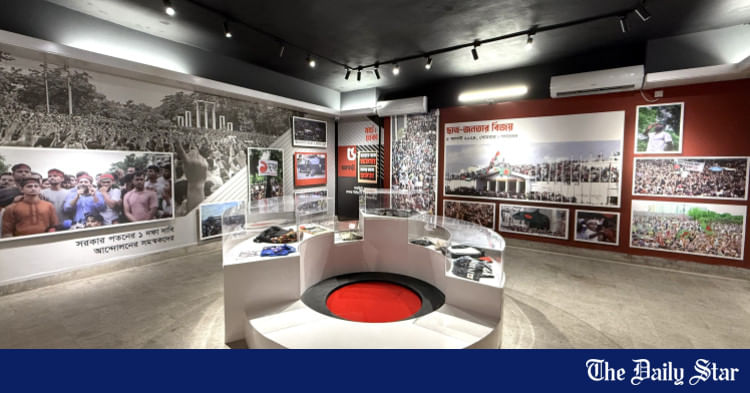
According to official sources, photos of the July uprising, various memorials, clothes of martyrs, letters, important documents, newspaper cuttings of that time, audio-videos and other materials will be kept in the July Memorial Museum.

In addition, the scene of the escape of the dictator and mass killers, Sheikh Hasina, will also be given a special place there.
This museum will be a part of the Bangladesh National Museum.​
 

Inside the July Memorial Museum at Dhaka University

1754360519640.webp

Photo: Mohammad Tawhid Ur Rashid

On July 21, the July Memorial Museum was inaugurated on the second floor of the Dhaka University Central Students Union (DUCSU) at Dhaka University (DU) following a discussion session. DU Vice-Chancellor Dr Niaz Ahmad Khan presided over the event, while Education Adviser Prof. Dr. Chowdhury Rafiqul Abrar was the Chief Guest. Family members of those who were martyred or injured during the July movement were present during the inauguration.

Upon entering the museum, visitors are met with a compelling visual where Abu Sayeed stands with his chest bared against police bullets. Right next to this visual is a touching photo of Mir Mugdho, who had simply stepped in to help the masses but was killed by bullets fired by his own countrymen.

Sadab, a student of DU's Public Administration department, while visiting the museum, remarked, "This museum will undoubtedly serve as a bearer and preserver of history. Every photograph and every item exhibited here stands as evidence of how we brought down a fascist regime through countless sacrifices."

Around 35 photographs are on display at this museum, many of which drew national attention and dominated headlines last year. One side of the wall features vivid graffiti, reflecting the faces of people rising up against oppression and injustice.

The personal belongings of the martyrs—including the watch worn by martyr Farhan Faiyaz and the torn pants of Abu Sayeed—have been placed here as powerful symbols of resistance.

From the harrowing scenes of students being assaulted by their own classmates in the struggle for rights to the rise of the one-point demand movement and the eventual victory of the student-led uprising—the entire journey is captured. The July Memorial Museum is a powerful portrayal of resistance against injustice.

Mohammad Tawhid Ur Rashid is a Campus Ambassador for The Daily Star from Dhaka University.​
 

July Museum highlights climax of 36 days, Hasina’s misrule: Foreign Adviser

UNB
Published :
Feb 03, 2026 20:28
Updated :
Feb 03, 2026 20:28

1770165620691.webp


Foreign Affairs Adviser Md Touhid Hossain on Tuesday said the July Mass Uprising Memorial Museum reflects Bangladesh people’s struggle against the misrule of former Prime Minister Sheikh Hasina.

“The museum showcases the climax of the 36 days of the July uprising, but it also highlights the elements of years of misrule,” he said, adding that the true lesson of history is to ensure it is not repeated.

The Foreign Adviser made the remarks as foreign diplomats stationed in Dhaka visited the museum on Monday, days before its opening to the public.

Cultural Affairs Adviser Mostofa Sarwar Farooki briefed the diplomats and guided them through the museum’s key sections.

Senior Secretary and SDGs Affairs Principal Coordinator Lamiya Morshed, Foreign Secretary Asad Alam Siam, and Cultural Affairs Secretary Md Mofidur Rahman were also present.

The Ministry of Foreign Affairs on January 29 wrote to all diplomatic missions, UN agencies and offices of international organisations in Dhaka, inviting Ambassadors, High Commissioners, CDAs and heads of international organisations and UN agencies to join the museum tour, a senior official at the ministry told UNB.

Chief Adviser’s Press Secretary Shafiqul Alam and Deputy Press Secretary Abul Kalam Azad Majumder are joined the programme.

Earlier, on January 20, Chief Adviser Prof Muhammad Yunus visited the museum. Gonobhaban, the former residence of ‘ousted autocrat’ Sheikh Hasina, has been converted into the July Museum, which is set for soft opening next week, said the Chief Adviser’s press wing.

At the start of two-hour long visit, the diplomats observed a minute of silence in memory of the nearly 4000 people who were martyred during the fascist regime Sheikh Hasina.

Farooki said the July Museum would collaborate with similar institutions in other countries.

“The idea behind the museum is to prevent the recurrence of such misrule, not only in Bangladesh, but anywhere in the world,” he said.

Chief Curator of the July Museum Tanzim Wahab described the various features of the museum to the visiting diplomats and guests.

“I am delighted to have visited the July Museum. It is both inspiring and a powerful reminder of how important it is to understand history, how mass uprisings occur, and the genesis of the 2024 mass uprising in Bangladesh,” said Michael Miller, Ambassador and Head of the Delegation of the European Union to Bangladesh.

Distinguished members of the diplomatic corps present at the event included Dr Abdelouahab Saidani, Ambassador of Algeria; Marcelo Carlos Cesa, Ambassador of Argentina; Dasho Karma Hamu Dorjee, Ambassador of Bhutan; Christian Brix Møller, Ambassador of Denmark; Omar Mohie Eldin Ahmed Fahmy, Ambassador of Egypt; Jean-Marc Séré-Charlet, Ambassador of France; Jalil Rahimi Jahanabadi, Ambassador of Iran; Wisam Hussein Ali Al Ithawi, Chargé d’Affaires of Iraq; Antonio Alessandro, Ambassador of Italy; Lulzim Pllana, Ambassador of Kosovo; Abdulmutalib S. M. Suliman, Ambassador of Libya; Bouchaib Ez Zahri, Chargé d’Affaires of Morocco; Ghanshyam Bhandari, Ambassador of Nepal; Håkon Arald Gulbrandsen, Ambassador of Norway; Imran Haider, High Commissioner of Pakistan; Yousef S. Y. Ramadan, Ambassador of the State of Palestine; Alexander Grigoryevich Khozin, Ambassador of the Russian Federation; Mitchel Lee, Chargé d’Affaires of Singapore; Gabriel María Sistiaga Ochoa de Chinchetru, Ambassador of Spain; Ramis Şen, Ambassador of Türkiye; Monica, Public Diplomacy Counselor, and Scott, Public Diplomacy Officer of the Embassy of the United States of America; Dr Liu Yuyin, Deputy Chief of Mission of the Embassy of the People’s Republic of China; and the Press Attaché of the High Commission of Brunei Darussalam.

Also present were Farouk Adatia, Diplomatic Representative of the Aga Khan Development Network (AKDN); Hoe Yun Jeong, Country Director of the Asian Development Bank (ADB); Indra Mani Pandey, Secretary General of BIMSTEC; P. Chandra Shekara, Director General of CIRDAP; Jiaoqun Shi, FAO Representative in Bangladesh; Muntasir Saqib Khan, Country Director of the International Fertilizer Development Center (IFDC); Lance Bonneau, Chief of Mission of the International Organization for Migration (IOM); Dr Susan Vize, Officer-in-Charge of UNESCO; Syed Iftikhar Ali, Officer-in-Charge of UNHCR; Coco Ushiyama, Resident Representative and Country Director of the World Food Programme (WFP); and Sudhir Muralidharan, Country Manager of UNOPS.​
 

July Uprising Museum Bill passed with provision of making state minister for culture head of the museum

The bill also allows the government authority to dismiss council members

Star online report

1775872339943.webp

Sculpture of a rickshaw puller carrying a demonstrator who was shot dead back to his family. Photo: July Revolution Memorial Museum

Parliament today passed the July Uprising Memorial Museum Bill, which includes provisions making the state minister for cultural affairs the head of the museum and granting the government authority to dismiss council members.

The move sparked heated debate in the chamber and ultimately led to a walkout by the opposition alliance led by Jamaat‑e‑Islami.

The amendments were introduced despite the parliamentary special committee’s earlier decision that 98 ordinances – including the July Uprising Memorial Museum Ordinance – would be ratified without changes.

Opposition MPs denounced the move as a breach of trust, calling it “trickery and outright deception” by the treasury bench.

In response, Law Minister Md Asaduzzaman, Home Minister Salahuddin Ahmed, and Chief Whip Nurul Islam argued that the amendment proposals had been raised by a private member, which was his prerogative.

Both Asaduzzaman and Salahuddin added that, if necessary, another bill could be introduced to address issues related to the museum.

The bill was moved by Cultural Affairs Minister Nitai Roy Chowdhury during a session presided over by Speaker Hafiz Uddin Ahmad.

The parliament ultimately adopted three amendments to Section 8 of the bill, proposed by treasury bench lawmaker Anisur Rahman, stipulating that the state minister for cultural affairs will serve as the chairperson of the museum’s board, replacing the original provision for an externally appointed expert.

After the passage of the bill in a voice vote, opposition MPs objected to the amendments, arguing – even without microphones – that if passed, the July Museum would fall under government control. In response, Speaker Hafiz Uddin Ahmad said that objections to amendments must be submitted in advance and that there is no scope to raise objections during the passage stage.

At that point, Jamaat MP Mir Ahmad Bin Quasem Arman was given the floor. Arman said they had not received the bill beforehand and were unaware of the amendments, asking how they could possibly submit objections under such circumstances.

The speaker then announced the Maghrib recess. After the break, Opposition Chief Whip Nahid Islam reminded the house that the special committee had reached a consensus to approve 98 ordinances unchanged, including the July Uprising Memorial Museum Ordinance.

He noted that the amendments were introduced only half an hour before the bill was tabled. “Anyone can propose amendments, and the opposition could have done so for all bills. But there was a consensus that no questions would be raised,” he said.

Addressing the speaker, Nahid added, “But today the ruling party has broken that consensus in front of you. This is a breach of trust. If the special committee’s consensus is ignored, then what was the point of forming the committee at all?”

He accused the government of using its majority to push through amendments, saying the bill had been passed “in broad daylight through trickery and outright deception”.

The speaker asked the state minister for cultural affairs whether the allegation of breaking the consensus was true. The junior minister replied that consensus had indeed been reached in the committee, but a member had introduced amendments, which he himself had only seen that day.

He also pointed out some justifications for the amendments.

Law Minister Asaduzzaman then took the floor. The speaker asked him the same question.

Asaduzzaman replied that while the allegation was partly true, the bill had been introduced based on the committee’s consensus. A private member had the right to propose amendments, and those amendments were passed.

He added that the bill could be reintroduced in amended form in the next session.

As the speaker continued speaking, opposition MPs grew noisy. He reminded them: “As the law minister said, there is a remedy if you are dissatisfied. I believe such discontent should not persist.”

NCP MP Hasnat Abdullah, a frontline leader of the July Movement, stood up from his seat and began shouting.

The speaker said, “Such intolerance will not do, Mr Abdullah. This is not Shahbagh Square. This is parliament. Here you must wait patiently and listen.”

Home Minister Salahuddin Ahmed also clarified that the amendments had not come from the government but from an individual member.

After a heated debate for a good amount of time, the opposition walked out of the house.​
 

Latest Posts

Back