Bangladesh Defense
Saif
Senior Member
- Joined
- Jan 24, 2024
- Messages
- 20,971
- Likes
- 9,685
- Nation

- Residence
- Axis Group


Investigation still incomplete in 86pc of the cases after two years
Now, because the examinations are being conducted long after the burials, it is no longer possible to determine the actual cause of death with certainty.
 en.prothomalo.com
Investigation still incomplete in 86pc of the cases after two years
Nazrul Islam
Dhaka
Published: 16 Jul 2026, 14: 36
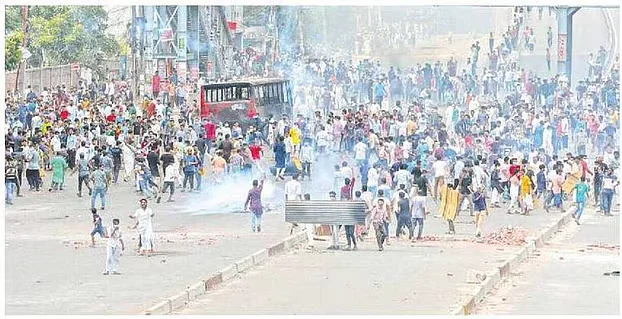
Student and public resistance during the mass uprising. 19 July 2024, Uttara, Dhaka. Prothom Alo
A total of 1,862 cases were filed across the country over the deaths and injuries that occurred during the July Mass Uprising. In nearly two years, the police have submitted investigation reports in only 254 cases (13.64 per cent). Investigations into the remaining 86.36 per cent of the cases have yet to be completed.
Senior police officials say the police have encountered various complications while investigating the cases filed over the deaths and injuries during the 2024 mass uprising. In most of the incidents, the bodies were buried without post-mortem examinations.
As a result, it is taking time to exhume the bodies and obtain post-mortem reports. Had post-mortem examinations been conducted at the time of the incidents, the reports would have recorded whether the victims died from gunshot wounds or specified the exact cause of death.
Now, because the examinations are being conducted long after the burials, it is no longer possible to determine the actual cause of death with certainty.
In addition, the investigations have been delayed because of inconsistencies such as incorrect descriptions of the crime scenes in the case statements, multiple cases being filed over the death of the same martyr while citing different locations of the incident, and the indiscriminate naming of large numbers of accused persons in many cases.
Mohammad Abu Sufian, Deputy Inspector General (Crime) at Police Headquarters, told Prothom Alo that forensic reports are an important element in murder cases related to the Mass Uprising.
It is taking time to obtain post-mortem reports in homicide cases. Many bodies were buried as unidentified persons. Until their identities are established, it is also difficult to register and investigate cases concerning their deaths.
These issues are creating complications. In addition, various errors, procedural complexities, and the lack of a clear picture of the incidents are causing delays in completing the investigations into many of the cases.
According to Police Headquarters, as of 30 June, charge sheets had been submitted in only 199 of the 1,862 cases filed over the deaths and injuries during the Mass Uprising. Police submitted final reports in 55 cases after finding no evidence to support the allegations.
A total of 799 murder cases were filed in connection with the Mass Uprising. Altogether, these cases named 327,841 accused persons, including 65,210 named in the First Information Reports (FIRs) and 262,631 listed as suspects.
The cases are being investigated by police stations, the Police Bureau of Investigation (PBI), the Criminal Investigation Department (CID), the Anti-Terrorism Unit (ATU), and the Detective Branch (DB).
Among the murder cases, charge sheets have been submitted in 63 cases where evidence was found. Police submitted final reports in 37 cases after finding no one's involvement in the incidents. The total number of accused persons named in the charge sheets in these cases is 5,793.
Police Headquarters also said that 1,063 cases were filed across the country over injuries sustained during the Mass Uprising. These cases involve a total of 282,879 accused persons, including 89,121 named in the FIRs and 193,758 listed as suspects.
Following the completion of investigations, reports have been submitted in 154 cases. Police filed charge sheets in 136 cases and final reports in 18 cases. The total number of accused persons named in these charge sheets is 10,202.
Innocent people also named as accused
During the July movement of 2024, members of the law enforcement agencies opened indiscriminate fire on students and protesters. As a result, after the Awami League government was ousted in the mass uprising on 5 August, many police officers went into hiding.
At that time, the entire policing system collapsed. Cases began to be filed only after police stations gradually resumed operations. However, because of the lack of proper police oversight during that period, many of the cases later came under scrutiny.
Many innocent people were named as accused out of personal enmity, business disputes, political vendettas, extortion, harassment, and malice. In many instances, influential political leaders in the respective localities determined who would be named as accused in the cases.
The practice of indiscriminately naming accused persons became so widespread that, on 14 October 2024, the Ministry of Home Affairs issued a warning notice. It instructed the relevant authorities to take legal action against those filing such cases for ulterior motives.
The government and the police also repeatedly stated that no action would be taken against those who had been made accused solely to harass them. Police Headquarters formed a special monitoring team to oversee investigations into cases related to the July Mass Uprising.
Sweeping prosecutions
On 5 August 2024, college student Rita Akter (17) was shot in front of Mirpur Shopping Complex, adjacent to Mirpur Model Police Station in Dhaka. She later died from her injuries.
In the case filed over the incident, 395 people, including the ousted Prime Minister Sheikh Hasina, ministers, and police personnel, were named as accused. The list also included businessman Afroz Uddin of Muktabangla Shopping Complex in Mirpur-1 and Kazi Joynal, a resident of Block D under Shah Ali Police Station.
Businessman Afroz Uddin told Prothom Alo that he had been falsely implicated because he had refused to withdraw the murder case over his brother's killing.
In 2005, his elder brother, businessman Aftab Uddin, was shot dead by notorious criminals led by top-listed criminal Shahadat over extortion demands. According to Afroz Uddin, the accused in that murder case were the ones who implicated him in Rita's murder case.
The complainant in the case, Rita's father Ashraf Ali, is a rickshaw puller by profession. At the time of the incident, he lived in Mirpur Section 2. He now lives in his ancestral home in Kalai, Joypurhat.
He told Prothom Alo, "BNP people were at the police station. They prepared the list of the accused. They asked me to sign it, and I signed. I cannot say exactly how many people were named as accused."
When asked whether he knew Afroz Uddin or Kazi Joynal, whose names appear on the list of accused, Ashraf Ali said, "How would I know them? BNP people gave me some money, and they were the ones who put the names in the case. Both innocent and guilty people ended up being included. I want to testify in court to save those who are innocent."
The case is being investigated by the Police Bureau of Investigation (PBI). Several police officers involved in the investigation said that no evidence had been found linking Afroz Uddin to the killing.
Since the case involves a large number of accused persons, including police officers, it is taking time to complete the investigation and submit the charge sheet. They said that those, including Afroz Uddin, who are found not to have been involved will be recommended for discharge.
Additional Inspector General of Police Khondkar Rafiqul Islam, who is supervising the investigations into the July Uprising cases, told Prothom Alo that the leaders of the Anti-Discrimination Student Movement had previously provided considerable information about the killings. Now, however, they are unwilling to speak. As a result, it has become difficult to collect evidence and witness testimony while investigating the murder cases.
The senior police official further said that, in some instances, separate cases had been filed at three different police stations over the killing of the same person by citing three different crime scenes and indiscriminately naming accused persons.
There are many such cases in which people filed complaints claiming to be the victim's brother or relative. Such cases have also become a source of business. In many investigations, the police found no relationship between the complainant and the deceased. Final reports have been submitted in such false cases.
Information not preserved
According to sources at Police Headquarters, most of the cases were filed over the deaths and injuries that occurred on 19 July and 4–5 August 2024. On 19 July, more than 150 people were killed in Dhaka and several other districts.
This was followed by the large-scale casualties on 4 August and Sheikh Hasina's departure from the country on 5 August. During those intense days of the movement, neither hospitals, the police, nor any other authority properly preserved information on where the bodies were taken, where they were buried, or who died while undergoing treatment and under what circumstances.
So far, the government has published a gazette listing the names of 836 martyrs of the July Mass Uprising. To date, 799 murder cases have been filed. This has also raised questions about how justice will be pursued for the remaining deaths.
Officials involved in investigations at Police Headquarters said that the identities of many of those martyred during the movement have yet to be established. In addition, some of the names included in the official gazette require further verification.
For these reasons, murder cases have not been filed in every death. However, once the exact cause of death has been confirmed and the identities of the martyrs established, the police may also initiate cases in those incidents.
Human rights activist Nur Khan told Prothom Alo that he had gone to hospitals to record the names of those killed and injured up to 5 August 2024. At the time, police, intelligence agencies, and members of the Awami League seized his documents.
At Dhaka Medical College Hospital, he witnessed many physicians being prevented from treating the injured under the influence of the police, intelligence agencies, and ruling party activists.
He said that when people who had been shot died on the way to the hospital, the same individuals arranged for the bodies to be buried as unidentified persons without preparing inquest reports or conducting post-mortem examinations. The bodies were not even handed over to their families.
Most of the hospital records relating to the dead and injured were destroyed. Although it was possible to identify the bodies through fingerprinting, this was not done properly.
After 5 August, criminal groups also exploited the situation by indiscriminately naming numerous innocent people as accused in many cases and engaging in case-related extortion. As a result, the investigations have become more complicated.
Six verdicts by the International Crimes Tribunal
Nearly two and a half months after the fall of the Awami League government in the mass uprising, the interim government reconstituted the International Crimes Tribunal on 14 October 2024.
To accelerate the judicial process, a second tribunal was established on 8 May last year. Over the past 19 months, the two tribunals have delivered verdicts in six cases concerning crimes against humanity committed during July.
An analysis of the six verdicts shows that, of the 61 convicted persons, 40 remain fugitives, while 21 are in prison. Of the 11 former police officers sentenced to death, 7 are fugitives and 4 are incarcerated.
Those who remain at large include former Dhaka Metropolitan Police (DMP) Commissioner Habibur Rahman; former DMP Joint Commissioner Sudip Kumar Chakraborty; former Additional Deputy Commissioner of the Ramna Division Shah Alam Md. Akhtarul Islam; former Officer-in-Charge of Ashulia Police Station AFM Sayed; former Assistant Sub-Inspector Biswajit Saha; former Additional Deputy Commissioner of the Khilgaon Division Md. Rashedul Islam; and former Officer-in-Charge of Rampura Police Station Md Mashiur Rahman. Prothom Alo published a detailed report on the matter on 3 July.
Essential to complete investigations quickly
Asked about the matter, former Inspector General of Police (IGP) Md. Abdul Kaiyum told Prothom Alo that many innocent people have been harassed after being indiscriminately named as accused in numerous cases filed over the mass uprising.
There have also been allegations that these cases have become a source of illegal financial gain. He said it is essential to form committees at the metropolitan and district levels, place the investigations under their supervision, set a time limit, and complete the investigations without delay.
The police should be instructed not to include anyone in a charge sheet without strong evidence and to remain free from lobbying and political influence. To ensure this, the police should be granted independent authority. Police reports should be submitted against the accused solely on the basis of the available evidence.
Nazrul Islam
Dhaka
Published: 16 Jul 2026, 14: 36
Student and public resistance during the mass uprising. 19 July 2024, Uttara, Dhaka. Prothom Alo
A total of 1,862 cases were filed across the country over the deaths and injuries that occurred during the July Mass Uprising. In nearly two years, the police have submitted investigation reports in only 254 cases (13.64 per cent). Investigations into the remaining 86.36 per cent of the cases have yet to be completed.
Senior police officials say the police have encountered various complications while investigating the cases filed over the deaths and injuries during the 2024 mass uprising. In most of the incidents, the bodies were buried without post-mortem examinations.
As a result, it is taking time to exhume the bodies and obtain post-mortem reports. Had post-mortem examinations been conducted at the time of the incidents, the reports would have recorded whether the victims died from gunshot wounds or specified the exact cause of death.
Now, because the examinations are being conducted long after the burials, it is no longer possible to determine the actual cause of death with certainty.
In addition, the investigations have been delayed because of inconsistencies such as incorrect descriptions of the crime scenes in the case statements, multiple cases being filed over the death of the same martyr while citing different locations of the incident, and the indiscriminate naming of large numbers of accused persons in many cases.
Mohammad Abu Sufian, Deputy Inspector General (Crime) at Police Headquarters, told Prothom Alo that forensic reports are an important element in murder cases related to the Mass Uprising.
It is taking time to obtain post-mortem reports in homicide cases. Many bodies were buried as unidentified persons. Until their identities are established, it is also difficult to register and investigate cases concerning their deaths.
These issues are creating complications. In addition, various errors, procedural complexities, and the lack of a clear picture of the incidents are causing delays in completing the investigations into many of the cases.
According to Police Headquarters, as of 30 June, charge sheets had been submitted in only 199 of the 1,862 cases filed over the deaths and injuries during the Mass Uprising. Police submitted final reports in 55 cases after finding no evidence to support the allegations.
A total of 799 murder cases were filed in connection with the Mass Uprising. Altogether, these cases named 327,841 accused persons, including 65,210 named in the First Information Reports (FIRs) and 262,631 listed as suspects.
The cases are being investigated by police stations, the Police Bureau of Investigation (PBI), the Criminal Investigation Department (CID), the Anti-Terrorism Unit (ATU), and the Detective Branch (DB).
Among the murder cases, charge sheets have been submitted in 63 cases where evidence was found. Police submitted final reports in 37 cases after finding no one's involvement in the incidents. The total number of accused persons named in the charge sheets in these cases is 5,793.
Police Headquarters also said that 1,063 cases were filed across the country over injuries sustained during the Mass Uprising. These cases involve a total of 282,879 accused persons, including 89,121 named in the FIRs and 193,758 listed as suspects.
Following the completion of investigations, reports have been submitted in 154 cases. Police filed charge sheets in 136 cases and final reports in 18 cases. The total number of accused persons named in these charge sheets is 10,202.
Innocent people also named as accused
During the July movement of 2024, members of the law enforcement agencies opened indiscriminate fire on students and protesters. As a result, after the Awami League government was ousted in the mass uprising on 5 August, many police officers went into hiding.
At that time, the entire policing system collapsed. Cases began to be filed only after police stations gradually resumed operations. However, because of the lack of proper police oversight during that period, many of the cases later came under scrutiny.
Many innocent people were named as accused out of personal enmity, business disputes, political vendettas, extortion, harassment, and malice. In many instances, influential political leaders in the respective localities determined who would be named as accused in the cases.
The practice of indiscriminately naming accused persons became so widespread that, on 14 October 2024, the Ministry of Home Affairs issued a warning notice. It instructed the relevant authorities to take legal action against those filing such cases for ulterior motives.
The government and the police also repeatedly stated that no action would be taken against those who had been made accused solely to harass them. Police Headquarters formed a special monitoring team to oversee investigations into cases related to the July Mass Uprising.
Sweeping prosecutions
On 5 August 2024, college student Rita Akter (17) was shot in front of Mirpur Shopping Complex, adjacent to Mirpur Model Police Station in Dhaka. She later died from her injuries.
In the case filed over the incident, 395 people, including the ousted Prime Minister Sheikh Hasina, ministers, and police personnel, were named as accused. The list also included businessman Afroz Uddin of Muktabangla Shopping Complex in Mirpur-1 and Kazi Joynal, a resident of Block D under Shah Ali Police Station.
Businessman Afroz Uddin told Prothom Alo that he had been falsely implicated because he had refused to withdraw the murder case over his brother's killing.
In 2005, his elder brother, businessman Aftab Uddin, was shot dead by notorious criminals led by top-listed criminal Shahadat over extortion demands. According to Afroz Uddin, the accused in that murder case were the ones who implicated him in Rita's murder case.
The complainant in the case, Rita's father Ashraf Ali, is a rickshaw puller by profession. At the time of the incident, he lived in Mirpur Section 2. He now lives in his ancestral home in Kalai, Joypurhat.
He told Prothom Alo, "BNP people were at the police station. They prepared the list of the accused. They asked me to sign it, and I signed. I cannot say exactly how many people were named as accused."
When asked whether he knew Afroz Uddin or Kazi Joynal, whose names appear on the list of accused, Ashraf Ali said, "How would I know them? BNP people gave me some money, and they were the ones who put the names in the case. Both innocent and guilty people ended up being included. I want to testify in court to save those who are innocent."
The case is being investigated by the Police Bureau of Investigation (PBI). Several police officers involved in the investigation said that no evidence had been found linking Afroz Uddin to the killing.
Since the case involves a large number of accused persons, including police officers, it is taking time to complete the investigation and submit the charge sheet. They said that those, including Afroz Uddin, who are found not to have been involved will be recommended for discharge.
Additional Inspector General of Police Khondkar Rafiqul Islam, who is supervising the investigations into the July Uprising cases, told Prothom Alo that the leaders of the Anti-Discrimination Student Movement had previously provided considerable information about the killings. Now, however, they are unwilling to speak. As a result, it has become difficult to collect evidence and witness testimony while investigating the murder cases.
The senior police official further said that, in some instances, separate cases had been filed at three different police stations over the killing of the same person by citing three different crime scenes and indiscriminately naming accused persons.
There are many such cases in which people filed complaints claiming to be the victim's brother or relative. Such cases have also become a source of business. In many investigations, the police found no relationship between the complainant and the deceased. Final reports have been submitted in such false cases.
Information not preserved
According to sources at Police Headquarters, most of the cases were filed over the deaths and injuries that occurred on 19 July and 4–5 August 2024. On 19 July, more than 150 people were killed in Dhaka and several other districts.
This was followed by the large-scale casualties on 4 August and Sheikh Hasina's departure from the country on 5 August. During those intense days of the movement, neither hospitals, the police, nor any other authority properly preserved information on where the bodies were taken, where they were buried, or who died while undergoing treatment and under what circumstances.
So far, the government has published a gazette listing the names of 836 martyrs of the July Mass Uprising. To date, 799 murder cases have been filed. This has also raised questions about how justice will be pursued for the remaining deaths.
Officials involved in investigations at Police Headquarters said that the identities of many of those martyred during the movement have yet to be established. In addition, some of the names included in the official gazette require further verification.
For these reasons, murder cases have not been filed in every death. However, once the exact cause of death has been confirmed and the identities of the martyrs established, the police may also initiate cases in those incidents.
Human rights activist Nur Khan told Prothom Alo that he had gone to hospitals to record the names of those killed and injured up to 5 August 2024. At the time, police, intelligence agencies, and members of the Awami League seized his documents.
At Dhaka Medical College Hospital, he witnessed many physicians being prevented from treating the injured under the influence of the police, intelligence agencies, and ruling party activists.
He said that when people who had been shot died on the way to the hospital, the same individuals arranged for the bodies to be buried as unidentified persons without preparing inquest reports or conducting post-mortem examinations. The bodies were not even handed over to their families.
Most of the hospital records relating to the dead and injured were destroyed. Although it was possible to identify the bodies through fingerprinting, this was not done properly.
After 5 August, criminal groups also exploited the situation by indiscriminately naming numerous innocent people as accused in many cases and engaging in case-related extortion. As a result, the investigations have become more complicated.
Six verdicts by the International Crimes Tribunal
Nearly two and a half months after the fall of the Awami League government in the mass uprising, the interim government reconstituted the International Crimes Tribunal on 14 October 2024.
To accelerate the judicial process, a second tribunal was established on 8 May last year. Over the past 19 months, the two tribunals have delivered verdicts in six cases concerning crimes against humanity committed during July.
An analysis of the six verdicts shows that, of the 61 convicted persons, 40 remain fugitives, while 21 are in prison. Of the 11 former police officers sentenced to death, 7 are fugitives and 4 are incarcerated.
Those who remain at large include former Dhaka Metropolitan Police (DMP) Commissioner Habibur Rahman; former DMP Joint Commissioner Sudip Kumar Chakraborty; former Additional Deputy Commissioner of the Ramna Division Shah Alam Md. Akhtarul Islam; former Officer-in-Charge of Ashulia Police Station AFM Sayed; former Assistant Sub-Inspector Biswajit Saha; former Additional Deputy Commissioner of the Khilgaon Division Md. Rashedul Islam; and former Officer-in-Charge of Rampura Police Station Md Mashiur Rahman. Prothom Alo published a detailed report on the matter on 3 July.
Essential to complete investigations quickly
Asked about the matter, former Inspector General of Police (IGP) Md. Abdul Kaiyum told Prothom Alo that many innocent people have been harassed after being indiscriminately named as accused in numerous cases filed over the mass uprising.
There have also been allegations that these cases have become a source of illegal financial gain. He said it is essential to form committees at the metropolitan and district levels, place the investigations under their supervision, set a time limit, and complete the investigations without delay.
The police should be instructed not to include anyone in a charge sheet without strong evidence and to remain free from lobbying and political influence. To ensure this, the police should be granted independent authority. Police reports should be submitted against the accused solely on the basis of the available evidence.