Donate ☕
201 Military Defense Forums
[🇧🇩] - Manpower Export: Prospects and Challenges. | PKDefense
Home Login Forums Wars Movies Watch Videos
Serious discussion on defense, geopolitics, and global security.

[🇧🇩] Manpower Export: Prospects and Challenges.

Reply (Scroll)
Press space to scroll through posts
G Bangladesh Defense
[🇧🇩] Manpower Export: Prospects and Challenges.
49
1K
More threads by Saif

We need to protect our migrant workers before it's too late

1737760421002.webp

Photo: Pexels/Anjan Karki

The plight of Bangladeshi migrant workers remains marred with hardship, exploitation, and tragedy, as reflected in the record-breaking 4,813 dead bodies repatriated in 2024. Behind this staggering number lies a grim reality: young lives extinguished far too soon, leaving behind grieving families and communities. These deaths are not isolated incidents but part of a broader narrative of systemic neglect and exploitation that continues to plague the lives of these labourers.

For decades, Bangladeshi workers have been the backbone of labour markets across the Gulf and Southeast Asia, often enduring grueling conditions with little to no support. They live in substandard accommodations, face unsafe workplaces, and remain under relentless pressure to recoup the exorbitant costs they incurred to migrate. This pressure drives many to work excessive hours, often at the expense of their health and well-being. As a result, heart attacks, strokes, and other stress-related ailments are commonly cited as causes of death in official records. However, these death certificates rarely tell the full story.\

An in-depth look into their lives reveals the physical and mental toll of their circumstances. Long hours under harsh conditions, combined with poor nutrition and limited access to healthcare, create a perfect storm of vulnerability. Many of these workers also face abusive treatment, psychosocial stress, and chronic health risks like hypertension and kidney disease, as highlighted in the 2022 report by the Vital Signs Partnership. Yet, the causes of these deaths remain "effectively unexplained," buried under layers of bureaucratic indifference and systemic failure.

Adding to their woes is the exploitation they endure at the hands of recruitment agencies and middlemen. Many workers are cheated and abandoned, left to navigate foreign lands without the promised support or resources. They invest their life savings, often by selling assets or taking out loans, only to find themselves trapped in cycles of debt and exploitation. In such a dire situation, their untimely deaths are not just a personal loss but a devastating blow to their families, who depend on their remittances for survival.

Addressing this crisis requires urgent and coordinated action from multiple stakeholders. The Ministry of Expatriates' Welfare and Overseas Employment and the Ministry of Foreign Affairs must work together to establish robust monitoring mechanisms for migrant workers. This includes ensuring workplace safety, improving accommodation standards, and providing regular health check-ups. A proactive approach could save countless lives by identifying and addressing risks before they escalate.

Bangladeshi missions abroad also have a critical role to play. They must act as advocates for the rights and welfare of migrant workers, ensuring that their grievances are heard and addressed. This involves collaborating with host countries to enforce labour laws and holding employers accountable for mistreatment or unsafe conditions. Missions should also offer support services, including counseling and legal assistance, to help workers navigate challenges in unfamiliar environments.

Furthermore, there needs to be greater investment in pre-departure training programmes that prepare workers for the realities of migration. These programmes should include health awareness campaigns, financial literacy training, and information on workers' rights. Such initiatives could empower migrants to better protect themselves and make informed decisions about their lives abroad.

As a nation, Bangladesh owes its migrant workers more than mere acknowledgment of their remittances. They are the unsung heroes of our economy, and their sacrifices deserve respect and protection. Behind every number in the repatriation statistics is a human story -- of dreams, resilience, and heartbreak. The government, civil society, and international community must come together to ensure that these stories no longer end in tragedy.

Hasan Meer is a journalist at The Daily Star​
 
Analyze

Analyze Post

Add your ideas here:
Highlight Cite Fact Check Respond

Authorities should address aspirant migrants’ concern
25 January, 2025, 00:00

PROSPECTIVE migrants to Saudi Arabia struggling to get meningitis vaccination, which the Middle Eastern country has recently made mandatory, warrants the attention of the authorities. Besides, the people who are scheduled to go to the country for umrah are also struggling to get the vaccines. Keeping to a Saudi government directives, meningitis vaccination is now compulsory for umrah pilgrims and travellers, which will take effect on February 10. Travellers now must get the vaccine at least 10 days before departure and carry a vaccination certificate. On January 21, several hundred people went on demonstration in Dhaka after failing to receive meningitis vaccines in hospitals. At least 300 people tried, as New Age reported on January 22, to get the vaccine from hospitals in the city but failed and they finally went to Square Hospitals on Panthapath when they were denied the vaccine because of supply inadequacy. The people then staged a protest in front of the hospital and later they moved to the Prabasi Kalyan Bhaban area. Hospital authorities say that there is a shortage of the vaccines amid an increase in demand and it might take two to four weeks to import more supplies.

Such a situation poses a problem to many prospective migrants and umrah pilgrims, who have deadlines to meet in Saudi Arabia. The situation, therefore, warrants intervention. Prospective migrants to Malaysia, who missed their flights because of a shortage of air tickets, meanwhile, went on demonstration on January 22 in the Karwan Bazar area in the capital demanding the jobs they were promised in the Southeast Asian country. The demonstrators are part of a group of about 18,000 people who missed the May 31, 2024 deadline that the Malaysian authorities had set. Around 50,000 Bangladeshi aspirants failed to migrate to Malaysia after completing almost all the processes by the May 2024 deadline. But many of the aspirants failed to fly to Malaysia, a top destination for Bangladeshi migrants as nearly 10 per cent of total workers migrate to Malaysia, because of the shortage of air tickets. Almost 17,000 of the 50,000 aspirants failed to fly to Malaysia at the last moment because of the unavailability of air tickets. The government of the day could not resolve the problem. This is assuring that the Malaysian prime minister, after a bilateral meeting in Dhaka, announced on October 4 that his country would consider issuing 18,000 work visas for those Bangladeshis who got stuck and could not fly.

The authorities should, therefore, address the issues that hinder the migration of aspirants to Saudi Arabia and Malaysia. The authorities should not leave the meningitis vaccine issue unresolved and should, rather, take initiatives for an early import of the vaccine. The authorities should expedite the migration of aspirants to Malaysia.​
 
Analyze

Analyze Post

Add your ideas here:
Highlight Cite Fact Check Respond
  • Like (+1)
Reactions: Bilal9

Migration cost 3-4 times higher in Bangladesh: Experts
Staff Correspondent
Dhaka
Updated: 25 Jan 2025, 22: 13

1737851277891.webp

The WARBE Development Foundation, in partnership with the International Labour Organization (ILO) and supported by Switzerland, recently hosted a "Dialogue with the Labour Reform Commission for Pragmatic Reform in Labour Migration" at the Department of Labour’s Head Office. Collected

Labour migration experts at a dialogue expressed concern over the high migration cost for the Bangladeshi migrants.

Highlighting the pressing challenges in Bangladesh’s labour migration system, Tasneem Siddiqui, Founding Chair of RMMRU, questioned why it remains flawed despite having numerous policies and regulations.

Referring to the White Paper she said “The collusion of interest among the political regime, private sector, section of top bureaucracy, has compromised the principles of good governance.”

The WARBE Development Foundation, in partnership with the International Labour Organization (ILO) and supported by Switzerland, recently hosted a "Dialogue with the Labour Reform Commission for Pragmatic Reform in Labour Migration" at the Department of Labour’s Head Office.

The event has brought together members of the Labour Reform Commission, civil society organisations, trade unions, private sector representatives, and migrant workers to discuss key reforms in labour migration governance.

She further noted the 4–5 times higher migration costs in Bangladesh, than in Nepal, India, and Pakistan, and significant financial losses during migration which they can’t recover.

Another key panelist Rahnuma Salam Khan, National Project Manager from ILO emphasized the need to reform the Migration Act and Trade Union Act to ensure migrant rights and safety.

She asked, "If migrants in other countries can have trade unions, why not ours?"

Rahnuma Salam Khan noted the dependency on intermediaries on both sides of the recruitment process.

She pointed out that high visa trading costs in Bangladesh significantly inflate overall recruitment expenses for the country’s migrants.

Rahnuma Salam further points out the ineffectiveness of TTC training, the lack of negotiation from the end of Bangladesh about migrants' rights and protection, and the bank's role in this flawed migrant system.

During further reflection moderated by Syed Saiful Haque, Associate Director of Migration Programme and Youth Platform, BRAC, Shariful Islam Hassan, shared his views on migrants' suffering in both sending and destination countries.

He said, “When we ask the migrants why they seek help from brokers, we should think whether they have any legal way to go abroad.”

BILS Executive Council member and BJSD Women Committee General Secretary Nasrin Akter Dina highlights the vulnerability of female migrants.

She said, “The law enacted for the protection of female migrant workers doesn’t ensure their safe migration to the host country.”

1737851328348.webp

The WARBE Development Foundation, in partnership with the International Labour Organization (ILO) and supported by Switzerland, recently hosted a "Dialogue with the Labour Reform Commission for Pragmatic Reform in Labour Migration" at the Department of Labour’s Head Office. Collected

Bangladesh Employers’ Federation joint secretary-general Asif Ayub points out the lack of accountability of the ministries.

“Whenever the issue of migrants arises, the persons in charge never step forward to take responsibilities, they always pass on the responsibilities to someone else. BMET officials are not even aware of their mandate of apprenticeship registration," he added.

ILO National Programme Officer Mazharul Islam moderated the open floor discussion by welcoming valuable recommendations from the panelists.

Trade unionists, female returnee migrants, and labour union members stressed the need for the legalisation of migration units of CSOs, facilitation of migration representatives to counter the corrupted bureaucracy, finding the reason behind migrants pursuing less-dignified jobs, properly structured reintegration programme for the returnee migrants and ensuring accountability and transparency.

IMA Research Foundation member Anisur Rahman seeks recognition of migrant workers, not integrated into other CSOs, to raise their voices properly.

He also pointed out the hindrance of returnee migrants to join any trade union as it requires being employed in the home country and most of the returnee migrants don’t get hired after coming back.

Labour Rights Commission member Shakil Akhter Chowdhury summarised the key takeaways from the discussion.

She said, “We have to find out a secondary source for foreign currency apart from migration."

In his closing remarks, Syed Sultan Uddin Ahmmed, Chair of the Labour Reform Commission, urged stakeholders to advocate for achievable recommendations at the national level.​
 
Analyze

Analyze Post

Add your ideas here:
Highlight Cite Fact Check Respond
  • Sad (0)
Reactions: Bilal9

Who will answer for our migrant workers’ deaths?
Authorities must do more to ensure their well-being

1737933143683.webp


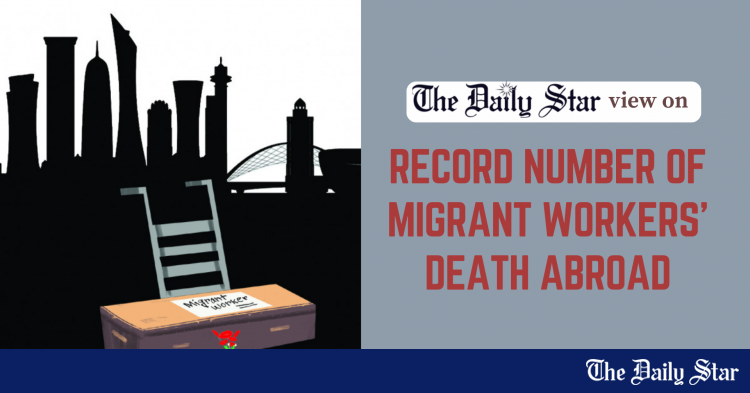
We are deeply concerned by the unnaturally high number of deaths of our migrant workers abroad, with the host country authorities failing to provide accurate explanations for them. According to the Wage Earners' Welfare Board (WEWB), 4,813 dead bodies of Bangladeshi migrants arrived in the country from the destination countries in 2024, mostly from the Gulf region. The number of deaths has steadily increased since 2021—with 3,818 in 2021, 3,904 in 2022, and 4,552 in 2023. Reportedly, WEWB received 56,769 dead bodies of migrants from 1993 to 2024, which is shocking. The question is, what is causing the deaths of so many of our workers? Have Bangladeshi authorities sought answers from the destination countries where these individuals met such dire fates?

Every year, many of our workers leave for foreign lands, hoping to improve their financial conditions. Unfortunately, many face severe hardships and return home in coffins, particularly from the Gulf region, the primary destination for Bangladeshi migrant workers. Often, the exact causes of their deaths remain unexplained, with "heart attack" commonly mentioned on their death certificates by the receiving countries. These countries rarely investigate the true reasons for these deaths, and Bangladeshi authorities also fail to find answers. Additionally, our female migrant workers often face physical, psychological, and sexual abuse at the hands of their employers—and many have reportedly died by suicide.

Over the years, our returnee migrant workers have shared the miserable conditions they faced in the Gulf states. Long hours, poor occupational health and safety practices, and exposure to cumulative health risks such as heat, air pollution, abusive conditions, psychosocial stress, hypertension, and chronic kidney disease have been common. The question is, have the Bangladeshi authorities made any effort to improve the living and working conditions of our workers? Additionally, our workers are under constant pressure to send money home to recoup the migration cost, leaving them with no opportunity for adequate rest. Have the authorities taken any steps to lower migration costs?

Why are we overlooking the struggles of our migrant workers, whose labour and remittances form the very backbone of our economy? We urge the authorities to prioritise the lives and welfare of our migrant workers above all else. While Bangladeshi missions abroad must advocate for the rights and welfare of migrant workers, the expatriates' welfare ministry and the foreign ministry should jointly establish a robust monitoring mechanism to ensure workplace safety, improved accommodation, and regular health check-ups for migrant workers. Additionally, they should collaborate with host countries to enforce proper labour laws and hold employers accountable for mistreatment, unsafe conditions, and deaths. The authorities must also demand transparency regarding the exact causes of our workers' deaths.​
 
Analyze

Analyze Post

Add your ideas here:
Highlight Cite Fact Check Respond

7964 stranded workers to go Malaysia in first phase: MoFA
FE ONLINE DESK
Published :
Jan 27, 2025 19:44
Updated :
Jan 27, 2025 19:52

1738023677503.webp


A total of 7,964 Bangladeshi workers, among the 18,000, who could not travel to Malaysia as of May 31 last year, have been selected for entry into the Southeast Asian nation in the first phase, the Ministry of Foreign Affairs (MoFA) confirmed on Monday.

Foreign Ministry spokesperson Mohammad Rafiqul Alam shared the information during the ministry’s weekly media briefing this afternoon.

He said that on December 5, 2024, Bangladesh High Commissioner in Malaysia held a meeting with Malaysian Home Minister Saifuddin Nasution Ismail in Kuala Lumpur.

The meeting focused on addressing the issue of nearly 18,000 Bangladeshi workers whose migration to Malaysia was delayed.

During the discussion, the Minister proposed the formation of a Joint Technical Group comprising representatives from the Malaysian Immigration Department and the Bangladesh High Commission.

The group was tasked with facilitating the phased entry of these workers, Alam noted.

The spokesperson further mentioned that following the group formation, two meetings were held on December 31 and January 14.

In these meetings, a list of over 17,000 workers was thoroughly verified with Malaysian stakeholders, resulting in the selection of 7,964 workers for the first phase, he said, adding that the workers have been identified as eligible for immediate entry.

When asked about the process for the workers’ travel, Alam said that Joint Technical Committee will finalize the procedures through continued discussions.​
 
Analyze

Analyze Post

Add your ideas here:
Highlight Cite Fact Check Respond
  • Like (+1)
Reactions: Bilal9

Members Online

⤵︎

Latest Posts

Latest Posts