[🇧🇩] Monitoring Bangladesh's Economy

[🇧🇩] Monitoring Bangladesh's Economy
1K
37K
More threads by Saif

G Bangladesh Defense
Inflation rises to 8.49% in December

1767663159216.webp


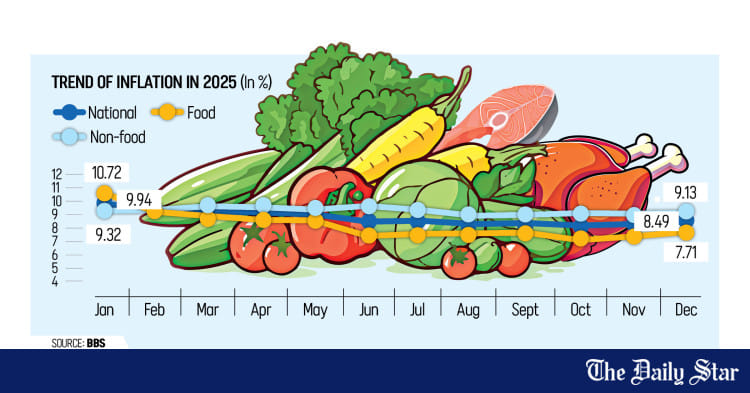
Following months of a brief pause, inflationary pressures continued to rise in December for the second consecutive month.


Headline inflation reached 8.49 percent in the last month of the year, up from 8.29 percent in November and October's 39-month low of 8.17 percent, according to data released by the Bangladesh Bureau of Statistics (BBS) yesterday.


For low and fixed-income households in both rural and urban areas, the latest increase adds fresh pressure on the cost of food and non-food essentials.

Economists say inflation is turning red-hot again despite the central bank's tightened monetary stance, pointing to supply-side constraints rather than rising demand as the main driver of price increases.


While this view questions the effectiveness of the current high policy rate and calls for closer market monitoring, economists still support keeping lending rates elevated.

In December, food inflation climbed to 7.71 percent from 7.36 percent in November, adding pressure on household budgets as prices of essential items edged up.

Non-food inflation also increased slightly to 9.13 percent from 9.08 percent a month earlier.


BBS data showed that the consumer price index (CPI), which tracks changes in the cost of a basket of goods and services, rose in both rural and urban areas.

According to the Trading Corporation of Bangladesh (TCB), prices of essential food items such as rice, flour, edible oil and lentils were higher in December compared to the same month last year.

Bangladesh has been facing persistent inflation for nearly three years. Consumer prices remained above 9 percent until May 2025 and have stayed above 8 percent since then, raising questions about the effectiveness of recent economic policies.

However, in index terms, food inflation showed a slight easing in December. The food CPI declined to 142.88 in December from 146.66 in November, although it increased on a year-on-year basis, BBS data showed.

"Inflation remains very high, and the data show no clear sign of a lasting decline," said Zahid Hussain, former lead economist of the World Bank Dhaka office.

"The measures taken so far to control inflation have not produced visible results. The current tightening measures are still not strong enough to bring prices down," he added.

Hussain also said food inflation in Bangladesh is not driven by exchange rates or credit conditions. "Instead, it largely follows its own past trend. This means structural and supply-side factors mainly drive food inflation, and demand-side measures alone are unlikely to work," he said.

He added that the data suggest it is too early to ease policy and questioned whether the current level of tightening is sufficient to achieve the intended outcome.

Sharing a similar view, Mustafa K Mujeri, executive director of the Institute for Inclusive Finance and Development (InM), questioned the effectiveness of the existing tightening monetary policy.

"If the policies adopted so far were working, inflation should have come down by now. Instead, inflation has stayed above 8 percent for several months, raising doubts about the effectiveness of the existing measures," he said.

He added that Bangladesh has followed a contractionary monetary policy for a long period, but it has failed to deliver the expected results because inflation is not driven by demand alone.

Mujeri said supply-side weaknesses, particularly poor market management and problems in the value chain, continue to keep inflation high, allowing powerful intermediaries to create artificial shortages and push up prices.

He added that higher prices often do not benefit producers such as farmers, as most of the gains go to intermediaries.

Without stronger market oversight and a coordinated approach involving monetary, fiscal, supply-side and credit policies, contractionary monetary policy alone cannot reduce inflation in a country like Bangladesh, Mujeri said.​
 

Attachments

  • 1767663072357.webp
    1767663072357.webp
    26.5 KB · Views: 12
Completing NBR reform

Published :
Jan 06, 2026 23:31
Updated :
Jan 06, 2026 23:31

1767746367842.webp

Splitting the National Board of Revenue (NBR) between its policymaking and revenue management functions has been one of the major reform agendas of the post-July 2024 interim government. The aim was to render the tax regulator more efficient, transparent and accountable. Though the interim administration's term in office is coming to an end soon, the bifurcation is yet to be completed. Notably, the government initially formed a five-member advisory body to guide the reform work. But the work has not progressed smoothly as there were delays as well resistance from the NBR officials after an initial ordinance had been issued in May last year. Two new bodies -- the Revenue Policy Division (RPD) and the Revenue Management Division (RMD) were supposed to emerge under the Ministry of Finance. The function of RPD would be to draft tax laws and deal with treaties, while that of RMD would be to enforce rules and collect tax. Notably, a split in the tax regulator was among the key conditions of the IMF loan advanced to Bangladesh.

But NBR officials started protests and non-cooperation programmes over fears of losing power, career uncertainty and loss of cadre status due to the proposed leadership structure of the new NBR divisions so created. Obviously, their protests including work abstentions and other activities seriously hampered normal work of NBR affecting export and import as well as the revenue administration. Against this backdrop, the government formed another advisory committee, which recommended some amendments to initial ordinance following talks with stakeholders. Meanwhile, disciplinary action was taken against some NBR officials for their disruptive activities.

No doubt, the internal conflict in the NBR has exposed its deeper structural weaknesses. In this context, some experts viewed that political stability and clear policies are the preconditions for restoring confidence in completing the reform work. Meanwhile, the December deadline of finishing the NBR bifurcation has already been missed. Now, to complete the task, some procedural steps are necessary which are obviously time-bound. Those include finalising the Rules of Business (RoB) and Allocation of Business (AoB). Before completion of these functions, it will first require obtaining approval from the NICAR (National Implementation Committee for Administrative Reforms). It is worthwhile to note that pre-NICAR was formed by the interim admin headed by the cabinet secretary in late August this year to provide suggestions for constituting new administrative bodies and approval for manpower. So, after having pre-NICAR's approval, the twin job of splitting up NBR has to get final go-ahead from the NICAR chaired by the CA.

Clearly, this involves a long procedure. For instance, to define the functions of the two split-up NBR bodies which include responsibilities, jurisdictions and operational framework, would require a Statutory Regulatory Order (SRO). These tasks of bifurcation yet to be finalised delay manpower deployment for two NBR departments. In this context, it could be gathered that the revised proposal for restructuring NBR was recently submitted to the cabinet division for approval but was returned with observations. Following corrections as necessary, the drafts of RoB and AoB have reportedly been resubmitted to the cabinet body for approval. Approvals from the pre-NICAR and the NICAR complete the NBR reform process. The question is, can the interim admin finish work within the time it still has in its hands? Some experts have expressed concern over what they termed 'non-transparency of reform process' being conducted by the interim administration. The NBR reform is an issue of transparency and accountability on the part of the interim admin, they added. Let the interim administration address all the concerns expressed and uncertainties created over completion of NBR restructuring and thus finish its NBR reform agenda within its term in office.

 
Economy is now at a turning point

1767748681703.webp

Bangladesh's economic success under the previous political regime rested on fragile foundations, with structural weaknesses masked by headline growth. These distortions fuelled a build-up of public debt and one of the world's highest non-performing loan ratios, estimated at 35.7 percent, reflecting deep abuse in the banking sector.


As confidence eroded, foreign exchange reserves fell by nearly 40 percent between end-2022 and mid-2024, while inflation rose to a 12-year high. An artificially low interest rate cap and aggressive monetary expansion by the Bangladesh Bank intensified price pressures, with weak data transparency obscuring the scale of deterioration and contributing to political upheaval.


The interim government has made progress in stabilising the macroeconomy. Foreign exchange reserves rebounded by more than 30 percent, supported by restrictive import policies and a recovery in remittance inflows following the shift to a market-driven exchange rate. Inflation has moderated, and initial steps have been taken to address the NPL crisis. Yet the recovery remains fragile, with GDP growth slowing to 3.69 percent in FY2025 amid weak business confidence, declining equity-related foreign direct investment and lingering political uncertainty.

Political clarity has therefore emerged as a decisive factor shaping the outlook. While uncertainty surrounding the transition to an elected government has weighed on investor sentiment, the return of Tarique Rahman after a prolonged exile has reduced electoral ambiguity. His emphasis on stability and national unity has improved expectations of policy continuity, supporting a more constructive medium-term outlook, with the IMF projecting growth to rebound to 4.9 percent in 2026.


Despite these stabilisation gains, Bangladesh's capital market continues to underperform. The DSEX remains near multi-year lows, valuations are deeply compressed and foreign participation has declined sharply, even as regional peers have rallied. This underperformance is structural, driven by a prolonged IPO drought, regulatory inefficiencies, the dominance of bank financing, elevated fixed-income yields and an underdeveloped institutional investor base. These weaknesses reinforce a cycle of low liquidity and weak participation.

Bangladesh now stands at a critical juncture. Macroeconomic stabilisation, improving reserves and emerging political clarity offer a narrow but meaningful window for capital market revival. Sustained recovery, however, will depend on a coordinated reform agenda that addresses structural bottlenecks, restores institutional credibility and realigns incentives towards long-term market development.

On the fiscal front, restoring listing incentives is essential. Expanding the corporate tax differential between listed and non-listed companies to 10 to 15 percentage points would reward transparency, while tax-free dividend income could redirect household savings towards equities.


Regulatory reforms are equally important. Streamlined, digitised financial reporting and a fast-tracked IPO process would help revive the listing pipeline, while stronger corporate governance and improved stock exchange oversight would enhance market integrity and investor protection.

Institutional strengthening remains central. Enhancing the effectiveness and accountability of the BSEC, alongside revitalising the Investment Corporation of Bangladesh, would restore regulatory credibility and provide counter-cyclical market support. Progress also depends on stronger inter-agency coordination, improved financial literacy and a better balance between bank financing and capital markets through incentives for private listings and rationalised savings instrument yields.

Sustainable capital market growth ultimately depends on building a strong institutional investor base, particularly through the development of the mutual fund industry. Greater mutual fund participation would help reduce volatility by reinforcing disciplined, long-term investment practices. Yet the sector remains underdeveloped.

Achieving durable, fundamentals-driven growth will require targeted policy support, including higher tax rebates on mutual fund investments, limited tax exemptions on dividend income, larger IPO quotas and the removal of the 15 percent bank investment cap on mutual funds. If implemented consistently, these measures could reposition the Bangladesh capital market as a credible engine of long-term economic growth.

The writer is managing director and CEO of Vanguard Asset Management Limited​
 
Regulate, not ban cryptocurrency

Atiqul Kabir Tuhin
Published :
Jan 08, 2026 01:01
Updated :
Jan 08, 2026 01:01

1767833328752.webp

Cryptocurrency is banned in Bangladesh, but its usage is booming in the shadow of a legal grey zone and the absence of effective regulatory oversight. Bangladesh ranks 13th among 151 countries worldwide in terms of cryptocurrency usage, according to the Global Crypto Adoption Index 2025, published by the international blockchain analytics firm Chainalysis. In the index, India ranks first, the United States second and Pakistan third, followed by Vietnam, Brazil and Nigeria. The index shows that despite the legal prohibition on the use and trading of cryptocurrencies, Bangladesh has emerged as one of the leading crypto-using nations in South Asia, ranking third in the region after India and Pakistan.

According to Investopedia, the growth of cryptocurrency from a speculative investment into a recognised asset class has prompted governments worldwide to develop regulatory frameworks. The United States, Canada, the United Kingdom, South Korea, Japan and many other countries allow crypto to operate within regulated frameworks. The European Union recognises cryptocurrencies as crypto-assets rather than illegal instruments.

In South Asia, India and Pakistan do not recognise crypto as legal tender, yet neither has formally outlawed its possession. India has lifted its ban and is now working toward a regulatory framework, while Pakistan is exploring blockchain and digital asset regulations. Japan, Switzerland and Singapore offer examples of balanced oversight that encourage innovation while attempting to curb misuse, raising questions about whether Bangladesh's blanket ban on its use is sustainable.

In Bangladesh, the absence of formal recognition has not prevented crypto activity. Instead, it has pushed the market into informal and largely unregulated channels, increasing risks related to fraud, security and capital flight. Although the country has made notable progress in digital connectivity and mobile financial services, there remains a lack of crypto-related infrastructure, public awareness and blockchain education.

Bangladesh Bank has repeatedly warned against cryptocurrencies, citing concerns over money laundering, terrorism financing and foreign exchange losses. While no law explicitly criminalises crypto ownership, existing regulations under the Foreign Exchange Regulation Act of 1947 and the Money Laundering Prevention Act of 2012 have been interpreted to prohibit such transactions. However, its usage continues to expand. Industry estimates suggest that millions of Bangladeshis hold accounts on international crypto exchange platforms such as Binance, Coinbase and Crypto.com, even though banks are not permitted to facilitate crypto payments.

Chainalysis identifies freelancing and remittances as key drivers. A large segment of Bangladesh's youth is engaged in online freelancing, and many receive payments from overseas clients in cryptocurrencies, particularly stablecoins such as USDT, because transactions are fast and relatively inexpensive. It is also believed that a portion of expatriate remittances is entering the country through crypto-based channels. At the same time, persistent currency depreciation and inflation have encouraged some users to convert savings into dollar-pegged digital assets. Cryptocurrency has also become a popular payment method for online gaming and international betting sites.

Most crypto activity in Bangladesh takes place through peer-to-peer exchanges. As users cannot directly purchase crypto with bank cards, they rely on local intermediaries listed on platforms such as Binance. Money is transferred in taka via banks or mobile wallets, and cryptocurrency is credited in return. Once received, it can be sent globally within minutes through blockchain networks. At the receiving end, holders may retain the asset, convert it into stablecoins or sell it back through local P2P markets. In effect, this system operates as a technology-driven money transfer network. It is kind of digital version of hundi.

The central bank views cryptocurrency as a threat because it is not issued or controlled by any government or central authority. Moreover, its value is highly volatile, and formal recognition carries the risk of encouraging gullible Bangladeshis to invest in crypto assets and suffer losses, just as many already suffered in the stock market. And then, it carries significant risk for money laundering. A recent investigation by the International Consortium of Investigative Journalists and The New York Times found that at least $28 billion in illicit funds flowed into prominent crypto exchanges, like Binance and OKX over the past two years.

Globally, regulators are also struggling with the misuse of digital assets by criminal networks. Hackers, cybercriminal groups and transnational fraud syndicates routinely exploit crypto platforms to move stolen or extorted funds. These concerns are legitimate. However, daily transactions continue to rise.

Faced with such a quandary, countries are increasingly moving away from imposing outright bans on cryptocurrency. Instead, they are focusing on regulating the points where digital assets intersect with the formal financial system. The intergovernmental Financial Action Task Force (FATF) now requires all countries to regulate Virtual Asset Service Providers (VASPs), including exchanges, peer-to-peer platforms, and wallet services, through strict KYC requirements, transaction reporting and cross-border information sharing.

Regions like the EU, the UK, and the UAE already enforce these rules. The EU's MiCA framework mandates full transparency from exchanges, while the UK requires platforms to freeze suspicious transfers. Even countries in the Gulf - Dubai, Abu Dhabi, and Bahrain - now require crypto businesses to register, maintain capital reserves and follow AML protocols. Meanwhile, rather than moving toward legalisation or prohibition, India has adopted a tax-first approach by imposing 30 per cent tax on gains and a transaction-level tax deduction.

The scale of the crypto use by Bangladeshis already indicates that it is no longer a fringe phenomenon. Ignoring it will not make it disappear. What is needed is acknowledgment, regulation and oversight that address genuine risks without denying economic reality.

To harness the potential of cryptocurrencies while mitigating their risks, Bangladesh could take several steps. First, it should develop a clear regulatory framework that defines legal usage, taxation, and compliance requirements. Public awareness campaigns are also essential to educate citizens about both the benefits and risks of cryptocurrency investments. At the same time, investment in digital infrastructure would help ensure secure and efficient crypto-related transactions. Regulations should prioritise consumer protection, anti-money laundering (AML)/know your customer (KYC) compliance, and innovation. Policymakers, central banks, fintech companies, academia, and civil society can collaborate to shape a strong legal framework for cryptocurrency adoption and prevention of its misuse.​
 
Alternatives Bangladesh can explore to move away from the debt trap

1767836330663.webp

VISUAL: FREEPIK

Last month, at a seminar on the state of the economy, the chairman of the National Board of Revenue said that Bangladesh has "already slipped into a form of debt trap." This alarming statement, echoed by other senior officials, has set the national discourse alight with anxiety. However, before we succumb to the fear of an impending financial crisis, it's important to closely examine the economic assessment and consider whether the narrative of a debt trap is prematurely ruling out the potential for sovereign alternatives.


Let's start with the cold, hard numbers. Yes, our external debt has surged by 42 percent in five years to $104.48 billion. Yes, debt servicing is now the second-largest expense in our national budget, after salaries and pensions. These are serious pressures. However, Bangladesh's debt-to-GDP ratio is within the manageable threshold for an emerging economy.


The true crisis is not the stock of debt, but the anaemic stream of revenue needed to service it. Our tax-to-GDP ratio has collapsed to a perilous 7.7 percent, one of the lowest in the world. Nearly a third of our meagre government income is consumed by debt repayments, starving public investment in health, education, and infrastructure. Furthermore, our external debt now stands at a staggering 192 percent of our export earnings in 2024. Sixteen percent of export earnings is needed just for debt servicing.

This is a liquidity and revenue crisis. The vulnerability stems from a hollowed-out revenue base and also a dangerous dependence on dollar-denominated borrowing. As the taka depreciates, the local currency cost of repaying foreign loans skyrockets, creating a vicious cycle. The solution, therefore, lies not in panic-induced austerity alone, but in a dual strategy: radically strengthening domestic revenue collection and strategically de-risking from the volatile US dollar.


As these debt anxieties peak, the country is deep into a $4.7 billion IMF programme, with the next tranche hanging in the balance. The IMF's prescriptions—fiscal discipline, a market-driven exchange rate, banking reforms—although presented as technocratic necessities, are also classic tools of geopolitical alignment, keeping countries under the Western-dominated Bretton Woods system.

That is why the debt-trap narrative often instils a fear that paralyses sovereign strategic thinking. It ignores the fact that some successful emerging economies, from India to Indonesia, have not chosen one bloc over another but have skillfully navigated a multipolar world to their advantage. While many in the Global South are rapidly constructing a parallel financial infrastructure, Bangladesh is lagging.

In July 2023, Bangladesh and India launched a landmark mechanism to settle bilateral trade in rupees, bypassing the dollar. Yet, this initiative remains underutilised and half-hearted. Contrast this with India and Russia: in December 2025, they reaffirmed their commitment to settling nearly all their $68.7 billion bilateral trade in national currencies. Where is our aggressive push for settlement in local currencies with our largest trade partners?


Nations insulate their foreign exchange reserves through bilateral swap lines. In early 2025, Indonesia and China renewed a massive swap agreement worth RMB 400 billion. Bangladesh has discussed a yuan swap line with China, but it is yet to materialise.

Over 50 countries, including Bangladesh, have expressed interest in joining BRICS, a bloc whose GDP now surpasses that of the G7. One advantage of joining BRICS is having access to alternatives like the BRICS Bridge—a payment messaging system designed to operate independently of SWIFT. Yet, Bangladesh's interest has not translated into a decisive strategy to engage with the New Development Bank.

The path forward requires the courage to look beyond the existing narrative. This can include activating and expanding the rupee-taka mechanism with India and initiating government-to-government negotiations with China, the UAE, and other major partners to establish bilateral local currency settlement frameworks. Each dollar of trade settled in taka or a partner's currency is a dollar of pressure lifted from our reserves.

In addition, Bangladesh should treat currency swaps not as a financial technicality but as a cornerstone of national economic security and pursue a major swap line with China to secure yuan liquidity. We must also explore similar arrangements with other friendly central banks to create a buffer against speculative attacks on the taka. Additionally, we should begin technical engagement to connect our banking system with the BRICS Cross-Border Payments Initiative (BCBPI), while pursuing BRICS membership.

However, external diversification is meaningless without internal accountability. We must end the culture of tax exemptions, digitally integrate the tax net, and aim to double the revenue-to-GDP ratio in five years. Concurrently, we need a war on NPLs that combines fast-track asset recovery tribunals with pragmatic restructuring of viable businesses to unclog the banking system.

Bangladesh has options to pull itself out of the "debt trap narrative," through vigorous domestic resource mobilisation and strategic diversification that can lead to sovereign agency in a multipolar world. The arithmetic is clear, the global examples are there, and the tools are being built by our peers in the Global South. The question is whether we have the political will to reach for the key that has always been in our own hands. The time for a strategic, sovereign pivot is now.

Zakir Kibria is a Bangladeshi writer, policy analyst and entrepreneur based in Kathmandu, Nepal.​
 
Remittances to be deposited to customers' accounts within 1-2 days

Staff Correspondent Dhaka
Published: 08 Jan 2026, 16: 04

1767920164177.webp

Bangladesh Bank has instructed banks to ensure that expatriate income or remittances received from abroad are credited to customers’ accounts on the same day or on the next working day.

The central bank on Thursday issued the directive through a circular which is effective immediately. However, banks have been given time until 31 March for full implementation.


Under the new directive, authorised dealer (AD) banks must notify customers via secure electronic means as soon as they receive an inward remittance message (internal expatriate income).

Remittances received during banking hours must be credited on the same working day, while those received after banking hours must be credited on the next working day.

Banks have also been advised to use straight-through processing (STP) or risk-based expedited procedures.

If the necessary information is available, funds may be credited to customer accounts even if some documentation or verification processes remain, with the remaining formalities to be completed later.

In cases where post-credit review is not possible, banks must complete verification before crediting the customer account and settle the transaction within three working days.

The circular emphasises payment tracking and transparency. To this end, banks have been instructed to use a unique end-to-end transaction reference (UETR) to follow the entire process from inward remittance receipt to final credit in the customer account.

Simultaneously, digital foreign currency platforms must be strengthened to eliminate the need for Form C and Form C (ICT) requirements.

A senior official of an international bank operating in Dhaka said, “This will increase trust among correspondent banks and further strengthen Bangladesh’s reputation in the global payment network.”​
 
Tailwinds may lift economic growth to 5.0pc in FY26

FE Report
Published :
Jan 09, 2026 23:45
Updated :
Jan 09, 2026 23:45

1768006075753.webp

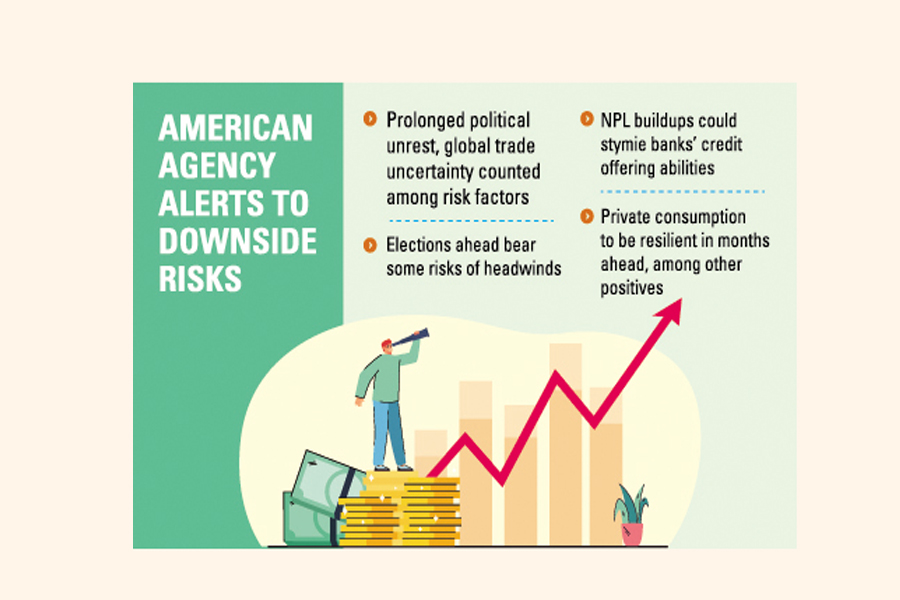
Bangladesh's slow-pace economic growth may be ramped up to 5.0 per cent by tailwinds before this fiscal year ends on June 30, 2026, as estimated by BMI, a unit of Fitch Ratings.

"We maintain our growth forecast of 5.0 per cent for FY2025/26," the global ratings agency's unit says in its latest report for Bangladesh.

This estimate is, however, lower than government's growth target at 5.5 per cent for the fiscal year.

But the agency has identified some downside risks, too, for the economy during the fiscal year under review.

"Risks to our forecasts are tilted to the downside, based on prolonged political unrest posing a greater drag on growth and global trade uncertainty."

The Fitch's unit forecasts private consumption will likely be more resilient in the next few months in Bangladesh, possibly as the country is on the cusp of transition from political turmoil.

While inflation appears to be "sticky to the downside", real wages contracted by a much slower average of 0.7 per cent year on year over January-November 2025 compared to an average contraction of 2.4 per cent y-o-y in 2024.

"The risk here is that unemployment rises aggressively in the coming months, as US tariffs continue to negatively impact the garment industry," it notes.

"Any further upside for spending will be capped by the elevated risk of unrest associated with the upcoming elections," the agency alerts.

"That will also weigh on private investment. Historically, economic growth in Bangladesh has slowed during periods of political unrest."

The American credit-rating agency, however, does not expect the current situation to match the severity of the "July Revolution" yet forecasts "a modest acceleration in growth".

It recounts that GDP growth typically falls during periods of high political unrest

Bangladesh, it says, is facing another key downside risk that lies in the credit sector. Non-performing loans (NPLs) in Bangladesh have been rising at a significant rate, reflecting years of weak credit-risk assessment and lending practices.

The situation is further aggravated by slow and ineffective loan recovery through the judicial system and highlights the growing difficulties that businesses face in servicing their debt.

"Elevated NPL ratios may also discourage banks from extending new credit, which would further constrain investment and weigh on economic growth."​
 
Industrial term loan disbursement grows 11.86pc in Q1 FY26

SAJIBUR RAHMAN
Published :
Jan 11, 2026 11:46
Updated :
Jan 11, 2026 11:46

1768112610323.webp

Industrial term loan disbursement posted significant year-on-year growth in the July-September quarter of fiscal year (FY) 2025-26, reflecting cautious investment appetite amid ongoing economic adjustments, according to Bangladesh Bank (BB) data.

Disbursement of industrial loans stood at Tk 247.71 billion during the period, marking an 11.86 per cent increase from Tk 221.46 billion in the same period of the previous fiscal year. The latest figure also shows a 1.96 per cent quarter-on-quarter rise compared to Tk 242.96 billion disbursed in the April-June quarter of FY25, indicating a gradual pickup in industrial credit flow.

However, loan distribution was notably higher in the October-December quarter of FY25, when banks disbursed Tk 310.82 billion, suggesting that credit momentum softened somewhat at the start of the current fiscal year.

On the recovery front, industrial loan repayments continued to improve, signalling stronger cash flow management by borrowers. Recovery of industrial loans reached Tk 289.22 billion in the July-September quarter of FY26, registering a sharp 41.06 per cent year-on-year increase from Tk 205.05 billion recovered in the corresponding quarter of FY25.

The recovery trend has remained on an upward trajectory over recent quarters.

Banks recovered Tk 271.81 billion in industrial loans during April-June FY25, up 2.82 per cent from Tk 264.36 billion recovered in the January-March quarter of FY25. Recovery peaked at Tk 331.75 billion in the October-December quarter of FY25, BB data showed.

Meanwhile, the outstanding stock of industrial loans stood at Tk 3.99 trillion at the end of the July-September quarter of FY26, underscoring the sector's continued importance in the overall credit portfolio of the banking system.

Bankers and analysts say the combination of moderate disbursement growth and rising recovery indicates a more risk-conscious lending approach by banks, amid concerns over asset quality, high interest rates and subdued private investment.

They also noted that sustained improvement in recovery performance could help ease pressure on banks' balance sheets and create room for fresh lending to productive industrial sectors in the coming quarters.

Syed Mahbubur Rahman, Managing Director and CEO of Mutual Trust Bank, said that mismanagement in certain sectors-particularly the recent LPG cylinder crisis-has disrupted market operations, leading to a temporary halt in LPG cylinder sales.

He emphasised the importance of prioritising energy security and maintaining law and order post-election to restore confidence among businesses and consumers.

Despite the current challenges, Mr. Rahman noted that new investments are still being made, albeit slowly, which he views as a positive indicator for the economy, contributing to job creation.

Additionally, he pointed out that some readymade garment (RMG) entrepreneurs are performing well, showing resilience and adaptability in the face of both global and domestic pressures, which is helping sustain export earnings and employment.

He also mentioned that one potential source of term loans could be demand/forced loans that are later restructured. With improvements in law and order and energy security, he believes that industrial lending could gain momentum in the near future, he added.​
 

Latest Posts

Back