Donate ☕
[🇧🇩] - Monitoring Bangladesh's Economy | Page 62 | PKDefense

[🇧🇩] Monitoring Bangladesh's Economy

⤵︎
Reply (Scroll)
Press space to scroll through posts
G Bangladesh Defense
[🇧🇩] Monitoring Bangladesh's Economy
927
24K
More threads by Saif

Regulate, not ban cryptocurrency

Atiqul Kabir Tuhin
Published :
Jan 08, 2026 01:01
Updated :
Jan 08, 2026 01:01

1767833328752.webp

Cryptocurrency is banned in Bangladesh, but its usage is booming in the shadow of a legal grey zone and the absence of effective regulatory oversight. Bangladesh ranks 13th among 151 countries worldwide in terms of cryptocurrency usage, according to the Global Crypto Adoption Index 2025, published by the international blockchain analytics firm Chainalysis. In the index, India ranks first, the United States second and Pakistan third, followed by Vietnam, Brazil and Nigeria. The index shows that despite the legal prohibition on the use and trading of cryptocurrencies, Bangladesh has emerged as one of the leading crypto-using nations in South Asia, ranking third in the region after India and Pakistan.

According to Investopedia, the growth of cryptocurrency from a speculative investment into a recognised asset class has prompted governments worldwide to develop regulatory frameworks. The United States, Canada, the United Kingdom, South Korea, Japan and many other countries allow crypto to operate within regulated frameworks. The European Union recognises cryptocurrencies as crypto-assets rather than illegal instruments.

In South Asia, India and Pakistan do not recognise crypto as legal tender, yet neither has formally outlawed its possession. India has lifted its ban and is now working toward a regulatory framework, while Pakistan is exploring blockchain and digital asset regulations. Japan, Switzerland and Singapore offer examples of balanced oversight that encourage innovation while attempting to curb misuse, raising questions about whether Bangladesh's blanket ban on its use is sustainable.

In Bangladesh, the absence of formal recognition has not prevented crypto activity. Instead, it has pushed the market into informal and largely unregulated channels, increasing risks related to fraud, security and capital flight. Although the country has made notable progress in digital connectivity and mobile financial services, there remains a lack of crypto-related infrastructure, public awareness and blockchain education.

Bangladesh Bank has repeatedly warned against cryptocurrencies, citing concerns over money laundering, terrorism financing and foreign exchange losses. While no law explicitly criminalises crypto ownership, existing regulations under the Foreign Exchange Regulation Act of 1947 and the Money Laundering Prevention Act of 2012 have been interpreted to prohibit such transactions. However, its usage continues to expand. Industry estimates suggest that millions of Bangladeshis hold accounts on international crypto exchange platforms such as Binance, Coinbase and Crypto.com, even though banks are not permitted to facilitate crypto payments.

Chainalysis identifies freelancing and remittances as key drivers. A large segment of Bangladesh's youth is engaged in online freelancing, and many receive payments from overseas clients in cryptocurrencies, particularly stablecoins such as USDT, because transactions are fast and relatively inexpensive. It is also believed that a portion of expatriate remittances is entering the country through crypto-based channels. At the same time, persistent currency depreciation and inflation have encouraged some users to convert savings into dollar-pegged digital assets. Cryptocurrency has also become a popular payment method for online gaming and international betting sites.

Most crypto activity in Bangladesh takes place through peer-to-peer exchanges. As users cannot directly purchase crypto with bank cards, they rely on local intermediaries listed on platforms such as Binance. Money is transferred in taka via banks or mobile wallets, and cryptocurrency is credited in return. Once received, it can be sent globally within minutes through blockchain networks. At the receiving end, holders may retain the asset, convert it into stablecoins or sell it back through local P2P markets. In effect, this system operates as a technology-driven money transfer network. It is kind of digital version of hundi.

The central bank views cryptocurrency as a threat because it is not issued or controlled by any government or central authority. Moreover, its value is highly volatile, and formal recognition carries the risk of encouraging gullible Bangladeshis to invest in crypto assets and suffer losses, just as many already suffered in the stock market. And then, it carries significant risk for money laundering. A recent investigation by the International Consortium of Investigative Journalists and The New York Times found that at least $28 billion in illicit funds flowed into prominent crypto exchanges, like Binance and OKX over the past two years.

Globally, regulators are also struggling with the misuse of digital assets by criminal networks. Hackers, cybercriminal groups and transnational fraud syndicates routinely exploit crypto platforms to move stolen or extorted funds. These concerns are legitimate. However, daily transactions continue to rise.

Faced with such a quandary, countries are increasingly moving away from imposing outright bans on cryptocurrency. Instead, they are focusing on regulating the points where digital assets intersect with the formal financial system. The intergovernmental Financial Action Task Force (FATF) now requires all countries to regulate Virtual Asset Service Providers (VASPs), including exchanges, peer-to-peer platforms, and wallet services, through strict KYC requirements, transaction reporting and cross-border information sharing.

Regions like the EU, the UK, and the UAE already enforce these rules. The EU's MiCA framework mandates full transparency from exchanges, while the UK requires platforms to freeze suspicious transfers. Even countries in the Gulf - Dubai, Abu Dhabi, and Bahrain - now require crypto businesses to register, maintain capital reserves and follow AML protocols. Meanwhile, rather than moving toward legalisation or prohibition, India has adopted a tax-first approach by imposing 30 per cent tax on gains and a transaction-level tax deduction.

The scale of the crypto use by Bangladeshis already indicates that it is no longer a fringe phenomenon. Ignoring it will not make it disappear. What is needed is acknowledgment, regulation and oversight that address genuine risks without denying economic reality.

To harness the potential of cryptocurrencies while mitigating their risks, Bangladesh could take several steps. First, it should develop a clear regulatory framework that defines legal usage, taxation, and compliance requirements. Public awareness campaigns are also essential to educate citizens about both the benefits and risks of cryptocurrency investments. At the same time, investment in digital infrastructure would help ensure secure and efficient crypto-related transactions. Regulations should prioritise consumer protection, anti-money laundering (AML)/know your customer (KYC) compliance, and innovation. Policymakers, central banks, fintech companies, academia, and civil society can collaborate to shape a strong legal framework for cryptocurrency adoption and prevention of its misuse.​
 
Analyze

Analyze Post

Add your ideas here:
Highlight Cite Fact Check Respond
Alternatives Bangladesh can explore to move away from the debt trap

1767836330663.webp

VISUAL: FREEPIK

Last month, at a seminar on the state of the economy, the chairman of the National Board of Revenue said that Bangladesh has "already slipped into a form of debt trap." This alarming statement, echoed by other senior officials, has set the national discourse alight with anxiety. However, before we succumb to the fear of an impending financial crisis, it's important to closely examine the economic assessment and consider whether the narrative of a debt trap is prematurely ruling out the potential for sovereign alternatives.


Let's start with the cold, hard numbers. Yes, our external debt has surged by 42 percent in five years to $104.48 billion. Yes, debt servicing is now the second-largest expense in our national budget, after salaries and pensions. These are serious pressures. However, Bangladesh's debt-to-GDP ratio is within the manageable threshold for an emerging economy.


The true crisis is not the stock of debt, but the anaemic stream of revenue needed to service it. Our tax-to-GDP ratio has collapsed to a perilous 7.7 percent, one of the lowest in the world. Nearly a third of our meagre government income is consumed by debt repayments, starving public investment in health, education, and infrastructure. Furthermore, our external debt now stands at a staggering 192 percent of our export earnings in 2024. Sixteen percent of export earnings is needed just for debt servicing.

This is a liquidity and revenue crisis. The vulnerability stems from a hollowed-out revenue base and also a dangerous dependence on dollar-denominated borrowing. As the taka depreciates, the local currency cost of repaying foreign loans skyrockets, creating a vicious cycle. The solution, therefore, lies not in panic-induced austerity alone, but in a dual strategy: radically strengthening domestic revenue collection and strategically de-risking from the volatile US dollar.


As these debt anxieties peak, the country is deep into a $4.7 billion IMF programme, with the next tranche hanging in the balance. The IMF's prescriptions—fiscal discipline, a market-driven exchange rate, banking reforms—although presented as technocratic necessities, are also classic tools of geopolitical alignment, keeping countries under the Western-dominated Bretton Woods system.

That is why the debt-trap narrative often instils a fear that paralyses sovereign strategic thinking. It ignores the fact that some successful emerging economies, from India to Indonesia, have not chosen one bloc over another but have skillfully navigated a multipolar world to their advantage. While many in the Global South are rapidly constructing a parallel financial infrastructure, Bangladesh is lagging.

In July 2023, Bangladesh and India launched a landmark mechanism to settle bilateral trade in rupees, bypassing the dollar. Yet, this initiative remains underutilised and half-hearted. Contrast this with India and Russia: in December 2025, they reaffirmed their commitment to settling nearly all their $68.7 billion bilateral trade in national currencies. Where is our aggressive push for settlement in local currencies with our largest trade partners?


Nations insulate their foreign exchange reserves through bilateral swap lines. In early 2025, Indonesia and China renewed a massive swap agreement worth RMB 400 billion. Bangladesh has discussed a yuan swap line with China, but it is yet to materialise.

Over 50 countries, including Bangladesh, have expressed interest in joining BRICS, a bloc whose GDP now surpasses that of the G7. One advantage of joining BRICS is having access to alternatives like the BRICS Bridge—a payment messaging system designed to operate independently of SWIFT. Yet, Bangladesh's interest has not translated into a decisive strategy to engage with the New Development Bank.

The path forward requires the courage to look beyond the existing narrative. This can include activating and expanding the rupee-taka mechanism with India and initiating government-to-government negotiations with China, the UAE, and other major partners to establish bilateral local currency settlement frameworks. Each dollar of trade settled in taka or a partner's currency is a dollar of pressure lifted from our reserves.

In addition, Bangladesh should treat currency swaps not as a financial technicality but as a cornerstone of national economic security and pursue a major swap line with China to secure yuan liquidity. We must also explore similar arrangements with other friendly central banks to create a buffer against speculative attacks on the taka. Additionally, we should begin technical engagement to connect our banking system with the BRICS Cross-Border Payments Initiative (BCBPI), while pursuing BRICS membership.

However, external diversification is meaningless without internal accountability. We must end the culture of tax exemptions, digitally integrate the tax net, and aim to double the revenue-to-GDP ratio in five years. Concurrently, we need a war on NPLs that combines fast-track asset recovery tribunals with pragmatic restructuring of viable businesses to unclog the banking system.

Bangladesh has options to pull itself out of the "debt trap narrative," through vigorous domestic resource mobilisation and strategic diversification that can lead to sovereign agency in a multipolar world. The arithmetic is clear, the global examples are there, and the tools are being built by our peers in the Global South. The question is whether we have the political will to reach for the key that has always been in our own hands. The time for a strategic, sovereign pivot is now.

Zakir Kibria is a Bangladeshi writer, policy analyst and entrepreneur based in Kathmandu, Nepal.​
 
Analyze

Analyze Post

Add your ideas here:
Highlight Cite Fact Check Respond
Remittances to be deposited to customers' accounts within 1-2 days

Staff Correspondent Dhaka
Published: 08 Jan 2026, 16: 04

1767920164177.webp

Bangladesh Bank has instructed banks to ensure that expatriate income or remittances received from abroad are credited to customers’ accounts on the same day or on the next working day.

The central bank on Thursday issued the directive through a circular which is effective immediately. However, banks have been given time until 31 March for full implementation.


Under the new directive, authorised dealer (AD) banks must notify customers via secure electronic means as soon as they receive an inward remittance message (internal expatriate income).

Remittances received during banking hours must be credited on the same working day, while those received after banking hours must be credited on the next working day.

Banks have also been advised to use straight-through processing (STP) or risk-based expedited procedures.

If the necessary information is available, funds may be credited to customer accounts even if some documentation or verification processes remain, with the remaining formalities to be completed later.

In cases where post-credit review is not possible, banks must complete verification before crediting the customer account and settle the transaction within three working days.

The circular emphasises payment tracking and transparency. To this end, banks have been instructed to use a unique end-to-end transaction reference (UETR) to follow the entire process from inward remittance receipt to final credit in the customer account.

Simultaneously, digital foreign currency platforms must be strengthened to eliminate the need for Form C and Form C (ICT) requirements.

A senior official of an international bank operating in Dhaka said, “This will increase trust among correspondent banks and further strengthen Bangladesh’s reputation in the global payment network.”​
 
Analyze

Analyze Post

Add your ideas here:
Highlight Cite Fact Check Respond
Tailwinds may lift economic growth to 5.0pc in FY26

FE Report
Published :
Jan 09, 2026 23:45
Updated :
Jan 09, 2026 23:45

1768006075753.webp

Bangladesh's slow-pace economic growth may be ramped up to 5.0 per cent by tailwinds before this fiscal year ends on June 30, 2026, as estimated by BMI, a unit of Fitch Ratings.

"We maintain our growth forecast of 5.0 per cent for FY2025/26," the global ratings agency's unit says in its latest report for Bangladesh.

This estimate is, however, lower than government's growth target at 5.5 per cent for the fiscal year.

But the agency has identified some downside risks, too, for the economy during the fiscal year under review.

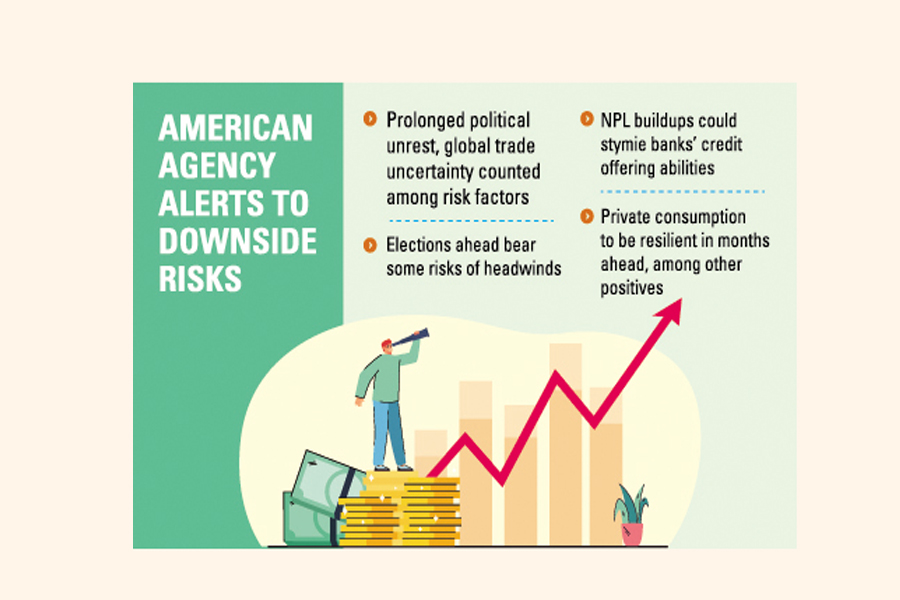
"Risks to our forecasts are tilted to the downside, based on prolonged political unrest posing a greater drag on growth and global trade uncertainty."

The Fitch's unit forecasts private consumption will likely be more resilient in the next few months in Bangladesh, possibly as the country is on the cusp of transition from political turmoil.

While inflation appears to be "sticky to the downside", real wages contracted by a much slower average of 0.7 per cent year on year over January-November 2025 compared to an average contraction of 2.4 per cent y-o-y in 2024.

"The risk here is that unemployment rises aggressively in the coming months, as US tariffs continue to negatively impact the garment industry," it notes.

"Any further upside for spending will be capped by the elevated risk of unrest associated with the upcoming elections," the agency alerts.

"That will also weigh on private investment. Historically, economic growth in Bangladesh has slowed during periods of political unrest."

The American credit-rating agency, however, does not expect the current situation to match the severity of the "July Revolution" yet forecasts "a modest acceleration in growth".

It recounts that GDP growth typically falls during periods of high political unrest

Bangladesh, it says, is facing another key downside risk that lies in the credit sector. Non-performing loans (NPLs) in Bangladesh have been rising at a significant rate, reflecting years of weak credit-risk assessment and lending practices.

The situation is further aggravated by slow and ineffective loan recovery through the judicial system and highlights the growing difficulties that businesses face in servicing their debt.

"Elevated NPL ratios may also discourage banks from extending new credit, which would further constrain investment and weigh on economic growth."​
 
Analyze

Analyze Post

Add your ideas here:
Highlight Cite Fact Check Respond
  • Love (+3)
Reactions: Bilal9
Industrial term loan disbursement grows 11.86pc in Q1 FY26

SAJIBUR RAHMAN
Published :
Jan 11, 2026 11:46
Updated :
Jan 11, 2026 11:46

1768112610323.webp

Industrial term loan disbursement posted significant year-on-year growth in the July-September quarter of fiscal year (FY) 2025-26, reflecting cautious investment appetite amid ongoing economic adjustments, according to Bangladesh Bank (BB) data.

Disbursement of industrial loans stood at Tk 247.71 billion during the period, marking an 11.86 per cent increase from Tk 221.46 billion in the same period of the previous fiscal year. The latest figure also shows a 1.96 per cent quarter-on-quarter rise compared to Tk 242.96 billion disbursed in the April-June quarter of FY25, indicating a gradual pickup in industrial credit flow.

However, loan distribution was notably higher in the October-December quarter of FY25, when banks disbursed Tk 310.82 billion, suggesting that credit momentum softened somewhat at the start of the current fiscal year.

On the recovery front, industrial loan repayments continued to improve, signalling stronger cash flow management by borrowers. Recovery of industrial loans reached Tk 289.22 billion in the July-September quarter of FY26, registering a sharp 41.06 per cent year-on-year increase from Tk 205.05 billion recovered in the corresponding quarter of FY25.

The recovery trend has remained on an upward trajectory over recent quarters.

Banks recovered Tk 271.81 billion in industrial loans during April-June FY25, up 2.82 per cent from Tk 264.36 billion recovered in the January-March quarter of FY25. Recovery peaked at Tk 331.75 billion in the October-December quarter of FY25, BB data showed.

Meanwhile, the outstanding stock of industrial loans stood at Tk 3.99 trillion at the end of the July-September quarter of FY26, underscoring the sector's continued importance in the overall credit portfolio of the banking system.

Bankers and analysts say the combination of moderate disbursement growth and rising recovery indicates a more risk-conscious lending approach by banks, amid concerns over asset quality, high interest rates and subdued private investment.

They also noted that sustained improvement in recovery performance could help ease pressure on banks' balance sheets and create room for fresh lending to productive industrial sectors in the coming quarters.

Syed Mahbubur Rahman, Managing Director and CEO of Mutual Trust Bank, said that mismanagement in certain sectors-particularly the recent LPG cylinder crisis-has disrupted market operations, leading to a temporary halt in LPG cylinder sales.

He emphasised the importance of prioritising energy security and maintaining law and order post-election to restore confidence among businesses and consumers.

Despite the current challenges, Mr. Rahman noted that new investments are still being made, albeit slowly, which he views as a positive indicator for the economy, contributing to job creation.

Additionally, he pointed out that some readymade garment (RMG) entrepreneurs are performing well, showing resilience and adaptability in the face of both global and domestic pressures, which is helping sustain export earnings and employment.

He also mentioned that one potential source of term loans could be demand/forced loans that are later restructured. With improvements in law and order and energy security, he believes that industrial lending could gain momentum in the near future, he added.​
 
Analyze

Analyze Post

Add your ideas here:
Highlight Cite Fact Check Respond
Global economic prospects and Bangladesh

Asjadul Kibria
Published :
Jan 11, 2026 00:10
Updated :
Jan 11, 2026 00:10

1768113496650.webp

Forecasting or projecting the world economic conditions for the near future is a regular exercise of a number of international bodies or organisations. The projections are primarily linked to a number of 'ifs' and 'buts', which minimises the scope for blaming organisations for wrong forecasts. The World Bank, International Monetary Fund (IMF), Organisation for Economic Co-operation and Development (OECD), and United Nations (UN) are four leading organisations that regularly forecast near- and long-term economic trends worldwide. Other organisations, such as the World Trade Organisation (WTO), forecast trends in global trade and use macroeconomic projections from the World Bank or the IMF. Organisations like the Asian Development Bank (ADB) focus on regional economic trends.

To predict the future of economic growth and inflation, the two most significant macroeconomic indicators, the organisations use various techniques and tools. Empirical data on economic indicators such as exports, imports, consumption, investments, interest rates, industrial output, consumer confidence, workers' productivity, retail sales, and unemployment rates are used to understand past trends. Geopolitical trends, such as wars and conflicts, and natural disasters, such as floods and droughts, are also taken into account by converting them into quantifiable variables. Models are applied to infer possible future scenarios using empirical data and other variables. Though economic forecasting is more than a century old, it gained momentum after the Great Depression in the 1930s.

The task of prediction, however, is tricky and complex, as economic environments are always changing. The conditions that shaped past events, such as technology, government policies, or global markets, may not be similar today or tomorrow. So, patterns of the previous years are unlikely to repeat exactly. In many economies, data quality is poor, leading to wide-ranging incorrect projections. The models used to predict the future also have limitations, as they are based on assumptions that may not be true. For instance, it is generally assumed that an economy goes through a business cycle, meaning that economic expansion is followed by a contraction, which then enters an expansionary phase later. Economic models, based on the alternating phases of expansions and contractions of the business cycles, predict that a recession will be followed by a recovery. Usually, forecasting models have tended to smooth out predictions. Forecasts may also be influenced by personal theories or biases. Human behaviour is another factor that may nullify the forecast. In many cases, people and markets often react to forecasts themselves, causing shifts that models cannot predict. Economists who generally forecast using various high-tech models mostly failed to predict most recessions over the last five decades. The most vivid example is the subprime mortgage crisis in the United States (US) that led to the global financial crisis in 2007 and the Great Recession in 2009.

Nevertheless, international organisations are making predictions and projections with the above-mentioned limitations, as these projections are critical for policymakers, investors, and consumers. Having an idea of where the economy might be headed helps them make better decisions about what to do today.

Last week, the United Nations Department of Economic and Social Affairs (UNDESA) released the World Economic Situation and Prospects 2026. It says the world economy is expected to grow by 2.7 per cent in 2026, slightly below the 2.8 per cent estimated for 2025 and well below the pre-pandemic average of 3.2 per cent. The report finds that last year, unexpected resilience to sharp increases in US tariffs, supported by solid consumer spending and easing inflation, helped sustain growth. According to the report, headline inflation declined from 4.0 per cent in 2024 to an estimated 3.4 per cent in 2025, and is projected to slow further to 3.1 per cent in 2026.

UNDESA identifies five key factors clouding the global economic outlook: increased macroeconomic uncertainties, shifting trade policies mainly due to the sharp rise in US tariffs by President Donald Trump, persistent fiscal challenges, geopolitical tensions, and financial risks. The abduction of Venezuelan President Nicolas Maduro and his wife Cilia Flores by the US army in the first week of the New Year has sharply increased global geopolitical tension. Trump is now threatening Iran with a hard strike, and he may order US troops to attack Iran at any time. These unseen and unpredictable factors are not directly included in projections for the global economy in 2026. It was also not possible to do so.

UN expects 'broadly stable growth prospects for major economies' but 'uneven growth momentum across developing regions'. For South Asia, the economic outlook remains robust, driven by strong private consumption and public investment. The regional gross domestic product (GDP) is expected to expand by 5.6 per cent in 2026 and 5.9 per cent in 2027, following an estimated 5.9 per cent growth in 2025.

In India, growth is estimated at 7.4 per cent for 2025 and forecast at 6.6 per cent for 2026 and 6.7 per cent for 2027, backed by resilient consumption and robust public investment. The UN expects these two factors to largely offset the adverse impact of higher US tariffs. The latest US move to impose 500 per cent punitive tariffs on India for purchasing Russian oil is not included in the projection. If imposed, a 500 per cent tariff would amount to a trade embargo, making Indian goods commercially unviable in the US market. An estimate shows that exports of $120 billion may take a severe hit, with labour-intensive sectors like textiles and gems and jewellery facing closures and job losses. These sectors have already been under 50 per cent tariffs since August last year.

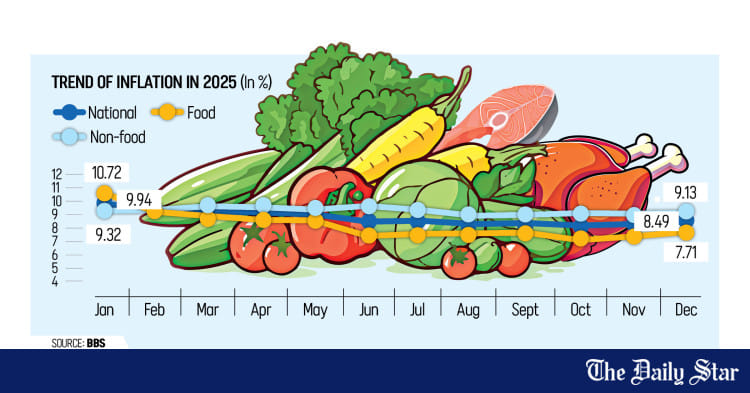
Average consumer price inflation is predicted to rise from an estimated 8.3 per cent in 2025 to 8.7 per cent in 2026. Last year, inflation across the region declined in 2025, with rates in most economies at or below central bank targets and long-term averages. Bangladesh, however, faced an inflation rate above the central bank's target, averaging 8.90 per cent. The report also projects that the rate may come down to 7.10 per cent in the current year. According to UNDESA, Bangladesh is likely to continue recovering, with economic growth projected at 5.1 per cent in FY26. How much these projections will be realised remains to be seen.

 
Analyze

Analyze Post

Add your ideas here:
Highlight Cite Fact Check Respond
Bangladesh sees $1.12b in remittances in first 10 days of January

UNB
Published :
Jan 11, 2026 21:46
Updated :
Jan 11, 2026 21:46

1768177650223.webp

The remittance from Bangladeshi expatriates continued its upward momentum in January, with the country receiving more than US$1.12 billion in the first 10 days of the month.

Bangladesh received $17.39 billion in inward remittances from July to January 10, 2026, in the current fiscal year, FY 2025-26. It was 14.49 billion in the same period of the previous FY2024-25, saw a growth of 20 percent.

Blessings on the remittance, the gross forex reserves of Bangladesh cross $33 billion. As per the IMF standard BPM6, the forex reserves stood at $29 billion plus.

Arif Hossain Khan, Executive Director and spokesperson of Bangladesh Bank (BB), said the expatriates have sent $1.12 billion in the first 10 days of January 2026, which was $7.17 million in the same period of January 2025. It means the remittance earnings grew by 57.2 percent in this time.

The growth is attributed to several factors, including incentives offered for sending money through legal banking channels, increased encouragement for using the formal system, and the active role of exchange houses.

In the FY2025-26, Bangladesh received $2.47 billion in remittances in July, $2.42 billion in August, $2.68 billion in September, $2.56 billion in October, $2.88 billion in November, and $3.22 billion in December.

The data showed an average inward remittance of over $2.42 billion in the past six months, prompting Bangladeshi policymakers to favour remittance inflows over borrowing from the IMF with stringent conditions.​
 
Analyze

Analyze Post

Add your ideas here:
Highlight Cite Fact Check Respond
Net FDI jumps over 200pc in Q3

BSS
Published :
Jan 11, 2026 19:42
Updated :
Jan 11, 2026 19:42

1768177988082.webp

Bangladesh recorded a robust rise in net Foreign Direct Investment (FDI) during July-September 2025, reflecting positive investor confidence amid global uncertainties.

According to the latest figures released by Bangladesh Bank, net FDI inflow for Q3 (Jul–Sep) stood at US$315.09 million, marking a 202 percent year-on-year increase from the $104.33 million recorded during the same quarter in 2024, said a press release.

Cumulatively, total net FDI inflows for January–September 2025 stood at $1.41 billion, marking an 80 percent increase compared to $780 million during the corresponding period of 2024.

All major FDI components saw significant improvement in Q3’25. Equity investment rose 31.69 percent YoY, from $76.79 million to $101.12 million; reinvested earnings soared 190.07 percent YoY, from $72.90 million to $211.47 million and intra-company loans reversed from a negative -$45.36 million to a positive $2.49 million.

This growth builds on a strong H1 performance. In April–June 2025, net FDI had already reached $303.27 million, compared to $272.22 million in Q2 of the previous year—representing a year-on-year gain of 11.4%. Overall, net FDI in H1’25 (January–June) increased by more than 61% compared to H1’24.

“BIDA’s core work is to improve the business climate and develop a credible pipeline of investment. It is encouraging to see this pipeline begin to convert into realized inflows. The benchmark remains low, but these back-to-back quarterly gains highlight that investors are placing their trust in Bangladesh,” said Ashik Chowdhury, Executive Chairman of BIDA.

“We expect some moderation in Q4’25 due to the upcoming elections, but anticipate a rebound post-election, supported by a strong investment pipeline,” he added.

Beyond the actualized figures, BIDA’s dedicated investment pipeline for 2025 has already surpassed $1.5 billion in addition to the traditional registered proposals.​
 
Analyze

Analyze Post

Add your ideas here:
Highlight Cite Fact Check Respond
Govt. implementing reforms to foster liberalised economic environment: Bashir

BSS
Published :
Jan 11, 2026 17:41
Updated :
Jan 11, 2026 17:41

1768178124174.webp

Commerce Adviser Sk Bashir Uddin said that the government is implementing comprehensive reforms to trade policies and commercial laws to foster a more liberalised, inclusive, and justice-based economic environment on Sunday.

The government is currently finalising changes to the Import Policy Order (IPO) aimed at simplifying trade operations, he said.

“These reforms focus on easing transaction instruments and aligning conformity assessment requirements with international standards to which Bangladesh is a signatory. These amendments are expected to be presented to the Cabinet for approval very shortly, possibly in the upcoming session,” the adviser said while talking with reporters at Bangladesh Secretariat in the city.

In his speech, Bashir said that to make the legal framework more time-befitting for future economic challenges, several key pieces of legislation are undergoing amendments, including the Company Act, the Consumer Rights Protection Act and the Control of Essential Commodities Act (Competition Act).

The adviser emphasised that the ministry, along with its various wings, is working collectively to bring about structural, procedural, and cultural changes in the trade sector.

On the international front, he highlighted significant progress in trade negotiations.

Addressing trade relations with India, Bashir stated that daily bilateral incidents generally do not impact broader trade dynamics.

“While Indian port closures earlier this year (around May) led to a decrease in Bangladeshi exports, the government has refrained from taking counter-measures,” he added.

The adviser clarified that specific domestic policies, such as restrictions on jute exports, are designed solely to meet internal demand and maintain local supply, rather than to target any specific trading partner.

Bangladesh remains committed to liberal trade globally unless a particular trade situation is deemed harmful to the national economy, he added.

In anticipation of the upcoming month of Ramadan, the adviser announced that a stakeholder meeting is scheduled for January 19.

This meeting will involve a thorough review of the current stock and import status of essential commodities to ensure market stability and address potential price hikes, he added.​
 
Analyze

Analyze Post

Add your ideas here:
Highlight Cite Fact Check Respond
Protecting local industries

Published :
Jan 11, 2026 23:37
Updated :
Jan 11, 2026 23:37

1768178578380.webp

For a developing country like Bangladesh, the importance of pursuing an import substitution strategy cannot be overstated. Import substitution is not merely about reducing dependence on foreign goods; it is a strategic pathway to building a robust industrial base, generating employment, saving foreign reserve and deepening backward linkages that support the export sector. Ironically, however, many of the country's local industries producing goods such as sugar, jute, yarn, handloom products and other items have already shut down or are on the verge of closure largely because imported goods are cheaper than their domestically produced counterparts. This exposes a stark reality of Bangladesh economy that when imported goods flood the market, locally made products remains unsold, triggering factory closures and large-scale layoffs.

The plight of local spinning mills vividly illustrates this problem. Over the years, nearly 500 spinning mills have been established to cater to the need for yarn in the country's thriving ready-made garment (RMG) industry. Yet, as Indian yarn is cheaper, the RMG sector has grown heavily dependent on imports for this critical raw material. While Bangladeshi mills sell 30-count yarn at around US$ 3.0 per kilogram, Indian producers sell the same yarn at US$ 2.60. Consequently, despite the government's ban on yarn imports through land ports, imports of Indian yarn surged by 137 per cent in the last fiscal year through sea ports. Estimates suggest that more than 80 per cent of the yarn used in the garment industry now comes from India. Meanwhile, leaders of the Bangladesh Textile Mills Association (BTMA) lament that unsold yarn worth around Tk 120 billion is currently lying idle in local mills. As a result, some 50 spinning mills have been forced to shut down operations in the past one year, leaving around 0.2 million workers unemployed.

The BTMA has called for the imposition of a safeguard duty on import, a 10 per cent cash incentive and other supportive measures to ensure the survival of the local spinning industry. In response, the government is reportedly considering a 20 per cent safeguard duty on imports of certain types of yarn. However, the move has run into a hitch as garment manufacturers have opposed it. Garment exporters say that they are also in favour of protecting the domestic spinning industry, but any move to raise import cost, ostensibly to compel them to buy local yarn at higher costs, would ultimately undermine their export competitiveness. This concern cannot be dismissed. The solution to the plight of local spinning mills does not lie in simply forcing garment manufacturers to buy costlier local yarn. Rather, the focus must be on enabling domestic spinners to become more competitive through modernisation, access to affordable fund and predictable, long-term policy support.

Other countries offer instructive examples in this regard. India, for instance, provides cash incentives of up to 15 per cent alongside dedicated funds for technological upgrades in the textile sector. Historically, most successful industrial economies nurtured their domestic industries through a mix of incentives, infrastructure investment and strategic protection. By contrast, Bangladesh reduced its cash incentive for domestic yarn production from 5.0 per cent to 1.5 per cent, at a time when producers were already struggling with rising costs. Policy inconsistency and weak institutional support have only compounded the problem. So, if protection of local industries is to move beyond rhetoric, Bangladesh must commit to a coherent industrial policy that prioritises competitiveness, technological upgrading and stability. Without such a framework, local industries will continue to wither under the pressure of cheaper imports. Without strong local industries, the promise of a self-reliant and resilient economy will remain out of reach.​
 
Analyze

Analyze Post

Add your ideas here:
Highlight Cite Fact Check Respond
Overcoming economic malaises

Published :
Jan 13, 2026 00:25
Updated :
Jan 13, 2026 00:25

1768264462038.webp

The Centre for Policy Dialogue (CPD), a local think tank, has pinpointed the weaknesses of the country's economy and also recommended various measures to overcome those. In fact, the very title of the paper, "State of the Bangladesh Economy in FY2025-26" amply clarifies the objectives of the briefing organised by the CPD's Independent Review of Bangladesh's Development (IRBD) programme at its Dhaka office. It has spelt out the challenges the government to be formed following the next month's general election will face. Strong fiscal discipline, according to the paper presented by Dr Fahmida Khatun, will be the key to a turnaround for the economy. The contractionary monetary policy now being followed cannot continue eternally. There is a compelling need for investment from the country's private sector as well as foreign sources. Unrelenting inflation with no compatible rise in income compounded by no job creation leads to stagflation which now stares in the face of Bangladesh.

The list of economic malaises is long but at a time when economists are in favour of private and foreign investments, the lowest ever ADP (annual development programme) implementation is a stark aberration. These are highly contradictory. ADP programmes not only boost infrastructure in developing countries but also create jobs. Why not the bungling bureaucracy be held accountable for this miserable performance? The interim government has totally failed to breathe fresh air into ADP execution and yet it goes for rewarding the same bureaucracy by offering salary increases for the inefficient behemoth. In the first quarter of FY2025-26, the ADP implementation was only 8.33 per cent, which increased to 11.75 per cent in the July-November period, forcing budget cuts. In the first quarter of the previous fiscal, the rate was 7.90 per cent, ending the year at 41 per cent. So, the rate may increase in the second and third quarters but still it will lag far behind the targets.

ADP programme implementation is fundamental for providing momentum to economic development through structural reforms and generation of employment. At the same time, mobilisation of tax by expanding the range and scope of taxable net prove vital for government's income. Now that debt servicing is eating away the country's income from taxes, export and remittance, the development fund is further squeezed. The heavy reliance on costly imported liquefied natural gas further reduces the accumulation of funds. To cope with the increasing demand for gas and power, there is no alternative to exploring local sources of gas and expanding the base of renewable energy. In this connection, climate change-induced compulsions may prove overriding within a few years.

That the time for trickle-down benefits of development for the poor is over should be kept in perspective of all development programmes. Education and skill must be compatible with industrial requirements in order to address the rising unemployment. The hard reality is that even if the educated youths are provided with jobs, there will be a huge legion of uneducated or barely literate young people. To bring them out of the rut, at least functional literacy with prospective skill development is required. As for food security of the most vulnerable, bottle-feeding has to be brought to an end at some point. The poor and vulnerable groups should be detected for initial support for education and health but the main objective would be to pull their next generation out of the poverty cycle. This is how they can cope with the supply side economy.​
 
Analyze

Analyze Post

Add your ideas here:
Highlight Cite Fact Check Respond
BD in troubled waters of tomorrow

SYED FATTAHUL ALIM
Published :
Jan 13, 2026 00:21
Updated :
Jan 13, 2026 00:21

1768264786845.webp

As is the usual practice every year, economists and experts on business trends locally and globally have been making their projections and predictions about how the country's as well as the world's economy will fare in the coming year (s). So far as Bangladesh's economy is concerned, much cannot be expected from it in the near future until its manufacturing sector comes of age. For, at present, the manufacturing is dominated by the Readymade Garment (RMG), which contributes roughly 25 per cent to the GDP and 81 per cent to the total export earnings. Overall, the manufacturing is contributing 34.81 per cent to the GDP.

The RMG sector demonstrated some resilience in the first half of last year, but in the second half its performance faced challenges (in November last year the export actually contracted) from external market due to uncertainties in international trade and politics. But to overcome Bangladesh's export-related challenges, diversification of exportable products as well as their destinations has become urgent. In this connection, the apparel industry's Apex body, BGMEA's talk of reaching a Free Trade Agreement (FTA) with Mercosur or Southern Common Market, which is a South American trade bloc, is a positive step forward. Notably, the size of the Mercosur economy is approximately USD 3 trillion. So, it is a move that may prove worth the while in the long run. The present-day world's economic order is highly volatile in the face of the US president Donald Trump's tariff-centred and other wars.

Bangladesh being an export-dependent economy, it could not remain unaffected by its impact since even after some exemptions, the main export item, the apparel products, would still have to pay 20 per cent tariff to enter the US market. The ongoing war in Ukraine, political volatility in the Middle East and other issues have reduced Bangladeshi apparel products' demand in their main destinations in the European Union (EU) and North American markets. And, following graduation scheduled for the month of November this year, the preferential treatment Bangladesh's exports had so far been receiving as a member of the LDCs from the EU markets might come to an end. So, the future does not hold much in store for Bangladesh as an export-and-remittance dependent economy. There are also challenges regarding remittance, given the political uncertainties in the Middle East. So, the hope that things both in the regional and international contexts would soon return to normalcy might prove to be a chimera. In that case, Bangladesh will have to fend for itself, keenly watch development abroad and prepare for the worst in the coming days. Economists and observers of the international financial markets are forecasting about the risk of another crisis in the global market driven by the US economy as the value of US dollar is falling. The US economy is facing a huge debt burden of USD38 trillion, with the public debt amounting USD30.8 trillion, which is between 120 and 125 per cent of that country's GDP. That explains to some extent President Trump's warmongering postures. In fact, US's economic decline vis-à-vis the rise of China's as a competitor on the global stage has a lot to do with the developments. The US-dominated unipolar world is giving way to multipolarity led by emerging economies like China. But changes are not going to happen smoothly. Bangladesh will have to learn to navigate through these ever-emerging complexities of the new world order in the making. That would require an able political leadership at the helm. It is expected that the elected government to take office following the February polls will be competent enough to efficiently deal with the upcoming challenges on the home as well as the regional and global fronts.​
 
Analyze

Analyze Post

Add your ideas here:
Highlight Cite Fact Check Respond
Three economic priorities for the upcoming political government

By Fahmida Khatun

1768268578031.webp

VISUAL: ANWAR SOHEL

The upcoming parliamentary election, scheduled for February 12, is of exceptional political and economic significance for Bangladesh. For many years, elections failed to serve as genuine instruments of democratic choice. The lack of meaningful opposition participation, allegations of vote manipulation, and ritualistic voting practices weakened democratic institutions and entrenched an increasingly authoritarian system. A generation of young citizens grew up without getting to exercise their right to vote, leading to political disengagement, erosion of public accountability, and a collapse of trust in state institutions. The election, therefore, offers a historic opportunity to restore democratic legitimacy, rebuild public confidence, and reset the relationship between citizens and the state.


However, restoring electoral credibility alone will not be sufficient. The next government will inherit an economy under severe strain after years of policy complacency, institutional erosion, and weak macroeconomic management.


In recent years, Bangladesh’s economic momentum has weakened. Growth has slowed, inflation has remained stubbornly high, and the banking sector continues to struggle under the weight of rising non-performing loans. Low private and foreign investment, inefficient public investment, rising public debt, declining real wages, and weak employment generation are placing a lasting strain on the economy.

Against this challenging backdrop, the newly elected government will inherit a daunting reform agenda aimed at restoring economic discipline, strengthening governance, and delivering better outcomes for ordinary citizens. The list of priorities is long and complex. However, three urgent and interconnected issues stand out and require immediate, decisive attention. These will shape not only the direction of economic recovery, but also the credibility and effectiveness of the new administration.


First, controlling inflation must be the new government’s top economic priority. Over the past several years, the country has experienced persistently high inflation, driven mainly by rising food and energy prices. As food accounts for more than half of household expenditure for low-income families, rising prices have significantly reduced purchasing power and increased financial pressure across income groups. Wage growth has lagged inflation, leading to declining real incomes and eroding household savings, while middle-income families have reduced spending on education, healthcare and nutrition.

High inflation also weakens overall economic performance. It creates uncertainty for businesses, discourages long-term investment, puts pressure on the exchange rate, and undermines confidence in economic management. Once inflation expectations become entrenched, restoring price stability becomes more difficult and costly.

Inflationary pressures reflect both global shocks and domestic policy weaknesses. While higher global commodity prices raised import costs, exchange rate controls delayed adjustment and encouraged speculation. Energy prices were kept below cost for years and then adjusted sharply, raising production costs. Heavy government borrowing from the banking system added demand pressures, while weak competition, poor storage facilities and inadequate transport infrastructure constrained food supply.


The next government must adopt a comprehensive and credible anti-inflation strategy. Bangladesh Bank should be granted clear operational independence to prioritise price stability, supported by a transparent interest rate framework aligned with economic conditions. Fiscal discipline must be restored by reducing reliance on bank borrowing and strengthening revenue mobilisation, so that monetary policy can operate effectively and inflationary pressures are contained.

Food market reforms should focus on strengthening competition, dismantling syndicates and hoarding, improving storage and transport infrastructure, and raising agricultural productivity. Energy pricing should follow a predictable, rules-based adjustment mechanism to avoid abrupt shocks. A transparent, automatic pricing formula, linked to global fuel prices and exchange rate movements, would allow gradual adjustments, reduce fiscal risks from subsidies, and provide greater certainty for households and businesses.


Second, private investment is essential to restoring growth, productivity, and job creation. Investment drives long-term economic expansion by supporting innovation, industrial upgrading and employment. In recent years, however, Bangladesh’s investment momentum has weakened. Private investment has stagnated, while rising public investment has delivered limited returns due to concerns about project quality, governance and efficiency.

Foreign direct investment remains particularly weak relative to regional competitors. This reflects persistent concerns about policy uncertainty, regulatory complexity, weak contract enforcement, infrastructure bottlenecks, bureaucratic inefficiencies, and financial sector fragility. Together, these factors have undermined investor confidence and discouraged long-term capital commitments.

The banking sector has become a major constraint on investment. Political interference, weak governance, and repeated loan rescheduling have eroded credit discipline. Productive firms struggle to access finance, while connected borrowers continue to receive preferential treatment, distorting capital allocation and weakening financial intermediation.

A comprehensive reform agenda is required to restore investment momentum. Banking sector governance must be strengthened, loan recovery enforced, asset quality reviews completed, and regulatory forbearance phased out. At the same time, the business environment must improve through streamlined regulation, digitised public services, simplified tax administration, reduced discretionary authority, and stronger contract enforcement.

Infrastructure development must prioritise efficiency and reliability over scale alone. Persistent weaknesses in power supply, ports, customs, and logistics continue to drive up business costs and undermine export competitiveness. Without modern infrastructure and predictable regulation, the country will struggle to integrate into global value chains and diversify its economy.

Third comes job creation. Bangladesh stands at a demographic crossroads. Around two million young people enter the labour force each year, yet employment growth has lagged far behind. Youth unemployment is more than twice the national average, and most new jobs are informal, with low productivity. Educated unemployment is rising, exposing a growing mismatch between education and labour market needs. This is not only an economic failure but also a social and political risk.

Job creation depends on restoring macroeconomic stability and reviving investment. High inflation erodes real wages, weakens consumer demand, and discourages hiring. Low private investment limits firm expansion and the formation of new enterprises. A stable macroeconomic environment, predictable policies, and a business-friendly regulatory regime are therefore essential foundations for employment growth.

Targeted labour market reforms are equally critical. Education and training must align with industry demand, with a major expansion of well-funded technical and vocational programmes. SMEs, the main source of employment globally, need easier access to finance, stronger market linkages, and simplified regulations. A focused SME growth strategy can rapidly create large numbers of jobs.

If employment opportunities grow, the gains will be transformative: higher incomes, lower poverty, stronger domestic demand, a broader tax base, and greater social cohesion.

The upcoming election is not only about who governs Bangladesh but also about how it is governed. Democracy must be matched by economic discipline, leadership and accountability. If the new government governs with courage and responsibility, the country can begin a new chapter of stability, opportunity and trust.

Dr Fahmida Khatun is executive director at the Centre for Policy Dialogue (CPD).​
 
Analyze

Analyze Post

Add your ideas here:
Highlight Cite Fact Check Respond

Latest Posts

Latest Posts

Post