Donate ☕
201 Military Defense Forums
[🇧🇩] - Monitoring Bangladesh's Economy | Page 19 | PKDefense
Home Login Forums Wars Movies Watch Videos
Serious discussion on defense, geopolitics, and global security.

[🇧🇩] Monitoring Bangladesh's Economy

Reply (Scroll)
Press space to scroll through posts
G Bangladesh Defense
[🇧🇩] Monitoring Bangladesh's Economy
948
25K
More threads by Saif

Challenges on the road to becoming the 28th largest economy​


1707959861055.webp

Investment, both domestic and foreign, plays a pivotal role in fostering economic growth. PHOTO: REUTERS

Bangladesh undeniably stands out as one of the most promising economies in the region. Despite facing resource constraints, the country has made commendable economic and social progress since independence. This success is a testament to the indomitable spirit of the Bangladeshi people, their relentless struggle for survival, and their remarkable commitment, determination, and entrepreneurial spirit. With an average annual GDP growth of six percent since the 2000s, Bangladesh currently holds the 35th position among global economies, and it is projected to become the 28th largest economy by 2030. However, this ambitious journey toward economic advancement is not without its challenges. The critical hurdles on our path include tackling poverty, addressing income inequality, managing high inflation and external debt burden, attracting foreign investment, improving resource mobilisation, addressing foreign exchange shortages, curbing corruption, ensuring the stability of the financial sector, and others.

In recent years, Bangladesh has borrowed heavily to finance various mega projects. Consequently, annual debt servicing has been on the rise, which now constitutes a substantial share of the government's expenditures. According to data from the Bangladesh Bank, the total government debt, comprising both domestic and foreign, reached around the $100-billion mark at the end of June 2023. While some of these projects may yield long-term benefits, the immediate requirements for debt servicing pose a challenge for the government's financial capacity. Currently, Bangladesh has to repay foreign loans ranging from $2-2.76 billion annually, and this amount is expected to rise in the coming years. According to a finance ministry projection, foreign debt repayments, including interests, will reach $4.5 billion in 2025-2026. The increasing external debt service payments are straining the country's foreign exchange reserves.​

1707959897795.webp

With an average annual GDP growth of six percent since the 2000s, Bangladesh currently holds the 35th position among global economies. VISUAL: TEENI AND TUNI

Concurrently, debt-service payments are diverting already scarce fiscal resources from critical sectors such as healthcare, education, social assistance, and infrastructure development. While experts argue that Bangladesh's current debt-GDP ratio is not a cause for concern, it shouldn't be seen as a green light for indiscriminate loan accumulation. To secure the nation's economic future, it is crucial for policymakers to prioritise projects by carefully assessing payback periods, thus preventing potential debt traps. Ensuring the efficient utilisation of borrowed funds is paramount to sustaining the economic cycle in the face of challenges.

Investment, both domestic and foreign, plays a pivotal role in fostering economic growth, improving the skills of the local workforce through the transfer of technology, leading to job creation, higher incomes, and improved standards of living. Research shows that to transform Bangladesh into a high-income country, it would need to raise its investment-to-GDP ratio to around 40-44 percent of GDP. Regrettably, private investment has shown little growth, hovering at around 23-24 percent of GDP for the past decade, as reported by the Bangladesh Bureau of Statistics (BBS). We are also lagging behind in attracting foreign direct investment (FDI). While even during the pandemic (2020) FDI flow to developing countries in Asia increased by four percent to $535 billion, according to figures from the UN Conference on Trade and Development (UNCTAD), Bangladesh could not achieve the expected FDI. As per Bangladesh Bank's data for the fiscal year 2023, the nation attracted approximately $3.2 billion in foreign direct investment. The rate of FDI inflow in Bangladesh is only around one percent of GDP, one of the lowest in Asia.

1707959948717.webp

ILLUSTRATION: Salman Sakib Shahryar

It's crucial to recognise that the level of convenience in doing business holds significant importance for foreign investors when deciding where to invest. The ease of doing business and global competitiveness are key factors influencing their investment choices. Investors assess various aspects, including the clarity of existing policies, reliability of government officials, taxation policies, adherence to rules and regulations and, most importantly, the security provided for their investments.

Regrettably, in the case of Bangladesh, investors often express frustration due to bureaucratic hurdles that impede smooth business operations. These challenges include bureaucratic red tape, inadequate socio-economic and physical infrastructure, inconsistent energy supply, corruption, underdeveloped money and capital markets, a complicated tax system, along with delays in decision-making processes. Furthermore, hidden costs related to procedures, policies, laws, and infrastructure significantly impact the overall cost of doing business.

Therefore, in light of the current economic challenges, it is essential to boost investment inflow by making timely adjustments to policies. The government should remove the impediments that are responsible for the high cost of investment and promptly take measures to improve public goods and services, including roads, electricity, gas, water, and sewerage. Additionally, the government should implement business-friendly policies safeguarding the rights of enterprises, workers, consumers, the environment and, most importantly, ensure a stable political environment to attract both domestic and foreign investments.

1707959994813.webp

Bangladesh undeniably stands out as one of the most promising economies in the region. VISUAL: REHNUMA PROSHOON

Bangladesh's export portfolio is primarily dominated by its ready-made garments (RMG) sector. In the fiscal year 2022-2023, the total export from Bangladesh amounted to $55.56 billion, with RMG exports contributing $46.99 billion. Currently, the RMG sector accounts for 85 percent of the country's total exports, with primary destinations being the European Union and the United States. The RMG sector has played a transformative role in shaping our economy, job market, and income, but due to ongoing global geopolitical conflicts, energy price hike, domestic political unrests, currently, the RMG sector is in a sluggish state. Hence, for Bangladesh to sustain its growth trajectory, diversification of the export basket and tapping into new markets is imperative.

Industry insiders say that there are promising export sectors such as pharmaceuticals, bicycles, shipbuilding, leather and leather goods, frozen and live fish, terry towels, furniture, and agricultural products, if the government provides adequate policy support, similar to what is offered to the RMG sector.
1707960028547.webp

According to a finance ministry projection, foreign debt repayments, including interests, will reach $4.5 billion in 2025-2026. VISUAL: TEENI AND TUNI

Foreign remittance is Bangladesh's lifeline. Despite an increasing number of Bangladeshis leaving for jobs abroad, in recent times, the remittance inflow has been decreasing at an alarming rate. In September 2023, migrant workers sent home $1.34 billion—the lowest since April 2020, according to data from Bangladesh Bank. Large remittances are sent through informal channels like hundi despite a 2.5 percent incentive for the remitters through the banking channel. Many argue that the widening gap between official and unofficial exchange rates, lack of motivation, and institutional barriers such as high transaction costs and formalities for sending remittances through formal channels hinder remitter's use of banking services. Currently, Bangladesh is struggling with a prolonged dollar crisis and is compelled to restrict imports due to falling reserves. Remittances play a vital role in growing foreign exchange reserves and economic growth. Hence, an urgent policy focus is required to shift remittances from informal to formal channels.

One of the biggest concerns for the economy is our ailing banking sector, which has, on numerous occasions, been tarnished by unwanted malpractices. It is now an open secret that the country's banking sector has been entangled in a series of scams and irregularities, such as the funnelling of loans worth billions of taka by violating banking rules and procedures to influential people known for lax repayments. Unfortunately, violators of banking norms and regulations are hardly ever punished, and they are allowed to continue to default on loans with impunity. As a result, at the end of FY 2022-23, defaulted loans in the banking sector stood at a record Tk 156,040 crore.

Banks are the lifeblood of the economy; therefore, regulators should take pre-emptive measures to control the current situation before it worsens and gets out of control. A combination of strong policy reforms and good governance in the banking sector is the need of the hour. Measures should include legal action against wilful loan defaulters, enhanced banking regulation and supervision, addressing banking sector weaknesses, tighter criteria for loan rescheduling/restructuring, and improved legal systems to accelerate loan recovery. If enforcement authorities take these measures with the right intentions, Bangladesh will embark on a path to creating a stronger economy.
1707960065757.webp

A vendor sells fish at a market in Dhaka. PHOTO: REUTERS

Over the past decade, Bangladesh has consistently demonstrated impressive economic growth. However, one may ask: has everyone been able to share its benefits equally? The answer, sadly, is "no." The growth has, unfortunately, bypassed the majority of the population while higher-income groups have been its main beneficiaries. The country has experienced a rapid increase in income inequality, with 10 percent of the population owning 40 percent of the national income, while the bottom 50 percent possess only 19.05 percent of GDP. The primary factors which deprive poor and vulnerable people of their most elementary rights—and which lead to greater income inequality—are unequal access to education and employment opportunities, low-wage jobs, unchecked corruption and systemic irregularities (such as those enabling the various scams in the banking sector), tax evasion, money laundering, and so on.

The growing gap between the rich and poor not only hinders sustainable growth but also increases the risk of social and political unrest. As such, it's essential for our policymakers to stop favouring the wealthy and start focusing on fair treatment for everyone. The main goal should be to achieve inclusive growth. We need to address issues like wealth sharing, good governance, and social policies that promote fairness and equality. It may be noted that a society that is happy, equal, and just will always experience peace and prosperity.

Inflation has been adversely affecting the common people in Bangladesh. Prices of daily essentials, including eggs, chicken, onions, potatoes, sugar, and oil, have consistently increased, contrasting with the global trend of decreasing prices. Purchasing daily necessities has become increasingly challenging, as highlighted in a recent report by the World Bank. According to the report, 71 percent of families are being affected by rising food prices. This alarming statistic implies that out of the 4.10 crore families, almost 2.91 crore are facing food insecurity, a matter of grave concern. If the current trajectory of inflation and escalating living costs persists, there is a significant risk of more families falling into poverty.

1707960125820.webp

VISUAL: STAR

Experts say that soaring food inflation rates in the country are linked to flawed government policies, poor market management and the profit-seeking behaviours of certain businessmen involved in syndicates. Moreover, the control of essential commodity imports by powerful businesses has resulted in market monopoly. The government has to address all the underlying reasons behind food inflation through a well-formulated action plan.

The need for continued investment in education and skill development is another challenge that Bangladesh must address. Over the past few years, numerous experiments have been carried out in the name of modernising and updating our primary, secondary, and higher secondary education. Yet, the existing education curriculum is not aligned with industry needs. While educational institutions worldwide emphasise soft skills like team-building, problem-solving, critical thinking, communication, negotiation, and decision-making, our education system is still stuck in the past.

So, often, we hear complaints from the business community about their inability to find skilled workers, leading them to hire foreign professionals due to a lack of efficient local human resources. This not only hampers the country's job market but also increases the strain on Bangladesh's depleting foreign-currency reserves.

Regrettably, our education budget doesn't reflect the urgency of developing human resources. The country spends around two percent of its GDP on education, which is the lowest among South Asian countries. It is high time for Bangladesh to focus on enhancing its education system, ensuring that the workforce is equipped with the skills necessary for the evolving job market. A well-educated and skilled population is not only vital for fostering innovation but also for attracting high-value industries and investments.

It's unfortunate that, even after 52 years of independence, the country's healthcare sector is in shambles. It is shameful that a nation on the path to becoming the 28th largest economy in the world still witnesses a substantial number of its citizens, including politicians, businessmen, and ordinary people, seeking medical treatment abroad each year. This trend reflects a lack of confidence in our own healthcare system. While individuals choosing overseas medical care may argue that they owe no public explanation, the scenario takes a more alarming turn when Bangladeshi leaders and politicians follow suit. Their decision to seek medical treatment abroad is not just a personal matter but a cause for concern, as they bear the responsibility for the development of a robust healthcare system for their fellow citizens.

This prevailing culture needs to be transformed urgently, given its detrimental impact on our hard-earned foreign currency reserves and the nation's image. The government should prioritise and guarantee equitable access to high-quality health services for all citizens. Failing to improve our health sector not only jeopardises the well-being of our population but also threatens to erode the significant economic gains Bangladesh has achieved over the years. Therefore, concerted efforts are imperative to instigate a paradigm shift and ensure that the healthcare system becomes a source of pride and reliability for every citizen, discouraging the need for seeking medical treatment abroad.

Corruption is a global problem, and Bangladesh is no exception to this pervasive issue. While the country holds the 147th position out of 180 countries in the Corruption Perceptions Index (CPI) for 2022, according to Transparency International, it is important to recognise that this ranking does not implicate every citizen in the web of corruption. I firmly believe that the majority of Bangladeshis are honest and possess integrity. Nevertheless, the harsh reality persists that a handful of people within key sectors such as government offices, businesses, healthcare, education, and political institutions are involved in corrupt practices such as bribery, embezzlement of public funds, bank loan scams, money laundering, under/over invoicing, adulteration of food and drugs, and various forms of cheating.

It is unfortunate that despite governmental claims of zero tolerance for corruption, there is a disconcerting trend where powerful individuals often escape accountability. It should be noted that instances of overlooking or condoning corrupt practices among associates, friends, and political supporters erode public trust, perpetuating a culture where dishonesty might be perceived as justifiable. The need to break free from this complacency is urgent. Holding wrongdoers accountable and instituting stringent measures against corruption are imperative. Currently, the absence of severe consequences for influential figures engaged in corrupt activities not only perpetuates a cycle of impunity but also undermines public confidence in the democratic process. It is time to revisit and reinforce our commitment to eradicating corruption.

Effective law enforcement is a critical pillar in ensuring that the corrupt face justice and that the culture of impunity is dismantled. However, punitive measures alone are insufficient, a comprehensive approach that includes legal reforms, institutional strengthening, and increased societal awareness is indispensable to combatting corruption. These measures are not only vital for sustained economic growth but are also fundamental for elevating Bangladesh's standing on the international stage.​
 

Analyze Post

Add your ideas here:
Highlight Cite Respond

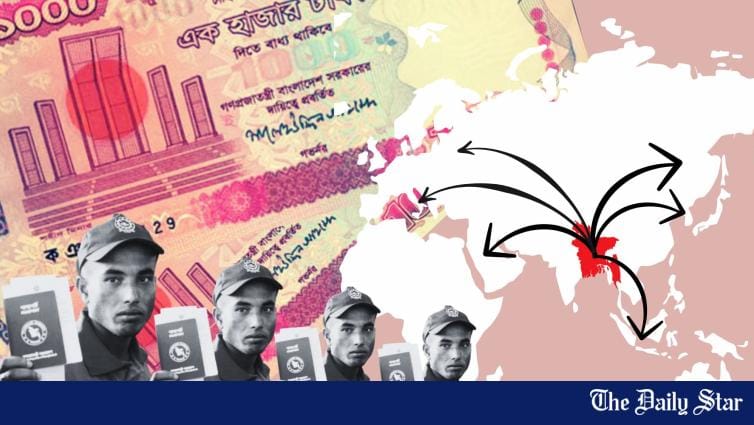
How we are missing out on higher remittances

1713478973543.webp

VISUAL: NAZIFA RAIDAH

Migrant workers from Bangladesh are disadvantaged in many ways compared to their counterparts from other countries. To cite one disadvantage: as per a February report by The Business Standard, an aspiring Bangladeshi migrant worker bound for Malaysia pays between $4,000 and $4,500 for employment in the manufacturing or construction industries. But for the same opportunities, Indonesian workers pay between $340 and $742. This is despite the Bangladesh government setting a maximum Tk 78,990 (less than $1,000) migration cost for workers travelling to Malaysia. The cost of migration is equally exorbitant for Bangladeshi workers travelling to other countries in search of livelihood. In fact, a 2020 International Organization for Migration (IOM) report suggested that the migration cost of Bangladeshi workers is considered one of the highest in the world.

This is attributed mostly to the corruption in the system that has enabled syndicates to be formed among recruitment agencies, in addition to ineffective migration diplomacy, and limited efforts from the concerned authorities to ensure the wellbeing and rights of the migrant workers.

While the remittances sent by the migrant workers are valued highly, we have not taken effective measures over the years to map international market demand for skilled labour and accordingly upskill aspiring migrant workers, which would have translated into higher remittance for us.

we must understand that in a fast-changing landscape, where quality of work is becoming increasingly important for employers, new avenues are opening up for the skilled workforce. So, being content with pushing more unskilled workers into the global labour market is no longer an option.

Even at a time when our volatile forex reserve remains a major economic concern and despite the growth in the number of migrant workers—around 1.3 million workers migrated abroad in 2023, a 15 percent increase from 1.13 million in 2022, thanks to Saudi and Malaysian markets opening up—we have not been able to tap the full potential of the expanding job market abroad, both in terms of revenue volume and skilled worker migration.

The remittance inflow in 2023 remained stagnant at the $21 billion mark, despite more workers migrating abroad. In 2022, remittance inflow was $21.28 billion and in 2021 it stood at $21.74 billion. Given the 15 percent year-on-year increase in worker migration in 2023, the mere 2.54 percent year-on-year increase in remittance in 2023 is a telling tale of wasted opportunities and the inability of formal banking channels to woo customers.

A study of government data by the Refugee and Migratory Movements Research Unit (RMMRU) revealed that of the workers who migrated in 2022, a staggering 78.64 percent were less skilled. In 2021, it stood at 75.24 percent. While there was some improvement in 2023, with an increased number of skilled and semi-skilled worker migration, less skilled workers still made up more than half of the entire pie, at 50.28 percent, according to the Bureau of Manpower, Employment and Training (BMET).

This is mostly due to our lack of demand mapping, planning, and political will to tap into the skilled labour market. Bangladesh has always eyed the less skilled market with its lower barrier to entry, entertaining demand from traditional markets needing low-paid unskilled, less skilled workers. But we must understand that in a fast-changing landscape, where quality of work is becoming increasingly important for employers, new avenues are opening up for the skilled workforce. So, being content with pushing more unskilled workers into the global labour market is no longer an option.

Our Asian peers are quickly upskilling their workforce to capture the new markets and their workers are earning higher wages, while in Bangladesh, we are patting ourselves on the back for sending about 1.3 million workers abroad, without a plan on how to tap into the new markets and enable our workers to find better-paying jobs, in turn us getting higher remittance.

We must study the global labour market patterns to identify new destinations for Bangladeshi workers, and the skill sets required to make sure our workers succeed there. Better coordination, cooperation, and oversight among the government and private sector actors are critical to improving the living conditions of our workforce abroad and driving forex earnings.

However, for this to happen, we would need to overhaul our overseas employment system which is lethargic by nature and mired in corruption. There is no way that notorious syndicates are given free reign to do as they wish—exploiting unsuspecting and powerless migrant workers—without the system benefitting from their illegal gains.

The transformative push in the labour migration landscape of our country would also mean that the Bangladeshi missions abroad would have to make efforts to identify potential industries for foreign worker recruitment in the countries where they are located and the skills that would be required to fill those requirements. The concerned officials would have to engage in robust migration diplomacy to negotiate good deals for our workers—both in terms of wages and living conditions.

It is true that in Bangladesh we lack adequate technical training centres and polytechnic institutes. So the focus should be on building additional capabilities while fully utilising the existing facilities.

It is high time the government came out of its complacency mindset and transformed the overseas employment sector to make the most of the new opportunities opening up for Bangladesh. While demand for unskilled and less skilled workers will sustain in the traditional markets for some more years, if we do not compete for the new markets in need of a semi-skilled and skilled workforce, our Asian peers will win them over, leaving us little room to manoeuvre.

Do we have the vision and political will to accelerate change and make the most of the opportunities that are about to unfold?

Tasneem Tayeb is a columnist for The Daily Star.​
 
Analyze

Analyze Post

Add your ideas here:
Highlight Cite Fact Check Respond

Bangladesh's gross forex reserve dips to $19.89b
Staff Correspondent 18 April, 2024, 22:33

1713479717797.webp

A file photo of Bangladesh Bank headquarters in Dhaka.

The gross foreign exchange reserves in Bangladesh, according to the International Monetary Fund guidelines, dropped to $19.89 billion again on Wednesday.

According to Bangladesh Bank data, the foreign exchange reserves reached the current level on the day from $19.91 billion on March 31 and $21.86 billion on December 28, 2023.

However, according to Bangladesh Bank's conventional valuation, the foreign exchange reserves were reported as $25.3 billion on that day.

The reserves had dropped to $19.13 billion on December 6, 2023, but rebounded to $21.74 billion on January 4 after receiving $689 million in loans from the International Monetary Fund and $400 million from the Asian Development Bank.

The reserves, however, started declining again thereafter.

This decline in Bangladesh's foreign exchange reserves is primarily due to a significant dollar shortage in the market.

The shortage has compelled the central bank to continue selling dollars to banks from its reserves.

The reserves significantly depleted as import payments of $1.29 billion were made to the Asian Clearing Union for January and February.

The Asian Clearing Union is a payment settlement forum whereby the participants settle payments for intra-regional transactions through participating central banks on a net multilateral basis.

Payment obligations of transactions among Bangladesh, Bhutan, India, Iran, the Maldives, Myanmar, Nepal, Pakistan and Sri Lanka are settled through the ACU payment system.

Apart from the payment obligations to ACU, the ongoing sales of foreign currency to the country's banks by the central bank contributed to the reduction in the country's foreign exchange reserves.

The central bank has been selling dollars to commercial banks, with more than $30 billion sold over the past 32 months.

This included $9.7 billion allocated to banks in July-February of the financial year 2023-24, $13.5 billion in FY23 and $7.62 billion in FY22.

The country's financial sector is facing a severe dollar shortage.

To address this, the government and the central bank have implemented measures to restrict imports, especially luxury and non-essential items.

Due to a liquidity crisis in the market and a sharp rise in government treasury bonds, banks are providing about $2 billion to the central bank in exchange for local currency.

The dollar rate has been set at Tk 110 a dollar by the Association of Bankers, Bangladesh, and the Bangladesh Foreign Exchange Dealers' Association.

According to IMF guidelines, the net reserve is below $17 billion.

The Bangladesh Bank follows the IMF's BPM6 for calculating gross and net international reserves.​
 
Analyze

Analyze Post

Add your ideas here:
Highlight Cite Fact Check Respond

IMF's 3rd loan tranche on track despite repeated failure to hit reserve goal

1713565780159.webp

3rd tranche of IMF loan

Bangladesh has repeatedly failed to retain foreign currency reserves in line with the goals set under the International Monetary Fund's $4.7 billion loan since the programme was launched in January last year.

The minimum net international reserves (NIR) will also remain below the threshold when an IMF mission visits Dhaka next week to review the progress of the programme before releasing around $681 million in the third tranche in May.

Despite the shortfall, driven by lower-than-expected remittance and export receipts and foreign direct investments, the country managed to secure the first two instalments of the multi-year loan.

And Bangladesh Bank Governor Abdur Rouf Talukder told reporters that the country will receive the third instalment on time as well.

In 2022, Bangladesh turned to the global lender after its forex reserves plunged to a critically low level amid higher import bills, leading to a sharp depreciation of the taka and an unprecedented level of inflation, hurting the poor and derailing the economic growth trajectory.

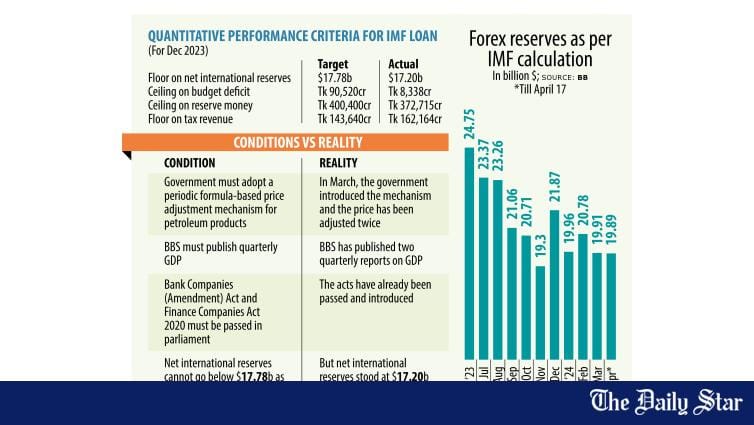
Initially, the government was given a target to keep a minimum NIR of $26.81 billion for December 2023. Later, it was revised downward to $17.78 billion since the reserve situation showed no signs of major improvements. Still, the country fell short of the target by $58 million.

The goal for NIR was $23.74 billion for June last year. However, the country had a reserve of $19.56 billion. Bangladesh also failed to meet the condition of the tax revenue at that time.

A central banker said this time the reserve shortfall will be comparatively low.

The NIR is defined as reserves assets minus reserve liabilities. Reserves liabilities are all foreign exchange liabilities to residents and nonresidents, including commitments to sell foreign exchange arising from derivatives and all credit outstanding from the IMF.

Officials at the finance ministry and the BB said except for the reserve-related criteria, all other conditions have been met.

During its visit, the IMF mission will review the government's performance against the targets set for December 2023.

Out of six quantitative targets set for the third tranche, the government has met five targets.

For December last year, the goal for tax revenue was set at Tk 143,640 crore. The government has already met the target.

According to the finance ministry, Tk 1,62,164 crore was collected in tax revenue in the first six months of the current fiscal year.

Another loan condition is that the budget deficit must not surpass Tk 90,520 crore. In December, the deficit stood at Tk 8,338 crore.

As per another target, the reserve money had to be within Tk 400,400 crore in December and it stood at Tk 372,715 crore in the last month of the year.

Besides, two of the loan conditions are that the government's social spending and capital investment had to be more than Tk 50,000 crore as of December.

The government spent around Tk 200,000 crore from the budget between July and December of 2023-24 and about Tk 100,000 crore was spent in these two segments, a finance ministry official said, adding that the government also met the condition on external payment arrears.

Apart from the quantitative and indicative targets, there are some structural conditions set by the IMF. The official said the structural conditions associated with the third tranche of the loan have been achieved.

As part of the structural conditions, the government adopted a periodic formula-based price adjustment mechanism for petroleum products in March and has adjusted it twice.

The Bangladesh Bureau of Statistics has begun publishing quarterly data on the gross domestic product (GDP) and released the economic growth figure for the first two quarters of FY24.

Besides, the parliament passed the Bank Companies (Amendment) Act and the Finance Companies Act and the laws have already been implemented, in line with the IMF recommendations.

Levi's now in Dhaka

Refayet Ullah Mirdha

Renowned American clothing company Levi Strauss & Co has opened a store in Dhaka offering its range of products under the third franchise deal secured by local conglomerate DBL Group following similar contracts with Nike and Puma.

Levi's is one of the world's biggest fashion retailers. Its products are sold in more than 110 countries through approximately 3,000 stores.

The 2,270 square feet store on Banani Road 11 opened on April 1, aiming to draw the rising middle-income population with an assortment of imported denim jeans, t-shirts, polo shirts, and formal and casual woven shirts for men and women.

Levi's will continue its expansion across key markets in Asia, with plans to open another store in Chattogram, said PR Newswire in a statement on April 17.

The company's focus are dynamic markets undergoing swift urbanisation, said Amisha Jain, senior vice president and managing director of South Asia-Middle East and Africa at Levi Strauss & Co.

"With a population exceeding 160 million, Bangladesh presents significant opportunities for retail expansion," she said.

The DBL plans to open Levi's stores in other parts of Dhaka, such as Dhanmondi, soon and eventually in Chattogram, said a senior official of the group asking not to be named.

"The response from consumers is good," said the official, adding that the country's economy has been growing and the purchasing power of consumers was also improving, enabling them to afford branded products.

Annual sales of clothes in Bangladesh are estimated to amount to over $15 billion.

Per capita consumption of apparels has been rising with a rise in income, for which the presence of international brands is also increasing gradually.

Three growth drivers, including farmers, remitters and garment workers, pushed the country's GDP to more than $460 billion in 2022. The nation is also set to graduate from least developed country (LDC) status in 2026.

Bangladesh's real GDP growth is projected to remain relatively subdued at 5.6 percent in FY24, compared to the average annual growth rate of 6.6 percent over the decade preceding the COVID-19 pandemic, according to World Bank (WB).

Persistent inflation is expected to weigh on private consumption growth, and shortages of energy and imported inputs combined with rising interest rates and financial sector vulnerabilities are expected to dampen investor sentiment.

Growth is expected to increase gradually over the medium-term as monetary, exchange rate, and financial sector policy adjustments are implemented, the WB said.

Stocks slip below 5,700 points after 35 months

Star Business Report

Stocks in Bangladesh suffered a massive setback yesterday with the benchmark index of the Dhaka Stock Exchange (DSE) falling below 5,700 points for the first time in 35 months as nervous investors sold their scrips.

This led to the price erosion of large-cap stocks, bringing down the benchmark index of the country's premier bourse by 77.08 points, or 1.33 percent, to 5,686 points, its lowest level since May 9, 2021.

Beacon Pharmaceuticals, the British American Tobacco Bangladesh Company, Renata, Olympic Industries, BRAC Bank, LafargeHolcim Bangladesh, Mercantile Bank and Pubali Bank were among the large-cap scrips that suffered the biggest losses.

Beacon Pharmaceuticals was the top dragger of the index, claiming 5 points, followed by British American Tobacco Bangladesh with 4 points, according to LankaBangla Securities.

The market dropped as investors panicked seeing the continuous fall of market indices, said a top official of a leading stock brokerage.

Foreign investors are still selling shares, so blue-chip stocks are falling even though these stocks are already traded at a very low price.

And as these stocks have been falling for the past few days, some brokerage houses are selling them by executing forced sales, he added.

If brokerage houses and merchant banks lend funds to investors to buy stocks and the stock price falls massively, then the brokers first call the investors to repay their loans or otherwise sell their shares in what is called forced sales.

The DSES, the index that represents shariah-compliant companies, shed 1.26 percent to close at 1,246 points yesterday while the DS30, which comprises blue-chip stocks, plunged 1.13 percent to 2,014 points.

However, daily turnover, which indicates the volume of shares traded during the session, increased 8.29 percent to Tk 522 crore compared to the previous trading session.

Almost all sectors closed in negative territory, with the non-bank financial institution, paper and printing and mutual fund sectors shedding the most, as per the daily market update of UCB Stock Brokerage.

The pharmaceuticals sector dominated the turnover chart, accounting for 18.98 percent of the total.

Of the issues traded at the DSE, the values of 29 increased, 342 decreased, and 24 did not see any price swing.

Asiatic Laboratories took pole position on the top gainers' chart with a rise of 9.96 percent followed by Dutch-Bangla Bank with 7.20 percent, Heidelberg Cement Bangladesh with 6.19 percent, Salvo Chemical Industry with 5.11 percent and IFAD Autos with 4.50 percent.

Best Holdings, HR Textile, Sikder Insurance Company, Shyampur Sugar Mills and First Janata Bank Mutual Fund also featured on the gainers' list.

Meanwhile, EXIM Bank 1st Mutual Fund shed the most, losing 6.81 percent, followed by IFIL Islamic Mutual Fund-1.

The two were followed by SEML FBLSL Growth Fund, Capitec Grameen Bank Growth Fund, Khulna Printing and Packaging, IDLC Finance, Apex Ternary, and Prime Bank 1st ICB AMCL Mutual Fund.

The Chittagong Stock Exchange saw a similar trend as the Caspi, the main index of the port city bourse, fell by 215 points, or 1.30 percent, to close at 16,244.52 points.

Rajesh Saha, chief executive officer of CAL securities, blamed the country's market situation for the abrupt ups and downs of stocks.

"Outsiders control the stock market in our country. Keeping them in the market, we can't expect a better situation. What is happening in the market, that's a normal thing. The market will not be well until we take back control of the market from outsiders," he said.

"Such things will happen until the market is structured. Look at our neighbouring countries, where markets are structured. Investors do not fear to invest there because no one can dare to earn in the wrong way," Saha added.

He also put forward a slew of suggestions to develop the market.

"We have to bring IPOs to the market in a proper way. So, we have to bring the companies under proper regulations. If any company breaches any rules, the regulatory body has to slap stiff punishments on them," Saha said.

"But in our market, we clearly understand what is happening and what will happen in such a situation. The shares we bought we are now selling out of fear," he added.

Saha pointed out that in developed countries, it is seen that there are some companies which are financially sound.

"So, investors pass their money to those companies if they get any indication of a bad situation. But we have no such places or companies in our market," he said.

"In our country, people see earning is tough through traditional ways. So, they choose poor stocks and try to chalk up more earnings. Our regulatory body knows well how to tackle the market and what needs to be done for the market's wellbeing," Saha added.​
 
Analyze

Analyze Post

Add your ideas here:
Highlight Cite Fact Check Respond

Towards a trillion-dollar economy
What Bangladesh needs to do to shift gears

1713739989906.webp

VISUAL: AZMIN AZRAN

In 2024, Bangladesh's economy has a firm footing. But what about the future? Will we continue to rely on the ready-made garments (RMG) industry for employment and export earnings, and depend on expatriate remittances to fuel a lopsided economy? This question came to my mind as I watched millions of RMG workers return to their factories, ploughing through traffic jams, clogged roads, and dilapidated infrastructure, with concern in their minds about their future job prospects.

And what about those with a graduate degree, who need help finding employment in their preferred profession? Or those who have bagged a low-paying job in a temporary gig—like my own nephew, who has an MBA and is an accountant, but is struggling pay his bills with a minimum wage job in a travel agency?

Bangladesh needs to embrace digital technology to modernise its economy and expand opportunities for people from all walks of life. We are already approaching the quarter-century mark of the 21st century, but the economy is stuck in a rut. It reminds me of the sculpture "The Struggle," based on painter Zainul Abedin's "Sangram," where two bullocks with the driver try to pull a cart laden with logs out of the mud while the wheels are stuck.

On April 2, The New York Times ran a long story which lauded Bangladesh's growth model of the last half a century. It gave leaders credit for lifting up millions of poor people and praised the success of turning farmers into textile workers. But the article also cautioned that changes in trade, supply chains, and technology are making our journey into the next quarter of the century perilous. I am sure this precaution applies to other nations, too. On April 1, in an opinion piece for The Wall Street Journal, Robert B Zoellick, former president of the World Bank, lashed out at Biden and Trump, the two presumptive candidates for the US presidency. He attacked them for their inability to see the writing on the walls, and rather than preparing the US for the challenges of the 21st century, taking it back to the 20th.

Earlier this year, the World Economic Forum (WEF) released its Future of Growth framework, which advised that with "the pressing need to rekindle global economic growth, we must move to innovative, inclusive, sustainable and resilient growth."

So, what is the takeaway for Bangladesh from these warnings coming from different corners?

Manufacturing, which should still form the base of our economy in the coming decades, must be more productive and will, in any case, require fewer workers to make garments, leather goods, and IT products. We will depend on innovation in artificial intelligence, quantum computing and general-purpose technologies.

To compete in the world, we can no longer rely on the two bread-and-butter sectors of our economy—the RMG sector for jobs and foreign exchange, and the external jobs market for further employment and remittances. Remarkably, we have a very educated young labour pool ready to tackle the challenges, but we need to remove the hurdles they face: nepotism, crony capitalism, and the stagnant services sector, which is only worsened by short-term profit motives.

The question, now, is this: what will spur the economy to reach the trillion-dollar target and the middle-income status? The answer lies within ourselves.

In an article on her Substack titled "Visiting the Future," Susan Crawford, a law professor at Harvard University, wrote in an admiring tone about the climate adaptation of Bangladesh after visiting the country. "They, too, are living in a future that hasn't quite reached everyone in the US yet. Extreme heat, salty water, destructive sea level rise and storms are all facts of life in Bangladesh," she wrote. "The country, in one of the most densely populated and lowest-elevation regions on the planet, was among the first to recognise the need to adapt to the climate changes that are already baked into our world." In her opinion, the country is ahead of the US on the climate curve, and she concluded very optimistically that "being there felt like visiting the future."

How can this country and its leaders, then, miss the cue on the world's economic future? We must marshal our resources and exploit the broad global economic trend. But we also need to support the economy's evolution from agriculture to manufacturing, and now to services, to reflect changes in our growing domestic demand. Our exports need to take advantage of economies of scale with a diverse array of manufacturing and services.

My friend, Prof Rahul Roy of Boston University's School of Medicine, just returned from a trip to Kolkata. I was curious to know how West Bengal was doing amidst the "chaos" in India. He simply said, "Fine." But he then added that West Bengal, like the rest of India, is moving towards rapid industrialisation. "Bangladesh needs to change direction to diversify and broaden its domestic market," he said. "As you know, the IT sector in India contributes only 15 percent to the GDP [actually, it is only 13 percent]. So, while you guys [Bangladesh] are going gung ho about AI and all that, the industrial sector needs to move away from its over-reliance on garments."

Prof Rashed Al Mahmud Titumir of Dhaka University agrees. In a recent article in The Daily Star, he outlines that the necessary conditions for our transition from the present stagnation are industrialisation, diversification, competitiveness, and technological catch-up through structural transformation to enhance the capabilities of our amazingly resilient labour force. Someday, a new cadre of leadership will tap into this opportunity with the spirit of embracing science, technology, innovation, and opportunity.

As I was finishing up this article, I came across a message from Prof Rehman Sobhan: "We are taking development forward, but there are gaps and continuing weaknesses of our institutions. This is a very central element," he said at the launching event in Dhaka of the book Fifty Years of Bangladesh: Economy, Politics, Society and Culture, that he co-authored. I am glad that he and I see eye to eye on some matters.

Dr Abdullah Shibli is an economist and works for Change Healthcare, Inc, an information technology company. He also serves as senior research fellow at the US-based International Sustainable Development Institute (ISDI).​
 
Analyze

Analyze Post

Add your ideas here:
Highlight Cite Fact Check Respond

Labour intensive digital economy is growing
AFSAN CHOWDHURY
Published :
Apr 08, 2024 22:10
Updated :
Apr 15, 2024 21:32


1713742164858.webp


Graduate employment is highly stressed in Bangladesh with the middle class unable to cope with the nature of changing market demands and its contingent labour market. The World Bank says the rate of unemployment is roughly 4.7 per cent but it's based on official statistics which is rarely reliable. It could be more or less but field level data by researchers show more hidden employment than is thought of.

Barring the hardcore unemployed including the disabled, it's best to say we don't know accurately and research doesn't throw up high rates. The problem is in the sushil white collar sector or the graduate desk bound jobs.

Many new urban employment sectors are emerging which are less known. One sector that is almost invisible is the global digital sector involved in both legal - freelancing -and non-legal employment led by gaming and betting.

Former Planning Minister MA Mannan had said that Bangladesh's economy was increasing due to the contribution of the freelancers. This was stated by him at a meeting, titled "City Bank BFDS Conference", organized by Bangladesh Freelancer Development Society (BFDS). "Our remittances are growing with the money earned by freelancers," Mr Mannan remarked. Freelancers will get 4 per cent cash assistance against the money brought home and it has been helped by the availability of the internet.

The size of the freelancer market is important. BFDS Chair Dr Tanjiba Rahman said the global market size of freelancers is about $1.5 trillion. There are over 10 lakh Bangladeshis working in this market, both online and offline. In fact, it's the global market segment that has withstood all pressures caused by the various conflicts around the world and the Covid pandemic as well.

With a 26 per cent growth rate, it's a very healthy situation. Of the 1.0 million freelancers, 0.65 million are in the field of IT.

Almost 75 per cent of freelancers are doing it as a part-time job. Freelancing in Bangladesh serves as a very good antidote to the current pay scale in our country relating to the educated.

Although the GOB is now promoting this sector, it has no role in the development of this sector. In fact, like all the major successful sectors such as external migration and RMG it can't claim any credit for its birth, growth and development. They have expanded due to opportunities taken advantage of by the entrepreneurs themselves, individual and collective.

While the RMG sector was the product of the initiatives of the better off investors, both external migration and digital freelancing belong to the rural and urban middle class respectively. It has been on for several decades and its only now being recognized by the GOB as dollar shortage has become an issue and freelancing has gained importance due to that.

Many problems and obstacles are there which the formal regulatory agencies can tackle and agencies can help. These include better policing of the internet scam including those aimed at the freelancers, training initiatives and help the freelancers with better capacity to negotiate and deal with new and regular clients. Lack of English language skills remains a major issue. However, as with the migration sector, the interest is more about incoming dollars and less about the sustainability of the sector as a whole by supporting the workers there.

The informal and non-legal digital sector is of course a shadowy world. The rise and explosive growth of the internet gaming and betting sector has largely gone unnoticed in the media but its growth is phenomenal and is the largest internal economic sector drawing particularly the young.

"The total value of bets placed through sports betting is estimated at around 8.5 billion taka per year. As of today, the most popular sports in Bangladesh are cricket, football, athletics, cycling, swimming, and other sports that are played in South Asia. The most popular sporting event in Bangladesh is the cricket match between Bangladesh and India. Each year, more than 10 million Bangladeshi people view cricket matches on television, which is the highest number of viewers of any event in the country."

No estimate is possible but that millions of bettors are involved is a fact. The issue is, most don't guarantee regular payments but like all gambling outfits offer uncertainty and insecure income. On top of that a significant percentage of the outfits operate outside the law. However, the gambling market size is so huge that international betters are hiring locally for even external employment.

Most of the gambling networks are controlled from outside Bangladesh and the locals are not English friendly. As a result a new sector has grown up where youth are hired and taken abroad to work in betting help centres who can communicate with Bangladeshi clients.

Given the internet penetration in Bangladesh, this can only grow. Unlike the freelancers their work is only of one kind and the system of payment is also not transparent. Their linkages with the other sectors including drugs and sex work sites are also common knowledge.

The fact remains that the formal institutional economy is weak in Bangladesh and given the global competitive scenario, the chances of becoming competitive is not high. The formal sector and the state agencies are unable to develop a framework that ensures higher employment. Plus the education system is not employment friendly. That has led to this situation where informal employment arrangements by individuals and groups score much better than state agencies.

Since nothing suggests that the capacity of the GOB to be a major player in employment generation is about to happen quickly, the support and capacity development will be fulfilled by the private sector. They do exist but much more needs to be done to meet the growing demand of the internet-based private sector labour intensive economy.​
 

Analyze Post

Add your ideas here:
Highlight Cite Respond
  • Like (+1)
Reactions: Bilal9

Members Online

⤵︎

Latest Posts