Home Watch Videos Wars Movies Login

[🇧🇩] Monitoring Bangladesh's Economy

Latest Posts Countries Wars Q&A

[🇧🇩] Monitoring Bangladesh's Economy
976
26K
More threads by Saif

G Bangladesh Defense

No visible progress in signing Cepa with India
1719788703432.webp


Bangladesh and India are yet to begin the formal negotiation to sign the Comprehensive Economic Partnership Agreement (Cepa) although nearly two years have passed since both countries agreed to kick off the talks.

Dhaka needs to pen bilateral deals with trading partners in order to retain preferential market access in the post-LDC era since duty-free export facilities end once the country becomes a developing nation.

Bangladesh and Bhutan signed a preferential trade agreement (PTA) in December 2020, the first bilateral trade pact for the former. The deal came into effect in July 2022, much ahead of Bangladesh's scheduled graduation from the group of the least-developed countries (LDCs) in November 2026.

There has not been visible progress when it comes to inking trade deals with other countries, including India.

Dhaka needs to pen bilateral deals with trading partners in order to retain preferential market access in the post-LDC era since duty-free export facilities end once the country becomes a developing nation

No specific timeline to begin the talks about the Cepa was cited in the joint statement issued after the meeting of both Bangladeshi Prime Minister Sheikh Hasina and her Indian counterpart Narendra Modi in New Delhi in the third week of June.

Both prime ministers talked about the Cepa during the meeting, State Minister for Commerce Ahasanul Islam Titu told The Daily Star.

After the meeting, the Indian Ministry of External Affairs, in a statement, said Bangladesh and India agreed to strengthen trade and investment ties, including through an early commencement of negotiations for a Cepa.

The statement also talked about an early operationalisation of two special economic zones offered by Bangladesh to India in Mongla and Mirsharai, the opening of new border haats, trade facilitation to enhance bilateral commerce, and improving road, rail, air, and maritime connectivity, and trade infrastructure.

Both Hasina and Modi welcomed the findings of a joint study on the Cepa in a statement in September 2022 and agreed to start the negotiations, saying a Cepa would be beneficial for both countries.

The Bangladesh Foreign Trade Institute and the Centre for Regional Trade of India conducted the study based on trade data between 2015 and 2020.

Titu said Bangladesh is ready to hold the first formal dialogue with India.

He is optimistic that the inaugural dialogue will be held this year. "Our team is ready."

"The political signal for beginning the formal Cepa negotiation is important," said Mustafizur Rahman, a distinguished fellow of the Centre for Policy Dialogue.

He said perhaps both countries are taking more time to begin the talks. Had there been strong political commitment, the process would have fast-tracked.

Also, maybe, the negotiators are taking more time to study further before signing the Cepa, he said.

Inking a trade deal would be important for both countries because they are increasingly becoming an important trade partner for each other.

India is the second-largest import source for Bangladesh after China.

Imports from India stood at $9.49 billion in the fiscal year of 2022-23 while exports to the country amounted to $2.13 billion, figures from Bangladesh Trade Portal and Bangladesh Bank showed.

Bangladesh mainly imports textiles and fabrics, industrial raw materials and intermediate goods, food items, cotton and chemicals for industrial use.

If Bangladesh can sign bilateral deals, it would be able to access LDC-induced benefits for three more years after graduation.

"Bangladesh's strategy should be enjoying the LDC scheme as long as possible. Simultaneously, we should be well-prepared for the Cepa," said Rahman.

Bangladesh might not make a large gain from the Cepa since it would lose the duty-free market access as an LDC, said the joint study. On the other hand, India will make a larger gain primarily through the removal of existing high tariff rates.

"The fear of losing the revenue from import duties may be another factor for the delay in launching the formal negotiation," CPD's Rahman said.

Bangladesh, however, has the potential to benefit from trade in services in tourism, transport and educational cooperation, and also through the creation of jobs by attracting Indian investments.

The Cepa is expected to boost Bangladesh's exports by 190.15 percent, and even more, if transaction costs are reduced through improved connectivity, according to the study.

India's exports to Bangladesh are expected to surge by 188 percent.

The Cepa will expand the size of Bangladesh's GDP by 1.72 percent and India's by 0.03 percent, the study found.​
 
Analyze

Analyze Post

Add your ideas here:
Highlight Cite Respond
  • Love (+3)
Reactions: Bilal9

BB halts daily repo facility to meet IMF condition

1719874827981.webp

Photo: Star/File

The Bangladesh Bank (BB) has stopped the daily repo facility for banks in line with one of the conditions provided by the International Monetary Fund (IMF) for a $4.7 billion loan programme.

The BB said the repo auctions, through which banks borrow funds from the central bank, will take place twice a week from now, according to a circular issued yesterday.

The BB said that auctions will take place on Monday and Wednesday every week. If there is a holiday, the auctions will be held on the next business day.

Repurchase agreements, or repos, are a form of short-term borrowing by banks.

The lenders keep government securities with the central bank with the condition of buying them back at a specific date, usually for a higher price, to get funds and meet their liquidity requirements.

Banks can generally borrow from the central bank through repo, assured liquidity support facility (ALSF), and standing liquidity facility (SLF). Islamic bank liquidity facility (IBLF) is also offered to Shariah-based banks.

The BB said auctions of the remaining instruments would be held every working day.

The central bank took the decision in line with the recommendations of the IMF, which approved $4.7 billion in loans for Bangladesh last year.​
 
Analyze

Analyze Post

Add your ideas here:
Highlight Cite Respond

Remittance hit $24b in FY24, highest in three years
1719876493511.webp


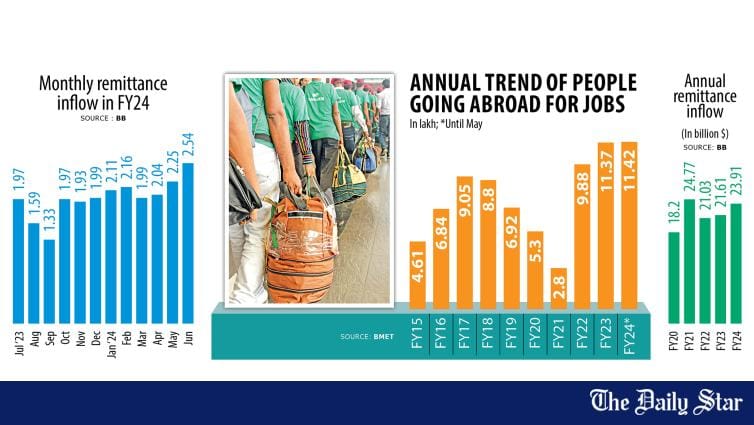
After hovering around the $21-billion mark for the previous two fiscal years, total remittances sent home by Bangladesh's migrant workers reached nearly $24 billion in the just concluded fiscal year of 2023-24, providing some breathing space amid the forex crunch.

As per the latest data from the Bangladesh Bank, remittance inflow stood at $23.91 billion in FY24, rising by 10.66 percent compared to the year prior.

"We put all our efforts to collect remittance as banks were very thirsty for foreign currencies to pay import bills. This helped boost remittance earnings," said Syed Mahbubur Rahman, managing director and CEO of Mutual Trust Bank.

Bangladesh's migrant workers sent home an increased amount of foreign currencies in the last two months of FY24 as the gap between the formal exchange rate and informal exchange rate narrowed due to the introduction of a flexible exchange rate, he added.

On May 8, the central bank introduced the crawling peg exchange rate system, allowing banks to buy and sell US dollars within a fixed band at around Tk 117.

The inter-bank exchange rate stood at Tk 118 per dollar yesterday.

In June, the last month of FY24, remittance inflow stood at $2.54 billion, up 15.59 percent year-on-year. Remittance inflow stood at $2.25 billion in May and $2.04 billion in April, BB data also showed.

Rahman, also a former chairman of the Association of Bankers Bangladesh (ABB), said remitters sent more money through banking channels in FY24 as the dollar rate was better than in previous years.

He added that some banks were providing incentives from their own fund, adding to the government incentives, which further boosted remittance inflow.

Rahman also attributed the increased remittance inflow to higher manpower exports.

Until May of FY24, around 11.42 lakh people left Bangladesh for work compared to 11.37 lakh in FY23, according to data from the Bureau of Manpower, Employment and Training (BMET).

In FY22, around 9.88 lakh individuals went abroad, the data also showed.

Rahman hoped the upward trend of remittance inflow would continue.

Bangladesh received a record $24.77 billion as remittance in FY21 because of the disruption of the hundi system -- an illegal channel that facilitates cross-border transactions -- due to the halt of international travel amid the Covid-19 pandemic.

The amount fell to around $21 billion in both FY22 and FY23 after the rules for travelling were relaxed.

At the same time, the gap between the formal and informal exchange rates adversely impacted remittance inflow through banking channels.

Mohammad Ali, managing director and CEO of Pubali Bank, told The Daily Star that remittance inflow increased in FY24 due to policy initiatives, including the introduction of a flexible exchange rate.

He said the use of hundi had come down in the final months of FY24, which positively impacted remittance earnings.

Ali added that over-invoicing and under-invoicing had also been curbed by strict monitoring.

He also said that the country's forex market is liquid now because of the increased remittance earnings.

Industry insiders alleged that some banks were providing a higher rate for dollars than the official rate in case of collecting remittance, which the banking regulator was not addressing.

In the first 21 days of June, Islami Bank Bangladesh received the highest remittance, amounting to around $441 million, BB data showed. Agrani Bank received $171 million and Janata Bank $127 million.

The growing trend of remittance will provide breathing space in the upcoming months as the country has been contending with a foreign exchange crisis for the past two and a half years.

Since August 2021, the forex reserves have fallen by $24 billion.

As per the calculation method used by the IMF, Bangladesh's gross forex reserves stood at around $22 billion on June 26 this year.

The foreign exchange market has been volatile because of higher US dollar outflow despite the government's austerity measures, including controlling import payments.

The $4.7 billion loan provided to Bangladesh by the International Monetary Fund (IMF) has also played a big role in tackling the ongoing crisis.​
 
Analyze

Analyze Post

Add your ideas here:
Highlight Cite Respond

PM urges ADB to help Bangladesh implement blue economy
1719961882639.webp


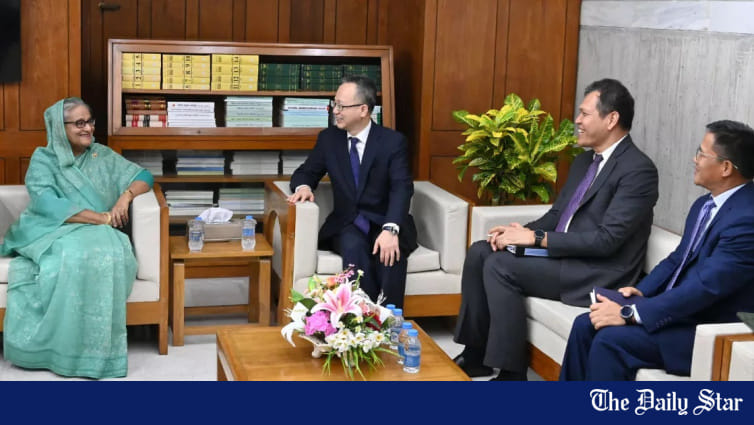
Prime Minister Sheikh Hasina yesterday sought cooperation from the Asian Development Bank in implementing blue economy and extract every resources from country's maritime boundary

She made the request while visiting ADB vice president Yingming Yang called on her at her office in Sangsad Bhaban.

PM's press secretary M Nayeemul Islam Khan briefed reporters afterwards.

Hasina also sought help in agricultural research. She mentioned that the per capital income and purchasing capacity of the people of Bangladesh needed to be improved.

"We want to develop Bangladesh as a big market particularly for our own products," she said.

She put emphasis on the production of the agricultural products as she mentioned that ensuring food security is the priority for the government.

Hasina also sought logistic support from the ADB to strengthening Bangladesh's competitiveness for its export items after the graduation from the LDC status in 2026.

She briefly described various short, medium and long term programmes of the government to improve the country in to a developed one by 2041.

The prime minister asked the ADB to assist Bangladesh in integrated river management including river training, capital dredging and maintenance dredging.

Yingming said ADB has decided to increase their support in urban and water policy from 13 percent of the total support to 26 percent.

He mentioned that ADB wants to assist Bangladesh in health project and digital technology apart of collaborating in agricultural research in longer version.

He said ADB wants to help Bangladesh in primary education and healthcare skills development in their new five year plan.

The ADB vice president said ADB wants to develop a city master plan for Bangladesh to better usages of available resources.

In this connection, the premier asked them to consider upazilas in Bangladesh for their project.​
 
Analyze

Analyze Post

Add your ideas here:
Highlight Cite Respond
  • Like (+1)
Reactions: Bilal9

Net reserves now $16.77b, BB releases data for the first time
The central bank has shared data of the net international reserves (NIR) of Bangladesh for the first time.

The NIR now stands at $16.77 billion, Bangladesh Bank Spokesperson Md Mezbaul Haque told reporters yesterday.

The net reserves represent readily-available cash derived from gross reserves.

It is calculated by excluding short-term liabilities from the gross reserves in line with the International Monetary Fund's BPM6 formula.

The central bank usually calculates the foreign exchange reserves using two methods.

One is as per the Balance of Payments and International Investment Position Manual (BPM6), the method used by the IMF, while the other is produced using the central bank's own calculation method.

As per the BPM6 method, the gross reserves stood at $21.83 billion on June 30, up from $19.4 billion on June 26, the spokesperson said.

As per the central bank's own method, gross reserves stood at $26.88 billion on June 30.

Bangladesh's monthly import bill is around $5 billion, which means Bangladesh will be able to cover at least three months of import bills using the NIR.

Bangladesh also achieved the targeted foreign exchange reserves set by the IMF for the first time since agreeing to a $4.7 billion loan programme, which has also played a big role in tackling the forex crunch.

The target was set at $14.7 billion for June.

The reserves also received a boost on June 24, when the IMF approved $1.15 billion in the third tranche of the loan.

The country's foreign exchange market has been volatile because of higher dollar outflow despite the government's austerity measures, including controlling import payments.

Since August 2021, the forex reserves have fallen by $24 billion.​
 
Analyze

Analyze Post

Add your ideas here:
Highlight Cite Respond
  • Sad (0)
Reactions: Bilal9

Bangladesh eyes longer-term loans at fixed rates to manage debt better
1719962388101.webp


The government aims to borrow more from the domestic sector at fixed rates and for longer periods and cut reliance on Treasury bills with a view to keeping debt risks lower and avoiding exchange rate volatility.

Although the risk posed by the ballooning debt is still moderate for Bangladesh, the exchange rate risk has heightened over time owing to its growing reliance on foreign loans, a government paper said.

This has prompted the government to rethink about its borrowing strategy.

According to the government's Medium Term Debt Management Strategy, the risk emanating from the existing debt portfolio is moderate primarily because most loans are denominated in the local currency while external loans have a long maturity period.

The domestic debt is, however, more expensive than external loans, it said. In the last financial year that ended on June 30, the weighted average cost of funds was 1.4 percent for external loans and 9.6 percent for domestic credits.

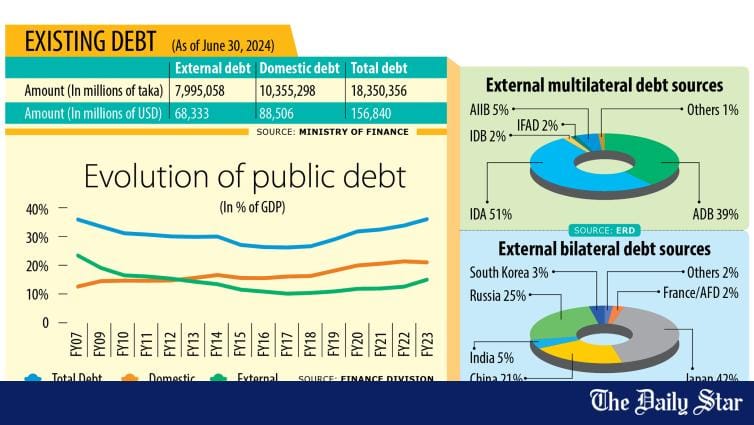
The data on Bangladesh's debt portfolio from the fiscal year of 2006-07 to 2022-23 highlights the shift in the composition of the total debt and the factors influencing it.

The total debt as a percentage of gross domestic product decreased from 35.9 percent in FY07 to 26.2 percent in FY17. There has been an upward trend since then, reaching 36 percent in FY23.

At the end of the just-concluded fiscal year, domestic debt is projected at 56 percent while the remaining is external debt.

The higher refinancing risk associated with domestic debts due to its shorter average time to maturity (ATM) and a higher percentage of debt maturing within a year (30.7 percent) indicates the necessity to further extend the maturity profile.

ATM is defined as the average remaining time to maturity for each security or contract composing a debt instrument, a commonly used measure for assessing interest rate sensitivity.

While a substantial portion of the debt has been secured at fixed rates, the shorter average time to refixing is 3.8 years for domestic debts compared to 8.8 years for external debts.

"This suggests that domestic debt is more vulnerable to interest rate fluctuations," said the document. The average time to refixing is a measure of weighted average time until all the principal payments in the debt portfolio become subject to a new interest rate.

"Strategies should, therefore, aim to increase the proportion of longer-term fixed-rate domestic debt."

Bangladesh's economy has grown at a faster pace over the past decade and a half, and the government plans to accelerate it.

In order to achieve the goal, the pace of investment in soft and physical infrastructure needs to pick up. Since revenue collections are not enough to cover the much-needed investments, Bangladesh has resorted to deficit financing, in line with standard practices around the world.

Sourcing this necessary financing through external as well as domestic sources is always competitive, the document said.

It said due to the terms of trade deterioration because of the war in Ukraine, Bangladesh's foreign currency reserve has come under severe pressure.

The gross reserves stood at $21.99 billion on Thursday, down from $41.7 billion in August 2021.

"The need to keep financing the growth-inducing investments and continue the reform in the fiscal sector with a keen focus on maintaining the debt sustainability is an imperative now," the document said.

The government has identified four alternative financing strategies, and they are being considered to cover the financing needs from FY24-25 to FY26-27.

Strategy 3 is the most preferred considering the cost and risk of new debt as it puts more emphasis on domestic market development, it said.

It examines an expansion in the issuance of medium-term and long-term T-bonds, consistent to support the development of the securities market.

The government has targeted to bring down the external debt to 16.7 percent of the total loan in FY27 from 22.9 percent in FY25. On the other hand, it aims to raise domestic debt to 83.3 percent in FY27 from 77.1 percent in FY25.

The share of T- bonds in gross financing needs to increase from 21.9 percent in the new fiscal year to 48.3 percent in FY27. The stake of T-bills will go down from 39.3 percent to 22.2 percent during the period.

The government is aware that as the liquidity position in the financial market remains tight, there will be some challenges to implement the strategy.

"The government will pursue external investment in the domestic debt market to alleviate the pressure," the paper said.

As per strategy, the government does not plan to issue any international sovereign bonds.

"The government's objective is to maintain the reforms already in place and plan and implement others as and when practicable."​
 
Analyze

Analyze Post

Add your ideas here:
Highlight Cite Respond

A bright spot: Govt project costs Tk 100cr less than estimate

1720049659187.webp

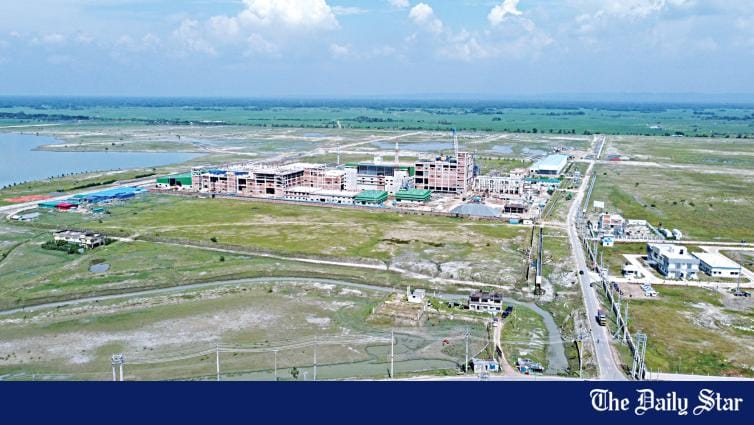
A view of the Bangabandhu Sheikh Mujib Shilpa Nagar, the biggest economic zone in Bangladesh. Built on about 33,800 acres of land in Chattogram, the BSMSN is located 200 kilometres away from Dhaka and 70 kilometres from both Chattogram port and Shah Amanat International Airport. Photo: Star/file

There is a common allegation that the actual implementation costs of government projects inevitably exceed the estimated costs due to a number of reasons, including time extensions and unnecessary expenditures.

However, the Implementation Monitoring and Evaluation Division (IMED) of the Ministry of Planning has found a project standing out as an exception, for which the implementation cost was Tk 100 crore less than estimated.

The gas pipeline construction and distribution project of the Bangabandhu Sheikh Mujib Shilpa Nagar (BSMSN) lays claim to this achievement, according to an IMED assessment.

The assessment said Karnaphuli Gas Distribution Company implemented the project between May 2017 and June 2019 at a cost of Tk 305.98 crore against an estimate of Tk 406.93 crore.

Initially, Tk 367.10 crore was approved before a revision for "river crossing by Horizontal Directional Drilling etc" increased the cost by about Tk 40 crore, or 11 percent, to Tk 406.93 crore.

Due to various reasons, progress has been achieved in some aspects of the project without any additional expenditure and in some cases at a lower cost, the IMED said.

1720049702914.webp


The report said in terms of land acquisition and requisition, the Bangladesh Economic Zones Authority (Beza) provided land for free for a valve station.

Besides, land previously acquired by Beza was used for construction of a 20 feet wide pipeline of Karnaphuli Gas Distribution Company and Gas Transmission Company, which meant no funds were required for land acquisition, it said.

"Besides, in case of river crossing and installation of cathodic protection system under horizontal directional drilling method on Engineering, Procurement, and Construction (EPC), the actual work required is less than the project plan estimated," it said.

Another reason behind the costs being lower is the absence of detailed feasibility studies by independent consulting firms, said the report.

Under the project, a gas distribution pipeline has been constructed up to Mirsarai industrial area or BSMSN, the report added.

As a result, infrastructure for gas supply has been created in the area and gas connections have already been provided to three industrial customers in that industrial area, it said.

Against this backdrop, the aims of the project have been achieved, the IMED said.

It also said as new industries would come under gas connection as a result of the implementation of the project, the positive impact of the project would increase.

However, the IMED said the estimated costs of various procurement packages of the project were not in line with market rates as the contractor submitted bids significantly higher than the estimated costs.

As a result, tenders had to be floated again and again, it said.

Besides, there was no feasibility study by a third party before the project was undertaken, hence the cost estimation and scope of work of various parts of the project was not proper, it said.

Khondaker Golam Moazzem, research director of the Centre for Policy Dialogue, said it was a good example that the entity implementing the project could save government revenue as the Beza did not charge anything for land.

The money saved can be used for other projects, which is important during an economic crisis, he said.

However, the funds were not saved by virtue of efficiency of the implementing entity, rather it was due to Beza's generosity, he said.

He believes such a scope was available for a number development projects, which could have led the implementing entities to save funds.​
 
Analyze

Analyze Post

Add your ideas here:
Highlight Cite Respond

Financial account turns positive as govt adjusts data as per IMF advice
1720058532850.webp


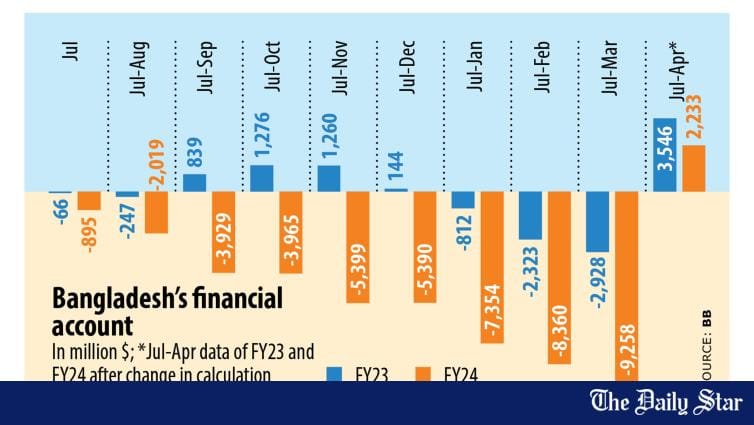
The financial account has turned positive after more than a year, yet it might not be good news for Bangladesh since it is the result of the revision of national data in line with IMF prescription and does not indicate improvement in the health of the economy.

During July to April of the just-concluded fiscal year, the financial account stood at $2.23 billion, which was negative for more than a year, data from the Bangladesh Bank showed.

A key part of the balance of payments, the financial account covers claims or liabilities to non-residents concerning financial assets. Its components include foreign direct investment, medium and long-term loans, trade credit, net aid flows, portfolio investments, and reserve assets.

On the other hand, the balance of the current account, which records a nation's transactions with the rest of the world, slipped to negative territory in the first 10 months of 2023-24. It stood at $5.72 billion in negative, BB data showed.

A senior official of the central bank told The Daily Star that the change in the BoP had occurred due to the change in accounting method.

He explained the gap between the figure provided by the Export Promotion Bureau (EPB) and the BB has been adjusted. "That's why, the current account balance turned negative while the financial account became positive."

For a long period, there was more than a $10 billion gap between the export data provided by the EPB and the BB, with the former showing a higher shipment compared to the latter, raising questions.

This prompted the International Monetary Fund (IMF) to come up with the observation in December last year that Bangladesh might have experienced capital flight in 2022-23 evidenced from the unusual outflow of funds as well as unrealised export proceeds.

It said the financial account experienced an outflow of 0.5 percent of GDP in 2022-23, compared to inflows historically averaging about 2.5 percent of GDP, signaling capital flight.

Yesterday, officials of the central bank said the EPB publishes figures based on the data from the customs department. Due to procedural reasons, the customs department took into account the same export data more than once in many cases, which is known as double or triple counting.

They said that even when shipments were rejected by the customs, they were still considered while preparing the export data. As a result, the EPB data showed higher exports than the actual sales in the global markets by local exporters.

The gap has been adjusted as per the recommendation of the IMF's $4.7 billion loan programme.

Following the revision, export earnings fell 6.8 percent to $33.67 billion in July-April of 2023-24. It rose 3.93 percent year-on-year to $47.47 billion when the EPB disclosed the data for the same period in May.

Speaking to The Daily Star, Ahsan H Mansur, executive director of the Policy Research Institute of Bangladesh, said that the revision in the BoP is the result of the change in accounting methodology.

"The financial account turned positive due to the change," he said, adding that it does not indicate that the economy's health has improved.

Bangladesh has been facing an economic crisis for the past two years owing to a sharp fall in foreign currency reserves, driven by higher outflows compared to inflows.

Inflation has surged while the local currency has lost its value by a third.

The economist said that there are some positive signs in the economy, but it will take some time to bring down higher inflation.

BB data showed that trade credit stood at negative $1.68 billion in July-April against a positive $2.43 billion during the same period of FY23. Net FDI rose 0.7 percent to $1.36 billion.

Imports fell 12.3 percent to $52.37 billion and the trade gap was $18.69 billion, down from $23.60 billion a year ago.

The overall balance was $5.56 billion, again a decrease from $8.80 billion.​
 
Analyze

Analyze Post

Add your ideas here:
Highlight Cite Respond

Members Online

No members online now.
Back
 
G
O
 
H
O
M
E