[🇧🇩] Monitoring Bangladesh's Economy

Afghanistan Albania Algeria Andorra Angola Antigua Austria Azerbaijan Bahamas Bahrain Bangladesh Barbados Canada China Egypt Finland Germany India Iran Israel Japan Lebanon North Macedonia Pakistan Palestine Qatar Russia Syria Turkey Ukraine United Kingdom United States Yemen
[🇧🇩] Monitoring Bangladesh's Economy
1K
39K
More threads by Saif

G Bangladesh Defense

IMF positive about lending additional $3b
1725233431792.webp


The International Monetary Fund (IMF) is positive about lending an additional $3 billion to Bangladesh but the multilateral lender wants to know what reforms the interim government is planning to take.

The topic came up during Finance Adviser Salehuddin Ahmed's maiden meeting with the Washington-based lender on Thursday.

Chris Papageorgiou, chief of the IMF staff mission that is overseeing the $4.7 billion loan programme for Bangladesh, led the IMF team at the virtual meeting, which was also attended by Finance Secretary Khairuzzaman Mozumder.

Speaking with journalists at the Secretariat yesterday, Salehuddin said the IMF wanted to know about reform plans and whether the tax-to-GDP ratio would increase.

"I told them 'definitely'," he added.

He said the Bangladesh Bank has already moved for the $3 billion loan proposal, adding that details would be discussed when an IMF mission visits Bangladesh later this month.

Following his appointment as Bangladesh Bank governor last month, Ahsan H Mansur initiated talks over an additional loan from the IMF to repay foreign liabilities and boost foreign exchange reserves.

IMF officials informed the finance ministry and central bank officials that they are assessing how much it can lend to Bangladesh without exceeding the quota for the country.

According to finance ministry calculations, Bangladesh can take another $3 billion without exceeding the quota.

A meeting on the loan arrangement could be held on the sidelines of the World Bank-IMF annual meeting in Washington in October, an event Bangladesh's finance adviser and central bank governor are likely to be a part of.

The IMF has so far released $2.3 billion under the $4.7 billion loan programme since it was approved in January last year.

The interim government took charge amid high inflation and depleting foreign currency reserves, issues that have been prevalent for almost two years.

Inflation remained high in July, with the consumer price index rising by 1.94 basis points to 11.66 percent while food inflation crossed 14 percent in July for the first time in 13 years.

Meanwhile, Bangladesh's foreign exchange reserves, which stood at more than $40 billion in July 2022, almost halved to $20.5 billion on August 21, according to the IMF's BPM6.

The interim government has taken some measures to tackle the situation, such as hiking the policy rate and implementing some strict measures for the banking sector.

Earlier, the IMF mission suggested various reform measures.

Considering Bangladesh's low tax-to-GDP ratio, the multilateral lender said it is imperative to prioritise sustainable revenue generation to bolster investments in social welfare and development initiatives.

To this end, tangible tax policy and administrative measures should be incorporated in the FY25 budget to augment tax revenues by 0.5 percent of the GDP, it added.

At the same time, a medium-and-long-term revenue strategy, with an accompanying implementation framework, should guide future reforms.

The IMF also recommended that reducing subsidies, improving expenditure efficiency, and managing fiscal risks will allow for additional spending on social safety nets and growth-enhancing investment.

"Reducing banking sector vulnerabilities remains a priority. Efforts to implement the non-performing loan reduction strategy should help support the growing financing needs of the economy," it said.

At the same time, the Bangladesh Bank should continue the transition to risk-based supervision to enhance financial sector resilience while continuing legal reforms to improve corporate governance and regulatory frameworks, it added.

Looking ahead, domestic capital market development will be instrumental in mobilising long-term financing to support growth, it further said.

ROOPPUR PLANT REPAYMENT PERIOD MAY BE EXTENDED

Finance Adviser Salehuddin also shared yesterday that Russia is positive about extending the loan repayment period for the Rooppur Nuclear Power Plant project.

However, they will only make a decision after the plant begins operations, he said.

Following a recent reshuffle to the advisory council of the interim government, Salehuddin was additionally charged with the Ministry of Science and Technology.

He started holding meetings with ministry officials yesterday.

Last week, Russian Ambassador to Dhaka Alexander A Nikolae paid a courtesy call to Salehuddin.

Responding to a query from journalists on the loan repayment schedule for the Rooppur plant, Salehuddin said: "We told them about the issue, and they told us to start operations [of the plant]."

Asked whether any cost-cutting initiatives would be taken, he said they are yet to assess it. He added that the plant would be operational soon.

The total loan for the project is $12.65 billion, according to an agreement signed with Russia in 2016.

At present, Bangladesh is paying $110 million yearly in two instalments with interest.

The 10-year grace period for the loan will end in March 2027. After that, Bangladesh must pay $390 million in two instalments every six months against the principal amount.

Recently, Bangladesh proposed to start making repayments against the principal amount in 2029 instead of 2027.​
 

Earning remittance senders' trust
Published :
Sep 03, 2024 23:03
Updated :
Sep 03, 2024 23:03

1725430983049.webp


Remittance, the second biggest source of Bangladesh's foreign currency earning after exports, the expatriate workers send home may vary in amounts from time to time. The variation depends on multiple factors. Last month, for instance, the homebound remittance recorded a 39 per cent rise in comparison to what it was in August 2023 at US$2.22 billion. An immediate explanation for this surge in remittance receipt may be the change in government following the ouster of thes former government. Notably, in July last, when the deposed Hasina government was still in power and, in a bid to suppress the student movement, shut down broadband internet service for five consecutive days, the homebound remittance flow took a jolt as it recorded a receipt of 10 months' low at US$1.90 billion. Also, the mobile internet service was shut off for 10 days in a row.

To make matters worse, the banks also remained closed between July 19 and July 23. No doubt, disruption of the internet service and bank closure played a part in reduced receipt of remittance from overseas migrant workers. But there were also reports that the expatriate workers as a show of solidarity with the agitating students stopped sending remittance. Whatever the case may be, the surge in remittance inflow is indeed a good augury for the incumbent interim government of Dr Yunus. With the remittance flow looking up, this may be considered a sign of the expatriate workers' confidence in the new interim government.

Political changes apart, there are also other issues that might have factored in this welcome boost to the homeward remittance flow. The measure that the Bangladesh Bank (BB), adopted shortly after the interim government's taking office did also contribute to increased remittance flow. This included the BB's raising the price of USD by 2.5 per cent with the result that the greenback's value increased by Tk 3.0 to Tk120. Obviously, this higher exchange rate did encourage remitters to send more money through the official channel instead of hundi. It is worth noting here that on May 8 last, the BB withdrew the then-prevailing fixed exchange rate regime and introduced the so-called crawling peg system for buying and selling US dollars on the spot market in Bangladesh Taka (BDT) and set the mid-rate at Tk117 for every USD. However, under the changed political circumstances last month, commercial banks, both state-owned and private, received their shares of remittance dollars in varied amounts that in some cases reflected the remitters' outlook towards the recipient banks in question. Six private banks owned by the notorious S. Alam group, for instance, reportedly, recorded 85 per cent drop in the receipt of remittance money. Most state-owned banks, on the other hand, reported an impressive growth in remittance receipts last month.

Overall, these developments have definitely come as a relief for the economy, particularly at a time when the country's foreign exchange reserve has been under strain. Now the latest BB data released on Sunday last show that the country's forex reserves recorded a rise by US$110 million from US$20.49 billion to US$20.60 billion within a span of four weeks between July 31 August 28. Admittedly, this is a significant development given that in May last the forex reserves fell to US$18.72 billion. However, remittance inflow is prone to fluctuations, so it would be prudent to observe the trend for some time to reach a firm conclusion. Meanwhile, the interim government would do well to improve service for the expatriate workers at the embassies in host countries and the airports at home. That would help build their trust in the present government.​
 

No action plan yet to explore blue economy
Wasi Ahmed
Published :
Sep 03, 2024 22:58
Updated :
Sep 03, 2024 22:58

1725431093609.webp


Quite a few years have passed since the settlement of maritime disputes with neighbours in the designated international court. Still, there is nothing in view to suggest any mentionable work programme to explore the vast resources of the ocean- blue economy as it is fondly dubbed. Clearly, what the international court's verdict implied was a horizon waiting to be explored and exploited with well planned policies and actions.

This has not happened. Up until now, there has not been any move forward except for a small 'cell' set up under the Energy Division of the government. The cell -- Blue Economy Cell (BEC) -- was set up on a temporary basis under the Energy Division. The BEC remains a small organ headed by a director general with only a few officials and employees appointed on temporary basis.

Terming it a frustrating situation, energy experts have said that this is because of the lack of interest in exploring resources including oil, gas and fisheries in the bay. They stressed the need for multi-client seismic survey in offshore areas. Without acquiring seismic data, according to them, it is impossible to make any headway in the assessment of our share in the resources in the Bay of Bengal.

It may be recalled that Bangladesh got 19,467 square kilometres out of the 25,602 sq km disputed area from Indian claimed area in the Bay of Bengal. In addition, the country sustained a claim to 200 nautical miles for exclusive economic zone and territorial rights in the Bay against Myanmar's claim. But things have not moved farther in terms of preparations, and needless to say, the subject demanding high level of expertise should have been left to experts to suggest how to go about it. The former government reportedly formed a 25-member 'Coordination Committee on Sea Resources Exploration and Fair Management' headed by Principal Secretary to the Prime Minister's Office years ago for taking up strategic planning in this regard. The committee, comprising top government officials and representatives from relevant organisations, was supposed to sit every three months, but it is not known whether it framed any framework for strategies. On the other hand, the BEC, too, could not make any worthwhile move.

There are talks of setting up a blue economy authority to deal with the massive development activities required in this regard in a planned way. Experts opine that moving ahead methodically and meaningfully could generate businesses worth $40 billion in the coming days from untapped sea resources. Globally, according to experts, blue economy has resources worth $24 trillion, but so far only around $3.0 trillion worth of resources has been utilised.

Ocean economy is an integral part of today's development paradigm, emphasising greener and more sustainable and inclusive economic development paths consistent with the 2030 Agenda for Sustainable Development and the Sustainable Development Goals (SDGs), especially Goal 14 (conservation and sustainable use of oceans, seas and marine resources for sustainable development).

The need for a well-empowered authority for methodical exploration of the sea resources cannot be overemphasised. Experts strongly support the idea because besides putting in place a general framework of activities including implementation and monitoring, a high level body such as the blue economy authority could be the appropriate agency to specifically outline proper business modules for investors in a planned way. Many sectors of the economy can immensely benefit from the marine resources. These include -- fisheries, mineral resources, pharmaceuticals, transportation, energy, foods, health and tourism etc. According to experts, the country's expanded sea area is almost 81 per cent of the entire mainland. The country has a total of 660 km-long sea boundary, but the fishing vessels cannot catch fish beyond 70 km. It means we have no access to almost 600 km. That's why fishing vessels from India and Myanmar often come to catch fishes from our territory. Not only that, our fishing net cannot go below 200 feet of water, whereas the high-valued fishes like Tuna and Swordfish are available in the deep water.

In this connection, it may not be out of place to mention that the UNCTAD has come up with some proactive moves to facilitate countries in need of financial and technical resources to seek assistance under what is called OETS (ocean economy and trade strategy) project. The OETS project aims to support developing countries in realising economic benefits from the sustainable use of marine resources. It will assist coastal and developing countries in promoting sustainable trade of products and services in ocean-based economic sectors by analysing, elaborating and adopting evidence-based and policy-coherent ocean economy and trade strategies and contribute to building national capacities to implement them. Some countries have already expressed interest to be part of the project. Bangladesh may also like to examine the scope for reaping benefits from the UNCTAD project.​
 

Export target set at $57.5b for FY25
Staff Correspondent 08 September, 2024, 23:21

1725840189409.webp


A file photo shows workers sewing clothes at a readymade garment factory in Narayanganj recently. The government has set the country’s export earnings target at $57.50 billion with 12.59 per cent growth for the financial year 2024-25. | New Age photo

The government has set the country’s export earnings target at $57.50 billion with 12.59 per cent growth for the financial year 2024-25.

The commerce ministry on Sunday approved the export target at the 146 meeting of the board of directors of the Export Promotion Bureau held at Bangladesh Secretariat in the capital Dhaka.

‘We have set an export earnings target aiming for over 12 per cent growth compared with the earnings for the financial year 2023-24,’ commerce adviser Salehuddin Ahmed told reporters following the meeting.

He said that the target has been set keeping the current situation in mind and expressed hope that it would be achieved.

In response to a question, the adviser said that the United States had put some queries, rather than conditions, regarding the GSP facilities, and the government had already addressed those.

‘This month, I will travel to Washington, where I will discuss the matter with them,’ Salehuddin said.

According to the presentation from the meeting, an export target of $50 billion has been set for goods, having a 12.44-per cent growth, and $7.5 billion for the service sector with a 13.64-per cent growth.

The meeting was attended by industries ministry senior secretary Zakia Sultana, commerce secretary Md Selim Uddin, finance secretary Khairuzzaman Mozumder and EPB vice-chairman Anwar Hossain.

Revised data from the EPB showed that total export earnings from both goods and services amounted to $51.07 billion for the financial year 2023-24.

In FY24, exports totalled at $44.47 billion for goods and $6.60 billion for services, with growth rates of -11.97 per cent for goods and -5.30 per cent for services, respectively.

According to sources from the commerce ministry, the export earnings target for readymade garments in FY25 has been set at $40.48 billion, with an 11.99-per cent growth from the $36.15 billion earned in FY24.

The commerce ministry has set the export earnings target for FY25 at $21.07 billion for knitwear, having a 12.54-per cent growth, and $18.78 billion for woven garments, with an 11.36-per cent growth.

Meanwhile, the EPB on Sunday submitted revised export earnings data for the FY23 and FY24 to the commerce ministry.

The EPB revised its earnings for FY24 downward by more than $10.81 billion to $44.46 billion, which was 4.22 per cent lower than the $46.43 billion earned in FY23.

After excluding double entries, the country’s export earnings for FY23 decreased by $9.06 billion, from the previously reported $55.56 billion.

There was a total decrease of $19.88 billion in export earnings over the past two financial years, official data showed.

Due to discrepancies between the statistics reported by the EPB and the National Board of Revenue, the EPB has suspended the publication of export data since last June.

On Sunday, the EPB data submitted to the commerce ministry showed that export earnings from readymade garment in the FY24 fell by 5.22 per cent to $36.15 billion from $38.14 billion in FY23.

The data showed that earnings from knitwear in FY24 decreased by 5.13 per cent to $19.28 billion, while earnings from woven garments fell by 5.32 percent to $16.87 billion during the same period.

Export earnings from home textile in FY24 feel by 22.05 per cent to $851 million from $1.09 billion in the previous financial year.

The country’s export earnings from leather and leather goods in FY24 fell by 11.6 per cent to $1.04 billion while the earnings from jute and jute goods declined by 6.17 per cent to $855.23 million.

Export earnings from agricultural products, however, increased by 16.59 per cent to $964.34 million in FY24 from $827.10 million in FY23.

Live and frozen fish exports in FY24 decreased by 10.71 per cent to $376.68 million from $421.86 million in FY23.

In June, the final month of FY24, the country’s export earnings decreased by 8.54 per cent, falling to $3.61 billion from $3.95 billion in the same month of FY23.​
 

Bangladesh seeks $3b from ADB, WB

1726017593753.webp


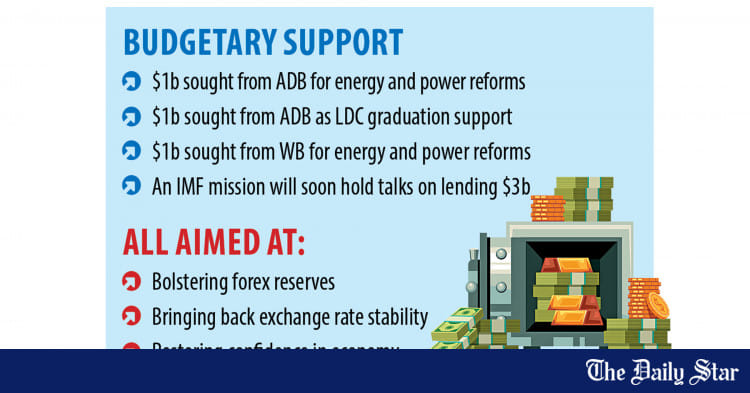
Bangladesh could get $3 billion in budgetary support under an Asian Development Bank (ADB) and World Bank (WB) arrangement for energy and power sector reforms and the upcoming status graduation from a least developed country (LDC) to a developing nation in 2026.

Last Thursday, the finance ministry sent a letter to the ADB seeking $1 billion in budgetary support for the energy and power sector.

Besides, an ADB mission has been holding talks with the government since September 3 over lending another $1 billion as LDC graduation-related support.

Of the amount, the ADB will provide $400 million. The remaining $600 million is expected to come from the Asian Infrastructure Investment Bank (AIIB) and Japan International Cooperation Agency (JICA) under an ADB arrangement.

In line with its bid to get budgetary support, the finance ministry on Sunday sought another $1 billion from the WB to bring about reforms in the energy and power sector.

Meanwhile, an International Monetary Fund (IMF) staff mission will arrive in Dhaka on September 24 to hold talks over lending another $3 billion in addition to the $4.7 billion it lent to the country in January last year.

All in all, the interim government, which took charge last month following the toppling of the Sheikh Hasina-led Awami League government on August 5, is seeking an additional $6 billion.

The interim government wants to bolster foreign exchange reserves, which have been falling for over two years, bring back stability to the exchange rate and restore confidence in the economy, which has been facing one of the most challenging situations in decades.

In the letter sent to ADB, budgetary support was sought for bringing about reforms in sustainable power and energy, according to a finance ministry official.

Focus points mentioned in the letter include improving sectoral governance, developing conducive policies and regulatory frameworks, improving financial viability and sectoral sustainability, attracting private investment, and preparing and formulating renewable energy procurement plans, the official said.

It also includes preparations for technical studies and pilot projects on smart grid energy storage and demands, the official added.

The letter added that the government's expenditure on importing energy and power increased significantly. Besides, due to a decline in domestic natural gas production, more primary fuel needs to be imported, it said.

In this context, the interim government has formed a committee to review the existing power generation practices and procurement process.

The finance ministry official said they requested $1 billion for the energy and power sector from the ADB in two tranches of $500 million each.

Government officials said the ADB suggested bringing about reforms in the revenue sector, budgeting, fiscal policy, procurement, logistics, and various other sectors to get the country status graduation-related budgetary support.

Officials said Bangladesh would lose different benefits, including concessional loans and tariff benefits, once it graduates from LDC status.

However, graduation will create other opportunities. To utilise those opportunities, Bangladesh must remove obstacles to smooth business activities and take steps to attract more foreign direct investment (FDI), they said.

Bangladesh must implement various reform programmes under the ADB-arranged loan so that the country does not have to face challenges following graduation from LDC status, they added.

Officials said a WB mission was expected to visit Dhaka in the second half of this month to discuss the power and energy sector reform programme.

"We are hopeful of getting support from the World Bank and ADB within December this year," a finance ministry official said.

Meanwhile, preliminary discussions for an additional $3 billion loan will begin with the IMF when its mission arrives in Dhaka in around two weeks.

Bangladesh Bank Governor Ahsan H Mansur had earlier requested the loan during a virtual meeting.

Finance Adviser Salehuddin Ahmed also held separate meetings with the IMF and stressed the need for additional loan support.

IMF officials informed the finance ministry and central bank that they were assessing how much it could lend to Bangladesh.

The IMF has so far released $2.3 billion under the ongoing $4.7 billion loan programme.

A finance ministry official said the upcoming IMF staff mission would mainly try to conduct a preliminary assessment of the reform measures that the interim government would undertake.

However, a meeting detailing the loan arrangement could be held on the sidelines of the World Bank-IMF annual meetings in Washington in October. The finance adviser and the central bank governor are likely to take part in the meeting.

Gayle Martin, WB's Acting Country Director for Bangladesh, said during a meeting with the Power and Energy Adviser that discussions have been held with the Bangladesh Bank governor and the finance adviser regarding the budget support. Martin also expressed optimism about providing the support for the energy and power sector by next December.

After taking charge as Bangladesh Bank Governor, Mansur created a list of priorities, one of which is to improve the condition of the foreign currency reserves.

For this, alongside increasing exports and remittance earnings, the government has been looking for budgetary support from various lenders, including the IMF.

A senior Bangladesh Bank official said the government has debts of over $2 billion in the energy sector. Besides, the country requires about $1 billion each month to meet various demands, including that for power and LNG.​
 

Forex reserves stand at $19.46b after ACU pay
Staff Correspondent 10 September, 2024, 22:14

1726019755501.webp

A file photo shows a man counting US dollar notes in the capital Dhaka. | New Age photo

The gross foreign exchange reserve in Bangladesh, according to the guideline of the International Monetary Fund, has dropped to $19.46 billion after the payment of import bills worth $1.37 billion to the Asian Clearing Union for July and August.

Before the payment, the foreign exchange reserve was $20.8 billion.

The payment is made in every two months.

However, according to conventional valuation by the Bangladesh Bank, the foreign exchange reserve dropped to $24.53 billion on Monday from $25.87 billion in the previous day.

The Asian Clearing Union is a payment settlement forum whereby the participants settle payments for intra-regional transactions through the participating central banks on a net multilateral basis.

Payment obligations of transactions among Bangladesh, Bhutan, India, Iran, the Maldives, Myanmar, Nepal, Pakistan and Sri Lanka are settled through the ACU payment system.

Following the political changes in Bangladesh since August 5, the central bank stopped selling dollars from its reserve, BB officials said.

Therefore, the decline will not affect the reserve as it would revive soon, they said

The reserve came down to the current level following continued sales of dollars in the past three years.

The foreign reserve was $20.39 billion on July 31 which increased to $20.8 billion on Sunday due to increased remittance flow after the fall of Awami League-led government.

Sheikh Hasina resigned as prime minister and fled to India on August 5 amid a student-led mass uprising.

The BB sold about $34 billion from its reserve in the past three financial years, which contributed most to depletion of reserve.

The Bangladesh Bank adheres to the IMF’s Balance of Payments and International Investment Position Manual, 6th edition (BPM6), for calculating both the gross international reserve (GIR) and the net international reserve (NIR).

The Bangladeshi taka weakened against the US dollar, reaching Tk 120 for a dollar, driven by a dollar shortage and a pressure on banks to settle import payments.

The exchange rate per dollar was Tk 84.81 in June 2021, Tk 93.45 in June 2022 and Tk 106 in June 2023.

The ongoing dollar crisis has substantially affected banks’ capacity to settle import payments and open letters of credit, posing challenges for businesses.

To address the dollar shortage, the government and the Bangladesh Bank had jointly introduced measures to curtail imports.

These initiatives involve restrictions on luxury and non-essential imports.​
 

IMF to assess Bangladesh’s need for fresh loan

An International Monetary Fund (IMF) delegation due to arrive later this month will assess Bangladesh's potential financial needs as the country sought a fresh $3 billion loan from the multilateral lender.

The delegation is likely to arrive in Dhaka on September 24 and stay till September 30, said a finance ministry official.

"As part of the upcoming mission [to Dhaka], the team will be assessing all of the economic developments and any potential financing needs," Julie Kozack, director of IMF Communications Department, told a press briefing in Washington DC on Friday.

"From the IMF side, we are working closely with the interim government [of Bangladesh]," she said, according to a transcript of the briefing published on the IMF website.

"We remain fully committed to working with Bangladesh and to support the people within the context of the IMF programme, we will continue to work closely with the authorities to help advance the reform agenda," she added.

Further details about the visit will be communicated in due course, she said.

Kozack also expressed her deep sorrow over the loss of lives and injuries during the recent protests in Bangladesh.

"It was very distressing to hear about those losses of lives," she said.

Addressing the nation on Wednesday, Professor Muhammad Yunus, chief adviser to the interim government, said budgetary support has been sought from development partners to enhance the country's foreign currency reserves.

The $3 billion loan was sought by Finance Adviser Salehuddin Ahmed and Bangladesh Bank Governor Ahsan H Mansur during separate virtual meetings with the IMF earlier.

The IMF has an ongoing $4.7 billion loan programme for Bangladesh, which was approved in January last year.

Over the past two years, Bangladesh's foreign currency reserves have been dwindling, having barely enough to cover import payments of a couple of months, which is the IMF's minimum benchmark.

In recent months, the reserves have been hovering around $20 billion, as per the IMF's calculations. On September 11, there was $19.44 billion.

In the energy and power sector alone, the government has outstanding dues of more than $2 billion, according to the central bank officials.

On top of that, the government requires about $1 billion each month for import bill payments for this sector.

Against this backdrop, the interim government has been seeking budgetary support from the development partners, alongside looking to bring in increasing amounts in remittance and export earnings.​
 
After the ouster of shaikh Hasina, BD should forget about economic development. Economic development does not happen in political instability particularly when the radical Islamist have taken over. BD should come back to normalcy as soon as possible by arranging far elections.
 

Latest Posts

Back