Home Watch Videos Wars Login

[🇧🇩] Monitoring Bangladesh's Economy

[🇧🇩] Monitoring Bangladesh's Economy
959
25K
More threads by Saif

G Bangladesh Defense

Forex market on the mend as remittances rebound

1726963868155.webp


After a prolonged period of crisis, the foreign exchange market in Bangladesh, especially the interbank forex market, is showing signs of recovery, driven by a rebound in remittance receipts and key policy interventions by the central bank.

The interbank forex market, which is crucial in facilitating international trade, had been under huge pressure lately owing to a crisis of US dollars, which was triggered by a combination of high import bills, lower-than-expected remittance inflows, and dwindling foreign exchange reserves.

However, the recent rebound in remittance inflows and some key policy decisions, such as the adoption of a crawling peg exchange rate system, are helping normalise the interbank forex trade.

"The interbank forex market is moving towards a stable phase riding on the strong rebound of remittance inflows," said Md Shaheen Iqbal, head of treasury and financial institutions at BRAC Bank Limited.

He added that the foreign exchange crisis is easing and the interbank forex market is functioning more smoothly.

Remittance inflows, a major source of foreign currency for Bangladesh, fell to a 10-month low in July, when the Awami League government imposed a five-day internet blackout to quell protests centring the students' quota reform movement.

However, receipts began to pick up again after former prime minister Sheikh Hasina fled to India on August 5 as many expatriates started campaigns to send money through formal channels to build the country.

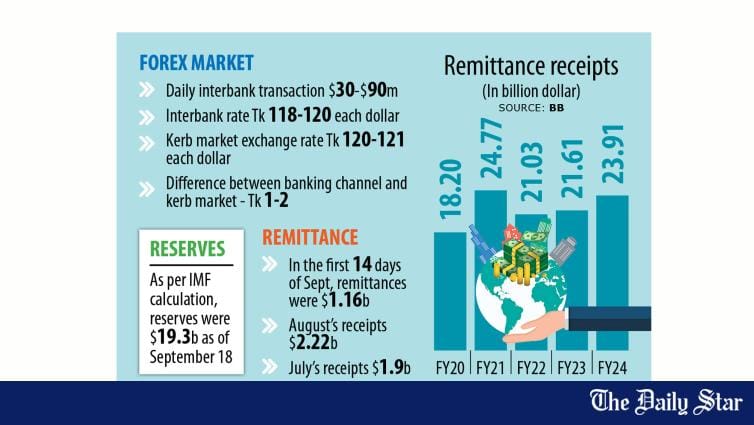
Remittance receipts climbed 16.10 percent in August compared to the month prior, hitting $2.2 billion.

In the first 14 days of September, remittance receipts reached around $1.17 billion, as per central bank data.

Riding on higher remittance inflows, the country's foreign exchange reserves are now showing signs of recovery. The foreign exchange reserves stood at nearly $20 billion as of Tuesday, according to the BPM-6 calculation standard of the International Monetary Fund (IMF).

Another benefit of increased inflows is that banks can now trade among themselves smoothly in the interbank forex market, Husne Ara Shikha, spokesperson of the Bangladesh Bank, told the media last week.

The price of the US dollar will also stabilise as the interbank forex transactions are active, she added.

Apart from rising remittances, some measures adopted by the central bank, including the introduction of the crawling peg, have also had a positive impact on the interbank forex market, said Mohammad Shams-Ul Islam, former managing director of Agrani Bank.

The Bangladesh Bank introduced the crawling peg, which allows the currency to adjust exchange rates based on demand and supply, on May 8 this year.

This move has reduced volatility in the market and helped narrow the gap between the US dollar price in the formal banking sector and the kerb market, Islam said.

Currently, the difference in US dollar prices between banking channels and the kerb market stands at about Tk 1 to Tk 2. Each dollar is sold for Tk 118-120 on the interbank forex market while it fetches Tk 120 to Tk 121 in the open market, according to market insiders.

Besides, after taking charge as the Bangladesh Bank governor, economist Ahsan H Mansur has taken some steps such as by reconstituting the boards of different crisis-hit banks.

He also stopped providing liquidity support to banks from the foreign exchange reserves.

These moves have restored the confidence of depositors, remitters and businesses in the banking sector, thereby improving the overall flow of interbank foreign exchange within the country, said Islam, former managing director of Agrani Bank.

As an example, he said, banks like the Bangladesh Krishi Bank, which receive a good amount of remittance but do not face pressure to open letters of credit (LCs), are supplying dollars to the interbank market, reducing the pressure on banks that deal with dollar-based trading.

As a result of sufficient dollar flow to the interbank market, the pressure on LC openings has reduced drastically, he added.

BRAC Bank's Shaheen Iqbal said now there is some surplus in the interbank market after meeting the demand for LCs.

"This is a significant positive trend," he said, estimating that daily transactions in the interbank forex market stood between $30 million and $90 million.

The interbank market will be fully operational after the government clears its outstanding import bills, Iqbal added.​
 
Analyze

Analyze Post

Add your ideas here:
Highlight Cite Fact Check Respond
  • Love (+3)
Reactions: Bilal9

Paradigm shift in ADP planning
Published :
Sep 21, 2024 22:52
Updated :
Sep 21, 2024 22:52

1726966061876.webp


The interim government has initiated a radical shift in annual development plan (ADP) implementation. The current five-year plan that forms the basis of ADPs has been suspended and the new focus is now on skill development of country's human resources, which is a major shift from several previous ADPs that had prioritised infrastructure development. To term the plans radical would be an understatement. For instance, with a view to quicker decision-making and implementation, the current administration has empowered individual ministries to approve projects. It has become abundantly clear that the top-down decision-making approach whereby projects were undertaken whimsically, while wholly or partially disregarding a need-based approach had resulted in very poor ADP implementation. This had been a major bone of contention with bilateral and multilateral foreign development partners who committed billions of dollars in grants and loans only to see partial implementation. Since there was hardly any need felt at the top for either transparency or accountability, it is interesting to note that a taskforce has been set up to deliver direction of the economy and submit a report within the next three months so as to give current policymakers a bird's eye view about the state of the economy.

It is good to know that finally, the dire needs of the massively unemployed educated youth are being addressed. The economy had become overly dependent on foreign workers and since the youth were graduating from a broken education system that failed to equip young people with requisite technical knowhow or with knowledge that industry needed, they found no employment. No exact figure exists on how many foreign workers are employed in Bangladesh, but it is more than a million people. They don't pay taxes here and this is why the human resource development has been prioritised to bring young people up to speed on various emerging opportunities like information technology. There is also realisation that the bulk of our expatriate workers are employed in the unskilled category. Hence, remittance value remains low which could be reversed if more technical hands could go abroad to work and whose pay would be many times more than that of unskilled workers. A qualitative improvement is needed and this is very much possible through vocational and IT-education development.

Previous government had opted to go for some projects which had bypassed the planning commission. This was done deliberately to favour select companies that opened the door wide for graft on epic proportions. Irregularities happened at the sole discretion of the former prime minister. As far as a number of mega projects are concerned, the country has ended up with a huge foreign debt, the servicing of which has become a burden the economy can ill-afford. These grandiose projects were taken to showcase the "development" made possible by the erstwhile government which were not based on any economic need but to serve the hubris of one person.

The current administration is having to repair the damage done over the last 15 years. It had become modus operandi that mega-projects mean mega-corruption. One instance of such graft can be cited here. The former roads and highways minister had claimed that it would require one year and Tk 1.5 billion to repair the damage caused by miscreants to two metro rail stations. One of the vandalised station at Kazipara was reopened on Friday last. The repair of the station was completed at a paltry amount of Tk 2.0 million under the new metro rail administration. Had the previous administration remained in power, a substantial amount would have ended up lining the pockets of corrupt politicians and contracting company. Let these be lessons learnt for the new administration. Hopefully, the mistakes of past regimes will not be allowed in the present. Transparency and accountability must become the guiding principles of today's political and economic decisions.​
 
Analyze

Analyze Post

Add your ideas here:
Highlight Cite Fact Check Respond
  • Like (+1)
Reactions: Bilal9

On new export earnings target
The first quarter of the current fiscal year is marked by a notable economic slowdown in the country. And, the reasons are obvious....
Asjadul Kibria
Published :
Sep 21, 2024 22:46
Updated :
Sep 21, 2024 22:46

1726966188542.webp


After a predictable setback in the country's export earnings in the last fiscal year, the interim government has set a fresh target for the current fiscal year (FY25). The new total export target is set at US$57.50 billion, a figure that carries significant weight as it is 13.30 per cent higher than the actual receipt of FY24. Of this, $50 billion is targeted as earnings from exports of goods and the rest from services.

It is to be noted that the country fetched $44.48 billion in exports of goods in the last fiscal year, which was 4.34 per cent lower than the earnings of exports in FY23. Again, the actual receipt in the previous fiscal year missed the original target of $62 billion by 39 per cent. Overambitious targets, coupled with the manipulation of data to artificially inflate the export earnings by the ousted autocratic government, result in a big gap between the targeted and actual figure. The manipulation of data on export earnings also provided a distorted scenario of the country's external trade and overall balance of payments (BoP).

After adjusting the export data, initially provided by the Export Promotion Bureau (EPB), which counted export earnings in some cases inflating the figure, it was found that there was an overestimation of around $9 billion in FY23. This underscores the crucial need for accurate and honest reporting, as the EPB data put the export earnings at $55 billion in FY23, which came down to $46.50 billion after the adjustment. Thus, there was an overestimation of around 16 per cent of the export receipt.

However, the new export target is fixed taking into consideration the adjusted figure of the export earnings. So, the figure was low compared to the indicative target set by the Hasina regime. The Cabinet Committee on Economic Affairs (CCEA) in May last approved the draft of the Export Policy 2024-2027, eyeing a $110 billion export target in FY27 based on an inflated figure.

A valid question in this connection is how feasible the new merchandise export target of $50 billion, set by the interim government in the second week of this month, is. This piece will try to find the answer, taking both external and internal factors into consideration.

To understand the external factor, a quick look at the current trend of global trade is necessary. Around three months ago, UN Trade and Development (UNCTAD) released its global trade update, which showed that the current international trade trends have turned positive. This positive trend, with trade in goods increasing by around one per cent quarter over quarter (QoQ) in the first quarter of 2024, and services trade growing at approximately 1.5 per cent on the same count, brings a sense of optimism. The UNCTAD predicted a stronger positive trend for Q2 in 2024, projecting an approximate 2 per cent increase for the first half of 2024.

The UN body also estimated that the growth would add around US$250 billion to trade in goods and about US$100 billion to services trade in the first half of the current year compared to the second half of 2023. Moreover, if positive trends persist, global trade in 2024 could reach almost US$32 trillion, though it is unlikely to surpass its record level seen in 2022.

Now, in the first week of this month, the World Trade Organization (WTO) released the latest reading of its Goods Trade Barometer, which is a composite leading indicator for world trade. It revealed that global merchandise trade has been picking up in the third quarter of 2024 after demand for traded goods stalled in 2023 amid high inflation and rising interest rates. In other words, global trade in goods is on the rise in the current year, as predicted by UNCTAD earlier. The reading of the WTO trade barometer also showed the possibility of continuing the rising trend. Taking a cue from these projections, there is hope for Bangladesh, no doubt, as the last half of the current calendar year is also the first half of the current fiscal year.

Nevertheless, according to the WTO barometer, the outlook for trade remains highly uncertain due to four downside factors. These are: rising geopolitical tensions, ongoing regional conflicts, shifting monetary policy in advanced economies, and weakening export orders. All these may severely subdue Bangladesh's export potential in the first half of the current fiscal year.

The Russia-Ukraine war has been continuing for two and half years. Israel continues to pound the Gaza Strip to uproot Hamas militants for almost a year, killing more than 41,000 Palestinians. Though its goal is yet to be achieved, the Zionist state is now going to launch a big offensive in Lebanon to fight Hezbollah, meaning the Middle East will become more volatile. These two key regional conflicts have already disrupted the global supply chain, and continuing the conflicts at a bigger scale will make things worse soon.

The looming presidential election in the United States (US) has become a matter of tension across the world, especially when Donald Trump is the candidate from the Republican camp. Winning Trump would mean escalating geopolitical tension and proliferating a trade war.

On the domestic front, the first quarter of the current fiscal year is marked by serious disruption of economic activities in the country for obvious reasons. The anti-discrimination movement launched by the students in July to reform the quota system in the public sector turned into a mass uprising against the Hasina regime. The movement forced Sheikh Hasina to step down and flee the country to take shelter in India.

Though an interim government under the leadership of Nobel Laureate Professor Muhammad Yunus has taken charge, the overall situation is still volatile. Several ready-made garments (RMG) and other factories were vandalised and faced labour unrest. Production has not fully resumed in all the industrial units. Imports are also slow, as many banks have been short of funds due to gross irregularities. Some big corporate entities, known for their strong affiliation with the ousted prime minister and mobilised big funds from the banks bypassing the rules, are in trouble now. So, the overall economic activities, including exports in the current fiscal year's first quarter, are undoubtedly dull. However, the situation is expected to start to recover in the second quarter, leading to a gradual rise in exports.

Thus, export earnings in the first half of the current fiscal year will grow moderately under the current trend in global and local factors. This will make achieving the target by the end of the fiscal year challenging.​
 
Analyze

Analyze Post

Add your ideas here:
Highlight Cite Fact Check Respond
  • Love (+3)
Reactions: Bilal9

Can Bangladesh achieve SDGs by 2030?
Published :
Sep 23, 2024 22:05
Updated :
Sep 23, 2024 22:05

1727141433466.webp


On the other side of unremitting inflation, a product of no-holds-barred free market economy, is decline in purchasing power of people ---only more so of the low- and fixed-income groups. If shrinking purchasing power is not compensated by corresponding rise in income, the inevitable consequence is deepening poverty. At a time Bangladesh economy was about to witness a turnaround early in the post-Covid-19 period, the Russo-Ukraine war not only halted the process but also threw the prospect of an economic recovery into uncertainty. The main culprit was the sudden price hike of fuel oils for which Bangladesh has to overwhelmingly depend on import. The wind taken out of its sails, the country, like many others with little or no domestic energy sources, discovered itself in a critical situation. Under a system of kleptocracy of the lumpen moneyed and business class unduly served by their bureaucratic cohorts, outrageously unequal wealth distribution only pushed more people to get marginalised.

So when a public meeting held under the title "Eliminating Poverty and Inequality and Strengthening Social Security" on Saturday last comes up with the disclosure that poverty rate in the country has gone up to 20.5 per cent from 18.7 per cent over the past two years, there is nothing to be surprised. Add to this, the urban poverty that saw a rise from 14.7 per cent to 20.5 per cent. Read between the lines, this indicates that urban employment and income have either shrunk or remained static for the low-income people who can barely save for the rainy days. Even if income does not fall, families can suffer income erosion when prices of essentials skyrocket. This has been happening for the past two years or so and there is no sign yet market volatility will ease soon.

There are two aspects of this reverse journey on the road to economic progress for a significant portion of the population. One is the financial vulnerability of this segment of population to unrelenting inflation often driven by intriguing market players; the other is either such people's failure to raise their income from self-employment or from employers who employ them for a pittance. Exploitation of both opportunities and labour explains the atrocious inequality. Otherwise, the national wealth generated annually should not have widened the economic disparities so grossly. Bhutan is a good example of smaller GDP which has been judiciously used, particularly in ensuring rational distribution of its wealth, for alleviation of its poverty. When businesspeople can make rampant profit and the unduly privileged close to the kleptocratic circle can loot and launder billions of Taka, it tells a different story of deprivation on the one hand, and filthy affluence on the other.

Now the deliberation of the Saturday's public meeting aired concern about Bangladesh's attainment of the much hyped Sustainable Development Goals (SDGs) by 2030. It is a genuine concern, no doubt but if the macroeconomic health and wealth creation are taken into account, the country should not miss the target. But if the microeconomic situation in relation to rising poverty comes into consideration, the path may be tortuous but the goals not quite unachievable. The key issue here is economic reform with special emphasis on ensuring greater share of created national wealth for the marginalised in order to ameliorate the lot of the poor during the next six years.​
 
Analyze

Analyze Post

Add your ideas here:
Highlight Cite Fact Check Respond
  • Love (+3)
Reactions: Bilal9

A game changing model for boosting remittance

1727224766661.webp


Bangladesh has been experiencing a severe forex crisis for the past two years. Our two main sources of foreign currency are exports and remittances. While we have devoted significant attention to increasing exports, we have largely neglected the potential of remittances. In the past fiscal year, exports have been in the range of $47 billion.

If we consider a value addition of around 50 percent, the net forex earnings is around $23 billion. Meanwhile, judging the current trends, this year the remittances could be between $27 billion and $30 billion.

Workers, especially unskilled labourers abroad, often face cumbersome processes when using formal channels. This drives them to informal options like hundi, which are easier but deprive the country of vital foreign currency. To increase formal remittances, we must understand that, beyond financial needs, wage earners are driven by higher aspirations for esteem and respect.

So, to foster their loyalty and encourage remittance through formal channels, we must adopt a dual strategy addressing their immediate and long-term needs for dignity and recognition.

SHORT-TERM SOLUTIONS

Wage earners' elite club: The government can introduce a "Wage Earners Elite Club," offering tiered membership (platinum, gold, silver and bronze) based on remittance volumes. Benefits for club members could include VIP airport services, meaning that elite members would enjoy dedicated immigration counters and transportation. Additionally, platinum, gold, and silver members could be given access to exclusive lounges at airports, ensuring more comfortable travel.

Recognition and awards: High contributors would be publicly recognised, invited to national events and treated as Commercially Important Persons.

Free travel benefits: Platinum and gold cardholders would be eligible for free round-trip tickets, further incentivising formal remittance channels.

Annual membership upgrades: Elite club membership would be reassessed yearly, with additional perks for top remitters, such as upgraded travel benefits.

Also, the government should develop a remittance app to simplify the process of sending money. Features could include payment gateway integration, transparent currency conversion rates, strong security measures and real-time transaction tracking.

LONG-TERM SOLUTIONS

Sustaining esteem and incentivising remittances: To maintain long-term engagement, the government should offer healthcare and educational benefits. Doing so would allow wage earners and their families to receive healthcare coverage and priority access to schools, thereby improving their social safety net.

Dignity and respect: Embassies and airports must adopt a customer-service approach, ensuring wage earners are treated with the respect they deserve. Special training programmes for embassy staff could be implemented to this end.

Social safety net: Offering wage earners access to pension schemes, scholarships for their children and government-backed housing loans would create loyalty and trust, incentivising formal remittances.

By treating wage earners as valued contributors to the economy and recognising their need for dignity, respect, and belonging, the country can significantly boost remittance inflows. These measures will not only alleviate the foreign currency crisis but also improve the lives of those who sacrifice so much for their families and the nation.

The author is chairman of Unilever Consumer Care Ltd and chief adviser of the board at Crown Cement Group​
 
Analyze

Analyze Post

Add your ideas here:
Highlight Cite Fact Check Respond
  • Love (+3)
Reactions: Bilal9

IMF mission inquires about slow growth of revenue receipts

1727396881323.webp


The fact-finding mission from the International Monetary Fund (IMF) inquired about the slow growth of direct tax collection under the National Board of Revenue (NBR).

A four-member delegation from the Washington-based lender, led by Mission Chief Chris Papageorgiou, raised the issue during their scheduled closed-doors meeting with NBR officials at the tax authority's headquarters in Agargaon.

"The delegation asked why we failed to meet the IMF's revenue collection target in the previous fiscal year and what measures to increase revenue collection have been taken for FY25 and FY26," a top NBR official who attended the meeting said on condition of anonymity.

"It's a form of taking accountability," he told The Daily Star yesterday.

"We explained our real situation to them and said what we have done in recent times, including measures to increase tax return submissions."

The IMF mission also underscored the need to increase the tax-GDP ratio, which is one of the lowest in the world, by a minimum of 0.5 percent in each of the coming years, the official said.

The IMF mission arrived in Dhaka on Monday as part of a weeklong visit to assess Bangladesh's potential financial needs after the country sought an additional $3 billion loan.

The multilateral lender emphasised revenue mobilisation, especially as Bangladesh witnessed an 11 percent drop in revenue collection in the first two months of this fiscal year.

The tax authority logged Tk 42,106 crore in revenue in the July-August period, which is Tk 15,000 crore short of the revenue collection target for the period.

The target for the entirety of FY25 has been set at Tk 480,000 crore.

The NBR official further said that the mission had enquired about the tax expenditures and various reform measures, including automation of the taxation system and processes.

"We have been asked to reduce tax exemptions in a rational way," the official added.

The IMF team also agreed to extend their assistance for automation.

On a positive note, the team expressed satisfaction over the state of indirect taxation.

Md Bodruzzaman Munshi, second secretary of VAT Act and Rule at the NBR, said: "The fact-finding mission was pleased with the value-added tax collection.

"Last fiscal year, we crossed the IMF's VAT collection target, gathering over Tk 150,700 crore."

He added that the delegation asked to submit both medium- and long-term revenue strategies by December this year as well as provide an update on the progress of the digital transformation process.

The IMF mission held four meetings with the NBR yesterday, including the three wings for income tax, value-added tax and customs.​
 
Analyze

Analyze Post

Add your ideas here:
Highlight Cite Fact Check Respond
  • Love (+3)
Reactions: Bilal9

Interest payments surpass Tk 100,000cr for first time

1727482590811.webp


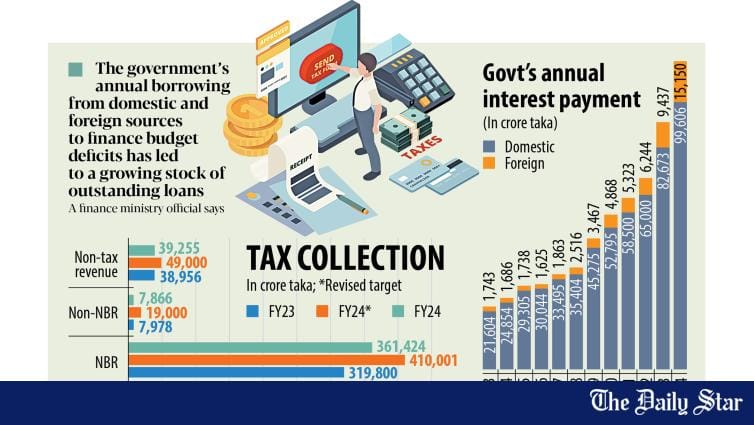
The government's interest payments against loans surged 24.5 percent in fiscal year 2023-24, exceeding the Tk 100,000 crore mark for the first time in history, thanks to higher borrowing costs for loans from both domestic and foreign sources.

According to the finance ministry's fiscal report released yesterday, over Tk 114,000 crore was spent on interest payments in FY24, representing more than one-sixth of the national budget.

While spending on subsidies decreased slightly, the government missed the revenue targets set by the International Monetary Fund (IMF) for its ongoing $4.7 billion loan programme.

Initially, the government allocated Tk 94,376 crore for interest payments in FY24. However, this figure rose to over Tk 105,000 crore in the revised budget.

However, the actual figure even overshot the revised mark, indicating the government's dependence on borrowing to finance budget deficits.

Interest payments for foreign loans increased 60.53 percent to Tk 15,150 crore last year while rising 20.48 percent to Tk 99,606 crore for domestic loans.

In FY23, total interest payments amounted to Tk 92,110 crore.

A finance ministry official said the government's annual borrowing to finance budget deficits had led to a growing stock of outstanding loans.

As of March 2024, the government's total outstanding debt stood at Tk 1,697,415 crore, which is equivalent to 33.78 percent of the country's gross domestic product (GDP).

The Finance Division's Medium-Term Macroeconomic Policy Statement (MTMPS) said that interest payments would continue to rise gradually in the coming years.

The report mentioned that the proportion of external interest payments as a percentage of the national budget would rise to 2.6 percent in FY27 from 0.9 percent in FY22, reflecting the growing impact of external debt on the budget.

The report also said two major factors contributed to the increase in interest payments for foreign loans.

It further anticipated that reference rates in advanced economies, which serve as benchmarks for setting other interest rates, would remain elevated for some time.

Besides, Bangladesh's graduation from least developed country status in 2026 will gradually limit access to concessional loans from external sources, increasing borrowing pressure.

"This increase is attributed to a higher proportion of borrowing through floating and semi-concessional rates, which are more sensitive to market fluctuations compared to fixed-rate financing," said the report.

Moreover, the depreciation of the local currency taka against the US dollar has inflated the value of external debt when measured in terms of the local currency.

Regarding domestic borrowing, the banking sector has been the main source of funds. The Bangladesh Bank's recent policy rate increases have contributed to rising interest payments on domestic loans.

SUBSIDY EXPENDITURES DECLINE SLIGHTLY

The government has also been facing a new challenge due to significantly increased subsidy expenditures in recent years.

As such, the IMF has been pushing the government to reduce these expenditures by raising power and fertiliser prices.

In FY24, the government spent less on subsidies than allocated in the revised budget. In the revised budget, the total subsidy allocation was Tk 85,906 crore, but actual spending amounted to Tk 72,497 crore.

IMF TARGET MISSED AGAIN

After the IMF approved a $4.7 billion loan programme in January last year, the government struggled to meet the targets set for revenue and foreign currency reserves. In most cases, it has failed to achieve the targets.

As a result, the government had to seek a waiver for disbursal of three tranches of the loan so far.

For the fourth tranche, the IMF has set the target for tax revenue collection at around Tk 394,000 crore by June this year.

At the end of the last fiscal year, the government's tax revenue collection was Tk 369,000 crore, meaning it missed the target by Tk 25,240 crore.

BUDGET IMPLEMENTATION FALLS FLAT

Despite announcing large annual budgets, the government consistently fell short in implementation.

In the last fiscal year, the budget size was initially set at around Tk 761,000 crore before being revised to Tk 714,000 crore. However, total budget spending reached only Tk 602,000 crore.

The spending in the previous fiscal year was around Tk 574,000 crore.

Last year, the government allocated Tk 245,000 crore for the Annual Development Programme (ADP) in the revised budget but spent only Tk 188,000 crore.

In FY23, the ADP spending was Tk 192,000 crore.​
 
Analyze

Analyze Post

Add your ideas here:
Highlight Cite Fact Check Respond
  • Love (+3)
Reactions: Bilal9

Progress slow in signing preferential trade deals with trading partners

1727568049628.webp


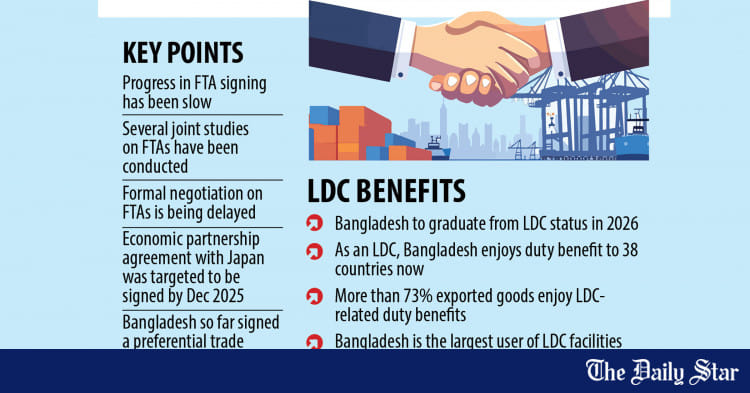
There has been little progress regarding the signing of preferential trade deals by Bangladesh with major trading partners amidst the change in government following the anti-discrimination movement in July.

Bangladesh wants to sign the free trade agreements (FTAs), comprehensive economic partnership agreements (CEPAs) and economic partnership agreements (EPAs) to continue enjoying zero-duty benefits once it graduates from the least developed country (LDC) status to that of a developing nation in 2026.

Initiatives had been taken for signing FTAs with China, Indonesia and members of the Association of Southeast Asian Nations (Asean), a CEPA with India and an EPA with Japan.

In this regard, Bangladesh has already conducted joint studies individually with India, China and Japan.

Formal negotiations were supposed to be launched soon but the fall of the Sheikh Hasina-led government on August 5 has led to the suspension of schedules.

"A meeting with Japan was supposed to be held in August in Dhaka…but this meeting is rescheduled for November and the date is yet to be confirmed," said a senior commerce ministry official asking not to be named.

Similarly, dates for formal talks with India and China could not be confirmed yet, the official also said.

There has been a slowdown in progress for the change in government, he added.

However, the official is hopeful that the interim government would start the negotiations soon.

Till date, Bangladesh has been able to sign only a preferential trade agreement (PTA) with Bhutan in December 2020 involving 100 goods of Bangladesh and 34 items of Bhutan.

The trade deals are necessary as higher duties will be imposed on Bangladesh after the LDC graduation.

Currently, Bangladesh as an LDC has been enjoying zero-duty benefits to 38 countries, including the 27 European Union (EU) nations.

However, after the LDC graduation, the local exporters will have to face duties on the shipment of goods and their competitiveness in global trade may wane.

However, the EU has announced plans to extend the trade facilities to the graduating LDCs for three more years to prepare for the status transition.

That means, Bangladesh will continue to enjoy the LDC trade benefits of the EU till 2029.

Moreover, Bangladesh and other LDCs have been negotiating under the World Trade Organization (WTO) for the extension of the trade benefits.

This prompted global leaders at the 13th WTO ministerial conference in Abu Dhabi to agree to extending the LDC trade benefits for three more years.

However, the countries need to undertake bilateral negotiations to enjoy the benefits.

The progress in negotiations has slowed and these should be reviewed, said Mohammad Abdur Razzaque, chairman of the Research and Policy Integration for Development (RAPID).

Primarily, the government should know whether it is prepared or not for launching the negotiation as capacity is a major factor in conducting trade deal negotiations with the trading partners, he said.

The preferential trade deals translate to tariff rationalisation as the partnering countries will always put pressure for reduction of tariffs for signing the final deals, he said.

Bangladesh should assess whether it is capable of rationalising the tariff structure as per demand of the partnering countries, said Razzaque.

Import duties are one of the major sources of revenue of the government as Bangladesh is one of the most protectionist countries with an average tariff rate of nearly 28 percent, he said.

One of the largest sources of import duty is China.

Bangladesh annually imports more than $20 billion worth of goods from China. From this, the government's revenue department earns more than Tk 25,000 crore.

Meanwhile, after the change in government, a section of businesspeople has been urging the interim government to review whether Bangladesh truly fits the criteria for LDC graduation.

There is a lot of mismatch in export and import data among different government bodies, for which questions remain over the country's actual economic potential, they say.​
 
Analyze

Analyze Post

Add your ideas here:
Highlight Cite Fact Check Respond
  • Like (+1)
Reactions: Bilal9

Members Online

No members online now.

Latest Posts

Back
 
G
O
 
H
O
M
E