New Tweets

[🇧🇩] Monitoring Bangladesh's Economy

G Bangladesh Defense
[🇧🇩] Monitoring Bangladesh's Economy
1K
29K
More threads by Saif


Turkish beverage giant Coca-Cola Icecek acquires Coca-Cola Bangladesh for $130m​

United News of Bangladesh . Dhaka | Published: 13:00, Feb 16,2024 | Updated: 22:05, Feb 16,2024


225610_160.png


In a strategic move to strengthen its presence in the South Asian market, Coca-Cola İçecek, the Turkish beverage giant, has inked a deal to acquire Coca-Cola Bangladesh Beverages Limited for a whopping $130 million.

The share purchase agreement was signed between CCI, its wholly-owned subsidiary CCI International Holland BV and a subsidiary of The Coca-Cola Company.

The agreement outlines the acquisition of the entire 100 per cent shares in CCBB, with CCIHBV emerging as the primary direct shareholder.

CCBB holds a pivotal role in Bangladesh as one of the key players in the production, sale and distribution of both sparkling and still brands under The Coca-Cola Company umbrella.

As per the terms of the agreement, CCI is set to acquire the complete shareholding of CCBB at an equity value determined by subtracting CCBB’s estimated net financial debt as of the closing date from an enterprise value of $130 million. A post-closing price adjustment mechanism will come into play after a comprehensive closing audit to ascertain the precise net financial debt amount of CCBB as of the closing date.

The acquisition is anticipated to be funded through CCIHBV’s existing cash resources, and it is expected to have a modest impact on CCI’s net leverage. This strategic move not only expands CCI’s global footprint but also underscores its commitment to capitalising on growth opportunities in emerging markets. The acquisition is subject to regulatory approvals and customary closing conditions and is expected to further solidify CCI’s position as a major player in the beverage industry on the Indian subcontinent.
— UNB​
 
Analyze

Analyze Post

Add your ideas here:
Highlight Cite Respond

Bangladesh seeks DFQF in Swiss market until 2029​

FM also seeks Swiss investment in IT, agro-processing sectors​

FE ONLINE DESK
Published :
Feb 13, 2024 13:06
Updated :
Feb 13, 2024 13:06

1708128584119.webp


Foreign Minister Dr Hasan Mahmud has urged Switzerland to follow suit of the European Union (EU) in extending duty-free and Duty-Free Quota-Free (DFQF) trade preferences until 2029.

The minister also invited Swiss investment in IT and agro-processing sectors in Bangladesh, reports UNB.
He stressed on the protracted Rohingya crisis and sought Swiss assistance and support in expediting the Rohingyas’ safe, dignified, and swift repatriation to Myanmar.

Ambassador of Switzerland to Bangladesh Reto Renggli met the Foreign Minister at his office on Monday and praised Bangladesh’s impressive value chain development journey from the 70’s to this day and flagged the scope of supply chain development where the Swiss side could chip in through their food processing machinery industry.

The ambassador reassured continued Swiss humanitarian support to the Rohingyas, recognising the recent border security issues as well.

The foreign minister and the Swiss ambassador shared their views on wars and conflicts in different parts of the world, including in Ukraine, Gaza and the Red Sea and their resultant negative impacts on the economies of the two countries.

Mr. Renggli congratulated Foreign Minister Dr Hasan on his appointment as the foreign minister.

The foreign minister termed the relations between the two nations as historic and strong.

The Swiss ambassador lauded the spectacular socio-economic development of Bangladesh over the last decade.
Mentioning Swiss President’s visit to Bangladesh in 2018 and Prime Minister’s visit to Switzerland in 2023, the envoy termed Bangladesh-Switzerland ties as ‘solid’.

He expressed hope for signing bilateral Air Services Agreement in March and holding the next Foreign Office Consultations in April to advance bilateral relations further.

Switzerland is a steady partner of Bangladesh in promoting key values - good business practices, multilateral cooperation and a vibrant civil society.​
 
Analyze

Analyze Post

Add your ideas here:
Highlight Cite Respond

Banking reform for whom?​

FE
Published :​
Feb 12, 2024 21:41
Updated :​
Feb 13, 2024 21:45

1708153135941.webp


In his speech at the launching ceremony of the fifth edition of the Banking Almanac held at the National Press Club on Saturday, eminent economist Wahiduddin Mahmud made quite a few critical observations on the much hyped banking reform and the recipes the multilateral lenders such as the World Bank (WB) and the International Monetary Fund (IMF) suggest for Bangladesh. By banking reform he was referring to the roadmap of banking reform the Bangladesh Bank (BB) unveiled last week. Although the roadmap has as many as 17 key issues for the authorities to decide action plans, they can broadly be encapsulated to five. These are reduction of defaulted loans, prevention of anonymous loans and fraudulent activities, developing mechanism for appointment of competent directors, appointment of qualified independent directors and merger of weaker banks with stronger ones.


Referring to his involvement with two bank reform commissions earlier, Dr Mahmud made it amply clear that banking rules and regulations of international order were formulated and had those been included in the Banking Company (amendment) Act, there would be no need for the roadmap. The action plans are mere words instead of strong measures. As for the guidelines put forward now cannot control the damage but may stem future rot. An analysis of the fault lines responsible for rendering the tougher rules and regulations inoperative is essential. Dr Mahmud's example of removal of 70 directors from bank boards, compelling some to repay loans and others opt for voluntary resignation in 2003 due to action by the BB and judiciary serves as a pointer. The question is why such tough measures were not followed up subsequently; rather banking regulations were rendered inoperative or made further relaxed to the advantage of motivated loan defaulters. Their undue influence not only stalled the inclusion of those rules and regulations in the Banking Company Act, but also helped establish their family monopoly in banking business by just purchase of shares of several banks.

How the rules and regulations were systematically tinkered with in the interest of certain coteries is clear from former BB governor Saleh Uddin Ahmed's reference to the advantageous manoeuvring by those involved and the authorities' submission to it. During his time, there was no provision for more than two family members on the board of a bank and their tenure was for three years. The number of family members was raised to four and the tenure to six years and lately nine years. Monopoly at its outrageous! The rescheduling policy that went from 10 per cent of the outstanding loans to 20 per cent and then to 30 per cent has now been slashed to just 2.0 per cent. Similarly, the scheduled time for writing off bad loans has been brought to two years from three years. All these are done purposefully to allow defaulters a leeway and give the balance sheet a fresh and clean look. But in the process loans amounting to billions of taka is gobbled up by the loan sharks.

Clearly, the banking conundrum is there for all to see but the areas requiring urgent attention have been ignored. The roadmap has bypassed the reconstructive surgery in favour of a cosmetic one. Dr. Mahmud stressed the need for inclusion of the written off bad loans in the Banking Almanac in the interest of receiving an authentic picture of the banking sector. His doubt that the merger theory will fall flat seems to be well founded. Why should healthy private banks accept liabilities of a sick one? Incorporation may be the right word in case the sick one is taken over on its asset value. If the national interests are given preference to coterie interests, the problem, however daunting it may look, can be solved.​
 
Analyze

Analyze Post

Add your ideas here:
Highlight Cite Respond

Saudi investors keen to set up SEZ in Payra​

FE ONINE REPORT
Published :​
Feb 07, 2024 18:13
Updated :​
Feb 07, 2024 18:13

1708153322657.webp


Saudi investors have expressed their interest in setting up a special economic zone (SEZ) at the Payra area in Kalapara upazila of Patuakhali district of Bangladesh.


Salman F Rahman, private industry and investment adviser to the prime minister, said this on Tuesday in a press conference at Bangladesh Investment Development Authority (BIDA) premises in Dhaka after his three-day visit to Saudi Arabia (SA).

The government wants to offer the investment opportunity to the SA for establishing an Economic Zone in Bangladesh, he told the conference.

Their investment minister has also expressed willingness to set up the SEZ in Payra, he said.

Also, Bangladesh is willing to establish a urea fertiliser factory in SA under the ownership of both countries to ensure an uninterrupted supply of the major agricultural input, he said.

“A joint venture fertiliser factory is under consideration which Bangladesh would import entirely after production,” he said.

The Saudi government is interested in moving forward with the proposal and its feasibility study would be completed by March 2024, he added.

There is a scope for private sector investors to join the initiative too, he added.

Bangladesh has sought the cooperation of SA to resolve the ongoing dollar crisis in the country.

“We have requested to allow Bangladesh one year time span, instead of the existing 45 days, to foot the energy import bills due to the dollar crisis. The counterpart assured to consider the request,” he said.

In the IMTC meeting, both countries came to a consensus on several issues including curbing terrorism in the name of Islam, strengthening cooperation between the Islamic countries, condemning of attack in Gaza, and cooperating to resolve Rohingya issues in Bangladesh.

The SA is also keen to invest in food security issues such as the production of vegetables, fish and other food products and import those to their country.

The advisor also discussed on joint research by Bangladesh and SA Rice Research Institute to produce long-grade rice.

Mr Rahman joined the Islamic Military Counter Terrorism Coalition (IMCTC) on behalf of the PM and defence minister.​
 
Analyze

Analyze Post

Add your ideas here:
Highlight Cite Respond

Roadmap for banking reforms: Implementation is key​


1708299345231.webp


Although the roadmap drawn up to reform the banking industry of Bangladesh may seem attractive on the surface, there are questions regarding its efficacy in ensuring good governance in the scam-hit sector.

The Bangladesh Bank outlined 17 action plans under the roadmap released on February 4.

The initiative mainly aims to bring down the ratio of non-performing loans (NPLs) to below 8 percent and ensure good governance in the sector by June 2026.

The overall NPL ratio was 9 percent by the end of last year.

The state-run banks accounted for the bulk of the bad loans as 20.99 percent of their disbursed funds had soured by the end of 2023.

As such, the BB has included measures to reduce the NPL ratio of public banks to less than 10 percent within the deadline.

Although most of the action plans and policy reforms already exist while others were added in the Bank Company (Amendment) Act 2023, the governance in the sector is getting worse.

For example, the roadmap shows that the banking regulator will provide necessary instructions to prevent lenders from exceeding the single-borrower exposure limit.

However, the provision is not new as it has existed in the Bank Company Act for more than a decade. Still, exceeding the single-borrower exposure limit has become a regular practice in the banking industry.

Around 89 borrowers of four state-run banks, namely Sonali Bank, Janata Bank, Agrani Bank and Rupali Bank, had exceeded the limit as of June last year, as per a central bank report.

Under the current single-borrower exposure limit, banks are allowed to disburse loans equal to 25 percent of their total capital to an individual client.

Against this backdrop, economists and financial experts said that implementing the existing policies is more important than introducing new ones.

Salehuddin Ahmed, a former central bank governor, recently said regulatory bodies are failing to adequately punish those who do not follow banking laws.

As per the first policy change included in the roadmap, banks are allowed to write off loans that remain in the "bad and loss" category for two years while it was three years previously.

The central bank expects that NPLs will be reduced by Tk 43,300 crore because of the policy change.

However, the fact is that when banks write off bad loans, the figure is hidden from the balance sheet but the liabilities still remain.

Usually, loans are written off only when they are 100 percent provisioned and there are no realistic prospects of recovery. These loans are transferred to the off-balance sheet records.

And although the practice of writing off loans is accepted worldwide, some analysts call it a "window dressing".

He criticised the policy change, saying it would not help reduce the volume of defaulted loans.

The banking sector's defaulted loans climbed 20.7 percent to Tk 145,633 crore in 2023.

A provision in the roadmap allowing weak banks to merge with financially sound ones was welcomed by experts. They, however, focused on visible actions to this effect.

"The central bank should restructure the board and management of the weak banks and conduct a comprehensive audit before allowing mergers," said Ahsan H Mansur, executive director of the Policy Research Institute.

Under the roadmap, the central bank toughened the rules for appointing both shareholder directors and independent directors by fixing age and educational requirements. The regulator also raised the allowance of independent directors.

Former central bank governor Ahmed said the central bank must have enough strength to tackle political interference and pressure from influential groups to implement the roadmap.

In a press briefing in January, BB Governor Abdur Rouf Talukder said the central bank's activities have never been influenced by outside forces.​
 

Analyze Post

Add your ideas here:
Highlight Cite Respond

Lack of trust in financial sector adversely impacting economy​

Economists say

1708299952974.webp


There is a lack of trust in the financial sector of Bangladesh, which is adversely impacting the country's overall economy, according to economists at discussion.

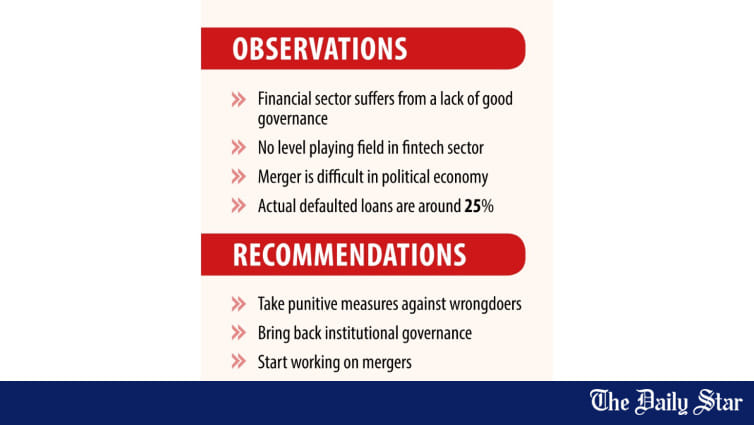
Against this backdrop, they urged the government and related regulatory bodies to ensure good governance and take punitive measures on all who disobey the guidelines.

These recommendations came during a panel discussion, styled "Transformation of the financial sector: Adapting to constraints", at the Muzaffar Ahmed Chowdhury Auditorium of Dhaka University yesterday.

The discussion was organised by the Economics Study Center in collaboration with the International Labour Organisation as a part of its three-day 5th Bangladesh Economics Summit 2024.

Ahsan H Mansur, executive director of the Policy Research Institute (PRI), said the domestic financial sector comprising banks, the stock market, bond market, and insurance sector has seen less development compared to that of neighbouring countries.

"The financial sector cannot support the real economy due to a lack of good governance," he added.

The economist also said people have lost trust in the financial sector, and that is adversely affecting the overall economy.

"There is a lot of talk about reforms in the banking sector," said Mansur, adding that it is expected that mergers will take place and non-performing loans will reduce but no steps have been taken to this end.

He informed that the actual amount of bad loans accounts for around 24-25 percent of the total loans disbursed. This includes loan repayments that are being held up until the dismissal of related court cases and loan write-offs.

The liabilities of the bad loans are ultimately borne by depositors and good borrowers, Mansur said.

The economist suggested ensuring institutional governance, saying that plans for the banking sector will have to be introduced with political willingness.

Salehuddin Ahmed, former governor of Bangladesh Bank, said everything is now going backwards as the laws and regulations are not being followed but there is no one to punish the offenders.

Firstly, borrowers had to pay 10 percent of their loan to reschedule it but now, they have to pay only 2 percent. If this continues, then influential borrowers will not repay their loans, Ahmed added.

He criticised the latest banking sector reform roadmap, saying it would allow banks to write off bad loans in two years whereas it was three years previously.

Ahmed also urged to bring good governance and accountability to the financial sector.

Lila Rashid, financial inclusion specialist at the Centre for Research and Development, said the financial technology sector lacks a level playing field.

For example, licenses for forming digital banks have been awarded to a particular group, she added.

Kanti Kumar Saha, CEO of Alliance Finance PLC, said there are several laws and regulations in the financial sector, but implementation remains absent.

In response to a query, the PRI's Mansur said the practice of mergers is accepted worldwide and although it is possible in Bangladesh, it could be difficult given the country's political environment.

He said that before any merger, the central bank should restructure the board and management of some weak banks and it will have to conduct a comprehensive audit of the merging firms.

The discussion was chaired by Selim Raihan, a professor of economics at the University of Dhaka.​
 
Analyze

Analyze Post

Add your ideas here:
Highlight Cite Respond

BB introduces currency swap with banks​

The move is designed to temporarily raise forex reserves

1708300125641.webp

Photo: Star/File

The Bangladesh Bank has introduced currency swaps with banks for the first time, a move that will enable the country to meet the net reserve condition set by the International Monetary Fund (IMF) with its $4.7 billion loan programme.

Usually, the central bank has to buy the greenback if it needs to raise the reserve to meet the condition. Now, it may get foreign currencies from banks for a certain period in exchange for only interest.

A currency swap involves the exchange of interest -- and sometimes of principal -- in one currency for the same in another currency. Companies doing business abroad often use currency swaps to get more favourable loan rates in the local currency than if they borrowed money from a local bank.

A forex swap has two legs or stages: a near leg date and a far leg date.

On the near leg date, one swaps a currency for another at an agreed spot foreign exchange rate and agrees to swap the same currency back again on a future date (far leg date) at a forward foreign exchange rate.

For conventional commercial banks, the central bank said, the taka will be sold in exchange for approved foreign currencies at the spot rate at the near-leg.

At the far-leg, the deal will be settled by applying the same exchange rate with a swap point based on the interest rate differential considering the prevailing benchmark rate of foreign currencies. Here, the three-month term SOFR for US dollars and the policy rate of the BB for the taka will be applicable.


The secured overnight financing rate (SOFR) is a benchmark interest rate for dollar-denominated derivatives and loans that replaced the Libor (London Inter-Bank Offered Rate).

The SOFR rate presently stands at 5.38 percent while the policy rate in Bangladesh is 8 percent, figures from the Federal Reserve of the US and the BB showed.

The treasury head of a private commercial bank said while the interest rate is flexible in currency swaps with other commercial banks, it is almost fixed in the case of the central bank.

"So, banks will analyse which one is more profitable."

For Shariah-based banks, at the near-leg, the taka will be sold in exchange for foreign currencies at the spot rate. At the far-leg, the deal will be settled by applying the same exchange rate, the BB said.

The swap deal will be executed within the counterparty limit to be set by the Forex Reserve and Treasury Management Department of the central bank.

Each deal will be in multiples of one million of foreign currency, starting from a minimum value of five million and equivalent taka with a tenure of seven days to 90 days.

The rollover may be allowed by applying the prevailing rates, the notice said.

"It seems that the central bank opened an alternative window to raise the foreign exchange reserve without buying dollars from commercial banks," said Zahid Hussain, a former lead economist of the World Bank's Dhaka office.

According to the IMF's conditions, the central bank was supposed to keep a net forex reserve of $17.78 billion in December.

However, there was a $58 million shortfall despite the central bank buying over $300 million from several commercial banks.

The reserve must stand at $19.27 billion by next March and $20.11 billion by June as part of the loan programme. However, the net reserve is still below the targets.

Hussain says if a bank had excess or idle dollars, there was previously no provision to keep it in the central bank. So, they had no interest income from it.

"Now, an option has been created to keep those idle dollars with the central bank in exchange for interest if the banks do not need it."

On the other hand, if a bank has excess dollars but a shortage of the taka, it can raise its liquidity in the form of the local currency through a currency swap.

At present, many banks have no excess dollars. On top of that, the demand for the currency is high.

However, there are questions about whether banks will be interested in engaging in currency swaps with the central bank as they can only avail the official rate exchange rate, which is much lower than the actual market rate, according to Hussain.

Banks also have the option to go for currency swaps between themselves and the rate is market-driven.​
 
Analyze

Analyze Post

Add your ideas here:
Highlight Cite Respond

Govt to promote value-added products for post-LDC era​

NBR chairman says

1708300749091.webp

The government suspends an assistant commissioner of taxes (ACT) for allegedly helping taxpayers evade tax through forgery. Photo: NBR website.

The government is considering further incentives while emphasising ICT and advanced technology in order to increase the production of value-added products as part of preparations for graduation from least developed country (LDC) status, Chairman of the National Board of Revenue (NBR) Abu Hena Md Rahmatul Muneem said yesterday.

"The IT sector and car manufacturing sector benefited last year and more opportunities will be given in the future. The work of the government is to create the environment, but you have to implement it," he said.

Muneem made the comments while addressing as chief guest a pre-budget meeting, organised by the Chittagong Chamber of Commerce and Industry (CCCI) at the Bangabandhu Conference Hall of the World Trade Centre in Chattogram's Agrabad area.
He also said that the industries of the country must become self-sufficient and proficient in order to confront the obstacles that come with transitioning from LDC status to the developing country status.

To this end, he emphasised the need for industries to become capable of not only confronting tax and VAT challenges, but also various other obstacles in order to compete in the global market.

He added that the nation would be unable to overcome these challenges if industries which require assistance through tax and value added tax (VAT) rebates were not adequately supported.

He also urged to move into more advanced sectors, saying: "Now is the time to turn our attention to the shipbuilding sector instead of the shipbreaking industry. Bangladesh cannot be the destination of foreign waste."

The CCCI earlier submitted around 12 proposals for the NBR for consideration in the next national budget.

CCCI President Omar Hazzaz, who chaired the meeting, proposed to raise the tax-free income limit for individual taxpayers from Tk 3.5 lakh to Tk 4 lakh considering the current global situation and persistent inflation.

He also proposed to reduce VAT on different goods from 15 percent to 8 percent since businesses and the general public are suffering due to the dollar crisis and inflation.

Managing Director of BSRM Group Aameir Alihussain mentioned that businesses face long delays in getting refunds after paying advance tax and VAT, underlining that businesses urgently need such refunds since they are currently facing a liquidity crisis.

In his speech, Muneem said they were working to solve these problems.

NBR member Md Masud Sadik said some traders were misusing government benefits.

"The government has given duty exemption of Tk 750 crore on various food products in the past year but the benefits have not reached the people. They (traders) have kept the price high, showing various reasons," he said.

Leaders of different business bodies, including the Bangladesh Garment Manufacturers and Exporters Association, Real Estate and Housing Association of Bangladesh, Bangladesh Frozen Food Exporters Association, Shop Owners Association, Clearing and Forwarding Agents Association, Rubber Garden Owners Association, and others also spoke.​
 
Analyze

Analyze Post

Add your ideas here:
Highlight Cite Respond

Members Online

Latest Posts

Back
PKDefense - Recommended Toggle