New Tweets

[🇧🇩] Monitoring Bangladesh's Economy

G Bangladesh Defense
[🇧🇩] Monitoring Bangladesh's Economy
1K
30K
More threads by Saif


Dhaka trade fair logs Tk 392 crore in export orders​

The month-long Dhaka International Trade Fair ends today

1708472669339.webp


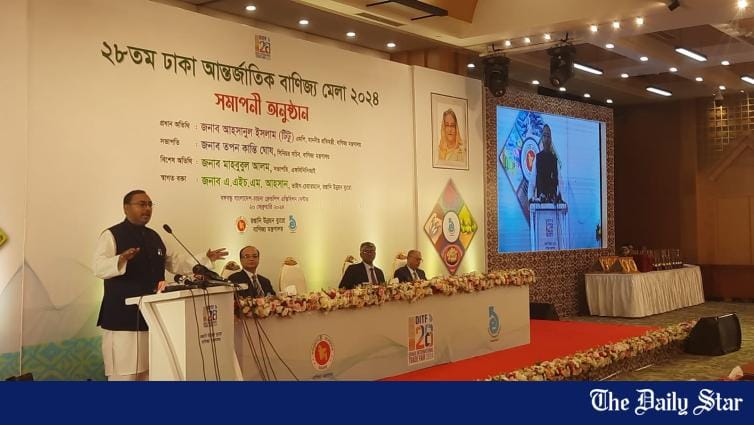
The 28th edition of the Dhaka International Trade Fair (DITF) has fetched export orders worth Tk 392 crore, up 17 percent from the previous year, according to the commerce ministry.

Additionally, it was found that customers spent around Tk 400 crore at the month-long event, indicating that sales have risen by roughly 15 percent year-on-year.

Organised by the Export Promotion Bureau, the DITF came to a close at the Bangladesh-China Friendship Exhibition Centre in the Purbachal area of Dhaka today.

Of the 304 stalls and pavilions set up at this year's fair, around nine were operated by foreign companies from five countries, namely India, Singapore, Hong Kong, Indonesia and Turkey.

Speaking as chief guest, State Minister for Commerce Ahsanul Islam Titu said the DITF will be diversified from next year to increase the country's exports.

"Seminars and symposiums will be organised next year to attract more foreign buyers," he added.

Titu also said they will ensure all necessary arrangements for foreign and local business representatives to increase their participation in the event.

"If we do everything right, the country's target of reaching $100 billion in export earnings by 2030 can be achieved faster," he added.

A total of 41 stalls were honoured with crests in different categories for their exemplary performance at this year's DITF.

Tapan Kanti Ghosh, secretary of the commerce ministry, chaired the closing ceremony.

Among others, Mahbubul Alam, president of the Federation of Bangladesh Chambers of Commerce and Industry, and AHM Ahsan, vice-chairman of the Export Promotion Bureau, also spoke.​
 
Analyze

Analyze Post

Add your ideas here:
Highlight Cite Respond

Forex reserves go above $20 billion​


Bangladesh's foreign currency reserves have gone past the $20-billion mark again, central bank data showed.

The reserves stood at $20.19 billion on February 20. It was $19.94 billion a week ago and $20.03 billion on January 24.

The slight increase in the reserves came a week after the Bangladesh Bank introduced currency swaps with banks for the first time in order to meet the net reserve condition set by the International Monetary Fund (IMF) with its $4.7 billion loan programme.

Usually, the central bank has to buy the greenback if it needs to raise the reserve to meet the condition. Now, it may get foreign currencies from banks for a certain period in exchange for only interest.

Recently, the reserves have also received a boost riding on loans from the development partners as well as a pick-up in exports and remittances and a fall in imports.

Merchandise exports rebounded strongly in January as manufacturers shipped goods worth $5.72 billion, the highest in a single month.

Similarly, the remittance flow rose to a seven-month high in the first month of the year. Imports fell 22.41 percent in November, the latest for which data from the central bank was available.

In December, the IMF and the Asian Development Bank provided $689 million and $400 million, respectively.

Amid higher import bills against moderate remittance and export receipts, the gross international reserves slipped to $24.3 billion in 2022-23 from $36 billion in 2019-20.

It stood at $46.4 billion in 2020-21, the highest on record.​
 
Analyze

Analyze Post

Add your ideas here:
Highlight Cite Respond

MFS transactions grow fourfold in five years​

People made Tk 4,100 crore MFS transactions in 2023's December

1708645681419.webp


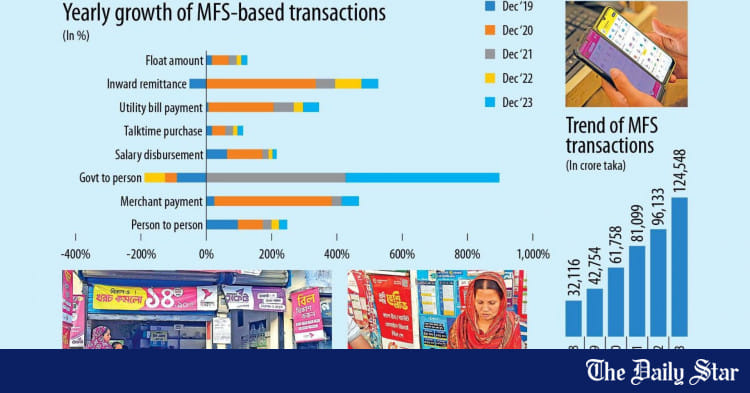
Bangladesh is registering a consistent growth in transactions through mobile financial services (MFS) and it grew four times to over Tk 4,100 crore in the last five years to December 2023.

In December 2018, the daily average transaction through the digital platform was Tk 1,070 crore, according to data from Bangladesh Bank (BB).

The popularity of MFS increased as it made available a number of activities in the palm of hand such as money transfer, talktime purchase, payment of utility bills and for online and offline purchases.

At the end of December 2023, overall transactions through MFS surged 30 percent year-on-year to Tk 124,548 crore, according to the BB data.

In that month, cash-in and cash-out grew by 29 percent and 31 percent year-on-year respectively.

Even, transaction through MFS rolled out in 2011 in Bangladesh posted a two-year high growth in the 12th month of last year.

"Due to convenience in digital transactions, the MFS industry has been experiencing a substantial growth in cashless spending by the customers for the last couple of years," said Shamsuddin Haider Dalim, head of corporate communications and public relations at bKash Ltd, the largest MFS provider in Bangladesh.

In general, he said, people spend more during festival seasons, special days, holidays and at the beginning and end of a year.

"The month of December falls within the holiday season when many people travel and spend."

Moreover, social gatherings, family reunions, weddings also take place during this time, he said.

The higher spending by people in such occasions fuel the overall growth in MFS transactions too, he said.
"Expatriates send more remittance at the yearend through MFS channel as well."

The central bank data showed that the government's distribution of money through MFS for social protection schemes skyrocketed in December 2023 from a year ago.

At the same time, people also showed increasing interest to shop and pay through MFS.

For example, merchant payment through the mobile financial services shot up 53 percent year-on-year to Tk 5,518 crore at the end of December 2023 when remittance sent through MFS grew 51 percent year-on-year to Tk 586 crore.

"MFS is not just a money transfer tool anymore, rather it has evolved into a platform of different financial services designed to meet people's day-to-day needs," said Muhammad Zahidul Islam, vice-president and head of media and communications at Nagad Ltd, one of the major MFS operators.

"From mobile recharge to utility bill payments to shopping, all now can be done on our MFS wallets."

"That is why people are now turning to more and more MFS services which are convenient, secure, and affordable," he added.

In December last year, MFS operators recorded a 49 percent year-on-year spike in payment of utility bills, which hit Tk 2,903 crore.

Money transfer from person-to-person soared 25 percent year-on-year to Tk 34,277 crore in that month.

Salary disbursement through MFS platforms increased too. But its growth was lowest among all the major services provided by the operators.

Islam said the way mobile money operators are now coming up with new and diversified financial services for customers, MFS transactions will continue to surge in the days to come.

In 2023's December, daily average transactions through Nagad stood at Tk 1,400 crore, mainly riding on government disbursements, various payments and mobile recharge, he added.

At present, the country has over 22 crore MFS accounts and more than half of them belong to people living in rural areas, according to BB data.

"The growth so far is positive. There is enough reason to be hopeful," said Md Nehal Ahmed, professor of Bangladesh Institute of Bank Management, adding that digital transaction will increase in near future.

"Convenience here is the main factor and the Covid-19 pandemic was a turning point for the spike in MFS-based transactions."

However, challenges are still there, he said.

The lack of awareness on the benefits of digital transaction, the fear of being defrauded and the popularity of paper documents of transactions are some of the many reasons which have slowed the growth of MFS transaction, he added.

The transaction cost is another reason, Ahmed said.

Many people want to avoid making big MFS transactions to keep service charges lower, he added.

At present, the users have pay up to Tk 20 to withdraw every Tk 1,000 from the MFS agents.

Ahmed said digital banks, for which the central bank has started giving permission, might throw a challenge to the MFS providers by offering lower transaction fees than the current rates.​
 
Analyze

Analyze Post

Add your ideas here:
Highlight Cite Respond

PM underscores maritime resources for country's progress​

Published :​
Feb 22, 2024 13:46
Updated :​
Feb 22, 2024 13:53


1708652758091.webp
Photo: BSS

Prime Minister Sheikh Hasina on Thursday stressed extracting marine resources from Bangladesh’s vast maritime zones, and maintaining friendly relations with the neighbouring countries to tap the potential of the "Blue Economy" for the country's socio-economic advancement, reports BSS.


"We have to explore the marine resources from the maritime areas we achieved. I believe the announcement of the blue economy will be implemented. We have to use the vast marine resources for the socio-economic development of Bangladesh" she said.

The premier made the remarks at a function marking the golden jubilee of enacting the law titled "The Territorial Waters and Maritime Zones Act, 1974" at Bangabandhu International Conference Centre (BICC) here this morning.

She said: "We will have to be cautious in extracting our marine resources and in continuing business and trade using seaways maintaining our foreign policy "Friendship to all, malice to none."

She also urged the overseas companies to come up with investment to explore resources in Bangladesh's maritime zones.

Sheikh Hasina said conflicting situations are being seen in many areas across the globe. But there is no conflict in this region, she said.

"This zone is very safe as there is no mess with each other here," she added.

The prime minister said the Bay of Bengal is a part of the Indian Ocean and it is very important marine way as international business and trade have been continuing using this way since ancient times.

"All our countries have been doing trade and commerce equally using the seaway. International commerce is also going on. No conflict has ever been seen. I want such peaceful situation always," she said.

She expressed her hope that this zone will remain peaceful for trade and commerce in the days to come.

The prime minister reiterated that Bangladesh always believe in peace, adding, "We don't want war rather we want peace. Peace shows the path of development and progress and helps the nation march forward".

She said, "We will never engage in war. But, we have to have capability to protect our sovereignty."

She later visited different stalls of the maritime stakeholders at the BICC.

State Minister for Shipping Khalid Mahmud Chowdhury spoke at the function.

Secretary (Maritime Affairs Unit) at the Ministry of Foreign Affairs Rear Admiral (Retd) Md Khurshed Alam presented the keynote speech and Chief of Naval Staff Admiral M Nazmul Hassan gave the address of welcome.

An audio-visual documentary to mark the celebration of golden jubilee of adopting "The Territorial Waters and Maritime Zones Act, 1974" was screened at the function.

Sheikh Hasina said Awami League government always followed the foreign policy formulated by Father of the Nation Bangabandhu Sheikh Mujibur Rahman and at the same time, took initiative to establish rights on the marine resources in line with "The Territorial Waters and Maritime Zones Act, 1974."

The prime minister said Bangladesh had established its rights on the vast marine areas and its resources by winning legal battles with Myanmar and India in the international court in 2012 and 2014.

She said Bangabandhu had first taken the initiative to establish rights on marine areas by enacting the maritime law in 1974 which the United Nations adopted in 1982.

The Father of the Nation with his wisdom had opened the path of prosperity using the marine resources with enacting the laws for the country's overall socio-economic development, she said.

She also said the subsequent governments after 1975 plot did not take any initiative to establish the rights on the vast sea areas.

The premier said the AL government had again taken initiative upon assuming office in 1996 after a long 21 years, adding that the initiative did not attain success as the Awami League did not come to power in 2001.

No initiative was taken by the BNP government after assuming power in 2001, she said.

But, after coming to power for second time, the AL government had taken measures to this end and established rights on vast sea areas and its resources, she added.

The marine resources can contribute immensely to the advancement of national economy, the head of the government said.

"We have been attaching priority to ensuring maximum use of the marine resources alongside its protection," she said.

To this end, she also said her government has been working to make Bangladesh Navy and coast guard stronger to foster their ability to secure the vast marine areas.

"We are working to use the marine resources appropriately so we can utilize it for the socio-economic development of the people," she said.

She continued they have already established an institute to conduct research to ensure maximum use of the marine resources.

Sheikh Hasina said her government has established Bangabandhu Sheikh Mujibur Rahman Marine University and marine institute to develop skilled manpower which is required to boost the blue economy.

She said, "The Territorial Waters and Maritime Zones Act, 1974" has been acting as an important guidelines and hoped that it will also work in the same way in the future.

She, as well, reiterated her commitment to transform Bangladesh into a developed, prosperous and smart country free from poverty and hunger by 2041, saying. "We must implement the dream of the Father of the Nation."​
 
Analyze

Analyze Post

Add your ideas here:
Highlight Cite Respond

Revenue collection accelerates in January​


1708736468524.webp


The pace of revenue collections quickened in January, driven by increased receipts from income tax as the deadline for filing personal income and wealth statements for the current fiscal year ended last month.

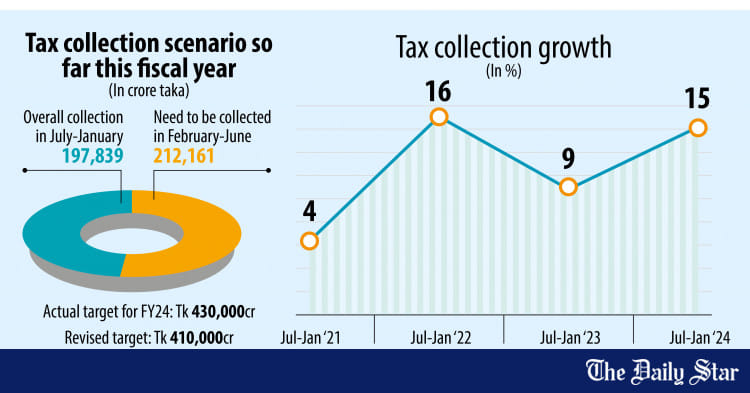
Provisional data from the National Board of Revenue (NBR) showed that all of its three wings -- customs, value-added tax (VAT), and income tax -- collected 15 percent higher tax year-on-year in the July-January period of the fiscal year 2023-24, amounting to Tk 197,839 crore.

Yet, the tax administration fell short of its target for the period by Tk 17,750 crore even after the government trimmed the collection target by 4.5 percent.

The NBR has a revised tax collection goal of Tk 410,000 crore for FY24. It managed to log 48 percent of the target in the seven months to January.

"It appears that the revised tax collection target for the whole year will not be achieved although there is a growing pressure on the side of public expenditure due to higher inflation and decelerating value of the taka against the US dollar and other foreign currencies," said Towfiqul Islam Khan, a senior research fellow of the Centre for Policy Dialogue.

A constrained revenue collection means the fiscal space will be limited for the government.

"The government should make judicious choices in having the right priorities in terms of public expenditure," he added.

"The budget will need to be revised in a realistic manner. Most importantly, the value for money needs to be ensured without exception. Indeed, good governance in both mobilising revenue and public money spending should be of utmost priority."

Income and travel tax registered an 18 percent growth to Tk 63,074 crore in July-January compared to the previous year, NBR data showed.

VAT collection – the biggest source of revenue for the government – climbed 16 percent to Tk 77,224 crore.

An official of the NBR said increased consumer prices, or inflation, boosted the receipts of VAT, the indirect tax paid by consumers, in the first seven months of the fiscal year.

However, the growth of revenue by customs from import and export was the lowest as foreign currency shortages continued to keep purchases from external markets down.

Overall imports slumped nearly 20 percent year-on-year to $30.5 billion in July-December of 2023-24, according to Bangladesh Bank data.

The customs wing recorded nearly 10 percent growth to Tk 57,540 crore in July-January, according to the NBR data.

Muhammad Shahadat Hossain Siddiquee, professor of economics at the University of Dhaka, said the revenue collection was lagging behind the target.

He said the deficit per month stood at more than Tk 2,500 crore on average, and it would total around Tk 30,000 crore at the end of FY24.

"Falling behind the target highlights the ineffectiveness of the authorities engaged in revenue collection."

However, Prof Siddiquee said, it is optimistic in a sense.

"Based on the current economic condition, especially in terms of imports and economic growth, revenue collection is satisfactory."

Bangladesh has been going through one of its worst economic crises in recent decades because of the lingering impacts of the coronavirus pandemic and the Russia-Ukraine war.

"To fulfill the target, the overall revenue collection needs to be increased by 30 percent, which seems unfeasible," Siddiquee said.

Siddiquee said the government had set an ambitious target as part of the International Monetary Fund's (IMF) loan condition, which is to increase the tax-to-GDP ratio by 0.5 percent in FY24.

He said the IMF had revised down the annual target for the government by Tk 20,000 crore.

"Still, it seems a major challenge to achieve the revised target, which will, in turn, definitely put an extra burden on the public."​
 
Analyze

Analyze Post

Add your ideas here:
Highlight Cite Respond

Forex reserves go above $20 billion​


1708736662651.webp


Bangladesh's foreign currency reserves have gone past the $20-billion mark again, central bank data showed.

The reserves stood at $20.19 billion on February 20. It was $19.94 billion a week ago and $20.03 billion on January 24.

The slight increase in the reserves came a week after the Bangladesh Bank introduced currency swaps with banks for the first time in order to meet the net reserve condition set by the International Monetary Fund (IMF) with its $4.7 billion loan programme.

Usually, the central bank has to buy the greenback if it needs to raise the reserve to meet the condition. Now, it may get foreign currencies from banks for a certain period in exchange for only interest.

Recently, the reserves have also received a boost riding on loans from the development partners as well as a pick-up in exports and remittances and a fall in imports.

Merchandise exports rebounded strongly in January as manufacturers shipped goods worth $5.72 billion, the highest in a single month.

Similarly, the remittance flow rose to a seven-month high in the first month of the year. Imports fell 22.41 percent in November, the latest for which data from the central bank was available.

In December, the IMF and the Asian Development Bank provided $689 million and $400 million, respectively.

Amid higher import bills against moderate remittance and export receipts, the gross international reserves slipped to $24.3 billion in 2022-23 from $36 billion in 2019-20.

It stood at $46.4 billion in 2020-21, the highest on record.​
 
Analyze

Analyze Post

Add your ideas here:
Highlight Cite Respond

Reaching high-Income status​

M ROKONUZZAMAN
Published :​
Feb 23, 2024 21:47
Updated :​
Feb 23, 2024 21:47

1708738627329.webp


Upon reaching the low middle-income status, a natural resource-poor populous country aspires to reach high-income status. As the low-cost labour advantage has already been exhausted, development professionals are of the opinion that the past path of labour export would not scale up to meet the aspiration. Hence, opinion has favoured an alternative--a knowledge economy. Therefore, advice has been to pursue service export out of knowledge. Upon citing India's large information technology (IT) and service export success, experts strongly believe in following India's footprint. However, how far is India's service export scalable, and how far can it empower an aspiring less developed country to reach high-income status? If not, what is the alternative left?

According to some popular indicators, per capita income should go above $12,000 to reach high-income status. Let's look at India's success in generating export income from IT service. One of the prominent sectors of service export in India has been microchip design services. Almost 100 multinational semiconductor companies have set up design centres to source design services from Indian graduates. So far, India has succeeded in creating a little more than 20,000 microchip designer jobs in serving these multinational companies. On average, each of the microchip designers earns around $14,000 per year.

Let's assume that each chip designer needs to support a family of four. Hence, the per capita income of a typical chip designer family reaches $3,500--far less than required for high-income status. Therefore, it is not unfair to state that if a naturally resource-poor populous country turns all of its students into high-end knowledge-based service exporters, it would not be able to reach high-income status. Besides, because of high-amenability of automation of knowledge, service export is not scalable either. Therefore, a plain vanilla suggestion of investing in education and creating an export-oriented service economy for getting high-income status runs short of merit.

The obvious question is about the alternative. In pursuit of finding an answer to this vital question, in 2006, the World Bank formed the Growth Commission-headed by a Nobel laureate economist. Upon hosting many seminars and dialogues at the expense of few million dollars, the commission came up with no clear pathway. Despite the common belief that innovation could be an answer, there has not been a well-articulated demonstration. However, Paul Romer got the Nobel Prize to increase the emphasis on exploiting ideas in driving economic growth. Unfortunately, his articulation of endogenous growth theory lacks clarity in finding implementable development solutions.

To compare service and idea export out of knowledge of science, technology, engineering, and mathematics (STEM) competence, let's draw an example from Taiwan's track record in microchip design. Compared to India's success in generating $14,000 per designer per year in revenue, Taiwan has generated $700,000 per designer per year in revenue. Such a per microchip designer revenue is sufficient to propel as many as 60 people to a $12,000 high-income status. Hence, for a country with a population of 170 million, the challenge is to empower as little as 3 million people to produce and export such a level of value to make such a country reach high-income status. The obvious question is how Taiwan has succeeded in doing so.

Instead of exporting microchip design services, Taiwanese home-grown firms like MediaTek turn microchip design expertise into ideas, implement them into finished microchips, and export them. But how does it make such a difference? Let's take an example of a hypothetical scenario. For example, ten microchip designers of MediaTek work a year to develop an idea to generate an additional $1 net profit from a microchip as a system-on-chip (SoC) for smartphones. Let's assume that if MediaTek succeeded in selling 10 million units of this SoC, net earnings from the work of those ten designers over a year would be $10 million. Yes, MediaTek has created such a success by capturing a 30 per cent market share of the smartphone SoC market in the second of 2023. In the first quarter of 2021, MediaTek exported 30.7 million smartphone SoC to the Chinese market alone. Taiwan's success shows enough logic to believe that STEM-based idea production and trading offers a prospect to a natural resource-poor populous country to reach high-income status.

The next question is how to reach such revenue from STEM-based idea production. Does it mean that upon getting inspired by Taiwan's success and Paul Romer's idea and object theory, should we ramp up STEM education and R&D-producing graduates, publications, and patents? Of course not. Unfortunately, there has been no natural correlation. For example, on the backdrop of the rising profit and hiring of engineers by Taiwan's MediaTek and TSMC, the USA's Intel recently reported loss and laid off high-caliber experienced engineers. It's worth noting that Intel has a history of filing more patents and recruiting graduates from more reputed institutions than TSMC. Besides, Intel has a track record of profiting from microchip design ideas. Despite the past success, high-quality engineers, and strong R&D investment and patent filing record, why Intel has been reporting such a reality is the subject of investigation to draw lessons from leveraging STEM ideas for growth.

The production of ideas alone creates little or no economic value for a firm or nation. At the outset, it costs money. The challenge is to predict, detect, and catch the new wave to generate revenue. The next challenge is to create a flow of ideas, forming a cumulative effect. For example, MediaTek's parent company, UMC, did not make money during the initial years.

Upon catching the smartphone wave and winning the competition of the idea race, MediaTek has succeeded in showing such an impressive financial performance from microchip design competence. However, this wave of profiting from ideas of advancing smartphone chips will not last for a never-ending period. For example, one of the reasons for Intel's poor performance has been the maturity of the personal computer market and its failure to catch up with the next wave.

The first challenge for crafting the path to reaching high-income status is understanding the wealth-creation dynamics of STEM ideas in a globally competitive market. It has been changing as waves unfold-creating new opportunities and destroying proven ones. Such an understanding must form the base of the education system for changing the beliefs, values, and culture of development of aspiring less developed countries. Along with it, unfolding waves of innovation should be kept monitoring. Upon detecting prospective waves offering the opportunity to create large-scale wealth from a flow of ideas, appropriate changes need to be made in economic policies, education, R&D, and investment to leverage them for driving economic growth. It's worth noting that a single idea like automobile or semiconductor has propelled few countries to high-income state. Yes, it is a long-term process. We must stay in course. Unfortunately, there has been no alternative--shortcut or leapfrogging.

Rokonuzzaman, Ph.D is academic and researcher on technology, innovation and policy.
 
Analyze

Analyze Post

Add your ideas here:
Highlight Cite Respond

Rising debt burden threatens our future​


1708817608661.webp

Government must ensure that the rich duly pay their taxes VISUAL: STAR

The continued increase in the government's debt burden amid insufficient revenue collection has emerged as a big concern. Despite public expenditure on development rising every year, the National Board of Revenue (NBR) has not been able to ramp up tax collection as much as the government had hoped for. Consequently, Bangladesh's tax-GDP ratio still stands below 10 percent, one of the worst in the world.

The ratio has not been good for the past two decades, which indicates how deeply rooted this problem is. Data from NBR and the finance ministry show that in the last 10 years, the amount of domestic and foreign loans has increased by 9 percentage points in proportion to the revenue collection of NBR. In other words, government borrowing has increased every year. In FY2013-14, the government reportedly had to borrow 44 percent of the amount that was the NBR's income. In FY2022-23, compared to the amount of money that NBR was able to collect, it was forced to borrow 53 percent more money to meet expenses. According to an IMF report, the amount of money Bangladesh has to spend on domestic and foreign debt interest payments is equal to 71.8 percent of revenue collection and grants. In the current fiscal year, that amount may increase to 101 percent, it said.

If a country has to spend the same amount (or more) that it earns as revenue to pay interest on debt, then it will have to borrow constantly to meet development and other expenses. Therefore, the government now finds itself in a tight spot. If it borrows from domestic sources, it will slow down investment (due to the crowding-out effect). But if it continues to borrow heavily from foreign sources, then it will lose foreign currency while paying interest. In FY2022-23, foreign loan repayment stood at $4.78 billion, up 32.8 percent year-on-year, according to the Economic Relations Division. And going forward, the repayments are expected to increase further.


So the only way out of this trap is to increase revenue collection. That should be more than possible if we can make the rich pay their taxes. Currently, an estimated 87 percent of rich and upper-middle-class people do not pay taxes, heavily contributing to the revenue and debt management problems. Therefore, it is high time the government reformed its tax collection system and ensured that the wealthy cannot continue avoiding taxes. Going forward, it should also think long-term about taking foreign debt.​
 
Analyze

Analyze Post

Add your ideas here:
Highlight Cite Respond

Latest Posts

Back
PKDefense - Recommended Toggle