[🇧🇩] Monitoring Bangladesh's Economy

[🇧🇩] Monitoring Bangladesh's Economy
1K
31K
More threads by Saif

G Bangladesh Defense

Has our ADP governance gone backwards?

1764725415451.webp

VISUAL: ANWAR SOHEL

Fifteen months have passed since the interim government assumed office, bringing celebrated development thinkers and outspoken reformers into the cabinet. Their inclusion raised hopes among citizens and development activists that the long-standing weaknesses of the annual development programmes (ADPs), the central mechanism through which the nation's development agenda is operationalised, would finally be addressed or at least meaningfully initiated. The absence of party-driven pressures and the strong record of many advisers in advocating for efficient public spending further amplified these expectations. As the tenure of this interim administration draws to a close, a pressing question emerges. Have these vibrant reformers strengthened the ADPs in any meaningful way, or have they simply allowed long-standing failures to continue under a new banner?

In this context of heightened public expectation, it is important to recall how the ADP evolved under the previous government. During their sixteen years in office, the allocation expanded dramatically, rising from Tk 25,600 crore in fiscal year (FY) 2009 to ten times that size at Tk 2,63,000 crore in FY24, a scale that signalled the country's steady economic progress. Implementation performance was also notable, reaching a high of 94.66 percent in FY19 and falling to 80.18 percent in FY20, a year heavily affected by the Covid-19 disruption. This period contributed to broader gains in growth and development, and the World Bank recognised Bangladesh as one of the fastest-growing economies in the world. At the same time, the government also faced legitimate criticisms about faulty feasibility studies, last-minute spending surges and governance gaps that often undermined project quality.

Google News LinkFor all latest news, follow The Daily Star's Google News channel.
Given this trajectory, the interim government entered office with ample scope to strengthen the ADPs and address longstanding weaknesses in development management. It inherited the ADPs for FY25 and revised the fund to Tk 2,26,125 crore after an 18 percent cut, and it also designed a fresh ADP of Tk 2,30,000 crore for FY26. Yet, these opportunities did not translate into meaningful progress. ADP implementation fell to a historic low of 67.85 percent in FY25 and reached only eight percent in the first four months of FY25-26. In this backdrop, it becomes essential to review recent patterns of development spending and determine how far the interim government has delivered in the priority sectors of health, education and power and energy, given their central role in socio-economic development.

A closer look at the health sector presents one of the clearest illustrations of the interim government's shortcomings. In FY25, the sector's allocation was cut by 50 percent from the original budget despite being classified as a priority area, and by year's end, the Health Services Division delivered an implementation rate of only 21.74 percent, among the lowest of all ministries. Early FY26 indications show the situation deteriorating further. In the first quarter, the Medical Education and Family Welfare Division spent just 0.003 percent of its Tk 4,809 crore allocation, while the Health Services Division managed to spend only 1.13 percent of its Tk 7,484 crore allocation. These trends reveal a sector where financial cuts, administrative inertia and weak coordination came together to halt progress, leaving essential projects without direction and the broader health system without the capacity to respond to national needs.

Turning to education, the sector has consistently been allocated around 11-12 percent of the total ADP, well below the Unesco recommendation of 15-20 percent of total public expenditure. Yet, even with a steady share, utilisation has weakened over time, with spending declining from 102 percent in FY10 to 79 percent in FY24. Under the interim administration, the situation has worsened. In FY25, education began with 11.36 percent of the total ADP, but the revised allocation imposed a sharp 34 percent cut. For FY26, the education ADP stands at about 12.1 percent of the total, still below the global standard and insufficient for meaningful reforms. Implementation has been weak as well. In FY25, the Ministry of Primary and Mass Education spent only 58 percent of its development allocation, placing it among the five lowest-performing ministries. In the first quarter of FY26, spending reached only 4.25 percent for primary and mass education and only 6.52 percent for secondary and higher education. Taken together, these figures expose a sector where investment levels remain inadequate and administrative capacity remains limited, resulting in a widening gap between policy ambition and actual learning outcomes.

When the interim government took office, the power and energy sector already held a central place in the national development agenda, with ADP allocations supporting major gains, including universal household electrification. The sector has also demonstrated strong execution with the Power Division implementing 101 percent of its revised fund in FY24, an exceptional outcome in public investment. During the interim period, however, the sector has clearly lost momentum. Although allocations remain substantial, project delivery has slowed, and strategic reform has stalled. In FY25, the Energy and Mineral Resources Division recorded 85.95 percent implementation, a respectable figure but significantly lower than earlier performance. The spending pattern has also shifted. Allocation for power generation projects fell by six percent from the previous year's revised ADP, while transmission and distribution claimed larger shares. Analysts warn that this shift again prioritises visible infrastructure over deeper issues such as subsidy pressure, fuel cost volatility and persistent system losses. In effect, the interim government has maintained large budgets but failed to set a coherent reform plan, leaving the sector without measurable gains in efficiency, financial stability or service quality.

Across these sectors, the evidence shows that development governance has not only weakened under the interim government but has moved in reverse, falling far short of the public expectations it sought to embody. Instead of strengthening the foundations of the development system, it has overseen collapsing implementation, drifting priorities and a clear distance between stated intentions and actual outcomes. What began with the hope that experienced reformers would correct long-standing weaknesses has ended with a development machinery more fragile, uncertain, and less capable than the one they inherited, raising serious questions about the cost of this transitional period for the country's development trajectory.

Muhammad Muktadirul Islam Khan is country researcher and head of consultants at Sustainability Action Learning Lab.​
 

For Bangladesh, a weak WTO is not an option
M G Quibria

Published :
Dec 03, 2025 22:12
Updated :
Dec 03, 2025 22:27

1764811173134.webp

The headquarters of WTO in Geneva, Switzerland— Reuters file photo

Bangladesh owes much of its economic rise to the predictability and stability of global trade rules. For decades, the World Trade Organization (WTO) provided exactly that: a system where a young, export-driven country could trust that its garments, pharmaceuticals, and services would be traded on terms no single power could unilaterally rewrite. That foundation is now cracking. And for countries like Bangladesh—whose future depends on a fair, open global marketplace—the consequences could be profound.

The WTO Is Drifting: The truth is uncomfortable: the WTO is drifting toward irrelevance. The institution built to govern global trade is increasingly unable to deliver on its most basic promises—not because the world no longer needs multilateralism, but because the WTO’s own structures have grown brittle.

Consensus Has Become a Cage. At the heart of the problem is the way the WTO makes decisions. Consensus, once a symbol of equality, now functions as a veto for any member willing to wield it. When General Agreement on Tariffs and Trade (GATT) had 23 members, unanimity was difficult. With 166, it is nearly impossible. A single dissent can halt the appointment of judges, block negotiations, or stall incremental reforms.

The result is paralysis. Countries frustrated by gridlock now gravitate toward regional trade blocs or informal groupings where deals can be struck more quickly. Efficiency has migrated outward, and the center has been left hollow.

For a country like Bangladesh, without the geopolitical heft to shape these exclusive clubs, that drift is worrisome.

Negotiations Are No Longer Negotiations. The collapse of the Doha Round marked a turning point. Since then, the WTO has not produced meaningful liberalisation. The ‘single undertaking’ principle—nothing agreed unless everything is agreed—proved incompatible with a diverse membership divided over agriculture, subsidies, and services.

The negotiating forum has evolved into a theater of speeches rather than a venue for compromise. The organisation that once expanded global trade now struggles simply to keep pace with it.

A Court Without Judges Cannot Uphold the Law. Perhaps the most visible symbol of the WTO’s decline is the breakdown of its dispute-settlement system. Because the United States blocked new appointments to the Appellate Body, the very mechanism responsible for enforcing trade rules has been suspended.

Members have resorted to improvised alternatives like the EU-led Multi-Party Interim Appeal Arbitration Arrangement (MPIA). But a patchwork is not a system. Without credible enforcement, compliance becomes voluntary—and in trade, voluntary rules are no rules at all.

Bangladesh’s exporters, who depend on stable dispute resolution, face a world where outcomes may hinge less on law and more on leverage.

A Rulebook Frozen in Time. The WTO’s legal framework still imagines a world of manufactured goods, tariffs, and quotas. But today’s global economy is defined by data flows, artificial intelligence, cross-border digital services, and climate-linked trade measures like carbon border adjustments. On these issues, the WTO is nearly silent.
This silence encourages unilateralism. Countries legislate individually, set their own standards, and negotiate regional agreements that often exclude or disadvantage developing nations. Without a modern rulebook, the global economy becomes a patchwork of incompatible regimes.

Bangladesh, entering middle-income status and aiming to expand beyond garments, needs rules—not vacuums.

A Crisis of Trust. The institutional stagnation is compounded by a legitimacy problem. In the global South, the WTO is often viewed as serving powerful nations. In advanced economies, it is blamed for inequality and job displacement. Both narratives feed nationalism and erode support for multilateralism.

Yet the alternative is worse: a world where trade norms are written by a handful of powerful actors and imposed on everyone else.

Reform Proposals — Paths Forward or New Divides: Many are offering ideas—some promising, some perilous.

Michael Froman’s ‘open plurilateralism’ would allow coalitions of willing countries to move forward on issues such as digital trade or supply-chain security. It is pragmatic, but risks leaving developing countries on the sidelines, unable to meet high regulatory standards and locked out of new rulemaking.

Emily Kilcrease and Geoffrey Gertz’s ‘concentric circles’ model would formalise a U.S.-anchored hierarchy: an inner circle of allies, a middle circle of neutral partners, and an outer circle of strategic competitors. The model moves away from the WTO principle of ‘Most Favored Nation (MFN) treatment, which requires countries to treat all trade partners equally. This approach may appeal to Washington, but it institutionalises exclusion. For countries outside the inner ring, including many in the South, it would reinforce the feeling of being perpetual outsiders to the global economy.

Lee Hsien Loong’s ‘World minus one’ approach offers a more constructive vision: don’t let one spoiler paralyse the system. If a major power refuses to join, let the rest press ahead. Mega-regional agreements like Comprehensive and Progressive Agreement for Trans-Pacific Partnership (CPTPP) and Regional Comprehensive Economic Partnership (RCEP) already reflect this logic.

Anne Krueger goes further. If the WTO cannot reform itself, she suggests a coalition of reform-minded countries build a new organisation grounded in the WTO’s original Articles—essentially a controlled institutional reboot.

Meanwhile, within the WTO, members push disparate agendas that include the following: India defends policy space and digital sovereignty; South Africa seeks equitable TRIPS reforms; China demands clearer subsidy rules while protecting its state-led model; and the European Union wants (EU) climate-aligned trade and a double-majority voting system to replace the consensus rule.

Diverse as they are, these proposals share one theme: the system must balance efficiency with legitimacy. Fast decisions mean little if half the world sees them as exclusionary; inclusive processes mean little if they produce no outcomes.

What the WTO Must Do to Survive: A viable reform agenda rests on three pillars: First, rebuild dispute settlement with a depoliticised appellate mechanism. The WTO cannot function without neutral, credible enforcement. Second, modernise the rulebook. Digital trade, data governance, carbon border adjustments, and AI-driven commerce must move from the periphery to the core. Third, elevate developing-country capacity. Participation must be substantive, not ceremonial. Without support, the rules will reflect only the interests of the technologically advanced.

This is not idealism. It is the pragmatic foundation of a stable global trading order.
The Stakes for Bangladesh—and Beyond: For Bangladesh, WTO reform is not an abstract debate among diplomats. It is a question of economic destiny. As the country navigates Least Developed Country (LDC) graduation, diversifies its exports, and confronts new barriers—from carbon tariffs to digital standards—it needs a global system that is predictable, fair, and inclusive.

The WTO was built to offer precisely that. But unless it adapts, it will not be able to. And if the WTO fails, Bangladesh will not find refuge in exclusive trade clubs or geopolitical ‘circles.’ It will face a world where power, not rules, determines market access.

A young, aspiring nation needs a global trading system that gives it space to rise. The world needs that system too.

The question is whether governments and the WTO itself can summon the imagination to rebuild the multilateral order before countries like Bangladesh are left navigating a world without one.

Dr M.G. Quibria is an economist whose career bridges international development and academia. He is currently a Distinguished Fellow at the Policy Research Institute of Bangladesh (PRI) and has held senior leadership positions at both the Asian Development Bank and the Asian Development Bank​
 

Bangladesh's economic policy not dictated by IMF or WB: BB Governor

UNB
Published :
Dec 04, 2025 17:17
Updated :
Dec 04, 2025 17:17

1764896904797.webp


Bangladesh Bank Governor Dr Ahsan H Mansur on Thursday said the country's economic policy is independently formulated and not dictated by the International Monetary Fund (IMF) or the World Bank.

"If we follow their prescriptions blindly, the exchange rate could surge to around Tk 170-180 per US dollar, as has happened in Pakistan and Sri Lanka," he said.

The governor made the remarks while speaking as the special guest at the 'Investment Dialogue with Local Partners' held at the multipurpose hall of the Bangladesh Investment Development Authority (BIDA) on Thursday.

Energy Adviser Muhammad Fouzul Kabir Khan was also present at the programme.

Dr Mansur said inflation is expected to fall to 5 per cent by the end of the current fiscal year, FY2025-26. Consequently, the policy rate would likely be reduced to 8-9 per cent, with lending rates settling between 10 and 11 per cent.

He cautioned that reducing interest rates without controlling inflation could destabilise the exchange rate and the money market, responding to businesses' demands for lower lending rates.

Citing examples from India and China, the governor noted that their low interest rates-3 per cent and zero per cent, respectively-reflect their economic conditions, which differ from Bangladesh's.

"We are not currently taking IMF loan instalments because some conditions cannot be fulfilled at this time for the sake of our economy. When needed, we will take IMF loans after fully meeting the global lender's conditions," he added.

About the financial sector, Dr. Mansur said it has now emerged from previous data manipulations that had posed serious risks to the country.

For instance, while official figures under the previous regime showed single-digit inflation, actual inflation was around 12-13 per cent, with lending rates in single digits, leaving depositors with negative returns. Similarly, defaulted loans were underreported, shown below double digits, though they stood at around 35 per cent in September 2025. Current accounts have now been corrected.

On the question of recovering defaulted loans through the sale of industry assets, the governor clarified that industries should not be penalised for individual mismanagement.

He cited the example of the SS power plant of S. Alam Group, which continues to operate with support from Bangladesh Bank for LC openings.

The project involves about US $2.5 billion in investment, 80 per cent of which is foreign-owned. Although the plant is running, S. Alam will not retain any profit, as all funds will be used to repay liabilities, he added.

Dr Mansur pointed out that the Bangladesh Bank has received 1,300 applications for loan restructuring, approving 250 of them. The remaining applications have been forwarded to respective banks for customer- and client-based restructuring.

He projected that defaulted loans will decrease by 5 per cent by March FY2025-26, but bringing overall non-performing loans to a reasonable level may take 8-10 years.

Lutfey Siddiqi, Special Envoy of the Chief Adviser on International Affairs, and Mohammad Abdur Rahman Khan, FCNA, Chairman of NBR, participated in the dialogue, held by Chowdhury Ashik Mahmud Bin Harun, Executive Chairman of BEZA and BIDA, in the chair.​
 

Remittance inflow exceeds $632 million in first six days of December

UNB
Published :
Dec 07, 2025 23:04
Updated :
Dec 07, 2025 23:04

1765154819799.webp


The upward trend in remittances sent by expatriate Bangladeshis has continued into December, with the country receiving approximately US $632 million in the first six days of the month.

According to the latest update from Bangladesh Bank (BB), the $632 million remittance figure for December 1-6 is an increase of approximately $38 million compared to the same period last year. In December of the previous year (2024), the country received around $594 million in the first six days.

The growth is attributed to several factors, including incentives offered for sending money through legal banking channels, increased encouragement for using the formal system, and the active role of exchange houses.

Remittance inflow has shown robust growth throughout the current fiscal year (FY 2025-26). From July 1 to December 6, 2025, the total remittance inflow reached $13.67 billion. This represents an increase of $1.939 billion compared to the same period in the previous fiscal year (FY 2024-25), when the total stood at $11.732 billion. The year-on-year growth rate for the fiscal year to date is 16.5 percent.​
 

The headwinds export sector faces

SYED FATTAHUL ALIM
Published :
Dec 07, 2025 22:28
Updated :
Dec 07, 2025 22:33

1765155292292.webp


Bangladesh's export sector has of late been facing headwinds mainly from the dual impact of the fall in demand in the international market and the reciprocal tariff imposed by the USA. According to the Export Promotion Bureau (EPB), last November Bangladesh exported merchandise worth US$3.89 billion. This is less than what the country exported in the same month last year by 5.54 per cent, the earning from exports was worth US$4.11 billion. Garments as usual is obviously the most exposed to any negative development in the world market. So, by earning about US$3.14 billion in November, the largest share of last month's fall in merchandise export was also borne by this sector (at 4.8 per cent) since in the same month last year, the apparel sector fetched US$3.30 billion.

However, a single month's poor performance may not be enough argument to say that the country's export is performing badly. But a similar trend of fall in exports compared to the previous year has been demonstrated during the past three months, too. Even making allowances for the disruptions in business activities caused in the wake of the July uprising of 2024, the development is still concerning. If Bangladesh's graduation takes place as scheduled in November next year (2026), the export sector is going to come up against the challenges of a highly competitive market as it would then be bereft of the preferential treatments it so far received from the major export destinations like the European markets. So, as the proverbial early bird catches the worm, so the preparations should be afoot to meet the upcoming post-graduation challenges for export. But to engage in future challenges, the issues that are urgent need to be addressed first. For the export figures presented in the foregoing do not merely reflect statistical fluctuations but a fundamental weakness in our export strategy. As is often discussed, the root cause of this weakness lies in the lack of export diversification. And the problem is that the ready-made garments (RMG) dominate the export basket taking an overwhelming share of 84.7 per cent of total exports. So, Bangladesh fell behind as it did not invest early enough in what the global market was clearly signalling-- man made fibre (MMF) and technical textiles over cotton basics, backward linkages in synthetics, quick turn design and product development and parallel bets on non textile value chains such as electronics and medical devices that peers cultivated a decade ago.

The result is a revenue ceiling, when fashion downgrades to value lines during global slowdowns. A country concentrated in basics absorbs the price hit, while diversified competitors cross subsidize with higher margin categories that buyers cannot easily bargain down. Leather and footwear should be first in line with modern effluent treatment across the Savar tannery estate, traceability systems and design support. Bangladesh can develop branded original equipment manufacturer (OEM) footwear and leather goods where per pair realizations exceed basic apparel. Incentives should reward environmental compliance, LWG certification and higher local value addition in accessories.

Agro processing is another natural winner. The country already exports processed foods to scores of markets, but Sanitary and Phytosanitary Standards (SPS) compliance, cold chain logistics and packaging finance are chronic bottlenecks. A ring fenced incentive for Hazard Analysis Critical Control Points /Brand Reputation Compliance Global Standards, formerly British Retail Consortium (HACCP/BRC) certification, zero interest loans for cold storage, and faster testing at accredited labs would unlock scale.

Pharmaceuticals have a strong domestic base and growing exports. What holds back the next step is regulatory recognition and approvals.

While neighboring countries invested in developing technological capabilities and high-value manufacturing, Bangladesh remained complacent with its garment-centric model. The absence of forward-looking industrial policies has left the country unprepared for shifting global demand patterns and vulnerable to sector-specific downturns. The government's export incentive structure further compounds this problem by reinforcing existing imbalances. Of the Tk 7,500 crore allocated for export incentives in FY2023-24, approximately 65 per cent went to the already-dominant garment sector. Meanwhile, emerging sectors with significant growth potential received disproportionately small allocations despite their need for support to achieve competitive scale.

This misallocation represents a missed opportunity to nurture promising sectors that could diversify our export base. The pharmaceutical industry, for instance, has demonstrated remarkable potential, growing at 15.6 per cent annually with exports reaching US$188 million in 2023. With appropriate incentives, industry experts project this figure could exceed US$1.0 billion by 2030. Similarly, the ICT sector, which currently contributes just US$1.3 billion in exports, has the capacity to reach US$ 5.0 billion within five years if given proper policy support.

Light engineering products represent another untapped opportunity. Countries like Taiwan and South Korea transformed their economies by focusing on this sector, yet Bangladesh's light engineering exports remain below US$500 million annually despite a skilled workforce and growing domestic capabilities. Redirecting even 20 per cent of current garment incentives towards these sectors could catalyse exponential growth and create a more resilient export economy.

Individual success stories demonstrate what becomes possible when innovation receives proper support. Kazi IT Center, starting as a small software development firm, now exports specialised healthcare management systems to seven countries, generating US$12 million annually. Similarly, Dhaka-based Bengal Plastic has successfully penetrated high-value European markets with specialised industrial components, commanding prices comparable to Chinese competitors.

These examples illustrate that Bangladesh can compete globally in diverse sectors when entrepreneurs receive adequate support and policy backing. The path forward requires a fundamental rethinking of our export strategy-one that balances continued support for established sectors while aggressively developing new export capabilities.

For Bangladesh to reverse its declining export revenue, policymakers must implement a balanced incentive structure that nurtures emerging sectors, invest in skills development beyond traditional manufacturing, and establish specialized export promotion agencies for high-potential industries. Without these changes, the country risks watching its hard-earned export gains continue to erode in an increasingly competitive global marketplace.

The choice before Bangladesh is clear: continue down the path of dangerous concentration or embrace the challenging but necessary work of diversification. Our economic future depends on making the right decision.​
 

Finding cure to jobless growth

M Rokonuzzaman
Published :
Dec 09, 2025 00:43
Updated :
Dec 09, 2025 00:44

1765242121909.webp


Bangladesh has entered a phase of development marked by jobless growth. Is it a short-term phenomenon that will somehow disappear or a systematic outcome of following the wrong development thesis? According to a recent report, while Bangladesh's productive sector experienced an impressive average annual growth rate of 10 per cent over the decade spanning 2013-2023, the manufacturing sector lost 1.4 million jobs during this period. Due to the adoption of increasingly advanced imported technologies, there has been a decrease in labour-based value-added production. For example, in contrast to the 220 workers needed to produce $1 million in exports in 2013, garment factories needed only 94 workers in 2024. Of course, it has increased labour productivity. But it has happened due to the import of technology. Hence, the benefit of productivity improvement migrated out of Bangladesh. More alarming is that this trend will continue, as technological advancements have been improving the quality and reducing the cost of whatever Bangladesh produces. Such a reality raises a vital question: has Bangladesh been following the wrong development thesis, and how can it exit from it?

There has been a call for striking a balance between growth and job creation. But if Bangladesh continues to follow incorrect economic theories, how can that balance be maintained? On the other hand, as media report indicates, some expert groups have been blaming government policies. Well, how does the government make policies, and who has been advising the government to take those policies? If a wrong thesis guides the policy advisors, should the government continue to seek policy advice from them to find a remedy for jobless growth?

At the core of development thinking, particularly for Bangladesh's industrial economy, there has been a labour-centric replication strategy. It's guided by a neoclassical production function linking economic output to labour, capital, and total factor productivity. There has also been a common belief that labour productivity improvement benefits labour suppliers. Hence, the focus has been on liberalising technology imports (capital) and offering training to factory workers to operate them. As a result, economic output has increased, along with improvements in labour productivity. Unfortunately, the benefit of labour productivity improvement did not benefit Bangladesh. Instead, the country has lost precious jobs.

There has also been an argument that an excessive focus on a single sector, primarily RMG, has left other industries underdeveloped. For this reason, such a reality of jobloss and growth has emerged. If Bangladesh continues to follow a technology-import-led replication economy, will the job reality change due to expansion in other sectors? Unfortunately, theory and data suggest that this is not the case. Regardless of the industry, technological advancements have a natural tendency to reduce labour in copying and using products. Unfortunately, it has not been factored into the development thesis prescribed for Bangladesh.

Experts appear to believe that a credible election, genuine political representation, the establishment of people-centred governance, and a renewed social contract between the state and citizens will help reverse the reality of job loss. Unfortunately, such a change will likely have very little implication on the underlying primary reason affecting the job market.

There could be an argument that a focus on agriculture may reverse the trend. Unfortunately, it will not likely happen. Further growth in the agricultural sector requires far less labour and more technology. For example, the use of precision dispensing of farming inputs, such as pesticides and fertilisers, involves replacing labour on the ground with flying intelligent spraying machines. If the policy is to import those machines, like in manufacturing, the farming sector will also experience the same jobless growth reality.

There has also been an issue of graduate unemployment. Invariably, all studies have indicated that Bangladesh has experienced exponential growth in the production of graduates. As a result, along with the shrinking salary difference between primary school dropouts and university graduates, there has been a rapid growth in graduate unemployment, reaching as high as fifty per cent.This is the unfortunate outcome of Bangladesh's policy of pursuing a technology-import-centric, labour-intensive replication economy, and the belief that there has been a positive correlation between human capital supply and total factor productivity as an exogenous factor.

To get further clarity about the wrong development thesis that is being implemented by borrowing billions, resulting in showing GDP numbers as a success indicator, asking for tax-to-GDP ratio growth, making a few people rich, killing existing jobs, and turning millions of graduates unemployed, we need to go back to the basics of wealth creation. Economic prosperity does not depend solely on the number of units we produce. Most importantly, it depends on how much value we add in each of those produced units. Unfortunately, this value-added aspect is missing from the prescription given to Bangladesh.

In every product, whether it is a shirt, a shoe, or furniture, the role of material and labour in total value has been declining. On the other hand, ideas or technologies in the form of product or process features have been increasing. Unfortunately, the focus on developing technology locally and integrating it into products and processes is missing. Unless this missing element is addressed, no type of change in the political or social sphere will reverse the trend of jobless growth. To make it happen, neoclassical economic theories are not sufficient. Even modern endogenous growth theories are insufficient, as they tend to promote a linear correlation between idea flow or R&D investment and economic growth. We need to have a clear understanding of the evolution of products and processes, and how to add value through innovative ideas to win the global race.

By the way, once we start discussing ideas and innovation, the subject of startups inevitably arises in policy circles. If we arrange an idea competition, offer cozy office space, address intellectual property issues, and allocate risk capital, startups will flourish as a new engine of economic growth. Over the last 25 years, numerous incentives have been introduced to foster this belief. But have we got any success stories? If not, why are we allocating more money behind this belief? Instead of believing that great ideas will inevitably lead to an economic powerhouse, we should focus on the underlying pattern of evolution of inventions and innovations through incremental progression and reinvention, resulting in the rise and fall of firms and the migration of prosperity. Besides, the current startup race appears to be driven by a toxic thesis of inflating valuations out of spreading hype and offering subsidies, as opposed to delivering economic value through innovation.

To sum up, Bangladesh's jobless growth is the outcome of following flawed development thesis based on neoclassical production function-based economic theory. Even endogenous growth theories are not sufficient to offer a prescription for remedy. Besides, rather than being a solution, the toxic thesis of startups has become a barrier to finding a cure. Hence, Bangladesh needs to focus on how to add value to products and production processes using local technological advancements to compete in the global market. Besides, Bangladesh needs to enter industries to pursue idea-based value addition, as opposed to relying on labour and imported capital.

Rokonuzzaman, Ph.D is Academic and Researcher on technology, innovation and policy.​
 

Economy at a critical point despite some stability
Tackle threats now or risk slower growth, rising poverty, warns GED report

1765243447072.webp


Bangladesh's economy may have regained some stability in recent months, but it now stands at a critical point, with inflation, financial sector weaknesses, low investment, governance shortcomings and external risks emerging as major threats, according to a new government report.

Unless these vulnerabilities are addressed, the country risks slower growth, falling living standards and rising poverty, warns the report, Bangladesh State of the Economy 2025, prepared by the General Economic Division (GED) of the Planning Commission.

"Foreign direct investment remains critically low and is expected to remain at this level in the coming months. Subdued investment and industrial activity are cited as major contributors to slower growth," states the report unveiled yesterday.

However, it added, "Bangladesh has a real chance to re-accelerate, build more resilient institutions, and make growth more inclusive.

"The key will be speed and seriousness of reform, clear communication, policy credibility, and ensuring that those reforms benefit ordinary people, not just aggregate macro statistics. Bangladesh has a real chance to re-accelerate."

The GED noted that the second half of fiscal year 2024-25 (FY25) showed rebounding economic activity. But the outlook remains clouded by political uncertainty, subdued industrial output, persistent inflation and global headwinds, including pressures linked to the reciprocal tariff imposed by the United States.

It pointed out that growth forecasts from international agencies, including the World Bank, now range between 3.3 percent and 4.1 percent for FY25, with a modest rebound expected in the ongoing fiscal year. According to provisional government data, the growth rate for FY25 stood at 3.97 percent.

The GED identified remittances, export performance and manufacturing, particularly garments and SMEs, as the main drivers of growth in FY26, while noting that improvements in capital machinery imports may indicate early signs of recovering investment appetite.

The report, however, stresses that inflation continues to erode real incomes, particularly among low-income households.

"If Bangladesh can keep inflation under control, rebuild investor confidence, and stabilise the financial sector, there is potential for stronger growth in FY26."

Foreign exchange reserves stabilised at a level above three months of import coverage, it also said, attributing this to prudent macroeconomic management and structural strengthening of the economy's external front.

"A VICIOUS CYCLE"

Speaking at the event, Prof Mustafizur Rahman, distinguished fellow at the Centre for Policy Dialogue (CPD), recognised that some stability has returned but said it comes at a cost.

"The [existing] high policy rates being used to curb inflation really hurt investment. But interest is only one part of the cost of capital. Entrepreneurs face many other expenses as well," he said.

"We needed to ease the burden on entrepreneurs in these other areas, like strengthening institutional capacity and reducing corruption. We should have done more, especially since the cost of capital is already high. But we didn't," he added.

The economist said the lack of initiatives has trapped the economy in a "vicious cycle" of high interest rates increasing the cost of capital, which is raising the cost of doing business, and which ultimately depresses investment and job creation.

He warned that without faster reforms and stronger revenue mobilisation, Bangladesh risks slipping into a debt trap.

Former World Bank economist Zahid Hussain said the economy is sending mixed signals.

Remittances, slower illicit outflows, stronger revenue trends, steady electricity supply and natural-disaster resilience are positives, he said. But inflation, falling real wages, stagnant employment, weak export momentum and low investment paint a more worrying picture.

"Overall, the negative basket outweighs the positive," he said, noting that while the situation has not deteriorated as severely as feared, more decisive implementation of reforms could have produced stronger results.

"This government has shown ample evidence of intent to reform. But at the ground level, we still do not see major, visible results. To push reforms forward, willpower alone is not enough-stamina is also crucial," he added.

Meanwhile, Bangladesh Bank Governor Ahsan H Mansur stated that stabilising the financial sector remains difficult, even though the external sector is showing no major signs of stress.

He mentioned several reform initiatives taken by the interim government to stabilise the financial sector, including changes to the Bank Company Act, issuing the Bank Resolution Ordinance and restructuring the boards of several banks. "We also have to make the next government accountable for these things because these are significant progressions."

The governor said reserves have risen by about $10 billion over the past 16-17 months, and reiterated that the policy rate will not be lowered until inflation declines to a tolerable level.

Shafiqul Alam, chief adviser's press secretary, criticised sections of the business community and media for highlighting "only negative developments", failing to acknowledge reforms such as the Chattogam port modernisation drive.

"If the Chattogram port becomes efficient, the garment sector would benefit first," he said, adding that the government has not seen a single welcoming statement from the many top trade bodies.

National Board of Revenue (NBR) Chairman Md Abdur Rahman Khan said the tax-to-GDP ratio has fallen from over 10 percent a few years ago to around 7 percent now, as revenue cannot be collected from all sectors of the economy.

Speaking on Prof Rahman's warning about falling into a debt trap, he said, "We have already fallen into a debt trap; unless we acknowledge this truth, it will not be possible to move forward."

Meanwhile, speaking on the government's reform initiatives, Anisuzzaman Chowdhury, special assistant to the chief adviser, said there is no textbook for the sequence and speed of reforms.

"We must decide what comes first, what comes later, and how to balance them. Low-hanging fruit should be taken first, but sometimes distortions or internal balance issues prevent that," he said.​
 

Some unpleasant arithmetic
Corruption and the four engines of growth

1765327895802.webp


Published :
Dec 09, 2025 22:29
Updated :
Dec 09, 2025 22:29

Bangladesh’s economy is often acclaimed for its remarkable resilience despite recurrent global disruptions — pandemics, energy shortages, supply-chain shocks, regional conflicts, and internal political instability. Observers frequently point to four powerful “engines” behind this endurance: the ready-made garments industry (RMG), export processing zones (EPZs), remittances from migrant workers, and the vital role of Chittagong Port in sustaining trade flows (henceforththe four engines are referred as FEEG). Yet while these four engines propel the economy forward, a fifth and darker force relentlessly pulls it backward. That force is corruption.

In economic and engineering terms, national output (GDP) can be represented through a production function that explicitly incorporates corruption-related factors. Instead of writing it only in the conventional functional form, we can express it—consistent with modern growth theory—as: Y (GDP) = A(m) × f(L, K, T); Or, in more descriptive algebraic terms: Y (GDP) = A(m) × [joint contribution of L, K, and T]

This expression applies for a given amount of land, structures, buildings, and all other available resources that are fully and efficiently employed. Here, L, K, and T denote labor, capital, and technology, respectively. The factor A(m) captures the system’s integrity — or lack thereof — by reflecting the prevailing degree of corruption, inefficiency, and mismanagement. When A(m) is low, the same inputs produce less output; when A(m) approaches 1, the economy operates closer to its true potential.

Here, A(m) = Actual GDP/Potential GDP represents the moral, or integrity, multiplier — implying that the same L, K, and T may be producing far less GDP than they should. The value of A(m) lies between 0 and 1. As A(m) approaches 1.0, nearly every unit of effort, capital, and knowledge is translated into real output. When corruption becomes systemic, A(m) may fall to 0.6, 0.4, 0.3, or even lower.In simple terms, an economy capable of producing 100 units of value may realise only 70 in practice, with the remaining 30 units absorbed by bribery, rent-seeking, inefficiency, and institutional decay.

Actual GDP cannot sustainably exceed potential GDP. Therefore, any value of A(m) greater than 1 does not imply “super-efficiency”; it signals an underestimation of potential output, statistical distortion, or unsustainable overextension—like forcing a machine to operate beyond its rated capacity for short-term gain at the cost of long-term stability.

The focus of this article is not the entire economy’s production of GDP. Rather, it is on the output generated by each of the four engines of economic growth (FEEG). Every sector or engine possesses both a measurable potential output, under conditions of efficiency, transparency, and rational management, and an actual realized output, under prevailing conditions of misgovernance and corruption.

In its most accurate and operational form, the corruption-adjusted output of the FEEG can be expressed in a single equation using sector-specific corruption factors, technically referred to as integrity (or corruption) multipliers: Output = A1X1 + A2X2 + A3X3 + A4X4 where X1, X2, X3, and X4 represent the four engines—RMG, EPZs, Remittances, and Chittagong Port, respectively—while each A represents a sector-specific corruption multiplier. The numerical value of each multiplier lies between 0 and 1, depending on the degree of corruption within the respective sector. Some sectors experience deeper leakage, greater rent extraction, and heavier bureaucratic drag than others. Because each sector’s labor skills, capital intensity, technology, and final product differ, the strength of its integrity multiplier also varies. These differences justify assigning a distinct corruption multiplier to each sector.

A1 = Actual output/Potential output in the RMG sector. The same definition applies to the remaining three multipliers.

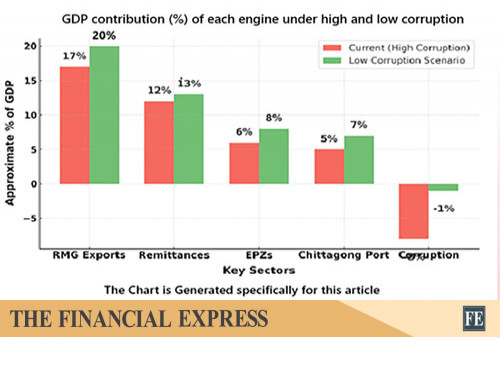
If A1 = 1 for sector X1, the RMG sector is converting almost all of its resources into real value for society. If A1 = 0.5, half of the sector’s potential output is being lost to corruption, leakage, misallocation, and institutional decay. As A1 falls further below 1, an increasing share of the sector’s output is lost to corruption and mismanagement. The same logic applies to each of the four sectors. The accompanying bar diagram makes this visible by illustrating the gap between potential and realised output in each engine.

The true power of this sector-specific model lies in its diagnostic capacity. By isolating each corruptmultiplier, policymakers can pinpoint where corruption and inefficiency are most severe and where reform would generate the greatest marginal return. The bar diagram depicts the visual alternative – identifying output gap with uncomfortable precision, the institutional pressure points where corruption is most corrosive and where reform is most urgently needed.

The unpleasant corruption arithmetic, however, is not entirely one-directional. Some of the largest beneficiaries of corruption — the “big sharks” — do not simply hoard their illegal wealth in cash vaults. A significant portion is transferred to foreign banks, concealed in offshore accounts, or converted into properties in London, Dubai, Toronto, or other global cities. Some finance the elite education of their children abroad, quietly exporting not only capital but future loyalty and allegiance away from the country.

At the same time, a portion of this corruptly acquired wealth is recycled domestically. It is invested in local real estate, luxury apartments, shopping malls, hotels, transport companies, and speculative land projects. It fuels consumption of imported goods, high-end construction, and visible urban opulence. In a narrow accounting sense, this type of spending may create a limited feedback effect within the economy — generating some employment, stimulating certain service sectors, and adding superficial vibrancy to urban landscapes.

But this “compensation” is both distorted and deceptive. It does not represent productive investment in innovation, manufacturing capability, education, or long-term economic transformation. Rather, it deepens inequality, inflates asset bubbles, distorts land and housing markets, crowds out honest entrepreneurs, and reinforces a dangerous illusion of prosperity. What appears as growth is in fact misallocated capital — circulating not according to merit, productivity, or national priority, but according to proximity to stolen power.

In terms of this framework, even if a fraction of leaked wealth returns in the form of local spending, the value it creates is still far less than the value destroyed. The corruption multiplier may be marginally cushioned at the surface, but its structural core remains damaged. What the economy loses is sovereign capacity — the ability to direct its own surplus toward equitable, productive, and future-oriented development. Corruption may generate the illusion of motion, but it is the motion of a wheel stuck in mud — spinning, splashing, showing energy, yet going nowhere.

In the RMG sector, Bangladesh commands one of the world’s largest garment workforces and enjoys preferential market access, yet factories are burdened by unofficial payments at every administrative step — from safety certification to export documentation. Substandard compliance is sometimes overlooked through bribery, while honest producers must pay “speed money” to meet shipment deadlines. The result is a sector forced to operate beneath its capacity. Here, A1 is lowered not by labor or technology, but by invisible tolls that drain value before it reaches workers or reinvestment.

Within EPZ sector, corruption appears through land acquisition, tax exemptions, utility contracts, and licensing. Rule-based incentives are often converted into personal privileges, while firms without political backing face delays, unpredictable inspections, and demands for “facilitation.” Every delay, inflated procurement, or informal payment lowers A2 — not because the zones lack capacity, but because their operating environment undermines efficiency.

Remittances should be among the cleanest inflows, yet systemic leakage occurs. Migrants pay excessive recruitment fees to middlemen, borrow at predatory rates, and face corrupt bureaucracy at home and abroad. Informal Hundi networks flourish due to inefficiency and mistrust in official channels. Each illegal fee and undocumented transfer reduces the benefit reaching families and the national reserve, quietly lowering A3.

At Chittagong Port, corruption is measured in time as much as in money. Congestion, artificial delays, misdeclared containers, bribed officials, and politically controlled contracts turn a logistical artery into a bottleneck. Each daydelays raise costs and weakens competitiveness. The port does not lack infrastructure or labor; it lacks insulation from interference and rent extraction, causing A4 to fall due to institutional decay, not physical limits.

Across all four sectors, capacity exists and demand persists, yet value is bled away through tolls, favors, embezzlement, and delay. The FEEG continue to run, but with friction and chronic underperformance.

Bangladesh economy suffers from the systematic erosion of value as that effort moves through corrupted channels of power and administration. Corruption is an invisible tax on productivity, an internal tariff on trade, and an undeclared transfer of income from the many to the few. Until this arithmetic is confronted, Bangladesh’s celebrated resilience will remain impressive in appearance, yet deeply limited in its realized potential.

Dr Abdullah A Dewan, Professor Emeritus of Economics, Eastern Michigan University (USA) and Former Physicist and Nuclear Engineer, Bangladesh Atomic Energy Commission.​
 

Latest Posts

Back