New Tweets

[🇧🇩] Monitoring Bangladesh's Economy

G Bangladesh Defense
[🇧🇩] Monitoring Bangladesh's Economy
1K
27K
More threads by Saif


Bigger economic challenges await next govt: Salehuddin

FE REPORT
Published :
Feb 03, 2026 08:13
Updated :
Feb 03, 2026 08:32

View attachment 24557

Finance Adviser Dr Salehuddin Ahmed on Monday said the next elected government would face major economic challenges despite the interim government's efforts to stabilise the economy.

"The interim government has tried to keep the economy relatively stable and has tackled many challenges. However, the challenges ahead are even bigger," he said while addressing the Sonali Bank Annual Conference 2026 as the chief guest at International Convention City Bashundhara in the capital.

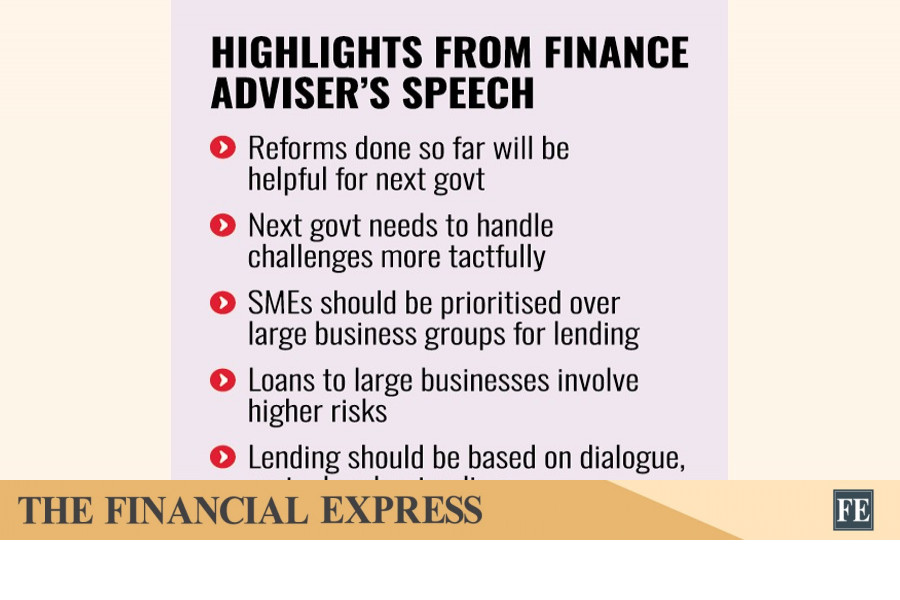
He acknowledged that the reforms undertaken so far were not sufficient but would be helpful for the next government.

"But the challenges that lie ahead need to be handled more tactfully," he added.

Advising Sonali Bank officials to maintain professionalism during the tenure of an elected government, the finance adviser warned that political pressure would inevitably arise.

"You cannot always say no directly. Instead, you need to develop negotiation skills and explain economic policies, banking laws, and audit norms," he said, recommending dialogue and mutual understanding in loan disbursement decisions.

He also urged banks to prioritise small and medium enterprises (SMEs) over large business groups for loan disbursements, noting that SMEs play a crucial role in employment generation.

"They deserve more credit support, while loans to large businesses involve higher risks," he said.

Speaking as a special guest, Bangladesh Bank Governor Dr Ahsan H Mansur said state-owned commercial banks were capable of disbursing loans but had consistently failed to recover those on time due to weaknesses in borrower selection.

He said if loans were disbursed after proper assessment and selection of borrowers, the risk of those becoming non-performing would remain minimal.

However, prolonged regulatory restrictions on state-owned banks had created excessive caution in lending operations, resulting in poor loan recovery performance, he also said.

Dr Mansur noted that due to these constraints, loan flows had to be kept limited in the past.

He added that even before 2000, lending by state-owned banks remained restricted, which he described as an unsustainable business model.

Collecting deposits without channelling them effectively into the broader economy would limit a bank's overall contribution, he said.

While Sonali Bank was currently disbursing loans cautiously, he emphasised that the time had come to expand lending activities more boldly.

Highlighting sectoral gaps, the governor said although consumer lending and housing finance were globally significant sectors, state-owned banks in Bangladesh had failed to play a meaningful role in these areas.

He pointed out that despite strong potential, progress in consumer lending remained limited, leaving ample room for expansion.

Stressing the need to transform Sonali Bank into a fully commercial institution, Dr Mansur said the bank was currently operating under a partially commercial framework.

He called for broader adoption of commercial banking principles to ensure profitability and sustainability.

The governor added that the government would grant Sonali Bank greater autonomy to operate under true commercial principles, and he hoped future governments would continue this policy.

He also urged the bank to take effective initiatives to boost remittance inflows and facilitate exports further to build up the stock of foreign currencies.

At the event, Sonali Bank Chairman Mohammad Muslim Chowdhury stressed the need for greater autonomy under the bank's new PLC structure.

He said the board should be given the authority to appoint and remove the managing director to ensure corporate governance.

"Hold the board accountable. Evaluate performance and make changes accordingly," he urged government officials.

Currently, appointments and promotions of managing directors and senior officials at state-owned banks are made by the government.

Sonali Bank Managing Director Md Shawkat Ali Khan said the bank aimed to reduce its default loan ratio to 10-12 per cent by this year and bring it down to a single digit next year.

Once the non-performing loan ratio reached 9 per cent, he said, the bank would focus on expanding export financing.

Sonali Bank, the country's largest bank with 1,234 branches, including two overseas ones, reported an operating profit of Tk 80.17 billion in 2025, which was Tk 23.22 billion higher than in 2024.

During the same period, deposits rose to Tk 1.79 trillion, an increase of Tk 150 billion from the previous year.

Loan disbursements also increased by Tk 55.0 billion on a year-on-year basis, bringing the total outstanding loans to Tk 1.05 trillion.

Finance Secretary Dr Md Khairuzzaman Mozumder and Financial Institutions Division Secretary Nazma Mobarek also spoke at the inaugural session of the bank's annual conference.​
Salehuddin is a compromised RAW asset, I'd doubt anything coming out of his mouth as Indian propaganda. Electing BNP was a bad idea, their actions will speak volumes.
 

Development spending plunges to 16-year low

Health spending hit hardest, threatening services amid rising out-of-pocket costs


Md Asaduz Zaman

View attachment 24594
The government’s development expenditure in the first seven months of the current fiscal year 2025-26 (FY26) has slumped to its lowest level in at least 16 years amid fiscal restraints and political disruptions.

Ministries and divisions spent just Tk 50,556 crore – a mere 21.18 percent of the total Annual Development Programme (ADP) outlay – during the period, shows Implementation Monitoring and Evaluation Division (IMED) data published yesterday.

During the same period in FY25, when operations were disrupted by a mass uprising and administrative instability, the ADP implementation rate stood at 21.52 percent. The rates were 27.11 percent and 28.16 percent in FY24 and FY23, respectively.

The slowdown is particularly acute in the health sector, which has recorded dismal implementation rates despite growing concerns about healthcare accessibility.

The Medical Education and Family Welfare Division has utilised only 2.98 percent of its allocation, while the Health Services Division has managed just 6.59 percent, according to the IMED.

Md Deen Islam, research director at Research and Policy Integration for Development (RAPID), blamed lackings in “institutional capacity” for the slow spending.

“The underperformance in the health sector reflects deeper governance challenges. In many cases, those in charge hesitate to take bold decisions, particularly when procurement-related scrutiny creates a climate of fear. That affects implementation,” he added.

The underperformance comes as Bangladesh continues to grapple with one of the world’s highest rates of out-of-pocket health expenditure.

This has led to a “structural vulnerability that demands urgent policy attention,” Islam said.

“A single chronic or terminal illness can push a non-poor family into poverty,” he warned, citing data from the Multiple Indicator Cluster Survey showing stagnation in key health indicators.

He emphasised that without immediate increases in health investment and execution, Bangladesh risks falling further behind on crucial development metrics.

The broader spending slump reflects multiple headwinds. For the current fiscal year, the government allocated Tk 238,695 crore for the ADP, including funds from autonomous bodies.

However, during the July-January period, utilisation of both state funds and foreign loans has declined sharply.

Foreign fund spending fell to approximately Tk 18,668 crore, while government funds amounted to Tk 28,052 crore, down from Tk 30,096 crore in FY25.

This deceleration comes as the interim government implemented a reduced, austerity-focused ADP that slowed or postponed certain projects initiated by the previous administration.

Planning ministry officials note that several contractors fled the country before completing their work following the mid-2024 political changeover, further hampering implementation.

RAPID’s Islam largely agreed, noting that smaller projects may have received less attention as larger initiatives were prioritised.

Infrastructure sectors have fared considerably better than social services.

Among the top 15 recipients of allocations, the Ministry of Water Resources achieved the highest implementation rate at 41.10 percent, followed by the Energy and Mineral Resources Division with 40.66 percent, and the Local Government Division with 36.91 percent.

For Islam, the health shortfall is particularly worrying given Bangladesh’s demographic outlook.

He warned, “Within 15 to 20 years, Bangladesh will gradually transition into an ageing society. Without adequate investment in health infrastructure and human resources, fiscal pressure will intensify.”

He urged authorities to view health spending through an economic lens, noting that Bangladesh maintains a low ratio of nurses and support staff compared to doctors.

“Expanding this workforce would improve service delivery while generating jobs. Health investment is not just social spending, it is also an economic strategy,” he said.

However, Islam said ADP implementation may accelerate under the newly elected political government.

A modest uptick in January offered limited encouragement. The month recorded 3.64 percent implementation of the revised ADP, marginally up from 3.55 percent in January 2024.

“As an elected party, the BNP will have to deliver on its pledges, including job creation, expanding health services, and reducing out-of-pocket costs,” Islam said.

Ashikur Rahman, principal economist at the Policy Research Institute of Bangladesh, concurred that a full-fledged political government could help strengthen ADP spending by accelerating countrywide development activities.​
"Development Spending" done during Hasina's time was more to line their own pockets than anything else.

Bangladeshis will be paying a long time for what Hasina and her cohorts looted and siphoned out of the country.

But BNP will be looting too, they are taking a break right now.
 

Bangladesh in economic high risks despite signs of stability
Oxford Economics shows structural vulnerabilities on five counts as cause of concern

Jasim Uddin Haroon
Published :
Mar 01, 2026 08:49
Updated :
Mar 01, 2026 08:49

1772412608117.webp


Bangladesh is in higher economic risks than regional peers, despite signs of macroeconomic stabilisation, on five counts of weaknesses as measured by an international watchdog.

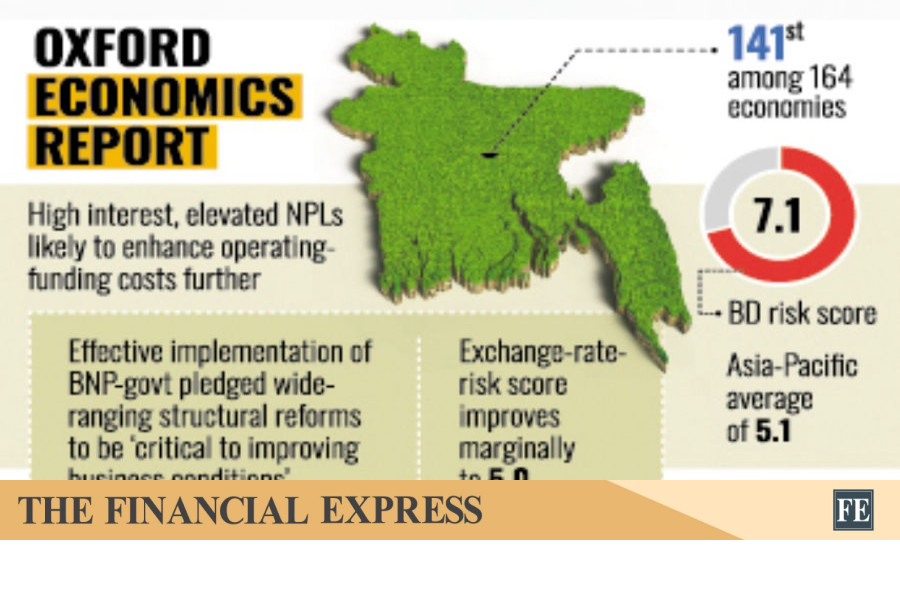
In latest ratings by Oxford Economics, Bangladesh has ranked 141st out of 164 economies, with an overall economic risk score of 7.1, well above the Asia-Pacific average of 5.1.

The agency has evaluated Bangladesh across five categories - market demand, market cost, exchange rate, sovereign credit and trade credit - highlighting structural vulnerabilities despite signs of macroeconomic stabilisation.

The country recorded a market-demand score of 7.0 out of 10, significantly higher than the regional average of 5.1, reflecting vulnerabilities in domestic demand conditions.

Demand remains exposed to regulatory uncertainties, delays in development projects and concerns over the maintenance of critical infrastructure.

"Political polarisation and periodic unrest also weaken the investment climate," the ratings report notes.

It also finds household income stability vulnerable to external shocks, with roughly two-thirds of remittances originating from Bangladeshi workers in Gulf economies, leaving consumption exposed to oil-price fluctuations and economic conditions in the region.

The report says Bangladesh scored 8.0 out of 10 in market costs, one of the highest levels in the assessment, indicating elevated operating and financing costs that deter investment and constrain productivity.

However, the BNP administration has pledged wide-ranging structural reforms, although Oxford Economics notes that effective implementation will be critical to improving business conditions.

"High interest rates and elevated levels of non-performing loans are expected to push up operating and funding costs further, placing upward pressure on domestic lending rates."

The country's exchange-rate-risk score improved marginally to 5.0, remaining above the emerging markets average of 4.3.

Bangladesh formally adopted a floating exchange-rate regime in July 2023, although the central bank continued to intervene in foreign-exchange markets to stabilise the taka.

In January 2024 the authorities announced a shift towards a crawling-peg system, implemented in May, with the longer-term objective of a fully flexible regime.

After a period of sharp depreciation through early 2025, the taka has since stabilised against the US dollar.

Oxford Economics expects relative currency stability over the medium term, supported by reforms under the IMF lending programme aimed at improving external balances and supporting long-term growth.

Bangladesh's sovereign credit-risk score stood at 5.3, higher than the emerging markets average of 4.7.

Weaknesses in the banking sector, low per-capita income and institutional challenges weigh on the sovereign-risk profile, while climate-related risks could affect creditworthiness over the longer term. However, government and external-debt ratios remain relatively low, providing some resilience.

Bangladesh received a trade-credit-risk score of 10.0, substantially higher than the emerging markets average of 6.3, reflecting structural weaknesses in the financial sector.

The report mentions high levels of non-performing loans - particularly in state-owned banks - linked to governance weaknesses, limited credit information and inadequate borrower financial disclosures.

Bank lending remains concentrated in services sectors and among large corporate borrowers, with relatively limited exposure to households and the real-estate sector, the report reads.​
 
Salehuddin is a compromised RAW asset, I'd doubt anything coming out of his mouth as Indian propaganda. Electing BNP was a bad idea, their actions will speak volumes.

BD is in hopeless situation. BD people are ideologically subverted. They have lost the intellect to distinguish between what is good for them and what is bad for them. Wherever Islam becomes mainstream ideology, it's failure is inevitable. Batter BD should shift to mobocracy like like gulf nation to survive . Islam and democracy are contradictory. Always, radical elements will continue to attack democratic forces and keep the nation unstable and will push BD towards failure. Hasina had created some hope but BD is pushed on the path of failure once again. Radical elements will continue to boycott anybody except themselves coming to power and will continue to declare them anti BD. India is facing one more failed nation on its border and will have to spend to deal with it. India is totally encircled with rogue unstable nation surrounded India except Nepal. Batter BD ends this Tamasha of democracy and accepts the mobocracy.
 

Over $3 billion remittance came in February

This is the highest amount in at least seven fiscal years

1 March 2026, 17:11 PM

1772413577578.webp

Representational image: Fatima Jahan Ena

Bangladesh witnessed strong growth in workers’ remittance inflow in February, as $3 billion came in ahead of Eid-ul-Fitr, one of the largest festivals for Muslims.

Bangladeshi expatriates sent home $3.02 billion in remittances in February, up from $2.53 billion received in the same period a year earlier, according to the latest central bank data.

This is the highest remittance inflow recorded in February in at least the last seven fiscal years.

Industry insiders said that remittances generally rise ahead of the Eid festival, as remitters send more money to their families in Bangladesh during Ramadan and Eid-ul-Fitr.

In the current fiscal year, remittance earnings have maintained a strong upward trajectory. Between July and February of this fiscal year, total remittance inflow reached $22.45 billion, registering a 21.4 percent year-on-year growth.

Bankers said that the continued rise in remittance inflow is helping ease pressure on Bangladesh’s balance of payments and stabilise the foreign exchange market.​
 

Bangladesh in economic high risks despite signs of stability
Oxford Economics shows structural vulnerabilities on five counts as cause of concern

Jasim Uddin Haroon
Published :
Mar 01, 2026 08:49
Updated :
Mar 01, 2026 08:49

View attachment 24794

Bangladesh is in higher economic risks than regional peers, despite signs of macroeconomic stabilisation, on five counts of weaknesses as measured by an international watchdog.

In latest ratings by Oxford Economics, Bangladesh has ranked 141st out of 164 economies, with an overall economic risk score of 7.1, well above the Asia-Pacific average of 5.1.

The agency has evaluated Bangladesh across five categories - market demand, market cost, exchange rate, sovereign credit and trade credit - highlighting structural vulnerabilities despite signs of macroeconomic stabilisation.

The country recorded a market-demand score of 7.0 out of 10, significantly higher than the regional average of 5.1, reflecting vulnerabilities in domestic demand conditions.

Demand remains exposed to regulatory uncertainties, delays in development projects and concerns over the maintenance of critical infrastructure.

"Political polarisation and periodic unrest also weaken the investment climate," the ratings report notes.

It also finds household income stability vulnerable to external shocks, with roughly two-thirds of remittances originating from Bangladeshi workers in Gulf economies, leaving consumption exposed to oil-price fluctuations and economic conditions in the region.

The report says Bangladesh scored 8.0 out of 10 in market costs, one of the highest levels in the assessment, indicating elevated operating and financing costs that deter investment and constrain productivity.

However, the BNP administration has pledged wide-ranging structural reforms, although Oxford Economics notes that effective implementation will be critical to improving business conditions.

"High interest rates and elevated levels of non-performing loans are expected to push up operating and funding costs further, placing upward pressure on domestic lending rates."

The country's exchange-rate-risk score improved marginally to 5.0, remaining above the emerging markets average of 4.3.

Bangladesh formally adopted a floating exchange-rate regime in July 2023, although the central bank continued to intervene in foreign-exchange markets to stabilise the taka.

In January 2024 the authorities announced a shift towards a crawling-peg system, implemented in May, with the longer-term objective of a fully flexible regime.

After a period of sharp depreciation through early 2025, the taka has since stabilised against the US dollar.

Oxford Economics expects relative currency stability over the medium term, supported by reforms under the IMF lending programme aimed at improving external balances and supporting long-term growth.

Bangladesh's sovereign credit-risk score stood at 5.3, higher than the emerging markets average of 4.7.

Weaknesses in the banking sector, low per-capita income and institutional challenges weigh on the sovereign-risk profile, while climate-related risks could affect creditworthiness over the longer term. However, government and external-debt ratios remain relatively low, providing some resilience.

Bangladesh received a trade-credit-risk score of 10.0, substantially higher than the emerging markets average of 6.3, reflecting structural weaknesses in the financial sector.

The report mentions high levels of non-performing loans - particularly in state-owned banks - linked to governance weaknesses, limited credit information and inadequate borrower financial disclosures.

Bank lending remains concentrated in services sectors and among large corporate borrowers, with relatively limited exposure to households and the real-estate sector, the report reads.​

Any nation where majority of people are islamist can not be a stable and progressive. Radical majority can never form a good nation. It was destined to extinct. Only it is a matter of time.
 

Members Online

Latest Posts

Back
PKDefense - Recommended Toggle