Will disinflation go away?
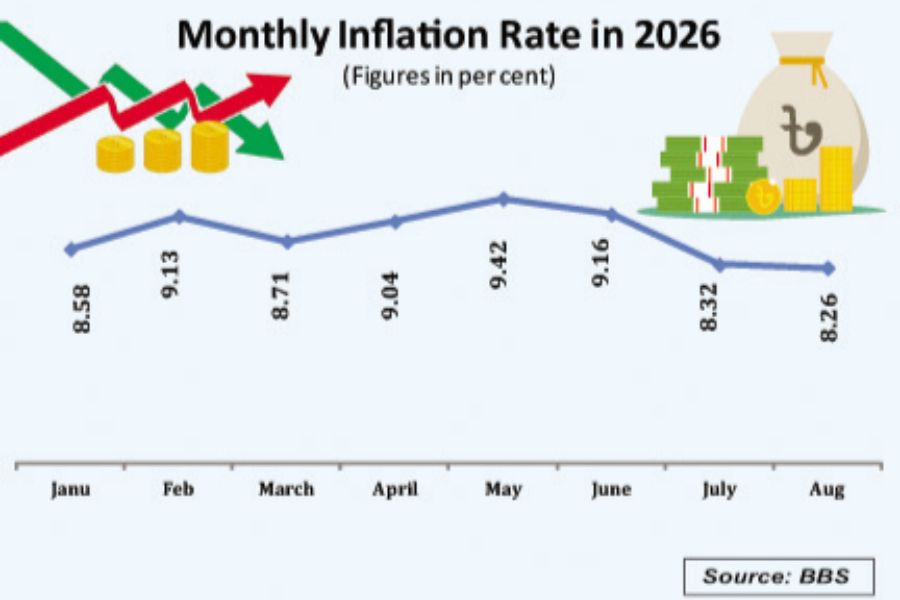
For the last few months, Bangladesh economy has gone through a phase of disinflation which means there was a slowdown in the rate of inflation although overall price level did not decline. The rate of inflation, on point-to-point basis, came down to 9.16 per cent in June from 9.42 per cent in May this year. The rate dropped again in July to 8.32 per cent and further came down to 8.26 per cent in August. The trend showed that inflation rate is going down slowly. The rates of food and non-food inflation declined during the period under review driving the overall decline in inflation rate. Food inflation came down to 7.02 per cent in August from 8.60 per cent in June this year while non-food inflation dropped to 9.32 per cent from 9.61 per cent respectively. At present, the weight of food is 45 per cent in the Consumer Price Index (CPI) and non-food 55 per cent.
Theoretically, disinflation is ‘a temporary slowing of the pace of price inflation.’ The term is generally used to ‘describe instances when the inflation rate has reduced marginally over the short term.’ So, disinflation is a short-term phenomenon that brings temporary relief for the consumers. As price level does not decline substantially during the period, prices of various goods and services remain high. That’s why when media reported the decline in inflation in July or August, many also raised the authenticity of the inflation data released by Bangladesh Bureau of Statistics (BBS). The question, raised by them, was: how could inflation decline when prices of essential commodities remained high? There is nothing wrong on raising such question especially when people have been suffering from high prices and their real wage has also been eroding. A missing point of the discussion is that despite a decline in inflation, the rate is still above 8 per cent which is also high.
Disinflation is usually viewed as a success of tight monetary stance. To put it simply, by raising interest rates, the central bank in an economy tightens the supply money in the market. As money supply reduces, the rate of inflation also starts to decline and a disinflation takes place for the time being. If the inflation rate comes down to the targeted or optimal level, the central bank may again go for rate cut slowly.
Bangladesh Bank has long been pursuing for the tight monetary policy to bring down the high rate of inflation. It kept the policy rate, repo rate to be precise, at 10 per cent for 22 months and finally brought it down by 50 basis points to 9.50 per cent two months back. The move came under criticism as inflation rate had not reduced to the optimal level of 7.50 per cent. A few weeks earlier, in the half yearly monetary policy statement, Bangladesh Bank announced that it would maintain its ‘contractionary monetary policy stance’ throughout the first half of FY27 to ‘rein in headline inflation and anchor long-term inflation expectations.’ So, the rate cut triggered debate on the policy consistency of the central bank.
Nevertheless, central bank’s move to cut policy rate modestly was based on its assumption that disinflation is already there. The rate cut was announced at the end July when complete data of inflation of the month was not at hand. Relevant data also came under review before the rate cut. For instance, private sector credit growth was 5 per cent since March this year. It was significantly below the projected 8.50 per cent growth rate.
Bangladesh Bank was probably expectating that disinflation would continue for a couple of months further and modest rate cut would not arrest there declining trend shortly. If disinflationary trend continued for longer period, it would reflect the decline in overall price level. But the fuel price hike by the government last week has changed the equation. The government increased the prices of all four major petroleum products by Tk 20 a litre in a bid to offset the higher costs of imports partially. The new prices came into effect from Monday, pushing up diesel to Tk 135 per litre from Tk 115, octane to Tk 165 from Tk 145, petrol to Tk 160 from Tk 140, and kerosene to Tk 155 from Tk 135. It is the third adjustment of fuel prices by Tarique Rahman-led BNP government since its assumed power in February this year.
As Bangladesh is largely dependent on the imports of fuel, volatility in the global market due to geopolitical tension makes it gradually expensive. The country imports around 85 per cent of the total demand of crude oil annually. The America-Israel joint assault on Iran in February suddenly restricted the supply of crude oil from the Gulf countries making it expensive. Iran retaliated and chocked the Strait of Hormuz so that no oil tanker can pass through it. After a fragile truce, the strait opened but faced restrictions time to time as the United States (US) breached the truce at regular intervals. Now the situation turned more complex as Iran-backed Huti militias in Yemen advanced to Bab el-Mandeb, a strategically important waterway connecting the Red Sea with the Gulf of Aden. The intensified conflicts and crisis in the Gulf region put the global oil market into turmoil.
Now, the sharp rise in oil prices will obviously push the inflation up in Bangladesh as transport fares and power tariffs are set to jump. Rise in transport fare means rise in transportation costs of goods and people’s mobility. Transport alone contributes around 10 per cent of the total CPI. Also, ‘housing, water, electricity, and gas’ contribute 15 per cent to the consumer basket. The cascading effect of oil price hike will also make electricity expensive. The rise in energy price will increase the cost of production and distribution.
Thus, disinflation will vanish soon. Will it be reflation, the opposite of disinflation? Theoretically, reflation aims to ‘expand output, stimulate spending, and counteract deflation after economic slowdowns.’ The fuel price hike does neither expand output nor stimulate spending. So, the fuel price shock will not lead to reflation. Instead, the country will return to a higher-inflation path. Bangladesh Bank, on Wednesday last, also decided to keep the policy rate at 9.50 per cent unchanged, as it anticipated a rise in inflation in the coming days due to the fuel price hike coupled with the implementation of the government’s upward-revised pay scale. It may even be forced to hike rates in the coming days to contain the inevitable surge in inflation.


 Bangladesh Defense