
 Bangladesh Defense
Saif
Senior Member
- Messages
- 21,756
- Likes
- 9,802
- Nation

- Residence
- Axis Group

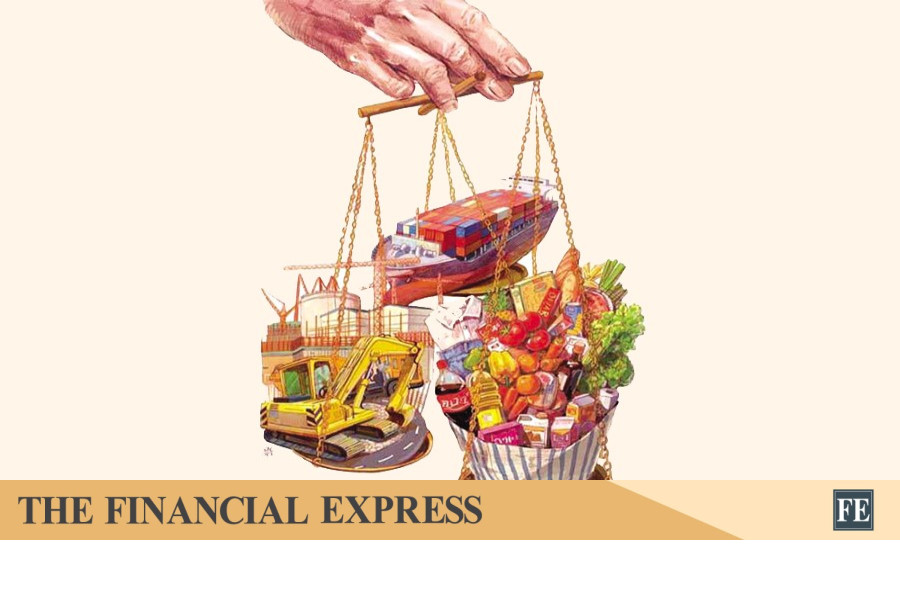
Beyond the stagflation trap
My October 11 article, “Bangladesh’s Stagflation Trap: Why It May Persist,” argued that the country’s persistent inflation, weak investment, inadequate productive employment and declining purchasing power constitute a multidimensional economic problem that cannot be resolved
Beyond the stagflation trap
Consumption, trust and economic justice

My October 11 article, “Bangladesh’s Stagflation Trap: Why It May Persist,” argued that the country’s persistent inflation, weak investment, inadequate productive employment and declining purchasing power constitute a multidimensional economic problem that cannot be resolved through isolated policy measures. A thoughtful response from Air Chief Marshal (Retired) Masihuzzaman Serniabat raised several additional questions concerning consumer behaviour, inflation, financial speculation, public confidence and economic justice. His observations invite an extension of the original argument by introducing public trust as an economic input influencing both economic behaviour and the effectiveness of government policies.
He observed that when consumers lose purchasing power and curtail spending, shopkeepers experience declining sales, producers reduce output, workers lose jobs and household incomes deteriorate further. The process can become a vicious cycle in which declining demand reinforces unemployment and economic stagnation. He also questioned why some economies continue operating with inflation exceeding 25 percent while others pursue much lower inflation targets. Drawing on Malaysia’s experience during the Asian financial crisis and the American housing crisis of 2008, he raised a broader concern about economic systems in which ordinary households bear consequences of financial decisions beyond their control.
The relationship between consumption and economic activity is fundamental to Keynesian economics. Consumption generates demand, demand sustains production, production creates employment and employment generates income that supports further consumption. When household purchasing power deteriorates, this mutually reinforcing process can operate in reverse. Economists recognise a related phenomenon as the paradox of thrift, whereby individually prudent reductions in spending can collectively depress economic activity.
However, an important distinction must be recognised between voluntary saving and involuntary reductions in consumption. A household that postpones purchasing a refrigerator to increase savings is behaving differently from one that cannot afford adequate food because prices have outpaced earnings. In Bangladesh, persistent inflation has increasingly forced lower- and middle-income households into the latter situation. Advising consumers to maintain normal spending cannot succeed when the necessary purchasing power no longer exists.
The problem becomes more complicated when inflation originates from rising production costs, imported inputs, currency depreciation and supply constraints rather than excessive consumer demand. Businesses may encounter declining sales while simultaneously paying more for energy, transportation and materials. Lowering interest rates may provide some relief, but it cannot automatically correct these interconnected distortions.
The question concerning countries experiencing inflation exceeding 25 percent also deserves clarification. Turkey, for example, has experienced prolonged periods of very high inflation while maintaining substantial economic activity. Yet continued production and employment do not establish that high inflation is necessary or desirable for economic development. Nominal spending, wages and investment may increase even while their real purchasing power or value deteriorates. The US Federal Reserve’s 2 per cent inflation target is intended to support long-run price stability and employment, not to establish a minimum inflation rate required for creating jobs.
Trust as an Economic Input: An often-overlooked determinant of economic performance is public trust in the qualifications, experience and integrity of policymakers and institutional leaders. In many developing economies, politically motivated appointments to key economic and regulatory institutions are facilitated by weak legislative scrutiny and inadequate institutional checks, unlike the formal confirmation process exercised by the U.S. Senate over certain senior appointments. Two governments may announce identical economic policies, yet households, businesses and investors may respond differently because their expectations depend not merely on the policies themselves but also on the perceived competence, credibility and integrity of those entrusted with their implementation.
Trust is therefore more than a political or psychological consideration. It is an intangible economic input that influences consumption, saving, investment, credit relationships and the transmission of economic policy. Although trust is not traded like labour or capital, its presence or absence can alter the effectiveness with which conventional economic resources are employed.
Public trust can be expressed through a conceptual Trust Function:
T = f(C, I, R, P, E)
Here, T = public trust; C = perceived competence of policymakers; I = integrity and accountability; R = institutional reputation and reliability; P = policy credibility, consistency and predictability; and E = observed economic performance.
The function is conceptual rather than econometrically estimated. It identifies institutional and behavioural channels through which public confidence influences economic decisions. The relationships are not necessarily linear, nor are the explanatory variables independent of one another. A major policy failure may destroy credibility rapidly, while rebuilding public confidence may require years of consistent institutional performance.
More importantly, public trust is endogenous, meaning that it both affects and is affected by economic performance. Public confidence in the competence, credibility and integrity of policymakers can stimulate consumption, investment and economic growth, while improved economic performance can further strengthen that confidence. Conversely, weak economic performance can erode public trust, discourage consumption and investment, and undermine policy effectiveness. This two-way relationship creates either a virtuous cycle of confidence and growth or a vicious cycle of distrust, economic stagnation and institutional deterioration.
A central bank may reduce interest rates, a government may announce investment incentives and a finance ministry may promise fiscal reforms. Yet their intended effects may fail to materialize when households and businesses distrust the institutions responsible for implementation. Conversely, credible institutions can strengthen policy effectiveness by reducing uncertainty and improving expectations.
The US Federal Reserve is arguably the world’s most influential central bank and one of its most credible monetary institutions. Its institutional independence, policy transparency and established reputation have earned it the confidence of financial markets, investors and policymakers worldwide.
The larger economic lesson is that institutional credibility is itself an economic asset. Trust in a central bank can strengthen the effectiveness of monetary policy, whereas diminished confidence in its independence, competence or integrity can weaken policy transmission, unsettle markets and discourage investment.
Trust cannot be manufactured through official declarations or appeals for public confidence. It must be earned through competence, accountability and demonstrable results.
Lessons from Malaysia and America: The Asian financial crisis provides an instructive example. During the turmoil beginning in 1997, Malaysian Prime Minister Mahathir Mohamad encouraged consumers to maintain confidence rather than respond to uncertainty through indiscriminate reductions in spending. In September 1998, Malaysia introduced selective capital controls and pegged the ringgit at 3.80 to the U.S. dollar. These controversial measures sought to contain financial instability and restore domestic policy flexibility.
Malaysia’s experience demonstrates that consumer expectations, exchange-rate management, financial institutions and government credibility interact during economic crises. Nevertheless, attributing financial turmoil primarily to individual speculators would overlook weaknesses in financial structures, credit allocation and regulatory oversight. Speculative pressures can aggravate vulnerabilities, but their consequences depend partly on the institutional environment.
The American housing crisis beginning in 2007 offers another dimension. Millions of households lost their homes during the ensuing financial collapse, while failures in mortgage lending, securitization, risk assessment and financial supervision spread losses throughout the economy. The experience raised uncomfortable questions about the distribution of financial rewards and responsibilities. Those making risky financial decisions were not necessarily the same people who ultimately bore their consequences.
The call for a justice-based economic order therefore warrants serious consideration. Economic justice does not necessarily require eliminating inequality, speculation or financial losses. It does require institutions that discourage exploitation, enforce accountability and prevent powerful economic actors from transferring disproportionate risks to vulnerable households.
When citizens believe that financial rewards are privately appropriated while losses are transferred to the public, institutional trust deteriorates. Such perceptions weaken the very foundation upon which effective economic policymaking depends. Economic injustice, therefore, carries consequences extending beyond the immediate distribution of income and wealth.
Digitalisation and blockchain-based recordkeeping may improve transparency and traceability, but transparency alone cannot guarantee justice. Transactions can be accurately recorded and still be exploitative. Technology may reveal economic behaviour, while effective institutions must establish and enforce the rules governing that behaviour.
Bangladesh’s Stagflationary Matrix Revisited: These observations bring the discussion back to Bangladesh. Persistent inflation weakens purchasing power, reduced consumption discourages production, weak investment constrains future productive capacity and distressed financial institutions obstruct the flow of credit. Institutional uncertainty further discourages investment, while declining public trust can intensify each of these pressures.
The original stagflationary matrix must therefore accommodate an additional dimension: the interaction between institutional credibility, public expectations and economic behaviour. Trust is not a substitute for capital, labour or technology. Rather, it influences how effectively these resources are mobilised and how strongly economic policies translate into actual economic outcomes.
Restoring trust requires more than changing interest rates or announcing ambitious development programmes. It requires credible central bank governance and regulatory independence from political interference and the vested interests of commercial banks. It also requires predictable regulations, responsible fiscal management, reliable energy supplies and demonstrable accountability.
Policy sequencing remains indispensable. Repairing distressed banks, strengthening credit allocation, improving the investment environment and mobilising domestic revenue should establish the conditions under which monetary easing can support productive expansion. Without these foundations, even appropriate policies may produce disappointing outcomes because the institutions transmitting them remain impaired and economic agents lack confidence in their effectiveness.
Ultimately, economic stability and economic justice are not competing objectives. Institutions that distribute risks responsibly, discourage financial misconduct and sustain public trust can promote both. Bangladesh’s stagflation is therefore more than an interaction of inflation, investment, employment and fiscal constraints. It is also a crisis of institutional credibility in which economic weakness erodes trust and declining trust further weakens economic performance. Escaping the trap requires rebuilding that credibility alongside the productive foundations of the economy, because economic policies cannot achieve their intended outcomes when the institutions responsible for implementing them have lost the confidence of those whose economic behaviour they seek to influence.
The writer is a Professor Emeritus of Economics at Eastern Michigan University, USA, and a former nuclear engineer at the Bangladesh Atomic Energy Commission.
Consumption, trust and economic justice
My October 11 article, “Bangladesh’s Stagflation Trap: Why It May Persist,” argued that the country’s persistent inflation, weak investment, inadequate productive employment and declining purchasing power constitute a multidimensional economic problem that cannot be resolved through isolated policy measures. A thoughtful response from Air Chief Marshal (Retired) Masihuzzaman Serniabat raised several additional questions concerning consumer behaviour, inflation, financial speculation, public confidence and economic justice. His observations invite an extension of the original argument by introducing public trust as an economic input influencing both economic behaviour and the effectiveness of government policies.
He observed that when consumers lose purchasing power and curtail spending, shopkeepers experience declining sales, producers reduce output, workers lose jobs and household incomes deteriorate further. The process can become a vicious cycle in which declining demand reinforces unemployment and economic stagnation. He also questioned why some economies continue operating with inflation exceeding 25 percent while others pursue much lower inflation targets. Drawing on Malaysia’s experience during the Asian financial crisis and the American housing crisis of 2008, he raised a broader concern about economic systems in which ordinary households bear consequences of financial decisions beyond their control.
The relationship between consumption and economic activity is fundamental to Keynesian economics. Consumption generates demand, demand sustains production, production creates employment and employment generates income that supports further consumption. When household purchasing power deteriorates, this mutually reinforcing process can operate in reverse. Economists recognise a related phenomenon as the paradox of thrift, whereby individually prudent reductions in spending can collectively depress economic activity.
However, an important distinction must be recognised between voluntary saving and involuntary reductions in consumption. A household that postpones purchasing a refrigerator to increase savings is behaving differently from one that cannot afford adequate food because prices have outpaced earnings. In Bangladesh, persistent inflation has increasingly forced lower- and middle-income households into the latter situation. Advising consumers to maintain normal spending cannot succeed when the necessary purchasing power no longer exists.
The problem becomes more complicated when inflation originates from rising production costs, imported inputs, currency depreciation and supply constraints rather than excessive consumer demand. Businesses may encounter declining sales while simultaneously paying more for energy, transportation and materials. Lowering interest rates may provide some relief, but it cannot automatically correct these interconnected distortions.
The question concerning countries experiencing inflation exceeding 25 percent also deserves clarification. Turkey, for example, has experienced prolonged periods of very high inflation while maintaining substantial economic activity. Yet continued production and employment do not establish that high inflation is necessary or desirable for economic development. Nominal spending, wages and investment may increase even while their real purchasing power or value deteriorates. The US Federal Reserve’s 2 per cent inflation target is intended to support long-run price stability and employment, not to establish a minimum inflation rate required for creating jobs.
Trust as an Economic Input: An often-overlooked determinant of economic performance is public trust in the qualifications, experience and integrity of policymakers and institutional leaders. In many developing economies, politically motivated appointments to key economic and regulatory institutions are facilitated by weak legislative scrutiny and inadequate institutional checks, unlike the formal confirmation process exercised by the U.S. Senate over certain senior appointments. Two governments may announce identical economic policies, yet households, businesses and investors may respond differently because their expectations depend not merely on the policies themselves but also on the perceived competence, credibility and integrity of those entrusted with their implementation.
Trust is therefore more than a political or psychological consideration. It is an intangible economic input that influences consumption, saving, investment, credit relationships and the transmission of economic policy. Although trust is not traded like labour or capital, its presence or absence can alter the effectiveness with which conventional economic resources are employed.
Public trust can be expressed through a conceptual Trust Function:
T = f(C, I, R, P, E)
Here, T = public trust; C = perceived competence of policymakers; I = integrity and accountability; R = institutional reputation and reliability; P = policy credibility, consistency and predictability; and E = observed economic performance.
The function is conceptual rather than econometrically estimated. It identifies institutional and behavioural channels through which public confidence influences economic decisions. The relationships are not necessarily linear, nor are the explanatory variables independent of one another. A major policy failure may destroy credibility rapidly, while rebuilding public confidence may require years of consistent institutional performance.
More importantly, public trust is endogenous, meaning that it both affects and is affected by economic performance. Public confidence in the competence, credibility and integrity of policymakers can stimulate consumption, investment and economic growth, while improved economic performance can further strengthen that confidence. Conversely, weak economic performance can erode public trust, discourage consumption and investment, and undermine policy effectiveness. This two-way relationship creates either a virtuous cycle of confidence and growth or a vicious cycle of distrust, economic stagnation and institutional deterioration.
A central bank may reduce interest rates, a government may announce investment incentives and a finance ministry may promise fiscal reforms. Yet their intended effects may fail to materialize when households and businesses distrust the institutions responsible for implementation. Conversely, credible institutions can strengthen policy effectiveness by reducing uncertainty and improving expectations.
The US Federal Reserve is arguably the world’s most influential central bank and one of its most credible monetary institutions. Its institutional independence, policy transparency and established reputation have earned it the confidence of financial markets, investors and policymakers worldwide.
The larger economic lesson is that institutional credibility is itself an economic asset. Trust in a central bank can strengthen the effectiveness of monetary policy, whereas diminished confidence in its independence, competence or integrity can weaken policy transmission, unsettle markets and discourage investment.
Trust cannot be manufactured through official declarations or appeals for public confidence. It must be earned through competence, accountability and demonstrable results.
Lessons from Malaysia and America: The Asian financial crisis provides an instructive example. During the turmoil beginning in 1997, Malaysian Prime Minister Mahathir Mohamad encouraged consumers to maintain confidence rather than respond to uncertainty through indiscriminate reductions in spending. In September 1998, Malaysia introduced selective capital controls and pegged the ringgit at 3.80 to the U.S. dollar. These controversial measures sought to contain financial instability and restore domestic policy flexibility.
Malaysia’s experience demonstrates that consumer expectations, exchange-rate management, financial institutions and government credibility interact during economic crises. Nevertheless, attributing financial turmoil primarily to individual speculators would overlook weaknesses in financial structures, credit allocation and regulatory oversight. Speculative pressures can aggravate vulnerabilities, but their consequences depend partly on the institutional environment.
The American housing crisis beginning in 2007 offers another dimension. Millions of households lost their homes during the ensuing financial collapse, while failures in mortgage lending, securitization, risk assessment and financial supervision spread losses throughout the economy. The experience raised uncomfortable questions about the distribution of financial rewards and responsibilities. Those making risky financial decisions were not necessarily the same people who ultimately bore their consequences.
The call for a justice-based economic order therefore warrants serious consideration. Economic justice does not necessarily require eliminating inequality, speculation or financial losses. It does require institutions that discourage exploitation, enforce accountability and prevent powerful economic actors from transferring disproportionate risks to vulnerable households.
When citizens believe that financial rewards are privately appropriated while losses are transferred to the public, institutional trust deteriorates. Such perceptions weaken the very foundation upon which effective economic policymaking depends. Economic injustice, therefore, carries consequences extending beyond the immediate distribution of income and wealth.
Digitalisation and blockchain-based recordkeeping may improve transparency and traceability, but transparency alone cannot guarantee justice. Transactions can be accurately recorded and still be exploitative. Technology may reveal economic behaviour, while effective institutions must establish and enforce the rules governing that behaviour.
Bangladesh’s Stagflationary Matrix Revisited: These observations bring the discussion back to Bangladesh. Persistent inflation weakens purchasing power, reduced consumption discourages production, weak investment constrains future productive capacity and distressed financial institutions obstruct the flow of credit. Institutional uncertainty further discourages investment, while declining public trust can intensify each of these pressures.
The original stagflationary matrix must therefore accommodate an additional dimension: the interaction between institutional credibility, public expectations and economic behaviour. Trust is not a substitute for capital, labour or technology. Rather, it influences how effectively these resources are mobilised and how strongly economic policies translate into actual economic outcomes.
Restoring trust requires more than changing interest rates or announcing ambitious development programmes. It requires credible central bank governance and regulatory independence from political interference and the vested interests of commercial banks. It also requires predictable regulations, responsible fiscal management, reliable energy supplies and demonstrable accountability.
Policy sequencing remains indispensable. Repairing distressed banks, strengthening credit allocation, improving the investment environment and mobilising domestic revenue should establish the conditions under which monetary easing can support productive expansion. Without these foundations, even appropriate policies may produce disappointing outcomes because the institutions transmitting them remain impaired and economic agents lack confidence in their effectiveness.
Ultimately, economic stability and economic justice are not competing objectives. Institutions that distribute risks responsibly, discourage financial misconduct and sustain public trust can promote both. Bangladesh’s stagflation is therefore more than an interaction of inflation, investment, employment and fiscal constraints. It is also a crisis of institutional credibility in which economic weakness erodes trust and declining trust further weakens economic performance. Escaping the trap requires rebuilding that credibility alongside the productive foundations of the economy, because economic policies cannot achieve their intended outcomes when the institutions responsible for implementing them have lost the confidence of those whose economic behaviour they seek to influence.
The writer is a Professor Emeritus of Economics at Eastern Michigan University, USA, and a former nuclear engineer at the Bangladesh Atomic Energy Commission.


