[🇧🇩] New Government (BNP) in Bangladesh

[🇧🇩] New Government (BNP) in Bangladesh
55
1K
More threads by Saif

G Bangladesh Defense

Govt officials should have mentality to work in all positions: PM
The Prime Minister said that the current government had to start its journey amid the most fragile economy, weak and divided public administration and deteriorating law and order situation in the country’s history.

BSS
Dhaka
Published: 03 May 2026, 22: 26
1777853902213.webp

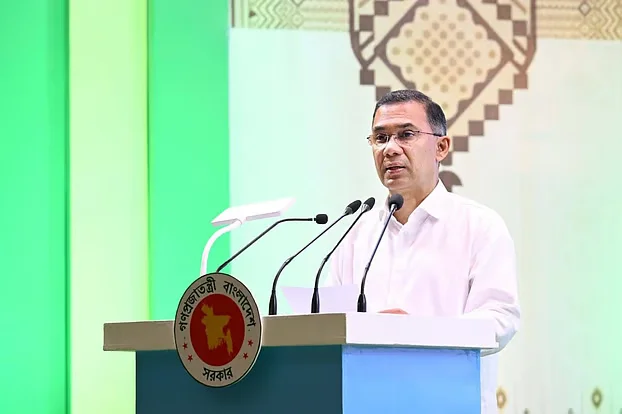
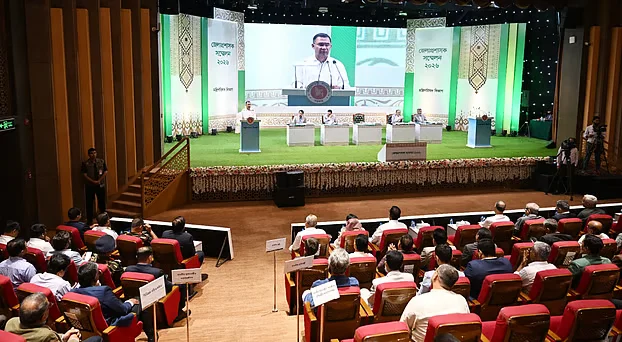
Prime Minister Tarique Rahman addresses the four-day DCs Conference 2026 at the Osmani Memorial Auditorium in Dhaka on 3 May 2026 BSS.

Stating that every position in public administration is important for the government, Prime Minister Tarique Rahman today, Sunday, said that it is essential for government officials to have the mentality to work in all positions.

“If professionalism is compromised only for promotion or posting in one’s preferred place, you may benefit temporarily, but it negatively affects the efficiency and neutrality of public administration as a whole,” he said while addressing the Deputy Commissioners’ (DCs) Conference this morning.

Earlier, the Prime Minister formally opened the four-day DCs Conference-2026 around 10:30 am at the Osmani Memorial Auditorium in the city, which will continue till 6 May.

Tarique Rahman, also chairman of the ruling BNP (Bangladesh Nationalist Party), said the mentality of always wanting appointment or posting in preferred positions is one of the main reasons for making the government officials corrupt and unprofessional.

“Therefore, my special request to you is to consider every path in public administration as important and inevitable. Keep you mentally prepared to perform duties in any position of public administration, at any place in the country, at any time,” he said.

Noting that honesty, merit and efficiency are the main principles in recruitment, transfer or promotion in public administration, the premier said that the government is firmly committed to ensuring accountability in the effectiveness of the administrative structure everywhere, including quick recruitment of manpower in vacant posts with transparency, formation of a strong Public Service Commission (PSC) and formulation of private service rules.

Cabinet members, advisers, the cabinet secretary, chiefs of three services, other senior officials and divisional commissioners were present at the inaugural ceremony.

The Prime Minister earlier walked from his office at the Bangladesh Secretariat to the Osmani Memorial Auditorium to join the programme around 10:20 am.

At that time, people standing on both sides of the road greeted the Prime Minister, who responded by waving back at them.

Noting that the present government is the reflection of the aspirations of general people, who have long expected an accountable, justice-based and welfare-oriented governance system, the Prime Minister said it is normal that the people would want to see a real reflection of their aspirations through every work of the government.

“Divisional commissioners and deputy commissioners are the main bridge between the government and the people. The success of the activities undertaken by the government depends entirely on your (DCs) honesty, efficiency and sense of responsibility,” he added.

At the beginning of the event, the Prime Minister thanked the government officials, who demonstrated their professionalism and performed national duty in the last national election.

“You have proved in the 12 (February) election that if public administration works properly, the people’s verdict is definitely reflected. On the other hand, we have also seen in 14, 18 or 2024 what can happen if you are not allowed to work,” he said.

“Yesterday afternoon you saw a sports event for children. You saw with what spirit the children want to move forward. I think the main spirit or motto of today’s deputy commissioners’ conference should be that motto of those children. That is, moving forward—let that be the spirit of today’s event,” Tarique Rahman added.
1777853944603.webp

Prime Minister Tarique Rahman addresses the four-day DCs Conference 2026 at the Osmani Memorial Auditorium in Dhaka on 3 May 2026 BSS.

Prime Minister’s Adviser for Public Administration Ministry Md Ismail Zabihullah, State Minister Md Abdul Bari and Prime Minister’s Principal Secretary ABM Abdus Sattar also spoke at the event, among others.

This is the first DC Conference since the BNP formed the government in February this year.

The Prime Minister said that the current government had to start its journey amid the most fragile economy, weak and divided public administration and deteriorating law and order situation in the country’s history.

“(However) with your cooperation, we have been able to change much of that situation in these two and a half months.

During fascist rule, corruption and looting had burdened the state and the people with debt. On the other hand, the current war situation has emerged as a challenge for the new government,” he added.

Tarique Rahman said, perhaps no country in the world has been spared from the war situation at this moment while Bangladesh has also been affected.

“However, our effort is how we can all together face the situation without increasing the suffering of the people. With your cooperation, we have continued that effort,” he added.

“While facing this very situation, the current government wants to establish a justice-based welfare state in the light of the country’s eternal religious and social values,” the Prime Minister said, adding, to achieve this goal, the government has started implementing various initiatives to improve the living standards of the people from every profession and class in the country.

“On the basis of a policy, through public administration- that is, through you- we have already introduced Family Card, Farmer Card, Sports-related initiatives, and monthly honorariums for imams, muezzins and other religious leaders in the country. These activities have started through you,” he said.

“We want to gradually implement our election manifesto and every point and every commitment we made in the July charter. We are committed in this regard. I hope you will be able to play a role in efficiently implementing every promise made by the government to the people with your talent and qualifications, InShAllah,” the head of the government said.

Advising deputy commissioners not to use excessive laws and regulations and complications as excuses, the Prime Minister said, “Let’s try to develop the mentality of taking realistic, effective and public-interest-related decisions at all levels of administration so that people can receive the expected benefits of every government programme on time”.

Mentioning that the world has entered the age of Artificial Intelligence (AI), Tarique Rahman said, “We are all aware of this. To survive in global competition, public administration officials must also keep themselves prepared to face the times”.

Stressing that this conference should not be just a place for formal exchange of views, he said rather, it should be a platform where the real experiences, limitations, needs and innovative thinking of field administration can be directly reflected in the national-level decision-making process.

Terming the DCs as the government’s administrative ambassadors at the field level, the Prime Minister said controlling commodity prices, maintaining market discipline and ensuring fair prices for farmers are extremely important.

He stressed the need for making mobile court operations effective, regular and visible.

Besides, the Prime Minister instructed DCs to keep strict watch so that service seekers do not face unnecessary harassment, delay or irregularities while visiting government offices.

“You should seriously address any legitimate complaint of the people. Strict measures must be taken to maintain law and order, control drug abuse and maintain communal harmony, and prevent child marriage, violence against women and children- the matters that are within your capacity,” he said.

Stating that national unity is “our greatest strength”, Tarique Rahman said, “Differences of opinion may exist among us. But in the interest of the country, personally as a political worker, I believe ‘Bangladesh First’.”

A total of 34 sessions will be held during this four-day DC Conference. Among these, 30 will be working sessions, and the number of participating ministries or divisions is 56.

A total of 1,729 proposals were submitted by the DCs to the government on different issues related to governance. Out of those proposals 498 have been included in the working papers. The highest 44 proposals came related to the Health Services Division.

Ministers and state ministers of 56 ministries and divisions will provide necessary instructions to the deputy commissioners regarding their respective ministries at the conference.​
 

Rizvi expects ‘constructive criticism’ of govt policies from opposition

UNB

Published :
May 08, 2026 21:22
Updated :
May 08, 2026 21:22

1778283176659.webp


Opposition parties should criticise the government, but such criticism must be constructive, BNP Senior Joint Secretary General Ruhul Kabir Rizvi said on Friday.

Speaking to reporters after inspecting preparations for a BNP dialogue meeting scheduled for Saturday (May 9) at the Krishibid Institution in the capital, Rizvi made the remarks.

The meeting will be attended by presidents and general secretaries of BNP’s three associate bodies — Jubo Dal, Chhatra Dal and Swechhasebak Dal — from district and metropolitan units.

Rizvi said Prime Minister Tarique Rahman will attend the programme as chief guest. Senior party leaders, including the secretary general, are also expected to be present, while district-level leaders from across the country will present their views on organisational issues and various government activities.

He added that ministers concerned will also present analyses of recent government initiatives over the past two to three months, including measures that have been implemented and those in progress.

“Our Family Card, Farmers’ Card, and initiatives on canal excavation are among several good programmes,” he said.

Referring to opposition politics and criticism of the government, Rizvi said BNP has struggled for democracy for 16 years, during which many lives were lost, including those of children, students, teachers and workers.

“In a democracy, the government performs its duties and the opposition provides criticism. That is the basic principle, and that is how it should be,” he said.

He added that opposition criticism is acceptable if it is constructive.

“If there are mistakes in the government’s work, pointing them out strengthens democracy and makes the state more effective and efficient,” Rizvi said.

“However, if we take programmes with the intention of putting the government in trouble or spread falsehoods, then that becomes conspiracy. Sheikh Hasina, both in power and outside power, has made many false claims. If politics follows that path, it falls under conspiracy,” he added.

Rizvi further said constructive opposition would strengthen democracy.

“If people consider the opposition’s stance positive, they will judge it accordingly. Ultimately, the people are the final judges. In the next election, they will decide whether the government has performed properly,” he said.

BNP leaders Mahfuz Kabir Mukta, president of the Nationalist Publicity Party, and Dr Towhidur Rahman Awal, vice-president of Jatiyatabadi Chhatra Dal, among others, were present during the briefing.​
 

Government voted ‘Yes’ to come to power but acted irresponsibly: Golam Porwar

UNB

Published :
May 09, 2026 22:17
Updated :
May 09, 2026 22:17
Share this news

1778368666530.webp


Jamaat-e-Islami Secretary General Mia Golam Porwar has alleged that the government voted in favour of “Yes” to come to power but is now acting inconsistently regarding reforms and constitutional commitments.

He made the remarks on Saturday afternoon while speaking to journalists during a view-exchange meeting at the Thakurgaon Manab Kalyan Parishad hall.

Porwar said the government supports 84 reform proposals and the July Charter in parliament, but takes a contradictory stance on the issue of a referendum. “They say they will implement the July Charter but will not accept the referendum. The government has separated the July Charter and the referendum for its own interest,” he claimed.

He further said that the Prime Minister, the Law Minister, and ruling party leaders have stated in parliament that they will implement the July Charter “word for word.” “This means they will accept even the notes of dissent included in the charter. But they never say they will implement the referendum verdict in the same way. This shows they acted irresponsibly by voting ‘Yes’ to come to power,” he added.

Commenting on local government elections and democracy, Porwar said Jamaat-e-Islami will participate in local government polls. He said the party had earlier demanded that local elections be held before national elections, but the government did not agree for “specific reasons.”

He also criticised the government for appointing administrators to city corporations immediately after coming to power. “This is a clear violation of democracy and the constitution. How can an elected government appoint selected party people to important local bodies like city corporations? It proves the government is not moving on the path of democracy,” he said.

The meeting was chaired by District Jamaat Ameer Professor Belal Uddin Prodhan. Among others, Jamaat Assistant Secretary General Maulana Abdul Halim, former Sadar Upazila Vice Chairman and District Secretary Mohammad Alamgir, and District Imam Samity President Fazle Rabbi were present.

After attending a Jamaat workers’ conference in Thakurgaon, Porwar later left for Panchagarh.​
 

Why strengthening local govt is essential

It is evident that under the existing constitutional framework, the local government system was meant to function as an autonomous governing structure alongside the central government. In other words, local government constitutes a parallel system of governance responsible for administering affairs at all local administrative levels.

Badiul Alam Majumdar

1778716749927.webp


Recently, Local Government Minister Mirza Fakhrul Islam Alamgir announced that elections to all local government bodies would begin towards the end of this year. We welcome his statement. However, it is important to remember that school and college examinations are scheduled for the year-end period. Therefore, it is essential that these elections begin and conclude as quickly as possible.

Holding local government elections without delay is imperative because the establishment of elected local government institutions is a constitutional obligation. Article 59 of the Constitution of Bangladesh states that “Local government in every administrative unit of the Republic shall be entrusted to bodies, composed of persons elected in accordance with law.” In other words, elected district councils must govern districts, elected upazila parishads must govern upazilas, elected union parishads must govern unions, and similarly, elected representatives must administer city corporations and municipalities.

It is noteworthy that the Constitution specifically refers to entrusting “local governance” to elected representatives. This means that elected representatives are meant to oversee all matters at their respective administrative levels, just as the elected central government administers affairs at the national level.

Put differently, the role of local government representatives should not be confined merely to constructing small-scale infrastructure, selecting beneficiaries for government welfare schemes such as TR or Kabikha programmes, or conducting minor arbitration proceedings. Rather, they are intended to govern at the local level in a meaningful sense.

To enable them to fulfil this responsibility effectively, the Constitution also places “administration and the work of public officials” within their jurisdiction. That means all government officials and employees at the local level are constitutionally expected to operate under the supervision of elected local representatives, just as all officials at the national level work under the elected government led by the Prime Minister.

In fact, the foundation of local government in this region was laid through the Bengal Local Self-Government Act of 1885. Our system, therefore, was intended to be one of autonomous local self-government, not a centrally controlled structure.

Yet, in practice, the opposite has occurred. While public officials at the centre work under elected representatives, at other administrative levels elected local representatives have effectively been subordinated to bureaucrats.

It is therefore evident that under the existing constitutional framework, the local government system was meant to function as an autonomous governing structure alongside the central government. In other words, local government constitutes a parallel system of governance responsible for administering affairs at all local administrative levels.

The Constitution also assigns three specific responsibilities to local government institutions: maintaining public order, planning and implementing public services and welfare programmes, and preparing and executing development plans. These are fundamentally important responsibilities for ensuring public welfare, and Parliament cannot ignore them when legislating on local government matters, as established in Kudrat-e-Elahi Panir vs Bangladesh, 44 DLR (AD).

The theoretical foundation of local government is the principle of subsidiarity, whose core idea is simple: problems should be solved where they arise. A closer look reveals that most issues people face in daily life — education, healthcare, sanitation, public safety and similar concerns — are inherently local in nature. Consequently, the most appropriate and effective solutions can often be achieved locally through governments operating closest to the people.

According to the subsidiarity principle, problems that cannot be resolved by grassroots institutions such as union parishads should be addressed by the next tier, such as upazila parishads, while more complex issues should move further upward to district councils or higher local authorities. If governance is organised according to subsidiarity principle, the role of the central government becomes more limited, focusing primarily on matters such as national security, foreign trade, foreign relations, legislation, and overarching policy and administrative affairs — issues that are not local by nature.

Implementing a governance system based on subsidiarity principle requires genuine decentralisation, under which substantial authority, responsibilities and financial resources are transferred to local governments. Achieving this would require a fundamental restructuring of the existing bureaucratic system — a process likely to face significant resistance.

The theoretical foundation of local government is the principle of subsidiarity, whose core idea is simple: problems should be solved where they arise. A closer look reveals that most issues people face in daily life — education, healthcare, sanitation, public safety and similar concerns — are inherently local in nature.

The greatest resistance, however, would probably emerge over the transfer of financial resources from the central treasury to local government institutions. Many politicians and officials in positions of power tend to assume that all state resources belong to the central government and that only the centre should decide how they are spent. In reality, however, all state resources belong to the people and should be utilised through institutions capable of ensuring the greatest public benefit.

It is widely recognised that public services and development initiatives produce the best outcomes when planned and implemented through governments operating at the people’s doorstep. Such an arrangement strengthens transparency and accountability.

For example, citizens can directly question union parishad chairmen and members regarding how funds are spent — something far more difficult when dealing with distant bureaucrats or senior political figures.

I recall attending an open budget session organised by The Hunger Project at union level several years ago, where a woman directly asked the chairman, “Mr Chairman, you repaired the road leading to your house — why is the road leading to mine still in ruins?” This type of direct accountability becomes possible through local governance.

Moreover, under the existing Union Parishad Act, transparency and accountability can also be strengthened through ward meetings. At the same time, open ward sessions can prepare beneficiary lists for government schemes, even identifying those genuinely entitled to family cards, thereby reducing opportunities for middlemen to demand money in exchange for access to public benefits.

Another compelling argument for strengthening local government is that it forms the foundation of democracy itself. Democracy means governance by the people through their elected representatives. Therefore, unless representative governance is established at every level, democracy cannot truly function. Local governance creates grassroots democracy, and only when democracy takes root at the grassroots level can the broader democratic system become fully effective.

In other words, grassroots democracy serves as the foundation upon which the wider democratic structure stands. If the foundation is weak, the entire democratic system inevitably becomes fragile.

Finally, if we genuinely wish to make our democratic system effective, elections at all levels of local government must be organised without delay. Doing so would also be consistent with the widely discussed 31-point reform agenda and election manifesto of the Bangladesh Nationalist Party (BNP).

To achieve this, it is essential to refine all local government laws by considering both the recommendations of the Shaukat Ali Committee, of which the present writer was a member, and the report of the Tofail Ahmed Commission formed during the immediate past interim government. A modernised legal framework must first be established, and only then should elections be held on that basis.

* Badiul Alam Majumdar is secretary of Citizens for Good Governance (SHUJON).​
 

PM urges all to remain alert against confusion in name of politics

BSS

Published :
May 16, 2026 21:08
Updated :
May 16, 2026 21:08

1778985464971.webp


Prime Minister Tarique Rahman has urged the countrymen to remain vigilant, saying that a group is spreading confusion in the country in the name of politics.

"A group is spreading confusion in the country in the name of politics. You should stay alert," he said while addressing the Family Card distribution ceremony at Chandpur Government College ground in Chandpur on Saturday afternoon.

Noting that BNP does the politics of changing the people's fate, Tarique Rahman, also BNP chairman, said, "BNP's politics means dredging canals, increasing agricultural production, building new mills and factories, creating employment opportunities, ensuring healthcare and guaranteeing public safety."

Addressing the crowd, he said, "If anyone tries to create confusion or anarchy in the name of politics, will you remain silent? We will not remain silent. We will resist with an iron hand."

Every programme undertaken by BNP aimed at improving the living standard of the country's working-class people, the Prime Minister said, adding, "We ousted the autocratic regime through a movement to this end. The people have now transferred power to an elected government. Now it is our turn to change people's fate."

Along with Chandpur, Prime Minister Tarique Rahman inaugurated the Family Card distribution programme in 20 other districts through video conference under the initiative of the Ministry of Social Welfare.

At the event, the Prime Minister handed over Family Cards to ten women beneficiaries. They are: Hasina Khatun, Sohagi Akhtar, Fatema Khatun, Amena Khatun, Moseda Begum, Monowara Begum, Mahmuda Khatun, Ruma Akhtar, Nazma Begum and Taslima.

Later, the premier pressed a button on a laptop while cash assistance of Taka 2,500 was instantly transferred to accounts of 15,000 women beneficiaries in Chandpur and 20 other districts.​
 

Govt to roll out new dev strategy targeting $1.0t economy by 2034
Plan marks shift from long-standing 5-yr dev model

FHM Humayan Kabir

Published :
May 20, 2026 09:09
Updated :
May 20, 2026 09:09

1779329565431.webp


The newly formed BNP government is set to introduce a new development strategy, moving away from the long-standing five-year planning model used during the previous Awami League administration, which remained in power for 17 years.

The ambitious macroeconomic blueprint aims to steer Bangladesh towards a US$1.0 trillion economy by 2034, with a projected terminal growth rate of 8.5 per cent by FY2030-31, ending in June 2031.

Officials at the Planning Commission said the government is preparing to finalise a Five-Year Strategic Framework (FYSF) within June, which will serve as the foundation for reforms and development planning over the next five years.

Under the proposed framework, the BNP government, in line with its election manifesto, seeks to expand the size of the economy from around $450 billion to $1.0 trillion.

The framework is being drafted by the General Economics Division (GED) of the Planning Commission and marks a significant shift in national economic policy direction.

Bangladesh has lacked a formal medium-term development plan for the past two years following the suspension of the 8th Five-Year Plan by the interim administration, creating what officials describe as a planning gap.

Earlier, Bangladesh implemented eight five-year plans -- five between FY1973 and FY2002, and three more from FY2010 to FY2025 -- alongside a two-year interim plan during former president Ziaur Rahman's administration.

Between FY2003 and FY2010, the country followed Poverty Reduction Strategy Papers (PRSPs) instead of five-year plans before returning to the FYP model in 2009.

The upcoming FYSF represents a structural shift from the previous development approach, which largely focused on infrastructure expansion and food security under two consecutive perspective plans up to 2041.

According to GED officials, the new framework prioritises institutional reform, private sector-led investment, and macroeconomic stabilisation, alongside efforts to significantly expand the size of the economy over the next decade.

Key targets include raising GDP growth gradually from 6.5 per cent in FY2027 to 8.5 per cent by FY2030-31, alongside achieving sustained high growth over the period.

Economists say the framework aims to restore a structured development pathway after the recent disruption in long-term planning, which left ministries operating without clear strategic targets.

The suspension of the 8th Five-Year Plan had created uncertainty in policy direction, which the new government aims to address by aligning planning with fiscal policy, budget allocations, and the Annual Development Programme (ADP).

The FYSF is expected to directly shape national budget priorities and development spending until the end of the decade, in line with the ruling party's election commitments.

The GED has also set targets to reduce inflation to 5.0 per cent by the end of the framework period.

Investment is projected to rise to 36.7 per cent of GDP by FY2030, while foreign direct investment (FDI) is expected to reach 2.5 per cent of GDP. The tax-to-GDP ratio is targeted to increase to 10 per cent by 2030 and 15 per cent by 2035.

The framework also signals a shift towards high-value and technology-driven sectors, moving away from reliance on low-cost labour. It targets the creation of 10 million new jobs across various sectors and plans to recruit around 500,000 people into government services through merit-based selection.

Information and Communication Technology (ICT), the blue economy, and renewable energy have been identified as key drivers of future growth.

For the first time, the national plan proposes establishing a structured pension fund for private-sector employees and introducing formal unemployment benefits.

A key highlight of the FYSF is its emphasis on state and institutional reforms to ensure accountability, moving beyond what policymakers described as the "detached, rubber-stamp planning documents" of the past.

It also proposes changes to the ADP selection process, stating that projects will no longer be approved based on political patronage or nepotism, but on strict economic rationale and public necessity.

The framework further introduces localised project dashboards at the grassroots level, giving citizens and journalists real-time access to monitor project expenditure, progress, and implementation timelines, aimed at eliminating the wasteful "June syndrome".​
 

62pc of cabinet decisions implemented in govt’s first 100 days: Mahdi Amin

UNB

Published :
May 25, 2026 18:44
Updated :
May 25, 2026 20:31

1779760693512.webp


Prime Minister’s Office (PMO) Spokesperson Mahdi Amin on Monday said 62 percent of the important decisions taken by the cabinet of the Tarique Rahman-led government during its first 100 days in office have already been implemented.

Speaking at a press conference at the Prime Minister’s Office at Tejgaon marking the government’s “100 days in office”, he said the cabinet held 10 meetings between February 17 and May 24 after the elected government assumed office.

“In these meetings, 60 important decisions were unanimously adopted. Of them, 37 decisions – around 62 percent – have already been implemented, while the remaining 23 are under implementation,” Mahdi Amin said.

The press conference was organised by the Prime Minister’s Press Wing at the PMO’s Karabi Hall, where the spokesperson presented a review of the government’s first 100 days.

Following the BNP’s landslide victory in the February 12 general election, its Chairman Tarique Rahman was sworn in as Prime Minister on February 17. The government will complete its 100 days in office on Wednesday.

Mahdi Amin, also Prime Minister’s adviser, said the government’s ability to implement a significant number of cabinet decisions within such a short period reflects its “speed, effectiveness and sincerity.”

He said the government has been working sincerely to establish human rights, freedom of expression and the rule of law, which he claimed, has been reflected in the “new standard of tolerance and openness” seen over the last more than three months.

“At the same time, the politics of propaganda, hatred and hostility in the name of freedom of speech, which has become a strategy for a certain group, is contradictory to the aspirations of the mass uprising,” the PMO spokesperson said.

Highlighting the government’s achievements, he said visible and significant progress has been made in different sectors during the first 100 days of Prime Minister Tarique Rahman’s government. “A new and positive sense of empowerment, hope and expectations has also emerged among the people,” he added.

Mahdi Amin said various timely and multi-dimensional initiatives have brought relief and discipline back to public life.

“If the country’s 20 crore people work together and the youth and women are empowered, Bangladesh will surely become a dignified and self-reliant state,” he said.

The PMO spokesperson said the elected government believes it is the responsibility of the state to ensure equal opportunities for all citizens regardless of political identity, religion or ethnicity.

Referring to the July mass uprising and the democratic movement over the past 16 years, he said Prime Minister Tarique Rahman remains committed to fulfilling people’s expectations in a democratic Bangladesh achieved through sacrifice.

“Forty crore hands of 20 crore people are the main strength behind the country’s progress. That is why the Prime Minister says: ‘Korbo Kaj, Gorbo Desh, Sobar Age Bangladesh’,” Mahdi Amin said.

He also said the government’s first 100 days have already brought positive changes to many people’s lives.

“The Prime Minister has taken quick, visible and effective steps to implement election pledges, and within a very short time, many problems are being solved, and people’s lives are changing,” the PMO spokesperson said.

He also said working-class and marginalised people are becoming more self-reliant and economically stable.

Referring to measles vaccination, Mahdi Amin said the government imported vaccines from abroad and ensured measles vaccination coverage for almost all children over the last three months.

“As a forward-looking government, we want to ensure that such a situation never happens again in the future,” he said.

The PMO spokesperson said the government is also working on long-term measures to protect future generations from different diseases and ensure health security for every family.

At the beginning of the press conference, he conveyed advance Eid-ul-Azha greetings to the nation.

Prime Minister’s Speechwriter SAM Mahfuzur Rahman, Additional Press Secretary Atikur Rahman Rumon, Deputy Press Secretaries Jahidul Islam Rony, Mostafa Zulfiquar Hasan (Hasan Shiplu), Md Suzauddhowla (Sujon Mahmud) and Shahadat Hossain Shadhin, and Assistant Press Secretaries Asrofa Emdad, Md Nazmul Haque Khan and Abdullah Al Mahmud Shahriar were present at the press conference.​
 

100 Days of BNP govt: Bright start despite grim inheritance

Sajjad Hossain and Wasim Bin Habib

1779763513670.webp

AFP file photo

When the BNP swept to power in February, expectations ran high. After years of misrule, voters were hungry for change. Three months on, Tarique Rahman’s government has made an encouraging start. As the administration is set to cross its first hundred days, the picture that emerges is one of earnest efforts.

The administration moved quickly on several fronts. It launched welfare programmes, signalled fiscal restraint and attempted to bring stability to key sectors. Family and farmers’ cards were distributed. Allowances were extended to religious leaders of various faiths. Canal excavation projects linked to rural development got under way. In a pointed gesture of austerity, BNP lawmakers gave up tax-free vehicles in a break from the past. The government is also taking steps to train people in technology, and has begun rolling out a 180-day programme tied to its electoral pledges -- the results of which, the home minister says, will be shared once the period concludes.

The first cabinet meeting set three clear priorities -- controlling commodity prices, improving law and order, and securing uninterrupted power and energy supplies. On all three, visible progress remains elusive.

The economic inheritance was grim. High public debt, a weakened banking sector and an investment drought greeted the new administration. Inflation, which had hovered between 8 percent and 9 percent for much of the past year, briefly eased in March, but it climbed back above 9 percent in April, prolonging hardship for the low-paid and those on fixed incomes.

Then came an external shock. The outbreak of the US-Israel war on Iran, within a fortnight of the government taking office, disrupted global energy supply chains, squeezed import budgets and forced hasty improvisation. The government introduced austerity measures -- cutting operating hours for offices, banks, shopping malls and markets to ease pressure on fuel, gas and electricity -- and scrambled to import LNG and fuel oil from multiple sources. Distribution, however, remained erratic. Complaints of shortages and irregularities surfaced in several districts, suggesting the government has struggled to enforce discipline and efficiency in the supply chain.

1779763555226.webp


Beyond steep economic challenges, the government is confronting multiple problems -- worsening law and order and a deadly public health failure -- which it argues were largely inherited.

Political analysts said the government is entering a critical phase, as its long-term credibility now depends on turning its strong mandate into visible progress in the economy, public services and security.

Mohammad Mojibur Rahman, a professor at Dhaka University’s Institute of Education and Research, said the government’s biggest weakness has been poor coordination.

“The prime minister appears to want positive changes, but cabinet members are not properly translating his expectations into action. Some ministers are speaking beyond their responsibilities, while government activities often seem uncoordinated.”

Referring to the ongoing measles crisis, he said the failure may have roots in the previous government, but the current administration must develop long-term plans for health, education and labour sectors, while ensuring swift justice in rape and sexual violence cases.

Al Masud Hasanuzzaman, a former professor of government and politics at Jahangirnagar University, said the government has taken some people-friendly measures, including the introduction of family cards, but major challenges such as maintaining law and order remain.

“The government is working, but no major structural changes are visible as of now. Administrative and institutional systems continue to operate with the same old weaknesses,” he said, pointing out that parliament has not yet approved the key reforms discussed during the interim government’s tenure.

Al Masud noted that the government should shun partisanship in the appointments of government employees as this directly affects its public image. “It must make sure that neutral and qualified people get appointed.”

Several top BNP leaders and government officials said the vulnerabilities now being exposed are the result of years of economic mismanagement, rising public debt and weakened institutions during the tenure of the Awami League government.

Home Minister Salahuddin Ahmed, also a BNP Standing Committee member, said a 180-day programme has been rolled out to fulfil scores of the ruling party’s electoral pledges. Once it ends, the government will share the outcome.

Noting that there is no coordination problem within the government, he said the PM coordinates with ministers and gives necessary instructions at every cabinet meeting. Inter-ministerial meetings are also held whenever needed.

He further said the government has started implementing programmes promised in the election manifesto, including card-based schemes. It is also taking steps to train people in technology.

The implementation of plans has begun across all sectors, but three months are insufficient for a meaningful assessment, he added.

LAW AND ORDER STILL A CONCERN

Despite being identified as a top priority, law and order remains a major concern.

During the interim government’s tenure, the security situation was volatile, marked by mob violence and other crimes, with little sign of improvement so far.

There has been hardly any let-up in murders, extortion incidents, mob attacks, kidnappings and other crimes across the country, renewing public anxiety over safety.

Although the authorities carried out several anti-crime drives over the last three months, law enforcement agencies continue to struggle to contain criminal activities.

Professor Mojibur said the government should have prioritised public safety over other matters such as multiple welfare initiatives.

“Law and order should have come first. The situation remains fragile,” he said.

When asked, Salahuddin said law enforcement agencies are trying their best to maintain law and order. They are responding quickly to complaints and arresting offenders.

He also said the government is working on police reform and on measures to ensure discipline within the force.

“I think law and order is now at a level that is in line with public expectations,” he said.

Meanwhile, the measles outbreak among children has posed the biggest challenge to the administration.

More than 500 children are reported to have died from measles or measles-like symptoms across the country. UNICEF said that it had repeatedly warned the interim administration about looming vaccine shortages and the risk of a major outbreak. Those warnings, however, went largely unaddressed.

The current government responded with emergency vaccine procurement, immunisation drives and administrative reshuffles in parts of the health sector.

Both Mojibur and Al Masud said the coming months will determine whether the BNP government can transform its overwhelming electoral mandate into durable political credibility.​
 

Latest Posts

Back