[🇧🇩] Political Activities of Awami League after the fall of Hasina's Regime

[🇧🇩] Political Activities of Awami League after the fall of Hasina's Regime
36
2K
More threads by Saif

G Bangladesh Defense

Saif

Senior Member
Joined
Jan 24, 2024
Messages
22,219
Likes
9,869
Nation

Axis Group

‘Secret meeting’: 15 AL-affiliated UP members held at Cox’s Bazar hotel

A Cox's Bazar court yesterday sent 15 local union parishad members to jail after they were arrested around midnight from a programme organised at a hotel in the beach town's Kolatoli area.

According to the police, initially, 18 UP members were detained when a large group of them were holding a meeting at a hall room on the fifth floor of the Uni Resort Friday night.

Police later arrested 15 of them for "suspicious activities" under Section 54 of the Code of Criminal Procedure.

Confirming the matter, Jasim Uddin, additional superintendent of police, said, "If specific allegations are found against them, further legal action will be taken accordingly."

When they were produced before Cox's Bazar Senior Judicial Magistrate's Court yesterday afternoon, they were ordered to be sent to jail, said Md Golam Jilani, court inspector.

The UP members who have been sent to jail are local Awami League leaders.

They are Azim Miya, 35, Md Kayes, 42, and Mohammad Ali, 55, of Kauwarkhop; Kamal Hossain, 37, of Garjoniya; Jasim Uddin, 48, and Rubel Jaldas, 33, of Saharbil; Junaid Ahmad, 40, and Irfanur Rahman, 40, of Paschim Bara Bheola; Kafil Uddin Md Jahangir, 46, of Badarkhali; Belal Uddin, 40, and Shafiqur Rahman, 42, of Bamo Bilchari; Abul Kalam, 55, of Konakhali; Nazrul Islam, 35, of Kakhara; Shah Alam, 39, of Teknaf Sadar; and Mohammad Miah, 54, of Chowfaldandi.

According to the meeting participants, the gathering titled the "Role of Root-Level Public Representatives in State Reform, Democracy, and Local Development" was organised by the Bangladesh Union Members' Organisation (Cox's Bazar branch).

Around 70 representatives were attending the meeting when police, along with members of Anti-Discrimination Student Movement, stormed into the hall room around 9:00pm and detained 18 of the participants around 12:00am, they added

"The operation was based on information that Awami League-backed UP members were conducting a clandestine meeting. We are now checking whether any of the arresting are facing any criminal charges," said Cox's Bazar Sadar Model Police Station Officer-in-Charge (OC) Faizul Azim.

Zahir Ahmed, member of Teknaf Sadar Union Parishad, who was detained and later released, denied the allegation of holding a clandestine meeting, saying, "If it was supposed to be a secret, we wouldn't organise such a large gathering at a roadside hotel. We're being harassed."

Another attendee, Mohammad Salim from Moheshkhali, who was not picked up, said, "Representatives of all political affiliations were present. I strongly condemn the arrests of our colleagues."​
 
‘গোপন বৈঠকের’ খবরে পুলিশ ও বৈষম্যবিরোধী ছাত্রদের তল্লাশি, ১৮ ইউপি সদস্য আটক


Anatomy of AL’s complaint to ICC
Quazi Omar Foysal 14 November, 2024, 00:00
1731548087968.webp

International Criminal Court. | Human Rights Watch

THE name ‘Bangladesh’ is not stranger to the International Criminal Court. It was one of the earliest signatories to the ICC Rome Statute and ratified the same on March 23, 2010. Publicly available information shows that the ICC received at least four communications containing complaints (institutionally known as Article 15 Communications or Communications) related to the recently ousted prime minister Sheikh Hasina and her associates, dated June 29, 2013, February 4, 2014, August 1, 2024, and October 28, 2024, respectively.

The ICC re-emerged in Bangladeshi public discourse on November 8, 2024. This time, however, the communication was filed by an Awami League leader against the leadership of the incumbent interim government and the Anti-Discrimination Student Movement. While this communication may be politically motivated, its legal prospects merit careful examination under the law and practice of the ICC.

Before approaching the anatomy of the communication in question, it is pertinent to shed some light on its contents. Filed under Article 15 of the Rome Statute, this communication alleges that all advisers of the current interim government, including chief adviser professor Muhammad Yunus, as well as certain student leaders of the July uprising, are responsible for alleged crimes of genocide and crimes against humanity against Awami League supporters, minority community members, and police forces in Augusy 5–8. The communication reportedly includes around 800 pages of documentary evidence. Although no public documents are available for this communication, the communicator’s press release provides sufficient background to understand its legal prospects.

To begin with, this type of communication is intended to provide the ICC prosecutor with information on crimes committed within the Court’s jurisdiction. The ICC may consider investigating and prosecuting certain crimes in three ways under the Rome Statute: referral by an ICC member state, referral by the UN Security Council, and initiatives of the ICC prosecutor. In respect of the ICC prosecutor, Article 15 of the Rome Statute empowers him to initiate a preliminary examination based on information available to him.

As per the OTP’s Policy Paper on Preliminary Examinations 2013 (2013 Policy Paper), the prosecutor may receive information from ‘individuals or groups, states, intergovernmental or non-governmental organisations, or other reliable sources.’ In fact, the ICC has a dedicated portal to receive such communications. While many Article 15 communications have been positively considered by the prosecutor, this process does not guarantee any action. Since anyone can submit a communication regardless of their connection to the alleged crime or the credibility of the claims, it is safe to assume that many such communications become unsuccessful as per the ICC standards.

At this point, the prospect of this communication warrants some scrutiny. The OTP, after receiving a communication, follows a four-stage procedure to determine its prospects as per the 2013 policy paper. First, the OTP assesses and verifies information on alleged crimes to determine if they fall within the ICC’s jurisdiction. Second, it conducts a detailed assessment to confirm the jurisdiction of the Court over the alleged crimes and identify potential cases, focusing on large-scale or systematic offences. Third, it validates if potential cases are serious enough and not being addressed by national courts, while also collecting more information on the crimes. Fourth, the OTP assesses whether starting an investigation serves the interests of justice.

If the prosecutor determines there is sufficient basis for a crime within the court’s jurisdiction and concludes that the proceeding meets the gravity of the offence and the interests of victims, he may initiate a preliminary examination. At this point, the prosecutor cannot automatically initiate a full-fledged investigation. Upon finding sufficient evidence through the preliminary examination, he must seek authorisation from the Pre-Trial Chamber of the ICC, which may either approve or reject the request for investigation. If the prosecutor is unconvinced by an Article 15 Communication, he may choose not to proceed at any point of the four-stage procedure.

It is evident that the ICC takes considerable time before deciding to invest its time and resources in a particular situation. While some may view this Article 15 Communication as a promising start, there is little likelihood that it will pass all four stages outlined in the 2013 Policy Paper. Three areas invite particular attention. Three specific issues merit attention.

First, the Article 15 Communication may struggle to meet the subject matter jurisdiction of the Court, i.e., crimes under its jurisdiction. Though there is credible evidence of human rights violations after August 5, it is highly contested whether those events reached the threshold of crimes against humanity, let alone genocide. This raises questions about the adequacy of the evidence provided with the Communication to establish the contextual elements of these crimes and meet the required thresholds of the Rome Statute.

Given the plethora of disinformation and misinformation regarding the events in August 5–8, the OTP will face significant challenges in verifying the accuracy of the information. However, the ICC is already aware of the limitations associated with digital evidence. It is expected that the OTP will objectively assess and corroborate the submitted evidence with third-party sources.

Second, the Article 15 Communication may face additional difficulties in establishing the ICC’s personal jurisdiction requirements. The names listed in the complaint are surprising, especially given that it alleges the interim government advisers’ responsibility for crimes that occurred prior to their appointments. Similar concerns apply to the ADSM leadership. This communication may presumably encounter insurmountable challenges in providing sufficient evidence to establish individual responsibility for these alleged crimes under the Rome Statute.

On another note, naming individuals in the communication is not an end in itself. The OTP first investigates the situation and subsequently, upon receiving a certain standard of evidence, moves to cases against specific individuals. Thus, naming the individuals in this communication does not serve any immediate legal purpose. It may be that this naming holds no significance beyond the press release.

Third, this communication will likely confront admissibility issues. Given that the International Crimes Tribunal in Bangladesh is investigating crimes committed on or before August 5, the OTP will certainly address the complementarity principle here. Moreover, it will also address the gravity of the alleged crimes, which is very high in the Rome Statute. The issue of admissibility of evidence will re-emerge in this context. Furthermore, the OTP will assess whether this communication serves the interests of justice or constitutes an abuse of process. In summary, this communication is unlikely to progress beyond the initial stages of the four-stage procedure. It is not an overstatement to say that this communication may never see the light of day.

Generally, Article 15 communications are kept confidential, with the ICC providing safeguards to ensure the privacy of the communicators and the safety of communicators. In this instance, however, the communicators have made the complaint public. Given the wiry legal prospects of this communication and the Awami League’s call for nationwide demonstrations post-US presidential election, this communication seems politically motivated, likely intended to rally supporters rather than genuinely pursue justice. To sum up, this communication may stand as yet another example of the ICC process being utilised for political purposes.

Quazi Omar Foysal is an international law expert, working at American International University-Bangladesh.​
 

Moral taint and the Awami League
Mostofa Nazmul Mansur 17 November, 2024, 00:00

THERE is little or no doubt that the recently ousted Awami League and its members established a horrific dictatorship in Bangladesh. The Awami League, as a party, and its leaders and workers, as individuals, were steeped in corruption and appeared as ruthless adversaries to their opponents. It is difficult to overlook that this party and its leaders and workers looted and smuggled billions of dollars abroad and engaged in brutal and inhumane treatment, including enforced disappearances and killings of opposition party leaders and activists. In these acts, they employed government bureaucrats and the state police force. From Begum Khaleda Zia, the most prominent opposition leader, to grassroots activists, all became victims of the atrocities and inhumanity perpetrated by this party and its members. Thus, neither the party nor its leaders and workers can evade legal punishment or moral responsibility. Ensuring legal consequences for the party and its leaders and workers, as well as moral condemnation, is among the responsibilities of a civilised society.

Yet, were there not leaders and workers in this party who refrained from direct participation in corruption or atrocities and only wished to engage in politics? Although they may be few in number, such individuals likely did and still do exist. Should we refer to them as ‘good Awami Leaguers’ in contrast to ‘bad Awami Leaguers’? Undoubtedly, these so-called ‘good Awami Leaguers’ should receive legal protection, as they committed no crimes by law. But how should we view them from a moral perspective? What should be the nature of our social relationships with them? Should they be treated similarly to other good citizens, both ethically and socially? These questions have become especially pertinent in post-August 5 Bangladesh.

In determining the nature of our moral and social relationships with these so-called ‘good Awami Leaguers’ in post-August 5 Bangladesh, the philosophical concept of ‘moral taint’ becomes highly relevant. Philosophers like Thomas Nagel, Hannah Arendt, and Karl Jaspers have introduced the notion of moral taint in philosophy. Moral taint can be defined as a condition in which an individual or a group is morally compromised due to indirect involvement with, proximity to, or association with immoral actions, systems, or individuals — even if they are not directly responsible for those wrongs. This concept suggests that one’s moral character or standing can be affected by associations that carry ethical implications. Moral taint is not about direct accountability but rather about an ethical contamination or stain that arises from being connected to wrongs in ways that implicate moral responsibility.

One’s morality can be tainted in various ways: (1) by being a member of an organisation that commits moral crimes; (2) by inheriting the moral burden of historical injustices (like slavery or colonialism); or (3) by being close to wrongdoings (proximity to wrongdoing). For example, an individual’s morality may be tainted by being part of a system, structure, organisation, or corporation that contributes to harm, even if the individual does not actively engage in harmful acts. Similarly, descendants of those who committed acts of slavery or colonialism may feel a sense of moral taint from their ancestors’ actions, despite their lack of direct participation. Additionally, simply being close to wrongdoing may invoke moral taint; for instance, witnessing harm and doing nothing, or inadvertently aiding another’s wrongdoing (such as unintentionally supplying resources that are misused), can give rise to a sense of moral taint.

From this perspective, it is clear that one’s morality may be tainted in at least three ways: (1) by being a member of an organisation that commits moral crimes, (2) by inheriting the moral burden of ancestors, and (3) by proximity to wrongdoings without resisting them. In this light, it appears that at least two of the conditions above — namely, conditions (1) and (3) — apply even to the so-called ‘good Awami Leaguers.’ Therefore, their morality too has been tainted. As such, they cannot claim to be regarded in the same way as other good citizens of Bangladesh as long as their morality remains tainted due to their affiliation with the Awami League.

Is there a way for them to be absolved of this taint? Certainly, there is. However, they must first acknowledge the crimes committed by the Awami League and its leaders and workers. They must recognise that the Awami League’s brutal and corrupt actions are punishable offences and that justice must be served for these crimes. Furthermore, they must express shame and remorse for being members of a party that committed such crimes and for being close to these wrongdoings without resisting them. They must seek forgiveness. By doing so, these so-called ‘good Awami Leaguers’ can transcend their tainted morality and elevate themselves to the status of other good citizens in the state. In short, the Awami League and the ‘bad Awami Leaguers’ must face punishment. If the so-called ‘good Awami Leaguers’ wish to be regarded as ordinary good citizens in society, they must acknowledge the crimes of their party and its leaders and workers, express shame and remorse, and seek forgiveness. In post-August 5 Bangladesh, there is no other alternative.

Finally, the concept of moral taint underscores the enduring impact of collective actions on individual morality, particularly in politically charged environments. In the case of Bangladesh’s post-August 5 reality, the onus lies not only on the perpetrators of wrongdoing but also on those who, by association, may carry a shadow of complicity. For ‘good Awami Leaguers,’ this moment calls for a deep moral reckoning, wherein they recognise the harm perpetuated by their organisation and seek genuine absolution through acknowledgement, remorse, and a commitment to ethical standards. Only by navigating this process of reflection and reform can individuals disentangle themselves from the past’s moral burdens and help foster a society grounded in justice, integrity, and unity. This journey is essential, not just for individual moral redemption but for the collective healing and progress of Bangladesh.

Dr Mostofa Nazmul Mansur is a professor of philosophy at Jahangirnagar University.​
 

Post-Hasina Bangladesh: realigning parties?
M Rashiduzzaman 17 November, 2024, 00:00

1731891831619.webp

Anti-government protesters display the national flag as they storm the residence of prime minister Sheikh Hasina deposed on August 5. | Agence France-Presse/KM Asad

CONFIGURATIONS of political parties in Bangladesh now carry multiple drifts — they are still inchoate after a long hiatus under an authoritarian stretch of 15 plus years. But the parties got a new lease of life since a populist revolt ousted prime minister Sheikh Hasina’s repressive regime. Now, they are optimistic, alive and thrusting. The expected contestants are mobilising resources for the future electoral race. Bangladeshis love politics even though their success in institution-building fell short of expectations on multiple occasions. Historically, parties ‘formed’ with a great ease in colonial and post-colonial Bengal; then, bulk of the outfits did not grow for long. Factional and personal rivalries are still so strong in Bengali political culture. Single-party domination, personalistic hegemony and the familiar dynastic claims characterised the rise and fall of parties in the past.

Among the squirming parties in the post-Hasina Bangladesh, I sense an ideological jolt. The Awami League-centric secular-liberal nationalism, with Sheikh Mujibur Rahman as the ‘jatir pita’ has lost its pitch since the July-August tectonic discontent. A fresh sense of patriotism is, however, yet to come out lucidly. It is even short of catchy slogans and rhetoric to attract public attention. Anti-Indian and anti-Awami League postures are the twins in the new mood in Bangladesh, which, of course, have their challengers — both internal and external. India is important to Bangladesh; on the other side, Bangladesh is too crucial for Indian security in the northeastern states. So, New Delhi might try to reinstate Hasina or her Awami League allies back in Bangladesh. Nostalgia for the bygone Hasina regime among her surviving beneficiaries is still amongst the Awami League leftovers, anxious to return to power by hook or by crook. The troubled Awami League will really have its own existential crisis if a band of its leaders, not directly associated with Hasina’s tyrannical regime, would jettison the old guards — the Mujib family — and recycle themselves as the new-fangled Awami League. Neither the caretaker regime nor the Bangladesh Nationalist party or Bangladesh Jamaat-e-Islami is ruling out such possibilities. The Awami League gained its historic thrust in 1971, which, of course, went adrift after the 1975 violent coup. Much later, it regained vigorously first since the 1996 election victory and then more solidly after the 2008 electoral triumph. Has the one-time mighty Awami League lost its previous momentum? Hasina’s prolonged autocracy destroyed a large and established party from within itself. Neither Mujib nor Hasina fully trusted the party although both used the party to climb the ladder of power. Mujib stabbed the party in the back by creating the BKSAL single-party system and Hasina preferred to rule by creating an oligarchy of corrupt businesspeople, crony politicians, sycophants, politicians, politicised bureaucrats, the police and henchmen.

Will post-Hasina Bangladesh wipe out the Mujib-Hasina brand of politics? In that case, the Awami League might lose its deceptive Indian patronage. India is the dominant power in the region and the regional actors are careful in dealing with the neighbourhood juggernaut. The Bangladesh Nationalist Party, now buoyant about its impending return to power, would avoid any direct confrontation with the next-door giant. Even the Jamaat-e-Islami has sent ‘soft’ messages to India. None of the leaders of those two major parties aggressively demanded the Awami League’s ban. Rumours floated that the Awami League leadership would change and it was willing to connect with the Bangladesh Nationalist Party for certain areas of common concerns. The Bangladesh Nationalist Party wanted legal actions and punishment for Hasina and her associates for their tyrannical intransigence and wanton deaths and destruction in July–August. So far, the Bangladesh Nationalist Party did not strongly demand the Awami League’s ban, but the leaders of the unbridled civil unrest denounced the Awami League as a fascist outfit that did not deserve a slot in a democracy.

A disconnect exists between the majority Bangladeshi parties and the student leaders who steered the furious anti-Hasina crusade. They want a radical change with a ‘revolutionary’ zeal by upending the entire post-1971 political narrative, including its historiography and the sense of identity. They condemn the Awami League’s exclusionary path and its alleged collusion with New Delhi to turn Bangladesh into a ‘vassal state’ of India. The time-worn Bangladeshi consensus, so long defined by the Awami League-delineated post-1971 chetana that deified the late Sheikh Mujib and sustained Sheikh Hasina’s prolonged tyranny is all but shattered since the July-August revolt. The conventional parties, including the Bangladesh Nationalist Party, the Jamaat and the lessor parties, would prefer to return to power soon by a majoritarian party rule or by sharing power by a coalition of like-minded parties. The smaller parties, however, want a proportional representation, which ordinarily gives better power-sharing opportunities to minor parties. The protest leaders and the smaller parties also want the proportional representation as a tool to fight against the single-party hegemony in Bangladesh. But the larger parties, both the Bangladesh Nationalist Party and the Awami League, are reluctant to give up the existing majority-style voting system. If Bangladesh switches to a proportional representation, the world of political parties will change substantially.

The student leaders of the July-August upheavals opposed the main parties’ dynastic leadership, which turned them against both the ousted Awami League and the Bangladesh Nationalist Party. Both the parties carry the family names at their highest echelon. The simmering encounter between the Bangladesh Nationalist Party and the protest leaders was clear recently when the Bangladesh Nationalist Party turned down the student leaders’ demand for the Bangladesh president’s immediate resignation. Senior BNP leaders are trying to establish the party’s relevance to post-Hasina Bangladesh politics. BNP front runners are active in the media. Out of her contrived jail sentence, Khaleda Zia is looking for a better health care abroad and Tareque Zia, the BNP’s president-in-charge, is more visible on social media. More prospective candidates are lobbying for BNP tickets in the next election, for which no date came out so far.

Will the samanwaykari (coordinating) student leaders float a party, as the rumour goes on? Neither the student campaigners nor Mohammad Yunus’s cabinet, so far, produced a clear political vision about their future. Spectacular political changes resulted from the student-led protests in the bygone. I remember the massive events that goaded East Pakistan chief minister Abu Hossain Sarker’s government to resign in 1956. it was the Awami League leader Ataur Rahman Khan who headed the succeeding government. Now, the caretaker authority is running the administration until the next election.

There was a time when the digits of ‘1971’ carried the ‘short-handed’ message for pruning Jamaat out of politics, as I read this in the past. Now, Jamaat’s greatest achievement is that the party, as a movement, could survive undercover, when necessary, and still explode as a big blow to its political adversaries. Jamaat’s student front, the Shibir, has a place in the student samanway committee that has worked with Dr Yunus. The Bangladesh Nationalist Party has maintained its unity during its trying times. And now, it is the largest party in Bangladesh with bright electoral prospects ahead. No longer, dependent on the Bangladesh Nationalist Party’s mercy, Jamaat has moved from the periphery to the centre of Bangladesh politics. Islamic politics is not the monopoly of Jamaat although it is the largest party upholding political Islam in Bangladesh. A few can predict now if Jamaat will go to the poll alone or as a coalition of the Islamic parties. Smaller parties also hope for its share in the Bangladeshi arena of politics. The evolving configuration of the Bangladesh Nationalist Party and Jamaat will substantively impact the future Bangladeshi party politics.

What happened earlier this year ripped through the Bangladeshi psyche while people feel empowered by the populist stump that ejected the Hasina rule. That colossal uprising worked like a referendum against Hasina’s unbending authoritarianism and crimes against humanity. But the main discourse of the revolt is yet to appear as a coherent institutional expression. Which of the established parties would embrace the July-August protest’s counter-narrative? The perceived relief is that the Awami League’s archaic single-party ascendency is not on its brutal rampage in Bangladesh now. And the rhetorical temperature against the Jamaat and the old fear-mongering about Islamic terrorism have significantly subsided. Bangladeshis, however, still acknowledge that parties are the essential vehicles for the parliamentary democracy that they cherish so much. The lingering polarisation, periodic lawlessness, disagreements and discontent over constitutional and institutional reforms and the absence of a road map for the next election are creating a chasm between the parties and the interim regime. The fear of internal instability and external interference on different pretexts wrestles a necessary consensus before the return of an elected and stable governance.

M Rashiduzzaman, a retired academic in the United States, occasionally writes on Bangladesh politics and history. Parts of this essay draw from his forthcoming ‘Parties and Politics in East Pakistan 1947-1971: The Political Inheritances of Bangladesh’, Peter Lang, 2024.​
 

Leaked calls of Hasina: a socio-political analysis
Serajul I Bhuiyan
Published :
Nov 19, 2024 23:01
Updated :
Nov 19, 2024 23:01

1732066134368.webp

Protesters at a gathering in Dhaka during the anti-discrimination movement in July —FE File Photo

Former Prime Minister Sheikh Hasina's leaked phone conversations, reportedly broadcast from her location in India, have become a sensation among the Bangladeshi people and reveal the extent of her influence over the Awami League loyalists in Bangladesh. During those calls, she allegedly mobilises her followers to resist and disrupt the interim government of Dr Muhammad Yunus. But instead of dividing or anarchising, these discussions have apparently mobilised that very spirit of resistance which ended up toppling her government. Political and social theories are guidelines toward understanding both Hasina's strategies and how those strategies have unexpectedly influenced Bangladeshi society.

THE PERSISTENCE OF CONSPIRACY NARRATIVES: One critical dimension of the phone calls of Hasina is an insistence on highlighting that the fall was out of international conspiracies and not an organic people's uprising. Several theories of social and cognitive psychology, particularly cognitive dissonance, explain why she clings on to this narrative. Cognitive dissonance occurs when individuals encounter information that is inconsistent with their self-concept or beliefs. To Hasina and her allies, recognising the movement as a legitimate cry for justice and democracy could well demolish their pretensions of moral and political authority. The plot framing allowed Hasina to skirt corruption, excesses of power, and episodes of authoritarianism that marked her regime. But this sounds like a poorly told story. Rather than convincing the people, her denial of reality seems to be feeding the revolutionary fervour. Each interview that confirms her in denial serves just to underline how removed she is from the woes of common Bangladeshis and increases the determination of those who saw her government go. The conspiracy theories are for many a fair reminder of how her administration treated the will of the people as something with no value, and thoroughly entrenched the need for systemic change.

THE THEORY OF POWER AND RESISTANCE: What is highly relevant here is the theory by Michel Foucault, who argued that power does not lie with the state alone but it is diffused through networks and enacted through social structure and associations. According to Foucault, power and resistance are interdependent, and the former generates a definite counter-reaction or resistance related to each application of power. Hasina's attempt, by exile, to continue wielding influence within grassroots networks of the AL was diffuse power. Rather than strengthening her position, it has led only to intensified resistance from below. Her calls for disruption are seen not as a rallying cry but as evidence of her desperation, illustrating Foucault's idea that when power attempts to dominate, it often spurs counter-movements. The protests and students' movement that have continued to expand in response to Hasina's phone calls lend credence to a fact that people resist attempts to regulate them through some form of authoritarian legerdemain. People in Bangladesh, particularly those amongst the youth, translate this resistance into collective actions that aptly depict the Foucauldian view that power is fluid and can be grasped by those who are prepared to challenge an entrenched order. In this way, this public empowerment shows that what little control Hasina attempts to exert through remote influence has only been met with equal forbearance by a pent-up desire for justice, one which disrupts her efforts at reinstating authority.

THEORY OF HEGEMONY AND COUNTER-HEGEMONY: Antonio Gramsci's theories on hegemony and counter-hegemony offer an insight from an angle at which acting by Hasina is conserving opposition forces inadvertently. Gramsci argued that ruling elites maintain power not just through the threat of violence but through cultural and ideological influence, establishing a "hegemony" that legitimates the authority of the rulers. More than a decade into Hasina's rule, that hegemony came from placing party loyalists in public institutions and dominance over the media, judiciary, and police. But in July-August, the revolution finally broke that hegemony, and her telephone calls only enforce the feeling that her leadership is out of step with the reality of the people's demands. The counter-hegemony in Bangladesh-a combination of students, civil society, and various opposition groups-seized this moment in order to contest hegemonic ideology. Hasina's remote instructions to the local leaders are seen as the last desperate acts of a regime losing its grip on both power and an opportunity for the opposition to consolidate and deepen its influence. Public reaction to Hasina's calls shows that people no longer buy into the hegemonistic narratives her party espouses-a societal values shift that prizes accountability and justice above authoritarian control.

THE ROLE OF SOCIAL MEDIA AND PUBLIC DISCOURSE: Social media has played an indispensable role in amplifying the phone calls of Hasina to a wide audience and shaping public discourse. Agenda-setting theory, which states that media influence decides the "salience of issues on the public agenda," leads toward explanations of even how these leaked conversations become the points of focus for discussion and action. Every word transmitted over the digital media exposed her to accusations of countering an ordinary citizen's wish, while strongly reinforcing the narratives of corruption and authoritarianism in AL that would lead to her fall. Moreover, young people resorted to social media to plan demonstrations, share information, and retighten their solidarity in confrontation with Hasina's maneuvers. Hasina's calls-Clifford Parker-Hasina's appeals-to destabilize the interim government have instead become rallying cries for the revolution, as with each new leak a reiteration was provided through social media to the public of the demand for meaningful reform. In these ways, social media has provided a site of digital contention in which Hasina's attempts at influence are met with overwhelming public resistance, a function of agenda-setting in shaping the political landscape.

THEORY OF CHARISMATIC AUTHORITY: Max Weber's concept on charismatic authority can come in handy in assessing Hasina's long-lasting influence upon AL members. In charismatic authority, the basis is devotion to an individual with perceived exceptional qualities, often depending upon emotional allegiance without rational or legal forms of power. Hasina's leadership was built on this charisma for years, with her status as part of Bangladesh's history fostering loyalty in the ranks. This loyalty allowed her to mobilize AL members even in exile. However, Weber noted that charismatic authority is inherently unstable, especially once the leader is post facto incapable of delivering tangible returns to their followers. Her present remote leadership is likely to further undermine her authority as the members of AL suffer from the consequences of following dictates that run counter to their interests in Bangladesh. The backlash from the people and the less-than-effective results of her instructions are likely to undermine the loyalty of grassroots leaders of AL. As Hasina's commands continue not to yield the wished-for result, her authority might shift from charismatic to increasingly tenuous, forcing her followers into reevaluation of loyalty.

DURKHEIM'S COLLECTIVE CONSCIENCE: Émile Durkheim's concept of the collective conscience-that is, the shared values, norms, and beliefs which unite a society-is alive and well in the student-led resistance against Hasina's calls. The July-August uprising created a strong, collective conscience of justice, transparency, and democratic reform. The incendiary instructions of Hasina, which aimed at scarring this collective ethos, only managed to reinforce unity among students and citizens alike in a paradoxical way: They are perceived as threats to the integrity of the struggle, and hence it is a rallying point for solidarity, building cohesion. In effect, Hasina has allowed the complete disregard of collective conscience and heightened the resolve of the students and the public-at-large that facilitated the ouster of her government. Her telephone calls remind them of what the public is against, while the attempts to pass reform by the interim government remind them of what the public is for. Durkheim's theory underlines that no powerful attempt can defeat a society with a unified collective conscience, especially if those attempts are perceived as threats to the ideals they harbour together.

UNINTENDED STRENGTHENING OF PEOPLE'S POWER: Sheikh Hasina's unremitting contacts with local AL leaders from abroad are designed to demoralize the interim government and regain people's support in her favour. But her instructions, wrapped in conspiracy theories and strategies of resistance, have brought forth unintended consequences: instead of causing splits in opposition, they have cemented the revolutionary spirit and marked peoples' demand for reform. Hasina's inability to relate to the ground realities only highlights her disconnect, turning her into a symbol of what the people rose against. Her efforts, as theoretical perspectives indicate, reveal the enduring power of people. Cognitive dissonance within her denials, building up counter-hegemony in response, and a collective conscience binding students and citizens are a sure-shot indication that Bangladesh is acquiring a final overthrow of authoritarianism. Hasina's continuous attempts to wield power from abroad managed only to seal in the people's resolve for a new political order cantered on transparency, justice, and democracy. But contrary to hastening the destruction of this interim government, leaked phone calls have become rallying points for a fully alert public. It is this revolutionary spirit, brought on inadvertently by Hasina's words, that more than likely will remain one of the cornerstones in forging ahead with a more just and representative Bangladeshi society.

Dr. Serajul I Bhuiyan is a professor and former chair of the Department of Journalism and Mass Communications at Savannah State University, Savannah, Georgia. USA. And a Georgia Governor's

AI Teaching Fellow at Louise McBee Institute of Higher Education, University of Georgia, Athens, USA.​
 

What will the consequence of Awami League be?
Maruf Mullick
Updated: 22 Nov 2024, 22: 33

1732326889966.webp


What will be the consequence of Awami League, the autocratic party that has been toppled from power? This question arose after the 5 August student-people's revolution, following which Sheikh Hasina and her people fled to India. While these Awami Leaguers may have all fled, they have left behind a bloody revolution's history of a brutal massacre.

The liability of the massacre in this revolution lies with Awami League. The ruling Awami League coterie mercilessly shot dead the revolutionary students and people. As a party, in no way can Awami League shrug off this responsibility. Due to this genocide and pitiless repression and suppression, the question naturally arises as to whether Awami League can return to politics or not. And even if they do, can their return with this same name?

After the fall of BKSAL in 1975, Awami League returned in its own name in 1979 during the rule of Ziaur Rahman. Even back then there were allegations against Awami League and BKSAL of using its para-military Rakshi Bahini to indiscriminately kill and torture civilians. Awami League faces the same allegations all over again.

Sheikh Hasina's Awami League is a continuity of Sheikh Mujibur Rahman's misrule. That is why the question has arisen regarding Awami League's right to practice politics. While various quarters are deliberating and debating on the issue, the chief advisor has placed the matter of rehabilitating Awami League on the shoulders of Bangladesh Nationalist Party (BNP).

In a recent interview with the Indian media, he said, "BNP wants the election with all parties in participation. BNP is a large party. We have accepted their demand." But the BNP secretary general Mirza Fakhrul Islam Alamgir has rejected this. He said, "We never said that we wanted to bring anyone to the election." While the chief advisor referred in BNP, in September it had been the amir of Jamaat-e-Islami who had also said that they did not want a ban on Awami League.

In the meantime, the government's advisor Asif Mahmud has said, when the topic of banning Awami League arose, the political parties opposed this in its statements. He referred to Germany's Nazi Party in this regard, saying that the party had been banned in 1945 and remains banned till date. He said that Awami League should face the same predicament.

It apparently seems that the government wants to keep the doors open to a ban of Awami League. The political parties, however, do not support this. The students are for a ban. Yet the political parties should have been the ones demanding a ban on Awami League. After all, they were the victims of repression for a long one and a half decades. Yet now the contrary is happening.

The government probably wanted to proceed towards a ban on Awami League. It had drawn up a draft for the International Crimes Tribunal to take action against any political party involved in crimes against humanity. The law advisor Asif Nazrul had said that the ICT Act was being amended and this provision would be added. This provision was not added to the amendment later. Instead, the government pitched the ball into the opposition parties' court.

Had this clause been added to the act, Awami League could have been proven guilty of crimes against humanity. The tribunal has ample evidence to prove Awami League's guilt in this regard. Also, the chief advisor Dr Muhammad Yunus has said that the massacre during revolution will be brought to justice. Assistance will be sought from the international courts in this regard. He has even spoken about the matter at various places, he said in his address to the nation.

He said that not only will the massacre during the July revolution be placed on trial, but justice will also be ensured for the enforced disappearances and extrajudicial killings that took place over the past 15 years. Other than this law, the government can ban Awami League through the court by referring to Article 16 of the Political Parties Ordinance of 1978. No matter what a hue and cry Awami League leaders may raise, or no matter whether the political parties take a stand against the ban or not, Awami League's space will shrink if the students want to ban the party. The students are keeping the pressure on in this regard.

While this is the stand of the government and the students, why do the political parties not speak out directly on the issue of banning Awami League? Have BNP and Jamaat-e-Islami forgotten the repression and torture unleashed upon them over the past 15 years? Have they forgotten so soon the cases filed against thousands and thousands of their party leaders and workers, how they were like refugees hiding as fugitives within their own country, the enforced disappearances, the extrajudicial killings?

They had kept BNP's chairperson Khaleda Zia incarcerated in false cases year after year. Awami League did not allow her to go abroad for treatment. They pushed her towards death with no proper medical treatment. They exiled BNP's acting chairman Tarique Rahman.

When the faces of Shaheed Abu Sayeed, Mugdha, Nafees whose bullet-ridden body was draped over a rickshaw, and the thousands of other martyrs, come before our eyes, we simply cannot even think of rehabilitating Awami League.

Perhaps it is with all this brutal torture in mind that BNP and Jamaat want to avoid banning any party, but instead build up a liberal political culture of tolerance. They have distanced themselves from the code of the Amorite kind Hammurabi, "An eye for an eye, a tooth for a tooth." They want the persons to be placed on trial rather than the party. These two parties possibly want to push aside politics of vengeance and vendetta and start politics of a new age. This may be their liberal stance or strategy. But it should be seen whether this strategy is realistic and relevant to the times.

It is true that an unleashing of vengeance was avoided after 5 August. Credit must be given to BNP and the other parties in this regard. The people want to see not just the Awami League leaders and activists being tried, they want to see Awami League in the dock too. No one is talking about revenge. They are talking about justice. It is not tolerant politics to let a criminal off the hook. The people may not accept such a soft stance of BNP regarding Awami League. As individuals and as a party they committed crimes against humanity during the July rebellion. Awami League as an organisation must face trial for these crimes. If the political parties cannot grasp the sentiments of the people, they will lose their position in the political arena.

Contemporary history indicates that fascist parties guilty of genocide have failed to return to politics. Not just in Germany or Italy, there had been authoritarian governments in various Latin American countries too. Most of them had to face trial eventually.

In that sense, Awami League too should not be able to return to politics. If everything proceeds normally and if Dr Yunus' words are implemented, then most of the leaders of Awami League as well as the bureaucrats and police officers who served during Awami League's rule will be proven guilty of genocide. Not just individuals, but Awami League as a party will face punishment. After all, it was both individuals and groups who were involved in these crimes. If law proceeds on the correct path and if the support of the international court is availed, then Awami League and its leaders will not be able to escape the liability of genocide.

If Awami League is banned, what could the possible repercussions be on a local and international level? Will Awami League men create chaos throughout the country? If everyone remains united, Awami League will not be able to do anything. And it is possible to hold the election even after banning and removing Awami League. This election will be accepted by the entire world. A free and fair election in a democratic environment will be acceptable to anyone. No one is taking about keeping a democratic Awami League out of the election. It is about keeping a fascist Awami League out of the election, an Awami League's whose hands are stained with the blood of innocent students and common people.

Awami League has lost its democratic character. Awami League was never democratic as a party. Every time that it came to power, it took on the character of a totalitarian tyrant. There is no reason to believe that the election will be one-sided without Awami League. If necessary a new party can be formed. In East Bengal, the two major parties were Congress and Muslim League. But they did not catch on to the people's mindset here and so after 1947 Congress was no longer here. Awami League filled that gap.

From 1947 to 1971 Muslim League also failed to grasp the psyche of the people. So they evaporated too after 1971. Then JSD came along. They too failed to practice politics, resorting instead to killings, robbery and repeated coup attempts. They too were soon lost from politics. Later, it was BNP that filled that space and they remain steadfast in politics. Over the past 15 years Awami League paid no heed to people's views. That is why now they have had to flee from the country. No party had to leave the country bag and baggage in such a manner. It would indeed be a reckless to make an attempt to bring back a party that has fled.

We must remain aware that Awami League is still active. Without understanding the situation, they are sitting outside of the country and making all sorts of threats. Normal politics is not possible with such a party. After the party is banned, its leaders and activists may assemble under a different name. They can form a new party.

But it will not be so easy to enter politics just if they want. After all, everyone knows very well who are in Awami League at a national level. It will not be possible for them to reorganise. As members of a banned party, they too will lose the right to practice politics. Nor it will not be easy on their part to form a new party. Excluding them and forming a party with new recruits will have no impact or influence.

But they will be able to pick up Awami League politics if the government and the political parties allow them. In the past, Awami League shrugged off BKSAL and came forward in 1979 with a clean image under Zohra Tajuddin. But it did not remain clean.

Coming to power in 1996, it ushered in the mafia rule of Haji Selim, Haji Maqbul, Hazari, Shamim Islam and others. Now there is talk of rehabilitating Awami League with people of clean image. But the party is imbued with fascist ideology. It is not possible for them to practice democracy. There is simply no alternative but to place Awami League in the dock as a political organisation.

When the faces of Shaheed Abu Sayeed, Mugdha, Nafees whose bullet-ridden body was draped over a rickshaw, and the thousands of other martyrs, come before our eyes, we simply cannot even think of rehabilitating Awami League. No matter how politely the fugitive Awami League leader Hasan Mahmud now refers to BNP's acting chairman Tarique Rahman has 'sir' and 'sahib', everyone is only too aware of his cruel and ruthless nature.

* Dr Maruf Mullick is a political analyst​
 

Hasina’s claims are nothing but a distortion of facts
India’s failure to prevent such false narratives won’t help bilateral relations

1733445011511.webp

VISUAL: STAR

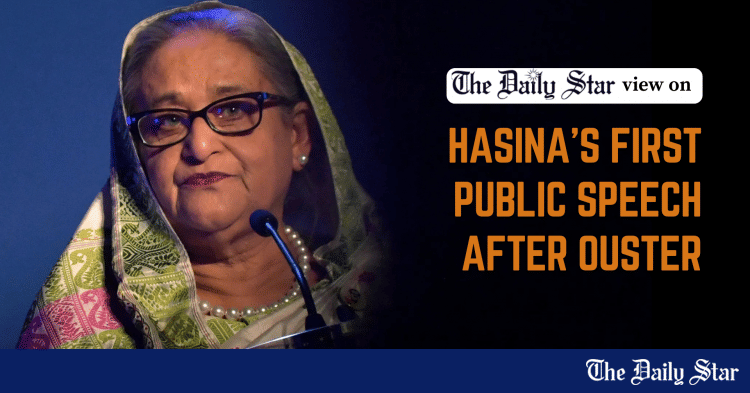
We strongly oppose the false narrative propagated by former Prime Minister Sheikh Hasina in her first public appearance—a virtual address at an event in New York—since fleeing Bangladesh following the July mass uprising. Her accusation that Chief Adviser Prof Muhammad Yunus is involved in perpetrating "genocide" clearly demonstrates that she is speaking from a place of vengeance, in total disregard for facts. In reality, it is Hasina who stands accused of being involved in mass murder during the uprising, along with numerous other grievous human rights violations committed during her 15 years of fascistic rule, for which there is substantial evidence. In her pursuit of vengeance against Prof Yunus, she has not only vilified him but also tarnished Bangladesh's image.

For instance, in her virtual address, she falsely claimed that Hindus, Buddhists, and Christians have been persecuted in large numbers in Bangladesh since her government was ousted. This blatant lie, initially spread on social media, is now being amplified in a coordinated effort by certain sections of the Indian media and political class. Echoing the narrative of those who have been systematically demonising Bangladesh recently, Hasina falsely claimed that Chinmoy Krishna Das, the former ISKCON leader, was arrested in response to Hindus protesting their persecution in the country. Ironically, many communal incidents occurred during her own rule which she failed to prevent or acknowledge.

Furthermore, Hasina stated that she had left the country to prevent further bloodshed when protesters were heading towards Ganabhaban. However, as this and other media outlets then reported, until her final moments in office, she made every effort to cling to power through the use of even more force, at the cost of spilling more blood. This was only prevented when the army refused to fire on the citizens.

Given the seriousness of the crimes she is accused of committing, we are disappointed that the Indian government, which gave her shelter, did not do more to prevent her from propagating such false narratives against Bangladesh's current government that emerged from a popular uprising. Moreover, the fact that her campaign to demonise Bangladesh is increasingly aligning with right-wing Indian media raises questions about whether India truly seeks "stable and constructive relations" with Bangladesh, as the Indian high commissioner recently asserted. This is particularly concerning given the ample evidence—such as leaked recordings of her phone calls—suggesting that Hasina has been trying to instigate and destabilise Bangladesh from New Delhi. In response, the Bangladeshi government—including its chief adviser—requested that its Indian counterpart prevent Hasina from carrying out such disruptive activities.

Yet, ignoring Bangladesh's request, the Indian government has not taken any substantial steps to dissuade the deposed former prime minister from spewing hateful rhetoric against Bangladesh. By doing so, how is India helping our bilateral relations? India should carefully consider how such decisions will affect its relationship with Bangladesh. We also hope the Indian media, instead of repeating Hasina's lies, portrays Bangladesh accurately in order to prevent harm to the relations between the two countries.​
 

ICT bans publication of Hasina’s hate speech
M Moneruzzaman 05 December, 2024, 14:21

1733446813474.webp


The International Crimes Tribunal on Thursday asked the government to ban the broadcasting and publication of any ‘hate speech’ or ‘incitement’ allegedly made by deposed prime minister Sheikh Hasina, who fled to India amid the student-people uprising on August 5.

The order followed Hasina’s implication in a filed on charges of crimes against humanity for over 1,500 murders and scores of injuries in indiscriminate firing, torture and other atrocities during the July-August uprising.

The tribunal of Justice Md Golam Mortuza Mozumder, Justice Md Shofiul Alam Mahmood and retired district judge Md Mohitul Haq Anam Chowdhury passed the order after hearing a petition filed by chief prosecutor Md Tajul Islam.

The tribunal asked its registrar to immediately notify the secretaries of the ministries of information and broadcasting and information and communication technology as well as the Bangladesh Telecommunication Regulatory Commission chairman to enforce the order.

It also asked the respondents to ensure the removal of all inflammatory content linked to Hasina from print, electronic and social media platforms.

The tribunal also took note of reported leaked telephone conversations between Hasina, also the Awami League president, and her party leaders that went viral on social media and were widely circulated in the press.

In the leaked conversations, Hasina reportedly asked AL leaders to hold rallies displaying images of US president-elect Donald Trump and urged her supporters to retaliate against those who reportedly attacked the homes of AL members.

Prosecutor Tamim Gazi Monwar Hossain argued that these statements met the criteria for hate speech as outlined in the United Nations’ Rabat Plan of Action.

The framework proposes a six-point threshold test, considers elements such as the context, speaker, intent, content, reach, and likelihood, including imminence, to determine whether an expression qualifies as criminal incitement.

Tamim emphasised that Hasina’s statements clearly fell within the parameters of incitement as defined by the Rabat Principles.

Tamim warned that Hasina’s rhetoric could obstruct the ongoing investigation into allegations of crimes against humanity and jeopardise the safety of witnesses and victims connected to the case.

The case accuses Hasina and her affiliates of orchestrating violence during the July-August movement, resulting in widespread deaths, injuries, and destruction.

The prosecution filed the application seeking ban on publication of Hasina’s speech following an amendment to section 23A of the amended International Crimes (Tribunals) Act ICT mandating tribunals to ‘take all necessary measures’ to ensure the safety, security, and well-being of witnesses providing testimony or evidence in proceedings under the act.

Section 23(2)(B) further empowers the tribunals to ‘order any protective measures deemed necessary to safeguard victims,’ either on their own initiative or upon a request from the prosecution or the victims.

On November 12, the tribunal directed the inspector general of police to request the Interpol to issue red notices for the arrest of Hasina and several of her associates.

Hasina, along with 46 cabinet members, party leaders and associates, faces arrest orders issued by the tribunal on October 17.

Chief prosecutor Md Tajul Islam informed the tribunal that steps were under way to secure Interpol assistance and a red notice would be sent to Hasina.​
 

Statements of a former PM from India ‘creating tension’
Says environment adviser after Indian delegation meets chief adviser

1733789963861.webp

Photo: Collected

Environment Adviser to the interim government Syeda Rizwana Hasan today said Bangladesh has expressed its "unease" to India about statements made by a former Bangladesh prime minister from that country aiming at "creating tension".

"We made our position on this issue very clear," she said while briefing journalists on the outcome of a meeting between Chief Adviser Prof Muhammad Yunus and Indian External Affairs Secretary Vikram Misri in Dhaka.

India, on their part, reiterated their interest in strengthening and advancing relations with Bangladesh, she added.

The Indian delegation also clarified that their government is not responsible for the activities of certain media outlets or organisations spreading misleading narratives about Bangladesh, she further said.

Rizwana said India assured Bangladesh of their commitment to increasing the issuance of visas to Bangladeshis.

Regarding the recent attack on the Bangladesh mission in Agartala, she said India expressed regret over the incident after Dhaka protested.

"Since they have now expressed a commitment to advancing bilateral relations with the interim government, we are assuming that their earlier regret remains consistent."

On the issue of Sheikh Hasina, Rizwana said there were no new discussions about her extradition from India.

On propaganda against Bangladesh, she said the Indian government reiterated that such activities are not supported or endorsed by their administration.

Rizwana said in the meeting with the chief adviser, both sides emphasised their eagerness to strengthen bilateral relations.

India closely monitored the events of July and August in Bangladesh and expressed their awareness of the situation, she said.

From Bangladesh's side, the government reiterated its desire to see SAARC play a stronger role and emphasised the importance of regional cooperation within BIMSTEC, she added.

Additionally, Bangladesh raised concerns about the ongoing misinformation campaigns aimed at damaging Bangladesh's reputation as a nation of harmony, she further said.​
 

India denies giving any facility to Hasina for political activities
Staff Correspondent 12 December, 2024, 15:38

1734053705441.webp

Indian foreign secretary Vikram Misri. | UNB photo

Indian foreign secretary Vikram Misri told a parliamentary committee that Sheikh Hasina was using ‘private communication devices’ to make her comments and India was not involved in providing her with any platform or facility that enabled her to carry out her political activity from Indian soil.

He made the comments in his briefing to the Parliamentary Standing Committee on External Affairs on his recent visit to Bangladesh, which was the first-high profile visit from New Delhi to Dhaka since Hasina’s downfall, Indian media reported on Wednesday.

He also told the panel that an early national election in Bangladesh was also expected, the Hindu reported.

It reported that Vikram described Hasina’s criticism of the interim government of Bangladesh as a pinprick and that India did not endorse deposed prime minister Sheikh Hasina.

Vikram Misri told the parliamentary committee that Hasina was present in India in line with its culture and civilisational ethos of protecting friends, reported Indian Express.

Vikram made the comment when the parliamentary body sought to know the status of Hasina in India, where the deposed prime minister of Bangladesh went on August 5 fleeing a student-people uprising against her misrule of 15 years.

Most of the Indian media reports on Vikram’s briefing tsaid that his reply to the question of Hasina’s status was either not known or that he avoided replying.

Diplomatic tension between the two neighbouring countries recently ran high. India is accused by protesters in Bangladesh of acting like a big brother, taking advantage of Bangladesh by its sheer size.

The Hindu reported Vikram saying that India did not view the relation with Bangladesh as one based on ‘reciprocity’ but as one that was grounded on ‘good neighbourly relationship.’

Vikram also informed the committee that the issue of review of bilateral treaties did not feature in his conversation with chief adviser Yunus, the Hindu said.

Vikram said that India was concerned about the lack of acknowledgement of the alleged incidents of violence against minority communities but welcomed the latest report that authorities in Bangladesh had arrested 88 people related to the violence against minorities after the fall of the Hasina government, the Hindu reported.

For India, he said, the Bangladesh authorities’ decision to release many of the convicted ‘terrorists’ who indulged in anti-India rhetoric, remained an issue of deep concern. The Bangladesh authorities, meanwhile, flagged the ‘disinformation’ campaign in the Indian press about the events unfolding in that country.

Some parliamentary committee members raised the arrest of ISKCON monks in Bangladesh, the Hindu reported, but Vikram made no reply.

Vikram, however, told the committee that during his visit to Dhaka, he informed the authorities there that there had to be an ‘acknowledgment’ of the incidents of attacks on temples and the Indira Gandhi Cultural Centre.

He said that while there was an attempt by the interim government of Bangladesh to describe the reports as exaggeration or media creation, there were ‘credible’ organisations that documented some of the incidents that required to be addressed.​
 

Awami League's participation in election depends on time: CEC
UNB
Sylhet
Published: 11 Jan 2025, 15: 05

1736642844037.webp


Chief election commissioner (CEC) AMM Nasir Uddin has said that time will determine whether the Awami League retains its registration and participates in the upcoming national election.

"Whether the Awami League maintains its registration and takes part in the election depends on time. The Election Commission is actively addressing this issue," the CEC said during a press briefing at the Sylhet Circuit House on Saturday.

He attended a views-exchange meeting with focus on voter list updates and preparations for the forthcoming national election.

When asked about the prospects of holding all local government elections simultaneously, the CEC refrained from making a specific comment. "It is not feasible to organise all elections on the same day," he noted.

Highlighting the election process, the CEC ruled out the use of electronic voting machines (EVMs) in the upcoming polls. "No EVMs will be used in the national election. We are committed to conducting the polls as per the timeline set by the chief adviser, adhering strictly to prescribed guidelines," he said.

The CEC also announced that expatriates will, for the first time, be able to cast their votes in the national election.

The meeting in Sylhet was attended by election officials and stakeholders, who discussed strategies to ensure a transparent and timely electoral process.​
 

AL won’t be allowed to hold protests’
CA’s press secy says it must apologise first, its leadership tried

1738191561094.webp

Photo: Screengrab

Chief Adviser's Press Secretary Shafiqul Alam has said the Awami League will not be allowed to demonstrate until it apologises and its leadership faces trial for the killings during the July uprising.

He made the comments yesterday, a day after the AL announced on Facebook that it would begin from February 1 a nine-day programme that includes hartals and blockades in protest at what it said were rising prices of essentials, deteriorating law and order, and killings of leaders and activists.

"Does any leader or worker of the Awami League regret committing genocide? Had they begged pardon? You saw 71 children get killed and shots fired at them from helicopters. Has anyone repented or apologised for this?" Shafiqul Alam told a press conference at the Foreign Service Academy.

"Have Awami League men said, 'We do not support the killings carried out by Hasina'? We want leadership with a clean image. I don't see it. Rather, many are lying and spreading rumors and propaganda," he said.

Shafiqul also wrote on Facebook, "Unless AL apologises for these massacres, killings and blatant corruption and until its tainted leaders and activists submit to justice system and they are purged and tried over their crimes -- and until AL separates itself from its current leadership and its Fascist ideology, there is no way it will be allowed to hold protests."

The interim government will not allow any attempt to push the country towards violence, he wrote.

"Since it took over in early August, the Interim Government has not stopped or banned any lawful protests. We believe in freedom of assembly and freedom of association. One report this morning said at least 136 protests took place alone in Dhaka in the past five and a half months. Some of these protests triggered massive traffic congestion. Yet, the IG [inspector general of police] has never imposed any restrictions on the protests.

"But should we allow the Fascist Awami League party to hold protests? The video footage of July and August clearly show that AL party activists took part in the killings of peaceful protesters who included young students and minor children. The party leadership headed by Sheikh Hasina is responsible for the massacres, murders and mayhem during the July mass uprising."

He further said, Hasina established a kleptocracy and murderous regime. Under her watch, 234 billion dollars were siphoned off by her cronies, according to an independent panel. Her family is now being investigated for making billions of dollars from corrupt deals, he wrote.

He added that no country allowed a bunch of killers and corrupt gangs to make a comeback. "No country allows a reset without accountability. The interim government represents the will of the Bangladeshi people who will react to the protest by the killers. We will not allow any attempts to push the country into violence. Anyone [who] dares to hold illegal protests under the AL banner will face the full power of the law."​
 

AL announces month long programme in Feb for Yunus’ resignation
Staff Correspondent 29 January, 2025, 16:48

1738194336964.webp

File photo

The Awami League has announced a month-long demonstration, including leaflet distribution, protest rallies and processions, blockades, and general strike throughout February demanding the resignation of interim government chief adviser Professor Muhammad Yunus.

The party will distribute leaflets from February 1 to February 5, protest rallies and processions on February 6 and February 10, road blockade on February 16, and countrywide dawn to dusk general strike on February 18, the AL shared the information in a post on its verified Facebook page Tuesday night.

The AL which was ousted from power amid a student-led mass uprising on August 5, 2024 announced the month-long protest programme at a time when most of the party’s senior leaders are either in jail or in hiding.

Terming the interim government as ‘illegal and unconstitutional’, the AL in the Facebook post claimed that they would protest against the attack on religious and national minorities, skyrocketing prices of essential commodities, arrest of several thousand AL leaders and activists, and murders and enforced disappearances, and demanding the release of all political prisoners.

The Bangladesh Chhatra League, the student wing of the AL, in line with the AL programme, also announced a month-long demonstration in February demanding the ‘resignation of Yunus for restoring democracy’.

The programme of the banned student organisation was announced in a press release signed by BCL president Saddam Hossain and general secretary Sheikh Wali Asif Enan on Wednesday.

The programmes include leaflet distribution from February 1 to February 5, protest rallies and processions on February 6, protest rally on February 10, roadway, railway, waterway, airway and port blockade on February 16, and dawn to dusk strike on February 18.

The chief adviser’s press secretary, Shafiqul Alam, said on Wednesday that the AL won’t be allowed to hold any programme until ensuring justice for July-August killings.

‘They [AL] will have to offer an apology to the nation for the killings,’ said Shafiqul, addressing a press conference in the Foreign Service Academy in the city on Wednesday.

He said that the interim government represented the people of Bangladesh.

‘We will not allow any attempts to push the country into violence. If killers hold any protest or rally, the country’s people will reply then in a hard way,’ he added.

He said that the AL would have to face trial for mass killings and offer apology for mass killings if the party wanted to continue politics in Bangladesh.

Asked why AL leaders at the grassroots would not be allowed to do politics as the party high-ups were responsible for the killings, he wanted to know whether any of the leaders uttered a sentence saying that they did not accept killings as per Sheikh Hasina’s direction.

‘Not a single person told this. Rather, many of them tell lies and spread rumor,’ Shafiqul added.

Professor Yunus-led interim government took power on August 8, 2024, three days after the ouster of the AL regime and the overthrown prime minister Sheikh Hasina’s fleeing to India on August 5, 2024.

According to the latest government data, 834 people were killed in the July-August uprising.

AL came to power in 2009 through a general election.

In the 2014 general election, the AL won and formed government again but the election was criticised as a farcical election as 153 AL candidates won uncontested and major political parties including the Bangladesh Nationalist Party did not join the polls.

In 2018, the AL won the general elections again amid allegations of overnight rigging and ballot stuffing ahead of the polls.

In 2024, the AL won once another in a rigged general election, also marred by low turnout and boycott by major opposition political parties, including the BNP.​
 

Hasnat warns media against airing Hasina’s speech
Vows to free Bangladesh from the 'pilgrimage site of fascism'

1738795071429.webp

Hasnat Abdullah. File photo

Hasnat Abdullah, convener of Students Against Discrimination, warned media outlets against broadcasting Sheikh Hasina's speech today, saying it would be seen as facilitating her agenda.

"Even now, we see hesitation in naming the real perpetrators. Some media still refer to her as a 'former prime minister' -- is she just a former leader, or is she the 'Butcher of this Motherland'?" Hasnat said addressing the media.

He said this at a press conference today held at the office of the Students Against Discrimination in the capital's Banglamotor.

Jatiya Nagorik Committee and the Students Against Discrimination arranged the press conference regarding the launch of a public opinion campaign titled "New Bangladesh Through Your Eyes".

Terming Sheikh Hasina as the "butcher" of Bangladesh, Hasnat said, "She killed 2,000 people to hold onto power. Yet, the media does not call her a fascist murderer. If you fail to do so, you are still keeping alive the pro-Awami media structure."

He further warned that there would be no rehabilitation of Hasina or fascism in Bangladesh.

"If any media outlet broadcasts Hasina's speech, it will be assumed that they are still facilitating her and have taken a stance against the aspirations of the people," added Hasnat.

He added that the mass uprising occurred because the people rejected the old order of so-called civility.

"After August 5, Sheikh Hasina and the Chhatra League men are no longer relevant in the country. If they were, they wouldn't have had to flee that day," said Hasnat.

Later, Hasnat Abdullah posted a cryptic message on his Facebook page, "Tonight, Bangladesh will get rid of the pilgrimage site of fascism."

Meanwhile, Students Against Discrimination, on its verified Facebook page, said, "If any statement of murderer, mass killer and fascist Hasina is broadcast, that media will have to take the consequences."​
 

Awami League protests: A comeback or a cry for relevance?

1738795913747.webp

VISUAL: SALMAN SAKIB SHAHRYAR

The Awami League, once the most dominant political force in Bangladesh, now finds itself in an unfamiliar and precarious situation. Its leadership has fractured following its disgraced fall from power on August 5, 2024 in the face of the student-led mass uprising. The party is now attempting to find its footing again through a month-long protest programme. This raises a critical question: is the Awami League truly interested in working its way to democracy, or is it merely struggling to survive?

Awami League's current predicament is largely of its own making. The party, which once led the country's liberation struggle and positioned itself as a beacon of democracy, gradually turned into an authoritarian entity. Over the past decade, allegations of election manipulation, political repression and corruption eroded its credibility. The parliamentary elections in 2014, 2018 and 2024 were all marred by accusations of vote-rigging. Only a few months after the 2024 election, a mass uprising—which grew from a protest by students against the reinstatement of the quota system in government service—forced Sheikh Hasina's government out of power. This ouster was not just a shift in governance, it was a clear rejection by the people of the party's undemocratic practices and governance failures.

However, the party appears to have learnt little from its downfall. Its leaflet recently distributed to justify its protest movement offers little evidence of introspection or reform. The rhetoric remains unchanged, reflecting an outdated political mindset that fails to address the new realities in Bangladesh. There is a conspicuous absence of acknowledgement of the public grievances that led to its downfall, including the deaths of protesters during the July-August uprising. Instead of expressing condolences or seeking justice for those who lost their lives, the party remains focused on reclaiming power without addressing its past transgressions.

The hypocrisy in Awami League's protests is evident. The very tactics it now condemns—mass arrests, suppression of dissent, and human rights abuses—were once cornerstones of its own governance strategy. When it was in power, Awami League showed little tolerance for opposition protests, often employing law enforcement agencies to suppress them. Now, finding itself on the receiving end of a similar treatment, it suddenly seeks to champion democratic rights. This selective outrage raises suspicions about the party's true intentions.

Meanwhile, the interim government led by Chief Adviser Prof Muhammad Yunus has taken a firm stance, refusing to allow Awami League to hold demonstrations unless it takes responsibility for the human rights violations committed under its rule. The government insists that the party must first seek public forgiveness before re-entering mainstream politics. While some may claim this approach as being harsh, it underscores the need for accountability and political reform in Bangladesh.

The Awami League's month-long protest includes demonstrations, strikes and blockades, citing grievances such as the arrest of its leaders, economic instability, and alleged human rights violations under the interim government. Even if some of these issues were valid, the party's selective outrage diminishes its credibility. It must recognise that its own governance was rife with economic mismanagement, suppression of free speech, and political violence.

The party's continued denial of public sentiment only worsens its predicament. Rather than acknowledging the people's movement as a legitimate expression of frustration, it continues to frame it as a conspiracy. This deep-seated tendency to dismiss opposition as foreign or domestic sabotage was one of the key reasons it became so isolated from the people of the country. The fact that the Awami League has not shifted from this stance suggests either a deliberate refusal to change or a complete failure to grasp the current reality. If this trend persists, it will be increasingly difficult for the party to re-enter Bangladesh's political mainstream in future.

If the Awami League wishes to regain credibility, it must first embark on a process of genuine self-reflection and reform. This means acknowledging past mistakes, removing corrupt elements, and rebuilding trust with the people it once alienated. Without these fundamental changes, its current movement risks being seen as nothing more than a desperate attempt to gain some relevance.

The responsibility of addressing Awami League's misdeeds does not solely rest on the interim government. The political opposition must also rise to the occasion by mobilising public support through democratic means, rather than relying on government crackdowns to sideline Awami League. True political change in Bangladesh will come not through suppression, but through the people's mandate.

Ultimately, Awami League's protests reflect a party grappling with its own political survival rather than a genuine struggle for democracy. Unless it undergoes a sincere transformation, it will remain trapped in a cycle of political irrelevance, unable to reclaim the trust of the Bangladeshi people.

Mohammad Al-Masum Molla is a journalist at The Daily Star.​
 

Fugitive party trying to destabilise Bangladesh: Yunus
United News of Bangladesh . Dhaka 03 March, 2025, 14:19

1741048812501.webp

Professor Muhammad Yunus.

‘No alternative to strong Bangladesh-India good ties’

Chief adviser Professor Muhammad Yunus said that a fugitive party was making every effort to unsettle Bangladesh.

‘A fugitive party has left the country, or its leadership is no longer here. They are making every effort to destabilise the situation [law and order],’ he told BBC Bangla in an interview published on Monday.

Highlighting historical close ties, Professor Yunus said that there was no alternative to maintaining a good relationship between Bangladesh and India, as there had been some clouds in the relations that mainly came through propaganda.

When asked whether there was any possibility of independence and sovereignty being at risk, citing the army chief’s recent statement that Bangladesh’s independence and sovereignty could be threatened if everyone could not work together, he said that the risk always existed. ‘This threat is constant—it exists at every moment, in every place.’

Replying to another question whether he was referring to the ousted Awami League as the threat, Yunus said that he referred completely.

‘That is obvious! They are frequently making announcements, giving speeches, addressing the public. We all hear it. People are getting agitated. They are making public addresses, calling on people to rise, to take action. They are announcing programmes—hartals, protests and so on,’ he continued.

‘How do you think people will interpret this? Do you think everything will settle down peacefully just like that?’ asked the chief adviser.

About Bangladesh-India relationship, he said that some conflicts had been seen in the midway. These clouds mostly came through propaganda.

Yunus said that the relations between the two neighbours were in very good shape and there had been ‘no deterioration’.

The chief adviser said that he had always explained that the relations between Bangladesh and India were so deep, the relationship was in good shape then and it would remain good in the future.

‘There is no alternative to maintain good relations between the two countries. The relationship between Bangladesh and India is historically, politically and economically are very close and they cannot deviate from this,’ he said.

Yunus spoke about the law and order situation, reforms and elections, the formation of a new student leadership party, and political developments during the nearly seven months of the interim government under his leadership.​
 

Students, locals intercept AL-BCL procession in Dhanmondi
Three people belonging to AL, Jubo Mohila League, BCL detained

1742689673635.webp

Dhanmondi 27. Image: Google Maps

Students and locals obstructed a procession of the Awami League and its affiliated organisations in the capital's Dhanmondi 27 area this evening.

They detained three people before handing them over to police.

The detainees are Laboni, 28, an activist of Jubo Mohila League, Sirajul, an AL activist, and Raju, 28, a BCL activist.

DMP Additional Deputy Commissioner (Mohammadpur Zone) Jewel Rana told The Daily Star that Mohammadpur police, with the help of students and public, detained three individuals from the AL procession.

He said around 40-50 AL and BCL activists brought out the procession after iftar. Students and locals stopped them and detained three individuals and handed them over to police.

Police are interrogating the detainees to find out why they organised a procession with the members of banned organisation BCL.

In a video on social media, it could be seen that at least 40-50 people participated in the procession, chanting "Joy Bangla".

In another video, locals were seen allegedly assaulting two of the detainees.​
 

Police preserve right to use force if Awami League takes to streets: NCP
Staff Correspondent
Dhaka
Published: 22 Mar 2025, 22: 14

1742689993169.webp

National Citizen Party holds a a press conference at the party’s head office in Dhaka on 22 March 2024.Suvra Kanti Das

National Citizen Party (NCP) on Saturday said the Awami League is clearly an anti-state force and agent of India, and if they take to streets they would do so to destabilise the country, and in that case police will have the right to use force on them.

NCP’s reform coordination committee coordinator and joint convener Sarwar Tushar said this in reply to queries from journalists at a press conference at the party’s head office in Dhaka on Saturday.

The NCP held the press conference as they will submit their primary reform proposal to the National Consensus Commission on Sunday.

The party proposed to lower the election candidate’s age limit to 23 and voter’s age limit to 16 years.

Replying to a query on what would happen if Awami League starts a movement, Sarwar Tushar said, “Awami League will not wage a movement. What they would do, we will not call it a movement. There is a definition of movement in a democratic state. We call it a movement that is waged to press home various demands.”

“Awami League is clearly an anti-state force and an agent of India, and if they take to streets we would not call it a movement. They will wage movement to destabilise the country. In that case the police have the right to use force," he added.

NCP said they are likely to sit with the National Consensus Commission after Eid-ul-Fitr on their proposals.​
 

Joy visits India to meet Hasina
New Age Desk 12 June, 2025, 00:22 Wellness retreats

1749774316979.webp

Sajeeb Wazed Joy

Former prime minister Sheikh Hasina’s US-based son, Sajeeb Wazed Joy, is in India to meet his mother, people familiar with the matter said on Tuesday, reports Hindustan Times.

Wazed, who has emerged as a key voice for the Awami League party, arrived in the country ahead of Eid-ul-Adha in order to celebrate the festival with his mother, currently living in self-exile in New Delhi, the people said.

Hasina fled to India after the dramatic collapse of the Awami League government in the face of nationwide protests led by student groups last August. She is currently living in a safe house in the heart of the Indian capital.

There was no word from Indian officials on the visit by Wazed, an American citizen.

‘Hasina’s son is visiting India primarily to celebrate Eid with his mother. He is the first visitor she has received since she arrived in India in August last year,’ a person close to the Awami League said.

The people said there are currently no plans for Wazed to participate in any public events.

Details of his itinerary too are not known, they said.​
 

22 arrested over secret meeting of BCL, AL in Bashundhara, Army officer under interrogation
FE ONLINE DESK

Published :
Jul 31, 2025 22:35
Updated :
Jul 31, 2025 22:35

1754007458088.webp


Police have arrested 22 members of the banned Chhatra League, Awami League, and its affiliates over a secret meeting held at a convention centre near Dhaka’s Bashundhara Residential Area.

The event, reportedly attended by 300–400 people, included anti-government slogans and alleged plans to mobilise nationwide protests under the direction of former Prime Minister Sheikh Hasina, as per local agency reports.

A Major of the Bangladesh Army linked to the meeting is currently in military custody and being interrogated. Authorities say training for subversive acts was conducted at the event.

The convention centre’s manager has also been arrested for disabling CCTV footage. The Detective Branch is investigating under the Anti-Terrorism Act, and efforts to identify and detain all conspirators involved in the plot are ongoing.​
 

Maj Sadique in custody for alleged training of AL activists: Army

UNB
Published: 31 Jul 2025, 22: 33

1754010657751.webp

Brigadier General Md Nazim-Ud-Daula, Director of Military Operations at Army Headquarters, briefs on Thursday at Officers’ Mess ‘A’ in Dhaka Cantonment. UNB

Bangladesh Army has taken Major Sadique into custody following a claim that surfaced recently on social media and various news platforms that he was involved in providing training to Awami League activists.

Brigadier General Md Nazim-Ud-Daula, Director of Military Operations at Army Headquarters, disclosed this at a press briefing held on Thursday at Officers’ Mess ‘A’ in Dhaka Cantonment.

“The issue involving Major Sadique has come to our attention. While the matter is still under investigation, I can confirm that he is currently in Army’s custody,” said Brig Gen Nazim replying to a question.

“If the investigation proves his involvement, action will be taken against him in accordance with the existing regulations of the army. Since the investigation is going on, it would not be appropriate to comment further at this moment,” he added.

About the situation in the Chattogram Hill Tracts, he said various groups, including the UPDF and JSS are often engaged in clashes over territorial dominance and extortion.

“This is nothing new. These groups regularly attempt to expand their influence, which leads to frequent conflicts. The army is working with utmost effort to keep the situation under control,” Brig Gen Nazim said.

He said the army alone is not the only stakeholder in the region. “Civil administration, police and others are all part of it. If we can all work together, I believe the situation can be brought under further control, and that is essential.”

When asked about the KNF (Kuki-Chin National Front), which is reportedly sourcing weapons from the Arakan Army, and attempting to expand influence, Brig Gen Nazim said, “It is not surprising that there is a connection between KNF and Arakan Army, given their ethnic and ideological similarities.”

He said KNF has failed to establish any dominance despite some logistical changes. Their influence has diminished considerably.

“Earlier, clashes with KNF resulted in the deaths of eight army personnel and many injuries. But in recent months, such incidents have notably decreased,” he said, adding that many KNF members were killed or injured in recent operations and several of their bases were destroyed.

“KNF is now in a vulnerable state. We strongly believe that with collective efforts, it is possible – and necessary – to uproot the KNF completely. In a sovereign country, the dominance of any armed group is unacceptable,” he said.​
 

Govt monitoring what AL doing from outside Bangladesh: Press Secretary

UNB
Published :
Aug 10, 2025 17:37
Updated :
Aug 10, 2025 17:37

1754873286276.webp


Chief Adviser's Press Secretary Shafiqul Alam on Sunday said they are monitoring what the Awami League is doing from outside the country, as its activities are banned in the country.

"You know their activities are banned in Bangladesh. Definitely, we are monitoring what they are doing from outside the country," he said while responding to a question regarding AL's party office in Kolkata, as reported by BBC Bangla recently.

The Press Secretary said they are looking into their activities to know whether they want to "create any instability" in the country.

"We will be able to know if we can gather concrete information," Alam said during a media briefing at the Foreign Service Academy in the capital.

Chief Adviser's Deputy Press Secretary Abul Kalam Azad Majumder and Director General (Public Diplomacy) at the Ministry of Foreign Affairs Shah Asif Rahman were present at the media briefing which was arranged to highlight Chief Adviser Prof Muhammad Yunus' engagements in Malaysia from August 11-13.

In the bustling outskirts of Kolkata, a commercial complex has begun drawing unfamiliar visitors for the last few months.

According to a BBC Bangla report, the Awami League has set up a "party office" on the 8th floor of this complex.

In May this year, the interim government issued a gazette notification banning all activities of the Bangladesh Awami League and its affiliated organisations under the Anti-Terrorism Act until the International Crimes Tribunal (ICT) completes the trial of the party's leaders and activists.

According to the notification, all activities of the Awami League and its affiliated and like-minded organisations are prohibited until the ICT concludes the trial against their leaders and activists.

The notification mentioned that any form of publication, media engagement, online and social media campaigns, rallies, meetings, assemblies, and conferences organised by the Awami League or any of its affiliated bodies are strictly prohibited.

Earlier, in a special meeting, the Council of Advisers decided to ban all activities of the Awami League - including in cyberspace - under the Anti-Terrorism Act until the conclusion of the trial by the International Crimes Tribunal.

Law Adviser Dr Asif Nazrul said the decision was taken to safeguard the country's security and sovereignty, ensure the safety of the leaders and activists of the July movement, and protect the plaintiffs and witnesses involved in the tribunal proceedings.​
 
Awami League has little future in Bangladesh politics: Shafiqul Alam

Correspondent Magura
Updated: 02 Jan 2026, 18: 00

1767402227902.webp


Press secretary to the chief adviser of the interim government, Shafiqul Alam speaks to the media after visiting the Nitai Gaur Gopal Sebashram under the Magura pourashava in Magura town on 2 January 2026 Prothom Alo

Press secretary to the chief adviser of the interim government, Shafiqul Alam has said that he sees little future for the Awami League (AL) politics in Bangladesh, adding that the party no longer enjoys public acceptance.

He made the remarks while responding to questions from journalists in his home district of Magura on Friday morning.

Earlier in the day, he visited the Nitai Gaur Gopal Sebashram under the Magura pourashava.


Replying to a question about the future of the politics of the Awami League, Shafiqul Alam said, “When people make mistakes, they apologise or express remorse. We all make mistakes. But even after 17 long months, the party has not expressed any regret for the large number of killings and enforced disappearances committed under its watch. They have not even spoken about remaining peaceful.”

Commenting further on the AL, he said, “From abroad, the party’s leaders and activists are instead spreading misinformation. They are claiming that 3,000 police officers were killed, which is not realistic.”

“They are also attempting to portray millions of students who took part in the movement as ‘terrorists’ before the international community, in order to legitimise the killings carried out against them. Because of such actions, the people of Bangladesh will no longer accept them,” he stated.

Asked whether the AL could still take part in the election, Shafiqul Alam said, “Even if they now come forward and admit their mistakes or say ‘sorry’, it has no value. The time has passed, and the opportunity for their nomination no longer exists.”

He also responded to a question on the credibility of the upcoming 13th national parliamentary election if the Awami League does not participate.

“There is no such perception among the general public that the election would become meaningless if the Awami League does not take part. On the contrary, people are eagerly waiting for the election,” the press secretary said.

According to him, “If a political party takes up arms and uses them against young students, carries out enforced disappearances, killings and mass murder, then no civilised country in the world considers it a democratic party. Actually, the Awami League has declared itself unfit to contest elections.”

Addressing journalists directly, Shafiqul Alam said, “You yourselves saw what happened in Magura in August. Alongside leaders of the (Bangladesh) Chhatra League and Jubo League, even the father of the local MP, Shakib Al Hasan, came out with weapons. Two students were killed by gunfire in Magura town. After that, can the Awami League still claim any moral legitimacy to engage in politics?”

In response to another question, Shafiqul Alam said that once the interim government’s tenure ends, he would like to return to journalism.

After visiting the Nitai Gaur Gopal Sebashram in the morning, he later went to his ancestral home in Sreepur.​
 

AL can’t do politics until it admits mistakes: TIB
Staff Correspondent 10 February, 2026, 14:28

1770773643081.webp


Transparency International Bangladesh executive director Iftekharuzzaman on Tuesday said that the Awami League could not expect to return to meaningful political participation without admitting its mistakes and expressing remorse.Bangladesh cultural tours

Responding to a journalist’s question at a briefing on the release of the TI Corruption Perceptions Index report 2025, Iftekharuzzaman questioned the narrative of ‘inclusive elections’, adding that the AL had already chosen a clear position to stay outside the electoral process.

‘The party has openly declared an anti-election position. If a party boycotts an election on its own, how can it then be included?’

He also challenged the claims that Bangladesh lacked inclusive elections only now, asking why such concerns were not strongly raised over the past 16 years.

‘When we talk about inclusive elections today, we must ask what we did in the past 16 years,’ he said.

‘How many institutions or individuals had the courage to say at those times that elections were not inclusive?,’ he asked.

Iftekharuzzaman alleged that while the AL was officially boycotting the polls it was still influencing the electoral environment indirectly. ‘They are trying to obstruct the election by ways of violence and instability,’ he observed.

‘This is happening through their supporters, agents at home and abroad, and in some cases with encouragement from sheltering countries.’

He further claimed that many AL voters had already cast their votes while in jail, raising questions about the party’s real stance on electoral participation.

At the grassroots level, he said, AL leaders and activists are not contesting elections under the party banner but are instead joining or campaigning for other political parties.

Iftekharuzzaman stressed that no one else could restore the AL’s political legitimacy except the party itself.

‘If the AL wants to re-establish itself politically, it must take responsibility for its actions,’ he said. ‘The current situation of the party is primarily the result of decisions taken by its own leadership.’

He added that public acceptance was still possible if the party showed accountability.

‘If they accept responsibility, express remorse, and say “we were wrong”, I think the people of this country will accept them,’ he said. ‘But whether they would choose to do that or not is entirely up to them.’​
 

Awami League open to talks with Tarique, says Joy

bdnews24.com
Published :
Feb 14, 2026 14:08
Updated :
Feb 14, 2026 14:08

1771119461429.webp


As Tarique Rahman prepares to lead a BNP government with a two-thirds majority, Sajeeb Wazed Joy says the Awami League would be willing to engage with him despite branding the Feb 12 election a “complete sham”.

In an interview with British broadcaster ITV, the son of deposed prime minister Sheikh Hasina signalled openness to dialogue with the BNP leader and said: “If he becomes prime minister -- I mean, it is a sham election -- but yes, if he becomes prime minister, then yes, of course, we will talk to him and deal with him.”

The Feb 12 vote resulted in a sweeping victory for the Bangladesh Nationalist Party (BNP), which secured 209 of 299 seats -- enough for a two-thirds majority in parliament -- while Jamaat-e-Islami emerged as the main opposition with 68 seats. The Awami League was barred from contesting.

Pressed further on whether he would personally work with Tarique, who is expected to become the next prime minister, Joy said he had “no interest in working in Bangladeshi politics whatsoeve”.

However, when asked whether he would be open to discussions aimed at improving relations between the two camps, he responded: “I am always open to it. I’m not a person who -- I’m a person who always believes in having a conversation, no matter how difficult or with whom. That is my strategy. That has always been my strategy in life.”

Joy also drew attention to what he described as inconsistencies in the treatment of convictions under successive governments.

Referring to past corruption cases against Tarique, many of which have since been overturned, he said: “You look at what’s happened, you look at Tarique Rahman -- he was convicted on evidence by the FBI. Now he’s likely to be prime minister. So these things don’t last forever.”

Asked whether he would make a plea to Tarique to dismiss charges against his own family if the BNP leader assumes office, Joy said the matter was not his to decide.

“That is not up to me. I don’t live in the country. That is really up to the party. They will decide what they want to do,” he said.

“The BNP is the other large party in Bangladesh. Of course, we should talk to them; I’ve always said that. The BNP should never have boycotted the elections.”

'COMPLETE SHAM'

Although he acknowledged the BNP’s electoral position, Joy rejected the legitimacy of the vote outright.

“[Thursday’s] election was a complete sham,” he said.

“You’ve had the largest party and all progressive parties barred from elections. You’ve had, essentially, a stage-managed election.”

He argued that banning the Awami League invalidated the process.

“How can you call an election where one of the two major political parties in the country are banned? … You cannot call that a free and fair election in any way.”

Calling the move “unprecedented”, he added: “It’s unprecedented, where a political party has been banned by a dictat from an unelected regime.”

He warned that the situation was unsustainable.

“This is not going to be sustainable. This is going to lead to more instability in the future.”

JAMAAT BAN UNDER AL 'FUNDAMENTALLY DIFFERENT'

When challenged by interviewer Mahatir Pasha that Jamaat-e-Islami had been barred from elections during the Awami League's rule, Joy rejected the comparisons.

“No, because they were banned because of a court ruling,” he said. “They were banned from participating because of a court ruling from an independent group, not from the government.”

He referred to the High Court verdict that declared Jamaat’s registration illegal, arguing that the issue lay in Jamaat’s constitution.

“The court ruled that Jamaat’s constitution, which recognises Shariah law above the Constitution of Bangladesh, conflicted with our Constitution. All Jamaat had to do was change their constitution and they could run again. There was no ban from the government on them.”

RIGGING ALLEGATIONS UNDER AL

The interviewer pressed Joy on whether his party had the moral standing to criticise elections, citing allegations of vote-rigging in the 2014, 2018 and 2024 elections.

“That’s not exactly true,” Joy said. “The last three times, the first and the third time the opposition boycotted.”

Regarding the 2018 election, he acknowledged problems but insisted they did not alter the outcome.

“If you look at the opinion polls leading up to the elections, the Americans did polling, and all the polls showed that our party would have a landslide majority. It was going to be a landslide for the Awami League.”

He conceded: “Unfortunately, the administration -- some people in the administration -- still took it upon themselves to commit irregularities. Those should have been investigated, they weren’t, but overall it wouldn’t have affected the result.”

Joy also defended the Awami League government’s security response in the lead-up to the 2014 polls, which the BNP boycotted.

“In the 2014 elections, there wasn’t a crackdown until our opposition started arson attacks on public transportation,” he said.

“Hundreds of people were burned alive in buses in arson attacks by the opposition because they chose to boycott the election. Awami League never banned anybody.”

SCEPTICAL OF OBSERVER ASSESSMENTS

The Election Commission said hundreds of international observers and foreign journalists monitored the Feb 12 polls. Asked if he would accept their verdict if they declared the election free and fair, Joy was dismissive of the process.

“You cannot accept -- I mean, again, you have a limited number of foreign observers in the country who are escorted by the regime,” he said.

“These foreign observers are not allowed to travel freely in the country, and frankly, it’s not even safe; the law and order situation is that bad. So, how much have these foreign observers really been allowed to observe?”

However, he added: “I will reserve my judgment until they make their statements.”

Returning to his central argument, he said: “If you’ve banned either the Democrats or the Republicans in the US, can you in any way call that election free and fair?”

'WITHOUT A DOUBT' MISTAKES WERE MADE

The conversation turned to the July–August 2024 student-led protests, which began over quota reforms and later escalated into a broader uprising that toppled the Awami League government on Aug 5.

Asked whether failings under his mother’s leadership contributed to her fall, Joy said: “Yes, without a doubt.”

“The protest started peacefully. They had a legitimate demand.

He argued that quotas had been reduced by the government in 2018 and later reinstated by a court ruling, which triggered renewed protests.

“Our government completely failed to communicate this; they completely failed to sit down with the student protesters,” he admitted.

But he accused Islamist groups of escalating violence.

“The Islamists, the Jamaat-e-Islami and their militant wing saw this as an opportunity to overthrow the government,” he said.

“They started the violence, and then the protest turned violent, and again, our government mishandled it; it should have never gone that far.”

DISPUTES UN FIGURE OF 1,400 DEATHS

The United Nations has estimated that around 1,400 people were killed between Jul 15 and Aug 15, 2024. Joy challenged both the figure and its attribution.

“The UN number… covers the period from the 15th of July until the 15th of August. Our government fell on the 5th of August. Yet the UN report still blames the continued killings on our government. I mean, how is that possible?” he said.

He argued that the total included police officers and Awami League activists.

“Also included in that number are police officers. There were hundreds of police officers killed, and during the protests themselves, hundreds of our activists were killed,” he said.

“We take full responsibility for the several hundred that were killed. Not 1,400, because half of those were police and our party activists.”

“Every single death is regrettable. We never wanted anyone to die.”

Asked directly whether he would apologise to families, he said: “My mother apologised to them immediately, during the protests, before our government fell. We met with them.”

He denied that Hasina had ordered lethal force against protesters.

“Lethal force was never authorised against protesters. My mother never ordered lethal force against anyone other than people attacking police, attacking other people. What else is a government supposed to do? It’s a government’s job to protect lives.”

He claimed that audio recordings suggesting otherwise were edited.

“You should listen to the full recordings… what was broadcast internationally was a little snippet taken out of context,” he said.

“In the conversation, they’re talking about militants attacking police stations. That is where lethal force was authorised.”

TULIP SIDDIQ'S RESIGNATION IN THE UK

The interview also touched on the resignation of his cousin, British MP Tulip Siddiq, who stepped down as a UK Treasury minister amid controversy linked to investigations in Bangladesh.

“She resigned to avoid embarrassment to the British government. That is the only reason,” Joy said.

He claimed British authorities had cleared her.

“The UK watchdog investigated her, they cleared her of any wrongdoings,” he said.

Asked whether it was fair that she resigned, he replied: “No, of course not. It’s not fair. I don’t think it’s fair at all.”

When asked whether the British prime minister had failed to defend her, Joy declined to comment.

“I cannot comment on British politics, unfortunately.”

'I COULD'VE BEEN PM A WHILE BACK'

The interviewer raised criticism that Bangladeshi politics has long been dominated by the families of Sheikh Mujibur Rahman and Ziaur Rahman.

“Is it dynastic politics because we choose to be in it, or is it because the grassroots keep voting for us in the party councils?” Joy responded.

Joy himself has been sentenced to five years in jail in Bangladesh. Asked when he might return, he noted he does not reside in the country.

“I don’t live in Bangladesh. I have spent a total of seven years of my entire life in Bangladesh. I’ve been settled in the US for over 30 years,” he said.

Asked directly whether he intended to go back, he replied: “Oh, I will go back at some point.”

However, he denied harbouring prime ministerial ambitions.

“No, I’ve never had political ambitions. If I had wanted to be prime minister of Bangladesh, I could have been prime minister a while back. My mother had been pushing me to run for elections… for over a decade.”

“I’ve never had a greed for power or money. I’m happy just to be comfortable.”

On whether reforms are on the agenda for the Awami League, he described the process as gradual.

“Reform is not a one-time process -- reform is a continuous ongoing process,” he said. “Over the last 10–15 years, we have had many younger leaders come up in the Awami League.”

HASINA'S EXILE, DEATH SENTENCE AND POSSIBLE RETURN

Hasina fled to India on Aug 5, 2024, as the mass uprising intensified and protesters converged on the capital, bringing an abrupt end to her 15-year rule.

Since then, she has been tried in absentia by the International Crimes Tribunal and sentenced to death for crimes against humanity linked to the violent crackdown on the July–August protests.

Hasina has remained in India under security protection, while the interim government has repeatedly sought her extradition.

Asked whether his mother would ever return to Bangladesh, Joy said he had “no doubt” she would.

“I have no doubt she will return someday,” he said.

He acknowledged, however, that the current environment makes that impossible.

“Right now, no. Not at all,” he said when asked if it was safe for her to return.

Joy expressed confidence in her safety in India and sharply criticised the legal proceedings against her in Bangladesh.

“Right now, she is in the safest place in the world that she can be,” he said. “The Indian government is providing her full security, and India has due process; the trials in Bangladesh do not anywhere near meet that standard.”

He questioned the speed and legitimacy of the judicial process that resulted in her death sentence.

“The trials against my family and my mother were completed in what, a month, month and a half?” he said, suggesting that such proceedings could not meet international standards of justice.

Despite her exile and conviction, Joy insisted that political fortunes in Bangladesh are cyclical and that the current order would not endure.

“None of this is going to last, none of this is sustainable,” he said.

He argued that the Awami League’s record in government would ultimately outweigh the circumstances of its fall.

“The one thing that is undeniable is that the 16 years of the Awami League's government, you also had the best economic development in Bangladesh’s history, the most infrastructure development, the most stability, you had the best law and order situation, and you had a complete stop to all terrorist activity,” he said.

Looking ahead, he predicted a reassessment of her legacy.

“I think within a very short time, people are going to say, well, despite all her shortcomings, the Awami League was the best government we had.”

He went further, asserting: “My mother’s time is going to be remembered in history as the best economic and security and stable time in Bangladesh’s history. I can guarantee you that.”​
 

Awami League's matter will be dealt with legally: Mirza Fakhrul Islam

Staff Correspondent
Dhaka
Published: 23 Feb 2026, 14: 09

1771850739450.webp


Mirza Fakhrul Islam Alamgir, the Secretary General of the BNP, speaks to journalists at the BNP central office in Naya Paltan in the capital. Prothom Alo

Mirza Fakhrul Islam Alamgir, the Secretary General of BNP and the Local Government Minister, stated that the issue of opening Awami League offices in various places would be addressed legally.

This statement was made by Mirza Fakhrul in response to journalists' questions at the BNP central office in Naya Paltan, Dhaka, on Monday morning.

Journalists asked about the government's stance on the opening of Awami League offices in different places.

In response, Mirza Fakhrul Islam Alamgir said, "We did not want this, and since it is legally stated that their activities are prohibited, it will be addressed in that manner everywhere."


After winning the 13th National Parliamentary Elections, it was the first time a BNP minister or senior leader visited this office.

The BNP Secretary General went to the Naya Paltan office at 10:30 AM, where the leaders and workers of the party greeted Mirza Fakhrul with flowers.

Later, while talking to journalists, Mirza Fakhrul mentioned that the most demonstrations and programmes were conducted from this BNP office in Naya Paltan, led by the late chairperson and former Prime Minister of BNP, Khaleda Zia.

Mirza Fakhrul stated that the programmes delivered from this office inspired the public.

In response to a question from journalists regarding local government elections, Mirza Fakhrul Islam Alamgir said that local government elections would be held on time following government regulations.

Mirza Fakhrul stated, "There are several governmental rules and practices. Some have a duration, and some have expired. We will consolidate them and arrange for holding these elections at the correct time from the government's side. However, priority will undoubtedly be given to these elections."

In response to a question about whom BNP will nominate for the reserved women's seats in the National Parliament, Mirza Fakhrul mentioned, "They must have connections with the people, must be connected with politics and the party. Priority will be given to those who are associated with the party on behalf of our party."​
 

Hints of activity amid ban, what Awami League is calculating
1772326807999.webp
 

Veteran AL leader Tofail Ahmed passes away
7 held after janaza at Dhanmondi

Staff Correspondent 01 June, 2026, 16:38

1780362723814.webp

Tofail Ahmed | File photo

Veteran politician and Awami League advisory council member Tofail Ahmed died while undergoing treatment at Square Hospital in Dhaka on Monday afternoon.

Tofail, 82, left behind his lone daughter to mourn his death.

‘My father breathed his last at the coronary care unit at around 3:30pm on Monday,’ Tofail’s daughter Taslima Akter Munni told New Age.

She added that her father would be buried at their family graveyard at Dakkhin Digholdi union in Bhola district today, following his second namaz-e-janaza at the Bhola Government High School ground after Zuhr prayers, where the late leader had studied.

Meanwhile, the police on Monday detained seven people after local leaders and activists of the party chanted slogan ‘Joy Bangla, Joy Bangabandhu’ when the vehicle carrying Tofail was heading towards Square Hospital.

The vehicle was going to the hospital after his first namaz-e-janaza was held at Takwa Masjid at the capital’s Dhanmondi after the Maghrib prayers.

1780362825804.webp

Police arrest several activists of Awami League, activities of which is banned, as they shout party slogan after the body of veteran politician Tofail Ahmed is brought at Taqwa Mosque at Dhanmondi for his namaz-e-janaza on Monday evening. — New Age photo

Dhanmondi police station officer-in-charge Muhammad Saiful Islam told New Age that they had detained seven people over the allegations of chanting slogans.

‘We have taken them to the police station. We are scrutinising their involvement and then we will decide the next course of action,’ the OC added.

Different sections of people, including politicians, attended the namaz-e-janaza held at Dhanmondi.

Tofail, a student leader of the Pakistan era and a prominent freedom fighter, had been suffering from prolonged illness and multiple age-related complications.

‘On September 24, at approximately 4:00pm, he was admitted to the Square Hospital with pneumonia-related respiratory distress, heart disease, and physical weakness. He was being treated under intensive care of ICU senior consultant Raihan Rabbani,’ said a press release issued by the Square Hospital Authority on Monday.

The immediate past Bangladesh interim government issued a gazette in 2025 imposing ban on all activities of the Bangladesh Awami League and its affiliated, associate, and like-minded organisations until the completion of the ongoing trial proceedings against the party’s leaders and activists at the International Crimes Tribunal.

Throughout his political career, Tofail Ahmed was elected Member of Parliament nine times — first to Pakistan’s National Assembly in 1970 and later to the Jatiya Sangsad of Bangladesh in 1973, 1986, 1991, 1996, 2008, 2014, 2018 and 2024.

He was elected a presidium member of the Awami League in 1992 and served in the position for 18 years.

In 2010, he became a member of the party’s advisory council.

Tofail Ahmed served as minister for commerce and industries from June 1996 to December 1999, and later continued as industries minister until 2001 during the AL ruling period.

From 2009 to 2013, he served as chairman of the Parliamentary Standing Committee on the industries ministry.

From January 2014 to December 2018, Tofail served as commerce minister.

Born to Azhar Ali and Fatema Khanam on October 22, 1943 at Koralia village under South Digholdi Union in Bhola district, Tofail Ahmed married Anwara Begum in 1964. She was the eldest daughter of Mofizul Haque Talukdar of Bhola town.

Tofail and Anwara’s only daughter, Taslima Akter Munni, is a physician.

Tofail Ahmed passed his matriculation examination from Bhola Government High School in 1960.

He obtained his intermediate and bachelor’s degrees in science from Brajamohan College in Barishal in 1962 and 1964 respectively.

Later, Tofail obtained a Master’s degree in soil science from the University of Dhaka.

He became actively involved in politics during his college life.

In 1962, he was elected sports secretary of the Brajamohan College Students’ Union and vice-president of the Ashwini Kumar Hostel union of the college.

During his university years, he was elected sports secretary of Iqbal Hall (now Seargent Zahurul Haque Hall) Students’ Union in 1964, vice-president of the department of soil science in 1965, and vice-president of Iqbal Hall Students’ Union in 1966-67.

Tofail Ahmed played an active role in the 1966 Six-Point Movement for autonomy of East Pakistan, led by Sheikh Mujibur Rahman, and took part in the 1969 Mass Uprising as a student leader.

He served as the vice-president of the Dhaka University Central Students’ Union – DUCSU -- from 1967 to 1969.

In 1969, Tofail was elected president of the Bangladesh Chhatra League and he joined the Awami League on June 2, 1970.

In the 1970 Pakistan general election, Tofail Ahmed was elected a member of the National Assembly for the Daulatkhan-Tazumuddin-Manpura constituency of Bhola at the age of 27.

During the 1971 War of Independence, he was one of the four regional commanders of the Mujib Bahini.

He was responsible for the western zone of the force, which included the districts of Barishal, Patuakhali, Khulna, Faridpur, Jessore, Kushtia, and Pabna.

After the country’s independence, Tofail took part in the constitution-drafting process for Bangladesh in 1972.

On January 14, 1972, he was appointed political secretary to prime minister Sheikh Mujibur Rahman with the status of a state minister and remained in the post until January 25, 1975.

After the introduction of the presidential form of government in Bangladesh on January 25, 1975, he was appointed special assistant to the president with the rank of state minister.

Later that year, when the Bangladesh Krishak Sramik Awami League – BAKSAL -- was formed by integrating all the country’s political parties, Tofail became general secretary of its youth wing, Jatiya Jubo League.

Following the assassination of Sheikh Mujibur Rahman on August 15, 1975, Tofail Ahmed was first placed under house arrest and later arrested on September 6.

While detained in Kushtia jail in 1978, he was elected organising secretary of the Awami League.

During the military-backed caretaker government in 2007, Tofail Ahmed was among the Awami League leaders who supported reform proposals that included the removal of party chief Sheikh Hasina from the leadership.

However, after the Awami League returned to power following the 2008 general election, he was not included in the cabinet despite being one of the party’s influential presidium members.​
 

How far has Awami League changed in the past two years

Nadim Mahmud

1780793367908.webp

The central office of Awami League in Gulistan of the capital, is in a dilapidated condition. As the party's activities are banned, there is no presence of leaders or activists there. Prothom Alo

It has been nearly two years since the mass uprising of 2024. During this long span of time, a kind of transformation has taken place across the country's political landscape as well as in the arts and cultural sphere, educational institutions, and many other areas. These are changes of a kind not seen before.

Although negative changes have outweighed positive ones amid the rise of mob culture, the possibility of a democratic path forward for the country has opened up.

As a result, many are now asking: Is Awami League, which was removed from power during the mass uprising and whose activities remain banned, making a comeback?

Whether the Awami League returns or not will depend on the party's leadership and the people of this country.

However, before a party that remains legally banned can rejoin the democratic process, we must ask how much change the party, widely labeled as authoritarian, has actually brought about within itself over the past two years. Only then can the people of this country decide whether to create a platform for its return to politics.

Before asking whether the party's popularity is declining or increasing, we need to understand how politically active the Awami League has been over the past two years.

This historic political party, the country's oldest and one that led the Liberation War, moved away over the last decade from the principles and ideals that once formed the foundation of its organisational structure.
Becoming members of parliament through elections lacking voter participation, along with the distribution of ministerial positions, effectively dismantled the party's grassroots structure.

Under a bureaucratic system of governance, the framework of political government faded away. As a result, Awami League''s period in power became marked by political alienation at the grassroots level.

Through corruption, enforced disappearances, killings, and the exercise of oligarchic power, the party became increasingly disconnected from the public, eventually facing the mass uprising of 2024. The government of Sheikh Hasina was subsequently removed from power.

The question now is whether Awami League has truly understood the reasons why it is facing the greatest crisis in its history. How much self-correction has the party actually been able to achieve?

While Awami League government was in power, reports of corruption and the accumulation of illicit wealth by the party’s members of parliament and ministers regularly appeared in newspapers.

The Awami League leadership, which failed to stop bank looters even after such reports were published, has surely now taken note of those issues.

During this period of crisis, when thousands of the party’s leaders and activists have been in jail, newspapers have reported that those accused of embezzling money have been living cushy lives abroad.

Many of those Awami League MPs and ministers who failed to stand by the party’s leaders and activists have now gone into “mute mode.” Once-powerful political figures have largely disappeared from public discussion.

For many, political careers are also coming to an end. Among the leaders who speak on online platforms, some have quietly acknowledged certain mistakes and shortcomings, but there has been little visible evidence of any significant structural change on their part.

A large segment of the younger generation had developed a negative perception of Awami League, yet there has been little in the party’s activities or rhetoric that appears aimed at improving that image.

Questions remain about how much the party has been able to cultivate leadership capable of attracting young people after its downfall. At the same time, it is worth considering how receptive young people are to political narratives built around the ideals of the Liberation War and Bangabandhu.

In the period following 1975, Awami League experienced internal divisions and organisational fractures, but during the current crisis we have not seen anything similar to that extent.

Although there has been speculation about a “refined Awami League,” the party’s leaders and activists do not appear to have responded enthusiastically to that idea. Instead, they seem intent on moving forward centered around Sheikh Hasina. This has become fairly clear.

We do not know to what extent former Prime Minister Sheikh Hasina has been able to reorganise the party’s leaders and activists, but clips of her regularly participating in virtual meetings have been circulating online.

The rhetoric in these clips still contains harsh attacks and denunciations. Alongside criticism of various irregularities of the interim government, there is also a tendency toward “settling scores” or “getting even,” which people are unlikely to view as normal or acceptable.

A wave of politics driven by revenge and retaliation is currently underway. Amid this trend, messages calling for “revenge” are being regularly communicated through social media by leaders of Awami League. This suggests that the politics of the future could become increasingly conflict-ridden.

Yet what ordinary people expect is for the party to move away from this politics of threats and intimidation. Although the failures of the interim government and the rise of mob violence may have created an opening for Awami League’s return to politics, the party still has not been able to convey a message of internal reform.

Unless the Awami League can abandon corrupt figures and looters and develop a political strategy centered on ordinary people, it will not be able to emerge from its current crisis.

Awami League must understand that a large segment of the younger generation has turned away from it, and overcoming this situation could make the party’s re-establishment in the politics of the future considerably more difficult
Since being removed from power, a noticeable change has been observed among the party’s grassroots leaders and activists. Many members who had been sidelined by influential “hybrid” leaders have come forward to support the party during this difficult period.

A large number of them had been dissatisfied with the previous leadership. Through this period of decline, the Awami League may be rediscovering its dedicated grassroots workers.

Yes, it is true that the Awami League has not been able to engage in street politics over the past two years. Since the 2024 movement, the party has not been involved in any major acts of violence.

As a result, despite rhetoric about taking revenge, the more important question is whether the party can sustain what appears to be a tendency toward creating a political arena free from bloodshed.

On the other hand, it cannot be dismissed that attacks on Liberation War memorials and incidents of persecution and harassment against the party’s leaders and activists in different parts of the country have generated a degree of public sympathy for the party. However, claiming this as evidence of growing popularity would be problematic.

The public will remain interested in whether thieves, opportunists, and corrupt individuals continue to find shelter within the party’s leadership.

Awami League must understand that a large segment of the younger generation has turned away from it, and overcoming this situation could make the party’s re-establishment in the politics of the future considerably more difficult.

How successful a new democratic journey for Awami League in Bangladesh will be, after addressing the allegations surrounding the killings of students and civilians during the 2024 movement and overcoming the legal complications stemming from the ban on its activities, will depend largely on positive changes in leadership.

The key question, however, is how much opportunity its political opponents will allow for such a process.

* Dr. Nadim Mahmud is a researcher at University of California​
 

Security beefed up to avert chaos over AL founding anniv
Army, additional police deployed, army captains and upper officers given magistracy power

Staff Correspondent 23 June, 2026, 00:00

1782174074098.webp

Police put barricade on the Dhanmondi Road 32 as security is beefed up centering the possible showdown of the activists of Awami League, activities of which are banned, on the occasion of its founding anniversary today. | New Age photo

The government has stepped up security measures across the country by deploying army and additional police personnel to forestall any untoward incidents ahead of the 77th founding anniversary of the Awami League, the activities of which have been banned.

The government has already deployed army personnel in six cities and districts — Dhaka, Chattogram, and Gazipur cities along with Narayanganj, Faridpur, and Gopalganj districts— in aid to civil administrations till June 30.

The deployment has been aimed at maintaining the law and order amid apprehension of sabotage, unlawful processions, showdowns and chaos in places across the country marking the AL founding anniversary, according to an official order issued by the home ministry on Monday.

The ministry’s order also apprehended the deterioration of the law and order in different places across the country and damage of people’s lives and properties.

The deterioration of law and order has been apprehended at a time when the Awami League and its associate bodies were bringing out processions in various places across the country, including Dhaka and Chattogram cities.

While talking to reporters at the secretariat on Monday, home minister Salahuddin Ahmed said that they had observed some misdeeds by the Awami League which tried to bring out processions in places.

‘We have deployed army personnel… in aid to civil power so that we can address any kind of subversive activity,’ he said, adding that the deployment of army and the Border Guard Bangladesh personnel in aid to civil power on occasions was a routine work.

He pointed out that the Army was withdrawn on June 15 after it served for more than one and a half years during the interim government.

Members of the armed forces were deployed in July 2024 during the Awami League regime when the country was witnessing a student-led movement against the discriminations in government job quotas.

They remained in the field throughout the interim government period to assist the civil administration.

The Police apprehended conflicts between the AL and the National Citizen Party and other political parties, according to the force.

The 11-party opposition alliance, led by the Bangladesh Jamaat-e-Islami, and the NCP chalked out programmes on Tuesday demanding punishment of AL ‘fascists’.

On Monday, the AL and its affiliated organisations took out flash processions at places amid police arrests.

The public administration ministry in another order on Monday gave magistracy power to officers -- captain and upward -- in the Armed Forces and such officers in deputation at the Bangladesh Coast Guard and the Border Guard Bangladesh from June 22 to June 30.

The BGB also deployed its members in five districts — Cox’s Bazar, Madaripur, Sherpur, Gazipur and Moulvibazar — from June 22 evening to June 30 following home ministry directives to maintain the country’s law and order and public security, said a BGB press release.

Meanwhile, the Dhaka Metropolitan Police will deploy over 18,000 police personnel, including officers, across Dhaka city on June 23 to maintain the law and order and ensure security.

Earlier, the police warned of possible clashes between AL leaders and activists and members of various political parties, particularly the National Citizen Party and Students Against Discrimination, across the country over the AL’s founding anniversary on June 23.

They said that necessary measures would be taken to prevent any untoward situation.

In a letter from the police headquarters dated June 18, the police also said that AL leaders and activists might become aggrieved if obstacles were placed in the way of the party’s activities.

‘We have increased the number of check-posts and patrolling across the country to prevent any untoward situation over the founding anniversary of a particular political party,’ the additional inspector general of police for crime and operations, Khondoker Rafiqul Islam, told New Age on Monday.

On Monday morning, AL leaders and activists brought out a procession in the capital’s Dhanmondi while the police detained 10 of them, Dhanmondi police station officer-in-charge Saiful Islam confirmed.

‘They started bringing out a procession at about 6:00am in front of the KFC outlet at Dhanmondi 7/A. We foiled the procession and detained 10 on the spot,’ he added.

Between Sunday and Monday, the AL and its associate bodies brought out eight processions at different places in Mymensingh district, according to videos shared on social media.

The AL in its verified official Facebook page also shared processions in various places in the country, including Narayanganj, Chandpur, Natore, Borguna, Patuakhali, and Gazipur on Monday.

Meanwhile, no official AL programme was announced neither in its official website, nor to any reporters’ group till filing this report at 8:00pm.

New Age correspondent in Barishal, quoting the Kaunia police station officer-in-charge Sanjit Chandra Nath, reported that Barishal City Corporation former panel mayor and AL Barishal city unit member Advocate Rafiqul Islam Khokon alias Mama Khokon was arrested on Monday in the city.

Leaders of Bangladesh Jatiyatabadi Chhatra Dal held a protest rally demanding the trial of the AL leaders and activists on Monday afternoon at the Central Shaheed Minar, New Age Dhaka University Correspondent reported.

On the other hand, the Jamaat-led alliance will hold a rally in front of the Bijoynagar water tank at 5:00 pm demanding trials of fascists of Awami League and their associates.

Moreover National Citizen Party, a partner of Jamaat led 11-party alliance, will also hold countrywide rallies and processions in district levels demanding trials of the fascist.

The Awami Muslim League was established on June 23, 1949 at Rose Garden in the capital’s old town and the party later emerged as the Awami League.

The party played significant roles in organising the War of Independence and the anti-autocracy movement in the’90s.

The Election Commission suspended the registration of the party on May 12, a day after the interim government issued a gazette notification, banning all activities of the party and its affiliated, associate and like-minded organisations until the completion of the trials of its leaders and activists on charge of atrocities during the student-led uprising that ended over 15 years of rule of the party on August 5, 2024.

Awami League president and the then prime minister Sheikh Hasina fled to India on the day and she has been in shelter in India ever since.

Most of the AL senior leaders are either in jail or in hiding to avoid arrests.​
 

77 years of Awami League: From people’s vanguard to an autocratic machine

Mohiuddin Ahmad

1782278448616.webp

VISUAL: SALMAN SAKIB SHAHRYAR

The territory that constitutes Bangladesh has been a political hotbed since the dawn of the 20th century. The country entered a new era in August 1947, after the partition of India, including Bengal. The Bangalee youth played a catalytic role in rallying the masses towards another independence, while the country shed the attire of Islamic brotherhood to linguistic fraternity. During this period, we see the advent of a political party named Awami League (AL), which steered a popular movement for autonomy. The Bangalee Muslim middle-class emerged as a dominant social force. AL cultivated language-based nationalism among them over a span of two decades, paving the way for a new state, Bangladesh.

Awami League’s birth was not an accident. Conditions were ripe. A section of the disgruntled rank-and-file of the ruling Muslim League (ML) convened a meeting in Dhaka on June 23, 1949, to voice their grievances. From there emerged the idea of forming a political party of ML supporters outside the orbit of the official ML dominated by the political elite centred at the Ahsan Manzil. The contradiction between ML and AL sharpened in a couple of years, centring the debate on the state language issue. Subsequently, AL emerged as a formidable opposition party.

At the provincial level, a veteran ML leader Maulana Abdul Hamid Khan Bhashani led AL. At the centre in Karachi, disgruntled ML leader Huseyn Shaheed Suhrawardy provided leadership of the All-Pakistan Awami League. Soon, AL became a serious contender for power. It joined hands with Abul Kasem Fazlul Huq and his Krishak Sramik Party (KSP). Their alliance led to a win-win situation. AL pledged support to Fazlul Haque to form the government in East Pakistan. In return, KSP would support Suhrawardy to become Pakistan’s prime minister. This alliance successfully routed the ML government in the provincial election of 1954. Fazlul Haque became the chief minister of the erstwhile East Pakistan. Suhrawardy had to wait two years to become the PM. These two years and beyond, Pakistan witnessed dirty power politics that paved the way for emergency and military rule in the country in October 1958. Then came the prolonged dictatorial rule of General-turned-Field Marshal Mohammad Ayub Khan. Ayub may certainly be recognised as the founder of a person-centric oligarchy that has been followed by his successors to date.

The 1960s were characterised by an anti-Ayub student movement that was transformed into a mass movement for democratisation and provincial autonomy. AL was the leading party in this respect. During this period, AL’s General Secretary and later President Sheikh Mujibur Rahman rose to prominence. He was successful in establishing himself and his party as the sole spokesperson of Bangalee interests. People of the province started believing that AL would represent their aspirations better than anyone else. This popular support put AL at the helm of affairs. It won the general election of 1970 with a huge mandate.

Then we were caught in a serious crisis. The military powers in West Pakistan imposed a war, indiscriminately killing Bangalees and perpetrating a genocide. An unprepared AL was in disarray. Having failed to have a negotiated settlement, Mujib courted arrest. His colleague, Tajuddin Ahmad, crossed the border, met the PM of India, and formed an exile government for independent Bangladesh, despite the opposition of many of his party colleagues. After nine months of war, Bangladesh was born.

Sheikh Mujib returned to Dhaka from captivity in Pakistan in January 1972. He assumed the leadership of the government. There began the second phase of AL, from opposition to a party in power. However, AL failed to meet the expectations of the people in a war-torn economy afflicted with massive inflation, bureaucratic inefficiency, and random corruption. Instead of addressing the crises, it tightened its grip on politics and switched to one-party rule. This centralisation of power was not an ideological choice, but a desperate move resulting from the government’s refusal to concede political space or accept pluralistic debate. Sheikh Mujib was assassinated, along with most of his family members, in a bloody coup d’état in August 1975. AL then went into hibernation and underwent several splits.

The post-1975 AL was marked by desperate efforts to get the momentum back. After 21 years, it again came to power through a general election. By this time, Mujib’s daughter, Sheikh Hasina, emerged as a new leader, thus ushering in the AL dynasty.

Over the years, the country has repeatedly experienced manipulated elections. In 2007, AL’s actions contributed to a crisis that ushered in a military-backed regime. After two years, the country returned to the conventional parliamentary system, bringing AL back to power. Since then, it has gradually established totalitarian rule and lost its identity to the former PM Hasina. She became the state. Autocracy, dynastic oligarchy, and massive corruption created a situation where a constitutional transfer of power through a genuinely competitive election became increasingly unlikely. After three consecutive farcical elections, the country witnessed a dramatic upsurge in 2024 that toppled her. She fled to India.

The trajectory of AL, from a liberation vanguard to a dominant, heavily personalised, and autocratic political machine within a span of a few decades, is nonetheless interesting. Despite having a collective leadership in its formative years, AL has historically revolved around a single, dominant figure. After 2008, AL underwent a deep transformation, alienating it from its traditional roots, the middle-class. It indulged in a culture of cronyism, power worship, and sycophancy. And it suffered as a result.

Since the July uprising of 2024, AL is officially non-functional; its activities were banned last year. There are rumours that it will return from exile. The party may argue that the people have not rejected them electorally, and that the government, driven by political vengeance, has kept them out of that process. However, does AL truly want to return to or become active in politics? Judging by the attitude of their leadership and their failure to acknowledge and repent for the crimes they committed, it doesn’t seem so. The top leaders of the party are all fugitives. The party chief, Hasina, remains practically the owner of the party. Nothing in her behaviour suggests she wants to return to politics. However, many within AL, reportedly, believe that some external force will once again restore them to power.

It is difficult to predict AL’s fate as it reaches its 77th anniversary. Those who were successful in ousting the AL in the 2024 uprising may feel that the party has been defeated once and for all. However, if the aspirations of the 2024 movement fail, it may create conditions for AL’s return. At this moment, though, that seems a distant possibility.

Mohiuddin Ahmad is a writer and researcher of Bangladesh’s political history.​
 

Awami League looks to its grassroots for a comeback


1785630506369.webp
 

53 arrested over AL processions in Dhaka, other places
Staff Correspondent . Dhaka 13 September, 2026, 00:00

1789256529681.webp


Police arrested 53 leaders and activists of the Awami League, activities of which are now banned for July atrocities, and its associate bodies till Saturday evening over processions taken out by them at different places in Dhaka and elsewhere in the country on Friday.

Of the arrestees, 32 were arrested in Dhaka city, eight in Mymensingh, four in Chattogram, one in Munshiganj and four in Bagerhat, according to police.

Leaders and activists of Awami League and its associate bodies brought out processions in Dhaka, Chattogram, Noakhali, Mymensingh, Netrokona, Pirojpur, Bagherhat, Barishal, Cumilla, Munshiganj and Bogura.

Police had arrested 32 people following a procession held by the Awami League in the capital’s Gulshan area, said Dhaka Metropolitan Police Media and Public Relations Division in a message on Saturday, alleging that the arrested people had directly participated in the procession.

A Dhaka metropolitan magistrate court on Sunday placed 24 AL activists on a 10-day remand in a case filed with the Gulshan police station under the Anti-Terrorism Act, 2009.

Dhaka metropolitan magistrate Farzana Haque passed the order following a 10-day remand prayer by the police, according to court officials.

Gulshan police sub-inspector Mahbub Hossain filed the case against 118 named and 80-100 unnamed people as the AL leaders and activists brought out the procession and threw crude bombs targeting police personnel.

According to police, leaders and activists of the Awami League and its student wing, banned Chhatra League, gathered near Police Plaza in Gulshan before Juma prayers on Friday to bring out the procession.

Police dispersed the procession after the activists chanted various slogans.

Munshiganj sadar police station officer-in-charge Taslim Uddin said that the procession began at Narayanganj and ended in Munshiganj territory.

‘We have arrested one in this connection,’ the OC added.

Hathazari model police station officer-in-charge Md Zahidur Rahman said that they had arrested four people over the allegations of bringing out processions in Chattogram.

Bhaluka police OC Zahidul Islam said that eight people were arrested in Mymensingh over bringing out the procession.

Bagherhat district SP Hasan Mohammad Naser Rikabder said that four AL leaders and activists were arrested over a flash procession held at Pachakiaran Union under Morolganj upazila.

On May 11, 2025, the then interim government slapped a ban on activities of the AL and its associate bodies until the completion of the trial over the atrocities during the 2024 July student-mass uprising that forced the fall of the authoritarian AL regime.​
 

No reconciliation with Awami League without justice, says deputy speaker

Kayser Kamal says accountability must precede national reconciliation and warns that impunity could allow authoritarianism to return

Star Online Report

1791332301035.webp

Photo: Star

There can be no reconciliation with the ousted Awami League, whose political activities remain banned, without justice and accountability, Deputy Speaker Kayser Kamal said today.

National reconciliation without justice is not peace but “simply a pause between conflicts”, he said while speaking at a session titled “Justice, Accountability, and National Reconciliation” at the Bay of Bengal Conversation 2026 in Dhaka.

He said transition from autocracy to democracy is often threatened by institutional remnants of former regimes.

“Transitional justice requires far more than symbolic gestures or premature calls for unity. It demands forensic, systemic dismantling of impunity,” he said.

He said reconciliation had at times been used around the world as a political shield to protect perpetrators of state violence from legal consequences.

Referring to Bangladesh’s political transition following the July-August uprising of 2024, the deputy speaker said the events culminating on August 5 represented more than a change of government.

“What occurred leading up to and on the 5th of August was not merely a change of administration. It was fundamentally redefining our political paradigm,” he said.

Those responsible for abuses under the previous government must be brought to justice, he said, arguing that accountability was necessary not only as punishment but also to prevent authoritarian rule from recurring.

Kayser Kamal rejected calls from some quarters at home and abroad for reconciliation with the former regime.

“Their criminal, inhuman and ruthless actions against their own citizens have permanently disqualified them from any role in our political future,” he said.

“One cannot reconcile with an apparatus that systematically weaponised the state against the very people it was supposed to protect,” he added.

Kayser Kamal also said the post-August government must remain subject to accountability and public scrutiny.

“A government’s legitimacy is derived solely from its transparency and its willingness to subject itself to relentless public scrutiny,” he said.

Justice mechanisms, he said, must operate independently of political influence, while institutions should serve as custodians of the people’s will rather than instruments of those in power.

New Age Editor Nurul Kabir, speaking at the session, said genuine reconciliation required three elements: a shared investigation into the conflict, reparations for victims, and admission of guilt and punishment of perpetrators.

“After these three things are over, a genuine reconciliation can start,” he said.

He said conflict and confrontation were not inherently negative, citing anti-colonial struggles through which many societies secured political independence. But conflicts within nation states eventually required processes to establish responsibility and enable societies to move towards reconciliation.

He cited Northern Ireland, Colombia and South Africa as examples of efforts to develop frameworks for resolving prolonged conflicts.

In Bangladesh, Nurul Kabir identified three major unresolved areas of confrontation: the legacy of the 1971 Liberation War, the conflict in the Chittagong Hill Tracts and the violence surrounding the 2024 uprising.

On 1971, he said those who collaborated with Pakistani forces had yet to acknowledge their role and admit guilt, adding that many of them were now organised under the banner of Jamaat-e-Islami.

On the Chittagong Hill Tracts, he said reconciliation required both Bengali and non-Bengali communities to recognise their mistakes and jointly assess responsibility for the prolonged conflict.

Referring to the 2024 uprising, Nurul Kabir said he had yet to see remorse from those responsible for killing pro-democracy protesters.

“They are rather still blaming or accusing millions of protesters who took to the streets in July and August 2024,” he said.

Nurul Kabir said reconciliation cannot begin until those responsible for wrongdoing recognised their actions and accepted accountability.

Karori Singh, professor at the University of Rajasthan, said public office should be treated as a position of trust and adequate safeguards were needed to prevent office-holders from exercising arbitrary power.

Madalitso Zililo Phiri, a researcher at Wits University in South Africa, said debates on justice and reconciliation also needed to address structural inequalities inherited from the past, including those based on race, geography, ethnicity and gender.

Drawing on Cambodia’s experience, Nikki Singer, executive director of the Centre for Peace and Conflict Studies, said reconciliation could continue for decades after formal conflict ended.

She stressed the importance of narratives, dialogue and how societies remembered the past, while cautioning that an exclusive focus on assigning blame could make it difficult for societies to move forward.​
 

Awami League’s future rests on past reckoning
Seven major obstacles to comeback

Ahammad Foyez


1792108185402.webp


BURDENED by the legacy of the July mass uprising, a lack of introspection regarding past governance, a leadership crisis, ousted former prime minister Sheikh Hasina’s presence on Indian soil, and a government ban on its activities — the Awami League’s political future currently faces a multidimensional crisis.

To discuss the AL’s potential return to Bangladeshi politics, one point must be clarified at the outset: it is impossible to make definitive predictions about any political party’s future. However, by analysing the party’s current state, the legacy of its past rule, its organisational capacity, and the prevailing political and legal realities, one can identify the obstacles lying ahead.

Following the fall of the Sheikh Hasina government during the mass uprising of July–August 2024, the Awami League did not merely lose power; serious questions arose regarding its long-standing political authority, leadership structure and public acceptability. Compounding these issues are the ban on the party’s activities and impending legal proceedings concerning allegations of crimes against humanity.

An investigative report by the Office of the United Nation High Commissioner for Human Rights, published on February 12, 2025, estimated that up to 1,400 people may have been killed between July 1 and August 15, 2024. The report detailed grave human rights violations involving the then-government, security and intelligence agencies, and violent elements affiliated with the AL.

Against this backdrop, there are at least seven major obstacles to the AL’s political comeback.

Loss of power and the departure of top leadership

THE circumstances under which the AL lost power mark a significant turning point in the party’s political history. Hasina’s departure from the country and the pressure exerted on the central leadership have forced the party to confront a new reality regarding its organisational structure and political strategy.

For a party that has long operated with state power at its core, reorganising itself within a new political landscape while out of power is no easy task. This is particularly challenging when nearly the entire central leadership has fled abroad, making it difficult to keep grassroots activists active, rebuild public engagement, and establish the credibility of new leadership. However, a political leader leaving the country or residing abroad does not permanently sideline their party from politics. History offers precedents of exiled or ousted leadership making a political comeback. Yet, the AL lacks the positive political agenda required for such a return, nor does it appear inclined to pursue that path. The question now arises: can the party adapt to the changing political reality without relying on its old organisational structure and leadership?

Limits of AL’s conspiracy narrative on the July uprising

INTERPRETING the July mass uprising is crucial to any discussion regarding the AL’s political future. If the party characterises the movement merely as a conspiracy or the result of foreign instigation, it risks overlooking the underlying political grievances, the lived experience of repression, and the demands for accountability that fuelled the protests.

Explaining the July movement solely through conspiracy theories is also inconsistent with the findings of the UN’s report. The report presents evidence of systematic and widespread violence used to suppress the protests and raises serious questions regarding the policy stance of the then-government.

Of course, allegations of political conspiracy or foreign influence within a movement can be examined based on concrete evidence. However, such allegations cannot be used to deny the domestic causes of the movement, the reality of public discontent, or the state’s use of force.

The deposed prime minister, Sheikh Hasina, was the one who directly ordered the indiscriminate killings. The fact that she authorised the use of lethal weapons against protesters has been proven by both domestic and international forensic analysis. Seeking a conspiracy theory instead of expressing remorse for these actions serves only one purpose: to mislead the public.

This is precisely where the AL faces a major challenge. If the party fails to view the events of July as a reflection of its own political failures, its opportunity to rectify past mistakes will be severely limited. A political comeback requires more than just attempting to discredit the movement; it necessitates addressing the fundamental question of why so many people rose up against the government.

Accountability for past repression and rights violations

OPPOSITION parties, human rights organisations, journalists and civil society have raised numerous allegations regarding the AL’s long tenure in power. These include enforced disappearances, extrajudicial killings, the harassment of political opponents, the curtailment of freedom of expression, and the dismantling of the electoral system.

The events of July and August have added a new dimension to these allegations. The UN’s 2025 report presents serious investigative findings regarding the repressive policies of the then-government and the role of security forces. It also highlights the involvement of violent elements associated with the Awami League.

As a political party, the AL faces questions it cannot evade: Will it engage in self-criticism regarding its past tenure? Will it cooperate with impartial investigations into the allegations? Will it take a stand on ensuring justice for victims? Or will it dismiss all accusations as mere political vendettas?

If the party fails to undertake credible self-criticism and accountability measures concerning its past rule, rebuilding public trust will become even more difficult. Restoring confidence through mere political rhetoric is challenging without tangible evidence of a shift away from the political conduct that sparked these allegations.

A tendency for retribution in political rhetoric

THREATS of retribution or violence against those who participated in the July movement remain evident in the political statements made by AL leaders and activists. This poses a significant obstacle to the party’s efforts to regain political acceptability.

Rhetoric aimed at annihilating political opponents narrows the scope for compromise and democratic coexistence. A crucial lesson from the events of July is that attempting to suppress a movement through state-sanctioned force cannot ensure long-term political legitimacy.

Despite the extensive use of force by security forces prior to the fall of the Hasina administration, the government could not remain in power. The lesson here for the Awami League is that a crisis of public support cannot be resolved through the exercise of political might, threats, or the language of revenge. At the same time, the party’s opponents must also bear in mind that political crimes should be addressed through the legal process, not through retaliatory violence or unlawful persecution.

Leadership centred on Hasina, the succession crisis

HASINA’S long-standing leadership has had a profound impact on the AL’s political structure. Her position is inextricably linked to the party’s leadership, organisational decisions, and political identity. Consequently, how the party’s leadership will function in her absence is a fundamental question.

Who will succeed the 79-year-old party leader, how acceptable that new leadership will be, and how the relationship between the central leadership and the grassroots organisation will be maintained — the answers to these questions could shape the party’s future organisational viability.

In this context, analysing the institutional framework of leadership is more important than speculating about age or personal futures. If a political party becomes overly dependent on a single individual, internal competition and differences of opinion tend to escalate during leadership transitions. The AL faces a significant risk in this regard.

Hasina’s presence in Delhi and Bangladesh-India relations

HASINA’S presence in India has become a crucial factor concerning both the AL’s political future and the broader relationship between Bangladesh and India. In a report published on October 3, 2026, Indian High Commissioner to Bangladesh Dinesh Trivedi stated that legal processes regarding Hasina’s return to Bangladesh were underway, though he did not specify a timeframe for her return.

This statement indicates that the question of Hasina’s return is part of ongoing diplomatic and legal discussions. However, one cannot rule out the possibility that India might be using her as a bargaining chip in its relations with Bangladesh or detaining her for specific political objectives.

Relations between India and Bangladesh should not revolve around a single political leader. Yet, during the AL’s long tenure, India demonstrated a profound lack of diplomatic maturity. They failed to grasp that, in the future, they might need to engage with entities other than the Awami League. India is now paying the price for having ‘put all its eggs in one basket’ regarding Bangladesh. Given the multitude of shared issues — such as trade, energy, border management, water sharing, and regional security — it is only natural that Sheikh Hasina’s status will influence the bilateral relationship.

However, this presents a political challenge for the AL. If the party’s future becomes overly dependent on leadership based abroad — rather than on rebuilding public support and political acceptability within the country — questions could arise regarding its political autonomy.

Ultimately, the primary factors determining the AL’s position in Bangladeshi politics will be the people of Bangladesh, the country’s political institutions, and the prevailing legal realities.

Ban on the AL’s activities and the judicial process

ONE of the most significant realities currently shaping the analysis of the AL’s future is the government-imposed ban on the party’s activities.

On May 12, 2025, the activities of the Awami League — along with its associate, fraternal, and affiliated organisations — were banned by the government. According to the notification, the ban is to remain in effect until the conclusion of the judicial proceedings against the party’s leaders and activists at the International Crimes Tribunal. This ban encompasses a prohibition on holding meetings, rallies, and processions, as well as conducting party activities through various channels, including online platforms.

On June 24, 2026 prime minister’s information and broadcasting adviser Zahed Ur Rahman stated that the AL’s political future would depend on the outcome of the trials concerning crimes against humanity and that the question of banning the party permanently would be determined by the courts.

Two distinct aspects need to be considered here. First, the current ban on the party’s activities directly limits the scope of its political operations. Second, the question of permanently banning the party and determining the criminal liability of specific individuals or leaders is tied to the judicial process.

Consequently, the AL’s political future hinges not merely on public support or leadership; it is also bound by legal hurdles, the progress of judicial proceedings, and future legal rulings. How these obstacles are overcome will depend not only on the party’s own political stance but also on decisions made by the courts and state institutions.

It is impossible to make a definitive prediction regarding the AL’s political comeback. However, the obstacles facing the party cannot be underestimated. Acknowledging the causes and significance of the July mass uprising, addressing serious allegations regarding past governance, cooperating with impartial investigations and judicial processes concerning human rights violations, determining future leadership, and rebuilding public trust within the country — these issues are directly linked to the party’s political future.

The question of the AL’s political comeback is not limited merely to how well-organised the party remains; it is also a test of its past liabilities, its current legal standing, and the nature of the politics it intends to pursue in the future.

For now, the most critical challenge facing the party is not simply returning to active politics but rather gaining the capacity to re-establish a lawful and credible political role within Bangladesh’s transformed political landscape.

Ahammad Foyez is managing editor at New Age.​
 

Can the Awami League return through violence?

Ahammad Foyez

12 November, 2026, 00:00

1794441519095.webp

A bus goes up in flames at Bajitpur in Kishoreganj on November 10 as arsonists set fire to it amid heightened security measures in the wake of crude bomb explosions and arson incidents across the country. | New Age.

FOLLOWING its ouster in the July uprising, the greatest political challenge facing the Awami League has been to restore public trust. Given its long history of authoritarian politics and responsibility for the loss of unarmed lives during the uprising, the party was presented with a difficult path — one requiring self-reflection and political reform. However, by choosing instead to engage in violence, bombings, arson attacks and the creation of an atmosphere of fear, the party has further narrowed its prospects for returning to mainstream politics.

Recent incidents, including the torching of vehicles, detonation of crude bombs (cocktails), attacks on police and acts of sabotage against various facilities have brought this issue to the fore. Reports of violence across 16 districts on November 10 underscore the gravity of the situation; one bus driver has even lost his life. According to media accounts, targets have included government institutions, educational establishments, banks, airports and critical infrastructure such as the Padma Bridge. If these actions are intended as a prelude to the return of leaders who fled during the mass uprising, it is clear that the Awami League remains trapped in a cycle of misguided politics. Such events will only invite further catastrophe for the party’s political future.

For the Awami League, the question is no longer merely about returning to power or resuming political activities; the more fundamental issue is whether the party can ever earn the public’s trust and function as a legitimate, mainstream political party.

Violence is not the path to a political comeback

STATEMENTS and reports suggesting that Sheikh Hasina will return to the country in December have sparked a renewed surge of political activity among Awami League supporters. However, the political aspiration to return is not the same as creating a political environment conducive to such a return. In fact, attempts to exert political pressure through violence and acts of sabotage may only make the path to a comeback even more difficult.

If a political party wishes to regain public support, it must engage with the people, acknowledge its past mistakes and compete fairly against its political opponents. A party cannot achieve long-term political legitimacy by resorting to tactics such as bombings, setting vehicles on fire or endangering the lives of ordinary citizens.

The memory of the loss of life among unarmed people during the 2024 mass uprising continues to leave deep scars on the public consciousness. If, instead of healing these wounds, there are fresh allegations of violence, public anger will only intensify. There is a significant risk that the existing negative perception of the Awami League will become even more deeply entrenched.

Increased legal and organisational risks for party people

IF THE path of violence continues, Awami League leaders and activists could face several types of risks.

First, operations and arrests by law enforcement agencies against its party members in Bangladesh may intensify. In addition to those already facing cases, new incidents of violence could lead to further investigations and charges. Consequently, a significant number of the party’s grassroots-level members could become entangled in long-term legal complications.

Second, securing bail for those already in custody may become increasingly difficult. New allegations and evidence of violence could negatively impact bail hearings in court — though it should be noted that bail decisions remain entirely within the court’s discretion, and each case is evaluated on its own judicial merits.

Third, affluent and influential party members remaining in the country may face growing concerns regarding their personal safety and potential legal actions. Reports suggest that some have already begun leaving the country, aiming to protect their business interests and avoid the prospect of arrest. While some Awami League members were previously able to maintain a local presence through political compromises, the current situation has effectively closed off such opportunities.

Sustaining political violence requires both organisational capacity and financial resources. Therefore, if a link is established between acts of sabotage or violence and their funding, those providing the financial backing could also find themselves under investigation.

Should law enforcement agencies succeed in identifying the sources of funding, organisational channels and the individuals issuing orders behind the violence, the party’s organisational and financial networks will come under significant pressure. The repercussions would not be limited to grassroots members; political patrons and potential financiers could also face serious legal risks.

A return to the politics of confrontation with students?

ONE of the most concerning aspects of the recent violence is the reports of attacks targeting educational institutions and university campuses. During the July uprising, students stood at the forefront of the movement against the Awami League government — a movement that ultimately paved the way for the government’s downfall.

If investigations into recent bombings or acts of violence — directed at students, campuses or educational institutions — reveal the involvement of individuals linked to the Awami League, the implications would be politically profound. It would clearly demonstrate that, rather than engaging in democratic political competition, the party has chosen a path of confrontation against the very student body that drove its ouster from power.

Recent crude bomb blasts at various universities across the country, including the University of Dhaka, Jahangirnagar University, Jagannath University, North South University, and Southeast University, suggest that the Awami League harbours deep-seated resentment towards students.

The apparent satisfaction the Awami League derives from attacking those who led the July uprising makes it clear that the party views the entire ‘Gen Z’ generation as its adversary.

The future of any political party is, in part, defined by how it treats its opponents. The allegations that the party has resorted to physical attacks — rather than engaging its opponents through political means — raise even more serious questions about its democratic credentials.

The AL’s public image faces further crisis

FOR the Awami League, the greatest danger may not be immediate arrests, legal cases or organisational weakness; rather, it is how the party is being perceived by the public.

The memories of the loss of life and the brutal crackdowns during the 2024 mass uprising have severely damaged the party’s image. New allegations involving bombings, arson attack and the endangerment of ordinary citizens will only intensify these painful recollections.

At one time, the Awami League’s political identity was intertwined with the Liberation War and the nation-building process following Bangladesh’s independence. However, recent political experiences and allegations of violence have created a stark contradiction between that historical identity and the party’s current conduct.

If the party continues to engage in acts of terror, the public will increasingly view the Awami League as a violent political force. This will pose a major obstacle to any long-term political rehabilitation.

What must be done to return to conventional politics?

THERE is no easy path for the Awami League to make a political comeback. First, the party must abandon the path of violence and sabotage. Second, it must acknowledge political responsibility for the killings, crackdowns and human rights violations that occurred during the 2024 mass uprising and its tenure of power. Third, it must allow for impartial investigations and trials for those involved in these crimes, regardless of their political affiliation.

A return to conventional politics cannot be achieved merely by issuing a few statements or mobilising party activists on the streets. The top leadership, including Sheikh Hasina, must clarify whether they intend to evade accountability for past political errors and crimes or whether they are prepared to face the consequences.

Most importantly, the party must seek forgiveness from the people. Apologising is not merely a political tactic; it signifies an acknowledgement of past wrongs, a commitment to the victims and a guarantee that such events will not be repeated.

The Awami League has a long history in Bangladeshi politics. Yet, its historical legacy cannot grant it immunity for its present actions. A party’s past duration in power, its historical role during the Liberation War, or its previous contributions to governance cannot serve as a shield against accountability for current crimes.

If the Awami League believes it can re-establish itself as a political force by inciting violence and fear, it is making a grave political miscalculation. Such violence is the antithesis of the self-reflection, genuine remorse and democratic conduct required for a political comeback after losing power.

Ultimately, the Awami League faces two paths: it can continue a politics of violence and vengeance — thereby deepening its own political isolation — or it can acknowledge its past transgressions, seek forgiveness, face the legal process and attempt to return to democratic politics.

It is impossible for the Awami League to return to mainstream politics while evading justice, failing to apologise to the public and persisting in a politics of violence.

Ahammad Foyez is managing editor at New Age.​
 
Back
Top