Bangladesh Defense
Saif
Senior Member
- Jan 24, 2024
- 20,857
- 9,685
- Nation

- Residence
- Axis Group

Time to rethink media transformation
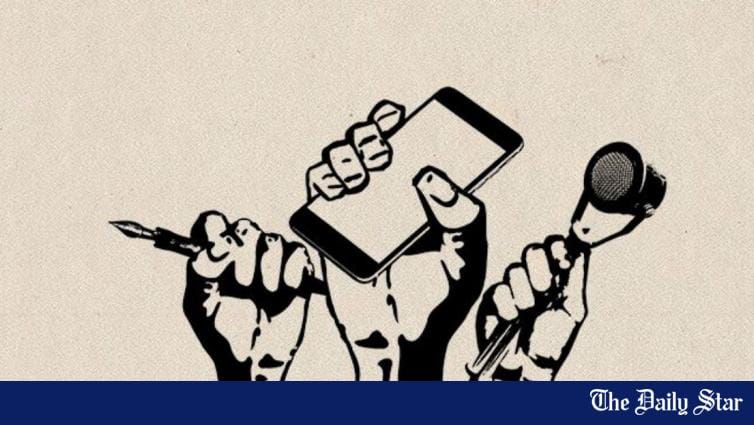
Media today has transformed into a spectacular performance focused on visibility.
Time to rethink media transformation

VISUAL: COLLECTED
I started my career as a cub journalist for a long-deceased daily. I worked there for three months without an appointment letter, or any pay, only to hear the editor one day telling a district correspondent to use his ID and collect wheat from the local DC instead of payment. The next day, I showed up at this daily's office. With S.M. Ali as its editor at the time, seasoned journalists with international experience, experienced sub-editors, and a fresh bunch of talented graduates, the place was vibrant with professional enthusiasm. Early in my career, I became aware of two types of journalism divided by their personal and public interests.
Every day, I learnt something new while typing on manual typewriters. I learnt the use of "reportedly" and "allegedly" as safeguards. I learnt the need for presenting both sides of the story to give balanced news and restrict myself from views. In the 1990s, "bothsideism" was still considered a principled journalistic norm. I started my career after the fall of an autocratic regime, when the media literally took up the role of the fourth estate. There was a renewed urgency to investigate, interrogate, and inform. Unfortunately, while the situation at present is somewhat similar, the mainstream media is now on the verge of being irrelevant in a political climate that thrives on distrust.
Media today has transformed into a spectacular performance focused on visibility. Instead of news, we have diluted and digitised versions of views. In the so-called post-truth era, a significant segment of the media no longer prioritises presenting the truth to power. Most media outlets are in survival mode. Truth is filtered through algorithms, while dissent is punished through digital mobs or official or unofficial sanctions on ads (with stories of such sanctions becoming common during Awami League's tenure). A large number of media outlets have been reduced to factories of consent. One contributing factor of such a change is the "digital transformation" of media and the emergence of new media. With the decline of print subscriptions and increasing disengagement of young readers from newspapers, media houses are all trying to stay afloat by chasing online clicks. Their platform performance comes at the expense of public trust.
Most mainstream media use aggressive PR machinery to inflate their algorithms to seek advertisements. Newspapers, like any other business house, pursue search engine optimisation (SEO), thumbnail attractiveness, and emotionally charged photo cards. The goal is no longer to give both sides of the story so the reader can come to their own intelligent conclusion. Instead, complex issues are chopped into bite-size testers and teasers. The trend has become to simplify, sensationalise, and provoke. The audience is given infographics, explainer videos, and amplified opinions. Clickbait is the new malaise that is conditioned by the desire to be viral. Contexts are often ignored, and facts conveniently trimmed. In the process, the core journalistic ethic of telling all sides of a story is compromised.
During the previous regime, surveillance, censorship, and even oppression were used to turn newsrooms into ideologically gated communities. Still, there were avenues to express dissent. But in a changed political milieu, one would have expected real reform that does not shy away from truth. But once again, we are seeing a return to the "either with us or against us" mentality. When the main exponents of the July uprising criticised binary thinking shortly after the political changeover, it gave us reasons to be optimistic. But as time rolls on, the motto "Either you're with us, or you're part of the problem" is striking firm ground. The sociopolitical polarisation is further deepened by the complicity of some media outlets. Voices of dissent are touted as agents of sabotage.
Any attempt to hold the dominant power or pressure groups accountable is considered a sacrilege. "Where have you been in the last 15 years?" is used to defuse any hint of criticism. The fear factors unleashed by some instances of ransacking media offices and withdrawal of press accreditation cards have tamed the watchdogs. Most media outlets function as echo chambers that endorse state actions under the guise of patriotism or stability. And many dissenting voices find themselves in the underground matrix, aired from foreign locations, preaching to their choirs.
The personal survival or profiteering strategy of some news outlets abandons public service. Credible investigative journalism is the biggest casualty of this transformation. Often foreign news agencies are no different, as they align themselves with the greater geopolitical interests. Reporters, with few exceptions, don't have the time or the protection to explore facts. The dwindling culture of whistleblowers and editorial courage has created a vacuum that allows power to thrive unchallenged. Algorithmic obedience has replaced editorial autonomy as newspapers now prioritise counting likes and angry reactions on social media. This fear of anonymous bot networks can drive any individual to their emotional nadir. The fear is more than an arrest under the cyber law. It involves social annihilation. Every digital footprint is monitored and vulnerable. As a coping mechanism, many of us resort to self-censorship. Every time I type something, I have to be careful of the editorial Ctrl+x as well as external reactions.
The ownership structure of media houses is also responsible for the decline of media. The privileges enjoyed by the owners close to the previous regime have created a template for the usurpers, or new media owners. Meanwhile, Dhaka-based tech-savvy reports dominate news today, creating an illusion of national consensus while excluding marginal voices or contributions. The media, by ignoring the locals, is partly responsible for this erasure.
But let me end on a positive note. The decline of mainstream media coincided with the rise of citizen journalism. Many independent vloggers have emerged as alternative voices, enjoying considerable trust among younger audiences. Then again, this citizen journalism can be vulnerable and dangerous without proper training, institutional backing, legal protection, and the editorial support that traditional media provides.
So when we talk about reform as part of the July protocol, we must rethink the media's transformation. The reform needs to be approached with courage and open-mindedness. For journalism to be the fourth estate of our democracy, media houses must recommit to truth over traffic. Claiming that we live in a post-truth era can only offer confusion. Media houses must unite to defend editorial autonomy over political compliance. Journalists need protection from all types of threats—physical and cyber. Instead of direct interventions, the transitional government must act through independent regulatory bodies, transparent ad policies, and genuine protection laws to spare the audience and the state from misinformation and disinformation. We have gone beyond the stage of performative declarations. Now is the time for change.
Dr Shamsad Mortuza is professor of English at Dhaka University.
VISUAL: COLLECTED
I started my career as a cub journalist for a long-deceased daily. I worked there for three months without an appointment letter, or any pay, only to hear the editor one day telling a district correspondent to use his ID and collect wheat from the local DC instead of payment. The next day, I showed up at this daily's office. With S.M. Ali as its editor at the time, seasoned journalists with international experience, experienced sub-editors, and a fresh bunch of talented graduates, the place was vibrant with professional enthusiasm. Early in my career, I became aware of two types of journalism divided by their personal and public interests.
Every day, I learnt something new while typing on manual typewriters. I learnt the use of "reportedly" and "allegedly" as safeguards. I learnt the need for presenting both sides of the story to give balanced news and restrict myself from views. In the 1990s, "bothsideism" was still considered a principled journalistic norm. I started my career after the fall of an autocratic regime, when the media literally took up the role of the fourth estate. There was a renewed urgency to investigate, interrogate, and inform. Unfortunately, while the situation at present is somewhat similar, the mainstream media is now on the verge of being irrelevant in a political climate that thrives on distrust.
Media today has transformed into a spectacular performance focused on visibility. Instead of news, we have diluted and digitised versions of views. In the so-called post-truth era, a significant segment of the media no longer prioritises presenting the truth to power. Most media outlets are in survival mode. Truth is filtered through algorithms, while dissent is punished through digital mobs or official or unofficial sanctions on ads (with stories of such sanctions becoming common during Awami League's tenure). A large number of media outlets have been reduced to factories of consent. One contributing factor of such a change is the "digital transformation" of media and the emergence of new media. With the decline of print subscriptions and increasing disengagement of young readers from newspapers, media houses are all trying to stay afloat by chasing online clicks. Their platform performance comes at the expense of public trust.
Most mainstream media use aggressive PR machinery to inflate their algorithms to seek advertisements. Newspapers, like any other business house, pursue search engine optimisation (SEO), thumbnail attractiveness, and emotionally charged photo cards. The goal is no longer to give both sides of the story so the reader can come to their own intelligent conclusion. Instead, complex issues are chopped into bite-size testers and teasers. The trend has become to simplify, sensationalise, and provoke. The audience is given infographics, explainer videos, and amplified opinions. Clickbait is the new malaise that is conditioned by the desire to be viral. Contexts are often ignored, and facts conveniently trimmed. In the process, the core journalistic ethic of telling all sides of a story is compromised.
During the previous regime, surveillance, censorship, and even oppression were used to turn newsrooms into ideologically gated communities. Still, there were avenues to express dissent. But in a changed political milieu, one would have expected real reform that does not shy away from truth. But once again, we are seeing a return to the "either with us or against us" mentality. When the main exponents of the July uprising criticised binary thinking shortly after the political changeover, it gave us reasons to be optimistic. But as time rolls on, the motto "Either you're with us, or you're part of the problem" is striking firm ground. The sociopolitical polarisation is further deepened by the complicity of some media outlets. Voices of dissent are touted as agents of sabotage.
Any attempt to hold the dominant power or pressure groups accountable is considered a sacrilege. "Where have you been in the last 15 years?" is used to defuse any hint of criticism. The fear factors unleashed by some instances of ransacking media offices and withdrawal of press accreditation cards have tamed the watchdogs. Most media outlets function as echo chambers that endorse state actions under the guise of patriotism or stability. And many dissenting voices find themselves in the underground matrix, aired from foreign locations, preaching to their choirs.
The personal survival or profiteering strategy of some news outlets abandons public service. Credible investigative journalism is the biggest casualty of this transformation. Often foreign news agencies are no different, as they align themselves with the greater geopolitical interests. Reporters, with few exceptions, don't have the time or the protection to explore facts. The dwindling culture of whistleblowers and editorial courage has created a vacuum that allows power to thrive unchallenged. Algorithmic obedience has replaced editorial autonomy as newspapers now prioritise counting likes and angry reactions on social media. This fear of anonymous bot networks can drive any individual to their emotional nadir. The fear is more than an arrest under the cyber law. It involves social annihilation. Every digital footprint is monitored and vulnerable. As a coping mechanism, many of us resort to self-censorship. Every time I type something, I have to be careful of the editorial Ctrl+x as well as external reactions.
The ownership structure of media houses is also responsible for the decline of media. The privileges enjoyed by the owners close to the previous regime have created a template for the usurpers, or new media owners. Meanwhile, Dhaka-based tech-savvy reports dominate news today, creating an illusion of national consensus while excluding marginal voices or contributions. The media, by ignoring the locals, is partly responsible for this erasure.
But let me end on a positive note. The decline of mainstream media coincided with the rise of citizen journalism. Many independent vloggers have emerged as alternative voices, enjoying considerable trust among younger audiences. Then again, this citizen journalism can be vulnerable and dangerous without proper training, institutional backing, legal protection, and the editorial support that traditional media provides.
So when we talk about reform as part of the July protocol, we must rethink the media's transformation. The reform needs to be approached with courage and open-mindedness. For journalism to be the fourth estate of our democracy, media houses must recommit to truth over traffic. Claiming that we live in a post-truth era can only offer confusion. Media houses must unite to defend editorial autonomy over political compliance. Journalists need protection from all types of threats—physical and cyber. Instead of direct interventions, the transitional government must act through independent regulatory bodies, transparent ad policies, and genuine protection laws to spare the audience and the state from misinformation and disinformation. We have gone beyond the stage of performative declarations. Now is the time for change.
Dr Shamsad Mortuza is professor of English at Dhaka University.