[🇧🇩] Textile & RMG Industry of Bangladesh

[🇧🇩] Textile & RMG Industry of Bangladesh
494
22K
More threads by Saif

G Bangladesh Defense

Race for grabbing share of US apparel market

FE

Published :
May 12, 2026 21:50
Updated :
May 12, 2026 23:35

Despite a turbulent phase marked by a significant slowdown in the first half of FY26 (July-December 2025) with a decline in exports, the Readymade Garment (RMG) sector appears to be experiencing a turnaround in its fortunes in the first quarter of 2026. As reports go, Bangladesh overtook China as a top garment exporter to the US in early 2026 (between January and March) primarily due to aggressive American reciprocal tariffs on Chinese apparel products. According to the latest data from the Office of Textiles and Apparel (OTEXA) under the US Department of Commerce, Bangladesh exported US$2.4 billion worth of apparel products to the US during (January-March) period of 2026.

Notably, during the same period China's apparel exports to the US market fell to US$1.70 billion. The OTEXA figures also indicate that US apparel retailers in their bid to avoid Chinese goods amid tariff storms are considering Bangladesh as an alternative sourcing destination. This clearly points to a major realignment in the US retail market so far as China's share in it is concerned. Within just a year, Chinese apparel exports to the US dropped by about 53 per cent (in the first quarter of 2026 as compared with the same period in 2025). Actually, the performance of major exporters to the US market remained largely negative, but China and India recorded the sharpest decline. Interestingly, Bangladesh's apparel exports to the US market also declined by 8.38 per cent year-on-year. This essentially means that comparison with other exporters whose fortunes in a certain market might be on the rocks due to any non-market influence cannot be the perfect yardstick to measure one's overall performance. Now that Bangladesh demonstrated its strength vis-à-vis Chinese export to US apparel market, it has still a long way to go to beat Vietnam. Because, as Bangladesh increased its market share to around 11.5 per cent in the first quarter of 2026, Vietnam held on to its position with 22.5 per cent market share as a top apparel supplier to the US market, benefiting from the broader trend of brands moving away from China.

In consequence of these developments, the order of dominance has been reset in that China now ranks third, while Bangladesh and Vietnam occupy the second and first places so far as export to the US market is concerned. It would be worthwhile to note that Cambodia, a Southeast Asian country, has meanwhile emerged as yet another potential competitor in the US apparel market and is being touted as the fastest growing supplier in the US apparel market. That means, it is not only Vietnam, Bangladesh will have to be watchful of other emerging players in the South and Southeast Asian region who are also in a race to have a slice of the US apparel market. While this competition to grab the US retail market for apparel goods among the traditional exporters is evolving, the overall US market is shrinking due to reduced consumer spending and the market even saw a general decline across most major suppliers. As the same division of the US department of commerce shows, during the period under review, overall import of apparel goods in US market shrank by 11.63 per cent. Seeing that the size of the US retail market of apparel goods is shrinking, Bangladesh's RMG sector should consider widening its export destinations to other fast-growing economies across the globe.

At the same time, this industry should also shift its focus from relying solely on low-cost labour to high-value-added products. And the strategies to that end should include automation, diversifying fibre beyond cotton and transitioning to manmade fibres. That Bangladesh's apparel sector has achieved some success vis-à-vis China's in a certain market is no reason to rest on its laurels. On the contrary, it should stress progressive improvement of its performance year-on-year and expansion of its market footprints.​
 
BD had built strength in this area with Indian RAW material.
Your information is not correct. Bangladesh buys RMG raw materials not only from India but also from China, Brazil, and the USA.. Bangladesh also has increased the use of domestic raw materials to save its textile and apparel industries. Bangladesh has suspended importing yarn from India which has significantly reduced Bangladesh's overall dependence on India.
 
Last edited:

Turning textile waste into opportunity

Atiqul Kabir Tuhin

Published :
May 14, 2026 00:03
Updated :
May 14, 2026 02:02

1778715103019.webp


Bangladesh's readymade garment (RMG) sector stands at a crossroads. For decades, the industry has been the backbone of the country's export economy, transforming Bangladesh into the world's second-largest apparel exporter and creating employment opportunities for millions. However, the global apparel industry is now undergoing a major transition from a linear to a circular production model. Although Bangladesh has made considerable progress in increasing the number of green factories, the majority of its apparel manufacturers still follow the traditional "make, use and throw away" model. Speaking at a recent seminar, industry leaders warned that without urgent policy support, use of modern technology and infrastructure upgrades to develop advanced recycling capacities, Bangladesh risks losing not only competitiveness in major export markets but also a massive economic opportunity from waste recycling estimated to be worth $8 billion annually.

A circular economy is fundamentally different from the conventional production model. In a circular system, products are designed and manufactured in a way that allows materials to be used, reused, repaired and recycled repeatedly, thereby reducing waste and extending the lifecycle of resources. Rather than allowing products to end up in landfills after a single use, circularity seeks to recover value from materials at every stage of production and consumption. It also emphasises responsible sourcing, reduced water and energy use, minimisation of waste and lower carbon emissions throughout the supply chain.

This transformation is no longer driven solely by environmental concerns; it is increasingly becoming a trade and business imperative. Legislative initiatives in the European Union, including the Green Deal and the Digital Product Passport (DPP), are accelerating the shift towards sustainable and traceable supply chains. These regulations will require apparel exporters to ensure greater transparency regarding sourcing, production methods, recycling practices and environmental impact. Since the European Union remains Bangladesh's largest apparel export destination, these developments carry enormous significance for the country's textile and garment industry.

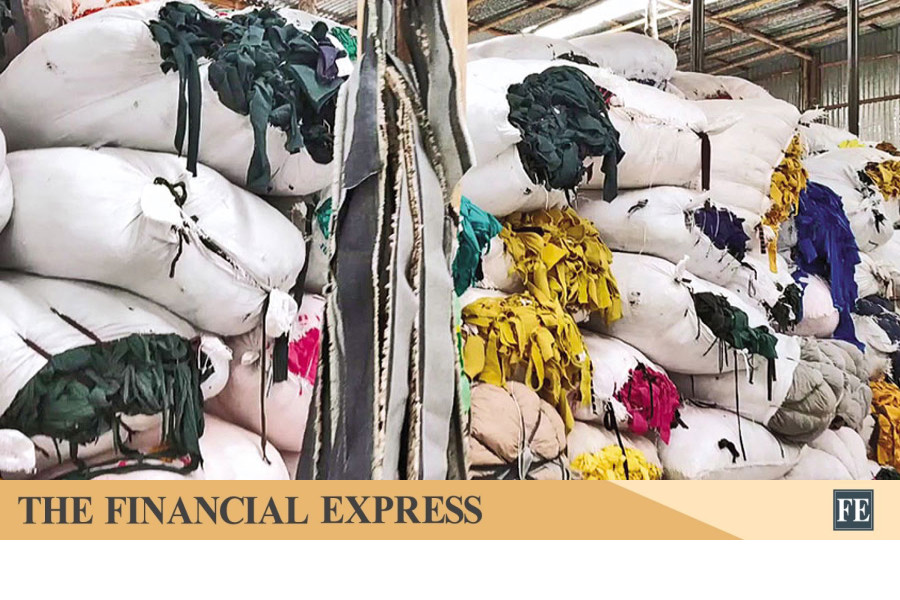
As the world's second-largest garment supplier, Bangladesh's apparel industry generates a substantial amount of textile waste. However, Bangladesh mainly deals with pre-consumer waste generated during the manufacturing process rather than post-consumer waste collected after products are used by consumers. According to BGMEA, the industry produces nearly 600,000 tonnes of pre-consumer textile waste annually. Yet this enormous volume of waste remains largely underutilised.

Currently, most textile waste is collected and traded through informal channels, with only a very small portion recycled domestically. A significant amount of recyclable garment waste is exported to neighbouring countries such as India and Pakistan, where it is processed into recycled yarn before being sold back to Bangladesh at higher prices. This represents not only a loss of valuable foreign exchange and domestic value addition but also a missed industrial opportunity. If textile waste is properly collected, sorted and processed within the country, it could become a valuable raw material for producing recycled fibres, yarns and fabrics, creating a new high-value industrial segment.

Industry leaders have rightly pointed out that formalising the recycling ecosystem would generate multiple benefits. It would reduce health and safety risks associated with unregulated waste handling, create new employment opportunities, strengthen industrial organisation and encourage safer working conditions. More importantly, it would help Bangladesh reduce its dependence on virgin raw materials at a time when global resource constraints and climate concerns are becoming increasingly severe.

Bangladesh's upcoming graduation from Least Developed Country (LDC) status adds further urgency to the issue. As preferential trade benefits gradually decline after graduation, maintaining export competitiveness will require stronger compliance with environmental, labour and sustainability standards. In this context, the transition to a circular economy should not be viewed merely as an environmental obligation, but as a strategy to preserve market access.

Experts also emphasise the importance of upstream circularity, which focuses on reducing waste at its source during design, production and cutting processes. Technology can play a transformative role in this regard. Innovations such as digital design systems, automated cutting technologies, 3D sampling and customised manufacturing platforms can significantly reduce fabric wastage and improve production efficiency. These technologies also enable closer collaboration between manufacturers and global buyers, helping both sides share responsibility for minimising pre-consumer waste.

However, upstream circularity alone cannot eliminate textile waste entirely. The next crucial step is to embrace the principle of "recycle and recover," whereby textile waste can be converted into fibre, fibre into yarn and fabric, and eventually into new RMG products. Recycling textile waste into new fabrics and apparel products would reduce the need for virgin resources while simultaneously lowering environmental pressure and carbon emissions.

A coordinated national strategy is therefore urgently needed to accelerate Bangladesh's circular transition. Such a strategy should include fiscal incentives for recycling investments, tax benefits for sustainable manufacturing, easier access to green financing and support for technological upgrading and research. Strong collaboration among the government, BGMEA, development partners, financial institutions and private entrepreneurs will also be essential. Special emphasis should be placed on developing domestic capacity for chemical recycling, improving waste traceability systems and encouraging innovation in eco-friendly materials and sustainable production techniques.

The future of Bangladesh's apparel industry will depend not only on how much it produces, but also on how environmentally responsible and sustainable its production processes are. If Bangladesh can successfully transform textile waste into economic value, it will not only protect its position in the global apparel market but also pave the way for a more resilient, resource-efficient and sustainable industrial future.​
 

RSC recognises 46 RMG factories for workplace safety
Staff Correspondent 13 May, 2026, 00:05

1778806325238.webp


The RMG Sustainability Council on Tuesday distributed formal recognition letter to 46 readymade garment factories for ensuring minimum life-safety standards in their workplaces.

RSC managing director Abdul Haque and chief safety officer Md Hassan Nawazis handed over the Letter of Recognition to the representatives of the factories at the RSC’s office in the capital, according to a press release.

With these new numbers, a total of 675 RMG factories have received the RSC recognition for their deep-rooted commitment to strengthening the safety culture across the garment sector, making Bangladesh one of the safest sourcing countries for the global fashion market.

The RSC is a first-of-its-kind national tripartite, private initiative founded in 2020, featuring equal representation from the Bangladeshi RMG industry, global fashion brands, and global and local trade unions, leading the charge in elevating factory safety across the country.

It inherited the infrastructure and functions of the Bangladesh Accord, a legally binding global pact formed after the fatal Rana Plaza collapse in April 2013.

Since its inception, RSC has carried out 26,822 safety inspections at the covered factories.

In the event, Md Hassan Nawazis said that LoR recognises the effort made for completing initial CAPs (Corrective Action Plans).

‘Sustainable compliance is critical, as it requires continuous monitoring effort and a collective mindset. It serves as a proactive measure for managing workplace safety and thereby helps create a safe RMG supply chain,’ he added.

After the initial inspections, the factory and the brands will develop a CAP with time-bound remedial actions, based on the severity of the findings.

RSC regularly coordinates with factories to ensure that outstanding CAPs are completed and conducts follow-up inspections to monitor the implementation of remedial processes, according to the press release.

After reaching 100 per cent completion of all initial findings, a factory is entitled to receive the LoR, which highlights factories that have consistently cooperated with the RSC’s workplace safety program, ensuring that structural, fire, and electrical safety measures remain in place and effective.Cultural Event Listings

These efforts are part of the ongoing work to strengthen safety culture across Bangladesh’s garment sector.

‘Our recognition reflects the continued progress of our industry in prioritising worker safety and compliance,’ said Abdul Haque, MD of RSC.

The factories receiving this have shown strong commitment to sustaining the safety standards achieved over the years, he added, saying that now sustaining this achievement is more challenging, and they must remain committed towards that.

RSC currently covers 1,921 factories and conducts inspections, along with workplace safety training programmes and an independent complaints mechanism.​
 

Plastic waste, reverse logistics, and Bangladesh’s textile opportunity

Ahamedul Karim Chowdhury

1779160145025.webp

VISUAL: ANWAR SOHEL

Bangladesh’s garment industry stands at a critical turning point. For more than three decades, the country built its economic success on low-cost manufacturing, efficient exports, and strong integration into global apparel supply chains. Today, Bangladesh is the world’s second-largest garment exporter, with the RMG sector serving as the backbone of exports, industrial employment, and foreign exchange earnings. But the global textile economy is changing rapidly. International buyers are no longer focused only on lower costs and production speed. Increasingly, they are seeking recycled raw materials, supply-chain transparency, lower carbon footprints, and circular production systems.

For Bangladesh, this shift creates both a challenge and an extraordinary opportunity. Ironically, part of that opportunity may already be floating in our rivers, clogging urban drainage systems, and scattered across city streets in the form of discarded plastic bottles.

Every day, thousands of waste collectors across the country recover used Polyethylene Terephthalate (PET) mineral water and beverage bottles from homes, roadsides, canals and landfills. This informal recovery network operates quietly but remarkably efficiently. Local businesses clean and process these bottles into plastic flakes, much of which is exported abroad, primarily to countries with advanced recycling industries. Those flakes are then converted into polyester fibre and re-enter global textile supply chains. Sometimes, they even return to Bangladesh as recycled textile inputs at significantly higher prices.

In simple terms, Bangladesh exports waste and imports value-added fibre derived from the same material. From an economic perspective, this is difficult to justify. At the same time, Bangladesh spends billions of dollars annually importing cotton, polyester fibre, and textile raw materials. Yet, enormous quantities of recyclable material generated within the country remain underutilised.

The issue is clearly not an absence of waste. Nor is it a lack of entrepreneurial capability. The real problem is that Bangladesh has built world-class forward logistics but weak reverse logistics. This means that our supply chains work exceptionally well in one direction. Raw materials enter factories, garments move through ports, and exports reach global markets with remarkable efficiency. But modern industrial systems do not end with export. Materials must also move backward—to be sorted, recovered, reprocessed, and reintegrated into production. This backward movement is reverse logistics and, in Bangladesh’s textile sector, it remains fragmented, informal, and undervalued. Addressing this challenge is becoming increasingly urgent because the textile industry itself is changing.

Globally, human-made fibres now dominate textile consumption, while cotton’s share continues to decline due to rising water stress, climate risks and volatile commodity prices. Recycled polyester, much of which is derived from PET bottles, has become central to global sustainability transition.

Major brands including H&M, Zara, Adidas, and Nike are rapidly increasing the use of recycled materials based on climate commitments and circular economy targets. European regulators are also introducing stricter sustainability requirements regarding recycled contents, traceability, and waste reduction. Future export competitiveness will increasingly depend not only on labour cost, but also on environmental performance and material circularity.

Bangladesh can either continue treating plastic bottles and textile scraps as low-value waste streams, or it can recognise them as the industrial raw materials of the future.

Importantly, global investors are already beginning to recognise the latent value embedded in Bangladesh’s waste streams. One notable example is Recover, a Spanish textile recycling company that has expanded operations in Bangladesh in partnership with local industry players. Recover specialises in converting textile waste into recycled fibre suitable for spinning and garment manufacturing. The significance of such investment is that it signals how international organisations already see Bangladesh as a future hub for circular textile production.

The logic is straightforward. Bangladesh possesses one of the world’s largest concentrations of textile manufacturing and recyclable textile waste. Instead of exporting this material abroad for processing, international firms increasingly see economic value in building recycling capacity closer to the source of waste generation. This is precisely where Bangladesh’s opportunity lies.

The country already has industrial clusters, garment expertise, logistics networks, entrepreneurial capability, and an active informal recycling economy. Waste collectors and traders have already demonstrated that large-scale material recovery is possible when economic incentives exist. What remains absent is policy coordination and industrial integration.

Recycling and fibre-production machinery still face relatively high import duties compared to incentives available for conventional export manufacturing equipment. Waste segregation at the source also remains weak. Reverse logistics systems lack traceability and formal organisation. Dedicated sorting hubs and recycling infrastructure remain limited despite growing global demand for recycled textile inputs. This is where policymakers need to think differently.

Plastic waste should no longer be viewed merely as an environmental burden. It should be treated as strategic industrial feedstock for Bangladesh’s next-generation textile economy. Reducing duties on recycling machinery, supporting domestic recycled polyester production, encouraging municipal segregation systems, and investing in organised recycling zones could help retain significant economic value within the country. At the same time, informal waste workers must be integrated into future systems rather than displaced by them. Thousands of livelihoods already depend on bottle and waste collection. Formalisation should improve safety, income stability, and operational efficiency while preserving the economic role these workers already play.

The benefits of building a circular textile ecosystem extend far beyond environmental improvement. Domestic recycling can reduce dependence on imported raw materials, ease pressure on foreign exchange reserves, create new industrial jobs, and strengthen Bangladesh’s long-term position in global supply chains. Reverse logistics could itself become a major growth sector involving transportation, sorting, warehousing, recycling, and material traceability services.

Most importantly, this transition aligns environmental necessity with economic opportunity. In the past, Bangladesh transformed itself into a global garment powerhouse by investing in ports, industrial zones, logistics systems, and export infrastructure. The next phase of competitiveness may depend on whether the country can build the reverse systems required for a circular economy.

The world is gradually moving towards textile systems where waste becomes raw material. The countries that learn to recover value from waste will shape the future of global textile trade. Bangladesh still has time to become one of them.

Ahamedul Karim Chowdhury is adjunct faculty member at Bangladesh Maritime University.​
 

High tariffs stifle Bangladesh RMG potential in LatAm

FHM HUMAYAN KABIR, BACK FROM BRAZIL


1779932442297.webp


Bangladeshi garment makers are missing out on a huge market in Latin America due to tariff barriers imposed by the Mercosur countries, businesses and analysts say.

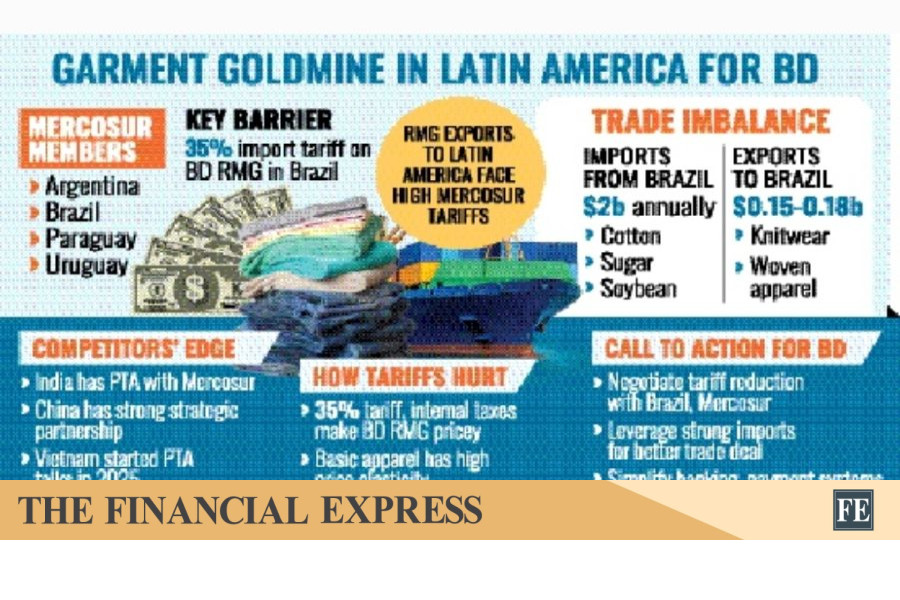
Established in 1991 to promote free trade and regional integration, Mercosur is a South American trade bloc with four full members -- Argentina, Brazil, Paraguay, and Uruguay.

Despite the enormous potential of Bangladeshi products to enter South America in higher volumes, the lack of bilateral or multilateral trade deals is affecting businesses.

Brazilian and Bangladeshi businessmen have told The Financial Express although they want to expand business with Bangladesh, the tariff barriers are creating huge roadblocks.

Brazil's 35 per cent import tariff on ready-made garment (RMG) from Bangladesh -- stemming from its Mercosur customs union membership -- severely erodes Bangladeshi apparel competitiveness.

By inflating the final retail prices, this duty restricts market penetration and forces Bangladesh into a structural trade deficit while limiting expansion into Latin America.

Bangladesh imports major agricultural commodities like raw cotton, sugar, and soybean from Brazil (exceeding $2.0 billion annually), while its exports - primarily knitwear and woven apparel -- have hovered around $150-187 million, severely tilting the trade balance.

Because the price elasticity for basic apparel is high, a 35 per cent duty coupled with cumulative internal taxes makes Bangladeshi garments substantially more expensive than locally produced Brazilian goods or items from competitors with preferential trade access.

Despite the recent spikes in bilateral trade, the high tariff continues to act as a ceiling for export growth, preventing Bangladesh from directly capturing a significant share of Brazil's apparel market.

Besides, the complex banking or payment system between Brazil and Bangladesh has held back garment importers and exporters, disrupting the potential bilateral business.

Bruno B Silveira, country manager of Brazilian garment importer RENNER in Bangladesh, tells The Financial Express the Bangladesh government should take steps to convince its Brazilian counterpart and the Mercosur trade bloc to slash tariffs on Bangladeshi products.

Since Bangladesh imports a handsome amount of Brazilian products, it can take steps to reduce trade barriers by establishing a good partnership, he adds.

Sheikh Khaledur Rahman, a Bangladesh-Brazil businessman, tells The Financial Express he has been doing garment business with Brazil for many years and tariffs are the main obstacle to trade expansion.

"Since Bangladesh has no trade deal with Brazil or the Mercosur nations, it has become very difficult to compete with other garment suppliers like India. Besides, they have good relations with China and Vietnam," he says.

"We have met some Brazilian policy-makers, bureaucrats, businessmen, and trade leaders. We suggested they go for establishing a trade relation with Bangladesh and eliminating the tariff barriers. But as we have not got any support from the Bangladeshi embassy in Brazil, we have failed to complete successful negotiations."

Another Bangladeshi businessman in Sao Paulo says they have requested the incumbent Bangladeshi ambassador to Brazil, appointed by the previous Sheikh Hasina government, to press their demands with the Latin American country, but the request has not been considered.

Echoing the same, several other businessmen have told The Financial Express the ambassador, Dr Md Tauhedul Islam, acts like a lord and does not care about the Bangladeshi community in Brazil.

In addition to Brazil, Dr Tauhedul holds concurrent diplomatic accreditation to Argentina, Chile, Uruguay, Paraguay, Bolivia, and Venezuela.

The main export items from Bangladesh include RMG, such as jerseys, pullovers, cardigans, shirts, suits, jackets, trousers, and shorts.

India and Mercosur have an active Preferential Trade Agreement (PTA) that came into force in June 2009.

Vietnam and Mercosur do not yet have any active Free Trade Agreement (FTA), but they officially launched PTA negotiations in late 2025.

China does not have a formal FTA with Brazil or Mercosur.

However, it is Brazil's largest global trading partner, and the two countries operate under major strategic partnerships and cooperation plans.

Brazil has historically vetoed formal Mercosur-China trade talks to protect domestic manufacturing, though Brazilian officials are discussing a possible partial or targeted Mercosur-China trade deal in response to shifting global tariffs.

By 2026, Brazil could become the world's eighth-largest economy with a gross domestic product (GDP) of $2.47 trillion.

A manager at a John Deere brand shop in the Brazilian city of Sao Carlos tells The Financial Express they are interested in importing Bangladeshi apparel and leather products, but tariffs are the major obstacle.

"We know that Bangladeshi garments are recognised worldwide. Bangladesh has a big export base in the US and European Union (EU) countries. We are also interested in importing Bangladeshi products if the barriers are removed."

Former Bangladesh Garment Manufacturers and Exporters Association president Rubana Huq tells The Financial Express that Brazil is one of the big potential markets in Latin America for Bangladesh, but tariff barriers are impeding bilateral trade.

She has urged the Bangladesh government to work with the Brazilian authorities to simplify business since the former country imports products like cotton, sugar, and soybean from the latter with zero duty.​
 

High tariffs stifle Bangladesh RMG potential in LatAm

FHM HUMAYAN KABIR, BACK FROM BRAZIL


View attachment 27157

Bangladeshi garment makers are missing out on a huge market in Latin America due to tariff barriers imposed by the Mercosur countries, businesses and analysts say.

Established in 1991 to promote free trade and regional integration, Mercosur is a South American trade bloc with four full members -- Argentina, Brazil, Paraguay, and Uruguay.

Despite the enormous potential of Bangladeshi products to enter South America in higher volumes, the lack of bilateral or multilateral trade deals is affecting businesses.

Brazilian and Bangladeshi businessmen have told The Financial Express although they want to expand business with Bangladesh, the tariff barriers are creating huge roadblocks.

Brazil's 35 per cent import tariff on ready-made garment (RMG) from Bangladesh -- stemming from its Mercosur customs union membership -- severely erodes Bangladeshi apparel competitiveness.

By inflating the final retail prices, this duty restricts market penetration and forces Bangladesh into a structural trade deficit while limiting expansion into Latin America.

Bangladesh imports major agricultural commodities like raw cotton, sugar, and soybean from Brazil (exceeding $2.0 billion annually), while its exports - primarily knitwear and woven apparel -- have hovered around $150-187 million, severely tilting the trade balance.

Because the price elasticity for basic apparel is high, a 35 per cent duty coupled with cumulative internal taxes makes Bangladeshi garments substantially more expensive than locally produced Brazilian goods or items from competitors with preferential trade access.

Despite the recent spikes in bilateral trade, the high tariff continues to act as a ceiling for export growth, preventing Bangladesh from directly capturing a significant share of Brazil's apparel market.

Besides, the complex banking or payment system between Brazil and Bangladesh has held back garment importers and exporters, disrupting the potential bilateral business.

Bruno B Silveira, country manager of Brazilian garment importer RENNER in Bangladesh, tells The Financial Express the Bangladesh government should take steps to convince its Brazilian counterpart and the Mercosur trade bloc to slash tariffs on Bangladeshi products.

Since Bangladesh imports a handsome amount of Brazilian products, it can take steps to reduce trade barriers by establishing a good partnership, he adds.

Sheikh Khaledur Rahman, a Bangladesh-Brazil businessman, tells The Financial Express he has been doing garment business with Brazil for many years and tariffs are the main obstacle to trade expansion.

"Since Bangladesh has no trade deal with Brazil or the Mercosur nations, it has become very difficult to compete with other garment suppliers like India. Besides, they have good relations with China and Vietnam," he says.

"We have met some Brazilian policy-makers, bureaucrats, businessmen, and trade leaders. We suggested they go for establishing a trade relation with Bangladesh and eliminating the tariff barriers. But as we have not got any support from the Bangladeshi embassy in Brazil, we have failed to complete successful negotiations."

Another Bangladeshi businessman in Sao Paulo says they have requested the incumbent Bangladeshi ambassador to Brazil, appointed by the previous Sheikh Hasina government, to press their demands with the Latin American country, but the request has not been considered.

Echoing the same, several other businessmen have told The Financial Express the ambassador, Dr Md Tauhedul Islam, acts like a lord and does not care about the Bangladeshi community in Brazil.

In addition to Brazil, Dr Tauhedul holds concurrent diplomatic accreditation to Argentina, Chile, Uruguay, Paraguay, Bolivia, and Venezuela.

The main export items from Bangladesh include RMG, such as jerseys, pullovers, cardigans, shirts, suits, jackets, trousers, and shorts.

India and Mercosur have an active Preferential Trade Agreement (PTA) that came into force in June 2009.

Vietnam and Mercosur do not yet have any active Free Trade Agreement (FTA), but they officially launched PTA negotiations in late 2025.

China does not have a formal FTA with Brazil or Mercosur.

However, it is Brazil's largest global trading partner, and the two countries operate under major strategic partnerships and cooperation plans.

Brazil has historically vetoed formal Mercosur-China trade talks to protect domestic manufacturing, though Brazilian officials are discussing a possible partial or targeted Mercosur-China trade deal in response to shifting global tariffs.

By 2026, Brazil could become the world's eighth-largest economy with a gross domestic product (GDP) of $2.47 trillion.

A manager at a John Deere brand shop in the Brazilian city of Sao Carlos tells The Financial Express they are interested in importing Bangladeshi apparel and leather products, but tariffs are the major obstacle.

"We know that Bangladeshi garments are recognised worldwide. Bangladesh has a big export base in the US and European Union (EU) countries. We are also interested in importing Bangladeshi products if the barriers are removed."

Former Bangladesh Garment Manufacturers and Exporters Association president Rubana Huq tells The Financial Express that Brazil is one of the big potential markets in Latin America for Bangladesh, but tariff barriers are impeding bilateral trade.

She has urged the Bangladesh government to work with the Brazilian authorities to simplify business since the former country imports products like cotton, sugar, and soybean from the latter with zero duty.​

Rubana is right.

We need to complete a mutual FTA with all Mercosur countries.

A mutual Free Trade Agreement (FTA) will eliminate tariffs between participating countries, promoting trade by reducing or removing trade barriers, including non-tariff barriers. This approach fosters a more balanced and reciprocal trading relationship.

Mutual Free Trade Agreement (FTA) will assist in smooth exports to these markets and will win business, because our apparel products are super competitive with those made in Vietnam and India.

It will also assist Bangladesh to access high quality Brazilian tanned leather, cotton and sugar imports, substituting import of these raw materials from India for our export industries.

Brazilian agri products are better priced and higher quality than Indian products. Plus it will assist in quieting dependence on India and subsequent 'chest-thumping talk' from Indians.
 

Latest Posts

Back