[🇧🇩] Textile & RMG Industry of Bangladesh

[🇧🇩] Textile & RMG Industry of Bangladesh
565
28K
More threads by Saif

G Bangladesh Defense

RMG makers seek PM’s intervention for yarn import

Saddam Hossain . Dhaka

1792108471795.webp


The readymade garment manufacturers of the country sought prime minister Tarique Rahman’s intervention to withdraw a restriction on imports of 10–30 count cotton yarn under bonded warehouse facilities.

They also said that the measure is disrupting raw material supplies and raising production costs for export-oriented garment factories.

The Bangladesh Garment Manufacturers and Exporters Association and the Bangladesh Knitwear Manufacturers and Exporters Association urged this in a joint letter to the prime minister sent on Thursday.

Earlier on September 7, the National Bureau of Revenue issued an order, following a meeting at the commerce ministry on August 20, withdrawing the bonded warehouse facility for the import of 10–30 count cotton yarn.

It allowed exporters to import the yarn against bank guarantees, subject to certification by the relevant trade bodies and release of the guarantees after export.

However, following major objections, the commerce ministry wrote to the NBR on September 13, requesting suspension of the decision for further review.

The NBR nevertheless issued another order on October 14 upholding the restriction order of NBR, according to the associations’ letter to the prime minister.

Signed by the BGMEA president Mahmud Hasan Khan and BKMEA president Mohammad Hatem, the letter said the latest order had created fresh uncertainty for exporters, with consignments of imported yarn held at Chattogram port disrupting production and supply chains.

They urged the government to withdraw the September 7 order without conditions and consult the relevant industry stakeholders before making such policy decisions.

They also proposed discussions among the BGMEA, BKMEA and the Bangladesh Textile Mills Association to develop a sustainable policy framework.

According to the letter, the consignments held at the port include twisted yarn used in sweater production, organic cotton yarn, Better Cotton Initiative cotton yarn, cotton melange and other specialised yarns that are not produced domestically to the required specifications and quality.

The associations said local spinning mills had already increased yarn prices by $0.30–$0.50 per pound since the September 7 order.

They also said that paying duties and taxes or providing bank guarantees for imported yarn would tie up exporters’ working capital and increase production costs, particularly for small and medium-sized exporters.

The BGMEA and BKMEA warned that the additional costs and supply disruptions could weaken Bangladesh’s competitiveness in international markets and put jobs at risk in the garment sector, which they said generated $39 billion in export earnings and supported the livelihoods of around four million people directly and indirectly.

The associations also claimed that frequent and unexpected policy changes had undermined buyers’ confidence, with some buyers shifting orders to India and Egypt.

Earlier, the NBR decision was welcomed by the BTMA, which argued that restricting duty-free imports of yarn available from local mills would protect domestic spinning industries, increase demand for locally produced yarn and help curb misuse of bonded facilities.

The BGMEA and BKMEA, however, opposed the measure, saying the decision had been incorporated into the meeting minutes without proper discussion with the apparel exporters’ associations and would increase costs for garment manufacturers.

They also said that they have been facing a series of policy changes since 2025, including the ban on yarn imports through land ports.

In this regard, they urged the prime minister’s instructions to protect the billion-dollar RMG industry.​
 

RMG exports to Poland rise amid Russia war

Refayet Ullah Mirdha

1792282338364.webp


Bangladesh’s garment exports to Poland are rising as the Russia-Ukraine war disrupts direct trade with Russia and buyers shift sourcing from China, even as shipments to several major markets face pressure.

Garment exports to Poland grew 9.8 percent year-on-year to $1.86 billion in fiscal year 2025-26 (FY26), according to Export Promotion Bureau (EPB) data.

In contrast, Bangladesh’s total garment exports fell 1.64 percent during the fiscal year.

The slowdown has continued in major destinations. Bangladesh’s garment exports to the US fell 5.3 percent in the first half of 2026, while shipments to the European Union declined 11.67 percent in the first eight months, according to World Bank and Eurostat data.

Industry leaders attribute the growth in exports to Poland partly to Polish buyers re-exporting garments to neighbouring Russia, where sanctions-related payment difficulties have complicated direct trade.

They also cite demand for basic garment items and opportunities created by Chinese suppliers losing orders.

A GROWING MARKET

Bangladesh exported garment items worth $1.38 billion to Poland in FY21, with the amount rising to $2 billion in FY22, according to EPB data.

Exports fell to $1.40 billion in FY23 before recovering to $1.54 billion in FY24 and $1.69 billion in FY25.

In contrast, garment exports to Russia have declined since the war began in February 2022.

Before the war, Bangladesh exported more than $665 million worth of garment items to Russia in FY21, with industry players considering it as a rising market for Bangladeshi apparels.

Exports to the country have since continued to fall, standing at $257.26 million in FY26.

POLAND AS A ROUTE TO RUSSIA

Mahmud Hasan Khan, president of the Bangladesh Garment Manufacturers and Exporters Association (BGMEA), said a significant volume of garment items was being re-exported from Poland to Russia.

Before the Russia-Ukraine war, Turkish traders also imported Bangladeshi garments for re-export to Russia, he said. Exports to Turkey declined after the country imposed a 17 percent duty on Bangladeshi garment items in 2011, according to him.

After the war began, Polish importers started re-exporting garments to Russia, contributing to the growth in Bangladesh’s exports to Poland, said Mahmud.

Salah Uddin Ahmed, managing director of IFS Texwear (Pvt) Ltd, which exports nearly $2 million worth of knitwear a month, also said some Polish buyers sourcing garments from Bangladesh also re-export products to Russia.

He, however, said he did not have specific evidence confirming that the garments being re-exported to Russia were sourced from Bangladesh.

Mohammad Hatem, president of the Bangladesh Knitwear Manufacturers and Exporters Association (BKMEA), said Poland could serve as a third country for exporting garments to Russia.

Western sanctions imposed after Russia’s invasion of Ukraine restricted several Russian banks’ access to the SWIFT international financial messaging system. The restrictions complicated some cross-border payment arrangements, making it harder for Bangladeshi exporters to receive payments from Russian buyers.

The war has also disrupted payments involving buyers linked to Russia. 28 Bangladeshi garment exporters have been struggling to recover $5.2 million from a Polish buyer for nearly two years, said Mijanur Rahman, managing director of Fabrica Knit Composite Ltd and a vice-president of the BGMEA.

Mijanur, who has been coordinating efforts to resolve the payment issue, said the buyer’s business had been disrupted by the war.

CHINA’S LOST ORDERS, BASICWEAR DEMAND

Exporters say the rise in shipments to Poland is not solely linked to the Russia-Ukraine war.

According to Mijanur, the loss of work orders by Chinese suppliers was one of the reasons behind the increase in Bangladesh’s garment exports to Poland.

Demand for basic garment items in the market was also strong, he added.

IFS Texwear’s Salah Uddin, meanwhile, noted that Poland was a growing market for Bangladeshi exporters because they enjoy zero-duty access under the European Union’s trade arrangements.

The duty advantage, combined with demand for basic garments and possible shifts in sourcing from China, has supported Bangladesh’s exports to Poland, exporters said.​
 

Govt eyes commercial revival of ‘Dhakai Muslin’: state minister

Star Business Report

1792368205663.webp


The government is working to bring the fabled ‘Dhakai Muslin’ back to commercial production, aiming to revive the heritage fabric, create jobs and open up global markets, State Minister for Textiles and Jute Md Shariful Alam said today.

Speaking at a seminar in Dhaka, he said research had restored the technology for producing the fabric, which was lost about 170 years ago. The next challenge is to improve the cotton used to make muslin and develop the textile for wider commercial use.

The seminar, titled “Dhakai Futi Karpas Fiber Genomics and Development”, was held at the CIRDAP Auditorium to discuss ways to improve the varieties of Futi Karpas, the cotton used to produce muslin.

It was organised under the second phase of the project to restore the technology for making muslin yarn and cloth. The Bangladesh Handloom Board is implementing the project under the Ministry of Textiles and Jute.

“Dhakai Muslin is not just a name; it is a witness to heritage and royal grandeur,” Shariful said. “Very soon, the long-awaited Dhakai Muslin, a golden chapter of our history, an inseparable part of our national identity and a saga of glory, will return in full once again.”

Textiles and Jute Secretary Sharf Uddin Ahmed Choudhury said under the ongoing project, researchers were working to develop Futi Karpas varieties that are less dependent on daylight duration, produce higher cotton yields and have more and larger cotton bolls with fewer seeds.

They are also seeking to control plant height, he said.

Research is also under way to improve the count, which determines finesse, and quality of muslin yarn and refine the processes involved in preparing, weaving and finishing the fabric, said the secretary.

Handloom Board Chairman Md Jakir Hossan said intensive training and research had helped spinners progress from producing yarn of 80 metric count to 750 metric count.

Md Ayub Ali, project director of the muslin restoration project, said the first phase was completed at a cost of Tk 12.10 crore, restoring the technology for producing Dhakai Muslin after nearly 170 years.

The second phase is now under way with a budget of Tk 18.50 crore, he said.

Ahmed Mohamed Abdelmoghny Abdulbaky, chief researcher at the Cotton Breeding Department of Cotton Research Institute under Egypt’s Agricultural Research Center, also took part in the seminar as a discussant.​
 

Extreme heat is raising costs for local garment factories

Mohiuddin Rubel


1792541085471.webp


As global temperatures rise, manufacturing and industrial sectors face a growing crisis: extreme heat. While global climate discussions often focus on emissions targets, the immediate challenge for Bangladesh’s $39 billion ready-made garment (RMG) industry lies inside its factories. The industry employs more than four million workers, and rising indoor temperatures are straining workers’ health, increasing operating costs and testing the industry’s ability to adapt.

The consequences of extreme heat are no longer abstract projections. Bangladesh lost an estimated 29 billion potential labour hours to heat exposure in 2024, a 92 percent increase on the 1990-99 average. This resulted in an estimated income loss of $24 billion, equivalent to nearly 5 percent of the country’s GDP.

Inside factories in Dhaka and Chattogram, conditions are becoming increasingly difficult. Indoor temperatures routinely exceed 35°C and can reach 40°C during peak summer months. A February survey by the Bangladesh Institute of Labour Studies (BILS) found that 78 percent of garment workers felt the summer heat had visibly worsened in recent years, with roughly half reporting weakness or illness as a direct result.

Keeping factory floors cool has become a business necessity rather than simply a matter of comfort. Factory managers are expanding the use of fans, improving ventilation and increasing maintenance of cooling systems. They are also ensuring access to safe drinking water and oral saline, introducing structured hydration breaks and first-aid protocols for heat-related illness, and adjusting working hours during severe heat spells.

These necessary measures come at a cost. Factory owners report that additional spending on electricity, backup generator fuel during power outages, drinking water and worker welfare programmes adds 2 to 5 percent to operating budgets during the peak summer months of April to June.

Extreme heat also directly affects productivity. A landmark 2025 study led by the University of Sydney and published in The Lancet Planetary Health, based on research inside Bangladeshi RMG factories, found that heat stress reduced output by 12 to 15 percent without cooling interventions, as workers slowed down under thermal strain. High temperatures cause fatigue, headaches and digestive illness, increasing error rates and production defects.

Poor sleep during hot nights and exhausting commutes leave workers arriving at factories already tired, contributing to absenteeism and health-related leave. However, the same study offered grounds for optimism. Targeted, low-cost interventions, such as cooling individual workers rather than entire factory floors, recovered a meaningful share of lost productivity. This suggests the problem can be addressed without prohibitive capital investment.

Factories cannot tackle the crisis alone. Workers’ living conditions determine how well they recover between shifts. Frequent power cuts, poor housing and inadequate water supplies in densely populated residential areas prevent workers from resting properly on hot nights, creating a cycle of fatigue. Building resilience requires targeted government investment in reliable electricity, clean water and climate-resilient urban infrastructure.

Global brands sourcing from Bangladesh must also recognise that suppliers cannot bear the costs of adaptation alone. Protecting supply chains requires long-term sourcing commitments, shared investment, realistic pricing that reflects rising operating costs, and the integration of climate resilience into core compliance frameworks. Without coordinated action, the next heatwave could become an industrial crisis.

The writer is founder and CEO of Bangladesh Apparel Voice.​
 

A new headwind facing Bangladesh’s export trade
Protests across EU could squeeze apparel orders
Exports already under pressure from sluggish demand, cutthroat competition


1792883865517.webp


Protests spreading like wildfires across France and other European countries are stoking concerns among garment exporters as prolonged unrest might weaken consumer spending and deepen pressure on apparel orders from Bangladesh's largest export market.

Global media reported that the protests in France are not over as fresh nationwide demonstrations and heavy security operations took place on Saturday, too, following a week of riots and looting over rising living-cost grievances.

Reuters on October 20 reported citing Carrefour CEO Alexandre Bompard that around 50 of its stores were hit on the day while many were looted.

Carrefour, one of the largest supermarket chains in France, apprehended the total impact could be between 80 million euros and 200 million euros of income.

Reuters also quoted Alexandre Bompard as saying "the unrest is hurting consumer confidence that was already weak because of high fuel prices."

Local apparel exporters have said protests across France, Italy and other European countries threaten to add another layer of uncertainty to Bangladesh's garment export that is already under pressure from sluggish demand, falling orders and intensifying competition from major suppliers, including India.

Talking to the Financial Expres, Nafis-Ud-Doula, director, Impress-Newtex Composite Textiles Ltd, said some buyers from Italy and France wanted to know the current status of the orders they have already placed -- whether they are already produced or not.

"Buyers might want to hold certain portion of work orders," he said.

Also a director of Bangladesh Garment Manufacturers and Exporters Association (BGMEA), he said they were yet to face any impact, but if the protests prevailed for a long time, sales in those markets might decline and so the sourcing from Bangladesh.

"It can put another blow to the local exports that have been falling for last several months," he noted.

Data analysis shows that August figures showed signs of improvement in overall EU apparel imports. Compared with August 2025, EU import value rose 0.72 per cent in August.

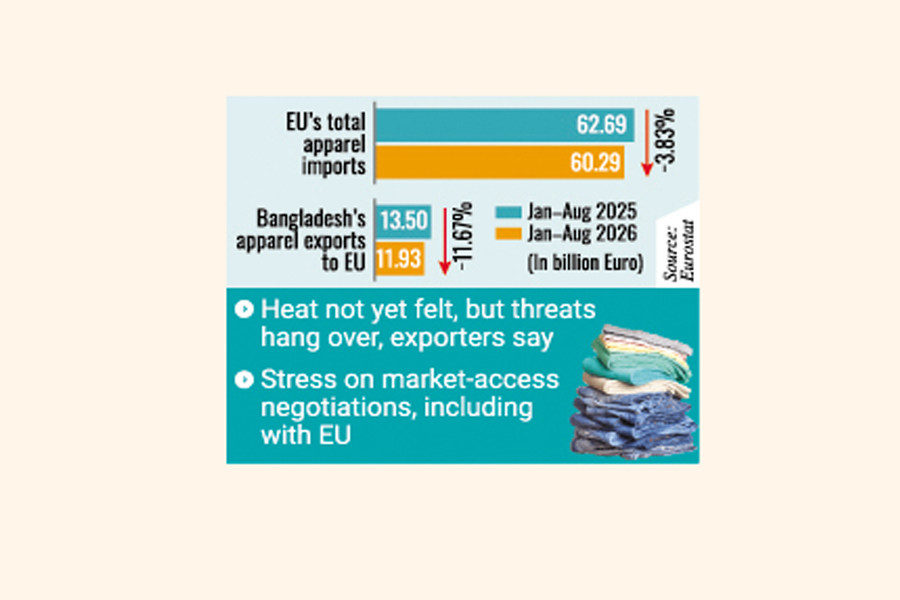
According to Eurostat data, the EU imported apparel worth 60.29 billion euros in January-August 2026, down 3.83 per cent from 62.69 billion euros in the same period last year.

Bangladesh's apparel exports to the EU fell 11.67 per cent to 11.93 billion euros during the period from 13.50 billion euros a year earlier.

However, the August data showed local exports increased by 1.39 per cent in a sign of recovery.

When asked, Fazlee Shamim Ehsan, executive president of Bangladesh Knitwear Manufacturers and Exporters Association, said one of his France buyers indicated that the situation is not good there and warned Mr Ehsan to get prepared for about 20-percent less work orders in January next from the expected ones.

Talking to the FE on Saturday, Nuria Lopez, chairperson of Eurocham Bangladesh, said Bangladesh can't control the global issues, including the protests in France.

"We need to keep an eye on it but it is too early to assume that the problem will be solved soon.

"Bangladesh should focus on addressing its own issues as to how it could raise its competitiveness, how to balance the upcoming wage hike, improve customs, energy supply and logistics issues," she noted.

On a note of concern, Ms Lopez further noted that India is emerging as one of the strong competitors of Bangladesh and stressed market- access negotiations, including FTA, with the EU and pay attention to how neighbours are competing with Bangladesh.​
 

Bangladesh's denim exports to EU rise 12.71pc in August

BSS


1792885115587.webp

Denim jeans Reuters

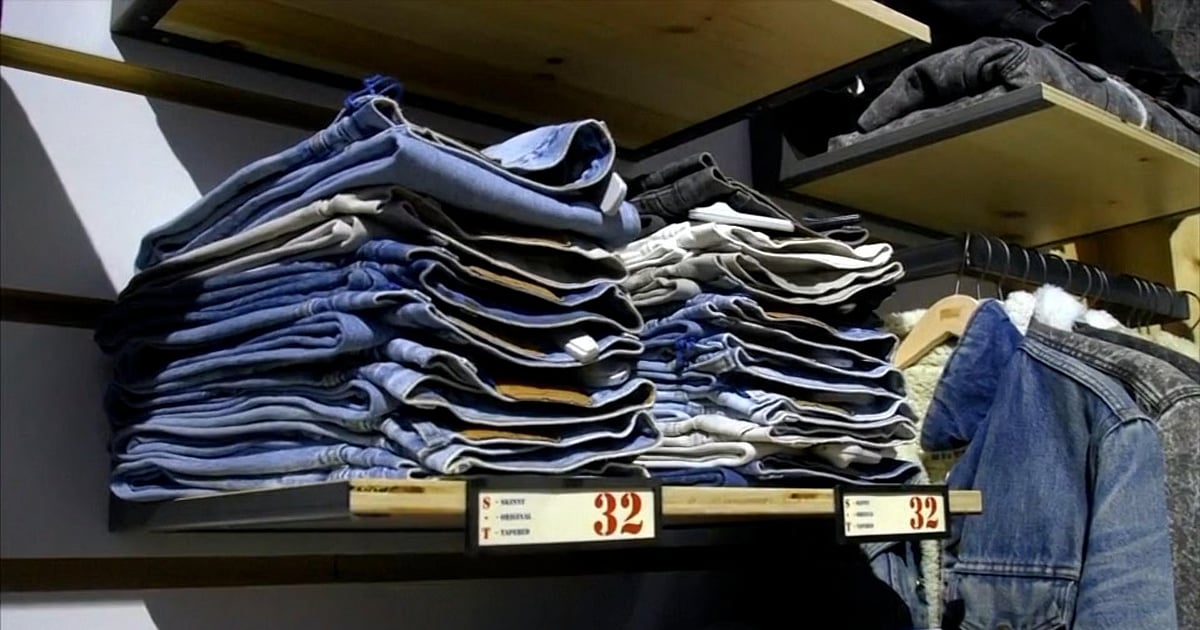
Bangladesh's denim exports to the European Union grew 12.71 per cent year-on-year in August 2026 to 134.08 million euros, from 118.96 million euros a year earlier, according to Eurostat data.

The August growth outpaced the overall market, as total EU denim imports from the world rose 11.23 per cent to 430.16 million euros. Bangladesh's share of the EU's August imports stood at about 31.2 per cent, up from about 30.8 per cent a year earlier.

Over January-August, however, Bangladesh's shipments fell 5.85 per cent to 869.13 million euros from 923.11 million euros, a drop of about 54 million euros. The decline was sharper than the overall market's 4.40 per cent fall to 2,956.21 million euros.

As a result, Bangladesh's eight-month market share slipped to 29.40 per cent from about 29.9 per cent a year earlier. It nonetheless remained the EU's largest denim supplier, well ahead of Pakistan, by about 344 million euros.

Pakistan, the second-largest supplier, saw August exports grow 14.99 per cent to 87.71 million euros, but its January-August shipments fell 7.88 per cent to 525.49 million euros, a 17.78 per cent share.

Turkey, the third-largest, was hit hardest. Its August exports fell 13.26 per cent to 58.84 million euros, and its eight-month exports dropped 21.08 per cent to 438.25 million euros, a 14.82 per cent share.

Tunisia's eight-month exports fell 6.44 per cent to 219.94 million euros, while Cambodia's declined 6.47 per cent to 144.83 million euros. Morocco fell 14.48 per cent to 63.87 million euros.

Egypt was the standout, with exports up 59.57 per cent in August to 30.67 million euros and up 31.46 per cent over eight months to 188.14 million euros, for a 6.36 per cent share. China's exports rose 17.70 per cent over eight months to 197.13 million euros, giving it a 6.67 per cent share.

Vietnam and India, though small, posted strong growth. Vietnam's eight-month exports rose 45.38 per cent to 53.98 million euros, and India's rose 18.62 per cent to 31.40 million euros.

Bangladesh's eight-month decline was milder than that of Pakistan, Turkey, Tunisia, Cambodia and Morocco.

Talking to BSS, former Director of BGMEA Mohiuddin Rubel said Bangladesh has maintained a strong position in the European Union (EU) denim market despite an overall decline in apparel imports, thanks to its well-established supply chain, skilled workforce and technological capabilities.

He said Bangladesh had developed a strong foundation in denim manufacturing over many years, enabling the country to remain competitive in major markets, including Europe and the United States.

“Bangladesh has a strong supply chain base that has developed over many years. We have built expertise in technicians, technology and other areas of production,” Rubel said.

He said the country could further strengthen its position by shifting from volume-based production towards higher-value products, expanding value addition and adopting innovative technologies.

Although Bangladesh does not produce cotton, its strong fabric manufacturing capacity and established industrial base provide significant opportunities to upgrade denim products and increase export earnings, he added.

Rubel said the current slowdown in the European apparel market had affected exporters across countries, largely due to inflation, weaker imports and energy-related challenges.

Despite the difficult market conditions, Bangladesh continued to hold the leading position in the EU denim segment, with a substantial gap between the country and its nearest competitor, he said.

Rubel also stressed the importance of preparing for evolving EU trade rules, Generalised Scheme of Preferences (GSP) requirements and the European Green Deal.

Bangladesh should therefore focus on higher-value products, technological upgrading, innovation and compliance with emerging sustainability requirements to sustain its long-term growth in the global denim industry, he added.​
 
Back
Top