Home Login Watch Videos Wars Movies

[🇧🇩] Those who have laid down their lives to free Bangladesh

[🇧🇩] Those who have laid down their lives to free Bangladesh
83
3K
More threads by Saif

G Bangladesh Defense
Quota reform movement: Six women, girls shot dead
Naznin AkhterDhaka
Updated: 15 Aug 2024, 19: 41

1723771902382.png

Quota reform movement: Six women, girls shot dead

Mustafizur Rahman, 29, lost his mother Maya Islam, 60, in the shooting. His son Basit Khan Musa, 7, is fighting for his life at the Intensive Care Unit (ICU) of Dhaka Medical College Hospital after being hit by a bullet on head.

Mustafizur’s mother and son received bullet wounds on 19 July near the staircase of their house in Dhaka’s Rampura. While talking with Prothom Alo on Sunday, Mostafizur asked why people could not remain safe even inside their homes.

Not only Maya Islam, others like Sumaiya Akter, 20, Naima Sultana, 15, Riya Gope, 6, Nasima Akter, 24, and domestic help Liza Aktar, 19, were not spared from bullets inside their houses.

Deaths of at least 580 were reported during the quota reform movement and subsequent violence. At least six of them are women, teenage girls and girl children. All of them died after being hit by bullets on 18-20 July.

There are allegations that police, RAB and Border Guard Bangladesh (BGB) personnel used firearms and shot protesters indiscriminately to quell the protests that ultimately led to the fall of Sheikh Hasina government.

Of the six women, teenagers and girls killed, three were shot in the head, two in the abdomen and one in the throat. Sumaiya, Naima and Liza were shot while on the balcony of their houses. Riya and Nasima were shot while on the roof. Maya Islam was shot while inside the 'collapsible gate' on the ground floor of her house.

Sheikh Hasina resigned from the post of prime minister and left the country on 5 August. Police started filing cases in Dhaka over the death of people in protests. The police in the case statements alleged that the victims died in indiscriminate firing by criminals.

However, Brigadier General M Sakhawat Hossain, home adviser to the interim government’s chief adviser, on Sunday told the journalists that it was not a right decision to give lethal weapons to police. The police who misused this would be brought to book.

Maya was buying ice cream for her grandchild

Maya Islam’s son Mustafizur told Prothom Alo that he lives at a rented flat at Meradia Haat area in front of Rampura police station. Maya Islam used to live there with the family. Mustafizur has an electronics shop at Malibagh Bazar.

Mustafizur is the elder of Maya Islam’s two offspring. He said Maya went downstairs around 3:00pm on 19 July with her grandchild Basit as the clashes subsided a bit. She wanted to buy ice cream for Basit. As she went downstairs, a bullet hit the head Basit and entered through her lower abdomen.

Hit by a bullet, Maya Islam was taken to a local hospital first. After primary treatment, she was taken to the house of a relative. As her condition had deteriorated, she was taken to Dhaka Medical College Hospital where she was declared dead. Mustafizur said a certain government agency called to confirm about the death of Maya. He does not have to pay the bills of ICU for his son but has to buy medicines and bear the costs of medical examinations.

Mustafizur on Sunday said his mother Maya would look after his son Basit and everything of the family.

Naima’s younger brother wakes up screaming

Tenth grader Naima Sultana would have turned 15 a few days later.

Around 5:00pm on 19 July, she was shot dead while on the balcony to bring the clothes hung for drying.

Naima was second among three offspring of homeopathic doctor Golam Mostafa and Ainun Nahar from Matlab Uttar upazila in Chandpur. She was a student of Milestone School and College. Naima was buried at her village home.

Ainun Nahar lives on the third floor of a five-storied building at Uttara sector 5. She said all the doors and windows were shut on the fateful day.

Naima was drawing and told her mother that she would make pizza.

Suddenly she said ‘let me bring the clothes from verandah’ with her mother on her heels. As soon as Naima opened the door leading to the balcony, a bullet hit her head.

‘I could not even imagine that we would become so unsafe inside the house. Fear has gripped me. My elder son (eight-year-old) has become ill seeing so much blood. He wakes up from sleep screaming now.

Naima wanted to become a physician. All her dreams have now come to an end,’ added Ainun Nahar.

Riya’s father cannot focus on anything

On 19 July, the six-year-old Riya Gope was playing on the roof of her family's four-storey building in the Naya Mati area of Narayanganj Sadar.

As clashes broke out outside, her father Dipak Kumar Gope rushed to the roof to get her inside. As Dipak took her in his arms, a bullet hit Riya in her head.

Riya was the only child of businessman Dipak Kumar and Beauty Ghosh. Riya was a first grader.

Dipak Kumar said he can no longer focus on anything. Riya’s mother Beauty Ghosh is also mentally devastated.

Nasima went to rooftop with two nephews

Nasima Akhter, 24, went to the roof with her two nephews on 19 July. He was shot there and died the next day while undergoing treatment in a private hospital in the capital. His nephew Ayman Uddin, 20, was shot.

Nasima’s sister-in-law Rehana Akhtar broke down in tears while talking about that day last Sunday. She said the bullet entered through one side of his son's chest and exited through Nasima's cheek.

Rehana's husband Helal Uddin lives in Spain. She lives at a rented apartment in a nine-storied building at Dhanmondi road no. 1 with his three sons and sister-in-law. Two weeks before the incident, Nasima came to visit her home from Noakhali. Her son Ayman returned home on 5 August after 15 days of treatment.

Ayman told Prothom Alo that he along with his elder brother Salman Uddin, Nasima and some others from the apartment were on the roof of the building at that time. Suddenly a bullet hit him.

Nasima was the eldest of seven offspring of Yousuf Ali and Saleha Begum. She was buried at her maternal grandfather’s home in Noakhali’s Begumgonj.

Liza fought for her life for four days

Liza Akter, 19, was a domestic help at a house in city’s Shantinagar. She used to work at a flat on the sixth floor of a 12-storied building. She was hit with a bullet on the balcony around 3:00pm on 18 July.

The family Liza had lived with got her admitted at Arora Specialized Hospital. After primary treatment there, she was admitted to Popular Medical College Hospital, where she succumbed to her wounds on 22 July.

She was buried at her family graveyard in Bhola’s Borhanuddin upazila.
Prothom Alo’s Bhola correspondent Neyamatullah talked with Liza’s elder sister Salma Akter, 28. Salma said she doesn't want any justice over the killing.

From whom will she seek justice, asked Salma.

Sumaiya’s infant looks for mother

Sumaiya Akhtar, 20, was shot dead on the balcony of his house at around 6:30pm on 20 July. She has a two-and-a-half-month-old baby. He lived with his family on the sixth floor of a building at Painadi in Narayanganj’s Siddhirganj.

Symaiya’s mother Asma Begum told Prothom Alo on Sunday that a helicopter was hovering above during the incident. Asma and her daughter Sumaiya stood on the balcony to see the helicopter. Sumaiya suddenly collapsed after being hit by a bullet on her head.

Asma initially thought Sumaiya got frightened, but after grabbing her Asma saw blood gushing out of her head. Sumaiya died on the spot.

Sumaiya’s husband Jahid Hossain works at a garments factory as operator at Kanchpur.

Asma said Sumaiya’s infant Sowaiba now looks for mother and her touch. She craves breast milk before going to sleep.

'To whom will I seek justice for the murder of my daughter?' Asma asked.​
 
Analyze

Analyze Post

Add your ideas here:
Highlight Cite Fact Check Respond
  • Sad (0)
Reactions: Bilal9

15 killed in 6 hrs even after Hasina’s departure
Md Abdullah Al Hossain
Dhaka
Updated: 06 Feb 2025, 10: 59

1739754354005.webp

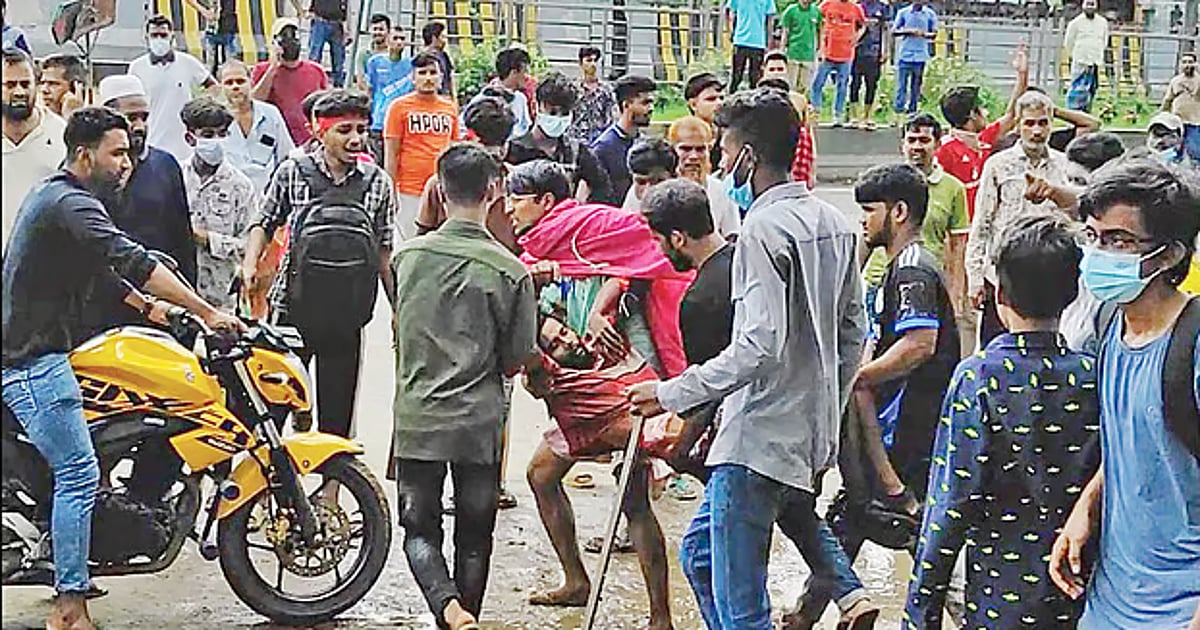
People carrying a man hit by bullet in front of the Lab Zone in Savar File photo

5 August 2024. When the helicopter carrying former prime minister Sheikh Hasina, who was fleeing to India in the face of the mass uprising of the students and people, was crossing the border at around 2.30 pm, a massacre was unfolding in Savar near Dhaka with intermittent fire from the police. There were ambushes in at least four places.

At least 15 people were killed there in just six hours after Sheikh Hasina fled the country. As many as 10 of them were students. The remaining of the deceased were day labourers and low income people. Besides, some 33 persons sustained severe bullet wounds in these incidents. This came up in a Prothom Alo investigation.

The protesting students and people came face to face with the policemen in front of the police station right before the evening. The police were equipped with lethal weapons while the students and people only had brickbats and sticks. All of sudden, the police started firing indiscriminately in the narrow lane filled with people and students.

The police opened fire even at the end of the day as they were fleeing from their stations. When the entire country was celebrating the fall of the government, it was an evening of terror for the residents of Savar.

During two months of investigation, Prothom Alo collected and analysed footage of at least 400 videos of these incidents and compiled them to make a documentary titled Savar Massacre: In the Six Hours After Hasina Fled.

Non-stop firing on the highway

The agitated students and people brought out a procession from the Jahangirnagar University campus with various slogans against Awami League. This procession was heading towards Ganabhaban. Around 11:00, the procession started gaining momentum as students from Ashulia Bypail joined.

Meanwhile, the police had taken a strong position in the Savar bus stand area since morning to prevent any procession from entering Dhaka. Local Awami League, Jubo League and Chhatra League leaders and activists with firearms were along with the police there. There had been intermittent fire in the lanes and the highways since the morning that day.

At around 11: 30 am, madrasah student Md Hasibur Rahman, 17, was shot. About an hour later another student Md Sazzad was shot. They both succumbed to their injuries later.

Meanwhile the procession brought out from the Jahangirnagar University to two and a half hours to reach the Savar bus stand area. The situation turned tense there. In the meantime, the news that the army chief would address the nation at 2:00 pm spread throughout the procession. As soon as the procession tried to move forward to Dhaka upon hearing the news, it was met with heavy police resistance, with tear gas and pellets being fired.

However, the protesters did not back off. To prevent them from moving ahead, the police were firing with lethal weapons. The protesters started to run away to save their lives. There are a number of videos of people carrying numerous injured persons who were hit by the bullets.

Eyewitness Md Mostafizur Rahmam said he saw three persons falling right beside him after being shot. Speaking to Prothom Alo, he said, “He was shot and fell in front of me. It made a hole in the side of his neck. Right next to him someone suddenly fell to the ground. The bullet probably got him in the chest or abdomen. Another fell to the right of him.”

Another teenager named Muzahid Mallik was shot dead. Auto-rickshaw driver Sujan Mia was shot right after. Sujan was shot on his chest and waist.

The highway became vacant following that. Although a large portion of the protesters returned after hearing the news of Sheikh Hasina’s departure from the country, a part of the protesters were scattered around in front of the New Market. Al-Amin was shot there.

At around 2:40 pm, the police backed off a little from the Savar bus stand and took position at the Pakeeza U-loop on the western side of the road. They were accompanied by the local Awami League leaders and activists there.

Nafisa Hossain was shot dead in front of the Pakeeza Model Mosque. A bullet hit the left of her chest and came out at the back, to the right.

At around 2:53 pm, police entered the Thana road from the Dhaka-Aricha highway. But they were still firing towards the highway. At that time, 10th grader Alif Ahmed Siyam, who was hiding behind the road divider, was shot.

Speaking to Prothom Alo, Tania Ahmed, Alif Ahmed Siyam’s mother, said, “When he raised his head to look over the divider, the bullet hit him in the right eye and came out at the back. He fell to the ground immediately.”

Massacre in front of the police station

A portion of the protesting students moved towards Dhaka to celebrate the fall of the government. The other portion stayed put in Savar to create a resistance against police firing and moved forward to the Savar police station. They were chanting slogans that – ‘Sheikh Hasina has fled, Sheikh Hasina has run away.”

Later, at around 3:50 pm the police and protester came face to face at intersection near the Savar police station. The police force moved inside the police station at around 4:30 pm and locked up the main gate from inside. They urged the students to calm down with a mike from inside. Meanwhile, students and locals thronged in front of the police station. The students and general people increase in number in front of the police station. After a while, the police fired tear-shells from the roof of the mosque inside the police station. Then they started lethal gunfire.

A local trader in front was shot 18-19 times in his left hands and 20-22 times on right hands with pellets within seconds.

Speaking to Prothom Alo on condition of anonymity, he said, “I fell down immediately. I crawled past at least 5 shops. The skin and flesh on the knees were scraped off. Then I lost consciousness.”

A man in a red t-shirt was seen lying along the boundary wall of a hospital opposite to the police station. His identity could not be confirmed.

Schoolboy Safwan Akhter was shot dead at the intersection area. A bullet smashed his right hand and another hit on the right side of his chest. The 15-year-old was shot dead at the spot while demonstrating.

Worker Al Amin was shot dead there too. The bullet pierced through the left side of his chest and came out the back at the right. And auto-rickshaw driver Md Rafique was shot in between his chest and abdomen. He too died on the spot.

By that time, the intersection area became vacant. The students and people started thronging the Muktir Mor at around 5:15 pm. After the last round of firing, the crowds had grown.

The situation escalated at the Muktir Mor (an intersection) within a minute with the slogan – “direction action, Savar people into action! Direct action!”

People scattered around Muktir Mor and different other places started moving towards the Chowrasta (another intersection). More than 100 people thronged there and the area turned into a battlefield. Police “fired bullets like rain”.

Video footage of the incident shows protesters fleeing as the police started firing. Numerous gunshots could be hard in the last 15 seconds of the video. People were seen trying to save the lives of people who have been shot. A number of bodies had been lying on the road for a long time.

Bus driver Manik Hossain was lying right in front of the police after being shot by them. He lost consciousness five minutes after being shot.

The police continued the firing for at least half an hour. Speaking to Prothom Alo, student Nazmul Hossain shared the terrible experience that he went through that day.

“As I was running I felt something hit my foot like a 1000-volt-shock. I saw my big toe was hanging loose, shaking. A bone was sticking out of my heel. It was all white,” he recalled.

Prothom Alo has information of four people being shot dead there. They are – Nishan Khan, Tanjir Khan Munna, Abdul Ahad Shaikat and Md Mithu.

Student Mithu was shot in his chest. He died at the Muktir Mor on the way to the hospital. Another student named Tanjir Khan died of excessive bleeding after being shot in his thigh.

Nishan Khan had a wound on the back side of his head. He died at the hospital.

Ambush one after another

Firing was still on in the New Market area when a team of police took stance in the Thana bus stand area after Sheikh Hasina’s departure. There was intermittent firing for 20 minutes. Two other students - Abdul Quayyum and Shrabon Gazi - were shot to death there by 2:45 pm.

Quayyum’s friend Al Amin said, “Suddenly I saw Quayyum falling to the ground in slow motion. I still didn’t realise Quayyum had been hit. He fell down and when we were lifting him, we saw blood trickling out from his side. The bullet hit him in the kidney damaging everything inside. I think the bullet came from across the road. It was shot from the roof.”

The witnesses suspect Quayyum was shot from the multi-storeyed City Centre on the other side of the road. Seeing suspicious movement of people in red clothes on the roof of the building, the agitated mob vandalised the building.

There was another incident of sneak attack in the Thana bus stand area at around 3:00 pm. Police fired bullets from the road while some other unidentified person opened fire from a building nearby. The agitated protesters attacked the local popular hospital suspecting that the gunshots were coming from that building.

Later, the people formed a procession to move forward. The procession faced another round of ambush as soon as it crossed the Enam Medical College. The aggrieved people then attacked a high-rise building nearby. They vandalised the ground floor but did not find anybody.

There was another round of ambush around 5:15 pm at the Muktir Mor. People raided the Zunaid Tower suspecting that the bullets were fired from that building. But they couldn’t find anybody.

Gunshots targeting upper body parts

The Prothom Alo investigation has identified 15 persons who have been shot to death in the Savar upazila from noon to evening on 5 August. As many as 13 of them were shot on the upper parts of their bodies. Four of them sustained lethal bullet wounds and one was shot on the neck. Nine of them were shot in between chest and waist and one died after being shot in the thigh.

Police opened fire while fleeing

After killing and injuring a number of people, the police were looking for ways to flee. Some members of the police fled through the river. Many of the police members put off their uniform to flee. It became easier as it was already evening by that time.

However, most of the police members came out through the Thana road in a convoy. They were still firing from the convoy.

At least 150 police members were marching in front of the police convoy followed by some motorcycles. The motorcycles were ahead of a convoy of 13 cars. There was a pick up van, an armoured car, ambulance, microbus, leguna (locally made public transport) and a truck in the convoy.

The locals claim there were local leaders and activists of the Awami League and its associate bodies. However, the claim couldn’t be verified. The police continued firing in the nearby lanes when the convoy was on the highway.

Relentless sounds of gunshots spread fear among the residents of Savar upazila. In the end, the police convoy moved towards the cantonment.

* This report appeared on the print and online versions of Prothom Alo and has been rewritten in English by Ashish Basu​
 
Analyze

Analyze Post

Add your ideas here:
Highlight Cite Fact Check Respond

The disappeared of the July uprising: Part 1
Hastily buried in unmarked graves
1741739013299.webp

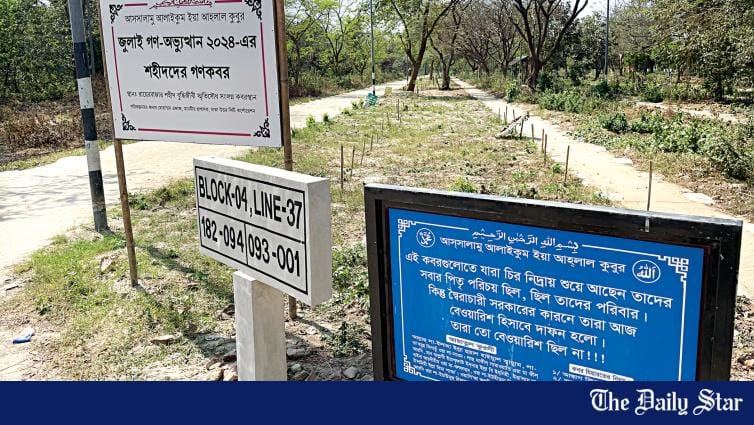
In Block 4 of Rayerbazar graveyard lie many unidentified victims of the July atrocities. Photo: Naimur Rahman

Seven months after the July uprising in Bangladesh, many protesters still remain missing. We investigated 31 cases: six were buried as unclaimed bodies at Rayerbazar graveyard; four were identified by families from among the charred bodies in Ashulia; two were handed over to families after DNA testing; and 19 are still unaccounted for. We found evidence of systematic government efforts to cover up medical records and bodies of the victims so they can never be found again. This four-part series also documents how families were denied time to collect the corpses from hospital morgues, and how they are now waiting for the bodies of their loved ones.

On July 18, 2024, two days after Abu Sayed's killing in Rangpur, Sohel Rana stepped out of his home in Dhaka's Jatrabari around 6:00pm to join the quota reform movement. He told his mother he would be back soon, but he never did.

Around an hour after he joined the protest in Jatrabari area, police detained Sohel, 28, tortured him, and then shot him several times, four fellow protesters and a person who admitted him to Dhaka Medical College Hospital told The Daily Star. His inquest report, prepared by Shahbagh police, confirms he had multiple pellet wounds on both sides of his chest and bruises on different parts of his body.

Faisal Sarker, 18, a college student who also worked as a supervisor of a bus company, left home for work at Abdullahpur bus stand in Uttara on July 19. By the time he got out, the crackdown on the streets was getting worse.

"The night he disappeared, we kept our front door open, thinking he would come home at any moment. My son never came home. Now I cannot even find his grave."— Rasheda Begum Sohel Rana's mother.

He called his mother to tell her that he was coming home, in Cumilla, to stay with her until the situation stabilised. His family last heard of him when he was crossing Uttara to get a bus. He then vanished.

The same day in Uttara, Md Assadullah, a driver and a father of two, was shot by Awami League-affiliated helmeted assailants, according to CCTV camera footage and multiple still images verified by The Daily Star.

1741739086616.webp


Sohel, Faisal and Assadullah never knew each other in life. But their fates converged in death.

Their bodies, along with many others, ended up at Dhaka Medical College morgue. Unidentified, unclaimed.

A nationwide curfew, intended to quash the movement, kept their families from finding them, and the six were hurriedly buried in unmarked graves at Rayerbazar before their relatives could collect their bodies, an investigation by The Daily Star has found.

Meanwhile, at least 19 more families we spoke to continue searching for their fathers, sons, brothers or husbands whom they lost during the July uprising. But they don't know if they will ever find them as there are hardly any efforts from the government to resolve the mystery of these missing men.

Sohel Rana’s mother Rasheda Begum weeps as she touches the photo of her son at an exhibition. Photo: Collected
At least 12 of these 19 people went missing on August 4 and 5 from Dhaka, Savar, Gazipur, Sirajganj, Panchagarh and Bogura amid clashes and police firing.

The fact-finding report by the UN Office of the High Commissioner for Human Rights (OHCHR) cited senior security officials' testimony, saying deposed prime minister Sheikh Hasina herself ordered security forces to "arrest the ringleaders of the protests, the troublemakers, kill them and hide their bodies."

However, there is no official account yet of how many bodies were actually hidden by the state apparatus.

The Daily Star investigated 31 cases of unclaimed or missing bodies, but evidence suggests that the actual number is higher.

Over the last two months, we have pieced together hospital records and police inquest reports as well as records from Anjuman Mufidul Islam, a charity for burial service, and Rayerbazar graveyard, and found evidence of deliberate attempts by state forces to kill protesters and hide their bodies.

1741739128242.webp

Burial of eight unidentified bodies related to the July massacre is underway at Rayerbazar graveyard on July 24, 2024. Photo: Collected

THE UNMARKED GRAVES

Anjuman Mufidul Islam is the only burial service in the country that handles unclaimed bodies. We reviewed its register and found that the charity buried 515 bodies from January to November 2024, an average of 47 bodies per month.

"We last heard of him when he said he was crossing Uttara to board a bus. There were sounds of gunfire. Since then, his phone has been switched off."— Abdur Rahim Brother-in-law of Faisal Sarker.

However, the body count jumped after the middle of July. Only in the last 10 days of that month, when police, Rab, BGB, Ansar and armed forces members were called in to tackle the protesters, Anjuman sent 45 bodies for burial in the Rayerbazar graveyard, just two less than its monthly average.

Anjuman's register shows it did not send a single body for burial from August 1 to 11, despite an intensified crackdown between August 2 and 5. But in the remaining 20 days, it buried 34 bodies.

We went to see the burial sites at Rayerbazar on January 29. Block 4 of the cemetery contained 114 graves without names or any other identifiable markings. Grave staffers said many were victims of the July uprising, but could not give a figure.

Analysing Rayerbazar's register, we found that 27 bodies buried in July and 13 in August had dates of death between July 17 and August 5, the final and the deadliest three weeks of Sheikh Hasina's 15-year authoritarian rule, when hundreds were killed and thousands injured by state forces.

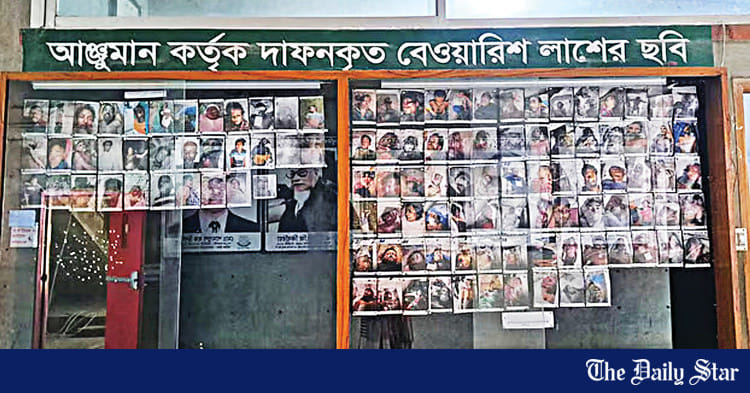
In addition to Sohel, Faisal and Assadullah, at least three more protesters – Rafiqul Islam, Mahin Mia, and Ahmed Jilani – now lie in Rayerbazar as unidentified bodies, The Daily Star can confirm.

Photos of their bodies are still on display on a wall of Anjuman among the 114 buried in July-August.

Of the 114, at least 40 died between July 17 and August 5 and the rest 74 before and after that period. Based on the dates of death of the 40, it is likely that many of them were victims of the July massacre.

All the six July uprising victims that we have been able to identify went missing between July 18 and 20 in and around the protest hotspots—Jatrabari, Shonir Akhra, Uttara, and Mohammadpur, witnesses and family members said.

Except Jilani, who was killed on August 3 and laid to rest on August 31, the rest were buried in July, within days of their deaths. Apart from Mahin, who went missing from Mohammadpur and taken to Suhrawardy Medical College Hospital, the other five were brought to DMCH.

When we met Sohel Rana's mother Rasheda Begum at her Jatrabari house in January, she clutched a picture of her son to her chest and wept.

"The night he disappeared, we kept our front door open, thinking he would come home at any moment. My son never came home. Now I cannot even find where among the 114 graves lies my son."

Read Part 2 tomorrow on the systematic efforts by state agencies to hide the true extent of the July massacre.​
 

Analyze Post

Add your ideas here:
Highlight Cite Respond

Summarily killed, hastily buried
Seven months after the July uprising in Bangladesh, many protesters still remain missing. We investigated 31 cases: six were buried as unclaimed bodies at Rayerbazar graveyard; four were identified by families from among the charred bodies in Ashulia; two were handed over to families after DNA testing; and 19 are still unaccounted for. We found evidence of systematic government efforts to cover up medical records and bodies of the victims so they can never be found again. This four-part series also documents how families were denied time to collect the corpses from hospital morgues, and how they are now waiting for the bodies of their loved ones.

On July 18, 2024, two days after Abu Sayed's killing in Rangpur, Sohel Rana stepped out of his home in Dhaka's Jatrabari around 6:00pm to join the quota reform movement. He told his mother he would be back soon, but he never did.

Around an hour after he joined the protest in Jatrabari area, police detained Sohel, 28, tortured him, and then shot him several times, four fellow protesters and a person who admitted him to Dhaka Medical College Hospital told The Daily Star. His inquest report, prepared by Shahbagh police, confirms he had multiple pellet wounds on both sides of his chest and bruises on different parts of his body.

Faisal Sarker, 18, a college student who also worked as a supervisor of a bus company, left home for work at Abdullahpur bus stand in Uttara on July 19. By the time he got out, the crackdown on the streets was getting worse.

1741825483818.webp

Sohel Rana’s mother Rasheda Begum weeps as she touches the photo of her son at an exhibition. Photo: Collected

"The night he disappeared, we kept our front door open, thinking he would come home at any moment. My son never came home. Now I cannot even find his grave."— Rasheda Begum Sohel Rana's mother.

He called his mother to tell her that he was coming home, in Cumilla, to stay with her until the situation stabilised. His family last heard of him when he was crossing Uttara to get a bus. He then vanished.

The same day in Uttara, Md Assadullah, a driver and a father of two, was shot by Awami League-affiliated helmeted assailants, according to CCTV camera footage and multiple still images verified by The Daily Star.

Sohel, Faisal and Assadullah never knew each other in life. But their fates converged in death.

1741825572576.webp


Their bodies, along with many others, ended up at Dhaka Medical College morgue. Unidentified, unclaimed.

A nationwide curfew, intended to quash the movement, kept their families from finding them, and the six were hurriedly buried in unmarked graves at Rayerbazar before their relatives could collect their bodies, an investigation by The Daily Star has found.

Meanwhile, at least 19 more families we spoke to continue searching for their fathers, sons, brothers or husbands whom they lost during the July uprising. But they don't know if they will ever find them as there are hardly any efforts from the government to resolve the mystery of these missing men.

At least 12 of these 19 people went missing on August 4 and 5 from Dhaka, Savar, Gazipur, Sirajganj, Panchagarh and Bogura amid clashes and police firing.

The fact-finding report by the UN Office of the High Commissioner for Human Rights (OHCHR) cited senior security officials' testimony, saying deposed prime minister Sheikh Hasina herself ordered security forces to "arrest the ringleaders of the protests, the troublemakers, kill them and hide their bodies."

However, there is no official account yet of how many bodies were actually hidden by the state apparatus.

The Daily Star investigated 31 cases of unclaimed or missing bodies, but evidence suggests that the actual number is higher.

Over the last two months, we have pieced together hospital records and police inquest reports as well as records from Anjuman Mufidul Islam, a charity for burial service, and Rayerbazar graveyard, and found evidence of deliberate attempts by state forces to kill protesters and hide their bodies.

1741825723123.webp


THE UNMARKED GRAVES

Anjuman Mufidul Islam is the only burial service in the country that handles unclaimed bodies. We reviewed its register and found that the charity buried 515 bodies from January to November 2024, an average of 47 bodies per month.

"We last heard of him when he said he was crossing Uttara to board a bus. There were sounds of gunfire. Since then, his phone has been switched off."— Abdur Rahim Brother-in-law of Faisal Sarker.

However, the body count jumped after the middle of July. Only in the last 10 days of that month, when police, Rab, BGB, Ansar and armed forces members were called in to tackle the protesters, Anjuman sent 45 bodies for burial in the Rayerbazar graveyard, just two less than its monthly average.

Anjuman's register shows it did not send a single body for burial from August 1 to 11, despite an intensified crackdown between August 2 and 5. But in the remaining 20 days, it buried 34 bodies.

We went to see the burial sites at Rayerbazar on January 29. Block 4 of the cemetery contained 114 graves without names or any other identifiable markings. Grave staffers said many were victims of the July uprising, but could not give a figure.

Analysing Rayerbazar's register, we found that 27 bodies buried in July and 13 in August had dates of death between July 17 and August 5, the final and the deadliest three weeks of Sheikh Hasina's 15-year authoritarian rule, when hundreds were killed and thousands injured by state forces.

In addition to Sohel, Faisal and Assadullah, at least three more protesters – Rafiqul Islam, Mahin Mia, and Ahmed Jilani – now lie in Rayerbazar as unidentified bodies, The Daily Star can confirm.

Photos of their bodies are still on display on a wall of Anjuman among the 114 buried in July-August.

Of the 114, at least 40 died between July 17 and August 5 and the rest 74 before and after that period. Based on the dates of death of the 40, it is likely that many of them were victims of the July massacre.

All the six July uprising victims that we have been able to identify went missing between July 18 and 20 in and around the protest hotspots—Jatrabari, Shonir Akhra, Uttara, and Mohammadpur, witnesses and family members said.

Except Jilani, who was killed on August 3 and laid to rest on August 31, the rest were buried in July, within days of their deaths. Apart from Mahin, who went missing from Mohammadpur and taken to Suhrawardy Medical College Hospital, the other five were brought to DMCH.

When we met Sohel Rana's mother Rasheda Begum at her Jatrabari house in January, she clutched a picture of her son to her chest and wept.

"The night he disappeared, we kept our front door open, thinking he would come home at any moment. My son never came home. Now I cannot even find where among the 114 graves lies my son."

Read Part 2 tomorrow on the systematic efforts by state agencies to hide the true extent of the July massacre.​
 

Analyze Post

Add your ideas here:
Highlight Cite Respond
  • Sad (0)
Reactions: Bilal9

EX-MINISTER HOUSE ATTACK: Students hold coffin procession as injured fellow dies
Staff Correspondent 13 February, 2025, 00:06

A student who was injured in a counter attack by local people allegedly over attacking on the ousted Awami League government’s liberation war affairs minister AKM Mozammel Haque on February 7 night, died while undergoing treatment at the Dhaka Medical College Hospital Wednesday afternoon.

The deceased was identified as Abdul Kashem, 17, a resident under Gacha police station in Gazipur city, who died at about 3:00pm on Wednesday at the Intensive Care Unit of the hospital, according to police and victim’s family.

‘The body was kept at the Dhaka Medical morgue for autopsy,’ said DMCH police outpost in-charge Md Faruk.

He said that Kashem had been taken to the DMCH at about 2:00am on February 8 in a critical condition, hours after he was injured in Gazipur.

Protesting at Kashem’s death, the Students Against Discrimination held a coffin procession at about 9:00pm on Wednesday following Kashem’s namaz-e-janaza at the Central Shaheed Minar in the capital Dhaka, demanding banning the Awami League.

Central convener of the platform Hasnat Abdullah in a Facebook post announced the coffin procession programme. He also announced coffin processions in districts, upazilas and unions across the country.

At least 15 students were injured in the counter attack as several dozens of students allegedly went to attack the residence of Mozammel.

A case was filed with the Gazipur Sadar police station on February 9, mentioning names of 239 people and 200-300 unnamed others over the attack on members of the Students against Discrimination.

Gazipur Sadar police station officer-in-charge Md Mehedi Hasan told New Age that at least 160 people, including 28 on Wednesday, had been arrested so far in this connection.​

They should drop a few incendiary bombs in that Gazipur area (stronghold of AL). These people need "shock and awe" treatment like in Iraq. Maybe after Ramzan.
 
Analyze

Analyze Post

Add your ideas here:
Highlight Cite Fact Check Respond

The disappeared of the July uprising: Part 1
Hastily buried in unmarked graves
View attachment 15360

In Block 4 of Rayerbazar graveyard lie many unidentified victims of the July atrocities. Photo: Naimur Rahman

Seven months after the July uprising in Bangladesh, many protesters still remain missing. We investigated 31 cases: six were buried as unclaimed bodies at Rayerbazar graveyard; four were identified by families from among the charred bodies in Ashulia; two were handed over to families after DNA testing; and 19 are still unaccounted for. We found evidence of systematic government efforts to cover up medical records and bodies of the victims so they can never be found again. This four-part series also documents how families were denied time to collect the corpses from hospital morgues, and how they are now waiting for the bodies of their loved ones.

On July 18, 2024, two days after Abu Sayed's killing in Rangpur, Sohel Rana stepped out of his home in Dhaka's Jatrabari around 6:00pm to join the quota reform movement. He told his mother he would be back soon, but he never did.

Around an hour after he joined the protest in Jatrabari area, police detained Sohel, 28, tortured him, and then shot him several times, four fellow protesters and a person who admitted him to Dhaka Medical College Hospital told The Daily Star. His inquest report, prepared by Shahbagh police, confirms he had multiple pellet wounds on both sides of his chest and bruises on different parts of his body.

Faisal Sarker, 18, a college student who also worked as a supervisor of a bus company, left home for work at Abdullahpur bus stand in Uttara on July 19. By the time he got out, the crackdown on the streets was getting worse.

"The night he disappeared, we kept our front door open, thinking he would come home at any moment. My son never came home. Now I cannot even find his grave."— Rasheda Begum Sohel Rana's mother.

He called his mother to tell her that he was coming home, in Cumilla, to stay with her until the situation stabilised. His family last heard of him when he was crossing Uttara to get a bus. He then vanished.

The same day in Uttara, Md Assadullah, a driver and a father of two, was shot by Awami League-affiliated helmeted assailants, according to CCTV camera footage and multiple still images verified by The Daily Star.

View attachment 15361


Sohel, Faisal and Assadullah never knew each other in life. But their fates converged in death.

Their bodies, along with many others, ended up at Dhaka Medical College morgue. Unidentified, unclaimed.

A nationwide curfew, intended to quash the movement, kept their families from finding them, and the six were hurriedly buried in unmarked graves at Rayerbazar before their relatives could collect their bodies, an investigation by The Daily Star has found.

Meanwhile, at least 19 more families we spoke to continue searching for their fathers, sons, brothers or husbands whom they lost during the July uprising. But they don't know if they will ever find them as there are hardly any efforts from the government to resolve the mystery of these missing men.

Sohel Rana’s mother Rasheda Begum weeps as she touches the photo of her son at an exhibition. Photo: Collected
At least 12 of these 19 people went missing on August 4 and 5 from Dhaka, Savar, Gazipur, Sirajganj, Panchagarh and Bogura amid clashes and police firing.

The fact-finding report by the UN Office of the High Commissioner for Human Rights (OHCHR) cited senior security officials' testimony, saying deposed prime minister Sheikh Hasina herself ordered security forces to "arrest the ringleaders of the protests, the troublemakers, kill them and hide their bodies."

However, there is no official account yet of how many bodies were actually hidden by the state apparatus.

The Daily Star investigated 31 cases of unclaimed or missing bodies, but evidence suggests that the actual number is higher.

Over the last two months, we have pieced together hospital records and police inquest reports as well as records from Anjuman Mufidul Islam, a charity for burial service, and Rayerbazar graveyard, and found evidence of deliberate attempts by state forces to kill protesters and hide their bodies.

View attachment 15362
Burial of eight unidentified bodies related to the July massacre is underway at Rayerbazar graveyard on July 24, 2024. Photo: Collected

THE UNMARKED GRAVES

Anjuman Mufidul Islam is the only burial service in the country that handles unclaimed bodies. We reviewed its register and found that the charity buried 515 bodies from January to November 2024, an average of 47 bodies per month.

"We last heard of him when he said he was crossing Uttara to board a bus. There were sounds of gunfire. Since then, his phone has been switched off."— Abdur Rahim Brother-in-law of Faisal Sarker.

However, the body count jumped after the middle of July. Only in the last 10 days of that month, when police, Rab, BGB, Ansar and armed forces members were called in to tackle the protesters, Anjuman sent 45 bodies for burial in the Rayerbazar graveyard, just two less than its monthly average.

Anjuman's register shows it did not send a single body for burial from August 1 to 11, despite an intensified crackdown between August 2 and 5. But in the remaining 20 days, it buried 34 bodies.

We went to see the burial sites at Rayerbazar on January 29. Block 4 of the cemetery contained 114 graves without names or any other identifiable markings. Grave staffers said many were victims of the July uprising, but could not give a figure.

Analysing Rayerbazar's register, we found that 27 bodies buried in July and 13 in August had dates of death between July 17 and August 5, the final and the deadliest three weeks of Sheikh Hasina's 15-year authoritarian rule, when hundreds were killed and thousands injured by state forces.

In addition to Sohel, Faisal and Assadullah, at least three more protesters – Rafiqul Islam, Mahin Mia, and Ahmed Jilani – now lie in Rayerbazar as unidentified bodies, The Daily Star can confirm.

Photos of their bodies are still on display on a wall of Anjuman among the 114 buried in July-August.

Of the 114, at least 40 died between July 17 and August 5 and the rest 74 before and after that period. Based on the dates of death of the 40, it is likely that many of them were victims of the July massacre.

All the six July uprising victims that we have been able to identify went missing between July 18 and 20 in and around the protest hotspots—Jatrabari, Shonir Akhra, Uttara, and Mohammadpur, witnesses and family members said.

Except Jilani, who was killed on August 3 and laid to rest on August 31, the rest were buried in July, within days of their deaths. Apart from Mahin, who went missing from Mohammadpur and taken to Suhrawardy Medical College Hospital, the other five were brought to DMCH.

When we met Sohel Rana's mother Rasheda Begum at her Jatrabari house in January, she clutched a picture of her son to her chest and wept.

"The night he disappeared, we kept our front door open, thinking he would come home at any moment. My son never came home. Now I cannot even find where among the 114 graves lies my son."

Read Part 2 tomorrow on the systematic efforts by state agencies to hide the true extent of the July massacre.​

Very sad and heartbreaking. Bewarish burials - when they had families and relatives, who could not bury them and draw closure.

Zalim Hasina and Modi will pay...
 

Analyze Post

Add your ideas here:
Highlight Cite Respond

Members Online

Latest Posts

Back
PKDefense
G
O
 
H
O
M
E