Home Login Watch Videos Wars Movies

[🇧🇩] Those who have laid down their lives to free Bangladesh

[🇧🇩] Those who have laid down their lives to free Bangladesh
83
3K
More threads by Saif

G Bangladesh Defense
Quota reform movement: Six women, girls shot dead
Naznin AkhterDhaka
Updated: 15 Aug 2024, 19: 41

1723771902382.png

Quota reform movement: Six women, girls shot dead

Mustafizur Rahman, 29, lost his mother Maya Islam, 60, in the shooting. His son Basit Khan Musa, 7, is fighting for his life at the Intensive Care Unit (ICU) of Dhaka Medical College Hospital after being hit by a bullet on head.

Mustafizur’s mother and son received bullet wounds on 19 July near the staircase of their house in Dhaka’s Rampura. While talking with Prothom Alo on Sunday, Mostafizur asked why people could not remain safe even inside their homes.

Not only Maya Islam, others like Sumaiya Akter, 20, Naima Sultana, 15, Riya Gope, 6, Nasima Akter, 24, and domestic help Liza Aktar, 19, were not spared from bullets inside their houses.

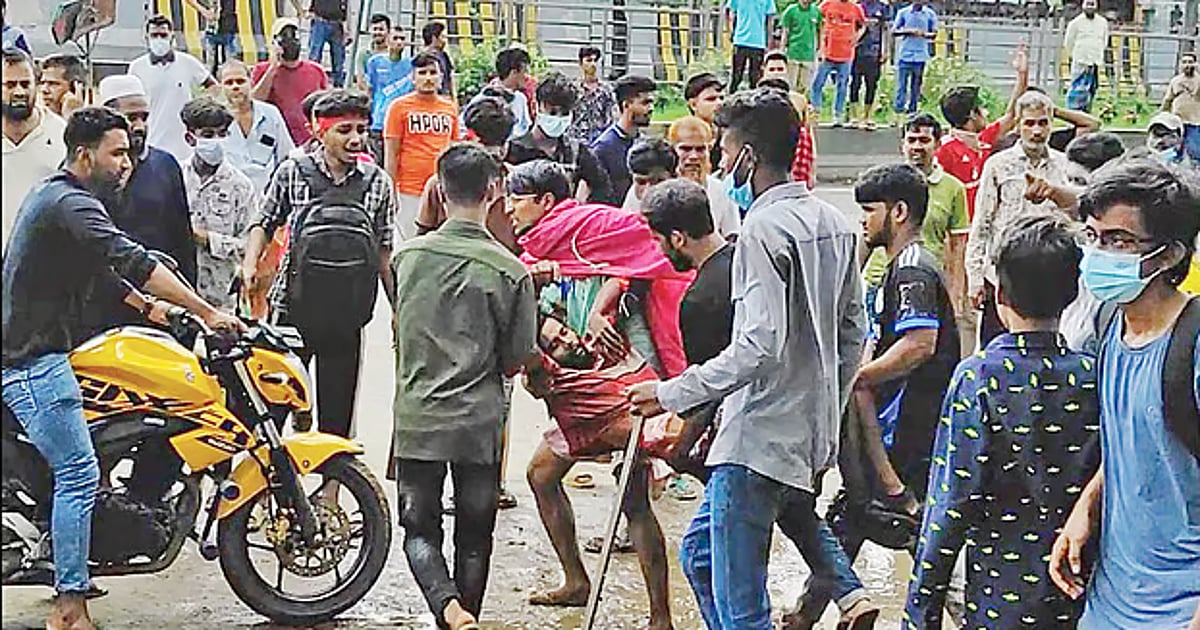
Deaths of at least 580 were reported during the quota reform movement and subsequent violence. At least six of them are women, teenage girls and girl children. All of them died after being hit by bullets on 18-20 July.

There are allegations that police, RAB and Border Guard Bangladesh (BGB) personnel used firearms and shot protesters indiscriminately to quell the protests that ultimately led to the fall of Sheikh Hasina government.

Of the six women, teenagers and girls killed, three were shot in the head, two in the abdomen and one in the throat. Sumaiya, Naima and Liza were shot while on the balcony of their houses. Riya and Nasima were shot while on the roof. Maya Islam was shot while inside the 'collapsible gate' on the ground floor of her house.

Sheikh Hasina resigned from the post of prime minister and left the country on 5 August. Police started filing cases in Dhaka over the death of people in protests. The police in the case statements alleged that the victims died in indiscriminate firing by criminals.

However, Brigadier General M Sakhawat Hossain, home adviser to the interim government’s chief adviser, on Sunday told the journalists that it was not a right decision to give lethal weapons to police. The police who misused this would be brought to book.

Maya was buying ice cream for her grandchild

Maya Islam’s son Mustafizur told Prothom Alo that he lives at a rented flat at Meradia Haat area in front of Rampura police station. Maya Islam used to live there with the family. Mustafizur has an electronics shop at Malibagh Bazar.

Mustafizur is the elder of Maya Islam’s two offspring. He said Maya went downstairs around 3:00pm on 19 July with her grandchild Basit as the clashes subsided a bit. She wanted to buy ice cream for Basit. As she went downstairs, a bullet hit the head Basit and entered through her lower abdomen.

Hit by a bullet, Maya Islam was taken to a local hospital first. After primary treatment, she was taken to the house of a relative. As her condition had deteriorated, she was taken to Dhaka Medical College Hospital where she was declared dead. Mustafizur said a certain government agency called to confirm about the death of Maya. He does not have to pay the bills of ICU for his son but has to buy medicines and bear the costs of medical examinations.

Mustafizur on Sunday said his mother Maya would look after his son Basit and everything of the family.

Naima’s younger brother wakes up screaming

Tenth grader Naima Sultana would have turned 15 a few days later.

Around 5:00pm on 19 July, she was shot dead while on the balcony to bring the clothes hung for drying.

Naima was second among three offspring of homeopathic doctor Golam Mostafa and Ainun Nahar from Matlab Uttar upazila in Chandpur. She was a student of Milestone School and College. Naima was buried at her village home.

Ainun Nahar lives on the third floor of a five-storied building at Uttara sector 5. She said all the doors and windows were shut on the fateful day.

Naima was drawing and told her mother that she would make pizza.

Suddenly she said ‘let me bring the clothes from verandah’ with her mother on her heels. As soon as Naima opened the door leading to the balcony, a bullet hit her head.

‘I could not even imagine that we would become so unsafe inside the house. Fear has gripped me. My elder son (eight-year-old) has become ill seeing so much blood. He wakes up from sleep screaming now.

Naima wanted to become a physician. All her dreams have now come to an end,’ added Ainun Nahar.

Riya’s father cannot focus on anything

On 19 July, the six-year-old Riya Gope was playing on the roof of her family's four-storey building in the Naya Mati area of Narayanganj Sadar.

As clashes broke out outside, her father Dipak Kumar Gope rushed to the roof to get her inside. As Dipak took her in his arms, a bullet hit Riya in her head.

Riya was the only child of businessman Dipak Kumar and Beauty Ghosh. Riya was a first grader.

Dipak Kumar said he can no longer focus on anything. Riya’s mother Beauty Ghosh is also mentally devastated.

Nasima went to rooftop with two nephews

Nasima Akhter, 24, went to the roof with her two nephews on 19 July. He was shot there and died the next day while undergoing treatment in a private hospital in the capital. His nephew Ayman Uddin, 20, was shot.

Nasima’s sister-in-law Rehana Akhtar broke down in tears while talking about that day last Sunday. She said the bullet entered through one side of his son's chest and exited through Nasima's cheek.

Rehana's husband Helal Uddin lives in Spain. She lives at a rented apartment in a nine-storied building at Dhanmondi road no. 1 with his three sons and sister-in-law. Two weeks before the incident, Nasima came to visit her home from Noakhali. Her son Ayman returned home on 5 August after 15 days of treatment.

Ayman told Prothom Alo that he along with his elder brother Salman Uddin, Nasima and some others from the apartment were on the roof of the building at that time. Suddenly a bullet hit him.

Nasima was the eldest of seven offspring of Yousuf Ali and Saleha Begum. She was buried at her maternal grandfather’s home in Noakhali’s Begumgonj.

Liza fought for her life for four days

Liza Akter, 19, was a domestic help at a house in city’s Shantinagar. She used to work at a flat on the sixth floor of a 12-storied building. She was hit with a bullet on the balcony around 3:00pm on 18 July.

The family Liza had lived with got her admitted at Arora Specialized Hospital. After primary treatment there, she was admitted to Popular Medical College Hospital, where she succumbed to her wounds on 22 July.

She was buried at her family graveyard in Bhola’s Borhanuddin upazila.
Prothom Alo’s Bhola correspondent Neyamatullah talked with Liza’s elder sister Salma Akter, 28. Salma said she doesn't want any justice over the killing.

From whom will she seek justice, asked Salma.

Sumaiya’s infant looks for mother

Sumaiya Akhtar, 20, was shot dead on the balcony of his house at around 6:30pm on 20 July. She has a two-and-a-half-month-old baby. He lived with his family on the sixth floor of a building at Painadi in Narayanganj’s Siddhirganj.

Symaiya’s mother Asma Begum told Prothom Alo on Sunday that a helicopter was hovering above during the incident. Asma and her daughter Sumaiya stood on the balcony to see the helicopter. Sumaiya suddenly collapsed after being hit by a bullet on her head.

Asma initially thought Sumaiya got frightened, but after grabbing her Asma saw blood gushing out of her head. Sumaiya died on the spot.

Sumaiya’s husband Jahid Hossain works at a garments factory as operator at Kanchpur.

Asma said Sumaiya’s infant Sowaiba now looks for mother and her touch. She craves breast milk before going to sleep.

'To whom will I seek justice for the murder of my daughter?' Asma asked.​
 
Analyze

Analyze Post

Add your ideas here:
Highlight Cite Fact Check Respond
  • Sad (0)
Reactions: Bilal9
Zalim Hasina and Modi will pay...
Hasina is Modi's kept and as long as Modi is alive he will not hand Hasina over to Bangladesh for a trial.
 
Analyze

Analyze Post

Add your ideas here:
Highlight Cite Fact Check Respond

The disappeared of the July Uprising: Part 2
AL govt sought to hide true extent of massacre


1741996219126.webp

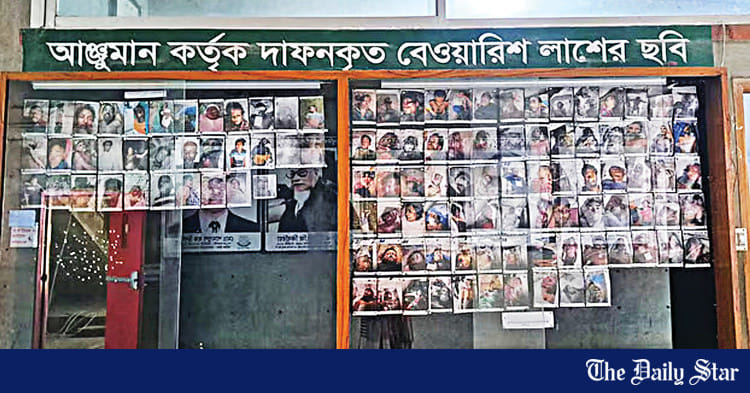
The ‘Wall of the Dead” at Anjuman Mufidul Islam. Among these 114 buried in unmarked graves in Rayerbazar in July-August 2024 are many victims of the July massacre. Photo: Collected

Seven months after the July uprising in Bangladesh, many protesters still remain missing. We investigated 31 cases: six were buried as unclaimed bodies at Rayerbazar graveyard; four were identified by families from among the charred bodies in Ashulia; two were handed over to families after DNA testing; and 19 are still unaccounted for. We found evidence of systematic government efforts to cover up medical records and bodies of the victims so they can never be found again. This four-part series also documents how families were denied time to collect the corpses from hospital morgues, and how they are now waiting for the bodies of their loved ones.

They all had families, desperately searching for them amid a nationwide curfew and internet shutdown at the height of the July uprising. Yet, they were buried as "unclaimed" bodies within one to six days after being shot dead, before their loved ones could find them. Seven months after the July killings, these families do not know where their kin rest.

An investigation by The Daily Star indicates that the hasty burials of the victims were part of a systematic effort by the fallen Awami League government to conceal the true extent of the massacre.

In some cases, medical records were tampered with and standard protocols for handling unclaimed bodies were bypassed. In other cases, the police quickly disposed of the bodies even though hospital morgues had the capacity to keep them longer, according to documents and morgue sources.

For example, Dhaka Medical College Hospital has two morgues with a combined capacity to hold around 100 bodies.

Before July 15, when killings of the protesters had not yet begun, there were 28 bodies in its mortuaries, said Ramu Chandra Das, a morgue assistant.

Yet, general diaries from Shahbagh police and registers at DMCH morgue and Anjuman Mufidul Islam, a burial service, show that eight protesters were buried on July 24 as "unclaimed" bodies in Rayerbazar graveyard within one to six days of their deaths.

These eight bodies include Sohel Rana, Md Assadullah, Faisal Sarker and Rafiqul Islam, who were killed by gunshots (Read their story in Part 1 of this series). The identities of the rest four remain unknown.

Asked why they got rid of these bodies so fast, Ramu said, "It was done on police instructions. We could have kept the bodies longer."

1741996344897.webp


(Left) Documents show six of the seven bodies buried by Anjuman on July 8 remained at the DMCH morgue for more than 10.

(Right) In contrast, all eight bodies sent from Shahbagh Police Station on July 24 were kept for less than two days.

Typically, DMCH reports about unclaimed bodies to police about a week after the bodies are brought to the hospital. Upon completion of various official processes, including autopsies, burial of such corpses takes about a month or even more.

"We could've kept the body longer; there were ample empty freezers. But the police took away the body."— Jatan Kumar, a morgue assistant at Suhrawardy hospital, about the hurried burial of a protester.

"We usually keep unclaimed bodies for at least a week in the morgue. Many bodies are also kept for months or even years," Ramu said.

Documentary evidence also suggests that DMCH does keep unclaimed bodies longer.

For instance, on July 8, 2024, a week before state forces began to kill protesters, Anjuman Mufidul sent seven bodies, all from DMCH, to Rayerbazar for burial. Records show they died between June 12 and July 4. This means, before these bodies were sent to Anjuman, six of the bodies were kept at mortuaries for about three weeks or more.

In contrast, Anjuman received eight bodies on July 24, by which time the number of corpses at hospitals was rising every day. Records show that four of these eight died just the previous day, and the four others the day before.

This suggests a systematic effort to erase evidence and prevent families from finding their loved ones.

According to the eight general diaries filed by Sub-inspector Jabbar from Shahbagh Police Station in relation to these bodies, six were from Jatrabari, and two from Uttara. All died from gunshot wounds, the GDs show.

Usually, Anjuman receives unclaimed bodies from hospitals after autopsies in the presence of police officers who facilitate the process. Before the handover of the bodies, representatives from Anjuman and a police officer are required to sign the morgue register.

"I just followed orders from Shahbagh's then officer-in-charge Mostajizur Rahman."— Constable Salauddin on why he rushed the burial of eight unidentified bodies.

However, this protocol was not followed in the case of at least nine bodies connected to the uprising.

Sub-inspector Salahuddin of Shahbagh police collected eight of these bodies from Dhaka Medical, and Sub-inspector Shakil Joarder of Sher-e-Bangla Nagar police collected another body from Suhrawardy Medical.

In both instances, Anjuman received the bodies from the respective police stations rather than directly from the hospitals, documents show.

Asked why he rushed the burial of these individuals, Shahbagh police Constable Salauddin said he just followed orders from Shahbagh's then officer-in-charge Mostajizur Rahman. Two other police officers gave a similar version. Mostajizur could not be reached for comments.

Both the DMCH authorities and Salauddin claimed that no other bodies related to the protests were sent to Anjuman.

Medical Records Tampered

Apart from DMCH, two other hospitals in Dhaka store unclaimed bodies—Shaheed Suhrawardy Medical College and Sir Salimullah Medical College (Mitford Hospital).

Both hospitals claim they haven't dealt with any protest-related unclaimed bodies.

Our findings about Suhrawardy Medical contradict this. (We did not investigate Mitford hospital's claim.)

Mahin Mia, one of the six confirmed by The Daily Star to have been buried at Rayerbazar as unclaimed bodies, protested on July 19 at Mohammadpur's Town Hall with his brother, Abdul Jabbar. Jabbar returned home, but Mahin did not.

Jabbar later found Mahin's picture among the deceased on Anjuman's "wall of the dead".

Mahin's wife gave birth to their first child 15 days after he disappeared.

The Daily Star found Mahin's autopsy report (autopsy # 679/24) from Suhrawardy Medical College. The report describes him as "unidentified" and says he was found on July 19, the day he went missing, with bullet wounds on both sides of his head.

His family later confirmed his identity from the photo on the autopsy report.

Suhrawardy Medical's morgue records show that Mahin's autopsy was done on July 20, and his body was handed over to Sher-e-Bangla police Sub-inspector Shakil Joarder two days later.

"We could've kept the body longer; there were ample empty freezers. But the police took away the body," says Jatan Kumar, a morgue assistant at the hospital.

SI Shakil told The Daily Star that he only handed over the body to Suhrawardy morgue, but did not collect it from there to send it for burial. However, the morgue register bears his name on two dates in relation to Mahin's body: on July 19, the day he handed over the body to Suhrawardy morgue for an autopsy, and on July 22, the day he collected it for burial. The Daily Star contacted him on the very mobile number recorded in the morgue register.

Despite such hard evidence, the Suhrawardy morgue authorities claim they did not deal with any unnamed bodies.

Apart from Mahin, eight other unclaimed bodies from Suhrawardy, with dates of death from July 17-23, were buried at Rayerbazar from July 22-27. Of them, five were aged between 23 and 35, according to the cemetery register.

At least some of these bodies are likely connected to the uprising, although we could not verify it as we could not collect their autopsy reports and other relevant documents.

Dhaka Medical's claim that only eight uprising victims were sent to Anjuman is also questionable.

For example, Ahmed Jilani was killed on August 3. His autopsy was conducted on August 13 at DMCH, and he was buried at Rayerbazar on August 31. The autopsy report shows he had gunshot and stab wounds on the back of his head.

Based on the autopsy numbers of the other eight bodies and Jilani, The Daily Star can confirm that Jilani is not on the DMCH list of the eight unnamed bodies buried at Rayerbazar.

Our suspicion that medical and burial records were tampered with to conceal the true extent of the massacre aligns with the UN fact-finding report.

The report, published last month, mentions that state agencies confiscated medical records and CCTV footage in many hospitals, without due process, and medical staff were pressured to withhold proper medical documentation.

In some hospitals, deaths from gunshot wounds were recorded as "accidental" under threat of legal action. From July 18 onwards, autopsies were often delayed or not conducted at all, violating national and international standards, the report adds.

[Read Part 3 tomorrow on how state agencies sought to cover up bodies, and how families were denied time to find their loved ones.]​
 
Analyze

Analyze Post

Add your ideas here:
Highlight Cite Fact Check Respond

The disappeared of the July Uprising: Part 4
Families want closure, however painful

1742169739759.webp

Rasheda Begum wants to know where her son was buried. Photo: Star

Seven months after the July uprising in Bangladesh, many protesters still remain missing. We investigated 31 cases: six were buried as unclaimed bodies at Rayerbazar graveyard; four were identified by families from among the charred bodies in Ashulia; two were handed over to families after DNA testing; and 19 are still unaccounted for. We found evidence of systematic government efforts to cover up medical records and bodies of the victims so they can never be found again. This four-part series also documents how families were denied time to collect the corpses from hospital morgues, and how they are now waiting for the bodies of their loved ones. This is the fourth and the last part of the series.

1742169811530.webp


When we first started visiting Dhaka Medical College Hospital in January for this story, there were seven protest-related unclaimed bodies freezing in its mortuaries. One of them, Md Hasan, a teenage trader from Gulistan, was handed over to his family on February 14 after DNA tests. The remaining six are still stored at DMCH morgue, growing colder.

Hasan's father, Md Monir Hossain, had searched for his son everywhere -- hospitals, clinics, cemeteries, and even Anjuman Mufidul Islam since his son went missing on August 5, 2024, the day Sheikh Hasina fell and fled the country.

"To exhume bodies from graves, the request needs to come from the relevant police stations based on cases filed in connection to the incidents. We did not receive any such request from the police stations either."— Tanvir Ahmed, DC, Dhaka.

"After four months, student leaders told me about the seven bodies at Dhaka Medical. I identified my son from his clothing. He always wore white."

Md Sogir from Sylhet believes his son, Md Waliullah, 25, a trader from Elephant Road in the capital, is also among the bullet-ridden bodies in the DMCH mortuary.

"My son went missing in July. I looked for him for five months. The bodies are barely recognisable, but I identified my son through an old surgery mark on his right leg."

Sogir has given his DNA sample to the Criminal Investigation Department of police and is awaiting confirmation.

"Even if the identities of the unclaimed bodies are found, detection of the graves is challenging because they were buried collectively. There's no way of knowing who was buried where."— Kamrul Ahmed, head of Anjuman Mufidul Islam's burial service.

A SYSTEM FAILING THE VICTIMS

If the sample does not match and if no one comes looking for the rest of the bodies still freezing at DMCH, these men, who were once someone's family, will likely be buried as "nobodies" in unmarked graves like many others (read more in Part 1).

On January 25, 2025, former information adviser Nahid Islam visited the Rayerbazar graveyard to pay tribute to the unidentified martyrs of the July uprising. There, Nahid, currently the leader of National Citizen Party, assured the families of these victims that efforts to identify those buried in unmarked graves had begun.

1742169884368.webp

Sohel Rana’s mother Rasheda Begum at Rayerbazar graveyard with July uprising leader Nahid Islam. A banner, top, placed in the cemetery demands that all unnamed victims buried there be identified. Photo: Star

Nahid along with other student leaders visited the graveyard again on March 4 after the launch of the new party, and reiterated their commitment to identifying the graves of the unclaimed bodies.

In reality, however, the process remains stuck in red tape.

In November last year, the July Uprising Cell under the health ministry gave families only a 12-day window to report missing persons, posting an obscure notice on a barely visible website. The Cell claims it did not receive any missing reports yet.

However, not a single of the 31 families we spoke to knew about this notice or the newspaper advertisements published by the cell. They don't even know where the office is.

Mahbub Ullah Mazumder, senior assistant secretary of July Foundation, has made a list of the six that this investigation confirmed to have been buried in Rayerbazar and one missing protester from Anjuman documents. After Mahbub shared the list with the cell, it only sent a letter to relevant ministries for actions.

Three government officials working on the July Uprising Cell said the health ministry is working to identify the missing bodies "very seriously" and asked The Daily Star to call health Secretary Md Saidur Rahman, who in turn advised us to contact Joint Secretary Dr SM Mustafizur Rahman.

The joint secretary said the ministry sent a letter to the deputy commissioner's office to take action. Dhaka DC Tanvir Ahmed said they did not receive the letter yet.

"To exhume bodies from graves, the request needs to come from the relevant police stations based on cases filed in connection with the incidents. We did not receive any such request from the police stations either," Tanvir added.

As the process remains stuck in the labyrinth of paper works involving a complex network of multiple government agencies, families of Sohel Rana, Faisal Sarker, Md Assadullah, Rafiqul Islam, Mahin Mia, Ahmed Jilani, and many other victims of the July massacre who remain missing, continue to look for answers.

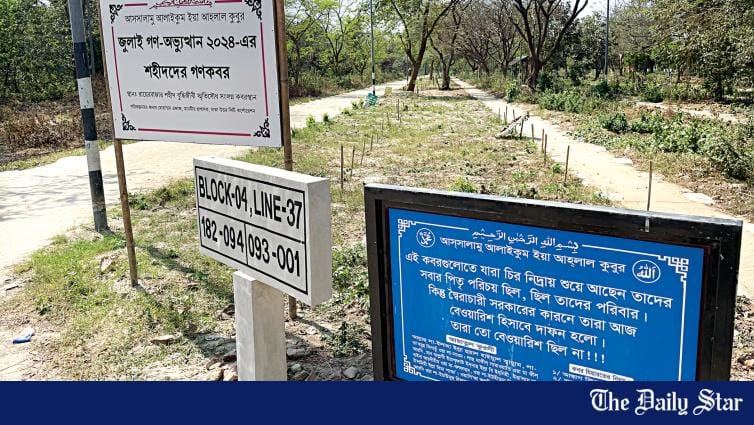
They want to know where exactly their loved ones lie among the 114 buried in Block 4 of Rayerbazar. These graves, each marked solely by a bamboo pole, leave the families with no way of knowing that. Meanwhile, rain has flattened the graves, and the bamboo markers are rotting.

If a GD number, a photo, a birthmark, age, clothing or any previous injury marks had been placed on the bamboo pole before burying the unclaimed bodies, identifying them would have been easier. Now, if any relative claims a body, all the corpses would need to be exhumed for DNA profiling.

"Even if the identities of the unclaimed bodies are found, detection of the graves is challenging because they were buried collectively. There's no way of knowing who was buried where," said Kamrul Ahmed, head of Anjuman Mufidul Islam's burial service, who oversaw the burial of many July massacre victims.

Prof Kamrul Islam Sardar, who served as a forensic head at some of the top hospitals, said even if DNA samples were collected from every unclaimed body, they are now useless since the graves are unmarked.

"All the bodies would need to be exhumed for new DNA samples, and this would then need to be matched with relatives. This is a very complicated process which might take years if effective steps are not taken by the government to expedite the process," he added.

Only six families among the many families know that their kin have been buried in Rayerbazar.

One reason behind this is that many of the families we spoke to do not even know that places like Anjuman Mufidul or Rayerbazar exist. They tried to rely on the police, who, in many cases, offered little help.

Ahmad Ferdous, head of CID's Forensic DNA Laboratory, said they completed 11 DNA profiling of as many victims related to the uprising. Of them, five bodies have been handed over to family members after the samples matched. The rest six remain unidentified as there are no claims for these bodies.

DNA profiling for 10 more bodies connected to the uprising is currently underway, Ferdous added.

Meanwhile, many families continue to gather at Dhaka Medical College morgue every day to find their fathers, sons, brothers or husbands among the six uprising-linked bodies still lying unclaimed there.

Rasheda Begum, mother of Sohel Rana who was killed in police shooting and buried at Rayerbazar as an unclaimed body, keeps visiting Block 4 of the cemetery with teary eyes.

"Which one is my son's grave?" she asks anyone who would listen.

The families of Ridoy, Miraj, Maruf and many others want to know if they are dead or alive.

For these families, uncertainty overshadows the agony of their loss. They now want closure, however painful.

Assadullah's widow Farjana Akter is tormented every day as she cannot console her two children, aged ten and four.

"My children keep asking where their father's grave is. Since I cannot bring their father back alive, I at least want to show them where he rests, so they can have a place to grieve and remember him."

[Our correspondents from Gazipur, Bogura, Pabna and Thakurgaon contributed to this story.]

WHERE ARE THEY?

Sohel Sheikh a vegetable trader from Tongi


Sohel Sheikh joined a victory procession on August 5 after Hasina fled the country. He headed for Gono Bhaban, the official residence of the deposed prime minister, like tens of thousands of others.

By 6:00pm, his wife, Ayesha Akhter, got a call—Sohel had been shot in front of Uttara East Police Station. Over a dozen died there as police opened fire on protesters trying to storm in. The caller told Ayesha that Sohel Sheikh was being taken to Crescent Hospital in Uttara.

Defying the curfew, she came to Dhaka from Pirojpur, rented a house for two months and looked for her husband at Crescent and Dhaka Medical, but did not find him.

Her initial attempt to file a case was also stalled by officers. Uttara East police eventually recorded a missing diary instead of a case and told her to omit that her husband was shot. Ayesha has no updates about the investigation.

"I abandoned all hopes. I took out loans to stay in Dhaka and find him. No one helped me. I now live in Pirojpur with my in-laws," Ayesha said.

The Daily Star spoke to the person who called Ayesha on August 5. He and multiple witnesses said Sohel Sheikh was shot. No one knows what happened next.

Shahidul Islam Miraj a trader from Kaptan Bazar

Shahidul Islam Miraj was enraged after watching the video of the police shooting of Abu Sayed on July 16. He shared the video and wrote several Facebook posts, and joined the protest the next day. His social media shows he was active in Jatrabari-Shonir Akhra area since July 17.

His elder brother, Saiful Islam Mithil, warned him and asked him to stay home until normalcy returns. On July 27, Miraj left without telling his brother, and never came back.

At least five protesters said they saw him at Jatrabari Police Station on August 5, but we could not independently verify this. That day, Jatrabari police killed protesters one after another like targets in a video game.

For six months, Mithil looked for his brother in morgues, police stations, Anjuman Mufidul Islam and Rayerbazar graveyard. He just wants to know whether his brother is dead or alive.

Md Maruf a student from Mirpur

HSC examinee Md Maruf, 17, went missing from Dhaka's Mirpur on July 20. That was the first full day of the curfew.

After August 5, family filed a case with Rupnagar police station. But, there are no updates.

When his mother demanded an update, officers told her that her son committed suicide. But there is no corpse.

When we asked Investigating Officer Md. Ibrahim of Rupnagar police station on what basis he claims that Maruf died by suicide, he shrugged. "I don't even know who Maruf is."​
 
Analyze

Analyze Post

Add your ideas here:
Highlight Cite Fact Check Respond

The disappeared of the July Uprising: Part 3
A systematic cover up of bodies


1742170167775.webp

Md Ridoy lies on the street after being shot at point-blank range by police on August 5.

Seven months after the July uprising in Bangladesh, many protesters still remain missing. We investigated 31 cases: six were buried as unclaimed bodies at Rayerbazar graveyard; four were identified by families from among the charred bodies in Ashulia; two were handed over to families after DNA testing; and 19 are still unaccounted for. We found evidence of systematic government efforts to cover up medical records and bodies of the victims so they can never be found again. This four-part series also documents how families were denied time to collect the corpses from hospital morgues, and how they are now waiting for the bodies of their loved ones.

On the afternoon of August 5, 2024, word spread across the country that Sheikh Hasina fled to India. In Gazipur, like elsewhere in the country, thousands poured into the streets in celebration. But there was also anger.

A group of protesters started chanting slogans outside Konabari Police Station, and the police opened fire. The protesters dispersed, but the cops kept hunting them down in nearby alleys.

Md Ridoy, 20, a student and an autorickshaw driver, found himself trapped in one such alley. The cops cornered him, dragged him onto the main road, right in front of Shareef General Hospital, according to authenticated video footage seen by The Daily Star.

Six officers closed in–one raised a stick, another held onto his shirt so he could not escape. Meanwhile, a third, later identified as Constable Akram, slowly stepped behind him with a gun in hand, like a predator marking its prey. Another cop slapped him. Simultaneously, Akram put the gun in his back and then pulled the trigger!

Ridoy collapsed, but the 20-year old was still breathing. The cops walked away as Ridoy bled profusely.

Minutes later, three officers returned, and carried him behind the police lines from where they were still firing at protesters. From there, three others, one in uniform and another in civilian clothing, dragged him towards an alley which leads straight to the Konabari Police Station. Ridoy is never seen again.

The International Truth and Justice Project, an organisation documenting crimes against humanity, has also investigated this incident.

"We went to the Konabari Police Station the next day. All we could find was the lungi Ridoy was wearing underneath a desk," said Md Ibrahim, Ridoy's brother-in-law.

This newspaper found another video from the night of August 5, 2024, which shows the inside of the Konabari Police Station. Some policemen were seen making preparations to leave. In the video was a man wearing a white sleeveless undershirt and a lungi. Ridoy's relatives and locals identified him as Abed Ali, a trader.

1742170266605.webp

Police drag Ridoy through the streets towards Konabari Police Station after shooting him.

According to Ibrahim and five locals, Abed helped the cops in disposing of Ridoy's body. Abed Ali could not be reached for comment.

Seven months on, Ridoy's family does not know where his body is. His name is not on the list of July martyrs prepared by the government, and his family is yet to receive any compensation from the government, his sister Jesmin Akhter said.

Five policemen, including Constable Akram and former Gazipur Detective Branch inspector Mohammad Shafiqul Islam, have since been arrested over Ridoy's killing. The case now sits before the International Crimes Tribunal.

A MASSACRE

As Ridoy bled out in Gazipur, a massacre unfolded in Savar's Ashulia.

Since the morning of August 5, Sheikh Hasina's final day in power, police were shooting relentlessly, blocking protesters from marching to Dhaka. Bodies were dropping one after another, blood soaking the streets.

A video that later emerged shows six bodies, bloodstained and barely covered, lying stacked on a van in front of Ashulia Police Station. One man was still moving and breathing, his fingers twitching.

In the video, later authenticated by fact checkers, Dhaka District Detective Branch Inspector Arafat Hossain is seen walking past. Beside him stands Masudur Rahman, officer-in-charge of Ashulia Police Station.

Then—flames. The bodies burn.

1742170350579.webp

Several bodies are piled up on a pickup in Ashulia moments before police set them of fire.

At least one of these victims, the one who was still seen moving and breathing, was certainly burned alive. Their remains were subsequently dumped in Ambagan graveyard, next to the police station.

The next day, the graves were opened, and six charred bodies were pulled from the earth. Families identified four of them–Ash-Sabur, Sazzad Hossen Sajal, Tanjil Ahmed Sujoy, and Baygid Bostame. Their faces barely recognisable, some were identified only by their clothes and identity cards.

The remaining two bodies are completely unrecognisable and have been sent for DNA profiling after families contacted police, said Kamal Hossen, inspector (investigation) of Ashulia Police Station.

The International Crimes Tribunal is now investigating this case. DB Inspector Arafat Hossain and ex-additional SP of Dhaka Abdullahil Kafi have been arrested over this incident.

The attempted cover-up in Gazipur and Savar is only the tip of the iceberg.

The UN report on the July uprising says that there are cases where "police collected bodies of unidentified victims, and it is unclear to what extent the bodies were later handed over to morgues and duly reported to health authorities."

About the burning of bodies, the report says that police did so to "create the false impression that the victims had been killed by protesters."

Meanwhile, at least 5 protesters from Savar still remain missing. Tamim Sikder, Moniruzzaman Milon, Omor Faruk and Abul Hossen went missing on August 5 from near Ashulia police station. Shahadat Hossain, a day labourer, remains missing since August 4, fellow protesters and family members said.

FAMILIES DENIED TIME TO FIND BODIES

Sohel Rana, 28, went missing on July 18 near Jatrabari. His younger brother, Md Nabil, stepped out the next morning to look for him but could not go far. Jatrabari was a warzone.

The government enforced a countrywide curfew that night, and the internet had been shut down.

Nabil still went out the next morning again to search for his brother, but got assaulted by the cops. He finally found his way inside Dhaka Medical College Hospital on July 21, risking his life amid curfew.

"There were bodies stacked on top of each other. Each freezer had two bodies in it," he said.

But he could not find his brother among so many bodies. Nabil returned to DMCH and visited Anjuman Mufidul Islam, a burial service, multiple times before August 5, but found no luck.

"We went to the Konabari Police Station the next day. All we could find was the lungi Ridoy was wearing underneath a desk,"— Md Ibrahim Ridoy's brother-in-law.

Sixteen days after Sheikh Hasina's fall and 34 days after Sohel disappeared, Nabil found his brother's photograph at DMCH on August 21. Later, he rushed to Anjuman only to find that his brother, along with eight others, was buried at an unmarked grave in Rayerbazar [Read more in Part 1] on July 24.

The Daily Star has tracked down the unnamed General Diary that Shahbagh police filed for Sohel. It states that Sohel was shot during protests in Jatrabari's Kajla area and died while receiving treatment at Dhaka Medical's emergency ward on July 18.

We also obtained Sohel Rana's inquest report. It says he died from multiple pellet wounds near the chest. Bruises on his back and other parts suggested possible torture before death.

Meanwhile, Md Assadullah, a 30-year-old private car driver, left his Uttara home after lunch on July 19. He was shot on Road 2 of Uttara's Sector 7.

Video footage verified by this newspaper shows Turag Thana Chhatra League Vice-President Murtafa Bin Omar, alias Sathil, wielding a shotgun, firing indiscriminately at protesters in Uttara that day.

With him were Jubo League leader Sohel Rana, councillors Yuvraj and Naim, and Yuvraj's son Leon, according to protesters, locals and the July Revolutionary Alliance, a student platform documenting the massacre.

Several shots, fired by Sathil, hit Assadullah, according to three protesters and the CCTV footage seen by The Daily Star.

Assadullah's family received a call from a protester that night saying he had been shot.

The curfew had already been announced. The next morning, his wife Farjana Akter went to Uttara Crescent Hospital and then DMCH to find him.

When she was looking for her husband in the morgue, emergency section, and other wards of DMCH, Assadullah was still alive. He was receiving treatment at the hospital's burn unit, according to CCTV footage seen by this newspaper.

There, lying in a bed, he took his last breath on July 22. Two days later, he was buried at Rayerbazar in an unmarked grave. Meanwhile, Farjana kept looking.

Sathil faces at least 11 cases over murder during the July uprising, locals and police sources said. Sathil and the rest of the AL activists seen in the video are now on the run, and could not be contacted for comment.

On July 19, the same day Assadullah was shot, Faisal vanished from Uttara, and Rafiqul from Gopibagh. They too, were buried in Rayerbazar on July 24 as unclaimed bodies.

A request for burial sent to Anjuman from Shahbagh police station, along with pictures of the bodies, writes, "As no one claimed these individuals, we are handing over the bodies to Anjuman Mufidul Islam for burial."

But the fact is, families were still looking for their loved ones–they only did not know where to find them.

[Our Savar Correspondent Aklakur Rahman Akash and Tangail Correspondent Mirza Shakil Contributed to this report]

Read part 4 tomorrow on the agonising wait of the families for the bodies of their relatives.​
 
Analyze

Analyze Post

Add your ideas here:
Highlight Cite Fact Check Respond

Tarique Rahman sends Eid gifts to families of July martyrs
Bangladesh Sangbad Sangstha . Dhaka 07 June, 2025, 21:49

1749340827996.webp

Bangladesh Nationalist Party senior joint secretary general Ruhul Kabir Rizvi Ahmed, on behalf of BNP acting chairman Tarique Rahman, visits the residence of a July uprising martyr in Dhaka on Saturday. | BSS photo

Bangladesh Nationalist Party senior joint secretary general Ruhul Kabir Rizvi Ahmed, on behalf of BNP acting chairman Tarique Rahman, on Saturday visited the residence of July uprising martyr rickshaw puller Kamal and exchanged greetings with the family.

Financial assistance was also provided to Kamal’s wife on the occasion.

Later, Rizvi also handed over Eid gifts to the family of Saikat, a meritorious student who was martyred on July 19, 2024, in Mohammadpur in the capital.

He also visited the family of Swechchhasebak Dal leader Kawsar, who disappeared on December 4, 2013, in Nakhalpara, the capital.

BNP health affairs secretary Md Rafiqul Islam, leader engineer Iqbalur Rahman Rokon, DAB leader Shariful Islam, Lohani Tajul Islam and Chhatra Dal vice-president Touhidur Rahman Awal were present, among others.​
 
Analyze

Analyze Post

Add your ideas here:
Highlight Cite Fact Check Respond

Members Online

Latest Posts

Back
PKDefense
G
O
 
H
O
M
E