Who investigates the state?
Mosfiqur Rahman Johan
During the rule of the Awami regime, Bangladesh seemed to exist in two parallel worlds. In one, life followed its familiar rhythms: people woke in the morning, had breakfast, went to work, attended parties, pursued careers, development and success, laughed, cried, performed the rituals of ordinary life, and moved relentlessly forward with time. Beneath that visible world, however, lay another Bangladesh, shrouded in darkness and largely hidden from view. There, time seemed to stand still. People vanished. Tears fell. Blood was spilled. Grief accumulated. Memories lingered. Yet scarcely a sound escaped into the world above. Through enforced disappearances, a reign of terror took shape in which people could simply vanish without a trace. So much time lost; so many memories, so many lives.
Enforced disappearance in Bangladesh was not merely a series of isolated acts. It was carried out through bureaucratically reproducible procedures and institutional practices that could remove people not only from their physical surroundings but also from the public record. As Arendt (1963) helps us understand, large-scale state crimes are not necessarily reducible to acts of individual cruelty. Bureaucratic rules, paperwork and chains of command can fragment responsibility so extensively that those involved may fail to confront the full scale of the crimes in which they participate. Yet enforced disappearance does not end when a person is taken away. For the families left behind, disappearance becomes a condition of everyday life: absence is repeatedly experienced as presence, while hope persists alongside the possibility of death. This sense of the disappeared person’s continued presence, and the accompanying oscillation between hope and despair, is not an isolated phenomenon. It emerges from the particular political and structural conditions created by a repressive state apparatus.
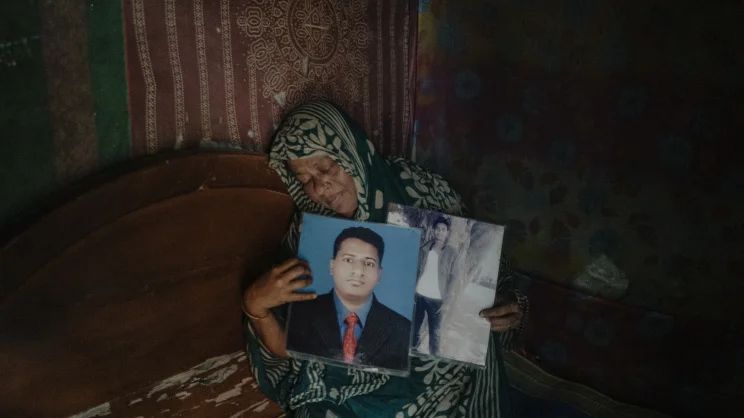
A grieving mother holds photographs of her disappeared son, among the few tangible reminders she has of him. In the absence of answers, photographs and memories become part of a family’s enduring search for a loved one who never returned. Photo: Mosfiqur Rahman Johan
Thousands of people in Bangladesh have reportedly been subjected to enforced disappearance amid political repression, with more than 2,000 cases documented between 2009 and 2022. Behind these numbers are families who have spent years searching for loved ones whose fate or whereabouts the state has failed to establish or acknowledge. Their experiences reveal not only the profound psychological and social consequences of enforced disappearance, but also the failures of the legal and institutional systems meant to uncover the truth and deliver justice.
For more than six years, I have worked closely with families of the disappeared. Following the July Uprising, I, along with several other activists, assisted families in filing cases concerning their missing relatives and witnessed the submission of 118 cases. One striking feature emerged repeatedly. Families often could not name a law-enforcement agency as responsible. Instead, their complaints described people being taken away by plainclothes men and never returning. This was not necessarily because the families did not know or suspect who was responsible. Rather, they had lived in an environment in which naming a security agency could itself carry risks. Police officers often did not allow families to identify law-enforcement agencies in their complaints. The language of the cases therefore became a language of uncertainty: “missing”, “taken away”, “plainclothes men” and “never returned”.
The state’s control over the narrative of disappearance also operated through language. This echoes Fassin’s (2012) argument about “humanitarian reason”, in which the vocabulary of suffering, compassion, assistance and the responsibility to protect can displace an older lexicon of social critique centred on justice, interests and rights. He observes that injustice can be articulated as suffering and violence recast as trauma—a shift that risks obscuring underlying structures of domination and reframing systemic injustice as individual misfortune. In Bangladesh, a similar politics of language can be seen in the substitution of terms such as “missing”, “taken away”, “plainclothes men” and “never returned” for the more politically and legally consequential language of enforced disappearance.
But behind this vocabulary lies a far deeper human experience. For Sanjida Islam Tulee, whose brother, a political activist, disappeared in December 2013, the river became a vast graveyard. She had learned of allegations that bodies were weighted down with bricks and thrown into the water. A river that for others might signify travel, work or leisure thus became, for her, a possible repository for her brother’s body. She repeatedly approached boatmen, asking whether they had seen security personnel bringing people to the river or witnessed anyone being thrown from a bridge or boat. Her search was not simply an attempt to establish a fact. It was an attempt to reconstruct a disappearance in a world where the state had provided no answers.
This is one of the defining characteristics of enforced disappearance: the victim is physically removed, but the uncertainty surrounding that removal is transferred to the family. In the absence of credible answers, family members are forced to become investigators, archivists and witnesses. They search hospitals, prisons, police stations, streets, rivers and detention facilities. They preserve documents, remember what their loved ones were wearing, reconstruct their final movements and repeatedly return to the last place where they were known to have been seen. The disappeared person is absent, but the search for them becomes an enduring presence in the lives of those left behind.
Raita described visiting a secret detention centre years after her father had disappeared. As she walked through the compound, she noticed an old, unsettling building, unaware that her father was being held inside. After the political transition of August 2024, she returned to the compound and was taken towards the same building. Only then did she discover that her father had indeed been held in cells there. What continues to haunt her is the knowledge that she had once been so close to him without knowing he was there. She remains troubled by the thought that, had she known, she might somehow have been able to get him out.
For years, families of the disappeared have demanded answers, filed cases and pressed the authorities to reveal what happened to their loved ones. Their struggle poses a fundamental question: who investigates when the state itself stands accused? Photo: Mosfiqur Rahman Johan
Raita’s experience finds striking parallels in the wider literature on enforced disappearance. Arditti (2002), in her study of the Mothers and Grandmothers of the Plaza de Mayo, documents an extraordinary oneiric dimension to their experiences. Mothers routinely described dreams in which their disappeared children appeared alive, revealed their whereabouts or communicated what had happened to them. These dreams were shared and compared at meetings and sometimes treated as provisional sources of evidence until definitive proof could be found. Arditti recounts, for instance, the experience of a mother whose son disappeared in 1977 and who repeatedly dreamt of a specific address in Buenos Aires. When she investigated the location herself, she discovered that it had been a clandestine detention centre where her son had indeed been held. The dream could not establish whether her son had survived, but it had mapped a geography of state violence that no official record acknowledged.
Such experiences demonstrate why enforced disappearance cannot be understood simply as a criminal offence committed at a particular moment. It creates an enduring relationship between the disappeared person, the family, the place of detention and the state. The act of disappearance may occur at a specific point in time, but its consequences do not end there. The disappearance continues for as long as the person’s fate or whereabouts remain unresolved.
For some families, the disappeared person continues to inhabit the sensory landscape of the home. Nipa, whose husband disappeared in 2013, described repeatedly hearing his voice calling from the window, just as he used to when returning home at night. On one occasion, she, her father-in-law and her husband’s younger brother all believed they heard him calling. They rushed outside, only to find nobody there. Such experiences show how disappearance transforms the most ordinary sounds, routines and memories. A familiar voice can suddenly carry the possibility of return.
For Baby, the wife of Tariqul Islam Tara, who was abducted in 2012, the search extended beyond the home and into public spaces. She described scanning the faces of strangers wherever she went. When she encountered people whom others considered mentally unwell, she would study their faces, wondering whether one of them might be her missing husband. If she noticed someone wearing a shirt resembling the one he had been wearing when he disappeared, she would stop and look. In this way, the disappeared person remains both absent and everywhere: in crowds, on buses, along roads and in the faces of strangers.
These experiences expose the inadequacy of treating disappearance as a completed event. For families, it is an ongoing violation, renewed each day that the fate or whereabouts of their loved one remain unknown. Criminal accountability alone is therefore insufficient. Families also need recognition, information, credible investigation, access to evidence, protection and effective remedies.
It is in this context that the proposed Enforced Disappearances Prevention and Remedy Bill, 2026 assumes particular importance. A dedicated legal framework would represent an important recognition that enforced disappearance requires a specific legal response. But the effectiveness of such a law ultimately rests on a fundamental question: who investigates a disappearance when the institution responsible for investigating the allegation is itself accused of carrying it out?
The case of Miraj, a 30-year-old fisherman who disappeared near the Sundarbans on 10 April, brings this problem into sharp focus. According to his family and witnesses, Coast Guard personnel detained Miraj and took him away. The following day, his wife, Mukta Khatun, went to the Coast Guard’s Digraj base in search of him. She was initially told that her husband was there and that Coast Guard personnel had taken him with them on an operation. When she returned later, however, she was told that no one named Miraj was being held there. He has not been seen since.
Marks scratched into the wall of a detention site bear witness to the longing of those held inside—to return home, to see their families again, and to reclaim the lives from which they had been forcibly separated. Photo: Mosfiqur Rahman Johan
The significance of Miraj’s case lies not only in the allegation itself, but also in a fundamental question of accountability: what happens when the institution accused of a disappearance is itself involved in examining the allegation? If Coast Guard personnel are alleged to have detained Miraj, an internal review by the Coast Guard cannot offer the same degree of independence as an investigation conducted by a body structurally separate from those accused. His family is therefore left confronting two uncertainties: what happened to Miraj, and can the institution implicated in his disappearance be trusted to establish the truth?
This is not merely a question of appearances. It goes to the heart of institutional credibility. An institution facing such allegations may conduct an internal administrative review of its personnel, but that process cannot substitute for an independent investigation into a possible enforced disappearance. When relatives of a missing person have to approach, answer questions from or seek information from officers belonging to the very force they accuse, the balance of power is fundamentally unequal. The process risks becoming less a search for the truth than an exercise in which the institution under scrutiny retains control over how the allegation against it is examined.
This concern becomes particularly important under the proposed legal framework, which places responsibility for investigating allegations of disappearance on the police. The difficulty is obvious: If police officers themselves are accused of involvement in a disappearance, the police could effectively end up investigating their own colleagues. Even when the allegation concerns another security or intelligence agency, the investigation remains within the broader law-enforcement structure. Investigators may still face difficulties obtaining documents, detention records, operational logs and other evidence, or securing cooperation from powerful security and intelligence agencies.
Miraj’s case therefore provides a concrete example of a deeper weakness in the proposed law. The concern is not simply that a particular investigation might be conducted poorly. It is that the legal architecture does not adequately answer a more fundamental question: which institution has the authority, independence and capacity to establish the truth when agents of the state themselves stand accused?
For families who have already spent years being denied answers, this is far more than an administrative problem. It risks reproducing the very conditions that have allowed disappearances to remain unresolved. A family may be told that an investigation is under way while having no credible means of knowing whether that investigation is genuinely independent, whether relevant evidence has been obtained, or whether the institutions implicated have been subjected to meaningful scrutiny. The law may therefore replace one unanswered question—where is our loved one?—with another: who can we trust to find out?
This is where the proposed law risks falling short of the reality experienced by victims and their families. Legal recognition of a disappeared person, compensation, rights concerning property and inheritance, and other forms of remedy ultimately depend on an effective and credible investigation. If that investigation is compromised by institutional conflicts of interest or lacks genuine independence, those rights may exist on paper while remaining inaccessible in practice.
Miraj’s experience also demonstrates why such a case cannot be dismissed as an isolated administrative failure. No case exists in isolation: how one allegation is handled can shape how institutions respond to those that follow. When allegations are met with denial or simply referred back to the very institutions accused of the violations, the absence of accountability risks becoming an institutional precedent.
The uncertainty surrounding Miraj’s fate therefore becomes a test of the law itself. A meaningful framework for prevention and remedy cannot stop at creating procedures for receiving complaints. It must establish a credible mechanism capable of investigating state institutions when agents of the state are themselves accused of carrying out enforced disappearances.
An independent investigative mechanism would serve not only victims and their families, but the state itself. It could distinguish credible allegations from unfounded ones, establish individual responsibility, protect officials not involved in the alleged violations from collective suspicion, and help restore public confidence in law-enforcement institutions. Most importantly, it could give families a credible path from uncertainty to truth.
A child’s plea for his disappeared father, preserved alongside newspaper clippings documenting the family’s search for answers. Photo: Mosfiqur Rahman Johan
The ultimate test of justice, therefore, is not simply whether Bangladesh adopts a law against enforced disappearance, but whether that law can uncover the truth when state institutions themselves are implicated. A legal framework that recognises the crime but cannot independently investigate those accused of committing it risks reproducing the same silence it seeks to end. Accountability requires more than legal recognition: it requires institutions capable of establishing what happened, identifying those responsible and providing families with answers.
For the families of the disappeared, those answers have already been delayed for years. Restoring the rule of law begins with ensuring that they are no longer required to search alone. Until the truth about the disappeared can be established independently, and those responsible can be held accountable, the violence of disappearance does not truly end.
Mosfiqur Rahman Johan is an anthropologist and documentary photographer based in Bangladesh. He is also a member of Maayer Daak, a collective advocating for justice for families of the forcibly disappeared, and the founder of the All Victims and Veterans Network (AVN), a victim-led organisation documenting state violence and its impact on marginalised communities.


 Bangladesh Defense