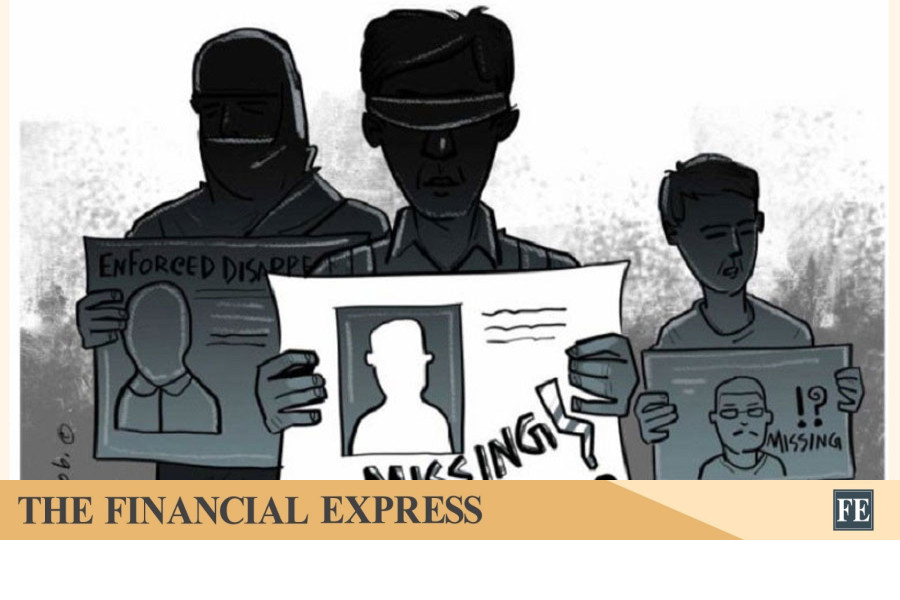
[🇧🇩] UN investigation into enforced disappearances /deaths of students/citizens at the hands of security agencies

[🇧🇩] UN investigation into enforced disappearances /deaths of students/citizens at the hands of security agencies
108
4K
More threads by Saif

G Bangladesh Defense

Enforced disappearances: Bodies were disposed of near rail tracks, in rivers, witness tells ICT-1

The witness said a group of men picked him up, handcuffed and blindfolded, from his Nilphamari home on April 13, 2016

Star Online Report

1786577766351.webp


A prosecution witness today told the International Crimes Tribunal-1 that the bodies of victims of enforced disappearance were disposed of near railway tracks and in rivers.

He cited an interrogator as saying during his detention at a secret facility, where he was also threatened to death.

Nur-e-Alam, a former Chhatra Dal leader from Nilphamari, made the allegations while testifying in a case over the enforced disappearance and illegal confinement of 24 people at the Joint Interrogation Cell (JIC), operated by the Directorate General of Forces Intelligence (DGFI) during the Awami League regime.

Out of the 13 accused -- Maj Gen Sheikh Md Sarwar Hossain and Brigadier Generals Md Mahbub Rahman Siddique and Ahmed Tanvir Majahar Siddique -- were in the dock during the proceedings. Other accused, including deposed prime minister Sheikh Hasina, are absconding.

The witness said a group of men picked him up, handcuffed and blindfolded, from his Nilphamari home on April 13, 2016, in a microbus, and later held in a small cell and repeatedly interrogated about his BNP links and social media posts criticising the AL government and India.

During one interrogation, an unidentified official allegedly told him, “The bodies found beside railway tracks, rivers and in sacks -- we do it…,” before beating him up and forcing him to write details about his education, family and political associates.

Alam also alleged that a female interrogator tied his hands, suspended him from a hook and beat him from the waist down.

He said he spent 14-15 days in one cell he believed to be around Dhaka Cantonment before being moved to another facility, where he was kept for around 40 days. Despite suffering injuries and illness, he received no medical treatment.

On his cell walls, he saw writings including pleas for rescue, dates and phone numbers.

Meanwhile, in a crimes against humanity case against former MP Shamim Osman and 11 others, garment truck driver Samrat Hossain, 33, told the ICT-1 that he lost vision in his right eye after being shot during the July uprising at Chashara in Narayanganj on July 19.

Testifying in the case, Samrat said around 40 pellets were lodged in his body, including in his eyes, head and other parts, as Shamim, his son Ayon, nephew Azmeri, and Chhatra League and Jubo League activists opened fire on protesters.

He also said he later had to undergo five surgeries and treatment at two Dhaka hospitals.

“I cannot see with my right eye, and have difficulty seeing with my left eye,” he told ICT-1.

He added that doctors said vision in his right eye will not return and may deteriorate further.​
 

Draft enforced disappearance law draws flak

Police designated to conduct probe, rights defenders seek independent probe mechanism

Solamain Salman and M Moneruzzaman 15 August, 2026, 01:32

1786752992621.webp


The government has moved to enact the draft Enforced Disappearance (Prevention and Remedy) Bill, 2026, proposing to allow the police to investigate allegations of enforced disappearances.

The proposal has raised concerns because members of law enforcement and security agencies have long been accused of involvement themselves in many enforced disappearance cases.

Human rights defenders and legal experts say that allowing the police to investigate under section 14 such allegations could weaken accountability and hurt public confidence in the justice system.

They also fear that a provision of the act, if it remains as proposed, allowing courts to punish complainants if allegations are found to be false could discourage victims and witnesses from coming forward for justice.

The law, they said, should provide for an independent investigation body because agencies accused of involvement in enforced disappearances cannot credibly investigate such cases themselves.

They argued that many past allegations of enforced disappearance involved members of law enforcement, intelligence and security agencies.

The interim government had earlier formed a Commission of Inquiry on Enforced Disappearances, which documented 1,913 complaints of such disappearances that occurred during the 15 years of AL regime.

According to the commission, the Rapid Action Battalion was involved in almost 25 per cent of complaints, followed by the police in nearly 23 per cent and the Detective Branch in 14.5 per cent of complaints.

Transparency International Bangladesh executive director Iftekharuzzaman told New Age that if the Cabinet-approved draft retained the provision to mandate the police to investigate and report on allegations of crimes related to enforced disappearances exclusive of an independent authority like NHRC the law would effectively mean that perpetrators would become judges of their alleged crimes.

‘This would mean to provide legal impunity and protection for the accused, especially those related to the ruling authority, police, security and intelligence agencies and a section of the armed forces who have been historically responsible for the greater share of this crime,’ he said.

Iftekharuzzaman also said that this provision would also mean that the government had hardly taken any lesson from the bitter experiences of the 15 years of authoritarian rule and from the aspirations of the July movement.

Supreme court lawyer Mohammad Shishir Manir urged the government to withdraw the draft law and formulate instead a comprehensive law, incorporating international standards and protocols.

He went on to point out that most allegations of enforced disappearance had involved law enforcement agencies, making police investigations ineffective.

He also noted that the interim government had earlier empowered the National Human Rights Commission to investigate such offences before the present government repealed that provision.

According to Shishir, the draft law treats enforced disappearance like an ordinary criminal offence by applying the Code of Criminal Procedure and the Penal Code instead of creating a separate legal framework for this extraordinary crime.

Rights activist Nur Khan Liton, a member of the Commission of Inquiry on Enforced Disappearances formed during interim government, Bangladesh’s past experience showed that law enforcement agencies had themselves been accused in many enforced disappearance cases, making it difficult for victims to trust police investigations.

Nur Khan also expressed concern over section 21 of the draft law, which allows legal action against complainants if allegations were found false by a court, with a possible punishment of up to five years of rigorous imprisonment.

The provision can discourage victims and their families from filing complaints as many might fear facing punishment if they fail to prove their allegations, he observed.

Brac University teacher Nabila Idris, who was a member of the Commission of Inquiry on Enforced Disappearances, questioned whether there had been any significant reform in the police force that would justify assigning them the responsibility of investigating such cases.

Nabila also said that if the police were to run the inquiry, the probe in enforced disappearance would be delayed while victims would not get justice on time.

Another human rights activist, Abu Ahmed Faizul Kabir, said that the government should establish an independent investigation mechanism in the proposed law.

Bangladesh, he said, has already had the Torture and Custodial Death (Prevention) Act, 2013, but victims have little confidence in police-run investigations as only 18 cases have been filed against police personnel under the law since the law came into force.

Rights organisation Odhikar echoed those concerns, saying that investigations conducted by the police into allegations against law enforcement agencies were unlikely to be impartial.

In a statement, the organisation urged the government to place the investigation authority under the NHRC or establish a dedicated commission of inquiry on enforced disappearances.

On August 3, the cabinet approved the draft of Enforced Disappearance law that prescribes life imprisonment or at least three years of imprisonment and a fine of up to Tk 50 lakh for enforced disappearance.

If the victim dies or remains missing for five years, the punishment may be death, life imprisonment or at least five years of imprisonment, along with a fine of up to Tk 1 crore, it said.

Investigations must normally be completed within 90 days of the filing of the case, extendable by up to 30 days. The requirement for prior government approval to prosecute has also been removed.

It allows trial in absentia in specified circumstances and requires trials to be completed within 90 working days, extendable by another 30 working days with reasons recorded.

An ordinance promulgated by the interim government had authorised the NHRC to investigate enforced disappearance cases. But the ordinance lapsed after failing to secure parliamentary approval during the first session of Jatiya Sangsad.​
 

Questions raised over investigations into enforced disappearances, calls for amendments to bills

Staff Correspondent
Dhaka
Published: 29 Aug 2026, 21: 45

1788046144104.webp

Human Rights Support Society (HRSS) organised a discussion ahead of International Day of the Victims of Enforced Disappearances at the National Press Club in Dhaka on 29 August. Prothom Alo

Human rights activists, lawyers and former members of the commission that investigated enforced disappearances have questioned a provision in two bills on human rights and enforced disappearances that would give the relevant law enforcement agencies the power to investigate allegations against their own forces.

They have called for amendments to the bills, warning that passing them without ensuring independent investigations would make it even more difficult to secure justice and accountability for enforced disappearances.

They made the remarks at a discussion held at the National Press Club in Dhaka on Saturday afternoon to commemorate victims of enforced disappearances. Human Rights Support Society (HRSS) organised the event ahead of International Day of the Victims of Enforced Disappearances on 30 August.

Victims of enforced disappearance and their family members, human rights activists, lawyers and civil society representatives attended the event.

Senior Supreme Court lawyer Sara Hossain said both the proposed laws on the National Human Rights Commission and prevention of enforced disappearances should provide for an independent investigation process.

“If the investigation process is not changed, people will essentially be deceived. You cannot be the judge of your own case,” she said.

She also said both laws were necessary.

Sara Hossain said there was no neighbouring country with such an arrangement. “The big test now is what the parliamentary standing committee will do with the two bills. It remains to be seen how much they will take expert opinions into account,” she said.

She also described the role of the courts as another major test. “Our courts have failed. Almost no one could approach the courts. …Those who did approach them did not get any kind of remedy there. …This is also a major test for the government: will they remain silent as before? Will they give the courts no direction…will they ignore the entire process? Or will they create an opportunity for accountability there for the first time?” she said.

Noor Khan Liton, a former member of the commission that investigated enforced disappearances, said it would be better not to have a law at all if the National Human Rights Commission was not given effective authority to investigate enforced disappearances allegedly carried out by law enforcement agencies.

“There is no point spending so much money to support five commissioners, giving them cars, security and offices if they cannot do this,” he said.

Noor Khan said the proposed law must give the National Human Rights Commission the authority to independently investigate enforced disappearances allegedly carried out by law enforcement agencies.

Keeping the commission dependent on the agencies by merely obtaining information from them or conducting inquiries through them would not ensure effective investigations, he said.

‘Will facilitate enforced disappearances’

Mir Ahmad Bin Quasem, also known as Barrister Arman, a Dhaka-14 lawmaker who was himself a victim of enforced disappearance during the previous Awami League government, said the current parliament was a gathering of people who had suffered persecution.

“There is no member of parliament here whose family or they themselves have not faced oppression or persecution over the past 17 years. A law that will facilitate enforced disappearances is now going to be passed by those very people who suffered,” he said.

Photographer Shahidul Alam said, “It is said that these laws are being framed in a way that benefits the security forces. But the security forces themselves are responsible for these things. And the responsibility of elected representatives is to control these security forces. If they do not control them but instead allow them to operate according to their wishes, then they are no longer representatives of the people.”

Shahidul Alam said, “I want to remind the government that…your job is not to please the security forces, nor is it to serve your own interests; you are supposed to work in the interests of the people who brought you here.”

‘Why are you leaving the door open?’

Nabila Idris, a former member of the commission on enforced disappearances, said, “The government repeatedly says, ‘We are not going to carry out enforced disappearances, so why are you so worried?’ If you are not going to carry out enforced disappearances, then why are you leaving the door open? If the door remains open, sooner or later someone will enter through it.”

Family members of victims of enforced disappearance also attended the event. They called for information about the whereabouts of their missing relatives and demanded that those responsible for enforced disappearances be brought to justice.

Liza Islam, sister of Miraj Sheikh, who has been missing since he was allegedly taken away in Mongla by people identifying themselves as Coast Guard personnel, called for information about her brother.

HRSS demands

HRSS Executive Director Ijajul Islam presented several demands on behalf of the organisation. These included locating Miraj Sheikh, who may have been a victim of enforced disappearance in Mongla, and others who went missing during the Awami League government; ensuring independent investigations into enforced disappearance cases; implementing the final recommendations of the Commission of Inquiry on Enforced Disappearances; ensuring trials for past enforced disappearances; amending the law on prevention of enforced disappearances; ensuring the right of families of victims to know the truth; and ensuring the independence of the National Human Rights Commission.

HRSS General Secretary Monirul Islam delivered the welcome address at the event. Others who spoke included International Crimes Tribunal prosecutor Shaikh Mahdi and Sabrina Ahmed, assistant human rights officer at the Bangladesh office of HCHR, among others.​
 

Enforced disappearance: President's words are reassuring but …


1788217711405.webp


President Mirza Fakhrul Islam Alamgir sounded emphatic on Sunday when he said, "There will be no more Aynaghar in independent Bangladesh." No mother, he said, should again have to shed tears for a missing son, no wife for a missing husband. Those responsible for enforced disappearances, however powerful they may be, must face justice and receive the maximum punishment prescribed by law, he told an event organised on the occasion of ' International Day of the Victims of Enforced Disappearances' in Dhaka.

For a country that has just come out of a period that had witnessed the incidents of forced disappearance regularly, words coming out of a person none other than the head of State matter. They offer recognition to families who have spent years waiting for answers and to victims who survived secret detention centres.

The real test of the president's pledge will be what the State delivers ultimately. It will depend on whether Bangladesh creates a system capable of investigating such heneous crimes independently, impartially and without fear or favour.

That question has become particularly urgent with the disappearance of Miraz Sheikh of Mongla, Bagerhat.

His wife and family allege that Coast Guard personnel took him away after the evening of 10 April. The Coast Guard has denied the allegation. Yet, despite a general diary, appeals to government authorities, a press conference and even intervention by the High Court, Miraz remains missing. On 12 July, the High Court ordered the relevant authorities, including law enforcement agencies, to find him and produce him before the court within 15 working days. By 24 August, his family said they had still received no answer about his whereabouts.

The case is particularly troubling because it sits uneasily alongside the government's assertion that there has been no enforced disappearance or extrajudicial killing since it assumed office.

If that is so, what happened to Miraz Sheikh?

And if a state security agency is accused of taking someone away, who investigates the allegation?

Those are not merely questions about one disappearance. They go to the heart of whether Bangladesh has genuinely broken with the culture of impunity that allowed enforced disappearance to flourish.

The government's proposed Enforced Disappearance Prevention and Redress Bill 2026 has therefore arrived at a critical moment. It is intended to replace the ordinance introduced by the interim government in December 2025 after Bangladesh joined the International Convention for the Protection of All Persons from Enforced Disappearance. But in several important respects, the new legislation appears to weaken the institutional safeguards that made the earlier ordinance significant.

Under the 2025 ordinance, the National Human Rights Commission occupied a central position in investigating allegations. Complaints could be submitted directly to the commission. Even when a complaint was lodged with police or a first-class magistrate, it had to be forwarded to the commission within 24 hours. The commission appointed investigators, supervised investigations and forwarded reports to a special tribunal.

It also had the power to inspect prisons, lock-ups, detention centres and other places under Bangladesh's control where secret detention might be suspected.

That architecture reflected a simple but essential principle: when the allegation concerns abuse of state power, the investigation should not be left to the institutions whose members might be involved.

The new bill takes a different approach.

It does contain an important safeguard. If members of a particular disciplined force are accused of enforced disappearance, that force will not be allowed to investigate the case itself. Another force or an inter-agency investigation team may be assigned the task, either following an application or at the government's initiative.

But this raises another question: how independent can an investigation be if the investigator remains within the state security apparatus and the government decides who conducts it?

The commission that investigated disappearances found instances in which victims were allegedly taken away by men in civilian clothes. Members of one agency sometimes reportedly used the identity of another. The commission documented allegations involving multiple security and intelligence agencies, including cases in which one institution allegedly took a person into custody, another held the individual and yet another became involved later.

In such circumstances, identifying the responsible force at the beginning of an investigation may itself be difficult. If the family does not know who took the victim, the proposed provision barring the accused force from investigating offers limited protection.

There is an even deeper concern. Bangladesh's international obligations require allegations of enforced disappearance to be examined promptly and impartially, with effective investigation where necessary. The process must also protect complainants, witnesses and relatives from intimidation or retaliation.

Independence, therefore, cannot simply mean transferring a case from one security agency to another.

It must mean independence from the security apparatus itself.

The previous ordinance also recognised an important distinction between finding a missing person and prosecuting those responsible. The search for a disappeared person was required to continue until the person was found or his or her fate became known. Families were to receive periodic updates.

That principle should remain central to the new law.

A disappearance is not resolved merely because a criminal investigation has been opened. For families, the first and most urgent question is always: where is our loved one?

The proposed law also removes another important feature of the earlier framework: the special tribunal for enforced disappearance. Under the ordinance, special tribunals could be established at divisional or district level, with judges of district and sessions rank. The new bill instead leaves trials to ordinary sessions courts.

Ordinary courts are indispensable to the rule of law. But enforced disappearance cases can be extraordinarily complex. They may involve secret detention facilities, military and intelligence records, chains of command, multiple agencies, forensic evidence and allegations stretching over years. Judges, prosecutors and investigators will require specialised expertise to handle such cases effectively.

A law can impose the death penalty and still fail to deliver justice if its investigative machinery is inadequate.

There is also a deeply personal dimension to this debate.

The Home Minister, Salahuddin Ahmed, was himself a victim of enforced disappearance. His abduction and subsequent emergence in a foreign country placed him among the many Bangladeshis who experienced first-hand the terror and uncertainty that families of the disappeared have endured.

That history gives the government an unusual moral responsibility.

It should reconsider the institutional architecture of the bill before it becomes law. The investigation of enforced disappearance should be placed in the hands of an authority genuinely independent of the police, military, intelligence and other security agencies. That authority should have unrestricted access to detention facilities, records and officials, as well as the power to protect witnesses and families.

There should also be a clear mechanism for maintaining comprehensive detention registers: who was detained, when, by whom, where the person was taken and when and to whom the detainee was transferred. A person should not be able to vanish administratively simply because the institutions involved failed to leave a paper trail.

The disappearance commission identified 1,569 cases as enforced disappearances and found that 287 of those missing were dead. Its findings described a pattern in which disappearances increased around elections and political opponents were allegedly targeted. These are not isolated crimes committed in the shadows by rogue individuals. They point to a system in which state institutions were allegedly used to suppress dissent.

President Fakhrul is right to describe this as one of the darkest and most shameful chapters in Bangladesh's history.

His vision of a country where political disagreement exists without political vengeance, where freedom of expression is not accompanied by fear, and where state power remains subordinate to the constitution and law is precisely the Bangladesh that victims and their families deserve.

But that vision will be judged by relevant institutions, not speeches.

The nation expects a law strong enough to prevent it, an investigation system independent enough to expose it, courts capable enough to punish it and safeguards robust enough to ensure it never becomes an instrument of state power again.

The ultimate objective should not simply be to punish yesterday's perpetrators. It should be to bury the culture of enforced disappearance forever.​
 

Who investigates the state?

Mosfiqur Rahman Johan

During the rule of the Awami regime, Bangladesh seemed to exist in two parallel worlds. In one, life followed its familiar rhythms: people woke in the morning, had breakfast, went to work, attended parties, pursued careers, development and success, laughed, cried, performed the rituals of ordinary life, and moved relentlessly forward with time. Beneath that visible world, however, lay another Bangladesh, shrouded in darkness and largely hidden from view. There, time seemed to stand still. People vanished. Tears fell. Blood was spilled. Grief accumulated. Memories lingered. Yet scarcely a sound escaped into the world above. Through enforced disappearances, a reign of terror took shape in which people could simply vanish without a trace. So much time lost; so many memories, so many lives.

Enforced disappearance in Bangladesh was not merely a series of isolated acts. It was carried out through bureaucratically reproducible procedures and institutional practices that could remove people not only from their physical surroundings but also from the public record. As Arendt (1963) helps us understand, large-scale state crimes are not necessarily reducible to acts of individual cruelty. Bureaucratic rules, paperwork and chains of command can fragment responsibility so extensively that those involved may fail to confront the full scale of the crimes in which they participate. Yet enforced disappearance does not end when a person is taken away. For the families left behind, disappearance becomes a condition of everyday life: absence is repeatedly experienced as presence, while hope persists alongside the possibility of death. This sense of the disappeared person’s continued presence, and the accompanying oscillation between hope and despair, is not an isolated phenomenon. It emerges from the particular political and structural conditions created by a repressive state apparatus.
1789256162443.webp

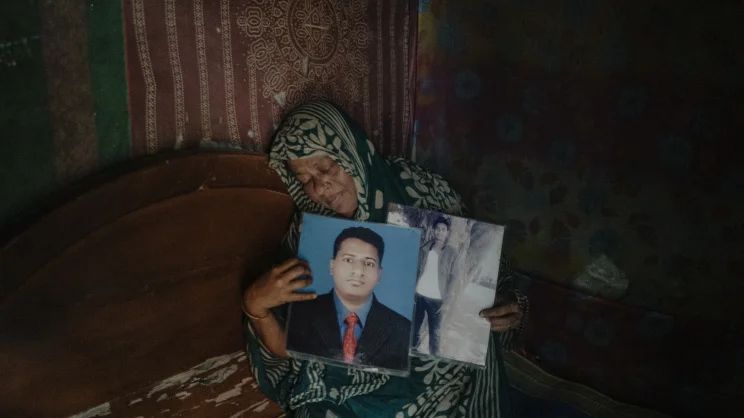
A grieving mother holds photographs of her disappeared son, among the few tangible reminders she has of him. In the absence of answers, photographs and memories become part of a family’s enduring search for a loved one who never returned. Photo: Mosfiqur Rahman Johan

Thousands of people in Bangladesh have reportedly been subjected to enforced disappearance amid political repression, with more than 2,000 cases documented between 2009 and 2022. Behind these numbers are families who have spent years searching for loved ones whose fate or whereabouts the state has failed to establish or acknowledge. Their experiences reveal not only the profound psychological and social consequences of enforced disappearance, but also the failures of the legal and institutional systems meant to uncover the truth and deliver justice.

For more than six years, I have worked closely with families of the disappeared. Following the July Uprising, I, along with several other activists, assisted families in filing cases concerning their missing relatives and witnessed the submission of 118 cases. One striking feature emerged repeatedly. Families often could not name a law-enforcement agency as responsible. Instead, their complaints described people being taken away by plainclothes men and never returning. This was not necessarily because the families did not know or suspect who was responsible. Rather, they had lived in an environment in which naming a security agency could itself carry risks. Police officers often did not allow families to identify law-enforcement agencies in their complaints. The language of the cases therefore became a language of uncertainty: “missing”, “taken away”, “plainclothes men” and “never returned”.

The state’s control over the narrative of disappearance also operated through language. This echoes Fassin’s (2012) argument about “humanitarian reason”, in which the vocabulary of suffering, compassion, assistance and the responsibility to protect can displace an older lexicon of social critique centred on justice, interests and rights. He observes that injustice can be articulated as suffering and violence recast as trauma—a shift that risks obscuring underlying structures of domination and reframing systemic injustice as individual misfortune. In Bangladesh, a similar politics of language can be seen in the substitution of terms such as “missing”, “taken away”, “plainclothes men” and “never returned” for the more politically and legally consequential language of enforced disappearance.

But behind this vocabulary lies a far deeper human experience. For Sanjida Islam Tulee, whose brother, a political activist, disappeared in December 2013, the river became a vast graveyard. She had learned of allegations that bodies were weighted down with bricks and thrown into the water. A river that for others might signify travel, work or leisure thus became, for her, a possible repository for her brother’s body. She repeatedly approached boatmen, asking whether they had seen security personnel bringing people to the river or witnessed anyone being thrown from a bridge or boat. Her search was not simply an attempt to establish a fact. It was an attempt to reconstruct a disappearance in a world where the state had provided no answers.

This is one of the defining characteristics of enforced disappearance: the victim is physically removed, but the uncertainty surrounding that removal is transferred to the family. In the absence of credible answers, family members are forced to become investigators, archivists and witnesses. They search hospitals, prisons, police stations, streets, rivers and detention facilities. They preserve documents, remember what their loved ones were wearing, reconstruct their final movements and repeatedly return to the last place where they were known to have been seen. The disappeared person is absent, but the search for them becomes an enduring presence in the lives of those left behind.

Raita described visiting a secret detention centre years after her father had disappeared. As she walked through the compound, she noticed an old, unsettling building, unaware that her father was being held inside. After the political transition of August 2024, she returned to the compound and was taken towards the same building. Only then did she discover that her father had indeed been held in cells there. What continues to haunt her is the knowledge that she had once been so close to him without knowing he was there. She remains troubled by the thought that, had she known, she might somehow have been able to get him out.


1789256200035.webp

For years, families of the disappeared have demanded answers, filed cases and pressed the authorities to reveal what happened to their loved ones. Their struggle poses a fundamental question: who investigates when the state itself stands accused? Photo: Mosfiqur Rahman Johan

Raita’s experience finds striking parallels in the wider literature on enforced disappearance. Arditti (2002), in her study of the Mothers and Grandmothers of the Plaza de Mayo, documents an extraordinary oneiric dimension to their experiences. Mothers routinely described dreams in which their disappeared children appeared alive, revealed their whereabouts or communicated what had happened to them. These dreams were shared and compared at meetings and sometimes treated as provisional sources of evidence until definitive proof could be found. Arditti recounts, for instance, the experience of a mother whose son disappeared in 1977 and who repeatedly dreamt of a specific address in Buenos Aires. When she investigated the location herself, she discovered that it had been a clandestine detention centre where her son had indeed been held. The dream could not establish whether her son had survived, but it had mapped a geography of state violence that no official record acknowledged.

Such experiences demonstrate why enforced disappearance cannot be understood simply as a criminal offence committed at a particular moment. It creates an enduring relationship between the disappeared person, the family, the place of detention and the state. The act of disappearance may occur at a specific point in time, but its consequences do not end there. The disappearance continues for as long as the person’s fate or whereabouts remain unresolved.

For some families, the disappeared person continues to inhabit the sensory landscape of the home. Nipa, whose husband disappeared in 2013, described repeatedly hearing his voice calling from the window, just as he used to when returning home at night. On one occasion, she, her father-in-law and her husband’s younger brother all believed they heard him calling. They rushed outside, only to find nobody there. Such experiences show how disappearance transforms the most ordinary sounds, routines and memories. A familiar voice can suddenly carry the possibility of return.

For Baby, the wife of Tariqul Islam Tara, who was abducted in 2012, the search extended beyond the home and into public spaces. She described scanning the faces of strangers wherever she went. When she encountered people whom others considered mentally unwell, she would study their faces, wondering whether one of them might be her missing husband. If she noticed someone wearing a shirt resembling the one he had been wearing when he disappeared, she would stop and look. In this way, the disappeared person remains both absent and everywhere: in crowds, on buses, along roads and in the faces of strangers.

These experiences expose the inadequacy of treating disappearance as a completed event. For families, it is an ongoing violation, renewed each day that the fate or whereabouts of their loved one remain unknown. Criminal accountability alone is therefore insufficient. Families also need recognition, information, credible investigation, access to evidence, protection and effective remedies.

It is in this context that the proposed Enforced Disappearances Prevention and Remedy Bill, 2026 assumes particular importance. A dedicated legal framework would represent an important recognition that enforced disappearance requires a specific legal response. But the effectiveness of such a law ultimately rests on a fundamental question: who investigates a disappearance when the institution responsible for investigating the allegation is itself accused of carrying it out?

The case of Miraj, a 30-year-old fisherman who disappeared near the Sundarbans on 10 April, brings this problem into sharp focus. According to his family and witnesses, Coast Guard personnel detained Miraj and took him away. The following day, his wife, Mukta Khatun, went to the Coast Guard’s Digraj base in search of him. She was initially told that her husband was there and that Coast Guard personnel had taken him with them on an operation. When she returned later, however, she was told that no one named Miraj was being held there. He has not been seen since.

1789256248480.webp

Marks scratched into the wall of a detention site bear witness to the longing of those held inside—to return home, to see their families again, and to reclaim the lives from which they had been forcibly separated. Photo: Mosfiqur Rahman Johan

The significance of Miraj’s case lies not only in the allegation itself, but also in a fundamental question of accountability: what happens when the institution accused of a disappearance is itself involved in examining the allegation? If Coast Guard personnel are alleged to have detained Miraj, an internal review by the Coast Guard cannot offer the same degree of independence as an investigation conducted by a body structurally separate from those accused. His family is therefore left confronting two uncertainties: what happened to Miraj, and can the institution implicated in his disappearance be trusted to establish the truth?

This is not merely a question of appearances. It goes to the heart of institutional credibility. An institution facing such allegations may conduct an internal administrative review of its personnel, but that process cannot substitute for an independent investigation into a possible enforced disappearance. When relatives of a missing person have to approach, answer questions from or seek information from officers belonging to the very force they accuse, the balance of power is fundamentally unequal. The process risks becoming less a search for the truth than an exercise in which the institution under scrutiny retains control over how the allegation against it is examined.

This concern becomes particularly important under the proposed legal framework, which places responsibility for investigating allegations of disappearance on the police. The difficulty is obvious: If police officers themselves are accused of involvement in a disappearance, the police could effectively end up investigating their own colleagues. Even when the allegation concerns another security or intelligence agency, the investigation remains within the broader law-enforcement structure. Investigators may still face difficulties obtaining documents, detention records, operational logs and other evidence, or securing cooperation from powerful security and intelligence agencies.

Miraj’s case therefore provides a concrete example of a deeper weakness in the proposed law. The concern is not simply that a particular investigation might be conducted poorly. It is that the legal architecture does not adequately answer a more fundamental question: which institution has the authority, independence and capacity to establish the truth when agents of the state themselves stand accused?

For families who have already spent years being denied answers, this is far more than an administrative problem. It risks reproducing the very conditions that have allowed disappearances to remain unresolved. A family may be told that an investigation is under way while having no credible means of knowing whether that investigation is genuinely independent, whether relevant evidence has been obtained, or whether the institutions implicated have been subjected to meaningful scrutiny. The law may therefore replace one unanswered question—where is our loved one?—with another: who can we trust to find out?

This is where the proposed law risks falling short of the reality experienced by victims and their families. Legal recognition of a disappeared person, compensation, rights concerning property and inheritance, and other forms of remedy ultimately depend on an effective and credible investigation. If that investigation is compromised by institutional conflicts of interest or lacks genuine independence, those rights may exist on paper while remaining inaccessible in practice.

Miraj’s experience also demonstrates why such a case cannot be dismissed as an isolated administrative failure. No case exists in isolation: how one allegation is handled can shape how institutions respond to those that follow. When allegations are met with denial or simply referred back to the very institutions accused of the violations, the absence of accountability risks becoming an institutional precedent.

The uncertainty surrounding Miraj’s fate therefore becomes a test of the law itself. A meaningful framework for prevention and remedy cannot stop at creating procedures for receiving complaints. It must establish a credible mechanism capable of investigating state institutions when agents of the state are themselves accused of carrying out enforced disappearances.

An independent investigative mechanism would serve not only victims and their families, but the state itself. It could distinguish credible allegations from unfounded ones, establish individual responsibility, protect officials not involved in the alleged violations from collective suspicion, and help restore public confidence in law-enforcement institutions. Most importantly, it could give families a credible path from uncertainty to truth.


1789256290780.webp

A child’s plea for his disappeared father, preserved alongside newspaper clippings documenting the family’s search for answers. Photo: Mosfiqur Rahman Johan

The ultimate test of justice, therefore, is not simply whether Bangladesh adopts a law against enforced disappearance, but whether that law can uncover the truth when state institutions themselves are implicated. A legal framework that recognises the crime but cannot independently investigate those accused of committing it risks reproducing the same silence it seeks to end. Accountability requires more than legal recognition: it requires institutions capable of establishing what happened, identifying those responsible and providing families with answers.

For the families of the disappeared, those answers have already been delayed for years. Restoring the rule of law begins with ensuring that they are no longer required to search alone. Until the truth about the disappeared can be established independently, and those responsible can be held accountable, the violence of disappearance does not truly end.

Mosfiqur Rahman Johan is an anthropologist and documentary photographer based in Bangladesh. He is also a member of Maayer Daak, a collective advocating for justice for families of the forcibly disappeared, and the founder of the All Victims and Veterans Network (AVN), a victim-led organisation documenting state violence and its impact on marginalised communities.​
 

Latest Posts

Back